Database Management
System (DBMS)
Outline
• The Need for Databases
• Data Models
• Relational Databases
• Database Design
• Storage Manager
• Query Processing
• Transaction Manager
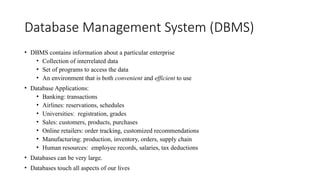
Database Management System (DBMS)
• DBMS contains information about a particular enterprise
• Collection of interrelated data
• Set of programs to access the data
• An environment that is both convenient and efficient to use
• Database Applications:
• Banking: transactions
• Airlines: reservations, schedules
• Universities: registration, grades
• Sales: customers, products, purchases
• Online retailers: order tracking, customized recommendations
• Manufacturing: production, inventory, orders, supply chain
• Human resources: employee records, salaries, tax deductions
• Databases can be very large.
• Databases touch all aspects of our lives
View of Data
Instances and Schemas
 Similar to types and variables in programming languages
 Logical Schema – the overall logical structure of the database
 Example: The database consists of information about a set of customers and accounts in a
bank and the relationship between them
 Analogous to type information of a variable in a program
 Physical schema– the overall physical structure of the database
 Instance – the actual content of the database at a particular point in time
 Analogous to the value of a variable
 Physical Data Independence – the ability to modify the physical schema without changing the
logical schema
 Applications depend on the logical schema
 In general, the interfaces between the various levels and components should be well defined
so that changes in some parts do not seriously influence others.
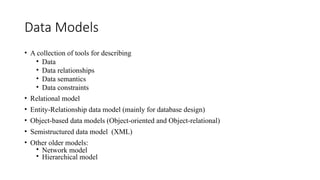
Data Models
• A collection of tools for describing
• Data
• Data relationships
• Data semantics
• Data constraints
• Relational model
• Entity-Relationship data model (mainly for database design)
• Object-based data models (Object-oriented and Object-relational)
• Semistructured data model (XML)
• Other older models:
• Network model
• Hierarchical model
Relational Model
• All the data is stored in various tables.
• Example of tabular data in the relational model
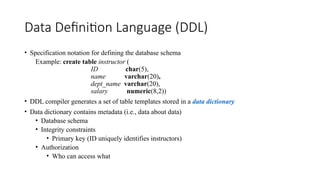
Data Definition Language (DDL)
• Specification notation for defining the database schema
Example: create table instructor (
ID char(5),
name varchar(20),
dept_name varchar(20),
salary numeric(8,2))
• DDL compiler generates a set of table templates stored in a data dictionary
• Data dictionary contains metadata (i.e., data about data)
• Database schema
• Integrity constraints
• Primary key (ID uniquely identifies instructors)
• Authorization
• Who can access what
Database Design
• Logical Design – Deciding on the database schema. Database design requires that we find a
“good” collection of relation schemas.
• Business decision – What attributes should we record in the database?
• Computer Science decision – What relation schemas should we have and how should the
attributes be distributed among the various relation schemas?
• Physical Design – Deciding on the physical layout of the database
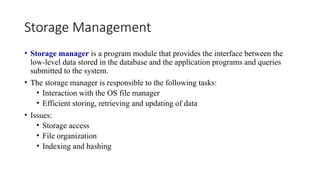
Storage Management
• Storage manager is a program module that provides the interface between the
low-level data stored in the database and the application programs and queries
submitted to the system.
• The storage manager is responsible to the following tasks:
• Interaction with the OS file manager
• Efficient storing, retrieving and updating of data
• Issues:
• Storage access
• File organization
• Indexing and hashing
Query Processing
1. Parsing and translation
2. Optimization
3. Evaluation
Transaction Management
• What if the system fails?
• What if more than one user is concurrently updating the same data?
• A transaction is a collection of operations that performs a single logical function
in a database application
• Transaction-management component ensures that the database remains in a
consistent (correct) state despite system failures (e.g., power failures and
operating system crashes) and transaction failures.
• Concurrency-control manager controls the interaction among the concurrent
transactions, to ensure the consistency of the database.

The Database Management System DBMS.pptx

  • 1.
  • 2.
    Outline • The Needfor Databases • Data Models • Relational Databases • Database Design • Storage Manager • Query Processing • Transaction Manager
  • 3.
    Database Management System(DBMS) • DBMS contains information about a particular enterprise • Collection of interrelated data • Set of programs to access the data • An environment that is both convenient and efficient to use • Database Applications: • Banking: transactions • Airlines: reservations, schedules • Universities: registration, grades • Sales: customers, products, purchases • Online retailers: order tracking, customized recommendations • Manufacturing: production, inventory, orders, supply chain • Human resources: employee records, salaries, tax deductions • Databases can be very large. • Databases touch all aspects of our lives
  • 4.
  • 5.
    Instances and Schemas Similar to types and variables in programming languages  Logical Schema – the overall logical structure of the database  Example: The database consists of information about a set of customers and accounts in a bank and the relationship between them  Analogous to type information of a variable in a program  Physical schema– the overall physical structure of the database  Instance – the actual content of the database at a particular point in time  Analogous to the value of a variable  Physical Data Independence – the ability to modify the physical schema without changing the logical schema  Applications depend on the logical schema  In general, the interfaces between the various levels and components should be well defined so that changes in some parts do not seriously influence others.
  • 6.
    Data Models • Acollection of tools for describing • Data • Data relationships • Data semantics • Data constraints • Relational model • Entity-Relationship data model (mainly for database design) • Object-based data models (Object-oriented and Object-relational) • Semistructured data model (XML) • Other older models: • Network model • Hierarchical model
  • 7.
    Relational Model • Allthe data is stored in various tables. • Example of tabular data in the relational model
  • 8.
    Data Definition Language(DDL) • Specification notation for defining the database schema Example: create table instructor ( ID char(5), name varchar(20), dept_name varchar(20), salary numeric(8,2)) • DDL compiler generates a set of table templates stored in a data dictionary • Data dictionary contains metadata (i.e., data about data) • Database schema • Integrity constraints • Primary key (ID uniquely identifies instructors) • Authorization • Who can access what
  • 9.
    Database Design • LogicalDesign – Deciding on the database schema. Database design requires that we find a “good” collection of relation schemas. • Business decision – What attributes should we record in the database? • Computer Science decision – What relation schemas should we have and how should the attributes be distributed among the various relation schemas? • Physical Design – Deciding on the physical layout of the database
  • 10.
    Storage Management • Storagemanager is a program module that provides the interface between the low-level data stored in the database and the application programs and queries submitted to the system. • The storage manager is responsible to the following tasks: • Interaction with the OS file manager • Efficient storing, retrieving and updating of data • Issues: • Storage access • File organization • Indexing and hashing
  • 11.
    Query Processing 1. Parsingand translation 2. Optimization 3. Evaluation
  • 12.
    Transaction Management • Whatif the system fails? • What if more than one user is concurrently updating the same data? • A transaction is a collection of operations that performs a single logical function in a database application • Transaction-management component ensures that the database remains in a consistent (correct) state despite system failures (e.g., power failures and operating system crashes) and transaction failures. • Concurrency-control manager controls the interaction among the concurrent transactions, to ensure the consistency of the database.