BY,
SANJANA CHOUHAN.S
OBJECTIVES
• Details of progressive lenses.
• Types of progressive lenses.
• Progressive markings.
• Fitting error and alignment and also the
types of bi-focals
INTRODUCTION
• The very first Progressive lens was invented
by Bernard Maitenaz, from the French
company Essel, in the year 1959 –known as
Varilux lens .
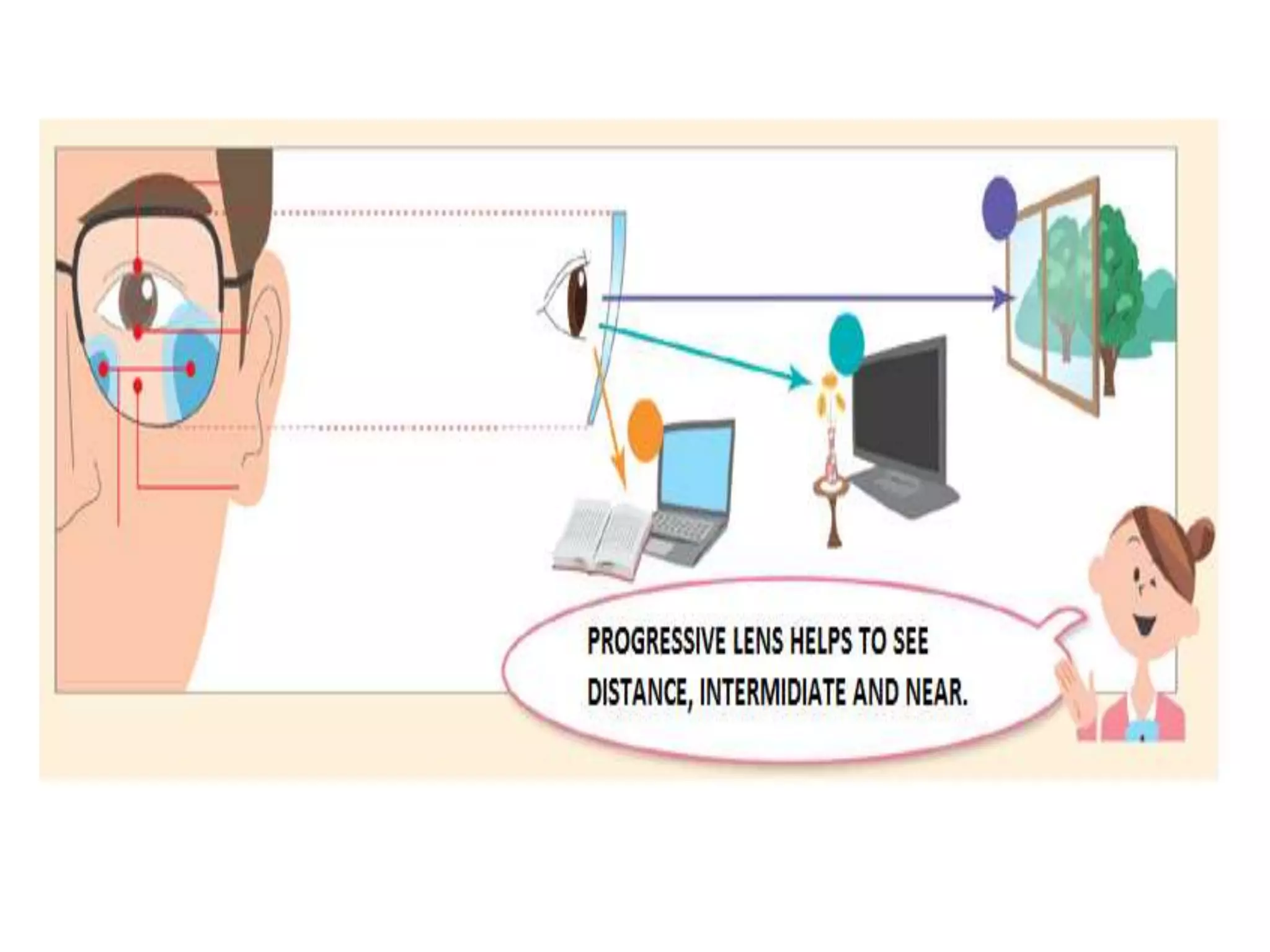
• A progressive addition lens has more than one
focal point or dioptric powers, without the
need to switch lenses.
• Progressive lenses can be called progressive
addition lenses (PAL), progressive power
lenses (PPL).
• Based on the number of focal points,
ophthalmic lenses are divided into four types
 Single vision lenses
 Bifocals
 Trifocals
 Progressive addition lens
• SINGLE VISION LENSES - Corrects only
one vision at a time . (Single focal point)
• BIFOCALS – Corrects two vision, Distance
and near.(Two focal points)
• TRIFOCALS – Corrects three vision,
distance, near and intermediate.(Three focal
points)
• PROGESSIVE – Corrects different
distances.(Many focal points)
FEATURE OF A PROGRESSIVE LENS
• A progressive lens provides visual
compensation at all distances namely Far,
Distances and Near.
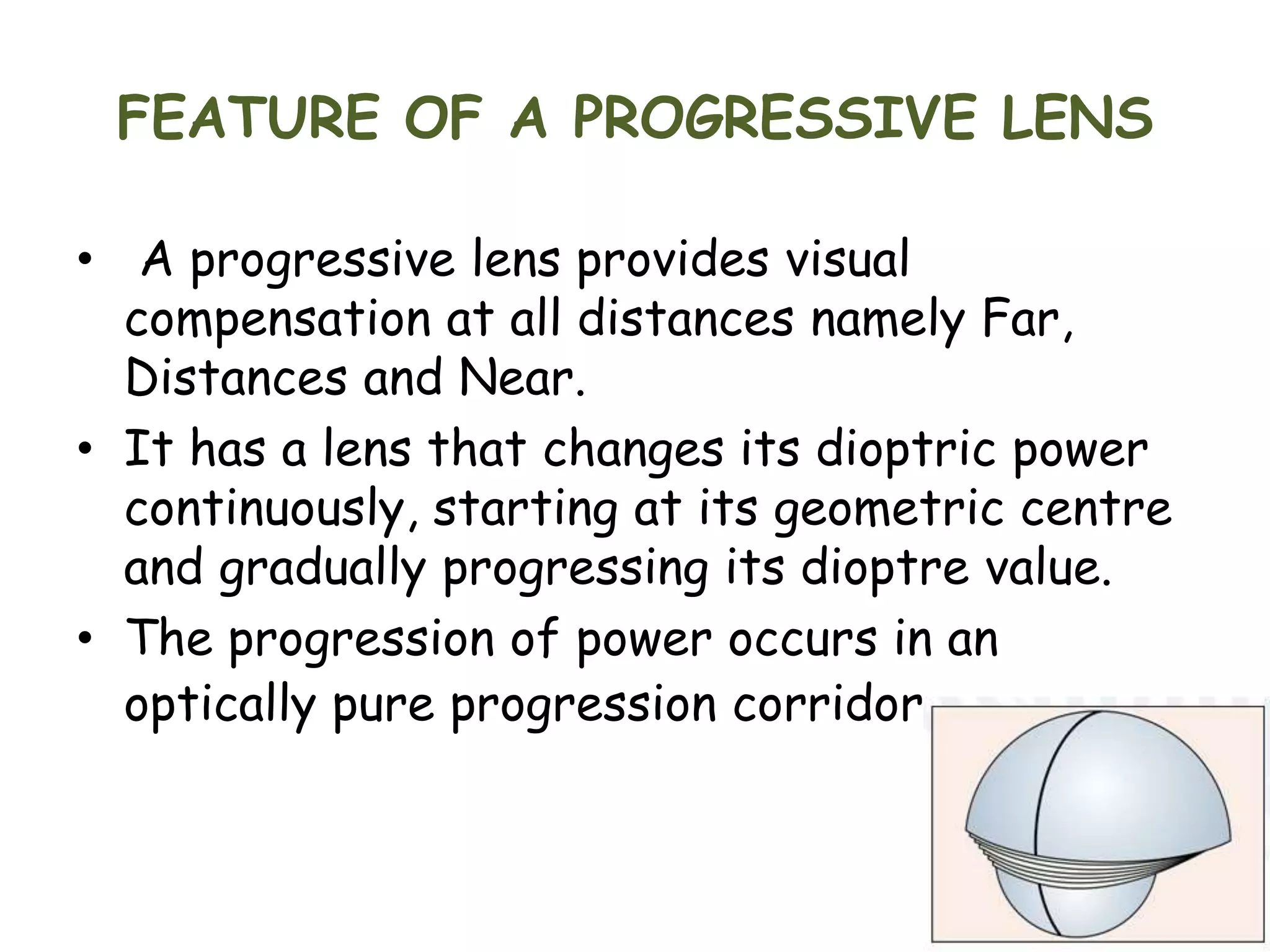
• It has a lens that changes its dioptric power
continuously, starting at its geometric centre
and gradually progressing its dioptre value.
• The progression of power occurs in an
optically pure progression corridor.
• By “Pure” it is meant that there are no
astigmatic aberrations in the peripheral zones
of the lens .
• The progression corridor starts few
millimetre (mm) below the fitting cross and
keeps progressing until it reaches the near
visual field .
• At the lateral zones the astigmatic
aberration zones are present, where vision is
not totally clear .
• The aspheric lens design is responsible for
the power progression of PALS and has
different radii of curvature.
• It is made up of multiple focal points due to
change in its radius of curvature.
PROGRESSIVE LENS DESIGNS
• Hard design
• Soft design
TEMPORARY MARKINGS
 Distance reference circle:
• This is the identification circle used to check
the distance lens power.
• It should be crossed checked with the
lensometer or focimetry.
 Fitting cross:
• It should be located exactly at the center of
the patients pupil.
• It is used to measure the MPD(monocular
pupillary distance) and fitting height.
 Prism reference circle:
• This is the point which is used to check the
amount of prism in the lens.
 Near reference circle:
• This marking is used to check the near vision
power.
• It should be verified with the lensometer.
 Small horizontal locater:
• This indicator should be level with the prism
reference point.
• This mainly helps the surfacing lab markers to
mount the lenses and check the position of
horizontality.
• The horizontality precision can even be
spotted easily with the naked eye.
TEMPORARY MARKINGS
PERMANENT MARKINGS
PERMANENT MARKING
 Lateral circles:
• There are two small lateral circles that are used to
relocate the temporary markings and they are
positioned exactly 34 mm apart one each on the nasal
and temporal sides.
• Lens logo and material code:
• The lens type is identified with the help of lens logo.
• The material coat helps us to identify the type of
lens material.
• E.g: In case of 1.5 index the lens logo is
followed by no.6 and in case of polycarbonate
lens, a letter P is seen.
• This logo is nasally located.
 Addition power:
• This is located below the temporal locator
• We can read the addition power directly from
the lens by using the lensometer.
DETAILS OF LENS MARKING
 Central fitting cross:
• The central fitting cross is marked with the
ink
• Mounted in the frame as per the center of
the customers pupil.
• It is a temporary marking.
• The marking can be wiped off with isopropyl
alcohol.
RELOCATING THE FITTING CROSS
• A template is provided by the manufacturer
for the progressive lenses.
• By placing the lens on the template marking
sure to align the 2 lateral traces in the
horizontal direction and mark the fitting
cross.
• The wearer should be looking straight ahead
with the head in the straight up while the
measurements are being taken.
• The fitting cross is placed exactly at the
pupillary center.
• If these precautions are not taken it will lead
to inaccurate measurements.
ADVANTAGES
• Improved appearance
• Complete range of working distance
• NO JUMP effect
• Thinner and lighter
• No need to switch lenses
• No dividing line
DISADVANTAGES
• Peripheral aberrations
• Adaptation problems
• More critical fitting required
• More expensive
Guess the markings ???
THANK YOU

Progressive addition lenses

  • 1.
  • 2.
    OBJECTIVES • Details ofprogressive lenses. • Types of progressive lenses. • Progressive markings. • Fitting error and alignment and also the types of bi-focals
  • 3.
    INTRODUCTION • The veryfirst Progressive lens was invented by Bernard Maitenaz, from the French company Essel, in the year 1959 –known as Varilux lens . • A progressive addition lens has more than one focal point or dioptric powers, without the need to switch lenses. • Progressive lenses can be called progressive addition lenses (PAL), progressive power lenses (PPL).
  • 4.
    • Based onthe number of focal points, ophthalmic lenses are divided into four types  Single vision lenses  Bifocals  Trifocals  Progressive addition lens
  • 5.
    • SINGLE VISIONLENSES - Corrects only one vision at a time . (Single focal point) • BIFOCALS – Corrects two vision, Distance and near.(Two focal points) • TRIFOCALS – Corrects three vision, distance, near and intermediate.(Three focal points) • PROGESSIVE – Corrects different distances.(Many focal points)
  • 7.
    FEATURE OF APROGRESSIVE LENS • A progressive lens provides visual compensation at all distances namely Far, Distances and Near. • It has a lens that changes its dioptric power continuously, starting at its geometric centre and gradually progressing its dioptre value. • The progression of power occurs in an optically pure progression corridor.
  • 8.
    • By “Pure”it is meant that there are no astigmatic aberrations in the peripheral zones of the lens . • The progression corridor starts few millimetre (mm) below the fitting cross and keeps progressing until it reaches the near visual field .
  • 9.
    • At thelateral zones the astigmatic aberration zones are present, where vision is not totally clear . • The aspheric lens design is responsible for the power progression of PALS and has different radii of curvature. • It is made up of multiple focal points due to change in its radius of curvature.
  • 11.
    PROGRESSIVE LENS DESIGNS •Hard design • Soft design
  • 12.
    TEMPORARY MARKINGS  Distancereference circle: • This is the identification circle used to check the distance lens power. • It should be crossed checked with the lensometer or focimetry.  Fitting cross: • It should be located exactly at the center of the patients pupil. • It is used to measure the MPD(monocular pupillary distance) and fitting height.
  • 13.
     Prism referencecircle: • This is the point which is used to check the amount of prism in the lens.  Near reference circle: • This marking is used to check the near vision power. • It should be verified with the lensometer.
  • 14.
     Small horizontallocater: • This indicator should be level with the prism reference point. • This mainly helps the surfacing lab markers to mount the lenses and check the position of horizontality. • The horizontality precision can even be spotted easily with the naked eye.
  • 15.
  • 16.
  • 17.
    PERMANENT MARKING  Lateralcircles: • There are two small lateral circles that are used to relocate the temporary markings and they are positioned exactly 34 mm apart one each on the nasal and temporal sides. • Lens logo and material code: • The lens type is identified with the help of lens logo. • The material coat helps us to identify the type of lens material.
  • 18.
    • E.g: Incase of 1.5 index the lens logo is followed by no.6 and in case of polycarbonate lens, a letter P is seen. • This logo is nasally located.  Addition power: • This is located below the temporal locator • We can read the addition power directly from the lens by using the lensometer.
  • 19.
    DETAILS OF LENSMARKING  Central fitting cross: • The central fitting cross is marked with the ink • Mounted in the frame as per the center of the customers pupil. • It is a temporary marking. • The marking can be wiped off with isopropyl alcohol.
  • 20.
    RELOCATING THE FITTINGCROSS • A template is provided by the manufacturer for the progressive lenses. • By placing the lens on the template marking sure to align the 2 lateral traces in the horizontal direction and mark the fitting cross.
  • 22.
    • The wearershould be looking straight ahead with the head in the straight up while the measurements are being taken. • The fitting cross is placed exactly at the pupillary center. • If these precautions are not taken it will lead to inaccurate measurements.
  • 23.
    ADVANTAGES • Improved appearance •Complete range of working distance • NO JUMP effect • Thinner and lighter • No need to switch lenses • No dividing line
  • 24.
    DISADVANTAGES • Peripheral aberrations •Adaptation problems • More critical fitting required • More expensive
  • 25.
  • 26.