Wafer WarfareA project aimed at understanding the Indian Wafer Snacks Market with special emphasis on Market Size, Market Structure,  Competitors and their Strategies.Submitted To:-Prof.  Dr.  Amit RangnekarBy:-Rahul VaswaniChetana’s R.K Institute of Management & ResearchRoll  No:116 (M3, MMS Marketing)
Introduction to the Indian Wafer Snacks Segment   The size of the Wafer Snacks Segment in India is estimated to be 4,500 – 5000 crores
   The market is growing at 30 percent annually
  The branded players account for 2,000 croresof the market size
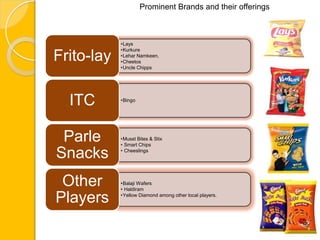
  Major branded players include Frito-Lay, Bingo, Haldiram, Balaji, Parle
  Potato Chips and Potato based items account for 85 percent of the total snacks segment.
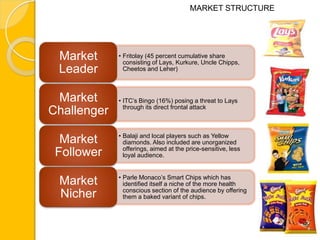
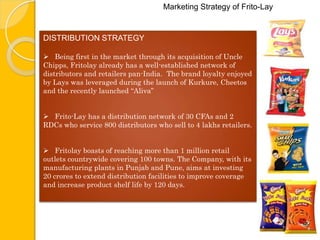
   As per Nielsen’s Retail Audit, Frito-Lay commands 45% market share, followed by Haldiram at 27% and Bingo at 16%
  The rest is divided between new players such as Smart Chips, regional players such as Balaji and handful of unorganized playersProminent Brands and their offerings 
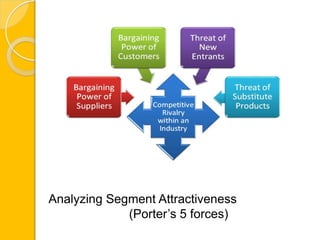
Analyzing Segment Attractiveness(Porter’s 5 forces)
Industry Attractiveness (Porter’s 5 forces)Threat of new entry:    As the market is growing at 30 percent annually, new entrants may consider it a profitable venture
   As branded players are priced similarly, new players might penetrate by adopting a lower price or by offering more grammage at the same price (Balaji-strategy)
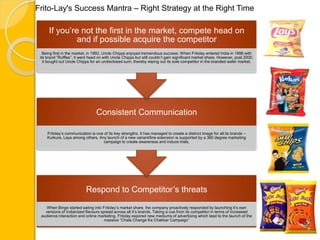
   New players with a distinct USP and marketing strategy may find it easier to enter the market (Bingo Strategy)
   Unorganized players still account for half of the total wafer segment, thereby discouraging market entry
    Veteran players such as Fritolay, Haldiram etc enjoy economies of scale, well-established distribution and good distributor relations.Hence, the threat of new entrants is moderate.
Industry Attractiveness (Porter’s 5 forces)Competitive Rivalry   High Competition – Branded Players involved in cut-throat competition to increase market share, entice new consumers, find new markets
   Low Quality differences among branded players.
   Quality difference between branded and unbranded offerings is offset by low price offered by unbranded players
   Cost of switching is low as all players have a similar pricing strategy
   Brand Loyalty is high for branded playersHence, the threat of competitive rivalry is high.
Industry Attractiveness (Porter’s 5 forces)Bargaining power of suppliersSuppliers provide raw materials such as potatoes, spices and other ingredients. Their ability to raise input costs is high.
   Higher cost of input commodities leads to lower margins, making the market unattractive for distributors and retailers (in an already low-margin, high-volume market)
   Shortage of any input material may also affect production and thereby impact distribution.
   Veteran players like Fritolay and ITC already have a well-established network of suppliers. ITC’s e-choupal venture permits a steady supply of raw materials at the lowest price. Hence, the bargaining power of suppliers is high.
Industry Attractiveness (Porter’s 5 forces)Bargaining power of consumers   Frito-Lay enjoys a healthy lead with a 45 percent market share for it’s portfolio of products
   Competitor differentiation is in terms of variants and communication.
   Ability to substitute is high as brands are priced similarly and distribution problems for one brand promote sales for the other.
   Price Sensitivity is high. An increase in the price of Lays may promote a switch to Bingo for most buyers (except for loyalists)Hence,  bargaining power of consumers is high.
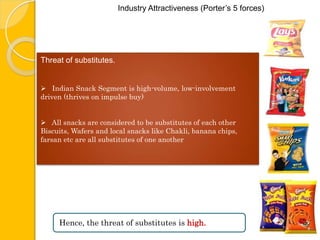
Industry Attractiveness (Porter’s 5 forces)Threat of substitutes.   Indian Snack Segment is high-volume, low-involvement driven (thrives on impulse buy)
   All snacks are considered to be substitutes of each otherBiscuits, Wafers and local snacks like Chakli, banana chips, farsan etc are all substitutes of one anotherHence, the threat of substitutes is high.
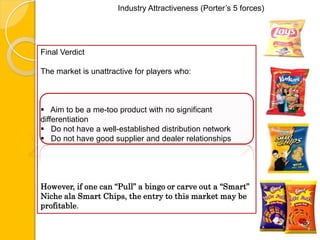
Industry Attractiveness (Porter’s 5 forces)Final VerdictThe market is unattractive for players who:   Aim to be a me-too product with no significant differentiation
   Do not have a well-established distribution network
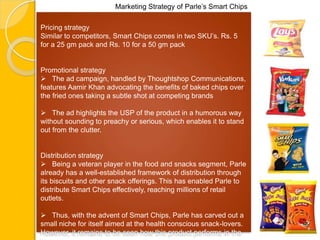
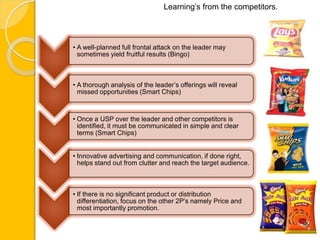
   Do not have good supplier and dealer relationships However, if one can “Pull” a bingo or carve out a “Smart” Niche ala Smart Chips, the entry to this market may be profitable.
UnderstandingTheMarketStructure
MARKET STRUCTURE
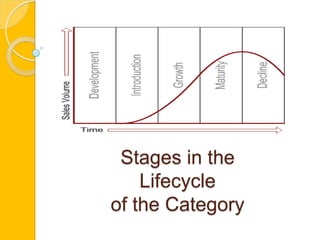
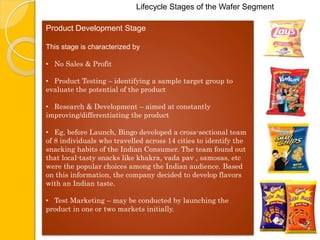
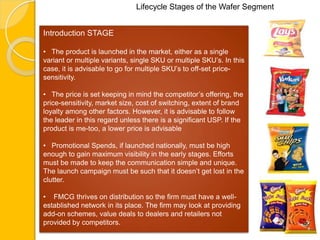
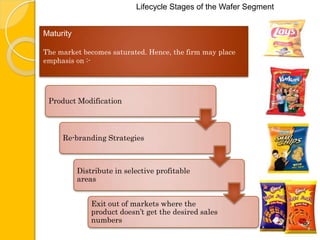
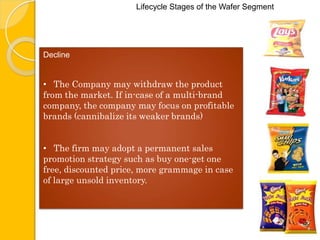
Stages in the Lifecycle of the Category

ITC's Bingo - Marketing Strategy

  • 1.
    Wafer WarfareA projectaimed at understanding the Indian Wafer Snacks Market with special emphasis on Market Size, Market Structure, Competitors and their Strategies.Submitted To:-Prof. Dr. Amit RangnekarBy:-Rahul VaswaniChetana’s R.K Institute of Management & ResearchRoll No:116 (M3, MMS Marketing)
  • 2.
    Introduction to theIndian Wafer Snacks Segment The size of the Wafer Snacks Segment in India is estimated to be 4,500 – 5000 crores
  • 3.
    The market is growing at 30 percent annually
  • 4.
    Thebranded players account for 2,000 croresof the market size
  • 5.
    Majorbranded players include Frito-Lay, Bingo, Haldiram, Balaji, Parle
  • 6.
    PotatoChips and Potato based items account for 85 percent of the total snacks segment.
  • 7.
    As per Nielsen’s Retail Audit, Frito-Lay commands 45% market share, followed by Haldiram at 27% and Bingo at 16%
  • 8.
    Therest is divided between new players such as Smart Chips, regional players such as Balaji and handful of unorganized playersProminent Brands and their offerings 
  • 9.
  • 10.
    Industry Attractiveness (Porter’s5 forces)Threat of new entry:  As the market is growing at 30 percent annually, new entrants may consider it a profitable venture
  • 11.
    As branded players are priced similarly, new players might penetrate by adopting a lower price or by offering more grammage at the same price (Balaji-strategy)
  • 12.
    New players with a distinct USP and marketing strategy may find it easier to enter the market (Bingo Strategy)
  • 13.
    Unorganized players still account for half of the total wafer segment, thereby discouraging market entry
  • 14.
    Veteran players such as Fritolay, Haldiram etc enjoy economies of scale, well-established distribution and good distributor relations.Hence, the threat of new entrants is moderate.
  • 15.
    Industry Attractiveness (Porter’s5 forces)Competitive Rivalry High Competition – Branded Players involved in cut-throat competition to increase market share, entice new consumers, find new markets
  • 16.
    Low Quality differences among branded players.
  • 17.
    Quality difference between branded and unbranded offerings is offset by low price offered by unbranded players
  • 18.
    Cost of switching is low as all players have a similar pricing strategy
  • 19.
    Brand Loyalty is high for branded playersHence, the threat of competitive rivalry is high.
  • 20.
    Industry Attractiveness (Porter’s5 forces)Bargaining power of suppliersSuppliers provide raw materials such as potatoes, spices and other ingredients. Their ability to raise input costs is high.
  • 21.
    Higher cost of input commodities leads to lower margins, making the market unattractive for distributors and retailers (in an already low-margin, high-volume market)
  • 22.
    Shortage of any input material may also affect production and thereby impact distribution.
  • 23.
    Veteran players like Fritolay and ITC already have a well-established network of suppliers. ITC’s e-choupal venture permits a steady supply of raw materials at the lowest price. Hence, the bargaining power of suppliers is high.
  • 24.
    Industry Attractiveness (Porter’s5 forces)Bargaining power of consumers Frito-Lay enjoys a healthy lead with a 45 percent market share for it’s portfolio of products
  • 25.
    Competitor differentiation is in terms of variants and communication.
  • 26.
    Ability to substitute is high as brands are priced similarly and distribution problems for one brand promote sales for the other.
  • 27.
    Price Sensitivity is high. An increase in the price of Lays may promote a switch to Bingo for most buyers (except for loyalists)Hence, bargaining power of consumers is high.
  • 28.
    Industry Attractiveness (Porter’s5 forces)Threat of substitutes. Indian Snack Segment is high-volume, low-involvement driven (thrives on impulse buy)
  • 29.
    All snacks are considered to be substitutes of each otherBiscuits, Wafers and local snacks like Chakli, banana chips, farsan etc are all substitutes of one anotherHence, the threat of substitutes is high.
  • 30.
    Industry Attractiveness (Porter’s5 forces)Final VerdictThe market is unattractive for players who: Aim to be a me-too product with no significant differentiation
  • 31.
    Do not have a well-established distribution network
  • 32.
    Do not have good supplier and dealer relationships However, if one can “Pull” a bingo or carve out a “Smart” Niche ala Smart Chips, the entry to this market may be profitable.
  • 33.
  • 34.
  • 35.
    Stages in theLifecycle of the Category