Sponsored by
InsightCenterCollection
Measuring Marketing
Insights
TURNING DATA INTO ACTION
© 2016 Harvard Business Publishing. All rights reserved.
HBR.ORG INSIGHT CE NT E R | ME AS UR ING MA R KETING INSIGHTS
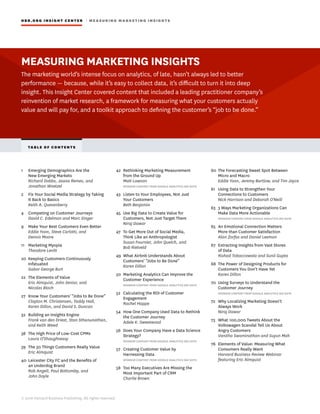
1	 Emerging Demographics Are the
New Emerging Markets
Richard Dobbs, Jaana Remes, and
Jonathan Woetzel
2	 Fix Your Social Media Strategy by Taking
It Back to Basics
Keith A. Quesenberry
4	 Competing on Customer Journeys
David C. Edelman and Marc Singer
9	 Make Your Best Customers Even Better
Eddie Yoon, Steve Carlotti, and
Dennis Moore
11	 Marketing Myopia
Theodore Levitt
20	 Keeping Customers Continuously
Infatuated
Gabor George Burt
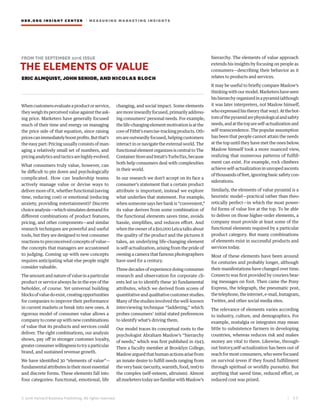
22	 The Elements of Value
Eric Almquist, John Senior, and
Nicolas Bloch
27	 Know Your Customers’ “Jobs to Be Done”
Clayton M. Christensen, Taddy Hall,
Karen Dillon, and David S. Duncan
32	 Building an Insights Engine
Frank van den Driest, Stan Sthanunathan,
and Keith Weed
38	 The High Price of Low-Cost CPMs
Laura O’Shaughnessy
39	 The 30 Things Customers Really Value
Eric Almquist
40	 Leicester City FC and the Benefits of
an Underdog Brand
Rob Angell, Paul Bottomley, and
John Doyle
42	 Rethinking Marketing Measurement
from the Ground Up
Matt Lawson
SPONSOR CONTENT FROM GOOGLE ANALYTICS 360 SUITE
43	 Listen to Your Employees, Not Just
Your Customers
Beth Benjamin
45	 Use Big Data to Create Value for
Customers, Not Just Target Them
Niraj Dawar
47	 To Get More Out of Social Media,
Think Like an Anthropologist
Susan Fournier, John Quelch, and
Bob Rietveld
49	 What Airbnb Understands About
Customers’ “Jobs to Be Done”
Karen Dillon
50	 Marketing Analytics Can Improve the
Customer Experience
SPONSOR CONTENT FROM GOOGLE ANALYTICS 360 SUITE
52	 Calculating the ROI of Customer
Engagement
Rachel Happe
54	 How One Company Used Data to Rethink
the Customer Journey
Adele K. Sweetwood
56	 Does Your Company Have a Data Science
Strategy?
SPONSOR CONTENT FROM GOOGLE ANALYTICS 360 SUITE
57	 Creating Customer Value by
Harnessing Data
SPONSOR CONTENT FROM GOOGLE ANALYTICS 360 SUITE
58	 Too Many Executives Are Missing the
Most Important Part of CRM
Charlie Brown
60	 The Forecasting Sweet Spot Between
Micro and Macro
Eddie Yoon, Jeremy Bartlow, and Tim Joyce
61	 Using Data to Strengthen Your
Connections to Customers
Nick Harrison and Deborah O’Neill
63	 3 Ways Marketing Organizations Can
Make Data More Actionable
SPONSOR CONTENT FROM GOOGLE ANALYTICS 360 SUITE
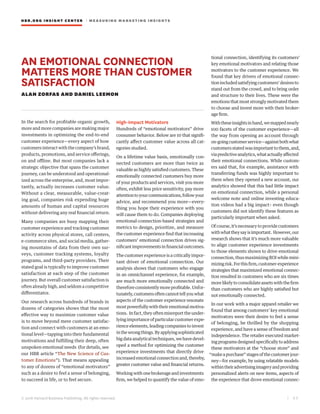
65	 An Emotional Connection Matters
More than Customer Satisfaction
Alan Zorfas and Daniel Leemon
67	 Extracting Insights from Vast Stores
of Data
Rishad Tobaccowala and Sunil Gupta
68	 The Power of Designing Products for
Customers You Don’t Have Yet
Karen Dillon
70	 Using Surveys to Understand the
Customer Journey
SPONSOR CONTENT FROM GOOGLE ANALYTICS 360 SUITE
72	 Why Localizing Marketing Doesn’t
Always Work
Niraj Dawar
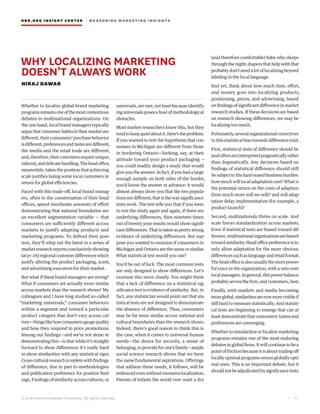
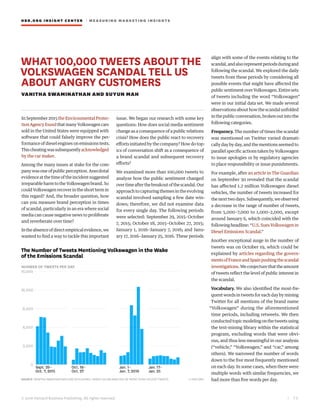
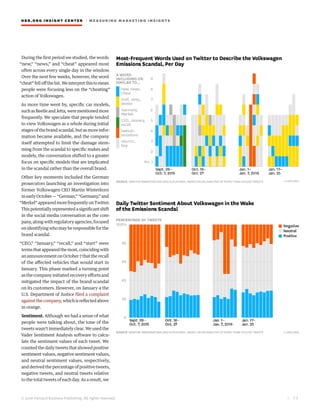
73	 What 100,000 Tweets About the
Volkswagen Scandal Tell Us About
Angry Customers
Vanitha Swaminathan and Suyun Mah
76	 Elements of Value: Measuring What
Consumers Really Want
Harvard Business Review Webinar
featuring Eric Almquist
TABLE OF CONTENT S
MEASURING MARKETING INSIGHTS
The marketing world’s intense focus on analytics, of late, hasn’t always led to better
performance — because, while it’s easy to collect data, it’s difficult to turn it into deep
insight. This Insight Center covered content that included a leading practitioner company’s
reinvention of market research, a framework for measuring what your customers actually
value and will pay for, and a toolkit approach to defining the customer’s “job to be done.”
HBR.ORG INSIGHT CE NT E R | ME AS UR ING MA R KETING INSIGHTS
© 2016 Harvard Business Publishing. All rights reserved.
SPONSOR PERSPECTIVE
Plenty of good things in life come in fours. Four seasons of the year.
Four leaf clovers. Four Beatles.
Four also seems to be a key number in analytics. As the articles in
this collection show, the challenge for enterprise marketers is no
longer collecting enough data—it’s making sense of the amazing
volume of data that is now available.
When we look at it from the high level, the companies that are doing great things as a
result of measuring the customer journey in a mobile-first world all have four key com-
ponentstotheirapproach.Whileeverycompanyhasitsowntechniques,allseemtodo
these four important things:
• See. The most successful companies have total visibility into all the ways its custom-
ersfindandinteractwiththebrandacrosstouchpoints.Thatmeansmobile,desktop,
search, video, offline engagements—their data covers all devices and channels.
• Sort. A mountain of data is only a starting point. The best companies find ways to
integrate various data sources and sift through all that information to turn up useful
insights. They also use technology and machine intelligence to do it fast, often in
near-real time.
• Share.Insightsarenohelpifthey’rehidden.It’simportanttohavesolutionswithbuilt-
inwaysforeveryonetolearnandcollaborate.Greatdatavisualizationhelpsmakesure
that everyone understands the most important numbers, too.
• Spark. It all leads to the “aha” moment when these brands use what they learn to
turninsightsintoengagingpersonalexperiencesforconsumers.Itdoesn’thappenby
accident; it takes planning and a willingness to experiment.
That’s the ultimate goal, after all: to make more meaningful connections with users in
their moments of interest and need. For marketers, that means being able to measure
and prove the impact of our efforts. As noted in one of the articles from this series:
“The companies that shine … build insights they can use, and they share those insights
in ways that everyone across the organization can understand—and act on—to make
every customer’s experience at every touch point the best it can be.”
If you’re looking for better ways to get a handle on your own enterprise data, you might
considerstartingwiththesefourpillars.Wecan’tallbeTheBeatles,butifyourteamhas
these four points covered, you’re probably on your way to success.
Matt Lawson
Managing Director, Ads Marketing
Google
HBR.ORG INSIGHT CE NT E R | ME AS UR ING MA R KETING INSIGHTS
| 1
© 2016 Harvard Business Publishing. All rights reserved.
and will continue to grow modestly in num-
ber and per capita spending. But they also
pose new challenges to companies, because
inequality is rising, and most incomes are
underincreasingpressure.Today,themedian
networthofthetop20%ofyoungadulthouse-
holds is eight times that of the other 80%; as
recentlyas2000,thatmultiplewasfourtimes.
Thatmeanscompaniesneedtoworkharderto
offergoodsandservicesatverydifferentprice
points. Compared with older cohorts, young
adults are 10 to 20 percentage points more
likely to consider and use sharing economy
services from accommodation to car rental to
furnishing.Thebehavioraldifferencesforthis
age group require new customized strategies
from companies seeking their dollars.
The consumer markets that matter have argu-
ably never been more varied and complex.
Rising inequality is one challenge. Another is
that, as population growth slows, city demo-
graphics — and therefore their growth pros-
pects—arediverging.Companiesneedtobein
therightplaces.Citiesarewhere91%ofglobal
consumption will take place over the next 15
years—the trick will be knowing which cities,
and even which neighborhoods within cities
will house the highest-spending consumers.
growth. In comparison, European millenni-
als, for instance, will contribute less than 2%.
The young may be the darlings of marketers,
but for companies chasing growth, the truly
glamorous market is the elderly.
Togiveanideaoftheirdominance,the60-plus
age group will account for 60% of total urban
consumption growth in Western Europe and
Northeast Asia, the latter comprised of Japan
and South Korea. This group, not surprisingly,
spends heavily on healthcare, but that’s not
all. In the United States, these consumers will
contribute more than 40% of consumption
growth in housing, transport, and entertain-
ment. A decade ago, those aged 55 and older
accounted for less than one-third of all U.S.
spendingonhomeimprovement.By2011,this
sharewasmorethan45%.Companiesinevery
sector — some of which have never been asso-
ciatedwiththeelderly—willneedtoprioritize
this market as never before.
The second group is China’s working-age con-
sumers age 15–59. Their numbers are set to
rise by 20% or 100 million people in just the
next15yearsandtheirpercapitaconsumption
is expected to double. By 2030, they will be
spending 12 cents of every $1 spent in cities
worldwide. These individuals are more opti-
mistic about their financial future and willing
to spend a greater share of their disposable
income than their counterparts in previous
generations.
The 2016 McKinsey Global Sentiment Survey
of more than 22,000 consumers finds that
nearly 30% of these Chinese consumers are
willing to pay more for new and innovative
householdproducts—doubletheshareoftheir
counterparts in North America and Western
Europe. These consumers are the successors
to Western baby boomers who were, in their
time,therichestinhistoryintheirprimeyears.
ThirdisNorthAmerica’sworking-ageconsum-
ers. They already constitute a major market,
A radical demographic shift is transforming
the nature of consumer markets. Until the
turn of the century, population growth pow-
eredmorethanhalfofglobalconsumption.As
population growth slows, that will fall to only
one-quarter in the next 15 years. Per capita
spending will be the engine of consumption
growth.Inthisnewworld,companiesneedto
know which consumers have the purchasing
firepower, where they are, what they want to
buy, and what drives their spending.
Marketing savvy just isn’t enough to track
theseconsumers.Companieswillneedamore
detailed portrait of target customer groups
than ever, including their age, income, eth-
nicity, and shopping preferences. There are
surprises. For example, people aged over 50
bought nearly two-thirds of the new cars sold
in the United States in 2011. McKinsey Global
InstituteresearchfindsthatChinaisexpected
to spend 12.5% of all consumption growth on
education for those under 30 — higher than
any other country apart from Sweden. Young
people in China are learning to love coffee.
And North American millennials don’t trust
company claims about their products, but are
happytoletaroomintheirhousetoastranger
who they trust because of an Airbnb rating.
A recent report by the McKinsey Global Insti-
tute, Urban World: The Global Consumers to
Watch,hasidentifiedthreekeygroupsofurban
consumers with the numbers and purchasing
power to shape the consumer landscape over
thenext15years.Onethingcommontoallthe
groups is their location in cities. Over 91% of
world consumption growth over this period
will come from city-dwelling consumers.
The first of these is the 60-plus age group
in the United States, Western Europe, and
Northeast Asia. Their number will grow by
more than one-third to stand at 222 million
in 2030. In those 15 years, they will generate
more than one-third of global consumption
EMERGING DEMOGRAPHICS ARE
THE NEW EMERGING MARKETS
RICHARD DOBBS, JAANA REMES, AND JONATHAN WOETZEL
HBR.ORG INSIGHT CE NT E R | ME AS UR ING MA R KETING INSIGHTS
| 2
© 2016 Harvard Business Publishing. All rights reserved.
FIX YOUR SOCIAL MEDIA STRATEGY
BY TAKING IT BACK TO BASICS
KEITH A. QUESENBERRY
ArecentCMOSurveyindicatesthatmarketers
plan to double their spending on social media
in the next five years. Yet IBM’s C-Suite Study
reports that nearly half of CMOs believe they
are not prepared to manage the challenges
of social media. This disparity highlights an
important, and potentially costly, problem:
Marketers continue to increase social media
spending, yet many are still uncertain about
management, strategies, and integration.
A quick Google search returns 140 million
results for “social media marketing tips,” but
no matter how many headlines promise it,
therereallyisnoone-size-fits-allsocialmedia
strategy. Some articles indicate that stories
are an effective marketing and advertising
tool. But what story will you tell? How will
you integrate it with your traditional efforts?
Other articles advise using social media net-
works, such as Pinterest. But what will your
brand post? Is your target audience even on
Pinterest? Still more articles offer a glimpse
intootherbrands’socialmediastrategies.But
what worked for Comcast or Best Buy or Uni-
versal Studios probably will not work for a
bank, tech startup, or retail company.
What marketers need is a process that leads
to individual solutions. They must use funda-
mental marketing concepts and modify them
for this new two-way, consumer-empowered
medium of social media. Here’s a framework
for doing that, adapted from my book Social
Media Strategy.
Definethestatusquo.Thefirststepisn’tabout
social media at all: Identify your business
objectives and target market. Also consider
your industry, the recent performance of the
brand, and the current traditional marketing
promotionsfortheproductanditscompetitors.
A startup or new product needs to generate
awareness,whileanolderproductmayneedto
berevived.Somebrandsneedanewimage,as
whenStarbucks’sreputationfelltoanall-time
low and Howard Schultz returned to restore
consumer confidence in the brand. One tool
Starbucks used was social media, launching
“My Starbucks Idea” to crowdsource feedback
and reengage customers.
Listen to your target audience. Here’s where
social media kicks in. Brands cannot talk to
everyone in every social channel, so narrowly
define whom you want to listen to and com-
municate with. Are you targeting Millenni-
als entering the workforce, dads with young
children, or senior executives nearing retire-
ment?Whataretheydoinginsocialmedia,and
where are they doing it? What are consumers
saying about your brand, products, services,
and competitors? Start with simple Google
searches on your brand name, analytics tools
withinsocialnetworks,andlooktosecondary
research, such as the Pew Research Internet
Project, Nielsen, or Edison Research, to iden-
tify larger trends in social media use. Gather a
snapshot of all current social media talk with
asocialmediaaudit.Followanaudittemplate
to organize what you find and identify action-
able insights.
Createsocialmediacontentthatdrivesengage-
ment. What is your target consumer looking
for? Social media is all about producing fresh,
relevant content, so create things that your
audiencewillfindvaluable,whetherit’s“how
to” articles or simply something entertain-
ing. Where you deliver the content matters
too: Some social media channels are best
for sharing short, current updates (Twitter),
others are better for delivering video content
(YouTube), some reach a younger audience
with pictures (Instagram), and others have
younger audiences with multimedia and high
engagement rates (Snapchat). The best social
media plans deliver content that’s optimized
to each channel. Engage the target audience
on the channels they use with material that is
unique to the channel. Select social channels
that fit brand message, type of content, and
target audience.
For long-term consumer monitoring, look
into a social media monitoring service, such
as Radian6 from Salesforce.com, Hootsuite,
or HubSpot. Live dashboards show streams
from multiple social accounts, keeping you
aware of hashtags and brand mentions. To
find the most influential people in your target
audience, look to tools such as Klout, which
measuresanindividual’sonlineimpact.Some
brands, including Wells Fargo and Johns Hop-
kinsMedicine,haveinvestedinasocialmedia
commandcenter.Thesebrandedsocialmedia
monitoring rooms acting as a central visual
hubforsocialdata,tospeedupmarketingand
engagement with customers.
Link marketing goals to social media KPIs. If
you are driving sales online, measure digital
KPIs with click-throughs from social plat-
formstothepurchase.GoogleAnalyticsSocial
Reportsareespeciallyusefulinbreakingdown
social traffic and assigning monetary value to
website conversions such as sales or lead gen-
eration. Measuring in-store sales is harder but
canbedonewithoffercodes,surveys,orscan-
ner data. Digital KPIs for awareness include
social media likes and shares, or unique web-
site visits referred from social media content.
All these KPIs can be collected and organized
in a simple social media metrics table. There
may also be larger business goals that social
media is affecting. Identify social integra-
tion opportunities beyond marketing such as
socialmediainteractionsthatimpactthesales
force, customer service functions, R&D and
HR department recruitment, and employee
policies and engagement. Social media strat-
egy may be led by the marketing team, but
the company’s social media efforts are too
important to be left to marketing alone.
How does this framework look in action?
One example is the Mercedes Tweet Race
to the Super Bowl. At the ripe old age of 125,
Mercedes-Benz was being positioned by
its competitors as tired and stodgy. Digital
agencyRazorfishintroducedtheautomakerto
ayoungergenerationofconsumersbyfiguring
outwhoitstargetaudiencewasandwherethe
audience was active on social media.
HBR.ORG INSIGHT CE NT E R | ME AS UR ING MA R KETING INSIGHTS
| 3
© 2016 Harvard Business Publishing. All rights reserved.
Fourtwo-persondrivingteamswererecruited
onFacebooktotakeonthechallenge.Powered
by online supporters’ tweets, each team cre-
ated social media engagement to drive real
Mercedes-Benzvehiclesforward,movingone
mileforeveryfourtweets.Thecontest’sresults
includeda7%increaseinMercedesscheduled
test drives, a 6% increase in first-time owners
and leases, and 27,000+ active participants
who generated more than 150,000+ tweets,
reaching 25 million people.
This four-step social media framework isn’t
everything you need, but it is a good start.
Don’t base your marketing strategy on 140
million people’s tips about what may work
foryourbusiness.Havingevenabasicprocess
in place can help you be more strategic about
social media decisions and make your social
media spending more effective.
HBR.ORG INSIGHT CE NT E R | ME AS UR ING MA R KETING INSIGHTS
| 4
© 2016 Harvard Business Publishing. All rights reserved.
COMPETING ON CUSTOMER
JOURNEYS
DAVID C. EDELMAN AND MARC SINGER
The explosion of digital technologies over
the past decade has created “empowered”
consumers so expert in their use of tools and
information that they can call the shots, hunt-
ing down what they want when they want it
and getting it delivered to their doorsteps at a
rock-bottom price. In response, retailers and
service providers have scrambled to develop
big data and analytics capabilities in order to
understand their customers and wrest back
control.Formuchofthistime,companieshave
been reacting to customers, trying to antici-
patetheirnextmovesandpositionthemselves
in shoppers’ paths as they navigate the deci-
sion journey from consideration to purchase.
Now, leveraging emerging technologies, pro-
cesses, and organizational structures, com-
panies are restoring the balance of power and
creatingnewvalueforbrandsandbuyersalike.
Central to this shift is a fresh way of thinking:
Rather than merely reacting to the journeys
thatconsumersthemselvesdevise,companies
areshapingtheirpaths,leadingratherthanfol-
lowing. Marketers are increasingly managing
journeysastheywouldanyproduct.Journeys
are thus becoming central to the customer’s
experienceofabrand—andasimportantasthe
productsthemselvesinprovidingcompetitive
advantage.
Consider how one company, Oakland-based
Sungevity,competesonitsabilitytoshapethe
journey. At first glance, Sungevity looks like
a typical residential solar panel provider. But
closer inspection reveals that the company’s
business is to manage the end-to-end process
of sales and custom installation, coordinat-
ing the work of an ecosystem of companies
that supply, finance, install, and service the
panels. Sungevity’s “product” is a seamless,
personalized digital customer journey, based
on innovative management of data about the
solar potential of each home or business. Sun-
gevity makes the journey so compelling that
oncecustomersencounterit,manynevereven
consider competitors.
One of us (David) experienced the Sungevity
journeyfirsthand.Theprocessbeganwhenhe
receivedamailingwiththemessage“Openthis
tofindouthowmuchtheEdelmanfamilycan
saveonenergycostswithsolarpanels.”Thelet-
terwithincontainedauniqueURLthatledtoa
GoogleEarthimageofDavid’shousewithsolar
panels superimposed on the roof. The next
click led to a page with custom calculations of
energy savings, developed from Sungevity’s
estimates of the family’s energy use, the roof
angle, the presence of nearby trees, and the
energy-generation potential of the 23 panels
the company expected the roof to hold.
Another click connected David through his
desktop to a live sales rep looking at the same
pages David was. The rep expertly answered
his questions and instantly sent him links to
videos that explained the installation process
and the economics of leasing versus buying.
Twodayslater,SungevityemailedDavidwith
the names and numbers of nearby homeown-
erswhouseditssystemandhadagreedtoserve
asreferences.Aftercheckingthesereferences,
David returned to Sungevity’s site, where a
single click connected him to a rep who knew
preciselywherehewasonthejourneyandhad
atailoredleasereadyforhim.Therepemailed
itandwalkedDavidthroughit,andthenDavid
esigned.Whenhenextvisitedthewebsite,the
landingpagehadchangedtotracktheprogress
of the permitting and installation, with fresh
alerts arriving as the process proceeded. Now,
asaSungevitycustomer,Davidreceivesregular
reports on his panels’ energy generation and
the resulting savings, along with tips on ways
to conserve energy, based on his household’s
characteristics.
Startingwithitsinitialoutreachandcontinuing
to the installation and ongoing management
of David’s panels, Sungevity customized and
automated each step of the journey, making
it so simple—and so compelling—for him to
move from one step to the next that he never
actively considered alternative providers. In
essence, the company reconfigured the clas-
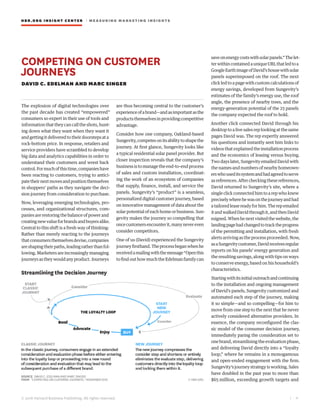
sic model of the consumer decision journey,
immediately paring the consideration set to
one brand, streamlining the evaluation phase,
and delivering David directly into a “loyalty
loop,” where he remains in a monogamous
and open-ended engagement with the firm.
Sungevity’sjourneystrategyisworking.Sales
have doubled in the past year to more than
$65 million, exceeding growth targets and
HBR.ORG INSIGHT CE NT E R | ME AS UR ING MA R KETING INSIGHTS
| 5
© 2016 Harvard Business Publishing. All rights reserved.
making Sungevity the fastest-growing player
in the residential solar business.
Getting Proactive
McKinsey’s marketing and sales practice has
spentmorethansixyearsstudyingconsumers’
decision journeys. The term (as explained in
“Branding in the Digital Age,” HBR, December
2010) broadly describes how people move
from initially considering a product or ser-
vice to purchasing it and then bonding with
the brand. More narrowly, the term can refer
to the sequence of interactions consumers
have before they achieve a certain aim—for
instance, transferring cable service to a new
address, or even discovering and buying the
right mascara. Many firms have become com-
petent at understanding the journeys their
customers take and optimizing their experi-
ence with individual touchpoints along the
way. The more sophisticated companies have
redesignedtheiroperationsandorganizations
tosupportintegratedjourneys(see“TheTruth
AboutCustomerExperience,”HBR,September
2013). Still, firms have largely been reactive,
improving the efficiency of existing journeys
or identifying and fixing pain points in them.
We’re now seeing a significant shift in strat-
egy, from primarily reactive to aggressively
proactive. Across retail, banking, travel, home
services, and other industries, companies are
designing and refining journeys to attract
shoppers and keep them, creating custom-
ized experiences so finely tuned that once
consumers get on the path, they are irresist-
ibly and permanently engaged. Unlike the
coercive strategies companies used a decade
ago to lock in customers (think cellular service
contracts), cutting-edge journeys succeed
because they create new value for customers:
Customers stay because they benefit from
the journey itself.
Through our experience advising more than
50 companies on journey architecture, infra-
structure,andorganizationaldesign;ourdeep
engagement with dozens of chief digital offi-
cersandmorethan100digital-businessleaders
worldwide; and our research involving more
than200companiesonbestpracticesforbuild-
ing digital capabilities, we have seen this shift
unfold.Andalthoughitisstillearly,webelieve
that an ability to shape customer journeys
will become a decisive source of competitive
advantage.
Four Key Capabilities
Companies building the most effective jour-
neys master four interconnected capabilities:
automation, proactive personalization, con-
textual interaction, and journey innovation.
Eachofthesemakesjourneys“stickier”—more
likely to draw in and permanently capture
customers. And although the capabilities all
rely on sophisticated IT (see the sidebar “New
Journey Technologies”), they depend equally
oncreativedesignthinkingandnovelmanage-
rial approaches, as we’ll explore later.
Automation.
Automation involves the digitization and
streamlining of steps in the journey that were
formerly done manually. Consider the analog
process of depositing a check, which used
to require a trip to the bank or ATM. With
digital automation, you simply photograph
the check with your smartphone and deposit
it via an app. Similarly, researching, buying,
and arranging delivery of, say, a new TV can
now be a one-stop digital process. By allow-
ing consumers to execute formerly complex
journey processes quickly and easily, auto-
mation creates the essential foundation for
sticky journeys. This may seem self-evident,
but companies have only recently started to
build robust automation platforms expressly
designed to enhance journeys. And consum-
ers can readily see who does it well. Superior
automation, while highly technical, is some-
thing of an art, turning complex back-end
operations into simple, engaging, increasingly
app-based front-end experiences.
Consider how Sonos, the intelligent con-
nected music system, automates setup. The
process used to involve threading wires
throughout the house, hooking up speakers
to a computer, and creating separate online
accounts with music providers. Sonos stream-
lines setup with wireless speakers (just press a
button to connect them) and an app that adds
music-streaming sources with a few taps and
allows users to select music, control volume,
and choose what plays in which room—all
from a mobile device.
Proactive personalization.
Building on the automation capability, com-
paniesshouldtakeinformationgleanedeither
frompastinteractionswithacustomerorfrom
existing sources and use it to instantaneously
customizetheshopper’sexperience.Amazon’s
recommendation engine and intelligent reor-
deringalgorithm(itknowswhatprinterinkyou
need) are familiar examples. But remember-
ing customer preferences is only the begin-
ning; the personalization capability extends
to optimizing the next steps in a customer’s
journey. At the moment a customer engages
(for example, by responding to a message or
launching an app), the firm must analyze the
customer’sbehaviorandtailoritsnextinterac-
tionaccordingly.CompaniessuchasPegaand
ClickFox (a firm in which McKinsey has an
ownership stake) offer applications that track
customers across many channels, blending
data from multiple sources (such as transac-
tionandbrowsinghistories,customerservice
interactions, and product usage) to create a
single view of what customers are doing and
whathappensasaresult.Thisallowsreal-time
insightsabouttheirbehavior—ineffect,isolat-
ingmomentswhenthecompanycaninfluence
thejourney—andpermitscustomizedmessag-
ingorfunctionality(forexample,immediately
putting a valued traveler on an upgrade list).
The retailer Kenneth Cole reconfigures ele-
ments on its website according to a visitor’s
interaction with the site over time: Some
people see more product reviews, while oth-
ers see more images, videos, or special offers.
The company’s algorithm constantly learns
which content and configuration work best
for each visitor and renders the site accord-
ingly, in real time.
L’Oréal’sMakeupGeniusapptakesthesecapa-
bilities a step further, allowing customers to
try on makeup virtually and delivering ever-
more-personalized real-time responses. The
app photographs a customer’s face, analyzes
morethan60characteristics,andthendisplays
images showing how various products and
shade mixes achieve different looks. Custom-
ers can select a look they like and instantly
order the right products online or pick them
up in a store. As the app tracks how the cus-
tomer uses it and what she buys, it learns her
HBR.ORG INSIGHT CE NT E R | ME AS UR ING MA R KETING INSIGHTS
| 6
© 2016 Harvard Business Publishing. All rights reserved.
preferences,makesinferencesbasedonsimilar
customers’ choices, and tailors its responses.
L’Oréal has created an enjoyable experience
thatquicklyandseamlesslyleadsthecustomer
alongthepathfromconsiderationtopurchase
and,asthedegreeofpersonalizationincreases,
into the loyalty loop. With 14 million users
already, the app has become a critical asset
both as a branded channel for engaging with
customersandasafirehoseofincominginfor-
mation on how customers engage.
Contextual interaction.
Another key capability involves using knowl-
edge about where a customer is in a journey
physically (entering a hotel) or virtually (read-
ingproductreviews)todrawhimforwardinto
the next interactions the company wants him
topursue.Thismaymeanchangingthelookof
a screen that follows a key step, or serving up
arelevantmessagetriggeredbythecustomer’s
current context. For example, an airline app
may display your boarding pass as you enter
the airport, or a retail site may tell you the
status of your recent order the moment you
land on the home page.
More-sophisticatedversionsenableaseriesof
interactionsthatfurthershapeandstrengthen
the journey experience. Starwood Hotels, for
example,isrollingoutanappthattextsaguest
with her room number as she enters the hotel,
checks her in with a thumbprint scan on her
smartphone,and,assheapproachesherroom,
turns her phone into a virtual key that opens
the door. The app then sends well-timed and
personalized recommendations for entertain-
ment and dining.
Journey innovation.
Innovation, the last of the four required capa-
bilities, occurs through ongoing experimenta-
tion and active analysis of customer needs,
technologies, and services in order to spot
opportunities to extend the relationship with
thecustomer.Ultimately,thegoalistoidentify
new sources of value for both the company
and consumers.
Best practitioners design journey software to
enable open-ended testing. They continually
doA/Btestingtocomparealternativeversions
of message copy and interface design to see
which works better. And they prototype new
services and analyze the results, aiming not
just to improve the existing journey but to
expand it, adding useful steps or features.
A journey innovation may be as simple as Star-
wood’sintroducingapromptfororderingroom
service after a guest uses a key, remembering
previous orders and using those as the ini-
tial options. Or it may be more sophisticated,
expanding a journey by integrating multiple
services into a single straight-through cus-
tomerexperience.DeltaAirLines’mobileapp,
forexample,hasbecomeatravelmanagement
toolforalmosteveryaspectofanairplanetrip,
from booking and boarding to reviewing in-
flight entertainment to ordering an Uber car
upon landing. Kraft has expanded its recipe
app to become a pantry management tool,
generating a shopping list that seamlessly
connects with the grocery delivery service
Peapod. Key to these expanded journeys is
often their integration with other service
providers. Because this increases the value
of the journey, carefully handing customers
off to another firm can actually enhance the
journey’s stickiness.
Capabilities in Practice
Let’s return to Sungevity to see how it com-
bines these four capabilities to create a valu-
able and evolving journey.
From initial customer contact to installation
and beyond, Sungevity has automated most
steps of the journey, including collecting
and integrating customer data, calculating
energy use, and creating personalized visu-
alizations of the panels on a roof. Crucial
here is sophisticated use of APIs (application
interfaces) to pull data from other provid-
ers, such as Google Earth and the real estate
service Trulia, to assemble a picture of the
customer. Data analysis allowed proactive
personalization that targeted David with cus-
tomized information such as costs, timeline,
and anticipated breakeven and savings, all
available across multiple channels, including
email, Sungevity’s site, and customer reps.
Contextual interaction capabilities allowed
Sungevity to serve the right content in the
right channel for each of David’s interac-
tions—for example, using APIs to track the
panel installation by the company’s local con-
tractor and then regularly updating David’s
landing page with the latest status.
Sungevity is continuing to pursue journey
innovation, using what it knows about its
customers to extend the journey into energy
storage and conservation services. Not long
ago, such activity might have been a generic
upsell, blanketing a customer segment with
pitches for a new offering. Today the outreach
can be to a single individual, and the strategy
not simply to sell another product but to
invite customers to take the next step on their
personalized journeys. With granular data on
each household’s energy use and habits, Sun-
gevity can advise people one-on-one about
managing their energy consumption, and it
can recommend a tailored package of prod-
ucts and services to help them reduce their
dependence on the grid and reap savings. To
this end, the firm will soon offer batteries
from the German supplier Sonnenbatterie
to store surplus electricity generated by the
solar panels. It is also creating customer dash-
boards that track energy production and use.
Ultimately, the firm plans to integrate its ser-
vices with home-management networks that
can automate energy conservation (adjusting
lights and heating, for example) according
to decision rules that Sungevity develops
with each customer. Another project is to
create conservation-oriented customer com-
munities.
The Rise of the Journey Product
Manager
Technology smarts are necessary but not
sufficient for designing competitive, continu-
ously improving journeys; companies also
need new organizational structures and types
of management. We have worked with many
“digital native” firms that have had the luxury
of building organizations optimized from the
outset for creating effective journeys—and
their experience offers lessons for traditional
firms. We have found that traditional com-
panies are most successful when they focus
on selected high-value journeys and create
dedicated teams to support them, drawing
from across the firm’s functions.
While we’ve seen many different organiza-
tional models for product-managing jour-
HBR.ORG INSIGHT CE NT E R | ME AS UR ING MA R KETING INSIGHTS
| 7
© 2016 Harvard Business Publishing. All rights reserved.
neys (and an array of titles for the execu-
tives involved), they generally have a similar
structure.
Overseeing all of a firm’s interactions with
customersissomeoneintheroleofchiefexpe-
rience officer, a relatively new position in the
C-suite. Chief digital officers are also starting
to have this top-level responsibility. Typically
reportingtothisexecutiveisajourney-focused
strategistwhohelpsguidedecisionsonwhich
journey investments and customer segments
to focus on; he or she prioritizes current jour-
neys for digital development and spots oppor-
tunities for new ones.
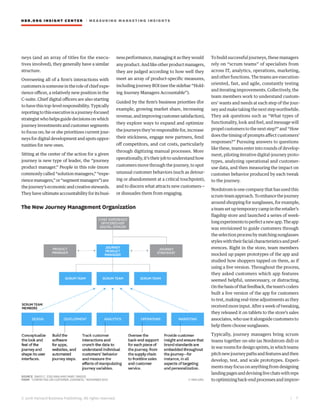
Sitting at the center of the action for a given
journey is new type of leader, the “journey
product manager.” People in this role (more
commonlycalled“solutionmanagers,”“expe-
riencemanagers,”or“segmentmanagers”)are
thejourney’seconomicandcreativestewards.
They have ultimate accountability for its busi-
ness performance, managing it as they would
anyproduct.Andlikeotherproductmanagers,
they are judged according to how well they
meet an array of product-specific measures,
including journey ROI (see the sidebar “Hold-
ing Journey Managers Accountable”).
Guided by the firm’s business priorities (for
example, growing market share, increasing
revenue,andimprovingcustomersatisfaction),
they explore ways to expand and optimize
the journeys they’re responsible for, increase
their stickiness, engage new partners, fend
off competitors, and cut costs, particularly
through digitizing manual processes. More
operationally, it’s their job to understand how
customers move through the journey, to spot
unusual customer behaviors (such as detour-
ing or abandonment at a critical touchpoint),
and to discern what attracts new customers—
or dissuades them from engaging.
To build successful journeys, these managers
rely on “scrum teams” of specialists from
across IT, analytics, operations, marketing,
and other functions. The teams are execution-
oriented, fast, and agile, constantly testing
and iterating improvements. Collectively, the
team members work to understand custom-
ers’ wants and needs at each step of the jour-
neyandmaketakingthenextstepworthwhile.
They ask questions such as “What types of
functionality, look and feel, and message will
propel customers to the next step?” and “How
does the timing of prompts affect customers’
responses?” Pursuing answers to questions
like these, teams enter into rounds of develop-
ment, piloting iterative digital-journey proto-
types, analyzing operational and customer-
use data, and then measuring the impact on
customer behavior produced by each tweak
to the journey.
Nordstrom is one company that has used this
scrum-teamapproach.Toenhancethejourney
around shopping for sunglasses, for example,
ateamsetuptemporarycampintheretailer’s
flagship store and launched a series of week-
longexperimentstoperfectanewapp.Theapp
was envisioned to guide customers through
the selection process by matching sunglasses
styleswiththeirfacialcharacteristicsandpref-
erences. Right in the store, team members
mocked up paper prototypes of the app and
studied how shoppers tapped on them, as if
using a live version. Throughout the process,
they asked customers which app features
seemed helpful, unnecessary, or distracting.
Onthebasisofthatfeedback,theteam’scoders
built a live version of the app for customers
to test, making real-time adjustments as they
receivedmoreinput.Afteraweekoftweaking,
they released it on tablets to the store’s sales
associates, who use it alongside customers to
help them choose sunglasses.
Typically, journey managers bring scrum
teams together on-site (as Nordstrom did) or
inwarroomsfordesignsprints,inwhichteams
pitchnewjourneypathsandfeaturesandthen
develop, test, and scale prototypes. Experi-
ments may focus on anything from designing
landingpagesanddevisinglivechatswithreps
tooptimizingback-endprocessesandimprov-
HBR.ORG INSIGHT CE NT E R | ME AS UR ING MA R KETING INSIGHTS
| 8
© 2016 Harvard Business Publishing. All rights reserved.
ing“experienceflow”(howacustomermoves
from one journey step to another).
While the best journey product managers
work in this way to continually refine exist-
ingjourneys,they’realsolookingatthebigger
picture, introducing larger-scale innovations
that extend the journey and increase its value
andstickiness.Consider,forexample,howone
of our clients, a global consumer electronics
company, is developing and marketing a new
countertop cooker. The product has program-
mablecompartmentsthatcanbecontrolledby
anapp,allowingcustomerstosimultaneously
cook different parts of a meal. This creates
opportunitiestobuildanarrayofservicesthat
help customers get the most from the cooker.
Although the firm had long experience with
product design, as it began adding connec-
tivity to its products, management realized
that it knew relatively little about creating
services to enhance them. Recognizing that
it would need a new structure for designing
and managing such services, the company
created a global experience-innovation team,
ledbyanew-business-developmentexecutive
and supported by a product design executive.
Essentially serving together as chief experi-
ence officers for the new services envisioned,
these executives oversee all of the firm’s con-
nected-product initiatives and supervise the
journey product managers (or “innovation
leaders”) in charge of these programs.
The cooker’s journey product manager was
tasked with creating various related services
(help with meal planning, ingredient purchas-
ing, and meal prep) and building the journeys
thatwoulddeliverthem.Withhisscrumteam
ofdesigners,programmers,operationsmanag-
ers, and marketers, the manager has led the
developmentofaservicethatprovidesrecipes
through the cooker app, tracks what custom-
ers make, and then personalizes suggestions
overtime.Theteamisnowdevelopingweekly
meal-planningapps,andithaspartneredwith
food producers to create recipes and offer dis-
countcouponsforkeyingredients.Ultimately,
the team plans to support a customer com-
munitywhosememberscreateandsharetheir
own recipes.
Todoallthis,theteamscrutinizesdataflowing
from the app: what percentage of customers
download it, how many register, how (and
how often) they use it, how cooker use and
meal type vary by geography, and, for those
who stop using the app, at what point they
defect. This data informs the team’s tuning
of the app’s navigation and prompts, along
with the meal ideas and incentives the firm
provides customers to keep them engaged.
Analysts within the broader work group focus
onnarrowsegmentsoftheuserbase,typically
zooming in on different countries to under-
stand how usage patterns vary. This tracking
extendstotheleveloftheindividual,revealing
whatrecipesagivencustomertries,howoften
she uses the cooker and the app, and which
app features she uses—all of which allows
continuing innovation and personalization
of the journey.
The move from selling products to managing
a permanent customer journey has required
mastering the four capabilities that all compa-
nieswillneedtocompete:automation(inthis
case, the ability to control the cooker from an
app); personalization (offering tailored reci-
pes);contextualinteraction(changingtheapp
interfaceascustomersmovefrompurchasing
ingredients to cooking); and journey innova-
tion (adding new recipes, online purchase
capabilities, and community).
In perfecting these capabilities, the firm has
made the continuing customer journey as
much a part of the brand as the cooker itself—
andasimportantasourceofvalue.Leveraging
itsnewjourney-focusedmanagerialstructure,
thecompanyisnowdevelopingservice-based
journeysforotherhomehealthandhousehold
management products.
Thinking about the customer journey as a
productisleadingtoamajorshiftinhowprod-
uct investments are determined, prioritized,
funded,andmeasured.Increasingly,firmswill
be focusing on how an investment improves
the economics of delivering products and
journeys to a customer segment—and how
powerfully it reinforces engagement—rather
than just how it drives sales or reduces costs.
Particularly for companies that are somewhat
distant from customer transactions, such as
consumer-goods makers and B2B firms, this
requiresdevelopingfundamentallynewskills
and structures for gathering and analyzing
customer data, interacting with customers,
and focusing on the experience design along
with product and creative design. Today, win-
ning brands owe their success not just to the
quality and value of what they sell, but to the
superiority of the journeys they create.
HBR.ORG INSIGHT CE NT E R | ME AS UR ING MA R KETING INSIGHTS
| 9
© 2016 Harvard Business Publishing. All rights reserved.
MAKE YOUR BEST CUSTOMERS
EVEN BETTER
EDDIE YOON, STEVE CARLOTTI, AND DENNIS MOORE
Justoverayearago,managersatKraftbelieved
that their Velveeta brand had only moderate
growth prospects. With the consumer migra-
tion toward natural and organic products,
salesofVelveeta—aprocessed,unrefrigerated
“cheesefood”—hadlanguished.Thecustomers
who did buy it typically used it once or twice
a year, usually to make a party dip. But as we
beganworkingwithKraftandanalyzingsuper-
market scanner and consumer panel data, we
foundahard-coregroupofVelveetafans.They
constituted 10% of buyers but accounted for
30% to 40% of revenue and more than 50% of
profits. In focus groups, these buyers—whom
we dubbed superconsumers—said that they
thinkofVelveetaassuperiorcheese.Theylove
thewayitmeltssmoothlyandeasily,andthey
have myriad uses for it, ones that range far
beyond dips (one person even claimed to use
a little when making fudge). After we finished
questioningthesuperconsumers,theytraded
recipes,e-mails,andphonenumberswithone
another—building friendships around their
shared passion for Velveeta.
To restart Velveeta’s growth, Kraft decided
to focus on these superconsumers, a group
whose size we estimated at 2.4 million. The
product team had recently launched refriger-
ated Velveeta slices, for use on burgers and
sandwiches. It had also introduced refriger-
ated shredded Velveeta, for use in casseroles.
Both launches had been surprisingly strong,
but they now took on much more importance
in light of the superconsumer strategy. Some
retailpartnersbeganmovingtheproducttothe
refrigerateddairyaisle,whereproductshavea
muchhigherrateofsales.Thestrategyinspired
a pipeline of innovations to meet new uses.
Kraft also began gathering customers’ recipes
andfindingwaystocirculatethemamongthe
faithful. “The previous thinking was that the
quickest,easiestpathtogrowthwastoidentify
light users or lapsed users,” Greg Gallagher,
the marketing director at Kraft Foods, recalls.
“But when we talked to superconsumers, we
learnedthatinfacttheywantedtouseVelveeta
more—they were starving for it.” The new
product launches have generated more than
$100 million in sales. Just as important, man-
agers believe they have found a viable growth
strategy for the first time in years.
Every marketer is familiar with the Pareto
principle. Known colloquially as the 80/20
rule, it suggests that one-fifth of a product’s
buyers are responsible for four-fifths of sales.
A similar effect applies to superconsumers.
Using Nielsen supermarket scanner data, we
analyzed the top 124 consumer packaged
goods categories and found that on average,
superconsumersrepresent10%ofacategory’s
customersbutaccountfor30%to70%ofsales
andanevenhighershareofprofits.Mostman-
agers take care to offer VIP treatment to these
bigspendersinordertoensuretheircontinued
loyalty, but few make them a focus of growth
plans. They assume that these customers are
already maxed out and can’t be persuaded
to buy more—or they believe other myths
aboutthem.InourworkwithCPGcompanies,
however,weroutinelyseebrandsthatareable
to grow sales by finding new ways to appeal
to these customers. And the phenomenon
isn’t limited to CPG categories: We have seen
companies successfully execute supercon-
sumerstrategiesinindustriesaswide-ranging
as apparel, consumer durables, and financial
services.
Reaping Benefits Beyond Sales
It’s important to distinguish superconsumers
from other segments of buyers. They aren’t
quite the same as “heavy users”—a product’s
highest-volume buyers, in traditional market-
ing terms. Heavy users are defined simply by
the quantity of their purchases. Supercon-
sumers are defined by both economics and
attitude:Theyareasubsetofheavyuserswho
arehighlyengagedwithacategoryandabrand.
They are especially interested in innovative
uses for the product and in new variations
on it. They aren’t particularly price sensitive.
Superconsumerstendtohavemoreoccasions
and“jobs”foraproduct.Thinkabouthotdogs:
While many consumers view them primarily
as a food for backyard barbecues, supercon-
sumers see them as an ideal fast meal or an
after-school snack.
In our experience, many managers are quick
to dismiss the concept of superconsumers or
toregarditwithskepticism.Butascompanies
build up their analytic capabilities, they are
becomingincreasinglyadeptatidentifyingand
engagingtheseconsumers.Whentheydo,they
not only find that these shoppers have good
reasons for buying so much, but also often
discoverahiddenappetitetobuymore—even
in the most unlikely product categories.
Staplers are a prime example. Most people
have just a single stapler—or maybe two, one
at home and one in the office. But in our work
with an office supply company, we identi-
fied stapler superconsumers, who own eight
staplers each, on average. These consumers
don’tdomorestaplingthanotherpeople.Their
stapler buying is related to a need to be highly
organized: They believe that the presentation
of the papers they staple together matters as
much as what is on the papers. So they want
justtherightstaplerforeachstaplingoccasion.
They keep different sizes and shapes in vari-
ous places—their offices, their kitchens, their
purses, their cars. Absent these findings, com-
mon sense might suggest that there would be
little ROI in trying to sell someone who owns
eight staplers a ninth or a 10th one. But the
analysis proves that selling those additional
staplerstosuperconsumersisasmartergrowth
strategy than simply selling replacements for
brokenorloststaplersto“normal”consumers.
Companiesthatfocusonsuperconsumerscan
realize benefits far beyond an opportunity to
drive sales growth. Because superconsumers
are already buying your products, it’s easy to
reach them. This means that you can dramati-
callyincreasetheefficiencyofyouradvertising
and promotions. Instead of trying to activate
lapsed users through expensive mass-market
campaigns or paying large sums to deliver
coupons to customers who haven’t bought
HBR.ORG INSIGHT CE NT E R | ME AS UR ING MA R KETING INSIGHTS
| 1 0
© 2016 Harvard Business Publishing. All rights reserved.
your product in months (and probably won’t
buy it now), you can focus your efforts on a
narrowsliceofyourcustomerbase.Directand
digital marketing are often much more effec-
tive with superconsumers than with others.
That effectiveness can be especially valuable
tolargeCPGcompanies,someofwhichspend
billions of dollars a year on advertising—and
for which a 1% increase in the efficiency of
ad spending can therefore be worth tens of
millions of dollars.
Many superconsumers are superb at offer-
ing insights that can drive product strategy.
Because they are passionate about the cat-
egory, they are an ideal audience for testing
out new-product ideas—and in many cases,
they themselves are the source of new ideas.
Consider another Kraft brand, Breakstone’s
sour cream. Shannon Lester, a Kraft brand
manager, and his team discovered that many
of its superconsumers were blending it with
Greek yogurt to create something that tasted
like sour cream but had about half the fat and
cholesterolandtwicetheproteinandcalcium.
Breakstone’s had once come up with a similar
combination, but the mixture had failed to
gain traction even inside the company. After
Kraft embraced the superconsumer strategy,
however, it retested the product, this time
targeting its superconsumers, who loved it.
Moreover, many of them offered input that
helped Kraft optimize the product, and their
insightsaboutpresentationhelpeditgainmass
appeal. Demand for Breakstone’s Greek Style
sour cream grew so rapidly that the product
was available in 60% of U.S. grocery stores
within months of the retest—astonishing
speed for the success of a new product.
The most important thing we’ve learned in
our work with companies that have decided
to focus on superconsumers is that the new
strategy can become a rallying cry for an
organization—particularly one that has been
marketing an old, slow-growing product per-
ceived as unexciting. Like many of the best
strategies, it is simple to explain, it appeals to
logic, and it is easy to back up with data. “To
be honest, I was a nonbeliever at first,” says
Cannon Koo, the director of analytics at Kraft
Foods. “I thought, How are these consumers
any different from heavy users? But as we did
moreandmoreresearch,webeganuncovering
more and more insights that were quite differ-
ent from what we were used to seeing from
heavy users.” Today the Velveeta team uses
the superconsumer strategy to plan its media
buying, trade promotions, and new-product
lines.Thebrand’sgeneralmanagersaysthatin
hisnineyearsatthecompany,he’sneverseen
a more tightly integrated brand plan.
The superconsumer phenomenon points to a
virtuous circle: Often companies can do well
by showing more love to the customers who
love them the most.
HBR.ORG INSIGHT CE NT E R | ME AS UR ING MA R KETING INSIGHTS
| 1 1
© 2016 Harvard Business Publishing. All rights reserved.
FROM THE JULY–AUGUST 2004 ISSUE
MARKETING MYOPIA
THEODORE LEVITT
Every major industry was once a growth
industry.Butsomethatarenowridingawave
of growth enthusiasm are very much in the
shadow of decline. Others that are thought of
as seasoned growth industries have actually
stopped growing. In every case, the reason
growthisthreatened,slowed,orstoppedisnot
because the market is saturated. It is because
there has been a failure of management.
Fateful Purposes
Thefailureisatthetop.Theexecutivesrespon-
sible for it, in the last analysis, are those who
deal with broad aims and policies. Thus:
• The railroads did not stop growing
because the need for passenger and
freight transportation declined. That
grew. The railroads are in trouble today
not because that need was filled by
others (cars, trucks, airplanes, and even
telephones) but because it was notfilled
by the railroads themselves. They let
others take customers away from them
because they assumed themselves to be
in the railroad business rather than in the
transportation business. The reason they
defined their industry incorrectly was
that they were railroad oriented instead of
transportation oriented; they were prod-
uct oriented instead of customer oriented.
• Hollywood barely escaped being totally
ravished by television. Actually, all the
established film companies went through
drastic reorganizations. Some simply
disappeared. All of them got into trouble
not because of TV’s inroads but because
of their own myopia. As with the railroads,
Hollywood defined its business incor-
rectly. It thought it was in the movie busi-
ness when it was actually in the enter-
tainment business. “Movies” implied a
specific, limited product. This produced
a fatuous contentment that from the
beginning led producers to view TV as a
threat. Hollywood scorned and rejected
TV when it should have welcomed it as an
opportunity—an opportunity to expand
the entertainment business.
Today,TVisabiggerbusinessthantheoldnar-
rowly defined movie business ever was. Had
Hollywoodbeencustomeroriented(providing
entertainment) rather than product oriented
(making movies), would it have gone through
thefiscalpurgatorythatitdid?Idoubtit.What
ultimately saved Hollywood and accounted
for its resurgence was the wave of new young
writers, producers, and directors whose pre-
vious successes in television had decimated
the old movie companies and toppled the big
movie moguls.
There are other, less obvious examples of
industries that have been and are now endan-
gering their futures by improperly defining
their purposes. I shall discuss some of them
in detail later and analyze the kind of policies
that lead to trouble. Right now, it may help to
show what a thoroughly customer-oriented
managementcandotokeepagrowthindustry
growing,evenaftertheobviousopportunities
have been exhausted, and here there are two
examples that have been around for a long
time. They are nylon and glass—specifically,
E.I. du Pont de Nemours and Company and
Corning Glass Works.
Both companies have great technical compe-
tence. Their product orientation is unques-
tioned. But this alone does not explain their
success. After all, who was more pridefully
product oriented and product conscious than
the erstwhile New England textile companies
thathavebeensothoroughlymassacred?The
DuPontsandtheCorningshavesucceedednot
primarilybecauseoftheirproductorresearch
orientation but because they have been thor-
oughly customer oriented also. It is constant
watchfulness for opportunities to apply their
technical know-how to the creation of cus-
tomer-satisfying uses that accounts for their
prodigious output of successful new prod-
ucts. Without a very sophisticated eye on the
customer, most of their new products might
have beenwrong,theirsalesmethodsuseless.
Aluminum has also continued to be a growth
industry, thanks to the efforts of two war-
time-created companies that deliberately set
aboutinventingnewcustomer-satisfyinguses.
Without Kaiser Aluminum & Chemical Cor-
poration and Reynolds Metals Company, the
total demand for aluminum today would be
vastly less.
Error of Analysis.
Some may argue that it is foolish to set the
railroads off against aluminum or the movies
off against glass. Are not aluminum and glass
naturally so versatile that the industries are
bound to have more growth opportunities
than the railroads and the movies? This view
commits precisely the error I have been talk-
ing about. It defines an industry or a product
or a cluster of know-how so narrowly as to
guarantee its premature senescence. When
we mention “railroads,” we should make sure
we mean “transportation.” As transporters,
the railroads still have a good chance for very
considerable growth. They are not limited to
the railroad business as such (though in my
opinion, rail transportation is potentially a
much stronger transportation medium than
is generally believed).
What the railroads lack is not opportunity
but some of the managerial imaginativeness
and audacity that made them great. Even an
amateur like Jacques Barzun can see what is
lackingwhenhesays,“Igrievetoseethemost
advanced physical and social organization of
thelastcenturygodowninshabbydisgracefor
lack of the same comprehensive imagination
that built it up. [What is lacking is] the will of
the companies to survive and to satisfy the
public by inventiveness and skill.”1
Shadow of Obsolescence
It is impossible to mention a single major
industry that did not at one time qualify for
themagicappellationof“growthindustry.”In
eachcase,theindustry’sassumedstrengthlay
HBR.ORG INSIGHT CE NT E R | ME AS UR ING MA R KETING INSIGHTS
| 1 2
© 2016 Harvard Business Publishing. All rights reserved.
in the apparently unchallenged superiority
of its product. There appeared to be no effec-
tive substitute for it. It was itself a runaway
substitute for the product it so triumphantly
replaced. Yet one after another of these cel-
ebrated industries has come under a shadow.
Let us look briefly at a few more of them, this
timetakingexamplesthathavesofarreceived
a little less attention.
Dry Cleaning.
This was once a growth industry with lavish
prospects.Inanageofwoolgarments,imagine
being finally able to get them clean safely and
easily. The boom was on. Yet here we are 30
years after the boom started, and the industry
isintrouble.Wherehasthecompetitioncome
from?Fromabetterwayofcleaning?No.Ithas
comefromsyntheticfibersandchemicaladdi-
tives that have cut the need for dry cleaning.
But this is only the beginning. Lurking in the
wings and ready to make chemical dry clean-
ing totally obsolete is that powerful magician,
ultrasonics.
Electric Utilities.
This is another one of those supposedly “no
substitute”productsthathasbeenenthroned
on a pedestal of invincible growth. When the
incandescentlampcamealong,kerosenelights
were finished. Later, the waterwheel and the
steam engine were cut to ribbons by the flex-
ibility,reliability,simplicity,andjustplaineasy
availability of electric motors. The prosperity
of electric utilities continues to wax extrava-
gant as the home is converted into a museum
of electric gadgetry. How can anybody miss
by investing in utilities, with no competition,
nothing but growth ahead?
But a second look is not quite so comfort-
ing. A score of nonutility companies are well
advanced toward developing a powerful
chemical fuel cell, which could sit in some
hiddenclosetofeveryhomesilentlytickingoff
electricpower.Theelectriclinesthatvulgarize
so many neighborhoods would be eliminated.
Sowouldtheendlessdemolitionofstreetsand
service interruptions during storms. Also on
the horizon is solar energy, again pioneered
by nonutility companies.
Who says that the utilities have no competi-
tion? They may be natural monopolies now,
but tomorrow they may be natural deaths.
To avoid this prospect, they too will have to
develop fuel cells, solar energy, and other
power sources. To survive, they themselves
willhavetoplottheobsolescenceofwhatnow
produces their livelihood.
Grocery Stores.
Many people find it hard to realize that there
ever was a thriving establishment known as
the“cornerstore.”Thesupermarkettookover
withapowerfuleffectiveness.Yetthebigfood
chains of the 1930s narrowly escaped being
completelywipedoutbytheaggressiveexpan-
sion of independent supermarkets. The first
genuine supermarket was opened in 1930, in
Jamaica, Long Island. By 1933, supermarkets
were thriving in California, Ohio, Pennsyl-
vania, and elsewhere. Yet the established
chains pompously ignored them. When they
chosetonoticethem,itwaswithsuchderisive
descriptions as “cheapy,” “horse-and-buggy,”
“cracker-barrel storekeeping,” and “unethical
opportunists.”
The executive of one big chain announced
at the time that he found it “hard to believe
that people will drive for miles to shop for
foodsandsacrificethepersonalservicechains
have perfected and to which [the consumer]
is accustomed.”2 As late as 1936, the National
Wholesale Grocers convention and the New
Jersey Retail Grocers Association said there
was nothing to fear. They said that the supers’
narrow appeal to the price buyer limited the
size of their market. They had to draw from
miles around. When imitators came, there
would be wholesale liquidations as volume
fell. The high sales of the supers were said to
be partly due to their novelty. People wanted
convenientneighborhoodgrocers.Iftheneigh-
borhood stores would “cooperate with their
suppliers, pay attention to their costs, and
improve their service,” they would be able to
weather the competition until it blew over.3
Itneverblewover.Thechainsdiscoveredthat
survival required going into the supermarket
business. This meant the wholesale destruc-
tion of their huge investments in corner store
sites and in established distribution and mer-
chandisingmethods.Thecompanieswith“the
courage of their convictions” resolutely stuck
tothecornerstorephilosophy.Theykepttheir
pride but lost their shirts.
A Self-Deceiving Cycle.
Butmemoriesareshort.Forexample,itishard
forpeoplewhotodayconfidentlyhailthetwin
messiahs of electronics and chemicals to see
howthingscouldpossiblygowrongwiththese
galloping industries. They probably also can-
notseehowareasonablysensiblebusinessper-
son could have been as myopic as the famous
Boston millionaire who early in the twentieth
centuryunintentionallysentencedhisheirsto
povertybystipulatingthathisentire estatebe
forever invested exclusively in electric street-
car securities. His posthumous declaration,
“Therewillalwaysbeabigdemandforefficient
urbantransportation,”isnoconsolationtohis
heirs, who sustain life by pumping gasoline at
automobile filling stations.
Yet, in a casual survey I took among a group
of intelligent business executives, nearly half
agreedthatitwouldbehardtohurttheirheirs
bytyingtheirestatesforevertotheelectronics
industry. When I then confronted them with
the Boston streetcar example, they chorused
unanimously, “That’s different!” But is it? Is
not the basic situation identical?
In truth, there is no such thing as a growth
industry, I believe. There are only companies
organized and operated to create and capital-
ize on growth opportunities. Industries that
assume themselves to be riding some auto-
matic growth escalator invariably descend
into stagnation. The history of every dead
and dying “growth” industry shows a self-
deceiving cycle of bountiful expansion and
undetected decay. There are four conditions
that usually guarantee this cycle:
1. The belief that growth is assured by an
expanding and more affluent population;
2. The belief that there is no competitive sub-
stitute for the industry’s major product;
3. Too much faith in mass production and in
the advantages of rapidly declining unit costs
as output rises;
4. Preoccupation with a product that lends
itself to carefully controlled scientific experi-
mentation,improvement,andmanufacturing
cost reduction.
HBR.ORG INSIGHT CE NT E R | ME AS UR ING MA R KETING INSIGHTS
| 1 3
© 2016 Harvard Business Publishing. All rights reserved.
I should like now to examine each of these
conditions in some detail. To build my case
as boldly as possible, I shall illustrate the
points with reference to three industries:
petroleum, automobiles, and electronics. I’ll
focus on petroleum in particular, because it
spans more years and more vicissitudes. Not
only do these three industries have excellent
reputations with the general public and also
enjoytheconfidenceofsophisticatedinvestors,
but their managements have become known
for progressive thinking in areas like financial
control, product research, and management
training.Ifobsolescencecancrippleeventhese
industries, it can happen anywhere.
Population Myth
The belief that profits are assured by an
expanding and more affluent population is
deartotheheartofeveryindustry.Ittakesthe
edge off the apprehensions everybody under-
standablyfeelsaboutthefuture.Ifconsumers
are multiplying and also buying more of your
product or service, you can face the future
with considerably more comfort than if the
market were shrinking. An expanding market
keeps the manufacturer from having to think
very hard or imaginatively. If thinking is an
intellectual response to a problem, then the
absence of a problem leads to the absence of
thinking.Ifyourproducthasanautomatically
expandingmarket,thenyouwillnotgivemuch
thought to how to expand it.
Ifthinkingisanintellectualresponsetoaprob-
lem, then the absence of a problem leads to
the absence of thinking.
Oneofthemostinterestingexamplesofthisis
providedbythepetroleumindustry.Probably
our oldest growth industry, it has an enviable
record.Whiletherearesomecurrentconcerns
aboutitsgrowthrate,theindustryitselftends
to be optimistic.
But I believe it can be demonstrated that
it is undergoing a fundamental yet typical
change. It is not only ceasing to be a growth
industry but may actually be a declining one,
relative to other businesses. Although there
is widespread unawareness of this fact, it
is conceivable that in time, the oil industry
may find itself in much the same position of
retrospective glory that the railroads are now
in. Despite its pioneering work in developing
and applying the present-value method of
investment evaluation, in employee relations,
andinworkingwithdevelopingcountries,the
petroleum business is a distressing example
of how complacency and wrongheadedness
can stubbornly convert opportunity into near
disaster.
One of the characteristics of this and other
industries that have believed very strongly in
the beneficial consequences of an expanding
population, while at the same time having a
generic product for which there has appeared
tobenocompetitivesubstitute,isthattheindi-
vidual companies have sought to outdo their
competitors by improving on what they are
already doing. This makes sense, of course, if
oneassumesthatsalesaretiedtothecountry’s
population strings, because the customer can
compareproductsonlyonafeature-by-feature
basis. I believe it is significant, for example,
that not since John D. Rockefeller sent free
kerosene lamps to China has the oil industry
done anything really outstanding to create a
demand for its product. Not even in product
improvement has it showered itself with emi-
nence.Thegreatestsingleimprovement—the
development of tetraethyl lead—came from
outsidetheindustry,specificallyfromGeneral
Motors and DuPont. The big contributions
madebytheindustryitselfareconfinedtothe
technology of oil exploration, oil production,
and oil refining.
Asking for Trouble.
In other words, the petroleum industry’s
efforts have focused on improving the effi-
ciency of getting and making its product, not
really on improving the generic product or its
marketing. Moreover, its chief product has
continuallybeendefinedinthenarrowestpos-
sibleterms—namely,gasoline,notenergy,fuel,
or transportation. This attitude has helped
assure that:
Major improvements in gasoline quality tend
not to originate in the oil industry. The devel-
opmentofsuperioralternativefuelsalsocomes
fromoutsidetheoilindustry,aswillbeshown
later.
• Major innovations in automobile fuel
marketing come from small, new oil com-
panies that are not primarily preoccupied
with production or refining. These are the
companies that have been responsible
for the rapidly expanding multipump
gasoline stations, with their success-
ful emphasis on large and clean layouts,
rapid and efficient driveway service, and
quality gasoline at low prices.
• Thus, the oil industry is asking for trouble
from outsiders. Sooner or later, in this
land of hungry investors and entrepre-
neurs, a threat is sure to come. The pos-
sibility of this will become more apparent
when we turn to the next dangerous
belief of many managements. For the
sake of continuity, because this second
belief is tied closely to the first, I shall
continue with the same example.
The Idea of Indispensability.
The petroleum industry is pretty much con-
vinced that there is no competitive substitute
for its major product, gasoline—or, if there is,
thatitwillcontinuetobeaderivativeofcrude
oil, such as diesel fuel or kerosene jet fuel.
There is a lot of automatic wishful thinking
in this assumption. The trouble is that most
refining companies own huge amounts of
crude oil reserves. These have value only if
there is a market for products into which oil
can be converted. Hence the tenacious belief
in the continuing competitive superiority of
automobile fuels made from crude oil.
This idea persists despite all historic evidence
against it. The evidence not only shows that
oil has never been a superior product for
any purpose for very long but also that the
oil industry has never really been a growth
industry.Rather,ithasbeenasuccessionofdif-
ferent businesses that have gone through the
usual historic cycles of growth, maturity, and
decay. The industry’s overall survival is owed
to a series of miraculous escapes from total
obsolescence, of last-minute and unexpected
reprieves from total disaster reminiscent of
the perils of Pauline.
The Perils of Petroleum.
To illustrate, I shall sketch in only the main
episodes. First, crude oil was largely a patent
medicine. But even before that fad ran out,
HBR.ORG INSIGHT CE NT E R | ME AS UR ING MA R KETING INSIGHTS
| 1 4
© 2016 Harvard Business Publishing. All rights reserved.
demand was greatly expanded by the use of
oilinkerosenelamps.Theprospectoflighting
the world’s lamps gave rise to an extravagant
promiseofgrowth.Theprospectsweresimilar
to those the industry now holds for gasoline
in other parts of the world. It can hardly wait
for the underdeveloped nations to get a car
in every garage.
In the days of the kerosene lamp, the oil com-
panies competed with each other and against
gaslight by trying to improve the illuminating
characteristics of kerosene. Then suddenly
the impossible happened. Edison invented a
light that was totally nondependent on crude
oil. Had it not been for the growing use of
kerosene in space heaters, the incandescent
lamp would have completely finished oil as a
growth industry at that time. Oil would have
been good for little else than axle grease.
Then disaster and reprieve struck again. Two
great innovations occurred, neither originat-
ing in the oil industry. First, the successful
developmentofcoal-burningdomesticcentral-
heating systems made the space heater obso-
lete. While the industry reeled, along came
its most magnificent boost yet: the internal
combustion engine, also invented by outsid-
ers. Then, when the prodigious expansion
for gasoline finally began to level off in the
1920s, along came the miraculous escape of
the central oil heater. Once again, the escape
was provided by an outsider’s invention and
development. And when that market weak-
ened,wartimedemandforaviationfuelcame
to the rescue. After the war, the expansion of
civilianaviation,thedieselizationofrailroads,
and the explosive demand for cars and trucks
kept the industry’s growth in high gear.
Meanwhile, centralized oil heating—whose
boom potential had only recently been pro-
claimed—ran into severe competition from
natural gas. While the oil companies them-
selvesownedthegasthatnowcompetedwith
their oil, the industry did not originate the
natural gas revolution, nor has it to this day
greatly profited from its gas ownership. The
gas revolution was made by newly formed
transmission companies that marketed the
productwithanaggressiveardor.Theystarted
a magnificent new industry, first against the
advice and then against the resistance of the
oil companies.
By all the logic of the situation, the oil com-
panies themselves should have made the gas
revolution.Theynotonlyownedthegas,they
also were the only people experienced in han-
dling, scrubbing, and using it and the only
peopleexperiencedinpipelinetechnologyand
transmission. They also understood heating
problems. But, partly because they knew that
naturalgaswouldcompetewiththeirownsale
ofheatingoil,theoilcompaniespooh-poohed
thepotentialofgas.Therevolutionwasfinally
startedbyoilpipelineexecutiveswho,unable
to persuade their own companies to go into
gas, quit and organized the spectacularly suc-
cessfulgastransmissioncompanies.Evenafter
their success became painfully evident to the
oil companies, the latter did not go into gas
transmission.Themultibillion-dollarbusiness
that should have been theirs went to others.
As in the past, the industry was blinded by its
narrow preoccupation with a specific product
andthevalueofitsreserves.Itpaidlittleorno
attention to its customers’ basic needs and
preferences.
The postwar years have not witnessed any
change. Immediately after World War II, the
oil industry was greatly encouraged about its
future by the rapid increase in demand for
its traditional line of products. In 1950, most
companies projected annual rates of domes-
tic expansion of around 6% through at least
1975. Though the ratio of crude oil reserves
to demand in the free world was about 20
to 1, with 10 to 1 being usually considered a
reasonable working ratio in the United States,
boomingdemandsentoilexplorerssearching
formorewithoutsufficientregardtowhatthe
future really promised. In 1952, they “hit” in
theMiddleEast;theratioskyrocketedto42to
1.Ifgrossadditionstoreservescontinueatthe
average rate of the past five years (37 billion
barrels annually), then by 1970, the reserve
ratio will be up to 45 to 1. This abundance of
oil has weakened crude and product prices all
over the world.
An Uncertain Future.
Management cannot find much consolation
todayintherapidlyexpandingpetrochemical
industry, another oil-using idea that did not
originate in the leading firms. The total U.S.
productionofpetrochemicalsisequivalentto
about 2% (by volume) of the demand for all
petroleumproducts.Althoughthepetrochem-
icalindustryisnowexpectedtogrowbyabout
10%peryear,thiswillnotoffsetotherdrainson
thegrowthofcrudeoilconsumption.Further-
more,whilepetrochemicalproductsaremany
andgrowing,itisimportanttorememberthat
there are nonpetroleum sources of the basic
raw material, such as coal. Besides, a lot of
plastics can be produced with relatively little
oil.A50,000-barrel-per-dayoilrefineryisnow
considered the absolute minimum size for
efficiency.Buta5,000-barrel-per-daychemical
plant is a giant operation.
Oil has never been a continuously strong
growth industry. It has grown by fits and
starts, always miraculously saved by innova-
tions and developments not of its own mak-
ing. The reason it has not grown in a smooth
progression is that each time it thought it had
a superior product safe from the possibility of
competitive substitutes, the product turned
out to be inferior and notoriously subject to
obsolescence. Until now, gasoline (for motor
fuel, anyhow) has escaped this fate. But, as
we shall see later, it too may be on its last legs.
Thepointofallthisisthatthereisnoguarantee
against product obsolescence. If a company’s
own research does not make a product obso-
lete, another’s will. Unless an industry is espe-
cially lucky, as oil has been until now, it can
easily go down in a sea of red figures—just as
the railroads have, as the buggy whip manu-
facturers have, as the corner grocery chains
have,asmostofthebigmoviecompanieshave,
and, indeed, as many other industries have.
Thebestwayforafirmtobeluckyistomakeits
own luck. That requires knowing what makes
a business successful. One of the greatest ene-
mies of this knowledge is mass production.
Production Pressures
Mass production industries are impelled by a
great drive to produce all they can. The pros-
pect of steeply declining unit costs as output
risesismorethanmostcompaniescanusually
resist.Theprofitpossibilitieslookspectacular.
HBR.ORG INSIGHT CE NT E R | ME AS UR ING MA R KETING INSIGHTS
| 1 5
© 2016 Harvard Business Publishing. All rights reserved.
All effort focuses on production. The result is
that marketing gets neglected.
John Kenneth Galbraith contends that just
the opposite occurs.4 Output is so prodigious
that all effort concentrates on trying to get rid
of it. He says this accounts for singing com-
mercials, the desecration of the countryside
with advertising signs, and other wasteful
and vulgar practices. Galbraith has a finger
on something real, but he misses the strategic
point. Mass production does indeed generate
great pressure to “move” the product. But
what usually gets emphasized is selling, not
marketing. Marketing, a more sophisticated
and complex process, gets ignored.
Thedifferencebetweenmarketingandselling
is more than semantic. Selling focuses on the
needs of the seller, marketing on the needs
of the buyer. Selling is preoccupied with the
seller’s need to convert the product into cash,
marketingwiththeideaofsatisfyingtheneeds
of the customer by means of the product and
the whole cluster of things associated with
creating,delivering,and,finally,consumingit.
In some industries, the enticements of full
mass production have been so powerful that
top management in effect has told the sales
department, “You get rid of it; we’ll worry
about profits.” By contrast, a truly marketing-
minded firm tries to create value-satisfying
goods and services that consumers will want
tobuy.Whatitoffersforsaleincludesnotonly
the generic product or service but also how
it is made available to the customer, in what
form, when, under what conditions, and at
what terms of trade. Most important, what it
offers for sale is determined not by the seller
butbythebuyer.Thesellertakescuesfromthe
buyerinsuchawaythattheproductbecomes
a consequence of the marketing effort, not
vice versa.
A Lag in Detroit.
This may sound like an elementary rule of
business, but that does not keep it from being
violatedwholesale.Itiscertainlymoreviolated
than honored. Take the automobile industry.
Here mass production is most famous, most
honored, and has the greatest impact on the
entire society. The industry has hitched its
fortune to the relentless requirements of the
annualmodelchange,apolicythatmakescus-
tomer orientation an especially urgent neces-
sity. Consequently, the auto companies annu-
ally spend millions of dollars on consumer
research. But the fact that the new compact
cars are selling so well in their first year indi-
cates that Detroit’s vast researches have for
a long time failed to reveal what customers
really wanted. Detroit was not convinced that
people wanted anything different from what
they had been getting until it lost millions of
customers to other small-car manufacturers.
How could this unbelievable lag behind con-
sumer wants have been perpetuated for so
long? Why did not research reveal consumer
preferences before consumers’ buying deci-
sions themselves revealed the facts? Is that
notwhatconsumerresearchisfor—tofindout
before the fact what is going to happen? The
answer is that Detroit never really researched
customers’ wants. It only researched their
preferences between the kinds of things it
hadalreadydecidedtoofferthem.ForDetroit
is mainly product oriented, not customer
oriented. To the extent that the customer is
recognized as having needs that the manufac-
turer should try to satisfy, Detroit usually acts
as if the job can be done entirely by product
changes. Occasionally, attention gets paid to
financing, too, but that is done more in order
to sell than to enable the customer to buy.
As for taking care of other customer needs,
there is not enough being done to write about.
The areas of the greatest unsatisfied needs
are ignored or, at best, get stepchild atten-
tion. These are at the point of sale and on the
matterofautomotiverepairandmaintenance.
Detroit views these problem areas as being of
secondaryimportance.Thatisunderscoredby
thefactthattheretailingandservicingendsof
this industry are neither owned and operated
nor controlled by the manufacturers. Once
the car is produced, things are pretty much
in the dealer’s inadequate hands. Illustrative
of Detroit’s arms-length attitude is the fact
that, while servicing holds enormous sales-
stimulating,profit-buildingopportunities,only
57 of Chevrolet’s 7,000 dealers provide night
maintenance service.
Motorists repeatedly express their dissatis-
faction with servicing and their apprehen-
sions about buying cars under the present
sellingsetup.Theanxietiesandproblemsthey
encounter during the auto buying and main-
tenance processes are probably more intense
and widespread today than many years ago.
Yet the automobile companies do not seem to
listentoortaketheircuesfromtheanguished
consumer.Iftheydolisten,itmustbethrough
the filter of their own preoccupation with pro-
duction.Themarketingeffortisstillviewedas
a necessary consequence of the product—not
vice versa, as it should be. That is the legacy
of mass production, with its parochial view
that profit resides essentially in low-cost full
production.
What Ford Put First.
The profit lure of mass production obviously
hasaplaceintheplansandstrategyofbusiness
management, but it must always follow hard
thinking about the customer. This is one of
themostimportantlessonswecanlearnfrom
the contradictory behavior of Henry Ford. In
a sense, Ford was both the most brilliant and
the most senseless marketer in American his-
tory. He was senseless because he refused to
givethecustomeranythingbutablackcar.He
was brilliant because he fashioned a produc-
tion system designed to fit market needs. We
habituallycelebratehimforthewrongreason:
for his production genius. His real genius was
marketing. We think he was able to cut his
sellingpriceandthereforesellmillionsof$500
carsbecausehisinventionoftheassemblyline
had reduced the costs. Actually, he invented
the assembly line because he had concluded
thatat$500hecouldsellmillionsofcars.Mass
production was theresult, not the cause, of
his low prices.
Ford emphasized this point repeatedly, but
a nation of production-oriented business
managers refuses to hear the great lesson he
taught. Here is his operating philosophy as he
expressed it succinctly:
Our policy is to reduce the price, extend the
operations, and improve the article. You will
notice that the reduction of price comes first.
We have never considered any costs as fixed.
Thereforewefirstreducethepricetothepoint
where we believe more sales will result. Then
we go ahead and try to make the prices. We
HBR.ORG INSIGHT CE NT E R | ME AS UR ING MA R KETING INSIGHTS
| 1 6
© 2016 Harvard Business Publishing. All rights reserved.
do not bother about the costs. The new price
forces the costs down. The more usual way is
totakethecostsandthendeterminetheprice;
and although that method may be scientific
in the narrow sense, it is not scientific in the
broad sense, because what earthly use is it to
know the cost if it tells you that you cannot
manufacture at a price at which the article
can be sold? But more to the point is the fact
that, although one may calculate what a cost
is, and of course all of our costs are carefully
calculated,nooneknowswhatacostoughtto
be.Oneofthewaysofdiscovering…istoname
apricesolowastoforceeverybodyintheplace
tothehighestpointofefficiency.Thelowprice
makes everybody dig for profits. We make
more discoveries concerning manufacturing
and selling under this forced method than by
any method of leisurely investigation.5
Product Provincialism.
The tantalizing profit possibilities of low unit
production costs may be the most seriously
self-deceiving attitude that can afflict a com-
pany,particularlya“growth”company,where
an apparently assured expansion of demand
already tends to undermine a proper concern
for the importance of marketing and the cus-
tomer.
The usual result of this narrow preoccupation
withso-calledconcretemattersisthatinstead
of growing, the industry declines. It usually
means that the product fails to adapt to the
constantly changing patterns of consumer
needs and tastes, to new and modified mar-
ketinginstitutionsandpractices,ortoproduct
developmentsincompetingorcomplementary
industries. The industry has its eyes so firmly
onitsownspecificproductthatitdoesnotsee
how it is being made obsolete.
The classic example of this is the buggy whip
industry.Noamountofproductimprovement
couldstaveoffitsdeathsentence.Buthadthe
industrydefineditselfasbeinginthetranspor-
tation business rather than in the buggy whip
business, it might have survived. It would
have done what survival always entails—that
is, change. Even if it had only defined its busi-
ness as providing a stimulant or catalyst to
an energy source, it might have survived by
becoming a manufacturer of, say, fan belts or
air cleaners.
What may someday be a still more classic
example is, again, the oil industry. Having let
others steal marvelous opportunities from it
(including natural gas, as already mentioned;
missile fuels; and jet engine lubricants), one
would expect it to have taken steps never to
let that happen again. But this is not the case.
Wearenowseeingextraordinarynewdevelop-
mentsinfuelsystemsspecificallydesignedto
power automobiles. Not only are these devel-
opments concentrated in firms outside the
petroleum industry, but petroleum is almost
systematicallyignoringthem,securelycontent
in its wedded bliss to oil. It is the story of the
kerosene lamp versus the incandescent lamp
all over again. Oil is trying to improve hydro-
carbonfuelsratherthandevelopanyfuelsbest
suited to the needs of their users, whether or
not made in different ways and with different
raw materials from oil.
Here are some things that nonpetroleum com-
panies are working on:
• More than a dozen such firms now have
advanced working models of energy
systems which, when perfected, will
replace the internal combustion engine
and eliminate the demand for gasoline.
The superior merit of each of these
systems is their elimination of frequent,
time-consuming, and irritating refuel-
ing stops. Most of these systems are fuel
cells designed to create electrical energy
directly from chemicals without combus-
tion. Most of them use chemicals that are
not derived from oil—generally, hydrogen
and oxygen.
• Several other companies have advanced
models of electric storage batteries
designed to power automobiles. One
of these is an aircraft producer that is
working jointly with several electric
utility companies. The latter hope to use
off-peak generating capacity to supply
overnight plug-in battery regeneration.
Another company, also using the battery
approach, is a medium-sized electronics
firm with extensive small-battery experi-
ence that it developed in connection with
its work on hearing aids. It is collaborating
with an automobile manufacturer. Recent
improvements arising from the need for
high-powered miniature power storage
plants in rockets have put us within reach
of a relatively small battery capable of
withstanding great overloads or surges
of power. Germanium diode applications
and batteries using sintered plate and
nickel cadmium techniques promise to
make a revolution in our energy sources.
• Solar energy conversion systems are also
getting increasing attention. One usually
cautious Detroit auto executive recently
ventured that solar-powered cars might
be common by 1980.
As for the oil companies, they are more or
less“watchingdevelopments,”asoneresearch
director put it to me. A few are doing a bit
of research on fuel cells, but this research is
almost always confined to developing cells
powered by hydrocarbon chemicals. None of
them is enthusiastically researching fuel cells,
batteries, or solar power plants. None of them
is spending a fraction as much on research in
theseprofoundlyimportantareasasitisonthe
usualrun-of-the-millthingslikereducingcom-
bustionchamberdepositsingasolineengines.
One major integrated petroleum company
recently took a tentative look at the fuel cell
and concluded that although “the companies
actively working on it indicate a belief in ulti-
matesuccess…thetimingandmagnitudeofits
impact are too remote to warrant recognition
in our forecasts.”
One might, of course, ask, Why should the oil
companies do anything different? Would not
chemical fuel cells, batteries, or solar energy
kill the present product lines? The answer is
that they would indeed, and that is precisely
the reason for the oil firms’ having to develop
these power units before their competitors
do, so they will not be companies without
an industry.
Management might be more likely to do what
isneededforitsownpreservationifitthought
of itself as being in the energy business. But
even that will not be enough if it persists in
imprisoning itself in the narrow grip of its
tight product orientation. It has to think of
HBR.ORG INSIGHT CE NT E R | ME AS UR ING MA R KETING INSIGHTS
| 1 7
© 2016 Harvard Business Publishing. All rights reserved.
itself as taking care of customer needs, not
finding, refining, or even selling oil. Once it
genuinely thinks of its business as taking care
of people’s transportation needs, nothing can
stop it from creating its own extravagantly
profitable growth.
Creative Destruction.
Since words are cheap and deeds are dear, it
may be appropriate to indicate what this kind
ofthinkinginvolvesandleadsto.Letusstartat
the beginning: the customer. It can be shown
thatmotoristsstronglydislikethebother,delay,
and experience of buying gasoline. People
actually do not buy gasoline. They cannot see
it, taste it, feel it, appreciate it, or really test it.
What they buy is the right to continue driving
theircars.Thegasstationislikeataxcollector
to whom people are compelled to pay a peri-
odic toll as the price of using their cars. This
makes the gas station a basically unpopular
institution. It can never be made popular or
pleasant,onlylessunpopular,lessunpleasant.
Reducing its unpopularity completely means
eliminatingit.Nobodylikesataxcollector,not
even a pleasantly cheerful one. Nobody likes
to interrupt a trip to buy a phantom prod-
uct, not even from a handsome Adonis or a
seductive Venus. Hence, companies that are
working on exotic fuel substitutes that will
eliminate the need for frequent refueling are
headingdirectlyintotheoutstretchedarmsof
the irritated motorist. They are riding a wave
of inevitability, not because they are creating
something that is technologically superior or
more sophisticated but because they are satis-
fyingapowerfulcustomerneed.Theyarealso
eliminating noxious odors and air pollution.
Once the petroleum companies recognize
the customer-satisfying logic of what another
power system can do, they will see that they
have no more choice about working on an
efficient, long-lasting fuel (or some way of
delivering present fuels without bothering
the motorist) than the big food chains had
a choice about going into the supermarket
businessorthevacuumtubecompanieshada
choiceaboutmakingsemiconductors.Fortheir
own good, the oil firms will have to destroy
theirownhighlyprofitableassets.Noamount
of wishful thinking can save them from the
necessity of engaging in this form of “creative
destruction.”
I phrase the need as strongly as this because I
think management must make quite an effort
tobreakitselfloosefromconventionalways.It
isalltooeasyinthisdayandageforacompany
or industry to let its sense of purpose become
dominatedbytheeconomiesoffullproduction
and to develop a dangerously lopsided prod-
uct orientation. In short, if management lets
itself drift, it invariably drifts in the direction
of thinking of itself as producing goods and
services, not customer satisfactions. While
it probably will not descend to the depths of
telling its salespeople, “You get rid of it; we’ll
worry about profits,” it can, without knowing
it,bepracticingpreciselythatformulaforwith-
ering decay. The historic fate of one growth
industry after another has been its suicidal
product provincialism.
Dangers of R&D
Another big danger to a firm’s continued
growthariseswhentopmanagementiswholly
transfixed by the profit possibilities of techni-
cal research and development. To illustrate, I
shall turn first to a new industry—electron-
ics—and then return once more to the oil
companies. By comparing a fresh example
with a familiar one, I hope to emphasize the
prevalence and insidiousness of a hazardous
way of thinking.
Marketing Shortchanged.
In the case of electronics, the greatest danger
that faces the glamorous new companies in
this field is not that they do not pay enough
attention to research and development but
thattheypaytoomuchattentiontoit.Andthe
fact that the fastest-growing electronics firms
owe their eminence to their heavy emphasis
on technical research is completely beside
the point. They have vaulted to affluence on
a sudden crest of unusually strong general
receptiveness to new technical ideas. Also,
their success has been shaped in the virtually
guaranteed market of military subsidies and
by military orders that in many cases actually
precededtheexistenceoffacilitiestomakethe
products.Theirexpansionhas,inotherwords,
beenalmosttotallydevoidofmarketingeffort.
Thus, they are growing up under conditions
that come dangerously close to creating the
illusion that a superior product will sell itself.
It is not surprising that, having created a suc-
cessful company by making a superior prod-
uct, management continues to be oriented
toward the product rather than the people
who consume it. It develops the philosophy
thatcontinuedgrowthisamatterofcontinued
product innovation and improvement.
A number of other factors tend to strengthen
and sustain this belief:
1. Becauseelectronicproductsarehighly com-
plexandsophisticated,managementsbecome
top-heavy with engineers and scientists. This
creates a selective bias in favor of research
and production at the expense of marketing.
The organization tends to view itself as mak-
ing things rather than as satisfying customer
needs. Marketing gets treated as a residual
activity, “something else” that must be done
once the vital job of product creation and pro-
duction is completed.
2. To this bias in favor of product research,
development,andproductionisaddedthebias
in favor of dealing with controllable variables.
Engineers and scientists are at home in the
world of concrete things like machines, test
tubes, production lines, and even balance
sheets. The abstractions to which they feel
kindlyarethosethataretestableormanipulat-
able in the laboratory or, if not testable, then
functional, such as Euclid’s axioms. In short,
themanagementsofthenewglamour-growth
companies tend to favor business activities
that lend themselves to careful study, experi-
mentation, and control—the hard, practical
realities of the lab, the shop, and the books.
Whatgetsshortchangedaretherealitiesofthe
market. Consumers are unpredictable, varied,
fickle, stupid, shortsighted, stubborn, and
generally bothersome. This is not what the
engineermanagerssay,butdeepdownintheir
consciousness, it is what they believe. And
this accounts for their concentration on what
theyknowandwhattheycancontrol—namely,
product research, engineering, and produc-
tion. The emphasis on production becomes
particularly attractive when the product can
be made at declining unit costs. There is no
HBR.ORG INSIGHT CE NT E R | ME AS UR ING MA R KETING INSIGHTS
| 1 8
© 2016 Harvard Business Publishing. All rights reserved.
more inviting way of making money than by
running the plant full blast.
The top-heavy science-engineering-produc-
tion orientation of so many electronics com-
panies works reasonably well today because
they are pushing into new frontiers in which
the armed services have pioneered virtually
assured markets. The companies are in the
felicitous position of having to fill, not find,
markets, of not having to discover what the
customer needs and wants but of having the
customer voluntarily come forward with
specific new product demands. If a team of
consultants had been assigned specifically
to design a business situation calculated to
prevent the emergence and development of
a customer-oriented marketing viewpoint, it
couldnothaveproducedanythingbetterthan
the conditions just described.
Stepchild Treatment.
The oil industry is a stunning example of how
science, technology, and mass production
can divert an entire group of companies from
their main task. To the extent the consumer
is studied at all (which is not much), the
focus is forever on getting information that
isdesignedtohelptheoilcompaniesimprove
what they are now doing. They try to discover
more convincing advertising themes, more
effective sales promotional drives, what the
market shares of the various companies are,
what people like or dislike about service sta-
tion dealers and oil companies, and so forth.
Nobodyseemsasinterestedinprobingdeeply
into the basic human needs that the industry
might be trying to satisfy as in probing into
the basic properties of the raw material that
the companies work with in trying to deliver
customer satisfactions.
Basicquestionsaboutcustomersandmarkets
seldomgetasked.Thelatteroccupyastepchild
status. They are recognized as existing, as
having to be taken care of, but not worth very
much real thought or dedicated attention. No
oil company gets as excited about the custom-
ers in its own backyard as about the oil in the
Sahara Desert. Nothing illustrates better the
neglect of marketing than its treatment in the
industry press.
The centennial issue of the American Petro-
leum Institute Quarterly, published in 1959
to celebrate the discovery of oil in Titusville,
Pennsylvania,contained21featurearticlespro-
claiming the industry’s greatness. Only one of
thesetalkedaboutitsachievementsinmarket-
ing,andthatwasonlyapictorialrecordofhow
service station architecture has changed. The
issuealsocontainedaspecialsectionon“New
Horizons,”whichwasdevotedtoshowingthe
magnificent role oil would play in America’s
future. Every reference was ebulliently opti-
mistic,neverimplyingoncethatoilmighthave
somehardcompetition.Eventhereferenceto
atomic energy was a cheerful catalog of how
oil would help make atomic energy a success.
There was not a single apprehension that the
oil industry’s affluence might be threatened
or a suggestion that one “new horizon” might
include new and better ways of serving oil’s
present customers.
But the most revealing example of the step-
child treatment that marketing gets is still
anotherspecialseriesofshortarticleson“The
RevolutionaryPotentialofElectronics.”Under
that heading, this list of articles appeared in
the table of contents:
•“In the Search for Oil”
•“In Production Operations”
•“In Refinery Processes”
•“In Pipeline Operations”
Significantly,everyoneoftheindustry’smajor
functional areas is listed, except marketing.
Why?Eitheritisbelievedthatelectronicsholds
no revolutionary potential for petroleum mar-
keting(whichispalpablywrong),ortheeditors
forgot to discuss marketing (which is more
likely and illustrates its stepchild status).
The order in which the four functional areas
are listed also betrays the alienation of the oil
industry from the consumer. The industry
is implicitly defined as beginning with the
search for oil and ending with its distribution
from the refinery. But the truth is, it seems to
me, that the industry begins with the needs
of the customer for its products. From that
primal position its definition moves steadily
back stream to areas of progressively lesser
importance until it finally comes to rest at
the search for oil.
The Beginning and End.
The view that an industry is a customer-satis-
fying process, not a goods-producing process,
is vital for all businesspeople to understand.
An industry begins with the customer and his
or her needs, not with a patent, a raw mate-
rial, or a selling skill. Given the customer’s
needs, the industry develops backwards, first
concerning itself with the physical delivery of
customer satisfactions. Then it moves back
further to creating the things by which these
satisfactions are in part achieved. How these
materialsarecreatedisamatterofindifference
to the customer, hence the particular form of
manufacturing, processing, or what have you
cannot be considered as a vital aspect of the
industry.Finally,theindustrymovesbackstill
further to finding the raw materials necessary
for making its products.
The irony of some industries oriented toward
technical research and development is that
the scientists who occupy the high execu-
tive positions are totally unscientific when
it comes to defining their companies’ overall
needsandpurposes.Theyviolatethefirsttwo
rules of the scientific method: being aware of
and defining their companies’ problems and
then developing testable hypotheses about
solving them. They are scientific only about
the convenient things, such as laboratory and
product experiments.
The customer (and the satisfaction of his or
herdeepestneeds)isnotconsideredtobe“the
problem”—not because there is any certain
beliefthatnosuchproblemexistsbutbecause
an organizational lifetime has conditioned
managementtolookintheoppositedirection.
Marketing is a stepchild.
Idonotmeanthatsellingisignored.Farfromit.
Butselling,again,isnotmarketing.Asalready
pointed out, selling concerns itself with the
tricks and techniques of getting people to
exchange their cash for your product. It is not
concernedwiththevaluesthattheexchangeis
all about. And it does not, as marketing invari-
ably does, view the entire business process
as consisting of a tightly integrated effort to
discover, create, arouse, and satisfy customer
HBR.ORG INSIGHT CE NT E R | ME AS UR ING MA R KETING INSIGHTS
| 1 9
© 2016 Harvard Business Publishing. All rights reserved.
needs. The customer is somebody “out there”
who, with proper cunning, can be separated
from his or her loose change.
Actually, not even selling gets much atten-
tion in some technologically minded firms.
Becausethereisavirtuallyguaranteedmarket
for the abundant flow of their new products,
they do not actually know what a real market
is. It is as if they lived in a planned economy,
moving their products routinely from factory
to retail outlet. Their successful concentra-
tion on products tends to convince them of
the soundness of what they have been doing,
and they fail to see the gathering clouds over
the market. • • •
Less than 75 years ago, American railroads
enjoyed a fierce loyalty among astute Wall
Streeters. European monarchs invested in
themheavily.Eternalwealthwasthoughttobe
thebenedictionforanybodywhocouldscrape
togetherafewthousanddollarstoputintorail
stocks. No other form of transportation could
competewiththerailroadsinspeed,flexibility,
durability, economy, and growth potentials.
As Jacques Barzun put it, “By the turn of the
centuryitwasaninstitution,animageofman,
a tradition, a code of honor, a source of poetry,
a nursery of boyhood desires, a sublimest of
toys, and the most solemn machine—next to
the funeral hearse—that marks the epochs in
man’s life.”6
Even after the advent of automobiles, trucks,
and airplanes, the railroad tycoons remained
imperturbably self-confident. If you had told
them 60 years ago that in 30 years they would
be flat on their backs, broke, and pleading
for government subsidies, they would have
thought you totally demented. Such a future
wassimplynotconsideredpossible.Itwasnot
evenadiscussablesubject,oranaskableques-
tion, or a matter that any sane person would
consider worth speculating about. Yet a lot
of “insane” notions now have matter-of-fact
acceptance—for example, the idea of 100-ton
tubes of metal moving smoothly through the
air 20,000 feet above the earth, loaded with
100 sane and solid citizens casually drinking
martinis—and they have dealt cruel blows to
the railroads.
Whatspecificallymustothercompaniesdoto
avoid this fate? What does customer orienta-
tion involve? These questions have in part
beenansweredbytheprecedingexamplesand
analysis.Itwouldtakeanotherarticletoshow
indetailwhatisrequiredforspecificindustries.
In any case, it should be obvious that build-
ing an effective customer-oriented company
involves far more than good intentions or pro-
motional tricks; it involves profound matters
ofhumanorganizationandleadership.Forthe
present,letmemerelysuggestwhatappearto
be some general requirements.
The Visceral Feel of Greatness.
Obviously, the company has to do what sur-
vival demands. It has to adapt to the require-
ments of the market, and it has to do it sooner
rather than later. But mere survival is a so-so
aspiration. Anybody can survive in some way
orother,eventheskidrowbum.Thetrickisto
survivegallantly,tofeelthesurgingimpulseof
commercialmastery:notjusttoexperiencethe
sweetsmellofsuccessbuttohavethevisceral
feel of entrepreneurial greatness.
Noorganizationcanachievegreatnesswithout
a vigorous leader who is driven onward by a
pulsatingwilltosucceed.Aleaderhastohave
avisionofgrandeur,avisionthatcanproduce
eager followers in vast numbers. In business,
the followers are the customers.
Inordertoproducethesecustomers,theentire
corporation must be viewed as a customer-
creating and customer-satisfying organism.
Management must think of itself not as pro-
ducing products but as providing customer-
creating value satisfactions. It must push this
idea (and everything it means and requires)
into every nook and cranny of the organiza-
tion. It has to do this continuously and with
thekindofflairthatexcitesandstimulatesthe
people in it. Otherwise, the company will be
merely a series of pigeonholed parts, with no
consolidating sense of purpose or direction.
In short, the organization must learn to think
ofitselfnotasproducinggoodsorservicesbut
as buying customers, as doing the things that
will make people want to do business with it.
And the chief executive has the inescapable
responsibility for creating this environment,
this viewpoint, this attitude, this aspiration.
The chief executive must set the company’s
style, its direction, and its goals. This means
knowing precisely where he or she wants to
go and making sure the whole organization is
enthusiastically aware of where that is. This
is a first requisite of leadership, for unless a
leader knows where he is going, any road will
take him there.
If any road is okay, the chief executive might
as well pack his attaché case and go fishing. If
an organization does not know or care where
it is going, it does not need to advertise that
factwithaceremonialfigurehead.Everybody
will notice it soon enough.
1. Jacques Barzun, “Trains and the Mind of Man,” Holiday,
February 1960.
2. For more details, see M.M. Zimmerman, The Super Mar-
ket: A Revolution in Distribution (McGraw-Hill, 1955).
3. Ibid., pp. 45–47.
4.JohnKennethGalbraith,TheAffluentSociety(Houghton
Mifflin, 1958).
5. Henry Ford, My Life and Work (Doubleday, 1923).
6. Barzun, “Trains and the Mind of Man.”
HBR.ORG INSIGHT CE NT E R | ME AS UR ING MA R KETING INSIGHTS
| 2 0
© 2016 Harvard Business Publishing. All rights reserved.
KEEPING CUSTOMERS
CONTINUOUSLY INFATUATED
GABOR GEORGE BURT
A few years back, my three-year-old son
Max had an unyielding passion for Thomas
the Tank Engine trains. Piece by piece, he
accumulated a rather impressive collection.
But here is the thing that fascinated me as
a parent: every time Max received a new
train that he had obsessed about, which he
just had to have, he promptly took out the
catalog to identify the next train that he could
no longer live without. So once he acquired
Thomas, Fearless Freddie had to be next,
then Clarabel, followed by Duncan, Rusty,
Diesel 10, and so on.
As parents, we naturally anticipated after
each purchase that Max would finally con-
sider his collection complete. But for Max,
what was equally natural was to expect
his train portfolio to continue to expand
indefinitely, or at least until the enchant-
ment ended. A big part of the thrill of build-
ing his collection in the first place was the
possibility of its everlasting expansion and
enhancement.
What Max’s experience demonstrates is that
there is no such thing as a perfectly and per-
manently satisfied customer. Put another
way, customers by nature are insatiable and
continuously yearn for things they don’t yet
possess. Their satisfaction frontier is always
beyond their grasp.
Therefore, trying to enduringly satisfy your
customers is dangerously misguided. Instead,
you should strive to infatuate them—over and
over again. Infatuation implies a very strong
yet short-lived attraction, which captures
the true essence of customer experience.
Understanding its implications is critical for
your ability to maintain ongoing relevance.
Let’s dig a little deeper. Any successful and
well-received offering first creates an infatu-
ation interval in which customers are fixated
on its novelty, seduced by its perceived bene-
fits, and blinded to its potential shortcomings.
However, such an interval is by definition
fleeting. As the veil of infatuation wears off,
customers will no longer feel privileged but
instead fully entitled to receive the offering’s
benefits.
Their shift in attitude represents the tran-
sition to the entitlement period, in which
customers will take notice of and express
all the things that could make the offering
even better for them. If you let your custom-
ers enter and then linger in the entitlement
period without heeding their suggestions
or demands, they will become increasingly
critical and at some point turn away from
your offering altogether.
To retain customer attention, companies
have to continuously refresh the customer
experience, introducing new dimensions
at just the right time to keep the flame of
infatuation burning.
Let me give an illustration. In the 2000s,
airlines launched personal entertainment
systems in economy class cabins on inter-
continental flights. The system provided
each passenger with a television screen and
a hand-held remote along with access to doz-
ens of movies, television shows, games, and
musical selections. This was huge. It gave
passengers control of how they would spend
their time in the air. It instantaneously lifted
the tedium of extended flying. Not surpris-
ingly, the entertainment system caused a
wave of excitement among passengers, who
fully embraced its capabilities. But this ela-
tion did not last indefinitely. After a while,
critical chatter — then outright complaints
— started to creep in, becoming more and
more frequent: “Why can’t the system be
used during the entire flight and not just at
flying altitude? Why can’t the movie selection
be changed more frequently? Why aren’t the
earphones better?”
Consider the progression here. In the begin-
ning, passengers welcomed the new offer-
ing with childlike gratitude and giddiness,
finding themselves squarely at the start of
the infatuation interval. But as the enter-
tainment system’s novelty began to wear off,
they started to notice and voice its apparent
shortcomings and how it should be made bet-
ter. Finally, they transitioned to the entitle-
ment period, in which they regarded the
system as the status quo and demanded it
be enhanced further.
To make use of the infatuation interval phe-
nomenon, you first have to envelop your cus-
tomers in an experience that evokes genuine
elation. Second, look to create features that
stretch your offering’s infatuation interval
to be as long as possible. Then generate a
continuous stream of infatuation intervals,
so that as soon as one is nearing its end, you
launch enticing innovations that elicit a new
one. The idea is to keep your customers in a
perpetual cycle of infatuation, and to attract
more and more new customers with each
cycle.
For insights on what fresh features to intro-
duce to create new infatuation intervals, col-
lect and analyze customer feedback regularly
and rigorously. For instance, you might col-
lect feedback from early adopters who’ve
already transitioned to the entitlement
period. Or, more powerfully, you can antici-
pate latent desires that customers themselves
are yet unable to express.
To understand the impact and progression
of each interval, social media provides an
unprecedented forum for the voluntary,
unsolicited expression of customer senti-
ment, which can be captured and inter-
preted. We use an analytic tool we’ve devel-
oped called the Infatuation Interval Index
(I-Cubed) to score how deeply, how broadly,
and how long an offering infatuates its target
audience. The index measures the intensity
and fluctuation of positive sentiment that
customers are articulating about an offering
by aggregating related activity on forums
like Facebook, YouTube, Pinterest, Twitter,
Instagram, and Snapchat. This gives us an
immediate, simple, and real-time measure
of an offering’s emotional pull on customers
HBR.ORG INSIGHT CE NT E R | ME AS UR ING MA R KETING INSIGHTS
| 2 1
© 2016 Harvard Business Publishing. All rights reserved.
and indicates the optimal time to re-seduce
them whenever the pull starts to weaken.
So consider that you shouldn’t merely focus
on providing your customers with a satisfying
experience. Rather, you should aim to deliver
them a string of experiences that keep them
perpetually infatuated.
HBR.ORG INSIGHT CE NT E R | ME AS UR ING MA R KETING INSIGHTS
| 2 2
© 2016 Harvard Business Publishing. All rights reserved.
FROM THE SEPTEMBER 2016 ISSUE
THE ELEMENTS OF VALUE
ERIC ALMQUIST, JOHN SENIOR, AND NICOLAS BLOCH
Whencustomersevaluateaproductorservice,
theyweighitsperceivedvalue against theask-
ing price. Marketers have generally focused
much of their time and energy on managing
the price side of that equation, since raising
pricescanimmediatelyboostprofits.Butthat’s
the easy part: Pricing usually consists of man-
aging a relatively small set of numbers, and
pricinganalyticsandtacticsarehighlyevolved.
What consumers truly value, however, can
be difficult to pin down and psychologically
complicated. How can leadership teams
actively manage value or devise ways to
deliver more of it, whether functional (saving
time, reducing cost) or emotional (reducing
anxiety, providing entertainment)? Discrete
choice analysis—which simulates demand for
different combinations of product features,
pricing, and other components—and similar
research techniques are powerful and useful
tools, but they are designed to test consumer
reactions to preconceived concepts of value—
the concepts that managers are accustomed
to judging. Coming up with new concepts
requires anticipating what else people might
consider valuable.
Theamountandnatureofvalueinaparticular
product or service always lie in the eye of the
beholder, of course. Yet universal building
blocksofvaluedoexist,creatingopportunities
for companies to improve their performance
in current markets or break into new ones. A
rigorous model of consumer value allows a
company to come up with new combinations
of value that its products and services could
deliver. The right combinations, our analysis
shows, pay off in stronger customer loyalty,
greaterconsumerwillingnesstotryaparticular
brand, and sustained revenue growth.
We have identified 30 “elements of value”—
fundamentalattributesintheirmostessential
and discrete forms. These elements fall into
four categories: functional, emotional, life
changing, and social impact. Some elements
aremoreinwardlyfocused,primarilyaddress-
ing consumers’ personal needs. For example,
the life-changing element motivation is at the
coreofFitbit’sexercise-trackingproducts.Oth-
ersareoutwardly focused,helpingcustomers
interactinornavigatetheexternalworld.The
functionalelementorganizesiscentraltoThe
ContainerStoreandIntuit’sTurboTax,because
both help consumers deal with complexities
in their world.
In our research we don’t accept on its face a
consumer’s statement that a certain product
attribute is important; instead we explore
what underlies that statement. For example,
when someone says her bank is “convenient,”
its value derives from some combination of
the functional elements saves time, avoids
hassle, simplifies, and reduces effort. And
whentheownerofa$10,000Leicatalksabout
the quality of the product and the pictures it
takes, an underlying life-changing element
is self-actualization, arising from the pride of
owning a camera that famous photographers
have used for a century.
Three decades of experience doing consumer
research and observation for corporate cli-
ents led us to identify these 30 fundamental
attributes, which we derived from scores of
quantitativeandqualitativecustomerstudies.
Many of the studies involved the well-known
interviewing technique “laddering,” which
probes consumers’ initial stated preferences
to identify what’s driving them.
Our model traces its conceptual roots to the
psychologist Abraham Maslow’s “hierarchy
of needs,” which was first published in 1943.
Then a faculty member at Brooklyn College,
Maslowarguedthathumanactionsarisefrom
an innate desire to fulfill needs ranging from
theverybasic(security,warmth,food,rest)to
the complex (self-esteem, altruism). Almost
allmarketerstodayarefamiliarwithMaslow’s
hierarchy. The elements of value approach
extends his insights by focusing on people as
consumers—describing their behavior as it
relates to products and services.
It may be useful to briefly compare Maslow’s
thinkingwithourmodel.Marketershaveseen
hishierarchyorganizedinapyramid(although
it was later interpreters, not Maslow himself,
whoexpressedhistheorythatway).Atthebot-
tomofthepyramidarephysiologicalandsafety
needs,andatthetopareself-actualizationand
self-transcendence. The popular assumption
has been that people cannot attain the needs
at the top until they have met the ones below.
Maslow himself took a more nuanced view,
realizing that numerous patterns of fulfill-
ment can exist. For example, rock climbers
achieve self-actualization in unroped ascents
ofthousandsoffeet,ignoringbasicsafetycon-
siderations.
Similarly, the elements of value pyramid is a
heuristic model—practical rather than theo-
retically perfect—in which the most power-
ful forms of value live at the top. To be able
to deliver on those higher-order elements, a
company must provide at least some of the
functional elements required by a particular
product category. But many combinations
of elements exist in successful products and
services today.
Most of these elements have been around
for centuries and probably longer, although
their manifestations have changed over time.
Connects was first provided by couriers bear-
ing messages on foot. Then came the Pony
Express, the telegraph, the pneumatic post,
thetelephone,theinternet,e-mail,Instagram,
Twitter, and other social media sites.
The relevance of elements varies according
to industry, culture, and demographics. For
example, nostalgia or integrates may mean
little to subsistence farmers in developing
countries, whereas reduces risk and makes
money are vital to them. Likewise, through-
out history,self-actualization has been out of
reach for most consumers, who were focused
on survival (even if they found fulfillment
through spiritual or worldly pursuits). But
anything that saved time, reduced effort, or
reduced cost was prized.
HBR.ORG INSIGHT CE NT E R | ME AS UR ING MA R KETING INSIGHTS
| 2 3
© 2016 Harvard Business Publishing. All rights reserved.
Growing Revenue
To test whether the elements of value can be
tied to company performance—specifically,
a company’s customer relationships and rev-
enue growth—we collaborated with Research
Now (an online sampling and data collection
company) to survey more than 10,000 U.S.
consumersabouttheirperceptionsofnearly50
U.S.-basedcompanies.Eachrespondentscored
one company—from which he or she had
bought a product or service during the previ-
oussixmonths—oneachelement,usinga0–10
scale. When companies had major branded
divisionssuchasinsuranceorbanking,wecon-
ducted separate interviews focused on those
divisions. We then looked at the relationships
among these rankings, each company’s Net
Promoter Score (NPS)—a widely used metric
for customer loyalty and advocacy—and the
company’s recent revenue growth.
Our first hypothesis was that the companies
that performed well on multiple elements of
value would have more loyal customers than
the rest. The survey confirmed that. Compa-
nieswithhighscores(definedasan8orabove)
on four or more elements from at least 50% of
respondents—suchasApple,Samsung,USAA,
TOMS, and Amazon—had, on average, three
timestheNPSofcompanieswithjustonehigh
score, and 20 times the NPS of companies
with none. More is clearly better—although
it’s obviously unrealistic to try to inject all 30
elements into a product or a service. Even a
consumer powerhouse like Apple, one of the
best performers we studied, scored high on
only 11 of the 30 elements. Companies must
choose their elements strategically, as we will
illustrate.
Our second hypothesis was that companies
doing well on multiple elements would grow
revenueatafasterratethanothers.Strongper-
formance on multiple elements does indeed
correlate closely with higher and sustained
revenue growth. Companies that scored high
on four or more elements had recent revenue
growth four times greater than that of compa-
nies with only one high score. The winning
companies understand how they stack up
against competitors and have methodically
chosen new elements to deliver over time
© HBR.ORG
FROM “THE ELEMENTS OF VALUE,” SEPTEMBER 2016
SOURCE © 2015 BAIN & COMPANY INC.
Products and services deliver fundamental elements of value that address four kinds of needs:
functional, emotional, life changing, and social impact. In general, the more elements provided,
the greater customers’ loyalty and the higher the company’s sustained revenue growth.
Provides
hope
Self-
actualization
Self-
transcendence
SOCIAL IMPACT
LIFE CHANGING
EMOTIONAL
FUNCTIONAL
Reduces
effort
Avoids
hassles
Reduces
cost
Quality Variety Sensory
appeal
Informs
Saves
time
Simplifies Makes
money
Reduces
risk
Organizes Integrates Connects
Wellness Therapeutic
value
Fun/
entertainment
Attractiveness Provides
access
Reduces
anxiety
Rewards
me
Nostalgia Design/
aesthetics
Badge
value
Motivation Heirloom Affiliation/
belonging
The Elements of Value Pyramid
HBR.ORG INSIGHT CE NT E R | ME AS UR ING MA R KETING INSIGHTS
| 2 4
© 2016 Harvard Business Publishing. All rights reserved.
(though most of them did not use our specific
framework).
Next we explored whether the elements of
value could shed light on the astonishing mar-
ket share growth of pure-play digital retailers.
This,too,wasconfirmedempirically.Amazon,
for instance, achieved high scores on eight
mostly functional elements, illustrating the
power of adding value to a core offering. It
has chosen product features that closely cor-
respondtothoseinourmodel.Forexample,in
creatingAmazonPrime,in2005,thecompany
initially focused on delivering reduces cost
and saves time by providing unlimited two-
day shipping for a flat $79 annual fee. Then it
expanded Prime to include streaming media
(provides access and fun/entertainment),
unlimited photo storage on Amazon servers
(reduces risk), and other features. Each new
element attracted a large group of consumers
and helped raise Amazon’s services far above
commoditystatus.Primehaspenetratednearly
40%oftheU.S.retailmarket,andAmazonhas
becomeajuggernautofconsumervalue.That
allowed the company to raise Prime’s annual
fee to $99 in 2015—a large price increase by
any standard.
Patterns of Value
To help companies think about managing the
value side of the equation more directly, we
wantedtounderstandhowtheelementstrans-
late to successful business performance. Are
someofthemmoreimportantthanothers?Do
companies have to compete at or near the top
of the pyramid to be successful? Or can they
succeed by excelling on functional elements
alone?Whatvaluedoconsumersseeindigital
versus omnichannel companies? We used our
datatoidentifythreepatternsofvaluecreation.
Some elements do matter more than others.
Acrossalltheindustrieswestudied,perceived
quality affects customer advocacy more than
anyotherelement.Productsandservicesmust
attain a certain minimum level, and no other
elementscanmakeupforasignificantshortfall
on this one.
After quality, the critical elements depend on
the industry. In food and beverages, sensory
appeal, not surprisingly, runs a close second.
In consumer banking, provides access and
heirloom (a good investment for future gen-
erations) are the elements that matter; in fact,
heirloom is crucial in financial services gen-
erally, because of the connection between
money and inheritance. The broad appeal of
smartphones stems from how they deliver
multiple elements, including reduces effort,
saves time, connects, integrates, variety, fun/
entertainment,providesaccess,andorganizes.
Manufacturersoftheseproducts—Apple,Sam-
sung, and LG—got some of the highest value
ratings across all companies studied.
Consumers perceive digital firms as offering
more value.
Well-designed online businesses make many
consumer interactions easier and more con-
venient. Mainly digital companies thus excel
on saves time and avoids hassles. Zappos, for
example, scored twice as high as traditional
apparel competitors did on those two ele-
ments and several others. Overall, it achieved
high scores on eight elements—way ahead
of traditional retailers. Netflix outperformed
traditional TV service providers with scores
three times as high on reduces cost, thera-
peuticvalue,andnostalgia.Netflixalsoscored
higher than other media providers on variety,
illustrating how effectively it has persuaded
customers, without any objective evidence,
that it offers more titles.
Brick-and-mortar businesses can still win on
certain elements.
Omnichannelretailerswinonsomeemotional
andlife-changingelements.Forexample,they
are twice as likely as online-only retailers to
scorehighonbadgevalue,attractiveness,and
affiliation and belonging. Consumers who
get help from employees in stores give much
higher ratings to those retailers; indeed, emo-
tional elements have probably helped some
store-based retailers stay in business.
Moreover, companies that score high on emo-
tional elements tend to have a higher NPS, on
average, than companies that spike only on
functional elements. This finding is consis-
tent with previous Bain analysis showing that
digital technologies have been transforming
physical businesses rather than annihilating
them. The fusion of digital and physical chan-
nels is proving more powerful than either one
alone.ThataccountsinpartforwhyE*TRADE
has invested in physical branches and why
retailers such as Warby Parker and Bonobos
have launched physical stores. (See “Digital-
Physical Mashups,” by Darrell K. Rigby, HBR,
September2014.)Thesepatternsdemonstrate
thattherearemanywaystosucceedbydeliver-
ingvariouskindsofvalue.Amazonexpanded
functionalexcellenceinamassmarket.Apple
excels on 11 elements in the pyramid, sev-
eral of them high up, which allows the com-
pany to charge premium prices. TOMS excels
on four elements, and one of them is self-
transcendence,because the company gives
away one pair of shoes to needy people for
every pair bought by a customer. This appeals
to a select group of people who care about
charitable giving.
Putting the Elements to Work
HBR.ORG INSIGHT CE NT E R | ME AS UR ING MA R KETING INSIGHTS
| 2 5
© 2016 Harvard Business Publishing. All rights reserved.
Thesepatternsareintriguingintheirownright,
andtheyilluminatehowsomecompanieshave
chosentonavigateupheavalintheirindustries.
Ultimately,however,theelementsmustprove
theirusefulnessinsolvingbusinesschallenges,
particularlygrowingrevenue.Companiescan
improve on the elements that form their core
value,whichwillhelpsetthemapartfromthe
competition and meet their customers’ needs
better.Theycanalsojudiciouslyaddelements
to expand their value proposition without
overhauling their products or services.
Companies have begun to use our method in
several practical ways, instilling a “hunt for
value”mentalityintheiremployees.Although
many successful entrepreneurs have instinc-
tively found ways to deliver value as part of
theirinnovationprocess,thatbecomesharder
as companies grow. The leaders of most large
organizationsspendlesstimewithcustomers,
and innovation often slows. The elements
can help them identify new value once again.
Some companies have refined their product
designs to deliver more elements. Vanguard,
forinstance,addedalow-fee,partlyautomated
adviceplatformtoitscoreinvestmentservices
in order to keep its clients better informed
and, in many cases, to reduce risk. A chain-
saw manufacturer that felt undifferentiated
usedtheelementsofvaluetoidentifyspecific
ways of making future products distinctive. It
focused on quality (defined as the results of
using its products), saves time, and reduces
cost. These three elements had the greatest
effect on customer satisfaction and loyalty,
and the company was able to build competi-
tive advantage with them.
Other companies have used the elements to
identify where customers perceive strengths
andweaknesses.Theystartbyunderstanding
which elements are the most important for
theirindustryandhowtheystackuponthose
relative to competitors. If a company trails in
the crucial elements, it should improve on
them before attempting to add new ones. A
large consumer bank found that although it
fared relatively well on avoids hassles and
saves time, it did not score well on quality.
The bank did extensive research into why its
quality ratings were low and launched initia-
tives to strengthen anti-fraud operations and
enhance the mobile app experience.
The broadest commercial potential of the ele-
mentsofvaluemodelcurrentlyliesindevelop-
ing new types of value to provide. Additions
make the most sense when the organization
can deliver them while using its current capa-
bilities and making a reasonable investment,
and when the elements align with the com-
pany’s brand.
Sometimes selecting an additional element
is fairly straightforward: Acronis and other
software providers added cloud backup and
storageservicestoreinforcetheirbrandprom-
iseofreducesriskforcomputerusers.Another
keyelementincloudbackupisprovidesaccess,
because users can reach their files from any
computer, tablet, or smartphone connected
to the internet.
It’s not always so obvious which elements to
add, however. One financial services com-
pany recognized that if it could attract more
consumers to its retail banking business, it
might be able to cross-sell insurance, invest-
ment advice, and other products. But how
could it do that? The company arrived at the
best answer through three largely qualitative
research stages followed by a fourth, highly
quantitative stage.
Structured listening.
Working with Bain, the company interviewed
current and prospective customers across the
UnitedStates,individuallyandingroups.The
goal was to understand consumers’ priorities
foracheckingaccount,theirfrustrations,their
compromises,andtheirreasonsforusingmul-
tiple institutions for banking services.
“Ideation” sessions.
We then used the elements to explore where
improvements in value might resonate with
consumers. Bain’s survey data had identified
the elements that tend to reinforce customer
advocacy in consumer banking, among them
providesaccess,heirloom,andreducesanxiety.
Those insights, combined with the consumer
research, informed ideation sessions with a
project team consisting of people from all
customer-touching departments across the
bank, not just marketers.
The sessions explored which elements might
be used to form the nucleus of a new offer-
ing. For example, provides access and con-
nects held appeal, because the bank might
be able to provide access to mutual funds or
connect consumers with financial planners.
In the end, however, the team decided that
neither element was feasible in this business,
primarily for reasons of cost. Instead it devel-
oped 12 checking-account concepts that were
built around reduces cost, makes money, and
reducesanxiety.Reducescosthighlightedlow
fees, while reduces anxiety emphasized auto-
matic savings. Reduces anxiety was particu-
larly important, because most of the targeted
consumers were living paycheck to paycheck
and struggling to save money.
Customer-centric design of prototype
concepts.
Each concept approved by the project team
contained a different mix of product features,
fees, and levels of customer service. Many
of these new concepts could be delivered
through an improved smartphone app that
wouldincreasecustomerengagementwiththe
bank.Almostallthetargetedconsumersused
smartphonesforfinancialservices(consistent
with our earlier observations on the many
elements of value delivered by these devices).
The financial services company then con-
ducted further one-on-one interviews with
consumersandgotfastfeedbackthatallowed
it to winnow the 12 prototypes down to four
concepts for enhanced value. Then, on the
basis of the feedback, it refined them in the
fourth, quantitative stage:
Rigorous choice modeling.
Having designed the four prototypes, the
project team tested them with thousands
of customers using discrete choice analysis,
which requires people to make a sequence of
explicit choices when presented with a series
of product options. The researchers began
by amassing a detailed list of the attributes
for each prototype—ATM fees, overdraft fees,
credit monitoring, customer service hours,
HBR.ORG INSIGHT CE NT E R | ME AS UR ING MA R KETING INSIGHTS
| 2 6
© 2016 Harvard Business Publishing. All rights reserved.
and so on. They presented respondents with
severalsetsofcheckingaccountsthatvariedon
these attributes, asking them to select which
prototype from each set they preferred. This
process was repeated several times, as attri-
butes changed according to an experimental
design, until the team derived the winning
combination of attributes.
Two clear finalists emerged, which the bank
recently launched in the marketplace. It will
use customer demographics and the increase
in demand to gauge the eventual winner.
Getting Started
The elements of value work best when a
company’s leaders recognize them as a
growth opportunity and make value a prior-
ity. It should be at least as important as cost
management, pricing, and customer loyalty.
Companies can establish a discipline around
improving value in some key areas:
New-product development.
Our model can stimulate ideas for new prod-
ucts and for elements to add to existing prod-
ucts. Managers might ask, for example: Can
we connect in a new way with consumers?
Can our customers benefit from integration
with other software applications? Can we add
therapeutic value to our service?
Pricing.
Managerscommonlyviewpricingasoneofthe
mostimportantleversindemandmanagement,
because when demand is constant, higher
prices accrue directly to profits. But higher
prices also change the consumer value equa-
tion, so any discussion about raising prices
shouldconsidertheadditionofvalueelements.
Recall how Amazon’s judicious increases in
value helped justify higher prices over time.
Customer segmentation.
Most companies have a formal method of seg-
menting their customers into demographic or
behavioral groups, which presents an oppor-
tunity to analyze what each of these groups
valuesandthendevelopproductsandservices
that deliver those elements.
Whenever an occasion to improve value pres-
entsitself,managersshouldstartwithasurvey
of current customers and likely prospects to
learn where the company stands on the ele-
ments it is (or is not) delivering. The survey
shouldcoverbothproductandbrand,because
examinations of the two may yield different
insights. For example, the product itself may
deliver lots of value, whereas customers have
difficulty getting service or technical support.
The elements of value have an organizational
dimension as well: Someone in the company
should be tapped to explicitly think about,
manage, and monitor value. One pay-TV exec-
utive, lamenting the success of Netflix, told
us, “I have a lot of people working on product
featuresandserviceimprovements,butIdon’t
have anyone really thinking about consumer
value elements in a holistic manner.”
The concept of value remains rooted in psy-
chology,buttheelementsofvaluecanmakeit
much less amorphous and mysterious. Abra-
ham Maslow emphasized the bold, confident,
positivepotentialofpsychology.Theelements
canhelpmanagerscreativelyaddvaluetotheir
brands, products, and services and thereby
gain an edge with consumers—the true arbi-
ters of value.
HBR.ORG INSIGHT CE NT E R | ME AS UR ING MA R KETING INSIGHTS
| 2 7
© 2016 Harvard Business Publishing. All rights reserved.
KNOW YOUR CUSTOMERS’
“JOBS TO BE DONE”
CLAYTON M. CHRISTENSEN, TADDY HALL, KAREN DILLON,
AND DAVID S. DUNCAN
For as long as we can remember, innovation
hasbeenatoppriority—andatopfrustration—
for leaders. In a recent McKinsey poll, 84% of
globalexecutivesreportedthatinnovationwas
extremelyimportanttotheirgrowthstrategies,
but a staggering 94% were dissatisfied with
their organizations’ innovation performance.
Most people would agree that the vast major-
ity of innovations fall far short of ambitions.
On paper, this makes no sense. Never have
businessesknownmoreabouttheircustomers.
Thanks to the big data revolution, compa-
nies now can collect an enormous variety and
volume of customer information, at unprec-
edented speed, and perform sophisticated
analyses of it. Many firms have established
structured, disciplined innovation processes
and brought in highly skilled talent to run
them. Most firms carefully calculate and miti-
gate innovations’ risks. From the outside, it
looksasifcompanieshavemasteredaprecise,
scientific process. But for most of them, inno-
vation is still painfully hit-or-miss.
What has gone so wrong?
The fundamental problem is, most of the
masses of customer data companies create is
structuredtoshowcorrelations:Thiscustomer
looks like that one, or 68% of customers say
they prefer version A to version B. While it’s
exciting to find patterns in the numbers, they
don’t mean that one thing actually caused
another. And though it’s no surprise that cor-
relation isn’t causality, we suspect that most
managershavegrowncomfortablebasingdeci-
sions on correlations.
Why is this misguided? Consider the case of
one of this article’s coauthors, Clayton Chris-
tensen. He’s 64 years old. He’s six feet eight
inches tall. His shoe size is 16. He and his wife
have sent all their children off to college. He
drives a Honda minivan to work. He has a lot
ofcharacteristics,butnoneofthemhascaused
himtogooutandbuytheNewYorkTimes.His
reasons for buying the paper are much more
specific. He might buy it because he needs
something to read on a plane or because he’s
a basketball fan and it’s March Madness time.
Marketerswhocollectdemographicorpsycho-
graphic information about him—and look for
correlations with other buyer segments—are
not going to capture those reasons.
Afterdecadesofwatchinggreatcompaniesfail,
we’vecometotheconclusionthatthefocuson
correlation—and on knowing more and more
aboutcustomers—istakingfirmsinthewrong
direction. What they really need to home in
on is the progress that the customer is trying
to make in a given circumstance—what the
customer hopes to accomplish. This is what
we’ve come to call the job to be done.
We all have many jobs to be done in our lives.
Some are little (pass the time while waiting
in line); some are big (find a more fulfilling
career). Some surface unpredictably (dress
for an out-of-town business meeting after the
airline lost my suitcase); some regularly (pack
a healthful lunch for my daughter to take to
school).Whenwebuyaproduct,weessentially
“hire” it to help us do a job. If it does the job
well, the next time we’re confronted with the
same job, we tend to hire that product again.
And if it does a crummy job, we “fire” it and
look for an alternative. (We’re using the word
“product” here as shorthand for any solution
that companies can sell; of course, the full set
of “candidates” we consider hiring can often
gowellbeyondjustofferingsfromcompanies.)
Thisinsightemergedoverthepasttwodecades
inacoursetaughtbyClayatHarvardBusiness
School. (See “Marketing Malpractice,” HBR,
December2005.)Thetheoryofjobstobedone
was developed in part as a complement to the
theory of disruptive innovation—which at its
coreisaboutcompetitiveresponsestoinnova-
tion: It explains and predicts the behavior of
companies in danger of being disrupted and
helps them understand which new entrants
pose the greatest threats.
But disruption theory doesn’t tell you how to
create products and services that customers
want to buy. Jobs-to-be-done theory does. It
transforms our understanding of customer
choice in a way that no amount of data ever
could, because it gets at the causal driver
behind a purchase.
The Business of Moving Lives
A decade ago, Bob Moesta, an innovation con-
sultant and a friend of ours, was charged with
helpingbolstersalesofnewcondominiumsfor
aDetroit-areabuildingcompany.Thecompany
had targeted downsizers—retirees looking to
move out of the family home and divorced
single parents. Its units were priced to appeal
tothatsegment—$120,000to$200,000—with
high-end touches to give a sense of luxury.
“Squeakless” floors. Triple-waterproof base-
ments. Granite counters and stainless steel
appliances.Awell-staffedsalesteamwasavail-
ablesixdaysaweekforanyprospectivebuyer
whowalkedinthedoor.Agenerousmarketing
campaign splashed ads across the relevant
Sunday real estate sections.
Theunitsgotlotsoftraffic,butfewvisitsended
up converting to sales. Maybe bay windows
would be better? Focus group participants
thought that sounded good. So the architect
scrambledtoaddbaywindows(andanyother
detailsthatthefocusgroupsuggested)toafew
showcase units. Still sales did not improve.
Althoughthecompanyhaddoneacost-benefit
analysis of all the details in each unit, it actu-
ally had very little idea what made the dif-
ference between a tire kicker and a serious
buyer. It was easy to speculate about reasons
for poor sales: bad weather, underperforming
salespeople, the looming recession, holiday
slowdowns, the condos’ location. But instead
of examining those factors, Moesta took an
unusualapproach:Hesetouttolearnfromthe
people who had bought units what job they
werehiringthecondominiumstodo.“Iasked
peopletodrawatimelineofhowtheygothere,”
HBR.ORG INSIGHT CE NT E R | ME AS UR ING MA R KETING INSIGHTS
| 2 8
© 2016 Harvard Business Publishing. All rights reserved.
he recalls. The first thing he learned, piecing
together patterns in scores of interviews, was
what did not explain who was most likely to
buy. There wasn’t a clear demographic or psy-
chographic profile of the new-home buyers,
even though all were downsizers. Nor was
there a definitive set of features that buyers
valued so much that it tipped their decisions.
But the conversations revealed an unusual
clue: the dining room table. Prospective cus-
tomers repeatedly told the company they
wanted a big living room, a large second bed-
room for visitors, and a breakfast bar to make
entertaining easy and casual; on the other
hand, they didn’t need a formal dining room.
Andyet,inMoesta’sconversationswithactual
buyers, the dining room table came up repeat-
edly.“People keptsaying,‘AssoonasIfigured
out what to do with my dining room table,
then I was free to move,’” reports Moesta. He
and his colleagues couldn’t understand why
the dining room table was such a big deal. In
mostcasespeoplewerereferringtowell-used,
out-of-date furniture that might best be given
to charity—or relegated to the local dump.
ButasMoestasatathisowndiningroomtable
with his family over Christmas, he suddenly
understood.Everybirthdaywasspentaround
that table. Every holiday. Homework was
spread out on it. The table represented family.
What was stopping buyers from making the
decision to move, he hypothesized, was not
a feature that the construction company had
failedtoofferbutrathertheanxietythatcame
with giving up something that had profound
meaning. The decision to buy a six-figure
condo, it turned out, often hinged on a fam-
ily member’s willingness to take custody of a
clunky piece of used furniture.
That realization helped Moesta and his team
begin to grasp the struggle potential home
buyers faced. “I went in thinking we were in
the business of new-home construction,” he
recalls.“ButIrealizedwewereinthebusiness
of moving lives.”
With this understanding of the job to be done,
dozens of small but important changes were
made to the offering. For example, the archi-
tect managed to create space in the units for a
dining room table by reducing the size of the
second bedroom. The company also focused
on easing the anxiety of the move itself: It
providedmovingservices,twoyears’worthof
storage, and a sorting room within the condo
development where new owners could take
their time making decisions about what to
discard.
Theinsightintothejobthecustomersneeded
done allowed the company to differentiate its
offering in ways competitors weren’t likely to
copy—orevencomprehend.Thenewperspec-
tive changed everything. The company actu-
ally raised prices by $3,500, which included
(profitably) covering the cost of moving and
storage. By 2007, when industry sales were
off by 49% and the market was plummeting,
the developers had actually grown business
by 25%.
Getting a Handle on the Job to Be Done
Successful innovations help consumers to
solve problems—to make the progress they
need to, while addressing any anxieties or
inertia that might be holding them back. But
we need to be clear: “Job to be done” is not an
all-purposecatchphrase.Jobsarecomplexand
multifaceted; they require precise definition.
Here are some principles to keep in mind:
“Job”isshorthandforwhatanindividualreally
seeks to accomplish in a given circumstance.
Butthisgoalusuallyinvolvesmorethanjusta
straightforwardtask;considertheexperience
a person is trying to create. What the condo
buyers sought was to transition into a new
life, in the specific circumstance of downsiz-
ing—which is completely different from the
circumstance of buying a first home.
The circumstances are more important than
customercharacteristics,productattributes,
new technologies, or trends.
Before they understood the underlying job,
the developers focused on trying to make the
condo units ideal. But when they saw innova-
tionthroughthelensofthecustomers’circum-
stances, the competitive playing field looked
totallydifferent.Forexample,thenewcondos
werecompetingnotagainstothernewcondos
but against the idea of no move at all.
Good innovations solve problems that for-
merly had only inadequate solutions—or no
solution.
Prospective condo buyers were looking for
simplerliveswithoutthehasslesofhomeown-
ership. But to get that, they thought, they had
to endure the stress of selling their current
homes, wading through exhausting choices
about what to keep. Or they could stay where
they were, even though that solution would
become increasingly imperfect as they aged.
It was only when given a third option that
addressed all the relevant criteria that shop-
pers became buyers.
Jobs are never simply about function—
they have powerful social and emotional
dimensions.
Creating space in the condo for a dining room
table reduced a very real anxiety that prospec-
tivebuyershad.Theycouldtakethetablewith
them if they couldn’t find a home for it. And
having two years’ worth of storage and a sort-
ing room on the premises gave condo buyers
permission to work slowly through the emo-
tions involved in deciding what to keep and
what to discard. Reducing their stress made
a catalytic difference.
These principles are described here in a busi-
ness-to-consumercontext,butjobsarejustas
importantinB2Bsettings.Foranexample,see
the sidebar “Doing Jobs for B2B Customers.”
Designing Offerings Around Jobs
A deep understanding of a job allows you to
innovate without guessing what trade-offs
your customers are willing to make. It’s a kind
of job spec.
Of the more than 20,000 new products evalu-
atedinNielsen’s2012–2016BreakthroughInno-
vation report, only 92 had sales of more than
$50 million in year one and sustained sales in
year two, excluding close-in line extensions.
(Coauthor Taddy Hall is the lead author of
Nielsen’sreport.)Onthesurfacethelistofhits
might seem random—International Delight
IcedCoffee,Hershey’sReese’sMinis,andTidy
Cats LightWeight, to name just a few—but
they have one thing in common. According
to Nielsen, every one of them nailed a poorly
performed and very specific job to be done.
HBR.ORG INSIGHT CE NT E R | ME AS UR ING MA R KETING INSIGHTS
| 2 9
© 2016 Harvard Business Publishing. All rights reserved.
International Delight Iced Coffee let people
enjoy in their homes the taste of coffeehouse
iced drinks they’d come to love. And thanks
to Tidy Cats LightWeight litter, millions of cat
owners no longer had to struggle with getting
heavy, bulky boxes off store shelves, into car
trunks, and up the stairs into their homes.
How did Hershey’s achieve a breakout suc-
cess with what might seem to be just another
versionofthedecades-oldpeanutbuttercup?
Its researchers began by exploring the circum-
stancesinwhichReese’senthusiastswere“fir-
ing” the current product formats. They dis-
covered an array of situations—driving the
car, standing in a crowded subway, playing a
videogame—inwhichtheoriginallargeformat
was too big and messy, while the smaller, indi-
viduallywrappedcupswereahassle(opening
them required two hands). In addition, the
accumulation of the cups’ foil wrappers cre-
ated a guilt-inducing tally of consumption: I
had that many? When the company focused
onthejobthatsmallerversionsofReese’swere
beinghiredtodo,itcreatedReese’sMinis.They
have no foil wrapping to leave a telltale trail,
and they come in a resealable flat-bottom bag
that a consumer can easily dip a single hand
into.Theresultswereastounding:$235million
in the first two years’ sales and the birth of a
breakthrough category extension.
Creating customer experiences.
Identifying and understanding the job to
be done are only the first steps in creating
products that customers want—especially
ones they will pay premium prices for. It’s
also essential to create the right set of experi-
ences for the purchase and use of the product
and then integrate those experiences into a
company’s processes.
When a company does that, it’s hard for com-
petitors to catch up. Take American Girl dolls.
Ifyoudon’thaveapreteengirlinyourlife,you
may not understand how anyone could pay
more than a hundred dollars for a doll and
shell out hundreds more for clothing, books,
and accessories. Yet to date the business has
sold29milliondolls,anditracksupmorethan
$500 million in sales annually.
What’s so special about American Girls? Well,
it’s not the dolls themselves. They come in
a variety of styles and ethnicities and are
lovely, sturdy dolls. They’re nice, but they
aren’t amazing. Yet for nearly 30 years they
havedominatedtheirmarket.Whenyouseea
productorservicethatnoonehassuccessfully
copied,theproductitselfisrarelythesourceof
the long-term competitive advantage.
AmericanGirlhasprevailedforsolongbecause
it’snotreallysellingdolls:It’ssellinganexperi-
ence.Individualdollsrepresentdifferenttimes
andplacesinU.S.historyandcomewithbooks
that relate each doll’s backstory. For girls, the
dolls provide a rich opportunity to engage
their imaginations, connect with friends who
also own the dolls, and create unforgettable
memorieswiththeirmothersandgrandmoth-
ers. For parents—the buyers—the dolls help
engagetheirdaughtersinaconversationabout
the generations of women that came before
them—about their struggles, their strength,
their values and traditions.
AmericanGirlfounderPleasantRowlandcame
upwiththeideawhenshoppingforChristmas
presents for her nieces. She didn’t want to
give them hypersexualized Barbies or goofy
CabbagePatchKidsaimedatyoungerchildren.
Thedolls—andtheirworlds—reflectRowland’s
nuancedunderstandingofthejobpreteengirls
hire the dolls to do: help articulate their feel-
ings and validate who they are—their identity,
theirsenseofself,andtheirculturalandracial
background—and make them feel they can
surmount the challenges in their lives.
There are dozens of American Girl dolls repre-
senting a broad cross section of profiles. Kaya,
for example, is a young girl from a Northwest
Native American tribe in the late 18th century.
Her backstory tells of her leadership, com-
passion, courage, and loyalty. There’s Kirsten
Larson, a Swedish immigrant who settles in
the Minnesota territory and faces hardships
and challenges but triumphs in the end. And
so on. A significant part of the allure is the
well-written,historicallyaccuratebooksabout
each character’s life.
Rowlandandherteamthoughtthroughevery
aspect of the experience required to perform
thejob.Thedollswereneversoldintraditional
toy stores. They were available only through
mail order or at American Girl stores, which
were initially located in just a few major met-
ropolitanareas.Thestoreshavedollhospitals
thatcanrepairtangledhairorfixbrokenparts.
Some have restaurants in which parents, chil-
dren, and their dolls can enjoy a kid-friendly
menu—or where parents can host birthday
parties. A trip to the American Girl store has
become a special day out, making the dolls
a catalyst for family experiences that will be
remembered forever.
No detail was too small to consider. Take the
sturdy red-and-pink boxes the dolls come in.
Rowlandremembersthedebateoverwhether
to wrap them with narrow cardboard strips,
known as “belly bands.” Because the bands
eachadded2centsand27secondstothepack-
aging process, the designers suggested skip-
pingthem.Rowlandsayssherejectedtheidea
outofhand:“Isaid,‘You’renotgettingit.What
hastohappentomakethisspecialtothechild?
I don’t want her to see some shrink-wrapped
thing coming out of the box. The fact that she
has to wait just a split second to get the band
off and open the tissue under the lid makes it
exciting to open the box. It’s not the same as
walking down the aisle in the toy store and
picking a Barbie off the shelf.’”
InrecentyearsToys“R”Us,Walmart,andeven
Disney have all tried to challenge American
Girl’s success with similar dolls—at a small
fraction of the price. Though American Girl,
whichwasacquiredbyMattel,hasexperienced
some sales declines in the past two years, to
date no competitor has managed to make a
dent in its market dominance. Why? Rowland
thinksthatcompetitorssawthemselvesinthe
“doll business,” whereas she never lost sight of
whythedollswerecherished:theexperiences
and stories and connections that they enable.
Aligning processes.
Thefinalpieceofthepuzzleisprocesses—how
the company integrates across functions to
supportthejobtobedone.Processesareoften
hard to see, but they matter profoundly. As
MIT’s Edgar Schein has discussed, processes
areacriticalpartofanorganization’sunspoken
culture. They tell people inside the company,
“This is what matters most to us.” Focusing
processes on the job to be done provides clear
guidancetoeveryoneontheteam.It’sasimple
HBR.ORG INSIGHT CE NT E R | ME AS UR ING MA R KETING INSIGHTS
| 3 0
© 2016 Harvard Business Publishing. All rights reserved.
but powerful way of making sure a company
doesn’t unintentionally abandon the insights
that brought it success in the first place.
A good case in point is Southern New Hamp-
shire University, which has been lauded by
U.S. News & World Report (and other publica-
tions)asoneofthemostinnovativecollegesin
America. After enjoying a 34% compounded
annual growth rate for six years, SNHU was
closing in on $535 million in annual revenues
at the end of fiscal 2016.
Likemanysimilaracademicinstitutions,SNHU
oncestruggledtofindawaytodistinguishitself
and survive. The university’s longtime bread-
and-butterstrategyhadreliedonappealingto
atraditionalstudentbody:18-year-olds,fresh
out of high school, continuing their educa-
tion. Marketing and outreach were generic,
targeting everyone, and so were the policies
and delivery models that served the school.
SNHU had an online “distance learning” aca-
demic program that was “a sleepy operation
on a nondescript corner of the main campus,”
as president Paul LeBlanc describes it. Yet it
hadattractedasteadystreamofstudentswho
wanted to resume an aborted run at a college
education. Though the online program was a
decadeold,itwastreatedasasideproject,and
the university put almost no resources into it.
On paper, both traditional and online stu-
dents might look similar. A 35-year-old and
an 18-year-old working toward an account-
ing degree need the same courses, right? But
LeBlanc and his team saw that the job the
online students were hiring SNHU to do had
almost nothing in common with the job that
“coming of age” undergraduates hired the
school to do. On average, online students are
30 years old, juggling work and family, and
trying to squeeze in an education. Often they
still carry debt from an earlier college experi-
ence. They’re not looking for social activities
or a campus scene. They need higher educa-
tion to provide just four things: convenience,
customer service, credentials, and speedy
completion times. That, the team realized,
presented an enormous opportunity.
SNHU’s online program was in competition
notwithlocalcollegesbutwithothernational
online programs, including those offered by
bothtraditionalcollegesandfor-profitschools
like the University of Phoenix and ITT Techni-
cal Institute. Even more significantly, SNHU
was competing with nothing. Nonconsump-
tion. Suddenly, the market that had seemed
finite and hardly worth fighting for became
one with massive untapped potential.
ButveryfewofSNHU’sexistingpolicies,struc-
tures, and processes were set up to support
the actual job that online students needed
done. What had to change? “Pretty much
everything,” LeBlanc recalls. Instead of treat-
ing online learning as a second-class citizen,
he and his team made it their focus. During
a session with about 20 faculty members and
administrators, they charted the entire admis-
sions process on a whiteboard. “It looked like
a schematic from a nuclear submarine!” he
says.Theteammemberscircledallthehurdles
that SNHU was throwing up—or not helping
people overcome—in that process. And then,
onebyone,theyeliminatedthosehurdlesand
replaced them with experiences that would
satisfy the job that online students needed
to get done. Dozens of decisions came out of
this new focus.
Herearesomekeyquestionstheteamworked
through as it redesigned SNHU’s processes:
What experiences will help customers make
the progress they’re seeking in a given cir-
cumstance?
Forolderstudents,informationaboutfinancial
aid is critical; they need to find out if continu-
ing their education is even possible, and time
is of the essence. Often they’re researching
options late at night, after a long day, when
thekidshavefinallygonetosleep.Sorespond-
ing to a prospective student’s inquiry with a
generice-mail24hourslaterwouldoftenmiss
thewindowofopportunity.Understandingthe
context, SNHU set an internal goal of a follow-
up phone call within eight and a half minutes.
Theswiftpersonalresponsemakesprospective
students much more likely to choose SNHU.
What obstacles must be removed?
Decisionsaboutaprospect’sfinancialaidpack-
age and how much previous college courses
would count toward an SNHU degree were
resolved within days instead of weeks or
months.
Whatarethesocial,emotional,andfunctional
dimensions of the job?
Ads for the online program were completely
reoriented toward later-life learners. They
attempted to resonate not just with the func-
tional dimensions of the job, such as getting
thetrainingneededtoadvanceinacareer,but
also with the emotional and social ones, such
asthepridepeoplefeelinearningtheirdegrees.
One ad featured an SNHU bus roaming the
country handing out large framed diplomas
toonlinestudentswhocouldn’tbeoncampus
for graduation. “Who did you get this degree
for?” the voice-over asks, as the commercial
captures glowing graduates in their homes. “I
got it for me,” one woman says, hugging her
diploma. “I did this for my mom,” beams a
30-somethingman.“Ididitforyou,bud,”one
fathersays,holdingbacktearsashisyoungson
chirps, “Congratulations, Daddy!”
But perhaps most important, SNHU realized
that enrolling prospects in their first class
was only the beginning of doing the job. The
school sets up each new online student with
a personal adviser, who stays in constant
contact—and notices red flags even before
the students might. This support is far more
criticaltocontinuingeducationstudentsthan
traditional ones, because so many obstacles
in their everyday lives conspire against them.
Haven’t checked out this week’s assignment
by Wednesday or Thursday? Your adviser will
touchbasewithyou.Theunittestwentbadly?
You can count on a call from your adviser to
see not only what’s going on with the class
but what’s going on in your life. Your laptop
is causing you problems? An adviser might
just send you a new one. This unusual level of
assistance is a key reason that SNHU’s online
programs have extremely high Net Promoter
Scores (9.6 out of 10) and a graduation rate—
about 50%—topping that of virtually every
communitycollege(andfarabovethatofcost-
lier, for-profit rivals, which have come under
fire for low graduation rates).
SNHU has been open with would-be com-
petitors,offeringtoursandvisitstoexecutives
from other educational institutions. But the
experiences and processes the university has
created for online students would be difficult
tocopy.SNHUdidnotinventallitstactics.But
HBR.ORG INSIGHT CE NT E R | ME AS UR ING MA R KETING INSIGHTS
| 3 1
© 2016 Harvard Business Publishing. All rights reserved.
what it has done, with laser focus, is ensure
that its hundreds and hundreds of processes
are tailored to the job students are hiring the
school for.
Manyorganizationshaveunwittinglydesigned
innovation processes that produce inconsis-
tentanddisappointingoutcomes.Theyspend
time and money compiling data-rich models
that make them masters of description but
failures at prediction. But firms don’t have
to continue down that path. Innovation can
be far more predictable—and far more prof-
itable—if you start by identifying jobs that
customersarestrugglingtogetdone.Without
thatlens,you’redoomedtohit-or-missinnova-
tion. With it, you can leave relying on luck to
your competitors.
HBR.ORG INSIGHT CE NT E R | ME AS UR ING MA R KETING INSIGHTS
| 3 2
© 2016 Harvard Business Publishing. All rights reserved.
FROM THE SEPTEMBER 2016 ISSUE
BUILDING AN INSIGHTS ENGINE
FRANK VAN DEN DRIEST, STAN STHANUNATHAN, AND KEITH WEED
Operational skill used to confer long-term
advantage. If you had leaner manufacturing,
madehigher-qualityproducts,orhadsuperior
distribution, you could outrun competitors.
But today those capabilities are table stakes.
The new source of competitive advantage is
customer centricity: deeply understanding
your customers’ needs and fulfilling them
better than anyone else.
You need data to accomplish this. Yet having
troves of data is of little value in and of itself.
Whatincreasinglyseparatesthewinnersfrom
the losers is the ability to transform data into
insightsaboutconsumers’motivationsandto
turnthoseinsightsintostrategy.Thisalchemy
requiresinnovativeorganizationalcapabilities
that,collectively,wecallthe“insightsengine.”
The vital role of the insights engine was
revealed in a global market-research study
led last year by the strategy consultancy Kan-
tar Vermeer. The study, called Insights2020
(i2020), involved interviews and surveys
of more than 10,000 business practitioners
worldwide. Of the factors that were found to
drivecustomer-centricgrowth,nonemattered
more than a firm’s insights engine, embodied
in its insights and analytics function. (While
these go by many names—including “I&A,”
“consumerandmarketinsights,”and“customer
intelligence”—for simplicity we refer to them
as insights functions here.)
In this article we describe the elements of
the insights engine and show how it works
at consumer goods giant Unilever. The firm’s
400-plus brands, which include Dove, Knorr,
and Axe, generated $60 billion in revenue in
2015, propelling underlying sales growth of
4.1% for the year. Performance at that level
requires the full engagement of the compa-
ny’s 169,000 employees, who span functions
from supply chain and R&D to marketing and
finance. But as we’ll show, it’s the insights
engine,manifestedinthefirm’sConsumerand
Market Insights (CMI) group, that underpins
Unilever’s customer-centric strategy.
A New Strategy
WhenUnileverreleaseditsfirst-quarterresults
in April 2016, CFO Graeme Pitkethly, address-
inganalysts,announcedamajornewinitiative
to shift resources to local markets around the
world. He noted that consumers are increas-
ingly seeking brands and products that align
with their cultural identity and lifestyle. The
result is that local firms, particularly in emerg-
ing markets, are growing fast and strength-
ening their competitive positions. The new
program,heexplained,wouldclarifyaccount-
ability and make Unilever’s marketing teams
more agile both globally and locally.
Countrybusinessheadshadrecognizedtheris-
ingpopularityoflocalbrands,andtheimplica-
tionswerebeingdiscussedseparatelyatmany
levels across the firm. A presentation to the
operating board by CMI’s head, coauthor Stan
Sthanunathan, drew on this intelligence and
on CMI’s own review of what was happening.
Sthanunathan walked the board members
through an analysis of why local brands were
growing,whatthreatthisposed,andhowUni-
levercouldcompete.Thepresentationfocused
attention, catalyzed the conversation about
strategy,andultimatelyledtochangesinboth
organization and mindset.
Unilever’snewinitiativeshowcasesthetypeof
high-level advisory role that leading insights
functionsareincreasinglytaking.Adecadeago,
thissortofstrategicinvolvementbyacustomer
intelligence operation was almost unheard of.
Themarketresearchdepartmenttypicallywas
areactiveserviceunitreportingtothemarket-
ingfunction,fieldingmarketingrequests,and
producingperformancemanagementreports.
Over time, however, market research depart-
ments have been shifting from merely supply-
ing data to interpreting it—distilling insights
about consumers’ motivations and needs on
the basis of their behavior.
Drivenbytheimperativetobecomecustomer-
centric, leading firms are now completing the
transformationofmarketresearchgroupsinto
true insights engines with a fundamentally
strategic role. At Unilever, CMI’s prominently
communicated mission is “to inspire and pro-
voke to enable transformational action.” Note
that the word “insight” is missing—intention-
ally. That’s because insights merely provide a
means to the desired end: action that drives
business growth.
In the text that follows, we describe 10 charac-
teristics of superior insights engines, gleaned
from the i2020 research and our experience
at Unilever. We divide these into two broad
groups: operational characteristics, such as
functional independence and experimental
orientation, and people characteristics, such
asbusinessacumenandwell-balancedanalytic
and creative thinking styles.
Operational Characteristics
Seven of the key characteristics relate to the
way insights engines operate.
Data synthesis
Until recently, large firms had an advantage
oversmallerrivalssimplybecauseofthescale
of their market research capability. Today
research that once took months and cost mil-
lions can be done for a fraction of that price
and in mere days. What matters now is not so
muchthequantityofdataafirmcanamassbut
itsabilitytoconnectthedotsandextractvalue
fromtheinformation.Thiscapabilitydifferen-
tiates successful organizations from less suc-
cessful ones: According to the i2020 research,
67%oftheexecutivesatoverperformingfirms
(those that outpaced competitors in revenue
growth)saidthattheircompanywasskilledat
linking disparate data sources, whereas only
34% of the executives at underperformers
made the same claim.
Thisproficiencyinusingdataisevidentinhigh-
performing firms across industries, including
pharmaceuticals, financial services, hospital-
ity, and consumer packaged goods. And to
improve, many firms are creating dedicated
datagroups,underseniorexecutiveleadership,
HBR.ORG INSIGHT CE NT E R | ME AS UR ING MA R KETING INSIGHTS
| 3 3
© 2016 Harvard Business Publishing. All rights reserved.
to consolidate, manage, and analyze data and
distribute it throughout the organization. At
Unilever, CMI has taken on this role.
For any insights group that serves as a data
aggregator, interpreter, and disseminator,
the first challenge is to integrate massive and
disparate sets of both structured and unstruc-
tured data from such sources as product
sales figures, spending on media, call-center
records, and social media monitoring. This
may amount to tens of millions of pieces of
data. The data sets are customarily owned by
different teams—sales data by sales, media
spendingbymarketing,customerinteractions
by customer service, and so on.
Working closely with IT, CMI implemented a
global marketing-information system, acces-
sible to all marketers throughout the com-
pany, that integrates data and presents it in
consistent formats. This ensures that all users,
wherevertheyresideinthefirm,seethesame
information in the same way—what CMI calls
“one version of the truth.” Thus if marketing
and finance are both looking at first-quarter
shares of Dove soaps in any market segment,
they’re viewing the same numbers and units,
derived using the same methodology and dis-
playedinthesamemanner.Likewise,theysee
precisely the same picture when they look at
data across brands, retailers, or regions.
Unilever’s global marketing-information sys-
tem has dramatically reduced the debates
about data definitions, methodology, and
interpretation that led to competing (and
sometimes wrong) conclusions. It has also
freedCMIfrommuchoftheresource-​intensive
reportingworkthatmiresmanyfirms’insights
groups, allowing it to shift its focus from sim-
ply providing data to delivering insights and
recommendations for action.
Consider CMI’s role in Unilever’s campaign to
improve consumers’ heart health. The firm
was selling cholesterol-lowering spreads and
drinks, but the hurdle was getting consum-
ers to consistently use them. CMI’s research
generated quantities of data about consump-
tion patterns. The initial insight was that for
behavioral change to stick, people had to use
the products for at least three weeks. The
further insight was that the best way to get
thatlong-termcommitmentwasthroughpeer
pressure—engaging a group to work together.
Thatinsightthenpoweredthemarketingteam
to create a program called It Takes a Village,
whichchallengesthepeopleofanentiretown
to lower their cholesterol. The program, now
in communities in more than 10 countries,
includes cholesterol testing, nutrition advice,
cooking guidance (involving the firm’s prod-
ucts), and group breakfasts and exercise. To
date, 85% of people taking the challenge have
lowered their cholesterol.
CMI’sapproachtodatagatheringandanalysis
is often technology-intensive. For example,
while monitoring Twitter chatter in response
toaBen&Jerry’s“freecone”promotion,aCMI
team noticed a strong relationship between
chatter and sales increases in most regions—
but not all. A real-time analysis of the slow
spotsrevealedthatstockoutstherewereinhib-
itingsales,allowingUnilevertoheadoffsimilar
problems with future promotions.
A full accounting of how CMI marshals tech-
nology to synthesize data is beyond the scope
of this article, but two major programs are
illustrative.Thefirst,CMI’sPeopleDataCentre,
combinessocialmediaandbusinessanalytics
with data mining of Unilever’s customer-care
lines and digital marketing channels, which
capture millions of conversations a day in 40
languages.CMIcanrapidlyturnrawdatafrom
thosesourcesintobusinessimpact.Whenthe
firm’s Knorr brand launched its “Love at First
Taste” campaign, for example, it was inspired
by research showing that most people are
attracted to others who like the same flavors
they do. So Knorr found singles with shared
tastes, set them up on food-based blind dates,
and filmed the results. Then it released the
videoonsocialmediaandengagedwithpeople
who’dbeenidentifiedas“foodinfluencers.”In
the first three weeks, the video received 100
million views.
AnotherCMIprogram,PeopleWorld,addresses
the problem “If only Unilever knew what Uni-
leverknows.”Oftentheanswertoamarketing
question already exists in the firm’s histori-
cal research; finding it is the challenge. But
using an artificial intelligence platform, any-
one within Unilever can mine PeopleWorld’s
70,000 consumer research documents and
quantities of social media data for answers
to specific natural-language questions. For
example, a brand manager might ask, “What
hair-careproblemsconcernmiddle-agedmen
inIndia?”PeopleWorldcomputerswouldintuit
what’s needed, search the vast repository of
information on hair loss, dandruff, and simi-
lar topics, and instantly deliver a high-level
overview. Through a set of related queries,
the manager could get a clear picture of the
distinct and overlapping hair-care concerns
of younger or older men and those in differ-
ent countries—information that might yield
insights about consumer needs in various
markets and how to meet them.
Independence
Superiorinsightsgroupssitdecisivelyoutside
marketingandotherfunctionsandoftenreport
to someone in the C-suite—the CEO, the chief
strategyofficer,orthechiefexperienceofficer.
The i2020 research shows that insights lead-
ers in overperforming organizations report
to these senior executives more than twice
as often as their counterparts in underper-
forming organizations do (29% versus 12%).
Kantar Vermeer’s work with dozens of firms
across industries indicates that this number
is increasing, and we expect that in time this
will be the typical arrangement.
At Unilever, Stan Sthanunathan reports to a
member of the executive board—coauthor
Keith Weed, who leads marketing, commu-
nications,andsustainablebusinessfunctions.
This reporting structure makes CMI a fully
independent function with direct lines to the
CEO. In this position, CMI can be objective,
collaborate on an equal footing with other
functions, and challenge or even set the direc-
tion of functional and organizational projects
and strategy.
Take CMI’s push to make advertising pretest-
ing a standard procedure. Because Unilever
is the world’s second-largest media spender,
improving advertising performance by even
a few percentage points can translate into
hundreds of millions of dollars in reduced
costs and new revenue. And yet in the past,
ads were often launched without hard data
abouttheireffectiveness.Tochangethat,CMI
implemented a disciplined testing program;
HBR.ORG INSIGHT CE NT E R | ME AS UR ING MA R KETING INSIGHTS
| 3 4
© 2016 Harvard Business Publishing. All rights reserved.
using consumer surveys and software that
readsfacialexpressions,theCMIteamcannow
see if people find the ads authentic, relevant,
andconversation-worthy—beforethey’reaired.
Poor ads are killed while powerful ones are
giventhego-ahead,andCMIcollaborateswith
marketing to boost their performance. Ad cre-
ators originally saw the testing program as a
threattocreativityandresistedit.Butitproved
so effective that marketers now embrace it,
knowing that it helps them do their best work
andthatsuccessfuladsfigureintotheirbonus
computations.
CMI’s independence is enabled by having
autonomy over its own budget, a mandate
to drive business performance, and account-
ability for helping other functions achieve
businesstargets.ThuswhenCMIrecommends,
forexample,extendingabrandintonewlocal
markets, it works in close partnership with
marketing on the strategy and execution,
because falling short would be as much CMI’s
responsibility as marketing’s.
Integrated planning
For most companies, the business- and brand-
planning cycle is the driving force behind
strategy development and execution. This is
wheredecisionsaremadeaboutwheretoplay
and how to win. And it’s here that resource
allocation and budgeting are formalized and
performance is monitored against goals. If
insightsgroupsaretohelpdrivestrategy,their
activitiesmustbealignedduringtheplanning
cycle with those of strategic planning, market-
ing,finance,sales,andotherfunctions.That’s
whysubstantiallymoreoverperformingfirms
thanunderperformingones(61%versus46%)
includeinsightsleadersatallkeystagesofthe
planningcycle.Wefindthatinsights-function
involvement in the cycle varies by industry;
it’s especially strong in retail.
Here’s how CMI participates in the planning
cycle: “Where to play?” is fundamentally a
question of where to direct growth invest-
ments—in existing, adjacent, or new markets.
To help determine this, CMI uses a bespoke
software tool called Growth Scout, which
mines millions of data points on consumer
demand across demographics, regions, and
countries to quantify the potential value of
deepercategoryorbrandpenetration.Atypical
application might be to gauge the impact of,
say, increasing the penetration of shower gels
by10%inThaimarkets.Theresultscouldhelp
Unilever prioritize growth opportunities and
decide where it could most profitably invest
additionalmarketingorproduct-development
resources. Recently, the CMI home-care team
used Growth Scout to uncover potentially
lucrative new markets for Unilever detergent
brands by identifying demographic segments
with weak penetration.
Once decisions have been made about where
to play, another custom-built software tool,
called Growth Cockpit, helps guide “How to
win?” strategies. The tool provides a one-
screen overview of a brand’s performance in
a market relative to the category. By rapidly
building a visual picture of how the brand
compares on a host of metrics—market share,
penetration, pricing, media spending, and
more—it points managers to growth oppor-
tunities.
Additionally, CMI employs other tools to help
answer questions about which product ben-
efits marketing should emphasize, which ads
are most effective, what marketing budget
allocations will yield the highest return on
investment, and what pricing is optimal. CMI
then plays a central role in tracking the perfor-
mance of marketing initiatives against targets
andadvisingontacticaladjustmentsthatmay
improve performance.
Collaboration
Thei2020studyfoundthatonaverage,69%of
respondents from overperforming firms said
they work closely with other functions and
customers, compared with just 52% of those
inunderperformingcompanies.Thisemphasis
oncollaborationisevidentparticularlyamong
tech start-ups, but we’re also seeing it among
giants such as Alibaba and Google, and it’s
certainly the norm at Unilever and other large
CPG firms.
In traditional market-research functions, the
emphasisisn’tsomuchoncollaborationason
being an effective service provider. Insights
functions like CMI have a distinctly different
rolethatemphasizessharedgoalsandpartner-
ships. We saw this in CMI’s work with IT to
create“smart”information-sharingplatforms,
like PeopleWorld, that anyone at Unilever
can use. Similarly, CMI consciously collabo-
rated with marketing, shedding its image as
a “policeman” monitoring performance and
instead coming to be seen as a helpful partner
in creating effective communications.
Morebroadly,CMI’sstructuralalignmentwith
therestoftheorganizationanditsintegration
intotheplanningcyclecreatenaturalchannels
for often-daily collaboration. For example,
CMI’sorganizationalstructureincludesteams
that focus on personal care, home care, foods,
and refreshments, and the team leaders are
colocated with the presidents of the same
product categories in the broader organiza-
tion.Thishelpsensurethatwhenthestrategy
discussionturnsto,say,expandingapersonal-
care brand into a new market, CMI and other
functions are participating in conversations
together and working as partners. Being held
accountableforbusinessresultsalsoprovides
an incentive for CMI to collaborate with all
commercially oriented teams, since that is
thebestwaytoinfluencethekeyperformance
indicators for each team’s operations.
It’s understood across the firm that insights
can come from anyone at any time. Therefore,
CMI encourages every employee to engage
with customers to gain insights about their
needsandtheroleofUnileverproductsintheir
lives, and it provides tools to help. Through
a program called People Voice, for example,
all employees, from factory workers in Asia
to members of global brand teams and up to
the CEO, can connect directly with custom-
ers at events with themes such as “sustain-
ability” and “shopper experience.” Another
option is for employees to use an “always-on”
platform, provided through a start-up called
Discuss.io, to arrange virtual meetings with
consumersanywhere.Atypicalrequestmight
be:“IwanttomeetaSouthAfricansouplover
nextweekat4pm.”Theemployeethengetsan
automated calendar invite to a live video chat.
Some category presidents use the platform
to engage with people in a country they plan
to visit, asking about their needs and explor-
ing opportunities for Unilever. This helps the
presidentsfocustheirconversationswithlocal
managers when they arrive.
HBR.ORG INSIGHT CE NT E R | ME AS UR ING MA R KETING INSIGHTS
| 3 5
© 2016 Harvard Business Publishing. All rights reserved.
To record their insights, employees use an
in-houseappthatcapturestheirobservations
from live chats or other consumer interac-
tions. For example, an employee might note
thatpeopleshetalkedwithinAlgeriaequated
“sustainability”withwaterconservation.Such
notes, stories, pictures, and videos of employ-
ees’ communications are stored centrally and
analyzedbyCMI,whichusesvideominingand
other technologies to identify behavioral pat-
ternsacrossregionsandgroupsandtogenerate
insights about consumer needs. For instance,
reports from employee visits to customers’
kitchens in China revealed that because of
high heat and tight space, grease buildup on
surfaces is a common problem. Brand teams
are now trying to determine what product
innovations and messaging can help provide
a solution.
About 30,000 people participate in People
Voiceprogramsannually.Inadditiontohelping
Unilever understand consumers’ needs, the
programsreinforcetheideathatit’severyone’s
jobtouncoverinsights—achallengethatmoti-
vates and engages employees at every level.
Experimentation
Overperformingcompaniesarethreetimesas
likelyasunderperformerstoembraceaculture
ofexperimentation,thei2020researchshows
(40% versus 13%), and B2B firms in general
are more experimental than B2C companies.
UnileverisanexceptionintheB2Cworld,hav-
ingformalizedexperimentationinavarietyof
ways, most visibly in its 2014 launch of the-
Foundry. Originally a marketing-technology
start-up incubator, the Foundry has since
expanded to include hackathons, a collabo-
ration platform for addressing sustainability
issues,anotherplatformthatsourcesandgives
prizes for creative marketing concepts, and a
mentoring program that connects start-ups
with Unilever experts who advise on prod-
uct and brand development and marketing
strategy.MuchoftheFoundry’sworkrevolves
around the “challenges” it posts on its site—
requests for proposals to address a specific
problem,suchasconsumers’quandariesover
what to cook for dinner or how to live a more
sustainable lifestyle.
Under the Foundry’s aegis, CMI’s Shark Tank
initiative applies a technique borrowed from
the CNBC show of the same name. A dozen or
so start-ups pitch new technologies to a CMI
executive team. Each has five minutes to tell
its story, followed by five minutes of Q&A.
After the presentations, the team votes on
which ideas to pilot and which to reject. Since
its inception two years ago, Shark Tank has
screenedmorethan650technologies,piloted
more than 175, and scaled up 37.
Oneofthestart-upsbroughtinwasDiscuss.io,
the online consumer-connection video plat-
form.Anotherwasweseethrough,whichuses
wearabletechnologytoobservewhatconsum-
ers actually do—which is often not what they
claim to do. Test subjects for weseethrough
wear Google Glass while engaging in routine
tasks, such as cleaning, cooking, or shopping.
The company then analyzes the video cap-
turedbytheheadsetstodiscernbehaviorsthat
consumersthemselvesmaybeunawareof.For
example, people may think it takes longer to
clean the living room than the bathroom, but
in fact the reverse is true. Insights like that
have helped Unilever adapt its portfolio of
productstoaddressconsumers’unarticulated
cleaning needs.
Forward-looking orientation
Togetahandleonthefuture,marketresearch-
ers traditionally focused on the past. They
mighthavereviewedaprojectlaunchmonths
after the fact, for instance. Most firms today
have shifted substantial attention to studying
the present, monitoring consumers in real
time to anticipate what they’ll do next. The
most sophisticated practitioners—those with
insights engines like CMI—take the next step,
using predictive analytics and other technolo-
gies,alongwithneworganizationalstructures,
to both anticipate and influence behavior.
Though overperformers currently aren’t far
ahead of underperformers in this regard (32%
versus 28%), the i2020 research suggests that
the gap is widening, and we expect the trend
to continue.
Consider how CMI worked with Google and
Razorfish to develop a program that lever-
agedreal-timemediamonitoringtoanticipate
hairstyletrendsandshapedemandforrelated
products.Unileverisoneofthelargestplayers
in the global hair-care market, with brands
including Suave and TRESemmé, but like its
competitors, it had struggled to differentiate
itself. Using a custom tool to analyze hair-
related Google searches (there are about a
billion a month), the program identifies styl-
ing trends and rapidly creates how-to videos
featuring (but not directly promoting) Unile-
ver products on a YouTube channel called All
Things Hair. There visitors can browse by hair
typeandbuyrelevantUnileverproducts.Now
livein10markets,AllThingsHairhashadmore
than 125 million views since its launch in 2013,
and the research shows that it’s three times
as likely to drive purchases as conventional
advertising is.
At a broader level, CMI created a team called
HumanandCulturalFutures(HCF),dedicated
to imagining the future, examining develop-
ments in key regions, and exploring the impli-
cations for strategy. The team has identified
certainsocietal,technological,environmental,
political, and economic pressures, or “macro
forces,”thatareshapingtheworld—including
a shift of economic and technological growth
totheEast(IndiaandChina)andSouth(Africa
and South America), and growing environ-
mental stress. Among its programs, HCF runs
cultural awareness workshops and prompts
brandandcategoryteamstodiscusshowvari-
ous macro forces might affect both consum-
ers and Unilever. In one conversation about
increased mortality among children under
five, the Lifebuoy soap brand team zeroed in
on data showing that over 40% of the deaths
occuramonginfantslessthanamonthold,and
many could be prevented with handwashing.
Thishasledtoasweepinghandwashingeduca-
tionprogramthathaschangedthebehaviorof
337 million people in 28 countries. In villages
in India, mothers reported that the incidence
of diarrhea in family members dropped from
36% in 2013 to 5% in 2014.
Affinity for action
The most influential insights functions focus
as much on strategy as on data. Indeed, i2020
found that 79% of insights functions at over-
performingcompaniesparticipatedinstrategic
decisionmakingatalllevelsoftheorganization,
HBR.ORG INSIGHT CE NT E R | ME AS UR ING MA R KETING INSIGHTS
| 3 6
© 2016 Harvard Business Publishing. All rights reserved.
compared with just 47% at underperforming
companies.
CMI’s action orientation manifests itself
in two broad ways: in its specific recom-
mendations to other functions and in the
recruitment and training of “action-oriented”
employees.
Look, for example, at CMI’s engagement with
marketing regarding market development.
CMI pointed out the large “size of the prize”
that Unilever stood to gain by expanding
the markets it operated in. Company lead-
ers acknowledged this as the firm’s biggest
growth opportunity. CMI helped break the
challenge into three parts—generating more
product users, more usage, and more benefits
for users—and then helped identify ways
to attack those challenges. For instance, in
the area of more usage, CMI suggested that
promoting nighttime use of toothbrushes
and toothpaste could boost business growth
and tie in with Unilever’s social mission of
improving oral hygiene. CMI facilitated a
workshop that highlighted the importance
of dads in teaching their children to brush.
That resulted in a marketing campaign with
a song encouraging kids to brush at night as a
way to have fun and bond with their fathers.
On the staffing side, from top to bottom, CMI
invests in development programs designed
to expand people’s capabilities beyond the
expected functional skills (research and
analysis) to “action” skills—communicating,
persuading, facilitating, leading. The idea is
to help employees become better at turning
insights into business results, whether by
conceiving of a new business opportunity or
by selling it within the organization.
People Characteristics
The operational characteristics that distin-
guish superior insights engines are comple-
mented by three traits characterizing the
people who are part of them.
Whole-brain mindset
For an insights engine to be collaborative,
experimental, and so on, it needs a culture
that breaks from the past. Historically, the
members of insights organizations focused
on analytics. That left-brain orientation
served them well, but today’s insights teams
must think holistically, exercising creative,
right-brain skills as well.
High-performing organizations are particu-
larly adept at integrating the two types of
approaches; far more respondents from
overperformers than from underperform-
ers agreed that their insights functions were
skilled at whole-brain thinking (71% versus
42%). Achieving balance between right- and
left-brain thinking requires a two-pronged
effort: recruiting whole-brain talent and
encouraging the mindset across the existing
organization. Few people are purely right- or
left-brained. But organizational work often
favors analytical thinking, so conscious
efforts to unleash people’s creative side are
particularly vital.
One approach that CMI uses is Upping Your
Elvis workshops, run by a company of the
same name. The energetic and interactive
training pushes people out of their default
thinking styles and gets them to engage in
creative problem solving with colleagues they
might not normally connect with. A recent
workshop, for example, brought together
people from marketing, R&D, CMI, and other
areas and asked them to brainstorm ways
to boost hair-conditioner sales in Southeast
Asia. Their insight was that consumers were
reluctant to risk buying a product when they
weren’t sure of its benefits. This led to the
idea of launching an inexpensive trial-size
packet.
In other CMI workshops, the focus is on
linking data about markets and brand per-
formance to the actual consumer experi-
ence. Marketers, R&D staff, and others in
the organization will go to people’s homes to
wash clothes or cook a meal, seeing first-hand
how users engage with Unilever products.
Workshop participants also connect directly
with both loyal and lapsed customers and
hear outside speakers present case studies
on customer engagement. And they join in
ideation sessions with colleagues across func-
tions to imagine new growth programs and
develop detailed action plans.
In all cases, employees leave these work-
shops with new collaboration tools, and
they become role models and evangelists
for whole-brain thinking.
Business focus
Historically, organizations’ right-brain think-
ers—marketing creative teams, for example—
have not naturally focused on the business
side. But i2020 found that respondents from
high-performing firms were much more
likely than those from low-performing firms
to believe that their insights functions were
business-focused (75% versus 50%).
At Unilever, CMI has implemented an array of
programstobuildbusinessacumen.Recallthat
the vision of the CMI team is “to inspire and
provoke to enable transformational action.”
CMI sees developing insights as a means to
an end—customer-centric business growth.
To reinforce the connection between insights
and growth, staff bonuses are linked to the
widerbusinessunitperformance.Thiscreates
shared accountability with other functions,
encourages CMI teams to take responsibil-
ity for growth, and motivates them to go the
extra mile. Teams are trained to think outside
their traditional areas through “CMI Acad-
emy” courses on topics such as finance for
nonfinance managers and effective business
partnering. As a result of these and other pro-
grams, teams now instinctively consider the
business impact of their work and of every
recommendation they make.
Storytelling
Thei2020researchimpartsafinallessonabout
what makes for a strong insights engine: good
storytelling. At overperforming firms, 61% of
surveyedexecutivesagreedthatpeopleintheir
insights functions were skilled at conveying
their messages through engaging narratives;
at underperforming firms, only 37% agreed.
At Unilever, CMI has embraced storytelling.
Traditionallyitspresentationsweredata-inten-
sive, built on the assumption that a fact-filled
talk would be more persuasive than a fact-
based one with less data and more narrative.
Although data has its place, CMI has moved
away from charts and tables and toward pro-
vocative storytelling, embracing an ethos of
“Show, don’t tell.” Increasingly, CMI is making
itspointswithmemorableTED-styletalksand
other experiential approaches.
HBR.ORG INSIGHT CE NT E R | ME AS UR ING MA R KETING INSIGHTS
| 3 7
© 2016 Harvard Business Publishing. All rights reserved.
For example, early in the business-planning
cycle, CMI does market-by-market presenta-
tions to leadership and staff, including the
heads of Unilever’s personal care, foods, and
other categories. These describe global demo-
graphic, consumption, and other trends that
arerelevanttoeachcategory.Ratherthanblud-
geon audiences with data, the presentations
include compelling imagery and vignettes
to advance a story line that has implications
for strategy.
For an initiative targeting senior citizens, the
CMIteamfoundanovelwaytobringtheexpe-
rience of older consumers to life. Instead of
simply reporting how seniors struggle with
products, CMI had marketing executives don
old-age simulation equipment and then try
to read labels and handle Unilever products
such as shampoo. Encumbered by gear that
reducedtheirmobilityandvision, themarket-
ersgainedarealappreciationfortheobstacles
the elderly face. One outcome of the event is
newly designed ice cream packaging that’s
easier to read.
Muchofwhatinsightsenginesatanyfirmdois
gather and analyze data. But today that is the
minimum needed for success. Being able to
translatethiscapabilityintocustomer-centric
growth is what distinguishes winners from
losers. The insights engine is critical to this
process—infact,it’sthemostimportantdriver
identified by the i2020 research. But by itself,
even the most advanced insights engine can’t
make a firm customer-centric. That requires
leadership from the top to ensure that every
function, from R&D to marketing to CMI itself,
maintains a singular focus on understanding
and meeting consumers’ fundamental needs.
HBR.ORG INSIGHT CE NT E R | ME AS UR ING MA R KETING INSIGHTS
| 3 8
© 2016 Harvard Business Publishing. All rights reserved.
THE HIGH PRICE OF LOW-COST CPMS
LAURA O’SHAUGHNESSY
Marketingisessentialforcompanies.Through-
out the customer journey, marketing both
changes brand perception and awareness and
drivessales.Simultaneously,companiesneed
to justify marketing expenses — down to the
last penny.
Reachingabalanceisn’teasy.ToooftenCMOs
succumb to the pressure to keep costs down
at the expense of their brand’s health or prod-
uct sales. This is especially true in the age of
digital media, in which the temptation to pay
low rates often leads to wasting money. Why?
Because a CMO can argue that they paid low
cost-per-thousand (CPM) rates on their ad
buy. But trafficking in low CPMs has become
dangerous. Too many times, those low rates
are borne of fraud and bots (ad impressions
created by automated scripts, not humans).
Our research suggests that up to half of paid
media impressions fail to reach a marketer’s
target audience.
The Problem with Programmatic
Channels
In a waste model we built to measure the
quality of impressions in common program-
matic channels, we found many contributors
to waste, all of which drive up the real cost of
whatinitiallyappearstobeinexpensive.Some
of these contributors are:
• Ads seen by bots, not humans
• Ads, including video ads, that are not
viewable
• Ads that don’t fully load
• Ads that miss the target audience
1.	 Ads that miss frequency windows
Facebook recently abandoned plans for its
demand-side platform solution because of
the many unviewable ads, fraud (like bots),
and the lack of valuable inventory available
indisplaynetworks.Marketersmustconsider
the real, hidden costs of low-cost marketing.
Anincreasingnumberofmarketersarelooking
at them — hard.
Marketers are well aware of these quality
issues. EConsultancy and Signal recently sur-
veyed 350 senior North American marketers
and media buyers with ad budgets ranging
from $10,000 to well over $1,000,000 per
month. The survey showed that because of
the industry’s lack of transparency, just 12%
of buyers feel comfortable with the current
display-advertising model. An ANA survey
released in March showed that two-thirds of
marketersworrythattheymayendupbuying
fraudulent inventory or inventory that shows
upatthebottomofthepageandisnevereven
seen, and they’re starting to demand more
transparency from their media partners. The
ANA is championing a standard whereby mar-
keters enter publisher agreements only when
impressions are “measurably viewable.”
Channels to Focus On
We see an overwhelming case for invest-
ing more in known, verified audiences with
logged-in users, like Facebook, Instagram,
Twitter, Pinterest, Snapchat, and YouTube.
And the same goes for addressable television.
Such networks nearly eliminate fraud and
waste. You know you’re dealing with real
humans — not bots or theoretical audiences
built with unreliable cookies or audience
panels.
Furthermore, when users log in to Facebook,
Twitter, or Pinterest on their computer, tablet,
or smartphone, the networks recognize that
they are the same person on each device. By
contrast, if you’re using cookies to reach pros-
pects, you as a brand don’t necessarily know
that the 36-year-old man you identify on a
smartphone is the same person who logged
on earlier that day on an iPad and MacBook
Air. This matters. Real, addressable audiences
result in greater measurability and perfor-
mance attribution in branding and direct
response campaigns.
Moreover, these audience-first platforms are
setting the highest standards for user experi-
ence, ensuring highly engaged audiences in
web and mobile app environments that are
least vulnerable to ad blocking.
However,decisionsaboutthesechannelsmust
be driven by cost per performance.
Moving Forward
We have two recommendations. First, don’t
work with partners who are not committed to
being transparent about every shred of data
andeverypennyofcost.Programmaticisgreat,
but let’s have transparent programmatic, in
which a partner gives you full access to the
data that enables you to gauge the success of
your campaigns.
Second,alwaysaskforCPMswithperformance
rightnexttothem.Forexample,usereturnon
adspendfordirect-responseadsandviewabil-
ity(ataminimum)forbrandsads.Yourimpres-
sionsaregettingcheaper?Whocares?Thereal
question is whether they are becoming more
effective.Itallcomesdowntoreturnoninvest-
ment, which is driven by outcome divided by
cost.Totrulymanageyourmediainvestments
to ROI, you must manage your cost based on
real impressions and business outcomes, not
poor quality disguised as low cost.
HBR.ORG INSIGHT CE NT E R | ME AS UR ING MA R KETING INSIGHTS
| 3 9
© 2016 Harvard Business Publishing. All rights reserved.
THE 30 THINGS CUSTOMERS
REALLY VALUE
ERIC ALMQUIST
Executive teams often struggle to land inno-
vations that will significantly grow the busi-
ness. A chronic problem is their emphasis on
searching for breakthrough innovation — the
creation of a truly new, highly valued product
or service that could redefine their industry
and lead to unprecedented revenue growth.
“Where’s our iPhone?” they wonder.
Almost by definition, breakthroughs are rare.
When they do occur, they usually come from
insurgent entrepreneurs who founded com-
panies such as Nest or Netflix (today), or East-
manKodakorFordMotor(overacenturyago).
Rarer still are breakthrough innovations from
established enterprises, Apple’s iPhone being
an obvious exception. Breakthroughs may be
worth pursuing, but most companies benefit
morefromincrementalinnovationeffortsthat
add new forms of consumer value to their
present products and services. The trick is
to determine what elements to add in order
to boost the perceived value of your offering.
You don’t want to expend resources adding
features that consumers don’t care about.
While what constitutes “value” can be
nuanced and vary from person to person, my
colleagues and I have identified 30 universal
building blocks of value that meet fundamen-
tal human needs. These are basic attributes of
a product or service that address four kinds
of needs: function, emotion, life changes,
and social impact. Functional elements, for
example, include saving time, reducing risk,
andorganizing.Thislatterelementiscentralto
brandslikeTheContainerStoreandtoIntuit’s
TurboTax, because both help consumers deal
withcomplexitiesintheirworld.Thepyramid
below shows how value elements fit into the
four categories.
In our September 2016 HBR article, “The Ele-
ments of Value,” my colleagues and I discuss
the power of the 30 elements in the market-
place and describe how companies can select
and integrate innovations into their products
to provide value that consumers actually
want. Companies that deliver well on mul-
tiple elements of value tend to have stronger
customer loyalty and higher revenue growth
rates,asBain&Company’sanalysisshows.The
research documents 50 companies that delib-
erately added elements over time to improve
their propositions, either to turn around a
flagging business or to accelerate growth.
In financial services, for example, Charles
Schwab has outperformed many other invest-
mentcompaniesbyexcellingonfourelements
of value: variety (a wide range of investment
products), providing access (multiple con-
tactandadvicechannelsavailablearoundthe
clock), making money (generates income for
customers), and quality (numerous Lipper
Fund Awards for investment performance).
Since 2013 Schwab has added several new
elements of value to its services. Schwab’s
Accountability Guarantee reduces risk by
refunding fees if clients are not fully satisfied
withtheproduct.ItsIntelligentPortfoliostool
informs customers about the status of their
portfolios and provides investment advisory
services with no advisory fees. StreetSmart
Edge reduces effort with an online trading
platform to simplify complex trading and pro-
vide an intuitive experience for active traders.
And its low-fee college savings plans provide
heirloom value to parents saving for their chil-
dren’s college education.
Likewise,intheretailpharmacyindustry,CVS
Health has embarked on a health initiatives
strategy by adding new elements of value for
consumers, including providing access, sav-
ing time, wellness, and therapeutic value. For
example, CVS Health bought Target’s pharma-
cies, adding over 1,600 locations in 47 states.
Many consumers now have more convenient
locations, which helps them save time. The
company has expanded access to health care
throughitsMinuteClinics,providingbothbasic
medicalservices,suchasgeneralexams,sum-
mercampphysicals,vaccinations,andthelike,
as well as assorted wellness services, such
as contraceptive care and smoking cessation.
Other companies have judiciously added
elements of value to their core proposi-
tion. Throughout 2015 Uber added services
to integrate multiple aspects of consumers’
lives, from delivering meals and groceries to
providing flu shots. Discover added a feature
thatallowscardholderstoinstantlyfreezeand
unfreeze their accounts without canceling
theircards,reducingriskandreducinganxiety
for cardholders. And Spotify added a feature
for runners in 2015 that detects their pace and
findsmusictomatchit,hittingonelementsof
wellness and motivation.
Thesearchforelusivebreakthroughscanmake
the entire innovation process intimidating
and discouraging. To help, think about which
newelementsofvaluewillresonatewithyour
customers and which can be delivered effec-
tively by your company. Judiciously adding
elements can bring new life and growth to
existing products as well as build customer
loyalty — with far less risk and lower costs
than hunting for breakthroughs.
HBR.ORG INSIGHT CE NT E R | ME AS UR ING MA R KETING INSIGHTS
| 4 0
© 2016 Harvard Business Publishing. All rights reserved.
LEICESTER CITY FC
AND THE BENEFITS OF
AN UNDERDOG BRAND
ROB ANGELL, PAUL BOTTOMLEY, AND JOHN DOYLE
Everyone loves it when a small competitor
takes on a Goliath and wins. To understand
how brands can accomplish that (and do so
profitably), we’ve examined various streams
ofresearchandidentifiedafewmovesthatare
nicely illustrated by Leicester City FC’s rise to
the top of the English Premier League (EPL)
last season. This remarkable underdog story
from the world of soccer provides a useful
case study of sorts for businesses as well as
sports organizations.
At the beginning of the season everything
aboutLeicestersuggesteditwouldnotsurvive
in the EPL: a dramatic escape from relegation
to a lower league the previous season; a neg-
ligible fan base; no glory days or trophies to
speak of; and a new manager, Claudio Ranieri,
who seemed a poor fit for the humble team,
givenhispastappointmentswithhigh-profile,
well-resourcedclubssuchasChelsea,Juventus,
and Inter Milan. At 5,000:1 Leicester had the
longest odds to win the EPL of all 20 teams;
according to various bookmakers it was more
likely that Elvis would be found alive (those
odds were estimated at a mere 2,000:1). So
when the team actually won the league for
the first time in its 132-year history, it defied
all expectations.
Impressive as Leicester was on the pitch, its
performance off the pitch underpinned its
commercial success. Three moves served the
club particularly well:
Frame the brand as an underdog — with a
caveat. One temptation for underdogs is to
imitate the market leader; another is to avoid
mentioning them altogether. But marketing
research suggests that openly acknowledging
the top dog’s competitive threat can build
brand support for the underdog — enhanc-
ing word of mouth and increasing sales while
reducing support for the top dog.
HowdidRanieriusethisapproachwithLeices-
ter City? When quizzed by the British media
on whether his team could actually win the
league — and this was after Leicester had
played 24 of 38 games and was leading the
pack — Ranieri reiterated what he’d been say-
ingallseason:“I’dliketosay‘Yes,wecan!’but
IamnotObama….Ofcourseweareunderdogs.”
Even when the title was within touching dis-
tance,Raniericontinuedtohighlighttheclub’s
humble background: “Leicester are a small
club.…We’vealreadywon,becausenextseason
we’ll be in the Premier League [again].” These
quotesaregreatexamplesofwhatresearchers
callframingthegame,ordrawingattentionto
the status differential between underdog and
topdog.Ranierispokedirectlytothemediato
remindeveryoneofhisteam’sunderdogstatus,
butresearchshowsthatframingthegamecan
also be achieved through a well-articulated
brand biography that emphasizes the grit
required to overcome limited opportunities
and resources. Leicester’s star striker Jamie
Vardy’s life story (recently commissioned as
a Hollywood movie) falls into this category.
Vardy’s implausible rise from part-time ama-
teur to England national team player neatly
parallels the club’s own story.
Ofcourse,notallsmall-sharebrandsareunder-
dogs that can bite. Before brands can effec-
tivelyframethegame(publiclyacknowledging
their underdog status), they must first enter
the frame — that is, be recognized by consum-
ersasagenuinealternativetothetopdog.The
underdogisnotacompleteno-hoper,abarely
visible brand whining about the competition;
rather, the underdog is a worthy opponent, a
challenger that manages to convey its own
strengths and potential in the competitive
marketplace.
During the 2015–2016 season, Leicester often
wasthehighest-trendingtopiconsocialmedia.
CelebritiesincludingTomHanks(himselfoften
cast as an underdog) were publicly declar-
ing their affection for the club. Leicester had
enteredtheframe.Fansbegantorecognizethe
team as possible winners, meaning Leicester
could then frame the game both by emphasiz-
ing its underdog status, winning fans’ hearts
and support, and by posting impressive finan-
cial results. The club’s share price value grew
63%duringtheseason.Likewise,thefanbase
reachednewheightsdomestically,withseason
ticketscompletelysellingout,andinternation-
ally, with demand for replica shirts and other
merchandise proving insatiable at times.
Be a more lovable dog. Consumers are
attractedtounderdogs,buttherestillaresome
perceptual hurdles to overcome. For instance,
underdogsoftenareviewedaslesscompetent
thantopdogs,sopositioningthebrandonper-
formance and expertise could be challenging.
But consumers also see underdogs as more
passionate and determined. This can foster
feelings of warmth and gratitude — which
are equally important for building brand rela-
tionships and conveying brand image. That’s
why, as communications research shows, per-
suasive underdog messages tend to focus on
warmth rather than competence, whereas
persuasivetop-dogmessagesfocusoncompe-
tence.Underdogsthatdevelopawarminternal
culture should convey that to the public.
How did Leicester make itself more lovable?
In February 2016, while fans of Liverpool FC
staged several match-day walkouts over the
spiraling cost of tickets, and former British
primeministerDavidCameronvowedtoinves-
tigate the wider pricing problem, Leicester
seized the opportunity to announce a price
freeze on its 2016–2017 tickets. In other gener-
ous gestures, the club’s owner offered home
fans complimentary beer and donuts to cel-
ebratehisbirthday—andannouncedhewould
donate £2 million toward building a local chil-
dren’s hospital. Such initiatives continued to
endear the club to British soccer fans, who
resoundingly voted Leicester their favorite
second team, regardless of the primary team
they supported.
Neverstraytoofarfromhome.Finally,under-
dogsuccesscanbeasourceoftensionbetween
existing customers, who may have made sac-
HBR.ORG INSIGHT CE NT E R | ME AS UR ING MA R KETING INSIGHTS
| 4 1
© 2016 Harvard Business Publishing. All rights reserved.
rifices to support their brand, and any new
oneswhocomealong.Thoughagrowingcom-
munity may provide existing customers with
social approval, affirming their brand choice,
it may also cause discontent — especially if
the brand previously satisfied their need for
uniqueness.(Researchshowsthatpeoplewant
to diverge from the crowd in domains that are
highly linked to their identity, such as their
taste in music.) When more people join the
community,earlymembersmaybegintolook
to other brands to satisfy that need. Finding
an equilibrium — keeping existing customers
contentwhilecourtingnewones—isaconun-
drumthatsuccessfulunderdogsmustresolve.
Leicester, with its small but enthusiastic core
of loyal supporters, knows this challenge
well. Following its success, the club found an
increasing number of fans popping up across
Southeast Asia, and particularly Thailand,
its owner’s birthplace. To capitalize on this
demand, Leicester organized a title parade in
BangkokandpreseasonfixturesinAsiaandthe
UnitedStatesprovidedopportunitiesforother
international fans to purchase merchandise
and fan club membership and to spectate at
localmatches.Atthesametime,theteamhad
to ensure that its original fans didn’t feel mar-
ginalized or less valued, so a membership loy-
altyschemewasinitiatedthatfavoredexisting
supporters. Leicester’s vice chair made open
promisestofansthat,giventhenewEuropean
competitivechallengesahead,theclubwould
purchasenewplayerswithoutsellinganyofits
stars to improve the team’s competitiveness.
Discontent and division were avoided, and
existing fans have welcomed new members
into the brand community.
As a result of these three moves, Leicester’s
brand is in a position of strength heading into
the new season. It will be interesting to see
whether the club continues to behave like an
underdogorassumesmoreofatop-dogstance
as it builds on its success.
HBR.ORG INSIGHT CE NT E R | ME AS UR ING MA R KETING INSIGHTS
| 4 2
© 2016 Harvard Business Publishing. All rights reserved.
SPONSOR CONTENT FROM GOOGLE ANALYTICS 360 SUITE
RETHINKING MARKETING
MEASUREMENT FROM THE
GROUND UP
MATT LAWSON, MANAGING DIRECTOR, ADS MARKETING, GOOGLE
From the moment smartphones touched
human hands, they began to change how
people interact with brands. It happened
slowly at first … but today 91 percent of
smartphone users turn to their phone for
ideas while doing a task (Source: Google/
Ipsos, “Consumers in the Micro-Moment”
study, March 2015).
Consumers expect more of marketers now.
They expect brands to answer their questions
and deliver the exact experiences they want
at the moments they need to know, go, do,
or buy things. They expect this across all
screens and all touch points, over hundreds
of interactions on their journeys.
This means there are three questions market-
ers should be asking:
• Is our brand useful to consumers at every
touch point?
• How can we measure our usefulness?
• How can we be even more useful tomor-
row?
By 2017, 89 percent of marketers expect cus-
tomer experience to be their primary differ-
entiator, according to a recent Gartner study.
That’s a tall order. To deliver on it, enterprise
marketers need a new approach to measure-
ment that shows them the entire customer
journey and lets them see what’s working at
each step along the way. The problem is that
many of our measurement tools and metrics
were created for a desktop world at a time
when marketing focused on channel perfor-
mance. Today we need an understanding of
our audiences across devices and channels.
That means taking into account the impact
of mobile online and offline, quickly spotting
insights, and trying new ways to provide
better customer experiences.
Breaking Down the Data Silos
A car shopper today can have hundreds of
digital interactions—or in this case 900-plus
interactions—beforebuying.Eachoneofthose
moments is an opportunity for a brand to be
useful. And each one leaves its own data trail.
But companies that look at data channel by
channel, in a silo, can miss the forest for the
trees. We need to break down measurement
and strategy silos and create an integrated
view of the consumer’s journey. It’s likely
you have found yourself in a debate with col-
leagues about metrics and campaign results
and thought, “It’s not about what matters to
department X—we need to zoom out to see
the whole picture and do what’s best for our
customers.”
The truth is that the future of enterprise mea-
surementdependsonpeopleanddepartments,
tools and systems, all talking to each other
and sharing insights in real time about what
customers want most.
From Silos to Synthesis
So if we know that one session and one click
doesn’t tell the full story … and if we want to
connect consumer behavior dots over time …
where do we start? The best place is with the
classicquestion“Whatoutcomesarewetrying
to achieve?” But then instead of saying “How
do we reach our goals?” let’s ask: “How do we
measure success?”
Key performance indicators (KPIs) have to
reflect the new objectives of the mobile-first
world. Marketers who link their metrics to
business results are three times more likely
to hit revenue goals than those who don’t
(Source: Forrester, “Discover How Marketing
Analytics Increases Business Performance,”
March 2016).
And while more data is always great, what
marketersreallyneedaremoreinsights.That’s
why the question “What’s working?” is so cru-
cial. If that car buyer sees a TV commercial for
a Mazda sedan or Chevy pickup and searches
for reviews and mileage ratings on his or her
mobile phone, watches videos about special
features, visits a dealer for a test-drive, and
then finally buys a month later, marketers
must find a way to bridge the gaps between
TV airings and search lift, and display ads and
video views, to see where the real influence
happened.
How much credit should mobile get? How
manytouchpointswerethere?Marketersneed
toknow.Andifthegapscan’tbefilledperfectly,
we should get comfortable with new proxies
that will give us a sturdy estimate instead.
Marketers, Mobile, and Tomorrow
Evolutionisagoodthing,evenifmeasuringin
new ways can be awkward at first. Measure-
ment and marketing go hand in hand—both
have to keep pace with the vastly rising expec-
tationsofmobile-firstconsumers.Discomfort
means you’re working to stay ahead.
So, take stock of what you measure and how
you measure. Ask if those KPIs account for all
the ways consumers may engage with your
brand. If not, ask yourself why you’re mea-
suring them in the first place. Focus on the
outcomesyouwantandmapyournewmetrics
back to your strategy.
Smartphones have already changed how peo-
ple interact with brands, and they’ll surely
alter those interactions even more in years
to come. We can’t predict how. But we can
say that the brands that measure the results
of those changes first will have a major edge
overthosethatdon’t.Measurementisn’twhat
happensattheend;it’swherethesmarterand
more successful future begins.
To learn more about enterprise marketing mea-
surementandanalyticsforamulti-screenworld,
visit the Google Analytics 360 Suite website.
HBR.ORG INSIGHT CE NT E R | ME AS UR ING MA R KETING INSIGHTS
| 4 3
© 2016 Harvard Business Publishing. All rights reserved.
LISTEN TO YOUR EMPLOYEES,
NOT JUST YOUR CUSTOMERS
BETH BENJAMIN
In 2014, Michael Callahan, then head of cus-
tomerexperienceatHulu,hadamysteryonhis
hands. When the big video streaming service
surveyed customers who renewed subscrip-
tions, it discovered, paradoxically, that some
customers stayed with Hulu even when they
didn’t necessarily have a positive perception
of the brand overall.
It turned out that some customer service rep-
resentatives of the third-largest player in the
streaming video space were pushing fence-
sitting customers too hard, said Callahan in a
recent interview. Paid digital TV companies,
whichalsoincludeNetflixandAmazonPrime,
facehighchurn.LikeHulu,theyneedtoensure
positive perceptions among customers rou-
tinely up for grabs between the big players.
“We had a gut-check conversation to discover
what it meant to truly serve customers,” Cal-
lahan remembers. “We wanted employees to
actmoreauthenticallytoachieveabetter,more
positive experience of the brand overall. We
didn’twantthemonlythinkingaboutretention.”
That’s when Callahan’s team took an unusual
step:Theteamcreatedandlinkedanemployee
feedback system to its customer feedback
system, in order to flag interactions where
customers and employees had different per-
ceptions. The linked system consisted of two
shortsurveys—onesenttoemployeesandthe
other to customers — right after a transaction.
The linked system allowed for more insight
into customers, and managers could use the
information to coach employees, to assess
whethertheyhadtherighttoolsandresources,
and to identify people with innovative ideas
and leadership potential.
Manycompanieslovecustomerfeedback,but
onlyahandfulhavedevotedasmuchenergyto
employeefeedbacksystems.“Foreverydollar
spentonemployeefeedback,companiesspend
hundreds of dollars on customer feedback,”
said Troy Stevenson, former vice president of
customerloyaltyateBay,inarecentinterview.
Companies rarely connect the two systems.
But, connecting them can create powerful
feedback loops that engage employees and
help companies adapt to fast-changing cus-
tomerexpectations,accordingtonewresearch
I conducted with my colleagues Carolyn Egel-
man, Julia Markish, Emma Sopadjieva, and
Dorian Stone at the Medallia Institute. The
research included interviews with more than
25 customer experience and HR executives
and a survey of 1,000 frontline employees
workingatlargecompaniesintheU.S.automo-
tive, financial services, retail, telecomm, and
hospitality sectors.
Linkingfeedbacksystemsallowscompaniesto
enlistfrontlineemployeesasagentsofchange.
In our Medallia Institute survey, 56% of front-
line employees said they have suggestions for
improving company practices, and 43% said
theirinsightscouldreducecompanycosts.Yet,
a third said they were surveyed once a year
or less, and more than half said employers
weren’t asking the right questions.
In the case Callahan described, two screen
pop-up surveys were sent to customers and
employeesimmediatelyfollowingacustomer
service transaction.
Customers were asked:
• Was your problem solved?
• Are we easy to work with?
• Did you enjoy the experience you just
had?
Employees were asked:
• Did you solve the problem?
• Was it easy to access the tools and
resources you needed to solve the prob-
lem?
• Did you feel proud to represent our brand
in the conversation?
The linked feedback system prompted execu-
tives to adjust the compensation plan: cus-
tomerservicerepresentativesreceivedareten-
tionbonusonlyifasubscriberremainedonthe
rolls 30 days after an interaction.
Reducing customer churn by even a small
amount can add up to a lot in a subscription-
based business. For example, if linked feed-
back loops helped to improve retention by
even one percentage point, the savings on a
subscriber base of 12 million (Hulu’s current
base) with a typical monthly subscription
price of $7.99, would generate an extra $11
million in annual revenue.
Why don’t more companies do this? Organi-
zational barriers are often the culprit. At one
170,000-employeebigboxretailer,linkingthe
feedback systems would require approvals
from three different senior executives, the
CMO, the chief human resources officer, and
the president of retail. The only person who
could drive a linked system was the CEO.
Companiesthatwanttheinsightsfromlinked
systems can navigate the organizational com-
plexities with these six steps:
Align feedback systems around high-level
business objectives. Which needle do you
want to move? Hulu wanted to build more
authentic relationships with customers. This
drove everything from its questions to how it
used the data.
Design your feedback system to aggregate
data at key touchpoints. Most companies
buildseparate,oftenexpensivesystemswithin
existing reporting hierarchies. Instead, work
backwards from the customer experiences
you want to understand. For example, if your
customerfeedbackisorganizedaroundtouch-
pointswithinlinesofbusiness,surveyemploy-
eeswhointeractwithcustomersatthosesame
touchpoints,suchasacallcenterconversation
or an account signup. Companies often make
the mistake of organizing customer feedback
systems around one structure — say lines of
businessorchannel—andemployeefeedback
systems around another — say geography or
function.
HBR.ORG INSIGHT CE NT E R | ME AS UR ING MA R KETING INSIGHTS
| 4 4
© 2016 Harvard Business Publishing. All rights reserved.
Establish the right frequency and pacing for
employee and customer surveys. Many com-
panies, including Nordstrom, Four Seasons
andVanguard,collectcustomerfeedbackona
continuous basis and distribute it in real time
(Disclosure: Nordstrom, Four Seasons, and
VanguardareallclientsofMedallia).Mostexec-
utivesIinterviewedsaidemployeesshouldbe
surveyed more than once a year but not more
than once a month. Match the timing of your
surveys to the pace at which you can act, so
that you can demonstrate results. Survey-
ing employees on a rolling basis, and using
quarantine rules (designated times when you
won’t ask for feedback) for customer surveys
can minimize survey fatigue.
Encourage honest feedback and protect
employeeswhoanswercandidly.Employees
may worry their feedback will get them into
trouble.Counterthisperceptionbyrewarding
and honoring employees for raising difficult
issues. After successes become clear, give
even more recognition to employees whose
feedback helped move the company forward.
Letpeoplespeakintheirownwordsandcap-
tureemotionalcues.As companies rely more
ontechnology,relatingtocustomersemotion-
ally and pinpointing what troubles them gets
trickier.Open-endedquestions,textanalytics
and sentiment analysis capture interactions
more vividly and compel leaders to act. “To
hear an employee who’s deeply empathetic
to the customer trying to explain a complex
policy … to feel them struggle is painful,” says
Callahan, who is now at Seattle-based Blue-
print Consulting Services.
Act on the most important feedback, and
communicate what you’re doing and why.
In our interviews, we learned that a hand-
ful of companies are using feedback to cre-
ate specific action plans tied to companies’
broader goals. At one company, executives
useaninternalwebsitetopostplansthatgrew
outofemployeefeedback.Employeescansee
who’s leading an effort, view timelines, and
trackprogress. Theycanalsoshareadditional
feedback or volunteer for projects.
In a world where big data algorithms and
technology increasingly dictate the customer
experience, linked feedback systems give
companies at least two great advantages. The
connections help senior managers get a more
completepictureofcustomer-employeeinter-
actions, including the behaviors — and emo-
tions—theygenerate.And,askingemployees
fortheirinput,notthroughaproformaannual
survey but as part of the company’s routine
operations,sendsasignalthatemployeeshave
useful insights and that they are valued.
Ultimately, well-designed feedback loops
enable employees to be more empowered
and companies to be more responsive, creat-
ing the competitive edge companies need to
adapt and thrive.
HBR.ORG INSIGHT CE NT E R | ME AS UR ING MA R KETING INSIGHTS
| 4 5
© 2016 Harvard Business Publishing. All rights reserved.
USE BIG DATA TO CREATE VALUE
FOR CUSTOMERS, NOT JUST
TARGET THEM
NIRAJ DAWAR
Big data holds out big promises for marketing.
Notably, it pledges to answer two of the most
vexingquestionsthathavestymiedmarketers
since they started selling: 1) who buys what
when and at what price? and 2) can we link
what consumers hear, read, and view to what
they buy and consume?
Answering these makes marketing more effi-
cient by improving targeting and by identi-
fying and eliminating the famed half of the
marketing budget that is wasted. To address
these questions, marketers have trained their
big-data telescopes at a single point: predict-
ing each customer’s next transaction. In pur-
suit of this prize marketers strive to paint an
ever more detailed portrait of each consumer,
memorizing her media preferences, scrutiniz-
ing her shopping habits, and cataloging her
interests, aspirations and desires. The result
is a detailed, high-resolution close-up of each
customer that reveals her next move.
But in the rush to uncover and target the next
transaction, many industries are quickly com-
ing up against a disquieting reality: Winning
the next transaction eventually yields only
shorttermtacticaladvantage,anditoverlooks
one big and inevitable outcome. When every
competitorbecomesequallygoodatpredicting
eachcustomer’snextpurchase,marketerswill
inevitably compete away their profits from
that marginal transaction. This unwinnable
short-term arms race ultimately leads to an
equalization of competitors in the medium to
longterm.Thereisnosustainablecompetitive
advantage in chasing the next buy.
This is not to say firms should never try to pre-
dict and capture the next purchase—but that
they can only expect above-average returns
from this activity in industries where com-
petitors are lagging and where there are still
some rewards to being ahead of the game. In
many industries, including travel, insurance,
telecoms,music,andevenautomobiles,weare
rapidlyclosinginonequalizationofpredictive
capabilitiesacrosscompetitors,sothereislittle
lasting competitive advantage to be gained
from predicting the next purchase.
To build lasting advantage, marketing pro-
grams that leverage big data need to turn to
more strategic questions about longer term
customerstickiness,loyalty,andrelationships.
Thequestionsthatneedtobeaskedofbigdata
arenotjustwhatwilltriggerthenextpurchase,
butwhatwillgetthiscustomertoremainloyal;
notjustwhatpricethecustomeriswillingpay
for the next transaction, but what will be the
customer’s life-time value; and not just what
willgetcustomerstoswitchinfromacompeti-
tor,butwhatwillpreventthemfromswitching
out when a competitor offers a better price.
Theanswerstothesemorestrategicquestions
resideinusingbigdatadifferently.Ratherthan
only asking how we can use data to better
targetcustomers,weneedtoaskhowbigdata
creates value for customers. That is, we need
to shift from asking what big data can do for
us, to what it can do for customers.
Big data can help design information to
augment products and services, and create
entirely new ones. Simple examples include
recommendation engines that create value
for customers by reducing their search and
evaluationcosts,asAmazonandNetflixdo;or
augmentingcommodityutilitieswithcustom-
izedusageinformation,asOpowerdoes.More
intriguing examples include crowd-sourced
datathatcangivecustomersanswerstoimpor-
tant questions such as “what can I learn from
otherconsumers?”or“howdoIcomparewith
other consumers?”
A look at startups that create new forms of
value using big data is instructive. Opower
allows customers to share their utility bills
with Facebook friends to determine how they
rank in relation to other customers like them.
INRIX,aggregatestrafficdatafromcustomers’
mobile phones and other sources to provide
real-timetrafficreports.Zillowcombinesinfor-
mation from an array of sources to provide
consolidated insight about home attributes
and values, competitive properties, and other
market characteristics to buyers, sellers, and
brokers.Thesecompaniesarebig-datanatives.
Their success should be a wake-up call to all
businesses: Today, there is no business that is
not an information business.
Every company should ask three questions to
examine how its big data can create customer
value:
What types of information will help my
customers reduce their costs or risks? Multi-
billion dollar businesses such as Yelp, Zagat,
TripAdvisor, Uber, eBay, Netflix, and Amazon
crunch quantities of data including ratings of
serviceprovidersandsellersinordertoreduce
customers’ risk. Currently, these good-bad-
ugly ratings provide generic evaluations of
sellersonstandardscales.Butincreasinglycus-
tomers are looking for more specific answers
to questions such as what do customers like
me think of this product or service. Answer-
ing such granular questions requires a much
deeper understanding of what customers are
lookingfor,andhowtheyseethemselves.That
isanopportunityforthenextgenerationofbig
data value creation.
Whattypeofinformationiscurrentlywidely
dispersed, but would yield new insight if
aggregated?Isthereanyincidentallyproduced
data(suchaskeystrokes,orlocationdata)that
couldbevaluablewhenassembled?InVenture,
a fascinating new startup operating in Africa,
isturningincidentaldataonsmartphonesinto
credit ratings that allow base-of-the-pyramid
customers access to loans and other financial
products. In an environment where most of
thepopulationhasnocredithistory,andthere-
forenocreditrating,evenrudimentaryphone
usage data serves as a handy proxy (people
who organize their contacts with both first
and last names are more likely to repay loans).
HBR.ORG INSIGHT CE NT E R | ME AS UR ING MA R KETING INSIGHTS
| 4 6
© 2016 Harvard Business Publishing. All rights reserved.
Istherediversityandvarianceamongmycus-
tomerssuchthattheywillbenefitfromaggre-
gatingothers’datawiththeirs?Forexample,a
company selling farm inputs (seeds, fertilizer
and pesticides) can collect data from farm-
ers with dispersed plots of land to determine
which combinations of inputs are optimal
under different conditions. Aggregating data
from many farms operating under diverse
soil, climatic, and environmental conditions
can yield much better information about the
optimal inputs for each individual farm than
any single farmer could obtain from his own
farmalone,regardlessofhowlonghehadbeen
farming that parcel.
Big data has helped marketers address funda-
mental questions whose answers have long
been out of reach. But the true contribution
of big data will reside in creating new forms
of value for customers. Only this will allow
marketers to turn data into sustainable com-
petitive advantage.
HBR.ORG INSIGHT CE NT E R | ME AS UR ING MA R KETING INSIGHTS
| 4 7
© 2016 Harvard Business Publishing. All rights reserved.
TO GET MORE OUT OF SOCIAL
MEDIA, THINK LIKE AN
ANTHROPOLOGIST
SUSAN FOURNIER, JOHN QUELCH, AND BOB RIETVELD
Thereissomethingmarketingmanagersseem
to forget about the internet: it was made for
people,notforcompaniesandbrands.Assuch,
it offers managers a source of insight they
never had — social listening.
Eavesdropping on consumers’ social-media
chatter allows marketers to economically and
regularly peer inside people’s lives as they
are being lived, without introducing biases
through direct interaction. Armed with traces
of revealed opinions and behaviors, manag-
ers can at long last discover the manifesta-
tions and ripple effects of their actions on
consumer behavior. Clear indications from
marketing science underline how chatter
affects sales, brand health, and even stock
performance. Social listening competency
will be critical to competitive advantage in
the digital age.
But despite its potential, companies under-
leverage the social media stream for market
intelligence. Analysts look for data confirm-
ing a predetermined viewpoint, or view the
social media conversation as something to be
managed rather than listened to. They frame
listening as a descriptive exercise rather than
the high-potential strategic project it should
become.
Some pay attention to social media data only
when corporate crisis demands it. Although
insights from social listening can and should
drive corporate strategy and innovation,
these are more likely trapped inside the mar-
keting and service departments that “own”
them. Social listening promises the Holy
Grail in business: superior understanding
of customers. Why, then, do managers fail
to fully exploit it?
Econometricians, computer scientists, and
information systems (IS) professionals often
manage social listening efforts and their skills
in database management and big data analyt-
ics are essential. But these hard scientists lack
the social science skill set that allows manag-
ers to move from data to insight in the social
listening world. At issue is the fundamental
difference between information and meaning.
True to their titles, IS professionals specialize
in managing information. Their function is
reductionist: bringing complex data down to
the simple level of numbers — zeros and ones.
Anthropologists and the culturally sensitive
analysts who think like them specialize in
meaning management. Their function is
to take complex bits of data and develop a
higher-order sense of them. Information and
meaning work at cross purposes. In manag-
ing meaning, context is everything while
in managing information context is error
and noise. When we give our social listening
projects to information specialists, we lose an
appreciation of context and with it the ability
to extract the meanings that provide insight
for our companies and brands.
To fix this problem, we need to move from
functionaldatamanagementtoamoreholistic
meaning-managementmindset.Socialmedia
data is inherently qualitative and while it can
andshouldbequantifiedformanageability,at
some stage in the analysis it must be treated
and represented as qualitative. In order to
“appreciate the qualitative” and extract mean-
ingfromit,managershavetothinklikeanthro-
pologists and jettison many of the scientific
principles that underlie traditional hard sci-
ence research.
Consider the tenet of “adequate sample sizes”
and its antithesis online. With social listen-
ing data, one quote, one comment, or one
postedpicturecansparkanideawithprofound
implications.Alargepharmaceuticalcompany,
for example, learned about an unsuspected
customerchallengethroughasinglephotoon
Flickr. The image showed a man wrapping a
partofhisleginfoilafterapplyingapainrelief
ointment.Itturnedoutthatthemedicationleft
untreatablestainsoncertainfabrics,hencethe
protective foil. Executives had been unaware
of the problem despite years of conventional
consumer research. This single picture led to
changes in the product and communications,
and increased customer satisfaction.
Thenotionof“representativesamples”thatwe
imposewhenjudgingthevalueofquantitative
researchmustsimilarlybeputaside. Engaged
social-mediaparticipantsarenodoubtadiffer-
ent breed from non-users, or those who read
butdonotcontributecontentthemselves,yet
they can serve a valuable signaling function
nonetheless. Listening to internet chatter can
provide a heads-up on which signals to take
in, which are being amplified in the culture,
andwhichneedresponsefromthefirm.Many
firms capitalize on this benefit but still listen
only in an exploratory fashion, as a precursor
toso-called“realresearch”thatwilldetermine
the truth of what is being said. But theory
development does not require representative
samples. Non-representative consumers can
berelevantbecauserelevancedependsonthe
question at hand.
Consider for example posters to an internet
discussion group focused on video process-
ing chips. Though this is a narrow group that
is in no way “representative” of the broad
sampleofcomputerusers,theseheavilyvested
and deeply knowledgeable netizens provide
critical knowledge about new product pick-
up and quality concerns that is relevant to a
broader population. In this case, social listen-
ing revealed how category-level loyalties can
trump brand loyalties, reinforcing the need
for first-to-market product strategies and a
marketing engagement plan that includes
presence not just in the branded community
but also in general computer forums as well.
“Appreciating the qualitative” challenges
notions about how knowledge advances.
Quantitative reasoning serves a hypothesis-
testing mindset or, at least, a quest for statis-
tical relationships between known concepts.
Social listening in its purest form does not
presupposeanythingandthisunsolicitedqual-
HBR.ORG INSIGHT CE NT E R | ME AS UR ING MA R KETING INSIGHTS
| 4 8
© 2016 Harvard Business Publishing. All rights reserved.
ity creates an opportunity to answer ques-
tions that managers do not even know they
should ask.
A manufacturer of baby strollers, for example,
operated for years on the assumption that
it owned an acutely defined brand position-
ing, with “no nonsense” being one of the
core brand associations. Qualitative analy-
sis of thousands of online statements across
several countries revealed a gap between the
intended and realized brand perception. Not
one statement reflected the core association,
forcing managers to the realization that the
no-nonsense positioning was lost on consum-
ers.Theirreactionwascuriosity—anapproach
IsaacAsimovputthisway:“Themostexciting
phrase in science—the one that heralds true
scientificprogress—isnot,“Eureka!”(“Ifound
it!”),butrather,“Hmm…that’sfunny.’”Manag-
ers should drill into the data to ask questions,
not confirm or reject hypotheses.
Meaning management also involves a deeper
appreciationofsociallisteningasacomponent
of a broader meaning-making system, rather
than as, simply, a data source to be exploited.
Sociallisteningdatadon’tstandalone:theyare
part of a complementary package of insights
into consumers, consumption, markets, and
cultures. Often managers stop at the first step
of correlating what is “known” through com-
pany research and what is revealed on the
internet.Thiscorrelationisoftenlow,prompt-
ing managers to ignore or minimize the social
listening data. This dismissive tendency is
reminiscentofhowmanagerstreatfocusgroup
data:theylovegroupdiscussionsfortheircon-
venience and the comforting sense that they
offerin-depthinsight,butmanagersarequick
to write off anomalous findings that do not
align with their thinking. But, if social chatter
revealsconsumers’livesinawaythatcommis-
sionedresearchnevercan,thenforthissimple
reason there are bound to be misalignments.
Misalignments are a key source of customer
insights because they challenge assumptions.
Misalignments suggest a mandate to attend
particularly closely to the data.
Togetthemostoutofsocialmediadata,opera-
tions have to go beyond data scientists and
the marketing departments that house them.
Everyexecutivehastobealistener.Chiefexec-
utivesatcuttingedgecompaniesactivelylisten
tosocialmediacommentary—inrealtimeeach
day,notthroughasanitizedmonthlysummary
reportfromthemarketingdepartment.Senior
managersacrossalldepartmentslikewisehave
to get their hands dirty.
Socialmediacommentsneedtomovebeyond
the marketing departments and service agen-
cies that collect them and become part of
monthly management committee meetings.
Many tools exist to make it easy to integrate
social listening data into reporting or other
business processes — and this can be part of
the problem.
For one client of Oxyme (the analytics firm
authorRietveldco-founded)theteamcounted
thenumberofdashboardsavailableonmarket
andcustomerbehavior.Therewere19.Instead
of deploying dashboard 20, Oxyme created a
dailyemailcontainingprovocativepositiveand
negative statements voiced that day by cus-
tomers online. This simple approach yielded
new consumer insights that would have been
hard to uncover though conventional data-
mining.Forexample,sentimentisalwayscon-
text dependent, and the analysis needs to be
sensitive to what the affective feeling is about
andwhoisdoingthetalking.Existingresearch
on bad breath revealed the expected negative
sentiment, but by analyzing the context, man-
agers learned that the authors responsible for
thenegativecommentsweremothersandthe
solutions they sought to bad breath were for
their children, not themselves. By focusing
on the context of negative sentiment rather
than its magnitude, the research revealed a
new target audience. Now when managers
lookattheirconsumersentimentcharts,their
interpretation is aided by the qualitative data
that provide context and meaning.
To leverage social media for customer insight
movebeyondthescienceofdatamanagement
to the art of interpretation, embrace the con-
text offered in qualitative commentaries, and
don’tdelegatesociallisteningtothemarketing
department.
HBR.ORG INSIGHT CE NT E R | ME AS UR ING MA R KETING INSIGHTS
| 4 9
© 2016 Harvard Business Publishing. All rights reserved.
WHAT AIRBNB UNDERSTANDS ABOUT CUSTOMERS’
“JOBS TO BE DONE”
KAREN DILLON
OnarecentbusinesstriptoLondon,Isurprised
theconferenceorganizersbyturningdownthe
opportunity to stay at the posh hotel hosting
the conference in favor of a rather modest
Airbnb flat. The hotel was clearly much more
luxurious. The flat would require me to take
the tube or an Uber to the event. Who in their
right mind would make such a choice?
Itturnsout,alotofpeople.Airbnbiscurrently
raisingmoneyata$30billionvaluation,accord-
ingtoTheNewYorkTimes.ThatmakesAirbnb
more valuable than most of the leading hotel
chains in the world. People are quick to point
to disruption as the reason for the rapid rise
of “upstarts” such as Airbnb. But that doesn’t
really explain its success. Disruption theory
explains and predicts the behavior of com-
panies in danger of being disrupted, but it
doesn’t tell a start-up company exactly what
product or service to create to successfully
disrupt a giant.
To get that right, companies have to under-
standwhatHarvardBusinessSchoolProfessor
Clayton Christensen calls the theory of Jobs
to Be Done. Too many companies focus on
making their products better and better with-
out ever understanding why customers make
the choices they do. Customers don’t simply
buy products or services. They “hire” them
to do a job. That job is not just about function
(having a nice bed to sleep in) but about creat-
ing the right set of experiences for customers.
Those experiences have social and emotional
components that may be even more powerful
than the functional ones.
In my case, I wanted to stay in an Airbnb
because I used to live in London and I didn’t
want to feel like a tourist in my former home-
town. I wanted to be part of the old neighbor-
hood, visit the same pastry and sushi joints,
meet friends for coffee, and pretend, for a
few days, I still was a Londoner. That experi-
ence mattered profoundly to me—more than
a swimming pool or chocolates on my pillow.
Airbnbwasn’treally competingwiththehotel
for my business. It was competing with stay-
ing with friends. And the modest Airbnb flat
was still better than my friends’ spare room.
Being cheaper and “good enough” doesn’t
guaranteethatpeoplewillchooseyourproduct
or service over all others. You have to know
whatjobcustomersarehiringyoutodobefore
you can hope to create the perfect solution
for them – one that they’ll choose over all
other options.
Airbnb’s founders clearly understood this.
Before launching, the company meticulously
identified and then storyboarded 45 different
emotional moments for Airbnb hosts (people
willing to rent out their spare room or entire
home) and guests. Together, those story
boardsalmostmakeupaminidocumentaryof
thejobspeoplearehiringAirbnbtodo.“When
you storyboard something, the more realistic
it is, the more decisions you have to make,”
CEO Brian Chesky told Fast Company. “Are
these hosts men or women? Are they young,
are they old? Where do they live? The city or
the countryside? Why are they hosting? Are
they nervous? It’s not that they [the guests]
show up to the house. They show up to the
house,howmanybagsdotheyhave?Howare
they feeling? Are they tired? At that point you
start designing for stuff for a very particular
use case.”
The experience of staying in an Airbnb is cen-
tral to its customer strategy, explains Airbnb’s
Head of Global Hospitality and Strategy, Chip
Conley.Oneofthecriticalstoryboardmoments,
forexample,iswhencustomersfirstturnupat
the home in which they’ll stay. How are they
greeted? If they’re expecting a place that has
been described as relaxing, is that evident?
Maybe there should be soft music playing or
a scented candle. Has the host made them
feel at ease with their decision? Has the host
made clear how they will solve any issues
or problems that arise during the stay? And
so on. The experience must match the cus-
tomers’ vision of what they hired Airbnb to
do. The Airbnb storyboards — which have
been constantly tweaked and improved since
its founding — reflect the importance of the
experience customers are seeking when they
hire Airbnb.
The same is true for Uber, whose founders
recognized the unsatisfactorily filled job of
urban transportation. In recent years, few
companies have captured the media’s atten-
tion like Uber. In my opinion, Uber has been
successfulbecauseit’sperfectlynailedaJobto
BeDone.Yes,Ubercanoftenofferanicecarto
takeyoufrompointAtopointB,butthat’snot
whereit’sbuiltitscompetitiveadvantage.The
experiences that come with hiring Uber solve
customers’ problems — from allowing you to
travel without any cash on hand to knowing
exactly when your specific driver will turn
up — are better than the existing alternatives.
That’s the secret to its success.
So before you look for a disruptive strategy
to create and launch a new product, make
sure you understand what job prospective
customers are looking to do — and who you
are competing with. That is the foundation
of successful innovation. If you nail that, the
rest will fall in line.
HBR.ORG INSIGHT CE NT E R | ME AS UR ING MA R KETING INSIGHTS
| 5 0
© 2016 Harvard Business Publishing. All rights reserved.
SPONSOR CONTENT FROM GOOGLE ANALYTICS 360 SUITE
MARKETING ANALYTICS CAN
IMPROVE THE CUSTOMER
EXPERIENCE
Almost every organization today is putting
customer experience (CX) at the core of its
strategy, aiming to provide products and
services that meet customers at every touch
point.Inacrowded,multichannelmarketplace,
companiesrealizethatagreatcustomerexperi-
ence—consistentlydeliveringwhatcustomers
want, when they want it—can be a powerful
differentiator.
But many companies fail to deliver, according
torecentresearchbyHarvardBusinessReview
Analytic Services (HBR-AS). Although half of
surveyed business leaders say CX is a top-two
differentiator for their business, just half of
them said they perform well in it.
The problem isn’t access to data; most busi-
nesses said they collect mountains of infor-
mation on their customers. The real obstacle
to better customer experience, the research
has found, is built into the way organizations
share that data, analyze it, and work together.
Improvingthecustomerexperienceistheend
game, but getting there requires more than
data. It requires the right data, from multiple
channels,integratedtogiveaholisticpictureof
thecustomerjourney.Andthatiswheremany
companiesstruggle.HBR-ASfoundthatfewer
than a quarter of companies integrate cus-
tomerdataacrosschannelstoprovideasingle
customer view. INSEAD research, meanwhile,
findsthatthenumberofsourcesofmarketing
and customer data that a company integrates
also correlates strongly to performance vis-à-
vis competitors.
“The most successful companies use analytics
tounderstandhowwelltheygeneratedemand
and the quality of the customer experience
they provide,” says Joerg Niessing, a mar-
keting professor at INSEAD. “If you want to
have a major impact, you need an integrated
approach to see what is happening at all cus-
tomertouchpointsandunderstandhoweffec-
tive you are.”
But integrating for customer value requires
getting around organizational silos, which
HBR-AS research has identified as the num-
ber one problem for companies struggling
to improve their total customer experience.
These silos prevent organizations from under-
standingthecustomers’expectationsatcritical
moments, and cultural resistance makes it
toughtogetthecollaborationneededtosolve
theproblem.Asaresult,respondentssaidthe
businessdoesn’tdeveloptherightinsights,get
the information to the right people, or make
the moves that could add real value.
Data-Driven Insight
By contrast, the study found that “best-in-
classcompanies”—thosewithstrongfinancial
performance and competitive customer expe-
riences—aremorelikelyto havebrokendown
those silos than are other organizations. And
they use sophisticated analytics in a way that
provides insights that open up the customer
experience to the whole organization. Every
departmentwithinanorganizationtouchesthe
customer at some point: Customer purchase
datadetermineswhichcolorproductsellsbest
so they know where to increase production,
and finance can forecast earnings based on
purchase patterns. Marketing can look at this
data and decide to test a hypothesis: Is that
color product selling best because it’s in an
image featured on the homepage?
Best-in-class companies recognize how mea-
surement and analytics can improve the cus-
tomer experience. Once a company begins to
collectandexaminecustomerdata,itbecomes
easytospotpatternsofconsumerpreferences
and behavior that suggest opportunities to
deliver a better CX.
For example, at Progressive Insurance, the
marketingteamcollecteddataonhowmobile
app users were behaving. These consumers,
they discovered, wanted more than just help-
ful insurance quotes in the mobile app; they
wanted to buy insurance on the spot. Progres-
sive responded by giving them exactly what
they wanted—the option to buy insurance—
which vastly improved the customer experi-
ence and delivered a big win for the company.
When a company creates customer value, the
business benefits naturally follow.
Marketing Takes the Lead
But who is going to break down silos, con-
nect the dots of the customer experience,
and drive its improvement? Chief marketing
officers, who have access to tools that give
them a 360-degree view of customers, are
uniquely positioned to lead the charge, says
Erich Joachimsthaler, author of Brand Leader-
ship: Building Assets in an Information Econ-
omy. And companies are looking to CMOs for
answers: According to a recent Gartner study,
improving customer experience is the num-
ber one expectation CEOs now have of their
marketing executives.
Buttotakechargeofthecustomerexperience
and steer the company toward adding more
value to the customer experience, Joachim-
sthaler said marketing leaders must broaden
their scope and jettison much of what they
think about brand management.
“In traditional brand management, marketers
are responsible for specific product lines,” he
says. “They have to compete with each other
fortheattentionoftheorganizationandoften
for the same customers.” Rigid silos are the
consequence,andthosemakeitdifficulttoget
the big picture needed to improve customer
experience.
Today, marketing leaders need to make the
case to the company that optimizing the cus-
tomerexperiencerequiresbreakingdownsilos
and opening up collaboration, and shifting
from a product-centric to a customer-centric
approach,Joachimsthalersays.Forexample,a
European beverage company assigns market-
HBR.ORG INSIGHT CE NT E R | ME AS UR ING MA R KETING INSIGHTS
| 5 1
© 2016 Harvard Business Publishing. All rights reserved.
ing groups to consumption moments, such as
a night out, instead of brands and channels.
The goal is to embed marketers deeply into
a particular customer experience and focus
them on each step of the customer journey.
“These companies realize that marketing is
about more than communications,” says
Joachimsthaler. “Marketing needs to connect
the dots across all customer-facing functions
of a company, including partners, in order to
deliver real value instead of just communicat-
ing the brand.”
Robust analytics and insights have given
marketing teams insight into how customers
interact with brands, highlighting product
preferences,purchasesequences,andsoforth.
And they reveal how top of the funnel market-
ing activities—such as an online display ad or
TV commercial—tie in to in-store sales or an
onlinewebsiteconversion.Measurementand
analytics allow brand marketing and perfor-
mance marketing to complement each other
for the customers’ benefit.
Clearly the stakes are high, and CMOs and
their teams are challenged to think in new
ways. They don’t need more data; they need
to find ways to identify and supply their orga-
nization with useful insights from that data.
And the information has to provide full vis-
ibility, enabling those within the organization
to make the fast decisions that allow them
to be there when customers are looking for
them—and deliver compelling experiences
that their competition can’t.
To learn how companies are using data and
marketing analytics strategies to improve the
customer experience, download “Marketing
in the Driver’s Seat: Using Analytics to Create
Customer Value.”
Organizational silos
Cultural resistance
Inflexible, outdated tech
LoB lack of knowledge/skills
Lack of leadership
37
50
38
44
32
34
11
28
17
26
SOURCE 2015 HARVARD BUSINESS REVIEW ANALYTIC SERVICES SURVEY, N=494
FIGURE 4
BEST IN CLASS OVERCOMING BARRIERS TO CX IMPROVEMENT
Percentage indicating the greatest barrier to improving customer experience at
their organization. TOP FIVE BARRIERS
● BEST IN CLASS ● UNDERACHIEVERS
HBR.ORG INSIGHT CE NT E R | ME AS UR ING MA R KETING INSIGHTS
| 5 2
© 2016 Harvard Business Publishing. All rights reserved.
CALCULATING THE ROI OF
CUSTOMER ENGAGEMENT
RACHEL HAPPE
We know that customer engagement matters.
Yet much of our thinking about engagement
remainssimplistic.Mostcurrentdefinitionsof
engagement are bimodal—someone is either
engaged or they’re not. But this is a limited
view that hampers our ability to manage
engagement in meaningful ways.
Amoresophisticatedunderstandingofengage-
ment allows community managers to effec-
tively influence and change it, and even to
calculate an ROI for engagement.
Community management is the discipline of
buildingtechnicalandsocialenvironmentsin
suchawaythatindividualscaneasilyorganize
and collaborate to achieve an objective. And
whatgoodcommunitymanagershavelearned
is that, first and foremost, all engagement is
notthesame.Thereareanumberofbehaviors
within the broader umbrella of engagement
that need to be understood and measured in
order to impact them. Engagement is a set of
behaviors, not a switch. It needs to be cali-
bratedtobusinessgoalstobeeffective.Second,
engagement behaviors are progressive. As
individuals get more comfortable and con-
nectedtothesocialenvironmentinwhichthey
are engaging, they will exhibit more complex
engagement behaviors.
AtTheCommunityRoundtable,we’veworked
to define these engagement behaviors in
enough detail so they can be measured and
addressed through community management.
We call this The CR’s Work Out Loud frame-
work and it includes the following behaviors:
Validate Out Loud includes liking, sharing
others’ posts, commenting, bookmarking or
responding to posts. This is often the first vis-
ible behavior beyond consuming that people
exhibit and is the equivalent of dipping their
toesinthewatertofeelhowwarmitisinorder
to assess whether the social environment is
comfortable.
Share Out Loud includes sharing documents,
graphics, updates and ideas. People tend to
start with sharing content that has been writ-
ten by someone else or approved and as they
feelvalidatedandconnected,willstarttoshare
their own observations and ideas.
AskandAnswerOutLoudincludesaskingand
answeringquestions.Individualstendtostart
withlogisticalquestions(“wherecanIfindx?”)
and if they find the culture to be validating,
supportive and trustworthy they will evolve
to asking deeper questions that expose a gap
intheirknowledgeorconfidence(“whatisthe
best way to manage a customer situation?”).
Explore Out Loud includes open-ended ques-
tions or questions about ambiguous topics
where there is no right or known answer. This
requiresindividualstofeellikethecommunity
culture is both supportive and challenging,
makingitasafespacetoexplore,admitvulner-
ability and share half-baked ideas. This stage
iswhererichcollaborationandinnovationlies.
This model helps community managers mea-
surethecultureintheircommunityornetwork
and then apply management techniques that
prompt and move each segment of their com-
munity to adopt more complex engagement
behaviors. For example, a customer support
community may be getting a lot of views and
likes, but very few questions or answers. To
address this, the community manager may
redesign the home page to highlight a ques-
tion box and also design a weekly newsletter
that highlights unanswered questions. This
focus on asking and answering questions will
trigger community members to exhibit more
of that behavior.
By understanding what kind of engagement
is in play, community managers can signifi-
cantlyimpactbothhowmuchthecommunity
engages and how much value is generated.
In 2006, Nielsen published the still oft-cited
90-9-1 rule of engagement, that says you can
expect a community or network to have 90%
of its members lurking/reading, 9% contribut-
ing and 1% creating. What we’ve found in our
research is that while that rule can still be
appliedtolargesocialnetworks,itisoutdated
for well-managed communities. In 2016, the
average community is achieving estimated
engagementratesof50%lurkers,23%contrib-
utors,and27%creators,accordingtoour2016
State of Community Management research.
Whileallofthisishelpful,itstilldoesn’tdefine
engagementintermsofaquantifiablefinancial
value. To do that, we focus on the engage-
mentbehaviorthatgeneratesthemostvalue—
answering questions. While communities are
applied to many different, complex use cases,
attheircoretheyareaboutenablingpeopleto
connectwithanetworkofpeerstogetinforma-
tion directly from each other, instead of going
through a formal structure. That information
sharingispromptedbyaquestion-and-answer
dynamic in every community—no matter its
use case. This is where we start to formulate
a ROI for engagement.
When we think about the value of answers
there are two categories:
Value of the Answers: There is immediate,
incrementalcostsavingsofnothavingtoman-
age and route the question to the appropriate
person and assign them to the task of answer-
ing (i.e. overhead cost savings) as well as the
value of capturing answers that never would
have been asked in more formal channels.
NetworkedValueoftheAnswers:Thegeomet-
ric value of making an answer available to the
entire community forever (i.e. cost avoidance,
productivity and opportunity identification)
To calculate the ROI of engagement, you
include the cost of generating that engage-
ment—all of the program expenses (like soft-
ware,content/programmingandstaff)related
tocommunitymanagementorculturechange
(see diagram on the next page).
One challenge in looking at the ROI of engage-
ment over time is that in new communities
and networks, asking and answering does not
happen right away. Most individuals need to
feel comfortable and connected before they
are willing to ask a question that might make
them feel vulnerable. This means there is a
HBR.ORG INSIGHT CE NT E R | ME AS UR ING MA R KETING INSIGHTS
| 5 3
© 2016 Harvard Business Publishing. All rights reserved.
lot of work for community managers to do to
prime the culture of the community so that
people do feel comfortable and connected.
For this reason, the ROI of engagement is typi-
cally negative until the culture supports and
rewards regular asking and answering.
Once the culture supports asking and answer-
ing, the floodgates of value open up and typi-
cally the value curve becomes geometric as
both more people answer and more people
come to the community looking for answers.
We’veseenthisfirsthandinourworkwiththe
H&R Block community.
Started as a community of practice — a com-
munityfocusedonsharingexpertiseandlearn-
ing — the H&R Block community evolved to a
highly effective and widely utilized client self-
service resource, where we could calculate in
financial terms the geometric growth in value
that communities theoretically generate, but
is seldom reported.
In its first year, the community did not pay for
itselfyetbecausemembershipandactivitywas
just beginning, but the number of members
and quantity of accumulated knowledge was
growingrapidly.Asmembershipgrewandwe
worked to make the community more sup-
portive and constructive, more people began
asking questions — and getting good answers.
As more of those discussions and content ele-
ments were captured, more and more people
were able to find answers by searching rather
thanaskingdirectly—creatingapositivefeed-
back loop of value.
Four years in, the community is producing
amazing results and has become the go-to
resource for people looking for tax support.
That helps H&R Block extend its brand pres-
ence by offering trusted support and access in
a way they never could before.
Looking at engagement through its most valu-
able behavior — asking and answering — can
help make cultural maturity more visible. If
the culture of your employee community or
customer community is not encouraging and
rewarding this behavior, you could benefit
from a more structured approach to commu-
nity management.
HBR.ORG INSIGHT CE NT E R | ME AS UR ING MA R KETING INSIGHTS
| 5 4
© 2016 Harvard Business Publishing. All rights reserved.
HOW ONE COMPANY USED DATA TO
RETHINK THE CUSTOMER JOURNEY
ADELE K. SWEETWOOD
Just how personal do customers want their
experiencetobewithacompanywhenmaking
a purchase? A few years ago, customers might
have said that a company’s attempts to offer a
unique and personalized experience felt too
much like stalking. Now, with so much time
spentonline,thoseexpectationshavechanged.
Customersknowthatthecompaniestheypur-
chase from have access to their interests and
behaviors. As the consumers, they must be
willingtosharetheirinformationiftheyexpect
a seamless, intelligent, and relevant experi-
ence across every channel and interaction. In
return,theyshouldexpectpersonalizedoffers,
advance notice, targeted suggestions, and a
high level of customer service. Customers
must be fully aware that they are generat-
ing a rich digital footprint with every trans-
action, click, and movement that generates
data. When that data is appropriately used, it
willhelpcementaloyalcustomerrelationship.
Imakemylivingontheothersideofthisequa-
tion. We have to make choices about how we
most effectively use that data. To realize the
full value and potential of customer data, we
neededtoshiftfromthatchannel-,product-or
message-focusedapproachtoabehavior-and
preference-based customer approach.
Customers demand personal and relevant
offers that come at the right time for them,
not the company. The challenge is to better
understandyourcustomerdatasothatyoucan
hone the timing and relevance of your mes-
sage. A rudimentary approach is to segment
customers into fairly large groups based on
somedemographicdata(age,address,gender,
etc.) coupled with recent purchase history.
Thenpresentoffersthatseemrelevanttothose
segments. This can be successful — but not
always. An evolving approach is to develop
customer data hubs with advanced analytics
thatenableone-to-onesegmentationandreal-
time decision making. When coupled with a
better understanding of where customers are
inthebuyingcycle,theseanalyticsallowusto
take a smart, informed next best action that,
most importantly, provides a relevant and
satisfying customer experience.
Here’showwemanagedthattransitionatSAS.
Our evolution began in earnest six years ago,
as we moved from email blasts to more per-
sonalized messages. Our goal was to uncover
the right mix of messages and channels to
better align and create increasingly refined
customer segments.
Ourteamgathereddataoncustomers’buying
journeys—whether they resulted in a sale or
not. That’s harder than it sounds. We had lots
and lots of data at varying levels of complex-
ity and in multiple places in multiple formats.
Plus, our business provides analytics, busi-
ness intelligence, and software services, so
our customers are often coming to us with
complex problems.
First, we had to clean the data and get it into
manageable and usable data stores. We used
a three-step approach: First, data cleansing:
correcting nonstandard customer data and
removing duplicate records. Next, data profil-
ing that enables better understanding of the
data by uncovering related data across tables,
databasesandapplications.Finally,entityreso-
lution:identifyingdatafrommultiplesources
and attaching them to a single customer.
For example, some data might be on a web
channel, another set from an inside sales
source.Morerecordsfromthesamecustomer
might be found in contact center data. Being
abletoseehowcustomerdatamovesthrough
your organization is vital.
Once the data is wrangled and corralled, you
canbettermanageitandsetgovernancerules.
Using analytics, we then compared the type
of messages sent to a particular contact, that
contact’s buying cycle phase, and the final
outcome.Wefoundthatalotofourmessaging
wasmisdirectedandoutofsync.Forexample,
we were sending early customer journey mes-
sages to contacts after a deal was completed—
whether we won or lost.
We also found that contacts were requesting
content in one subject area (for example, ana-
lyticssolutions),butthosecontactswereactu-
ally involved in a deal for a different solution
(say customer intelligence), so they weren’t
getting the right content.
Our analyses were extensive and resulted in
some crucial changes in how we interacted
with customers. Based on our customer data,
we are better able to identify where the cus-
tomer is at any point in their buying journey.
For example, are they researching? Do they
have an open sales opportunity and they are
still deciding? Did they just buy something
and are needing more information? Are they
an existing user?
While customers’ content needs might be
similarinsomeofthestages,themessageand
approachshouldbedifferent.Whensomeone
is researching a purchase, we may not have
enough data to fully understand their needs,
so we’ll gather information and notify sales
so it can follow up.
Theeasiestwaytogatherthisdataisbyrequir-
ing some minimal registration information in
the online experience. Our intent is to share
our expertise and ensure they have all the
information and resources they need. The
follow-onmessagestheyreceivearetriggered
by ongoing interactions with us and the data
we collect from those interactions.
We also use the data to better identify the
mosteffectivechannelsandcontenttoengage
customers to better fit the stages of our new
customer journey life cycle:
Need – High-level messaging, including
thought leadership strategies (articles, blog
posts,etc.).Contentatthisphaseexplainsthe
problem and provides a path forward.
Research – Content that validates the cus-
tomer’s need to solve the problem. Material
here focuses on specific business issues and
includesthird-partyresources(analystreviews,
research reports, etc.).
HBR.ORG INSIGHT CE NT E R | ME AS UR ING MA R KETING INSIGHTS
| 5 5
© 2016 Harvard Business Publishing. All rights reserved.
Decide – Deeper content that provides more
product-specific information. This material
validates the proposed solution through cus-
tomer success stories, research reports, prod-
uct fact sheets, etc.
Adopt–On-boardingandself-servicecontent.
This stage focuses on introducing customers
to support resources and online communities
as well as “do-it-yourself” material that intro-
duces the customer to the solution.
Use – Adoption content, such as advanced
educational information, user conferences
and product-specific webinars. At this stage,
usersmaturewiththeiruseoftechnologyand
turn to more technical resources to expand
their knowledge.
Recommend – Content specific to extend-
ing the relationship with the customer. This
includes speaking opportunities, focus group
participation and sales references as well as
involvement in cross- and up-sell opportuni-
ties.
Based on the re-conceptualization of our
customer journey, some of our key market-
ing strategies changed. For example, a major
retailer came to SAS looking for information
on customer intelligence software. What we
failed to notice was that we had two different
contacts from the same company looking at
different, but related information. Because
we hadn’t yet realigned our organization to
have a more unified view of customers, we
ended up sending them 30 emails during a
30-day period. Unfortunately, none of those
messages had anything to do with customer
intelligence solutions. Not surprisingly, none
of those emails were opened or acted upon by
the folks we sent them to. They likely ended
up in a spam folder.
As we engage with customers today, we make
sureourinteractionsaremoremeaningful.We
are able to identify all of the contacts for a cus-
tomer (and there may be many), the products
orsolutionstheyneed,whereinthecustomer
journey they fit, and we provide messaging
and information that aligns with their needs.
After the sale, we engage them with relevant
activities—invitations to join our user com-
munities and support functions or provide
other technical resources.
But all of this is only possible with the use
of customer data. In the same spirit that we
as consumers have become willing to trade
information for personalization, we ask our
customersandprospectstogiveusdataabout
themselves (what they want to tell us), and
how they prefer we interact with them. Our
promise is to use it effectively when interact-
ing with them.
HBR.ORG INSIGHT CE NT E R | ME AS UR ING MA R KETING INSIGHTS
| 5 6
© 2016 Harvard Business Publishing. All rights reserved.
SPONSOR CONTENT FROM GOOGLE ANALYTICS 360 SUITE
DOES YOUR COMPANY HAVE A
DATA SCIENCE STRATEGY?
Theimpulseisalwaystowantmore.Butwhen
it comes to customer data, is more a good
thing? Maybe not. After all, the data an organi-
zation has on customers and prospects is only
as good as the insights that can be extracted
from it and acted upon. More data, if it leads
to fewer insights, is no good.
ArecentstudyfromAccentureconcludedthat
one of the biggest challenges for marketing
leaders today is not finding or hiring analytic
talent, but rather it is finding the right ways
to move the mountains of data into insights
and then into action.
Thestudyconcludedthatmarketingorganiza-
tions need analytics professionals who under-
stand data and the technologies that collect,
house, and integrate it. That’s a given. But
beyond that, experts say, executives need to
place more emphasis on data science than on
data scientists. Put another way: They should
paymoreattentiontoanalyzingandactingon
whattheyhavenowbecauseanalysisparalysis
doesn’t create customer value.
“Data scientists are technicians who are very
goodatmanagingandmanipulatingdata,”says
Peter Fader, the Frances and Pei-Yuan Chia
Professor of Marketing at the Wharton School
of the University of Pennsylvania and author
of Customer Centricity: Focus on the Right
Customers for Strategic Advantage. “But data
science is about looking for patterns, coming
up with hypotheses, testing them, and acting
on the results.”
Machine Learning
That’s where machine learning can speed
analysis and augment your analytics team’s
work—bycrunchingmassiveamountsofdata
to identify patterns and anomalies.
A type of artificial intelligence that uses
algorithms that iteratively learn from data,
machinelearningcansurfaceinsightswithout
being explicitly programmed where to look
for them. It makes it easy to crunch massive
amounts of data, calling out issues before you
see them and providing answers to questions
you may not have even thought to ask. This
speedtoinsightallowsmarketersandanalysts
to do more with the data that comes in and
seethewholepictureofthecustomerjourney.
But instead of building data science capabili-
ties, companies too often bring on increasing
numbers of analytics specialists. The result is
oftenwhatFadercallsa“datafirehose”instead
of a targeted set of insights that help answer
specific questions about customer behaviors.
Business leaders have practically no time to
make good decisions about customer experi-
ence because so much data is being given to
them.
AccentureManagingPartnerConorMcGovern
says,“Ifyoucan’tmaketherubberhittheroad
with a disciplined approach to analytics, you
will end up with customer experiences that
aren’taseffectiveorengagingastheycouldbe.
As with any source of information, you need
to embed and ingrain analytics into decision-
makingprocessestoobtainthedesiredresults.”
Competing on Analytics
That targeted data science approach can give
companiesofanysizeacompetitiveadvantage.
One company that did that well was Harrah’s
Entertainment (now Caesars Entertainment),
saysFader.Thecompanybecameananalytics
legend through a rigorous approach to analyt-
ics when time was definitely not on its side.
“Competitorswithdeeppocketswerehanding
Harrah’s their lunch, and the company was
desperate,”hesays.“Theyneededtofigureout
how to zig where competitors were zagging.”
Through analytics, Harrah’s aggressively
experimented to find out who its best cus-
tomers were and what would increase cus-
tomerbusinesswiththecasinos.Forexample,
Harrah’s discovered that its best customers
weren’t the high rollers most casinos targeted.
Its best customers were retired professionals
such as doctors and lawyers.
Thefocuspaidoff—theloyaltyprogramended
up generating more than 80 percent of the
company’s gaming revenue.
“Harrah’s prevailed in the end by using a disci-
plined approach to hypothesis development
and experimentation,” says Fader, and then
it was able to “move quickly and effectively.”
In order to pursue an effective analytics strat-
egy, executives have to clearly define busi-
ness problems and what the questions are
that analytics can answer. If executives don’t
do this, they risk getting back data that sends
the organization in the wrong direction.
For example, companies frequently find
themselves puzzling over a dip in conver-
sions among a desired demographic. Orga-
nizations need to be able to study the data,
ask customers and potential customers the
rightquestions,andexperimentwithoffering
different solutions to optimize the customer
experience. Answers need to come in quickly
so the organization can act quickly—ahead of
the competition.
The speed to insight that machine learning
offers can help companies act strategically on
the data they have, homing in on the insights
with impact, allowing executives to make
informed decisions.
Says Joerg Niessing, a marketing professor
at INSEAD: “Executives still have to make
the same strategic decisions that they have
alwaysmade.Theyneedtounderstandmarket
dynamics and what competitors are doing—
andthendeterminehowthecompanyshould
react.Theonlydifferenceisthatwenowhave
a great deal more data and analytics to help
make these decisions.”
Tolearnmoreabouthowleadingcompaniesare
usingmarketingmeasurementandanalyticsto
create customer value, download “Marketing
in the Driver’s Seat: Using Analytics to Create
Customer Value.”
HBR.ORG INSIGHT CE NT E R | ME AS UR ING MA R KETING INSIGHTS
| 5 7
© 2016 Harvard Business Publishing. All rights reserved.
SPONSOR CONTENT FROM GOOGLE ANALYTICS 360 SUITE
CREATING CUSTOMER VALUE BY HARNESSING DATA
Towinheartsandminds(anddollars),market-
ers must be able to identify those intent-rich
moments—when someone is looking to learn
something, go somewhere, do something, or
buy something … and act. They need data
and analytics strategies that will show them
both what consumers want in these micro-
moments and how to drive new and better
experiences for customers.
Gettingthere,however,requirescollectingand
analyzing,inrealtime,mountainsofconsumer
data, and integrating it to get a more holistic
view of the consumer journey.
Erich Joachimsthaler, author of Brand Lead-
ership: Building Assets in an Information
Economy and Hidden in Plain Sight: How to
Find and Execute Your Company’s Next Big
GrowthStrategy,saysthatmarketingorganiza-
tions now have access to the tools they need
tointegratedataandcreatea360-degreeview
ofcustomers.Thechallenge,however,isusing
those tools effectively.
Lenovo Creates Better Value for Customers
Lenovo is a prime example of a marketing
team that mastered the use of those tools,
driving the company to create better value
for its customers.
Ajit Sivadasan, vice president and general
manager of global e-commerce, realized that
customer data was burgeoning and Lenovo
neededtoharnessit.Hebeganbyestablishing
an analytics team in his e-commerce unit that
today integrates and analyzes customer and
marketing data from more than 60 sources
worldwide.
Sivadasan’s team provides data and analysis
to support specific value-adding activities
across the enterprise. For senior executives,
forinstance,theanalyticsteamhelpsimprove
NetPromoterScoresbyrollingupdataonhow
well the company performs on the drivers of
those scores.
On the ground, the team integrates data from
multiple customer touch points to drive
increasing customer loyalty. Sivadasan has
found that there are three main drivers of
customersatisfactionthatcorrelatetoloyalty:
1. The first is the quality of the online experi-
ence, and Sivadasan’s team tracks important
variablessuchashoweasyitistofindproduct
information and whether Lenovo provides
sufficient follow-up on the status of an order.
2.Theseconddriverismeetingcommitments,
such as how often the company misses prom-
ised ship dates.
3. The third driver is the experience with the
product itself. By analyzing social media and
direct customer feedback, Lenovo’s ecom-
merce team helps the company improve its
products.
As an example, Sivadasan points to Lenovo’s
tablet offering using a Microsoft operating
system.Originally,Lenovolauncheditstablet
in only an Android version. By monitoring
customer sentiment globally, the analytics
teamdiscoveredasignificantopportunityfora
tabletwithaMicrosoftoperatingsystem.“We
were able to act on that data,” says Sivadasan.
“The Microsoft version was very successful.”
Likeotherleadingcompanies,Lenovowasable
to build on its brand strength by leveraging
sophisticatedmarketinganalyticstooptimize
every micro-moment for its customers.
Strategy& (formerly Booz & Company),
together with INSEAD’s eLab, conducted a
surveyofnearly500executivesregardingtheir
dataanalyticsstrategies,akeyfindingofwhich
is that “companies that invest in big data and
deploy the resulting knowledge strategically
appeartogainaconsistentcompetitiveadvan-
tage,resultinginfinancialperformancethatis
better than that of competitors.”
To learn how other companies are using ana-
lytics to create customer value, download the
Harvard Business Review Analytic Services
whitepaper “Marketing in the Driver’s Seat.”
HBR.ORG INSIGHT CE NT E R | ME AS UR ING MA R KETING INSIGHTS
| 5 8
© 2016 Harvard Business Publishing. All rights reserved.
TOO MANY EXECUTIVES ARE
MISSING THE MOST IMPORTANT
PART OF CRM
CHARLIE BROWN
For all the emphasis placed on customer rela-
tionships these days, very few large organiza-
tions really understand how to manage them.
Whether you’re a corporation, a nonprofit
or a government agency, chances are that
your approach to customer relationships at
a system-wide level begins and ends with
CRM (customer relationship management)
software — yet its implementation rarely
does much to foster real relationships. As a
consultant, I’ve seen dozens of CRM imple-
mentations in a wide range of organizations,
and consistently find that they fail more than
they succeed. This isn’t the fault of the tech-
nology or the CTO, who usually manages it.
It’s a result of misguided strategy.
The problem is that CRM’s purported goals
are vastly different from the way it usually
functions in real life. For most organizations,
it’s calibrated to drive sales, which means
sales conversions are the primary metric it
follows. Moreover, CRM implementations
tend to entrench ineffective practices rather
than introduce new ones: contact your aver-
age CRM consultant and the first question
you’ll likely get is, “What’s your current
process for customer management?” This
approach might make sense when bringing
in accounting or supply chain management
software, where the greatest gains come
from bringing order and clarity to an exist-
ing system.
Relationships aren’t numbers, though, and
CRM isn’t an efficiency tool. It’s a relation-
ship-building tool — that’s why there’s an “r”
in it — and it’s one of your only opportuni-
ties to put real effort and resources toward
developing your network of relationships. By
treating it as merely another piece of software
to optimize, most organizations squander
this opportunity.
Instead, CRM should be an executive con-
cern, not just an IT one. Because it involves
software, many companies make it the CTO’s
responsibility. But relationship management
also depends on policy, incentive structures
and people. In the brand-driven environment
of modern commerce, no strategy impacts
your business more than how relationships
are managed, inside and outside the orga-
nization, and that’s an executive role if ever
there was one.
But how does the relationship-savvy CEO
or CMO go about mending these gaps? In
my experience, relationship leadership boils
down to three essential components.
Setting a vision for your relationship
network
Great organizations have a strong sense of
purpose — this has been argued and proven
so many times that I won’t rehash it here.
But for some reason, purpose-setting tends
to evaporate when it comes to relationships.
Just as there are many purposes that can
make a company great, there are many kinds
of effective relationship models. In both cases,
it’s the CEO’s job to form a vision for which
direction to take, and embed that vision
within the organization.
Think about the relationships that Amazon,
Patagonia and Airbnb have with their cus-
tomers. Amazon is about connecting people
with the information and vendors they need,
while Patagonia fosters a community of like-
minded explorers and environmental stew-
ards. Airbnb blurs the line between provider
and consumer, to encourage deeper personal
connections—even, occasionally, at cost to
the company. Each model is clearly stated
and universally understood, internally and
in the market. Without this kind of clarity,
there’s little beyond sales conversions for
CRM to track.
The Airbnb example is particularly instruc-
tive. Its business model — an online market-
place for peer-to-peer lodging — was already
established by services like HomeAway and
VRBO. But Airbnb surpassed both of them
by actively encouraging hosts and guests to
form genuine relationships. Members are
urged to provide photos and background
information, hosts contribute to online city
guidebooks, and the company rewards its
especially responsive hosts with greater vis-
ibility and even small gifts. Individually, each
gesture is small, yet they add up to a com-
munity that emphasizes relationships over
strictly transactional interactions.
CRM is a crucial tool for making this happen,
but only if there’s a clear goal for it to pursue.
This starts with organizational leaders asking
the question, “What relationships are critical
to the success of my business?” And it con-
tinues with the question, “How do I support
those relationships to help them grow into
a community?”
Prioritizing the right relationships
A good CEO knows that not every relationship
is equally important, and not every important
relationship is about money. Often, the most
valuable people in your network are those
who are most engaged, who take the time
to learn about your brand, who proactively
share their enthusiasm or who are simply well
connected to potential new customers. The
key is figuring out which of these behaviors
correlate to success for your organization,
prioritizing the relationships with those who
have them and then letting those people
know they are important to you.
The highly targeted buyer and seller rating
system that eBay uses makes an excellent
example. Not only does it reward consistent
positive engagement over the long term (a
more important metric than dollars spent),
it also steers buyers toward sellers likely to
provide a good customer experience. Beyond
the technological back-end that lets the site
function, this is eBay’s real value: an inten-
tionally built network that pushes eBay’s
most valuable members to the forefront,
HBR.ORG INSIGHT CE NT E R | ME AS UR ING MA R KETING INSIGHTS
| 5 9
© 2016 Harvard Business Publishing. All rights reserved.
empowers them and inspires the newly
engaged to follow suit.
Assigning metrics that measure
relationship activity
To be fair, most CRM software can track more
thanjustsalesactions,yetveryfewimplemen-
tationsactuallydo.Thisomissionstemsfroma
lack of intent, and it’s up to the organization’s
leadership to correct it.
How often are customers logging into your
site? Are they creating content and discussing
yourbrandunpromptedonsocialmedia?How
aboutreferringnewcustomers,orcontributing
tosupportforums?Bycombiningandcorrelat-
ing metrics like these, it’s possible to measure
not just who’s in your community, but how
active they are, and whether the community
itself is thriving.
Findmetricsthatmeasurerelationshiphealth,
not just sales. EBay’s seller ranking system,
mentionedabove,grants“PowerSeller”status
tomemberswhotransactfrequentlyandearn
consistent high marks from buyers. At Airbnb,
getting repeated five-star ratings from guests
and responding quickly to booking requests
puts you on the path to “Superhost” status.
Each program comes with perks that incen-
tivize certain behaviors, but also combines
metrics in a way that helps these companies
track the health of their community.
When strategically designed, CRM can mea-
sure all of these things, and, when properly
managed, it provides that most crucial of
insights: how important your organization is
in people’s lives.
Great relationships matter because they’re
durable. More than today’s sales numbers or
quarterlyreports,your“relationshipnumbers”
let you know whether your organization will
continuetothriveinthecomingyears.CRMisa
toolforfindingthisout,andforhelpingcorrect
what’snotworking.Aswithanytool,itcando
as much harm as good; its value stems from
strategic design and supported implementa-
tion.Successstartswiththerightpeopleasking
therightquestions.Inthiscase,successstarts
with an aligned leadership team setting the
direction for a culture of relationships.
HBR.ORG INSIGHT CE NT E R | ME AS UR ING MA R KETING INSIGHTS
| 6 0
© 2016 Harvard Business Publishing. All rights reserved.
THE FORECASTING SWEET SPOT
BETWEEN MICRO AND MACRO
EDDIE YOON, JEREMY BARTLOW, AND TIM JOYCE
Forecasting is the third rail of business. Few
companies are really good at it, and there can
be big penalties for being wrong. In fact, asur-
veyofmorethan500seniorexecutivesshowed
that only 1% of companies hit their financial
forecast over three years, and only one out of
five are within 5%. Overall, companies were
offby13%,whichimpactedshareholdervalue
by 6%.
Forecasting,asanalyticallychallengingasitis,
is a lot like politics, in that there are multiple
agendas. Those responsible for delivering a
revenue forecast typically want to lower it.
Thoseseekingmoreresourceswanttoincrease
it.Thismanipulationmakessense:Ifaforecast
isunlikelytobeaccurate,thenyoumayaswell
align it with your agenda.
The clear solution is to improve the quality
of forecasts, especially in further-out years.
With the growth of big data, it is tempting to
hopethatforecastingwillgetbetter.Butsome
forecasts focus too much on macro data, like
GDP, urbanization, and population growth.
Thosearecertainlyimportant,butoftenthings
get lost in translation by the time they get to
your category.
Other forecasts focus too much on micro data
that is very specific to your category. They
can become too narrow, and it becomes easy
to lose sight of bigger disruptions that might
occur. Some even believe the answers will
emerge if we just keep crunching bigger and
bigger data with better computers.
Our view is that “middle data” is the key to
improvingforecasts.Bymiddledata,wemean
informationthat’ssomewherebetweenthebig,
country-level data and the category-specific
microdata. Sometimes this information indi-
cates life events and triggers at the individual
level—gettingmarried,movingtoanewhome,
or a lifestyle change such as finding a new job.
All of these things can dramatically influence
your need for products and services. Middle
data is closer to actual consumers than far-
flung data like GDP, but it elevates the frame
of reference, as most companies mistakenly
believe consumers spend more time think-
ing about their categories and brands than
they really do.
Consider a few examples:
Trends in religious growth are one of the best
predictors of fashion-related categories. Cer-
tain religions strongly influence the type of
clothing you wear during religious services.
They can also influence your attitudes to tra-
ditionaldressversusWesternclothingoutside
of religious services. In areas where Christian-
ity is growing, sales of Western-style formal
fashions are likely to grow too, since Christi-
anity usually carries a strong acceptance and
influence of Western culture and clothing. As
an example, an area of the world that could
be strongly impacted is sub-Saharan Africa.
The share of the world’s Christians living in
sub-Saharan Africa is expected to grow from
24% in 2010 to 38% by 2050 (according to Pew
Research).Growthofreligionisastable,steady,
and sustainable trend, which is the ideal type
of data for forecasting.
Your climate and the type of house you live
in are great predictors of entertainment (e.g.,
toys) and education (books) spending per
capita on babies and toddlers. Contrast the
availablelivingspaceofalargesuburbanhome
withafull-sizebasementversusasmallcondo
in a large city. Compound this with your local
climate, which dictates how much time you
spend in or outside your home in harsher
weather. You will quickly see how one family
inalargerhouseandharsherclimatehasmuch
more capacity and demand to buy entertain-
mentproductsandeducationaltoysandbooks
for their growing children.
The fundamental driver of demand isn’t the
choice to live in a certain house and climate.
The parents’ demand for the type of home
and climate to raise their children in drove
the choice of the house and climate, which
in turn drove demand for entertainment and
education spend. But the choice of house and
climateiseasytomeasure,whereasasetofbig
data on parental motivations does not exist.
The UN human development index (an
amalgam metric of education, economy, and
infrastructure) is another great predictor of
consumerbehavior,specificallyasitrelatesto
consumer spending on beverages. This index
can help explain whether consumer demand
for beverages is more “drink to live,” buying
basic functional beverages such as dairy prod-
uctsandbigbottlesofwatertocook,wash,and
drink, or “live to drink,” in which people buy
more enjoyment-related beverages such as
wine,coffee,andotherpremiumorfunctional
health-related beverages.
China was a great example of this as it shifted
from“medium”to“high”onthehumandevel-
opment index during the 2000s. Specifically,
from 2000 until 2012 its development index
rose from 59 to 72, putting it into the “high”
development standard. During that same
period its grape wine consumption increased
more than fivefold, from just over 0.25 liters
per capita to 1.5 liters per capita, according to
astudybyAustralianNationalUniversity.And
again,thisispubliclyavailabledatathatisalso
slow and steady in development, making it
great for forecasting.
In the end, like many analytics exercises, fore-
casting is a “garbage in, garbage out” process
— you get only what you put in. Using big data
to incorporate “middle data,” — ideally from
slower, steady, and sustainable data sources,
andoftenusingdataadjacenttoyourbusiness
and category, can be a great way to improve
forecast accuracy, growth, and shareholder
value.
HBR.ORG INSIGHT CE NT E R | ME AS UR ING MA R KETING INSIGHTS
| 6 1
© 2016 Harvard Business Publishing. All rights reserved.
USING DATA TO STRENGTHEN YOUR
CONNECTIONS TO CUSTOMERS
NICK HARRISON AND DEBORAH O’NEILL
Customerinsight,segmentation,andbehavior
tracking have proliferated in recent years. But
theirimpactonsaleshasbeenunderwhelming,
primarily because they ignore the needs of
one key constituent: the frontline employee
working to make the best possible marketing
decisions day by day.
Across industries, staff such as retail category
managers, sales representatives, financial
advisers, and wealth managers are awash
with reports and insights that comfort their
companies’ top executives and by making
them feel that they are leading a “customer-
centric” organization. But managers in the
trenches often describe the data in these
reports as unhelpful, contradictory, and dis-
tracting. Worse, they become demoralized
when centralized “black-box” solutions and
algorithms make strategic decisions for them.
In theory, deep insights from customer big
data should enable highly skilled employees
to be more creative and free up time to con-
nect with customers in new ways that add
value. In practice, however, many lose inter-
est in visiting stores and talking to customers,
instead spending most of their time in front
of their computers. Some just give up entirely
and look for a different role.
There is a way to use customer insight data
to strengthen, rather than weaken, connec-
tionstocustomers.We’veobservedbusinesses
makebigimprovementswhentheystrikeabal-
ancebetweenthecreativityoftheirpeopleand
thescienceofsales.Whatmadethedifference?
Five broad rules enable managers to move
from working for customer data to having the
data work for them.
Determine decisions first, data later. Most
managersknowthatdataisnotanendinitself:
Itmustservethebusiness.Yet,curiously,many
managers rush to collect all of the data they
can or the insight they find most interesting,
rather than analyzing the decisions that need
to be made and working backward to decide
what data, analytics, and insights will help.
This is a potentially fatal mistake. To be sure,
most major retailers find a wide range of cus-
tomer segmentation data helpful in under-
standingcustomers’lifestylehabitsandneeds.
Revelations from this data can shape busi-
ness priorities. But this data is a far cry from
the specific information that retail managers
need to figure out which products to put into
aparticularstore—oneofthemostimportant
frontline decisions in an organization.
Retail leaders such as Kroger and Tesco over-
come this challenge by focusing on collecting
exactly the right product-focused insights to
drivethesecrucialassortmentdecisions,such
astheitem’ssellingpower,orits“incremental-
ity” (which shows whether customers loyally
purchase the product week after week or hap-
pily switch between alternatives). The trick is
to deliver the end goal of customer-focused
decisionsbydeliveringnotinsightsoncustom-
ers but customer key performance indicators
at the product level — because those are the
true deciding factors for assortment.
The same principle applies in other areas of
retail. For example, local weather forecasts,
eventcalendars,anddeliveryschedulesassist
with carrying the optimal mix of inventory in
eachstore.Theyenablestorestoseizechances
to sell more ice cream during a heat wave and
higher-margin snacks to students when big
sports events happen at nearby stadiums.
When a cereal’s sales suddenly slump, store
managerscanseeifit’sbecausetheproductis
no longer popular or because a delivery truck
neverarrived.Theapproachisthesame:Don’t
just supply insights that may look interesting.
Ensure that insights are “shaped” around the
decisions that must be made.
Empower, don’t automate. Marketing and
commercial decision makers often complain
that customer analytic tools developed to
improve their productivity actually make
them less effective. More often than not, this
isbecausethecompanyhasbuiltacentralized,
impenetrable black box that makes decisions
for people rather than helping them make
better decisions themselves.
Butdataanalyticshasblindspots.Itcan’ttake
intoaccountallconsiderations,and,bydefini-
tion, it’s based on history. Making decisions
basedoncustomeranalyticsaloneisasurefire
way to become a prisoner of your past.
Continuingwiththeretailmanagementexam-
ple,tryingtomakeassortmentdecisionsbased
purely on analytics misses many important
insights that only the category managers can
provide:discussionswithsuppliersaboutnext
year’s trends and promotional events, pre-
dictions about what’s going to be “hot” next
season,newproductideasanddevelopments,
and broader impacts on the market. What’s
worse, putting a black box in place disempow-
ers category managers and may rob them of
any motivation to correct the mistakes of the
algorithm.
Contrast this with a system that serves up the
correctkeyperformanceindicatorsintheright
format to help frontline managers make bet-
ter decisions so that they can make the final
call. In this situation, decisions are improved
because even if data challenges gut feelings,
there is still space for creativity.
Design “with the users, for the users.” Once
a company decides to try out an insight tool,
it should keep its first data project small and
focused on frontline decisions, that way par-
ticipating managers can be engaged and help
to ensure its success. We find that small, test-
and-learn data projects on 90-day cycles help
to steer clear of committee consensus. Incre-
mental changes also help to surface errors,
whichcanbepickedupmorequicklyandfixed
withoutlosingtheprojectmomentumorstake-
holderbuy-in.Afterachievingsufficientbuy-in,
the project can be easily scaled.
That’s exactly what one bank is attempting by
encouraging its managers to spend more time
withclientsandlesstimeporingoverresearch.
The bank started out working with a small
number of account managers and clients to
HBR.ORG INSIGHT CE NT E R | ME AS UR ING MA R KETING INSIGHTS
| 6 2
© 2016 Harvard Business Publishing. All rights reserved.
identify developments that would improve
the business. It then developed a system that
wouldsendtheseaccountmanagersreal-time
alertsaboutpotentialopportunities.Whenoil
prices dropped, the system alerted managers
to call their top five clients whose businesses
would be impacted by the change. Over multi-
ple90-daycycles,thecompanywasabletotry
out new alerts, remove the ones that weren’t
working, and continue to refine the tool as it
wasrolledouttomoremanagers.Todaynearly
all of the account managers receive business
insights from the tool and are spending about
20% more time with their clients.
Continuetoremovedistractions. Companies
mustcontinuallyreviewcustomerdatareports
withmanagersonthefrontlinestobesurethat
theyarerestrictedtothosethatprovideaction-
ableinsights.Theymustresistthetemptation
togetmoreandmorereportsoutofthesystem
just because they can.
An effective report is one that leads to mea-
surable benefits. Using that lens, one major
European grocer axed half of its sales reports
because they didn’t provide actionable infor-
mation. Managers loved receiving a weekly
list of the 10 best-selling products — but it
turned out that no one was making decisions
based on it.
So the grocer’s chief information officer
replaced the list with a more detailed one of
thetop10itemsinlocalstoregroups.Category
managers took actions based on this report
becausetheycouldseewhatsomestoreswere
selling well and determine whether a product
should be stocked on their own shelves.
Buildanalyticalcapabilityandcultureacross
theorganization.Finally,evensuccessfuldata
projects will fail eventually unless a company
builds an organization that can continue to
refine and maintain the new approaches, so
thatdemandforthemspreadsacrosstheorga-
nization.
Leading consumer-facing companies are
putting huge efforts into building their own
customerinsightandanalyticalorganizations
— particularly those based in big cities such as
London, Paris, or New York, which can access
top analytical talent. For example, one lead-
ing retailer in London recently formed a new
analytics and digital division, led by a senior
executive. The new group is now attracting
top customer analytics talent, in part because
it operates and feels like more like a startup
than a blue-chip corporation, right down to
its office layout. Another London-based retail
bank has set up a separate business unit with
its own profit-and-loss statement. The unit’s
mission is to improve the performance of the
bank’s core business and to develop new busi-
ness streams, all via the use of customer data
and analytics.
In addition to establishing these “centers of
excellence,”bothofthesecompaniesaresimul-
taneouslyusingtheirbestpeopletohelpbring
thenewapproachesintothefrontlines.That’s
because they realize that their new groups’
customer data and analytics must work well
for the frontline staff, or else their companies
will revert to their old ways of working.
It’s often said that the devil is in the details.
Whentherightinsightreachestherighthands
onthefrontlinesofabusiness,theresultscan
be truly transformational. Carefully identify-
ing and executing your company’s customer
insight mission in consultation with frontline
managers can make all the difference.
HBR.ORG INSIGHT CE NT E R | ME AS UR ING MA R KETING INSIGHTS
| 6 3
© 2016 Harvard Business Publishing. All rights reserved.
SPONSOR CONTENT FROM GOOGLE ANALYTICS 360 SUITE
3 WAYS MARKETING
ORGANIZATIONS CAN MAKE
DATA MORE ACTIONABLE
Optimizing every customer experience to be
useful and engaging at every touch point is a
marketingimperativeintoday’smulti-channel,
multi-screen world. Customers demand con-
sistentlysuperbexperiences,andCEOsexpect
marketing executives to deliver them.
Data,ofcourse,iskeytomaximizingeverycus-
tomerexperience.Butthedataanorganization
collects will be useful only if it is interpreted
accuratelyandmadeactionable.Thatrequires
dataandinsightstobesharedandunderstood
across the organization.
Just because marketing managers and analyt-
ics teams all have access to the same data sets
andusethesametoolsdoesn’tmeaneveryone
“gets” the story that the data is telling. Misin-
terpretation can easily lead an organization
down the wrong path.
The whole organization has to collaborate in
order to connect the dots, communicate the
meaning and impact of the insights surfaced
by the data, and come up with solutions that
drive improved customer experiences.
To become better data storytellers—who turn
insightsintoaction—marketingorganizations
should follow these three steps:
1. Organize
Silos prevent many organizations from reach-
ing current and potential customers because
they impede the integration of customer data.
AccordingtoarecentHarvardBusinessReview
survey, silos represent “the biggest barriers to
improving customer experience and best-in-
class companies—those with strong financial
performance and competitive customer expe-
riences—aremorelikelyto havebrokendown
those silos than are other organizations.”
Silos aren’t just organizational; data silos are
created when marketers and analysts don’t
use the same tools.
Whether caused by organizational structures
ortheuseofdifferenttools,silosmustbetaken
downifanorganizationistogetaholisticview
of the customer journey. Only when data is
organized and integrated does it open up a
true perspective on every touch point and
allow the organization to optimize each step
of the customer’s journey.
Determining how to organize data and inte-
grate it begins with marketing having a clear
understanding of the organization’s business
objectivesandKPIs.Inthatway,marketerscan
know the right questions to ask via analytics.
2. Visualize
Afterorganizingandintegratingdata,analytics
teamsfacethechallengeofnotonlygenerating
new knowledge from it but also making sure
marketers and decision makers are able to
quickly consume that data. And that requires
datastorytelling,whichisessentialforsharing
information, gaining executive buy-in, and
makingrecommendationstobusinessleaders,
whoneedtoquicklyprocesscomplexinforma-
tion in a simple way.
A critical part of making data easy to under-
stand is visualizing it, using anything from a
straightforward chart to dynamic dashboards
that update in real time. Such visualizations
are more than bells and whistles. “The best
ones,” says Scott Berinato in a recent Harvard
BusinessReviewarticle,“getatsometruthand
movepeopletofeelit—toseewhatcouldn’tbe
seenbefore.Tochangeminds.Tocauseaction.”
Effective data visualization:
• Simplifies complex information
• Reduces misinterpretations of data
• Promotes one data set for multiple uses
(consistency)
By contrast, ineffective data visualizations
misinterpret the data in some way, whether
througherrororbias,andthatcanbeaserious
impediment to executing on that data.
Tools can help in interpreting data for quick
comprehension.Forexample,GoogleDataStu-
dio360,partoftheGoogleAnalytics360Suite,
makes data quickly actionable by integrating
it from multiple sources and turning it into
interactive reports and dashboards with real-
time collaboration. With an intuitive visual
editinginterface,drag-and-dropfunctionality,
and a rich library of visualizations, it helps
marketing teams more easily reveal the real
story behind the data.
3. Share
Self-service processes are often offered as a
way to share data across many levels of the
organization and spur action. While valuable,
this type of sharing doesn’t guarantee that
everyone can make sense of the numbers. If
the data can’t be understood, its insights can-
not be acted on.
Data visualization and dashboarding tools
make every bit of the organization’s vital data
clearer, so all can find and share the solutions
andstrategiesthatwilloptimizethecustomer
experience. Armed with the data they need,
whentheyneedit,teamscanfullyleveragethe
power of the organization’s marketing data to
make better decisions. What’s more, built-in
collaboration and dynamic dashboards allow
teams to share ideas in real time.
With exponential volumes of data being pro-
cessed and powering most C-suites, data visu-
alization has become instrumental to quickly
making sense of the most important points.
It simplifies complex information so it can
be understood and acted on. Because data is
updated in real time, decisions aren’t being
made based on outdated data.
“Real-time data is critically important. Other-
wise, business leaders may be making deci-
sions off data that is no longer relevant. The
business landscape changes so quickly, and
staledatamayinadvertentlyleadtothewrong
decision,” says Suzanne Mumford, head of
marketing for the Google Analytics 360 Suite.
HBR.ORG INSIGHT CE NT E R | ME AS UR ING MA R KETING INSIGHTS
| 6 4
© 2016 Harvard Business Publishing. All rights reserved.
The companies that shine at optimizing the
customerexperiencegobeyondanalyticsand
measurement. They build insights they can
use, and they share those insights in ways
that everyone across the organization can
understand—and act on—to make every cus-
tomer’s experience at every touch point the
best it can be.
To learn how data visualizations and dash-
boards can help your marketing team share
insights and make better decisions, visit the
Google Analytics 360 Suite website.
HBR.ORG INSIGHT CE NT E R | ME AS UR ING MA R KETING INSIGHTS
| 6 5
© 2016 Harvard Business Publishing. All rights reserved.
AN EMOTIONAL CONNECTION
MATTERS MORE THAN CUSTOMER
SATISFACTION
ALAN ZORFAS AND DANIEL LEEMON
In the search for profitable organic growth,
more and more companies are making major
investments in optimizing the end-to-end
customer experience—every aspect of how
customers interact with the company’s brand,
products, promotions, and service offerings,
on and offline. But most companies lack a
strategic objective that spans the customer
journey, can be understood and operational-
ized across the enterprise, and, most impor-
tantly, actually increases customer value.
Without a clear, measurable, value-creat-
ing goal, companies risk expending huge
amounts of human and capital resources
without delivering any real financial return.
Many companies are busy mapping their
customer experience and tracking customer
activity across physical stores, call centers,
e-commerce sites, and social media, gather-
ing mountains of data from their own sur-
veys, customer tracking systems, loyalty
programs, and third-party providers. Their
stated goal is typically to improve customer
satisfaction at each step of the customer
journey. But overall customer satisfaction is
often already high, and seldom a competitive
differentiator.
Our research across hundreds of brands in
dozens of categories shows that the most
effective way to maximize customer value
is to move beyond mere customer satisfac-
tion and connect with customers at an emo-
tional level—tapping into their fundamental
motivations and fulfilling their deep, often
unspoken emotional needs (for details, see
our HBR article “The New Science of Cus-
tomer Emotions”). That means appealing
to any of dozens of “emotional motivators”
such as a desire to feel a sense of belonging,
to succeed in life, or to feel secure.
High-Impact Motivators
Hundreds of “emotional motivators” drive
consumer behavior. Below are 10 that signifi-
cantly affect customer value across all cat-
egories studied.
On a lifetime value basis, emotionally con-
nected customers are more than twice as
valuable as highly satisfied customers. These
emotionally connected customers buy more
of your products and services, visit you more
often, exhibit less price sensitivity, pay more
attentiontoyourcommunications,followyour
advice, and recommend you more—every-
thing you hope their experience with you
will cause them to do. Companies deploying
emotional-connection-based strategies and
metrics to design, prioritize, and measure
the customer experience find that increasing
customers’ emotional connection drives sig-
nificant improvements in financial outcomes.
The customer experience is a critically impor-
tant driver of emotional connection. Our
analysis shows that customers who engage
in an omnichannel experience, for example,
are much more emotionally connected and
therefore consistently more profitable. Unfor-
tunately,customersoftencannottellyouwhat
aspects of the customer experience resonate
most powerfully with their emotional motiva-
tions. In fact, they often misreport the under-
lying importance of particular customer expe-
rience elements, leading companies to invest
inthewrongthings.Byapplyingsophisticated
big data analytical techniques, we have devel-
oped a method for optimizing the customer
experience investments that directly drive
increased emotional connection and, thereby,
greater customer value and financial returns.
Working with one brokerage and investments
firm, we helped to quantify the value of emo-
tional connection, identifying its customers’
key emotional motivators and relating those
motivators to the customer experience. We
found that key drivers of emotional connec-
tion included satisfying customers’ desires to
stand out from the crowd, and to bring order
and structure to their lives. These were the
emotions that most strongly motivated them
to choose and invest more with their broker-
age firm.
Withtheseinsightsinhand,wemappednearly
100 facets of the customer experience—all
the way from opening an account through
on-goingcustomerservice—againstbothwhat
customers stated was important to them, and,
viapredictiveanalytics,whatactuallyaffected
their emotional connections. While custom-
ers said that, for example, assistance with
transferring funds was highly important to
them when they opened a new account, our
analytics showed that this had little impact
on emotional connection, while a personal
welcome note and online investing educa-
tion videos had a big impact– even though
customers did not identify these features as
particularly important when asked.
Ofcourse,it’snecessarytoprovidecustomers
withwhattheysayisimportant. However,our
research shows that it’s much more valuable
to align customer experience investments
to those elements shown to drive emotional
connection, thus maximizing ROI while mini-
mizingrisk.Forthisfirm,customer-experience
strategies that maximized emotional connec-
tion resulted in customers who are six times
morelikelytoconsolidateassetswiththefirm
than customers who are highly satisfied but
not emotionally connected.
In our work with a major apparel retailer we
found that among customers’ key emotional
motivators were their desire to feel a sense
of belonging, be thrilled by the shopping
experience, and have a sense of freedom and
independence. The retailer executed market-
ing programs designed specifically to address
these motivators at the “choose store” and
“makeapurchase”stagesofthecustomerjour-
ney—for example, by using relatable models
withintheiradvertisingimageryandproviding
personalized alerts on new items, aspects of
the experience that drove emotional connec-
HBR.ORG INSIGHT CE NT E R | ME AS UR ING MA R KETING INSIGHTS
| 6 6
© 2016 Harvard Business Publishing. All rights reserved.
tioneventhoughcustomerssaidtheseweren’t
important.
By implementing an emotional-connection-
based strategy across the entire customer
experience—includinghowitcommunicates
with customers and attracts prospects—this
retailer has increased its percentage of emo-
tionally connected customers from 21% to
26%, reduced its customer attrition rate from
37%to33%,andincreasedcustomeradvocacy
from 24% to 30%, resulting in a 15% increase
in the number of active customers and more
than a 50% increase in the rate of same-store-
sales growth.
Shaping a customer experience by being pre-
cise about the emotional connections you’re
trying to build and investing in the touch
points that drive these connections is an
powerfulwaytoincreasecustomervalue,and
maximizethe returnon investmentdecisions
andminimizetherisk.Emotionallyconnected
customersnotonlygenerategreatervalue,but
in every interaction become more and more
convinced that “this company gets me.”
Customer experience improvement is critical,
but it’s very hard and expensive to execute.
It requires prioritizing and managing large
investments that span multiple functions
across the organization, all in the hope that
customer value will increase. By setting emo-
tional connection as the overarching goal, the
“true north” of the customer experience, com-
paniescanpointtheirinvestmentsintheright
direction, execute more effectively, and reap
significant financial rewards.
HBR.ORG INSIGHT CE NT E R | ME AS UR ING MA R KETING INSIGHTS
| 6 7
© 2016 Harvard Business Publishing. All rights reserved.
EXTRACTING INSIGHTS FROM VAST
STORES OF DATA
RISHAD TOBACCOWALA AND SUNIL GUPTA
Companies have invested millions of dollars
in big data and analytics, but recent reports
suggest most have yet to see a payoff on these
investments. In an age where data is the new
oil, how are smart companies extracting
insights from these vast data reservoirs in
order to fuel profitable decisions?
In a provocative and influential article, Chris
Anderson, the editor of Wired magazine,
argued, “…faced with massive data, this
approach to science—hypothesize, model,
test—is becoming obsolete…There is now a
better way. Petabytes allow us to say: ‘Correla-
tionisenough.’Wecanstoplookingformodels.
We can analyze the data without hypotheses
about what it might show.”
Uncovering hidden patterns in data thus
became the new Holy Grail. But even if data
scientists are able to find the Grail, these dis-
coveries are often divorced from business
problems.
Companies that have been successful in har-
nessing the power of data start with a specific
business problem and then seek data to help
in their decision making. Contrary to what
Anderson preached, the process starts with
a business problem and a specific hypothesis,
not data. Consider these three cases:
Amazon’s Prime Now
In 2005 Amazon launched its Prime service,
which offers members free two-day shipping.
Brick-and-mortar retailers who found it hard
tocompeteonpriceorvarietyhighlightedthat
customers could immediately pick up prod-
ucts in their stores instead of waiting for days.
To stay competitive, Amazon launched free
same-day delivery for its Prime members in
2015. Soon it announced a new service,Prime
Now, allowing its members to order from over
25,000productsthatcouldbedeliveredtotheir
doorstepswithintwohours.HowcanAmazon
deliver thousands of products to millions of
households within hours when other online
businesses take three to five business days?
While efficient warehousing and logistics is
part of the answer, Amazon uses customers’
past purchase behavior to predict what they
are likely to order in the future. This insight
helpsAmazonoptimallylocateitswarehouses
andstockthemwiththeappropriateproducts.
Amazon knows the products you are likely to
order even before you do. Better predictive
ability from rich customer data has another
importantbenefit:Amazondoesnotkeepmost
of its products in inventory for very long, sig-
nificantlyreducingitsworkingcapitalrequire-
ment. In fact, its cash conversion cycle is 14
days, much smaller than the nearly 30 days
for most retailers.
Heineken’s Cities of the World
In 2014 Heineken was facing a challenge
around the world: Its consumers, especially
the young “in crowd,” were beginning to pre-
fer local craft beers that were seen as more
authentic. How can a global brand stay rel-
evant to these consumers? Heineken execu-
tives recognized that beer drinking is part of
consumers’ social life. So what other things
or events drove and enriched their social
behavior? The company saw that people
were using social signals to determine what
was hot in a city (bars, restaurants, events)
to reduce FOMO (fear of missing out). Using
this insight, Heineken launched a campaign
called “Cities of the World,” supported by a
Twitter-based service called @wherenext to
drive social engagement. To use this service,
consumers simply tweet @wherenext and
geo-tagtheirlocationtoreceiverecommenda-
tions of restaurants, events, or clubs in their
area, effectively turning mobile phones into
a customized map of city hotspots. Heineken
fueledthe@wherenextalgorithmwithinsider
information, mobilizing influencers to post
about their adventures. Soon more than 100
markets translated this global strategy into
local markets, creating other unique ways to
help consumers find adventurous, worldly
experiences. In London Heineken-branded
cabsliterallydrovepeopleoutoftheircomfort
zones, delivering customers who drank a pint
ofHeinekentootherpubsinthecityforfree;in
Mexico green Heineken doors around the city
opened to surprising experiences — an unex-
pectedbikeride,atriptoLondon,orafabulous
dinnerout.Apartfromcreatingstrongaffinity
for the brand, the overall activation led to 5%
volume growth in the top 20 markets
BuzzFeed’s Native Ads
Native advertising, or sponsored content
that often blurs the line between advertising
and editorial, is all the rage among advertis-
ers. BuzzFeed, one of the leaders in this field,
was founded by Jonah Peretti in 2006 on the
premise that it was possible to reliably pro-
duce content that would go viral. BuzzFeed
now generates 7 billion views from 200 mil-
lion unique visitors every month. Advertis-
ers flock to Buzzfeed for its ability to create
sponsored content that achieves 30%–80%
social lift, a measure of virality. How does
BuzzFeed achieve this level of virality con-
sistently? Jon Steinberg, former president of
BuzzFeed,explained,“Thereisalotofcreativ-
ity [in producing content], but once the posts
are published the system takes over. We take
control during takeoff, but while the thing is
in the air it is on autopilot, steered by an algo-
rithm.”Thecompanyeffectivelyusesinsights
from data that allow algorithms to feed the
winners and starve the losers.
These examples have one thing in common:
The insights from data emerge from having a
laser focus on a business problem rather than
from taking shots in the dark in the hope of
uncovering a hidden truth. Sure, there are
scenarios where data patterns that are dis-
covered by chance yield insight, but most of
the benefit from data comes from pursuing
well-defined problems.
HBR.ORG INSIGHT CE NT E R | ME AS UR ING MA R KETING INSIGHTS
| 6 8
© 2016 Harvard Business Publishing. All rights reserved.
THE POWER OF DESIGNING
PRODUCTS FOR CUSTOMERS
YOU DON’T HAVE YET
KAREN DILLON
When my daughters were little, each time
one of them received a birthday or holiday
card from their grandparents with a crisp $20
in it, I silently vowed that I would finally get
around to opening a savings account for them
at our local bank so they could start learning
thevirtuesofsavingandcompoundedinterest.
Butroutinely,monthslater,I’dstumbleacross
thelong-forgottenmoney,stillinthecard,that
I’d stowed in a bag or a desk drawer. Opening
an account for a child is a hassle. Minimum
balances, virtually no interest accumulation.
I wasn’t sure it was actually worth it.
For a brief while, my husband and I went to
the extraordinary lengths of setting up a sym-
bolic “Bank of Daddy” so we could at least
demonstratethepowerofcompoundinterest.
Everymonthwe’dcredittheirallowancetothe
account and make a big show of calculating
the interest they had accrued. But to make
that point, we had to pay an interest rate far
beyond what real banks paid. That got old
quickly.Andafterawhile,westoppedplaying
Bank of Daddy and did nothing.
It’s no surprise that many people have given
uponsavingsaccountsaltogether.Fordecades,
traditional banks had made it clear that the
segment of “low net worth” individuals who
wantedasimplesavingsaccountswasundesir-
able.Theywereunprofitableinbanks’existing
businessmodels.Sothebanksdideverything
intheirpowertoputthemoff:Requiringmini-
mum balances, charging fees for every con-
ceivable service and imposing penalties for
any violation of the “rules.” Banks saw little
upsideinencouragingordinarypeopletosave.
Enter ING Direct, which looked at the market
through a new lens. There were many people
likemeforwhomsavingmoneyinsmallincre-
ments was not the primary reason for open-
ing an account for the children. I wanted to
feel like good parent by helping my children
understand the power of saving toward goals.
But without good options for doing that, I
ended up doing nothing—what Harvard Busi-
ness School professor Clayton Christensen
calls “non consumption.” But as Christensen
observes,findingpocketsofnonconsumption
is a ripe opportunity for innovation.
By focusing in on what people like me were
trying to achieve with a savings account—the
“jobtobedone”aconceptChristensenexplores
intheSeptemberissueofHBR–INGDirectsaw
potential where other banks saw low profit
margins.INGDirect createdanincrediblysim-
ple offering: The bank offered a few savings
accounts, a handful of certificates of deposit,
andmutualfunds.Thesavingsaccountshave
no deposit minimums — you can open an
accountwithasingledollarifyouwant.It’sfast,
convenient,andmoreeffectivethanjamming
tensandtwentiesintoadrawerandforgetting
about them — or calculating outsized interest
rates at the Bank of Daddy. But people like me
“hired”thebankforaveryspecificjob:Tohelp
usfeellikegoodparentsbydemonstratingthe
power of saving to our children.
By creating offerings that address consumers’
jobs to be done, ING Direct swiftly became
the fastest-growing bank in the United States.
Traditionalbanksshouldhavehadallthetools
to create new products for consumers who
were frustrated with their options, but they
focused instead on segmenting customers
more or less into “wealthy” or “not worth it.”
In 2012 ING Direct was sold to Capital One
for $9 billion. My daughters, now teens, are
both deft at managing their own savings in a
Capital One account and I finally feel like I’ve
completed the job to be done that I intended
to do all those years ago.
Too often, organizations are myopic. They
only look for growth in the customer base
they already serve. But by looking for non-
consumersandexploringwhattheyaretrying
to accomplish — rather than focusing on their
personal characteristics, purchasing patterns,
or product preferences — organizations can
discover the potential for new growth.
Another example is found at Southern New
Hampshire University, which is also explored
in Christensen’s recent article (I’m one of the
co-authorsonthepiece).SNHUpresidentPaul
Leblanc was charged with steering the univer-
sitythroughthe2008recession,whengrowth
looked bleak. The seventy-year-old college
wasrelativelyunknown.Enrollmentnumbers
hadn’t moved in decades. So where was this
growth supposed to come from?
You can’t create growth out of nothing. Or
can you?
When LeBlanc reframed his challenge from
competing for the usual-suspect applicants
(graduating teens) to attracting the millions
of aspiring learners (online students looking
to earn their degree or professionals looking
to develop their credentials) who choose to
do nothing, the landscape suddenly seemed
far more fertile. Rather than fight the same
old battle with long-established competitors,
LeBlanc realized SNHU could appeal to a very
differentaspiringadult-learnersegmentwitha
distinct job to be done, and a woefully unmet
need.
For SNHU, the key was to pivot from a tradi-
tional“productlines”viewofthemarketplace
to a jobs-to-be-done perspective. That shift
made all the difference. Instead of continuing
thebenignneglectofitsdistance-learningdivi-
sion,theuniversityhasnurturedandinvested
in it to support the goals of later-life students
who want to earn their degree from the com-
fort of their kitchen table after the kids have
gone to bed or early morning before heading
out to a long day at work. That’s meant chang-
ing everything from how SNHU responds to
queries of interest (the goal is to do so within
minutes) to the speed with which it puts
together financial packages and determines
credits for previous work to the flexibility
professors allow in completing assignments.
HBR.ORG INSIGHT CE NT E R | ME AS UR ING MA R KETING INSIGHTS
| 6 9
© 2016 Harvard Business Publishing. All rights reserved.
Getting innovation right doesn’t have to be
a crap shoot. When you deeply explore what
consumers are actually trying to achieve,
opportunity may appear where none seemed
possible.Withthatshiftinperspective,youcan
often predict, confidently, what products or
servicesconsumersarelikelytohiretoaccom-
plish their job to be done.
HBR.ORG INSIGHT CE NT E R | ME AS UR ING MA R KETING INSIGHTS
| 7 0
© 2016 Harvard Business Publishing. All rights reserved.
SPONSOR CONTENT FROM GOOGLE ANALYTICS 360 SUITE
USING SURVEYS TO UNDERSTAND
THE CUSTOMER JOURNEY
Your organization has plenty of data about
customer behavior that tells you what differ-
ent customers do where and when. You can
see when they visit you online, how long they
search, and how much they spend.
But too often the why behind their actions
remains elusive. With the mountains of infor-
mation you collect, the insights are often dif-
ficulttofind,taketoomuchtimetodiscern,or
requireadditionaldata.Allthismeansittakes
marketers too long to get important informa-
tion that could make a real difference to the
customer experience—and the bottom line.
“If you want to have a major impact, you
need an integrated approach to see what is
happening at all customer touch points and
understand how effective you are,” says Joerg
Niessing, a marketing professor at INSEAD.
A recent study published by INSEAD found
that the number of sources of marketing and
customer data that a company integrates cor-
relates strongly to performance vis-à-vis com-
petitors. The study focused on customer and
marketing data, including:
Digital analytics such as optimizing email
campaigns, testing content, and analyzing
digital pathways to optimize website use and
experience.
• Customer analytics including lifetime
value and loyalty calculations, response
and purchase propensity modeling, and
micro segmentation.
• Marketing analytics such as demand
forecasting, marketing attribution models,
market mix modeling, and media budget
optimization.
• Sales analytics including pricing elasticity
modeling, assortment planning, and sales
territory design.
• Consumer analytics including surveys/
questionnaires, customer experience
research, and customer satisfaction/advo-
cacy modeling.
Those companies that leverage multiple
sources and focus diligently on demand gen-
eration have significantly stronger business
performance, especially total shareholder
return.
But insights uncovered from many data
sources often beg the question, “Why?” To
answer that, modern marketers go directly to
the source: consumers.
Traditionally,companiesthatusesurveysand
field research to try to get at the why behind
the what pay a lot of money for information
that is often too complex to understand and
too slow to arrive. When it does come in, it
is sometimes no longer relevant and leaves
organizations trying to solve last month’s or
last year’s problem at the expense of current
ones. Attempting to get speedier or less costly
results risks compromising accuracy.
But innovations in market research are chang-
ingthegame.Today’seasy-to-usesurveytools
help marketers fill out their knowledge of cus-
tomer behavior much faster than traditional
surveying methods.
Companies that make use of these fast, con-
venient survey solutions gain insight not only
into what people actually do, but also what
they say they will do—and in that gap there
could be opportunities. “Marrying digital and
marketing analytics with consumer research
from surveys gives marketers deeper insights
and opens up the number of hypotheses a
company can test,” says Suzanne Mumford,
head of marketing for the Google Analytics
360Suite.“Marketingtodayisinnearrealtime
and your data should be, too.”
Sayyourwebsiteanalyticsrevealthatoneseg-
ment of your visitors are highly engaged with
your site content, but their visits aren’t con-
verting into sales. “You can ask them directly
aboutwhatkeepsthemcomingbackandabout
why they don’t buy. Surveys let you take your
dataonestepfurtherandroundoutthepicture
of the customer so you can make informed
business decisions and tailor your customer
experiences,” says Kevin Fields, product mar-
keting manager for Google Surveys.
Surveysarealsousefulifmarketersfindthem-
selves in an internal debate about two cam-
paign concepts. Before making a large invest-
ment based on subjective opinion, marketing
leaders can validate messaging by asking the
target audience about their preference.
For modern marketers, surveys have become
an essential element in an integrated mar-
keting approach—they produce insights that
complement those uncovered by other data
sources. “I want to make sure that the cus-
tomervoiceisfrontandcenterbutthatwealso
surrounditwithotherdata—thatwecanmake
really good, holistic business decisions,” says
StaceySymonds,seniordirectorforconsumer
insights at Orbitz.
So think about what you’d most like to ask
your customers—or those who visit your site
but don’t buy. Today’s survey solutions allow
businesses to get sophisticated, accurate data
inamatterofdays,notmonths.Becausethese
methods are more affordable and quick, they
allowbusinessestocontinuallyiteratetomeet
customers’ needs.
“Surveysempowerorganizationstogetanswers
when they matter,” Fields says. “And getting
those insights quickly helps marketing stay
nimble.”
Tolearnhowmarketingorganizationsareusing
surveys to gain more consumer insights, read
more about smarter, faster market research.
HBR.ORG INSIGHT CE NT E R | ME AS UR ING MA R KETING INSIGHTS
| 7 1
© 2016 Harvard Business Publishing. All rights reserved.
WHY LOCALIZING MARKETING
DOESN’T ALWAYS WORK
NIRAJ DAWAR
Whether to localize global-brand marketing
programsremainsoneofthemostcontentious
debates in multinational organizations. On
the one hand, local brand managers typically
arguethatconsumerhabitsintheirmarketare
different,theirconsumers’purchasebehavior
isdifferent,preferencesandtastesaredifferent,
the media and the retail trade are different,
and,therefore,theircustomersrequireunique,
tailored,anddelicatehandling.Theheadoffice,
meanwhile, takes the position that achieving
scale justifies losing some local customers in
return for global efficiencies.
Faced with this trade-off, local brand manag-
ers, often to the consternation of their head
offices, spend inordinate amounts of effort
demonstrating that national boundaries are
an excellent segmentation variable — that
consumers are sufficiently different across
markets to justify adapting products and
marketing programs. To defend their posi-
tion, they’ll whip out the latest in a series of
marketresearchreportsconclusivelyshowing
(atp<.05)regionalcustomerdifferenceswhich
justify altering the product packaging, scent,
and advertising execution for their market.
But what if these brand managers are wrong?
What if consumers are actually more similar
across markets than the research shows? My
colleagues and I have long studied so-called
“marketing universals,” consumer behaviors
within a segment and toward a particular
product category that don’t vary across cul-
ture—thingslikehowconsumersgaugequality
and how they respond to price promotions.
Among our findings—and we’re not alone in
demonstrating this—is that while it’s straight-
forward to show differences it’s really hard
to show similarities with any statistical rigor.
Cross-culturalresearchisrepletewithfindings
of difference, due in part to methodologies
and publication preference for positive find-
ings. Findings of similarity across cultures, or
universals,arerare,notleastbecauseidentify-
ing universals poses a host of methodological
obstacles.
Most market researchers know this, but they
tendtokeepquietaboutit.Here’stheproblem:
If you wanted to test the hypothesis that con-
sumers in Michigan are different from those
in bordering Ontario—looking, say, at their
attitude toward your product packaging —
you could readily design a study that would
give you the answer. In fact, if you had a large
enough sample on both sides of the border,
you’d know the answer in advance: it would
almost always show you that the two popula-
tionsaredifferent;thatisthewaysignificance
tests work. The test tells you that if you were
to run the study again and again, if there are
underlying differences, then nineteen times
out of twenty your results would show signifi-
cantdifferences.Thatistakenasprettystrong
evidence of underlying differences. But sup-
pose you wanted to examine if consumers in
Michigan and Ontario are the same or similar.
What statistical test would you use?
You’d be out of luck. The most common tests
are only designed to show differences. Let’s
examine this more closely. You might think
that a lack of difference on a statistical sig-
nificance test is evidence of similarity. But, in
fact, any statistician would point out that sta-
tistical tests are not designed to demonstrate
the absence of difference. Thus, consumers
may be far more similar across national and
cultural boundaries than the research shows.
Indeed, there’s good reason to think this is
the case; when it comes to universal human
needs—the desire for security, a sense of
belonging,toprovideforone’sfamily—ample
social science research shows that we have
the same fundamental aspirations. Offerings
that address these needs, it follows, will be
embracedevenwithoutexcessivelocalization.
Parents of infants the world over want a dry
(and therefore comfortable) baby who sleeps
through the night; diapers that help with that
probably don’t need a lot of localizing beyond
labeling in the local language.
And yet, think about how much time, effort,
and money goes into localizing products,
positioning, prices, and advertising, based
on findings of significant difference in market
research studies. If these decisions are based
on research showing differences, we may be
localizing too much.
Fortunately,severalorganizationalcorrectives
to this statistical bias towards difference exist.
First, statistical tests of difference should be
(andoftenare)interpretedpragmaticallyrather
than dogmatically. Any decisions based on
findings of statistical difference should still
besubjecttothehard-nosedbusinesshurdles:
how much will local adaptation cost? What is
the potential return on the costs of adaption
(how much more will we sell)? and will adap-
tation delay implementation (for example, a
product launch)?
Second, multinationals thrive on scale. And
scale favors standardization across markets.
Even if statistical tests are biased toward dif-
ference,multinationalorganizationsarebiased
toward similarity. Head office preference is to
only allow adaptation for the more obvious
differencessuchaslanguageandretailformat.
Theheadofficeisalsousuallythemorepower-
ful voice in the organization, with a veto over
localmanagers.Ingeneral,thispowerbalance
probablyservesthefirm,andcustomers,best.
Finally, with markets and media becoming
moreglobal,similaritiesarenowmorevisibleif
still hard to measure statistically. And statisti-
cal tests are beginning to emerge that can at
least demonstrate that consumers’ tastes and
preferences are converging.
Whether to standardize or localize marketing
programs remains one of the most enduring
debates in global firms. It will continue to be a
point of friction because it is about trading off
locally optimal programs versus globally opti-
mal ones. This is an important debate, but it
shouldnotbeadjudicatedbysignificancetests.
HBR.ORG INSIGHT CE NT E R | ME AS UR ING MA R KETING INSIGHTS
| 7 2
© 2016 Harvard Business Publishing. All rights reserved.
WHAT 100,000 TWEETS ABOUT THE
VOLKSWAGEN SCANDAL TELL US
ABOUT ANGRY CUSTOMERS
VANITHA SWAMINATHAN AND SUYUN MAH
In September 2015 the Environmental Protec-
tionAgencyfoundthatmanyVolkswagencars
sold in the United States were equipped with
software that could falsely improve the per-
formanceofdieselenginesonemissionstests.
Thischeatingwassubsequentlyacknowledged
by the car maker.
Among the many issues at stake for the com-
panywasoneofpublicperception.Anecdotal
evidenceatthetimeoftheincidentsuggested
irreparableharmtotheVolkswagenbrand.So
couldVolkswagenrecoverintheshorttermin
this regard? And, the broader question, how
can you measure brand perception in times
of scandal, particularly in an era where social
media can cause negative news to proliferate
and reverberate over time?
Intheabsenceofdirectempiricalevidence,we
wanted to find a way to tackle this important
issue. We began our research with some key
questions: How does social media sentiment
change as a consequence of a public relations
crisis? How does the public react to recovery
efforts initiated by the company? How do top-
ics of conversation shift as a consequence of
a brand scandal and subsequent recovery
efforts?
We examined more than 100,000 tweets to
analyze how the public sentiment changed
overtimeafterthebreakoutofthescandal.Our
approach to capturing themes in the evolving
scandal involved sampling a few date win-
dows; therefore, we did not examine data
for every single day. The following periods
were selected: September 29, 2015–October
7, 2015; October 18, 2015–October 27, 2015;
January 1, 2016–January 7, 2016; and Janu-
ary 17, 2016–January 25, 2016. These periods
align with some of the events relating to the
scandal,andalsorepresentperiodsduringand
following the scandal. We explored the daily
tweets from these periods by considering all
possible events that might have affected the
publicsentimentoverVolkswagen.Entiresets
of tweets including the word “Volkswagen”
were in our initial data set. We made several
observationsabouthowthescandalunfolded
inthepublicconversation,brokenoutintothe
following categories.
Frequency. The number of times the scandal
was mentioned on Twitter varied dramati-
cally day by day, and the mentions seemed to
parallel specific actions taken by Volkswagen
to issue apologies or by regulatory agencies
to place responsibility or issue punishments.
For example, after an article in The Guardian
on September 30 revealed that the scandal
has affected 1.2 million Volkswagen diesel
vehicles, the number of tweets increased for
thenexttwodays.Subsequently,weobserved
a decrease in the range of number of tweets,
from 5,000–7,000 to 1,000–2,000, except
around January 6, which coincided with the
following headline: “U.S. Sues Volkswagen in
Diesel Emissions Scandal.”
Another exceptional surge in the number of
tweets was on October 19, which could be
explained by articles regarding the govern-
mentsofFranceandSpainpushingthescandal
investigations.Weconjecturethattheamount
of tweets reflect the level of public interest in
the scandal.
Vocabulary. We also identified the most-fre-
quent words in tweets for each day by mining
Twitter for all mentions of the brand name
“Volkswagen” during the aforementioned
time periods, including retweets. We then
conductedtopicmodelingonthetweetsusing
the text-mining library within the statistical
program, excluding words that were obvi-
ous, and thus less meaningful in our analysis
(“vehicle,” “Volkswagen,” and “car,” among
others). We narrowed the number of words
down to the five most frequently mentioned
on each day. In some cases, when there were
multiple words with similar frequencies, we
had more than five words per day.
HBR.ORG INSIGHT CE NT E R | ME AS UR ING MA R KETING INSIGHTS
| 7 3
© 2016 Harvard Business Publishing. All rights reserved.
During the first period we studied, the words
“new,” “news,” and “cheat” appeared most
often across every single day in the window.
Over the next few weeks, however, the word
“cheat”felloffthelist.Weinterpretthistomean
people were focusing less on the “cheating”
action of Volkswagen.
As more time went by, specific car models,
suchasBeetleandJetta,werementionedmore
frequently. We speculate that people tended
to view Volkswagen as a whole during initial
stages of the brand scandal, but as more infor-
mation became available, and the company
itself attempted to limit the damage stem-
ming from the scandal to specific makes and
models, the conversation shifted to a greater
focus on specific models that are implicated
in the scandal rather than the overall brand.
Other key moments included the German
prosecutors launching an investigation into
former Volkswagen CEO Martin Winterkorn
inearlyOctober—“German,”“Germany,”and
“Merkel”appearedmorefrequentlyonTwitter.
Thispotentiallyrepresentedasignificantshift
in the social media conversation as the com-
pany,alongwithregulatoryagencies,focused
onidentifyingwhomayberesponsibleforthe
brand scandal.
“CEO,” “January,” “recall,” and “start” were
termsthatappearedthemost,coincidingwith
anannouncementonOctober7thattherecall
of the affected vehicles that would start in
January. This phase marked a turning point
as the company initiated recovery efforts and
mitigated the impact of the brand scandal
on its customers. However, on January 4 the
U.S. Department of Justice filed a complaint
againstthecompany,whichisreflectedabove
in orange.
Sentiment. Although we had a sense of what
people were talking about, the tone of the
tweets wasn’t immediately clear. We used the
Vader Sentiment Analysis software to calcu-
late the sentiment values of each tweet. We
countedthedailytweetsthatshowedpositive
sentiment values, negative sentiment values,
and neutral sentiment values, respectively,
and derived the percentage of positive tweets,
negative tweets, and neutral tweets relative
to the total tweets of each day. As a result, we
HBR.ORG INSIGHT CE NT E R | ME AS UR ING MA R KETING INSIGHTS
| 7 4
© 2016 Harvard Business Publishing. All rights reserved.
concluded that the daily percentage of nega-
tive tweets decreased as time went by. This
overall trend is consistent with our previous
results from using topic modeling on word-
of-mouth communications.
We also calculated the average sentiment val-
ues for each day, which showed a rise from
negative to positive.
What does this all mean? Here are our take-
aways:
• The volume of social media conversation
tends to attain a high point immediately
following a scandal. There are brief spurts
in conversation later as regulatory agen-
cies launch investigations, but these do
not match the volume that is attained in
the early periods.
• The valence of social media conversation
shifts dramatically, with brand sentiment
becoming extremely negative immedi-
ately after the scandal incident. Following
that, the sentiment shifts as the company
initiates recovery efforts (e.g., apology,
recall) and regulatory agencies attempt to
place responsibility for the scandal on the
company itself. These actions make the
sentiment itself quite volatile. Ultimately,
if the company’s efforts at recovery are
successful, the sentiment returns to a
neutral state.
• The topics that are discussed in social
media change during the course of a
brand scandal. Initially, there is a great
deal of focus on the crisis itself, as
conversations focus on the scope of the
crisis. Following that, topics revolve
around identifying who may be respon-
sible. Different regulatory agencies
become involved in the crisis, and their
voices become prominent in social media
conversations. This is followed by the
company initiating recovery efforts, such
as issuing apologies, initiating recalls, etc.
In this stage, there is an attempt to limit
the scope of the crisis incident to specific
products within the brand’s portfolio.
As the scandal itself dies out, the social
media conversation shifts to the broader
topic of the brand and its future prospects.
Our analysis of the Volkswagen scandal offers
useful insights regarding the management of
a crisis incident. By analyzing the topics most
frequently discussed, managers can better
understand what consumers are discussing
and apply appropriate recovery strategies.
One issue with our analysis is that data is not
available for a longer time period. In other
words, we do not evaluate all the data prior
to the start of the recall incident and compare
with the events that occurred as the scandal
unfolded.Alongertimeperiodwouldhelpgen-
erate deeper insights. We are still in the early
stages of text mining and sentiment analysis,
but we believe that early findings can help
firms optimize the time and costs associated
with a brand crisis.
Thebiggesttakeawayisthatmanagersshould
immediately focus on recovery strategies fol-
lowing an incident, and aim to neutralize the
negativesentimentsurroundingthebrand.In
this way, managers can accelerate the shift in
conversationfromtheincidentitselfandlimit
the potential damage.
© 2016 Harvard Business Publishing. All rights reserved.
HBR.ORG INSIGHT CE NT E R | R E INV E NT ING MA R KET RESEARCH: MEASURING MARKETING INSIGHTS
| 7 5
ELEMENTS OF VALUE: MEASURING WHAT CONSUMERS
REALLY WANT
HARVARD BUSINESS REVIEW WEBINAR FEATURING ERIC ALMQUIST, PARTNER, BAIN & COMPANY
CONTRIBUTORS
ERIC ALMQUIST Partner, Bain & Company
Moderator:
GARDINER MORSE Senior Editor, Harvard Business Review
OVERVIEW
When potential customers evaluate a product or service, they weigh
its perceived value against the price. It is fairly easy for marketers to
understand and analyze how consumers think about the price side of
the equation. However, understanding what consumers truly value is
much more complicated.
Bain & Company’s Eric Almquist and his colleagues have identified 30
“Elements of Value” that span four categories: functional, emotional,
life changing, and social impact. Companies that deliver multiple Ele-
mentsofValueexperiencebetterbusinessperformance.Thisframework
enables firms to redefine competition within their business sector.
CONTEXT
Eric Almquist described the Elements of Value and explained how
marketerscanusethisframeworktoimprovecustomerexperienceand
value, and spark growth. The Elements of Value can be applied to cus-
tomersegmentation,newproductdevelopment,andcustomerloyalty.
KEY TAKEAWAYS
When combined, the Elements of Value create compelling
value propositions that elevate products and services above
commodity status.
AuthorsRobertKaplanandDavidNortonsuggestthatstrategyisbased
on a differentiated customer value proposition, and that satisfying cus-
tomersisthesourceofsustainablevaluecreation.Researchconducted
by Bain & Company has found a relatively small set of ways to satisfy
customers,whichBaincallstheElementsofValue.WhentheElements
of Value are combined in various ways, they create a compelling value
propositionandelevateproductsandservicesabovecommoditystatus.
The hypothesis behind the Elements of Value is that value isn’t
monolithic. Instead, it is built from multiple factors. For example,
Nespresso owners appreciate the product’s beautiful design, as well
as its simplicity, time-saving ability, and European coffee experience.
Netflix customers like the variety, cost, quality, and convenience of
the entertainment offering.
“There is a relatively small set of ways to satisfy
customers, which we call the Elements of Value.
The Elements of Value, in various combinations,
create a compelling value proposition. These
elements raise products and services above
commodity status.” ERIC ALMQUIST
© 2016 Harvard Business Publishing. All rights reserved.
HBR.ORG INSIGHT CE NT E R | R E INV E NT ING MA R KET RESEARCH: MEASURING MARKETING INSIGHTS
| 7 6
Maslow’s hierarchy of needs forms the basis of the Elements
of Value framework.
As Bain looked for a framework to understand the Elements of Value,
they turned to psychology and sociology. Maslow’s hierarchy of needs
was a useful starting point. Although most executives and marketers
are aware of this hierarchy, it is far removed from the world of market-
ing strategy.
The Bain team modified Maslow’s hierarchy to create a new heuristic
model of value. The 30 Elements of Value are divided into four cat-
egories:
1.	 Functional elements. What a product or service does for the cus-
tomer.
2.	 Emotionalelements.How a product or service makes the user feel.
3.	 Life changing elements. How a product or service changes the
customer’s life.
4.	 Social impact elements. How a product or service delivers value
to society.
Inaddition,theElementsofValuecanbecategorizedbasedonwhether
they provide inwardly focused value, such as reducing anxiety, or out-
wardlyfocusedvalue,likeconveyingasenseofaffiliationandbelonging.
Companies with strong value propositions deliver multiple
Elements of Value.
A recent Bain survey found that successful companies deliver on
multipleElementsofValue.ExamplesincludeTomsShoes,USAA,and
Amazon. Amazon is notable for delivering on eight Elements of Value.
Companies strengthen and differentiate their value propositions by
adding new Elements of Value. To illustrate this, Eric Almquist offered
six examples:
1.	 Vanguard. In May 2015, the company added low-fee advice to its
core investment services to better inform clients.
2.	 AmericanExpress.AMEX introduced novel cardholder programs
which provide access to exclusive venues and events.
3.	 Google. Since 2007, the company has expanded Google Maps to
give users access to street views, restaurant menus and reviews,
business hours, and more.
4.	 Domino’s.In2007,thecompanyintroducedindustry-leading,easy,
and engaging mobile ordering and order tracking. This reduces
the effort associated with pizza orders.
5.	 RedBull.Thecompanysponsorsextremesportscompetitionsand
communities that connect action sports enthusiasts worldwide.
“Amazon is a juggernaut when it comes to adding
new Elements of Value to its offering.”
ERIC ALMQUIST
© 2016 Harvard Business Publishing. All rights reserved.
HBR.ORG INSIGHT CE NT E R | R E INV E NT ING MA R KET RESEARCH: MEASURING MARKETING INSIGHTS
| 7 7
6.	 Nordstrom. In 2014, the company acquired Trunk Club, a per-
sonal shopping subscription service that simplifies the process
of selecting stylish, well-fitted apparel.
Organizations that excel on several Elements of Value have
higher Net Promoter Scores and higher revenue growth.
To explore value patterns, Bain surveyed over 8,000 customers of 47
U.S.companiesacrossmultipleconsumer-facingsectors.Akeyfinding
from this research is that companies that deliver on multiple Elements
of Value have higher Net Promoter Scores and higher revenue growth.
Digital companies exhibit unique value characteristics
compared to traditional and omnichannel businesses.
Bainresearchuncoveredinsightsrelatedtodigitalcompaniesandvalue.
• Across categories, digital competitors deliver much more perceived
value than traditional players. Companies like Zappos, Amazon,
eBay, and Netflix are rated much higher than their peers on several
Elements of Value.
• Online-onlyretailerswinonfunctionalelements,whileomnichannel
websites win on emotional elements. Consumers appreciate that
online-onlyretailershelpthemsavetime,avoidhassles,reducecosts,
provide access, reduce effort, and simplify their lives. Omnichannel
websites are seen as providing badge value, attractiveness, sensory
appeal, wellness, self-transcendence, and affiliation and belonging.
• In the retail sector, online purchasers perceive the most value and
in stores, assistance helps. Customers feel that online transactions
deliver more value than in-store transactions. However, in-store
valueissignificantlyimprovedwhensalesassociatesofferassistance.
The Elements of Value can be used to improve business
performance and change the game.
High-performing companies hunt for value relentlessly. They leverage
the Elements of Value in two ways:
1.	 Improve performance. High performers strive to deliver more
valueonelementsthatdriveNetPromoterScoresintheircategory.
They identify and capitalize on their relative strengths to widen
leads within their category on elements that matter. They go
head to head with the market leader on core Elements of Value
and close the gaps.
2.	 Change the game. Companies can change the game by adding
new Elements of Value to their category. It is helpful to identify
the“whitespace”inthecategorywherecompaniesmaybeableto
drivevalueanddifferentiate.Byinnovatingandbreakingthrough
on emotional elements, it’s possible to drive Net Promoter Scores
and to differentiate further.
For value leaders like Amazon, the hunt for value is a continuous
process. Amazon Prime and Echo are excellent examples of new
Elements of Value.
© 2016 Harvard Business Publishing. All rights reserved.
HBR.ORG INSIGHT CE NT E R | R E INV E NT ING MA R KET RESEARCH: MEASURING MARKETING INSIGHTS
| 7 8
ABOUT THE SPEAKER
ERIC ALMQUIST
Eric Almquist is a partner in Bain & Company’s Boston office. He is a
leaderinBain’sAdvancedAnalyticspracticeandamemberofthefirm’s
global Customer Strategy & Marketing practice.
Erichasmorethanthreedecadesofmanagementconsultingexperience
and delivers strategies that work for leading companies. He has led
assignmentsinthefinancialservices,telecommunications,internet,and
electricutilityindustries.Inaddition,heuseshisexpertiseincustomer
strategy and marketing to help clients to develop value propositions,
improve customer experience, and implement loyalty strategies.
Eric has contributed to such publications as the Harvard Business
Review, Marketing Management, Journal of Brand Management, and
Design Management Journal. He was the recipient of a Social Science
Research Council Foreign Area Fellowship and has served as a Trustee
of the Marketing Science Institute.
Prior to joining Bain in 2007, Eric built extensive experience as a leader
in the customer strategy sector where he founded one of the first com-
prehensive marketing science capabilities in the consulting industry.
Eric earned a BA from Stanford University and MA and PhD degrees in
anthropology from Boston University.

Measuring Marketing Insights

  • 1.
  • 2.
    © 2016 HarvardBusiness Publishing. All rights reserved. HBR.ORG INSIGHT CE NT E R | ME AS UR ING MA R KETING INSIGHTS 1 Emerging Demographics Are the New Emerging Markets Richard Dobbs, Jaana Remes, and Jonathan Woetzel 2 Fix Your Social Media Strategy by Taking It Back to Basics Keith A. Quesenberry 4 Competing on Customer Journeys David C. Edelman and Marc Singer 9 Make Your Best Customers Even Better Eddie Yoon, Steve Carlotti, and Dennis Moore 11 Marketing Myopia Theodore Levitt 20 Keeping Customers Continuously Infatuated Gabor George Burt 22 The Elements of Value Eric Almquist, John Senior, and Nicolas Bloch 27 Know Your Customers’ “Jobs to Be Done” Clayton M. Christensen, Taddy Hall, Karen Dillon, and David S. Duncan 32 Building an Insights Engine Frank van den Driest, Stan Sthanunathan, and Keith Weed 38 The High Price of Low-Cost CPMs Laura O’Shaughnessy 39 The 30 Things Customers Really Value Eric Almquist 40 Leicester City FC and the Benefits of an Underdog Brand Rob Angell, Paul Bottomley, and John Doyle 42 Rethinking Marketing Measurement from the Ground Up Matt Lawson SPONSOR CONTENT FROM GOOGLE ANALYTICS 360 SUITE 43 Listen to Your Employees, Not Just Your Customers Beth Benjamin 45 Use Big Data to Create Value for Customers, Not Just Target Them Niraj Dawar 47 To Get More Out of Social Media, Think Like an Anthropologist Susan Fournier, John Quelch, and Bob Rietveld 49 What Airbnb Understands About Customers’ “Jobs to Be Done” Karen Dillon 50 Marketing Analytics Can Improve the Customer Experience SPONSOR CONTENT FROM GOOGLE ANALYTICS 360 SUITE 52 Calculating the ROI of Customer Engagement Rachel Happe 54 How One Company Used Data to Rethink the Customer Journey Adele K. Sweetwood 56 Does Your Company Have a Data Science Strategy? SPONSOR CONTENT FROM GOOGLE ANALYTICS 360 SUITE 57 Creating Customer Value by Harnessing Data SPONSOR CONTENT FROM GOOGLE ANALYTICS 360 SUITE 58 Too Many Executives Are Missing the Most Important Part of CRM Charlie Brown 60 The Forecasting Sweet Spot Between Micro and Macro Eddie Yoon, Jeremy Bartlow, and Tim Joyce 61 Using Data to Strengthen Your Connections to Customers Nick Harrison and Deborah O’Neill 63 3 Ways Marketing Organizations Can Make Data More Actionable SPONSOR CONTENT FROM GOOGLE ANALYTICS 360 SUITE 65 An Emotional Connection Matters More than Customer Satisfaction Alan Zorfas and Daniel Leemon 67 Extracting Insights from Vast Stores of Data Rishad Tobaccowala and Sunil Gupta 68 The Power of Designing Products for Customers You Don’t Have Yet Karen Dillon 70 Using Surveys to Understand the Customer Journey SPONSOR CONTENT FROM GOOGLE ANALYTICS 360 SUITE 72 Why Localizing Marketing Doesn’t Always Work Niraj Dawar 73 What 100,000 Tweets About the Volkswagen Scandal Tell Us About Angry Customers Vanitha Swaminathan and Suyun Mah 76 Elements of Value: Measuring What Consumers Really Want Harvard Business Review Webinar featuring Eric Almquist TABLE OF CONTENT S MEASURING MARKETING INSIGHTS The marketing world’s intense focus on analytics, of late, hasn’t always led to better performance — because, while it’s easy to collect data, it’s difficult to turn it into deep insight. This Insight Center covered content that included a leading practitioner company’s reinvention of market research, a framework for measuring what your customers actually value and will pay for, and a toolkit approach to defining the customer’s “job to be done.”
  • 3.
    HBR.ORG INSIGHT CENT E R | ME AS UR ING MA R KETING INSIGHTS © 2016 Harvard Business Publishing. All rights reserved. SPONSOR PERSPECTIVE Plenty of good things in life come in fours. Four seasons of the year. Four leaf clovers. Four Beatles. Four also seems to be a key number in analytics. As the articles in this collection show, the challenge for enterprise marketers is no longer collecting enough data—it’s making sense of the amazing volume of data that is now available. When we look at it from the high level, the companies that are doing great things as a result of measuring the customer journey in a mobile-first world all have four key com- ponentstotheirapproach.Whileeverycompanyhasitsowntechniques,allseemtodo these four important things: • See. The most successful companies have total visibility into all the ways its custom- ersfindandinteractwiththebrandacrosstouchpoints.Thatmeansmobile,desktop, search, video, offline engagements—their data covers all devices and channels. • Sort. A mountain of data is only a starting point. The best companies find ways to integrate various data sources and sift through all that information to turn up useful insights. They also use technology and machine intelligence to do it fast, often in near-real time. • Share.Insightsarenohelpifthey’rehidden.It’simportanttohavesolutionswithbuilt- inwaysforeveryonetolearnandcollaborate.Greatdatavisualizationhelpsmakesure that everyone understands the most important numbers, too. • Spark. It all leads to the “aha” moment when these brands use what they learn to turninsightsintoengagingpersonalexperiencesforconsumers.Itdoesn’thappenby accident; it takes planning and a willingness to experiment. That’s the ultimate goal, after all: to make more meaningful connections with users in their moments of interest and need. For marketers, that means being able to measure and prove the impact of our efforts. As noted in one of the articles from this series: “The companies that shine … build insights they can use, and they share those insights in ways that everyone across the organization can understand—and act on—to make every customer’s experience at every touch point the best it can be.” If you’re looking for better ways to get a handle on your own enterprise data, you might considerstartingwiththesefourpillars.Wecan’tallbeTheBeatles,butifyourteamhas these four points covered, you’re probably on your way to success. Matt Lawson Managing Director, Ads Marketing Google
  • 4.
    HBR.ORG INSIGHT CENT E R | ME AS UR ING MA R KETING INSIGHTS | 1 © 2016 Harvard Business Publishing. All rights reserved. and will continue to grow modestly in num- ber and per capita spending. But they also pose new challenges to companies, because inequality is rising, and most incomes are underincreasingpressure.Today,themedian networthofthetop20%ofyoungadulthouse- holds is eight times that of the other 80%; as recentlyas2000,thatmultiplewasfourtimes. Thatmeanscompaniesneedtoworkharderto offergoodsandservicesatverydifferentprice points. Compared with older cohorts, young adults are 10 to 20 percentage points more likely to consider and use sharing economy services from accommodation to car rental to furnishing.Thebehavioraldifferencesforthis age group require new customized strategies from companies seeking their dollars. The consumer markets that matter have argu- ably never been more varied and complex. Rising inequality is one challenge. Another is that, as population growth slows, city demo- graphics — and therefore their growth pros- pects—arediverging.Companiesneedtobein therightplaces.Citiesarewhere91%ofglobal consumption will take place over the next 15 years—the trick will be knowing which cities, and even which neighborhoods within cities will house the highest-spending consumers. growth. In comparison, European millenni- als, for instance, will contribute less than 2%. The young may be the darlings of marketers, but for companies chasing growth, the truly glamorous market is the elderly. Togiveanideaoftheirdominance,the60-plus age group will account for 60% of total urban consumption growth in Western Europe and Northeast Asia, the latter comprised of Japan and South Korea. This group, not surprisingly, spends heavily on healthcare, but that’s not all. In the United States, these consumers will contribute more than 40% of consumption growth in housing, transport, and entertain- ment. A decade ago, those aged 55 and older accounted for less than one-third of all U.S. spendingonhomeimprovement.By2011,this sharewasmorethan45%.Companiesinevery sector — some of which have never been asso- ciatedwiththeelderly—willneedtoprioritize this market as never before. The second group is China’s working-age con- sumers age 15–59. Their numbers are set to rise by 20% or 100 million people in just the next15yearsandtheirpercapitaconsumption is expected to double. By 2030, they will be spending 12 cents of every $1 spent in cities worldwide. These individuals are more opti- mistic about their financial future and willing to spend a greater share of their disposable income than their counterparts in previous generations. The 2016 McKinsey Global Sentiment Survey of more than 22,000 consumers finds that nearly 30% of these Chinese consumers are willing to pay more for new and innovative householdproducts—doubletheshareoftheir counterparts in North America and Western Europe. These consumers are the successors to Western baby boomers who were, in their time,therichestinhistoryintheirprimeyears. ThirdisNorthAmerica’sworking-ageconsum- ers. They already constitute a major market, A radical demographic shift is transforming the nature of consumer markets. Until the turn of the century, population growth pow- eredmorethanhalfofglobalconsumption.As population growth slows, that will fall to only one-quarter in the next 15 years. Per capita spending will be the engine of consumption growth.Inthisnewworld,companiesneedto know which consumers have the purchasing firepower, where they are, what they want to buy, and what drives their spending. Marketing savvy just isn’t enough to track theseconsumers.Companieswillneedamore detailed portrait of target customer groups than ever, including their age, income, eth- nicity, and shopping preferences. There are surprises. For example, people aged over 50 bought nearly two-thirds of the new cars sold in the United States in 2011. McKinsey Global InstituteresearchfindsthatChinaisexpected to spend 12.5% of all consumption growth on education for those under 30 — higher than any other country apart from Sweden. Young people in China are learning to love coffee. And North American millennials don’t trust company claims about their products, but are happytoletaroomintheirhousetoastranger who they trust because of an Airbnb rating. A recent report by the McKinsey Global Insti- tute, Urban World: The Global Consumers to Watch,hasidentifiedthreekeygroupsofurban consumers with the numbers and purchasing power to shape the consumer landscape over thenext15years.Onethingcommontoallthe groups is their location in cities. Over 91% of world consumption growth over this period will come from city-dwelling consumers. The first of these is the 60-plus age group in the United States, Western Europe, and Northeast Asia. Their number will grow by more than one-third to stand at 222 million in 2030. In those 15 years, they will generate more than one-third of global consumption EMERGING DEMOGRAPHICS ARE THE NEW EMERGING MARKETS RICHARD DOBBS, JAANA REMES, AND JONATHAN WOETZEL
  • 5.
    HBR.ORG INSIGHT CENT E R | ME AS UR ING MA R KETING INSIGHTS | 2 © 2016 Harvard Business Publishing. All rights reserved. FIX YOUR SOCIAL MEDIA STRATEGY BY TAKING IT BACK TO BASICS KEITH A. QUESENBERRY ArecentCMOSurveyindicatesthatmarketers plan to double their spending on social media in the next five years. Yet IBM’s C-Suite Study reports that nearly half of CMOs believe they are not prepared to manage the challenges of social media. This disparity highlights an important, and potentially costly, problem: Marketers continue to increase social media spending, yet many are still uncertain about management, strategies, and integration. A quick Google search returns 140 million results for “social media marketing tips,” but no matter how many headlines promise it, therereallyisnoone-size-fits-allsocialmedia strategy. Some articles indicate that stories are an effective marketing and advertising tool. But what story will you tell? How will you integrate it with your traditional efforts? Other articles advise using social media net- works, such as Pinterest. But what will your brand post? Is your target audience even on Pinterest? Still more articles offer a glimpse intootherbrands’socialmediastrategies.But what worked for Comcast or Best Buy or Uni- versal Studios probably will not work for a bank, tech startup, or retail company. What marketers need is a process that leads to individual solutions. They must use funda- mental marketing concepts and modify them for this new two-way, consumer-empowered medium of social media. Here’s a framework for doing that, adapted from my book Social Media Strategy. Definethestatusquo.Thefirststepisn’tabout social media at all: Identify your business objectives and target market. Also consider your industry, the recent performance of the brand, and the current traditional marketing promotionsfortheproductanditscompetitors. A startup or new product needs to generate awareness,whileanolderproductmayneedto berevived.Somebrandsneedanewimage,as whenStarbucks’sreputationfelltoanall-time low and Howard Schultz returned to restore consumer confidence in the brand. One tool Starbucks used was social media, launching “My Starbucks Idea” to crowdsource feedback and reengage customers. Listen to your target audience. Here’s where social media kicks in. Brands cannot talk to everyone in every social channel, so narrowly define whom you want to listen to and com- municate with. Are you targeting Millenni- als entering the workforce, dads with young children, or senior executives nearing retire- ment?Whataretheydoinginsocialmedia,and where are they doing it? What are consumers saying about your brand, products, services, and competitors? Start with simple Google searches on your brand name, analytics tools withinsocialnetworks,andlooktosecondary research, such as the Pew Research Internet Project, Nielsen, or Edison Research, to iden- tify larger trends in social media use. Gather a snapshot of all current social media talk with asocialmediaaudit.Followanaudittemplate to organize what you find and identify action- able insights. Createsocialmediacontentthatdrivesengage- ment. What is your target consumer looking for? Social media is all about producing fresh, relevant content, so create things that your audiencewillfindvaluable,whetherit’s“how to” articles or simply something entertain- ing. Where you deliver the content matters too: Some social media channels are best for sharing short, current updates (Twitter), others are better for delivering video content (YouTube), some reach a younger audience with pictures (Instagram), and others have younger audiences with multimedia and high engagement rates (Snapchat). The best social media plans deliver content that’s optimized to each channel. Engage the target audience on the channels they use with material that is unique to the channel. Select social channels that fit brand message, type of content, and target audience. For long-term consumer monitoring, look into a social media monitoring service, such as Radian6 from Salesforce.com, Hootsuite, or HubSpot. Live dashboards show streams from multiple social accounts, keeping you aware of hashtags and brand mentions. To find the most influential people in your target audience, look to tools such as Klout, which measuresanindividual’sonlineimpact.Some brands, including Wells Fargo and Johns Hop- kinsMedicine,haveinvestedinasocialmedia commandcenter.Thesebrandedsocialmedia monitoring rooms acting as a central visual hubforsocialdata,tospeedupmarketingand engagement with customers. Link marketing goals to social media KPIs. If you are driving sales online, measure digital KPIs with click-throughs from social plat- formstothepurchase.GoogleAnalyticsSocial Reportsareespeciallyusefulinbreakingdown social traffic and assigning monetary value to website conversions such as sales or lead gen- eration. Measuring in-store sales is harder but canbedonewithoffercodes,surveys,orscan- ner data. Digital KPIs for awareness include social media likes and shares, or unique web- site visits referred from social media content. All these KPIs can be collected and organized in a simple social media metrics table. There may also be larger business goals that social media is affecting. Identify social integra- tion opportunities beyond marketing such as socialmediainteractionsthatimpactthesales force, customer service functions, R&D and HR department recruitment, and employee policies and engagement. Social media strat- egy may be led by the marketing team, but the company’s social media efforts are too important to be left to marketing alone. How does this framework look in action? One example is the Mercedes Tweet Race to the Super Bowl. At the ripe old age of 125, Mercedes-Benz was being positioned by its competitors as tired and stodgy. Digital agencyRazorfishintroducedtheautomakerto ayoungergenerationofconsumersbyfiguring outwhoitstargetaudiencewasandwherethe audience was active on social media.
  • 6.
    HBR.ORG INSIGHT CENT E R | ME AS UR ING MA R KETING INSIGHTS | 3 © 2016 Harvard Business Publishing. All rights reserved. Fourtwo-persondrivingteamswererecruited onFacebooktotakeonthechallenge.Powered by online supporters’ tweets, each team cre- ated social media engagement to drive real Mercedes-Benzvehiclesforward,movingone mileforeveryfourtweets.Thecontest’sresults includeda7%increaseinMercedesscheduled test drives, a 6% increase in first-time owners and leases, and 27,000+ active participants who generated more than 150,000+ tweets, reaching 25 million people. This four-step social media framework isn’t everything you need, but it is a good start. Don’t base your marketing strategy on 140 million people’s tips about what may work foryourbusiness.Havingevenabasicprocess in place can help you be more strategic about social media decisions and make your social media spending more effective.
  • 7.
    HBR.ORG INSIGHT CENT E R | ME AS UR ING MA R KETING INSIGHTS | 4 © 2016 Harvard Business Publishing. All rights reserved. COMPETING ON CUSTOMER JOURNEYS DAVID C. EDELMAN AND MARC SINGER The explosion of digital technologies over the past decade has created “empowered” consumers so expert in their use of tools and information that they can call the shots, hunt- ing down what they want when they want it and getting it delivered to their doorsteps at a rock-bottom price. In response, retailers and service providers have scrambled to develop big data and analytics capabilities in order to understand their customers and wrest back control.Formuchofthistime,companieshave been reacting to customers, trying to antici- patetheirnextmovesandpositionthemselves in shoppers’ paths as they navigate the deci- sion journey from consideration to purchase. Now, leveraging emerging technologies, pro- cesses, and organizational structures, com- panies are restoring the balance of power and creatingnewvalueforbrandsandbuyersalike. Central to this shift is a fresh way of thinking: Rather than merely reacting to the journeys thatconsumersthemselvesdevise,companies areshapingtheirpaths,leadingratherthanfol- lowing. Marketers are increasingly managing journeysastheywouldanyproduct.Journeys are thus becoming central to the customer’s experienceofabrand—andasimportantasthe productsthemselvesinprovidingcompetitive advantage. Consider how one company, Oakland-based Sungevity,competesonitsabilitytoshapethe journey. At first glance, Sungevity looks like a typical residential solar panel provider. But closer inspection reveals that the company’s business is to manage the end-to-end process of sales and custom installation, coordinat- ing the work of an ecosystem of companies that supply, finance, install, and service the panels. Sungevity’s “product” is a seamless, personalized digital customer journey, based on innovative management of data about the solar potential of each home or business. Sun- gevity makes the journey so compelling that oncecustomersencounterit,manynevereven consider competitors. One of us (David) experienced the Sungevity journeyfirsthand.Theprocessbeganwhenhe receivedamailingwiththemessage“Openthis tofindouthowmuchtheEdelmanfamilycan saveonenergycostswithsolarpanels.”Thelet- terwithincontainedauniqueURLthatledtoa GoogleEarthimageofDavid’shousewithsolar panels superimposed on the roof. The next click led to a page with custom calculations of energy savings, developed from Sungevity’s estimates of the family’s energy use, the roof angle, the presence of nearby trees, and the energy-generation potential of the 23 panels the company expected the roof to hold. Another click connected David through his desktop to a live sales rep looking at the same pages David was. The rep expertly answered his questions and instantly sent him links to videos that explained the installation process and the economics of leasing versus buying. Twodayslater,SungevityemailedDavidwith the names and numbers of nearby homeown- erswhouseditssystemandhadagreedtoserve asreferences.Aftercheckingthesereferences, David returned to Sungevity’s site, where a single click connected him to a rep who knew preciselywherehewasonthejourneyandhad atailoredleasereadyforhim.Therepemailed itandwalkedDavidthroughit,andthenDavid esigned.Whenhenextvisitedthewebsite,the landingpagehadchangedtotracktheprogress of the permitting and installation, with fresh alerts arriving as the process proceeded. Now, asaSungevitycustomer,Davidreceivesregular reports on his panels’ energy generation and the resulting savings, along with tips on ways to conserve energy, based on his household’s characteristics. Startingwithitsinitialoutreachandcontinuing to the installation and ongoing management of David’s panels, Sungevity customized and automated each step of the journey, making it so simple—and so compelling—for him to move from one step to the next that he never actively considered alternative providers. In essence, the company reconfigured the clas- sic model of the consumer decision journey, immediately paring the consideration set to one brand, streamlining the evaluation phase, and delivering David directly into a “loyalty loop,” where he remains in a monogamous and open-ended engagement with the firm. Sungevity’sjourneystrategyisworking.Sales have doubled in the past year to more than $65 million, exceeding growth targets and
  • 8.
    HBR.ORG INSIGHT CENT E R | ME AS UR ING MA R KETING INSIGHTS | 5 © 2016 Harvard Business Publishing. All rights reserved. making Sungevity the fastest-growing player in the residential solar business. Getting Proactive McKinsey’s marketing and sales practice has spentmorethansixyearsstudyingconsumers’ decision journeys. The term (as explained in “Branding in the Digital Age,” HBR, December 2010) broadly describes how people move from initially considering a product or ser- vice to purchasing it and then bonding with the brand. More narrowly, the term can refer to the sequence of interactions consumers have before they achieve a certain aim—for instance, transferring cable service to a new address, or even discovering and buying the right mascara. Many firms have become com- petent at understanding the journeys their customers take and optimizing their experi- ence with individual touchpoints along the way. The more sophisticated companies have redesignedtheiroperationsandorganizations tosupportintegratedjourneys(see“TheTruth AboutCustomerExperience,”HBR,September 2013). Still, firms have largely been reactive, improving the efficiency of existing journeys or identifying and fixing pain points in them. We’re now seeing a significant shift in strat- egy, from primarily reactive to aggressively proactive. Across retail, banking, travel, home services, and other industries, companies are designing and refining journeys to attract shoppers and keep them, creating custom- ized experiences so finely tuned that once consumers get on the path, they are irresist- ibly and permanently engaged. Unlike the coercive strategies companies used a decade ago to lock in customers (think cellular service contracts), cutting-edge journeys succeed because they create new value for customers: Customers stay because they benefit from the journey itself. Through our experience advising more than 50 companies on journey architecture, infra- structure,andorganizationaldesign;ourdeep engagement with dozens of chief digital offi- cersandmorethan100digital-businessleaders worldwide; and our research involving more than200companiesonbestpracticesforbuild- ing digital capabilities, we have seen this shift unfold.Andalthoughitisstillearly,webelieve that an ability to shape customer journeys will become a decisive source of competitive advantage. Four Key Capabilities Companies building the most effective jour- neys master four interconnected capabilities: automation, proactive personalization, con- textual interaction, and journey innovation. Eachofthesemakesjourneys“stickier”—more likely to draw in and permanently capture customers. And although the capabilities all rely on sophisticated IT (see the sidebar “New Journey Technologies”), they depend equally oncreativedesignthinkingandnovelmanage- rial approaches, as we’ll explore later. Automation. Automation involves the digitization and streamlining of steps in the journey that were formerly done manually. Consider the analog process of depositing a check, which used to require a trip to the bank or ATM. With digital automation, you simply photograph the check with your smartphone and deposit it via an app. Similarly, researching, buying, and arranging delivery of, say, a new TV can now be a one-stop digital process. By allow- ing consumers to execute formerly complex journey processes quickly and easily, auto- mation creates the essential foundation for sticky journeys. This may seem self-evident, but companies have only recently started to build robust automation platforms expressly designed to enhance journeys. And consum- ers can readily see who does it well. Superior automation, while highly technical, is some- thing of an art, turning complex back-end operations into simple, engaging, increasingly app-based front-end experiences. Consider how Sonos, the intelligent con- nected music system, automates setup. The process used to involve threading wires throughout the house, hooking up speakers to a computer, and creating separate online accounts with music providers. Sonos stream- lines setup with wireless speakers (just press a button to connect them) and an app that adds music-streaming sources with a few taps and allows users to select music, control volume, and choose what plays in which room—all from a mobile device. Proactive personalization. Building on the automation capability, com- paniesshouldtakeinformationgleanedeither frompastinteractionswithacustomerorfrom existing sources and use it to instantaneously customizetheshopper’sexperience.Amazon’s recommendation engine and intelligent reor- deringalgorithm(itknowswhatprinterinkyou need) are familiar examples. But remember- ing customer preferences is only the begin- ning; the personalization capability extends to optimizing the next steps in a customer’s journey. At the moment a customer engages (for example, by responding to a message or launching an app), the firm must analyze the customer’sbehaviorandtailoritsnextinterac- tionaccordingly.CompaniessuchasPegaand ClickFox (a firm in which McKinsey has an ownership stake) offer applications that track customers across many channels, blending data from multiple sources (such as transac- tionandbrowsinghistories,customerservice interactions, and product usage) to create a single view of what customers are doing and whathappensasaresult.Thisallowsreal-time insightsabouttheirbehavior—ineffect,isolat- ingmomentswhenthecompanycaninfluence thejourney—andpermitscustomizedmessag- ingorfunctionality(forexample,immediately putting a valued traveler on an upgrade list). The retailer Kenneth Cole reconfigures ele- ments on its website according to a visitor’s interaction with the site over time: Some people see more product reviews, while oth- ers see more images, videos, or special offers. The company’s algorithm constantly learns which content and configuration work best for each visitor and renders the site accord- ingly, in real time. L’Oréal’sMakeupGeniusapptakesthesecapa- bilities a step further, allowing customers to try on makeup virtually and delivering ever- more-personalized real-time responses. The app photographs a customer’s face, analyzes morethan60characteristics,andthendisplays images showing how various products and shade mixes achieve different looks. Custom- ers can select a look they like and instantly order the right products online or pick them up in a store. As the app tracks how the cus- tomer uses it and what she buys, it learns her
  • 9.
    HBR.ORG INSIGHT CENT E R | ME AS UR ING MA R KETING INSIGHTS | 6 © 2016 Harvard Business Publishing. All rights reserved. preferences,makesinferencesbasedonsimilar customers’ choices, and tailors its responses. L’Oréal has created an enjoyable experience thatquicklyandseamlesslyleadsthecustomer alongthepathfromconsiderationtopurchase and,asthedegreeofpersonalizationincreases, into the loyalty loop. With 14 million users already, the app has become a critical asset both as a branded channel for engaging with customersandasafirehoseofincominginfor- mation on how customers engage. Contextual interaction. Another key capability involves using knowl- edge about where a customer is in a journey physically (entering a hotel) or virtually (read- ingproductreviews)todrawhimforwardinto the next interactions the company wants him topursue.Thismaymeanchangingthelookof a screen that follows a key step, or serving up arelevantmessagetriggeredbythecustomer’s current context. For example, an airline app may display your boarding pass as you enter the airport, or a retail site may tell you the status of your recent order the moment you land on the home page. More-sophisticatedversionsenableaseriesof interactionsthatfurthershapeandstrengthen the journey experience. Starwood Hotels, for example,isrollingoutanappthattextsaguest with her room number as she enters the hotel, checks her in with a thumbprint scan on her smartphone,and,assheapproachesherroom, turns her phone into a virtual key that opens the door. The app then sends well-timed and personalized recommendations for entertain- ment and dining. Journey innovation. Innovation, the last of the four required capa- bilities, occurs through ongoing experimenta- tion and active analysis of customer needs, technologies, and services in order to spot opportunities to extend the relationship with thecustomer.Ultimately,thegoalistoidentify new sources of value for both the company and consumers. Best practitioners design journey software to enable open-ended testing. They continually doA/Btestingtocomparealternativeversions of message copy and interface design to see which works better. And they prototype new services and analyze the results, aiming not just to improve the existing journey but to expand it, adding useful steps or features. A journey innovation may be as simple as Star- wood’sintroducingapromptfororderingroom service after a guest uses a key, remembering previous orders and using those as the ini- tial options. Or it may be more sophisticated, expanding a journey by integrating multiple services into a single straight-through cus- tomerexperience.DeltaAirLines’mobileapp, forexample,hasbecomeatravelmanagement toolforalmosteveryaspectofanairplanetrip, from booking and boarding to reviewing in- flight entertainment to ordering an Uber car upon landing. Kraft has expanded its recipe app to become a pantry management tool, generating a shopping list that seamlessly connects with the grocery delivery service Peapod. Key to these expanded journeys is often their integration with other service providers. Because this increases the value of the journey, carefully handing customers off to another firm can actually enhance the journey’s stickiness. Capabilities in Practice Let’s return to Sungevity to see how it com- bines these four capabilities to create a valu- able and evolving journey. From initial customer contact to installation and beyond, Sungevity has automated most steps of the journey, including collecting and integrating customer data, calculating energy use, and creating personalized visu- alizations of the panels on a roof. Crucial here is sophisticated use of APIs (application interfaces) to pull data from other provid- ers, such as Google Earth and the real estate service Trulia, to assemble a picture of the customer. Data analysis allowed proactive personalization that targeted David with cus- tomized information such as costs, timeline, and anticipated breakeven and savings, all available across multiple channels, including email, Sungevity’s site, and customer reps. Contextual interaction capabilities allowed Sungevity to serve the right content in the right channel for each of David’s interac- tions—for example, using APIs to track the panel installation by the company’s local con- tractor and then regularly updating David’s landing page with the latest status. Sungevity is continuing to pursue journey innovation, using what it knows about its customers to extend the journey into energy storage and conservation services. Not long ago, such activity might have been a generic upsell, blanketing a customer segment with pitches for a new offering. Today the outreach can be to a single individual, and the strategy not simply to sell another product but to invite customers to take the next step on their personalized journeys. With granular data on each household’s energy use and habits, Sun- gevity can advise people one-on-one about managing their energy consumption, and it can recommend a tailored package of prod- ucts and services to help them reduce their dependence on the grid and reap savings. To this end, the firm will soon offer batteries from the German supplier Sonnenbatterie to store surplus electricity generated by the solar panels. It is also creating customer dash- boards that track energy production and use. Ultimately, the firm plans to integrate its ser- vices with home-management networks that can automate energy conservation (adjusting lights and heating, for example) according to decision rules that Sungevity develops with each customer. Another project is to create conservation-oriented customer com- munities. The Rise of the Journey Product Manager Technology smarts are necessary but not sufficient for designing competitive, continu- ously improving journeys; companies also need new organizational structures and types of management. We have worked with many “digital native” firms that have had the luxury of building organizations optimized from the outset for creating effective journeys—and their experience offers lessons for traditional firms. We have found that traditional com- panies are most successful when they focus on selected high-value journeys and create dedicated teams to support them, drawing from across the firm’s functions. While we’ve seen many different organiza- tional models for product-managing jour-
  • 10.
    HBR.ORG INSIGHT CENT E R | ME AS UR ING MA R KETING INSIGHTS | 7 © 2016 Harvard Business Publishing. All rights reserved. neys (and an array of titles for the execu- tives involved), they generally have a similar structure. Overseeing all of a firm’s interactions with customersissomeoneintheroleofchiefexpe- rience officer, a relatively new position in the C-suite. Chief digital officers are also starting to have this top-level responsibility. Typically reportingtothisexecutiveisajourney-focused strategistwhohelpsguidedecisionsonwhich journey investments and customer segments to focus on; he or she prioritizes current jour- neys for digital development and spots oppor- tunities for new ones. Sitting at the center of the action for a given journey is new type of leader, the “journey product manager.” People in this role (more commonlycalled“solutionmanagers,”“expe- riencemanagers,”or“segmentmanagers”)are thejourney’seconomicandcreativestewards. They have ultimate accountability for its busi- ness performance, managing it as they would anyproduct.Andlikeotherproductmanagers, they are judged according to how well they meet an array of product-specific measures, including journey ROI (see the sidebar “Hold- ing Journey Managers Accountable”). Guided by the firm’s business priorities (for example, growing market share, increasing revenue,andimprovingcustomersatisfaction), they explore ways to expand and optimize the journeys they’re responsible for, increase their stickiness, engage new partners, fend off competitors, and cut costs, particularly through digitizing manual processes. More operationally, it’s their job to understand how customers move through the journey, to spot unusual customer behaviors (such as detour- ing or abandonment at a critical touchpoint), and to discern what attracts new customers— or dissuades them from engaging. To build successful journeys, these managers rely on “scrum teams” of specialists from across IT, analytics, operations, marketing, and other functions. The teams are execution- oriented, fast, and agile, constantly testing and iterating improvements. Collectively, the team members work to understand custom- ers’ wants and needs at each step of the jour- neyandmaketakingthenextstepworthwhile. They ask questions such as “What types of functionality, look and feel, and message will propel customers to the next step?” and “How does the timing of prompts affect customers’ responses?” Pursuing answers to questions like these, teams enter into rounds of develop- ment, piloting iterative digital-journey proto- types, analyzing operational and customer- use data, and then measuring the impact on customer behavior produced by each tweak to the journey. Nordstrom is one company that has used this scrum-teamapproach.Toenhancethejourney around shopping for sunglasses, for example, ateamsetuptemporarycampintheretailer’s flagship store and launched a series of week- longexperimentstoperfectanewapp.Theapp was envisioned to guide customers through the selection process by matching sunglasses styleswiththeirfacialcharacteristicsandpref- erences. Right in the store, team members mocked up paper prototypes of the app and studied how shoppers tapped on them, as if using a live version. Throughout the process, they asked customers which app features seemed helpful, unnecessary, or distracting. Onthebasisofthatfeedback,theteam’scoders built a live version of the app for customers to test, making real-time adjustments as they receivedmoreinput.Afteraweekoftweaking, they released it on tablets to the store’s sales associates, who use it alongside customers to help them choose sunglasses. Typically, journey managers bring scrum teams together on-site (as Nordstrom did) or inwarroomsfordesignsprints,inwhichteams pitchnewjourneypathsandfeaturesandthen develop, test, and scale prototypes. Experi- ments may focus on anything from designing landingpagesanddevisinglivechatswithreps tooptimizingback-endprocessesandimprov-
  • 11.
    HBR.ORG INSIGHT CENT E R | ME AS UR ING MA R KETING INSIGHTS | 8 © 2016 Harvard Business Publishing. All rights reserved. ing“experienceflow”(howacustomermoves from one journey step to another). While the best journey product managers work in this way to continually refine exist- ingjourneys,they’realsolookingatthebigger picture, introducing larger-scale innovations that extend the journey and increase its value andstickiness.Consider,forexample,howone of our clients, a global consumer electronics company, is developing and marketing a new countertop cooker. The product has program- mablecompartmentsthatcanbecontrolledby anapp,allowingcustomerstosimultaneously cook different parts of a meal. This creates opportunitiestobuildanarrayofservicesthat help customers get the most from the cooker. Although the firm had long experience with product design, as it began adding connec- tivity to its products, management realized that it knew relatively little about creating services to enhance them. Recognizing that it would need a new structure for designing and managing such services, the company created a global experience-innovation team, ledbyanew-business-developmentexecutive and supported by a product design executive. Essentially serving together as chief experi- ence officers for the new services envisioned, these executives oversee all of the firm’s con- nected-product initiatives and supervise the journey product managers (or “innovation leaders”) in charge of these programs. The cooker’s journey product manager was tasked with creating various related services (help with meal planning, ingredient purchas- ing, and meal prep) and building the journeys thatwoulddeliverthem.Withhisscrumteam ofdesigners,programmers,operationsmanag- ers, and marketers, the manager has led the developmentofaservicethatprovidesrecipes through the cooker app, tracks what custom- ers make, and then personalizes suggestions overtime.Theteamisnowdevelopingweekly meal-planningapps,andithaspartneredwith food producers to create recipes and offer dis- countcouponsforkeyingredients.Ultimately, the team plans to support a customer com- munitywhosememberscreateandsharetheir own recipes. Todoallthis,theteamscrutinizesdataflowing from the app: what percentage of customers download it, how many register, how (and how often) they use it, how cooker use and meal type vary by geography, and, for those who stop using the app, at what point they defect. This data informs the team’s tuning of the app’s navigation and prompts, along with the meal ideas and incentives the firm provides customers to keep them engaged. Analysts within the broader work group focus onnarrowsegmentsoftheuserbase,typically zooming in on different countries to under- stand how usage patterns vary. This tracking extendstotheleveloftheindividual,revealing whatrecipesagivencustomertries,howoften she uses the cooker and the app, and which app features she uses—all of which allows continuing innovation and personalization of the journey. The move from selling products to managing a permanent customer journey has required mastering the four capabilities that all compa- nieswillneedtocompete:automation(inthis case, the ability to control the cooker from an app); personalization (offering tailored reci- pes);contextualinteraction(changingtheapp interfaceascustomersmovefrompurchasing ingredients to cooking); and journey innova- tion (adding new recipes, online purchase capabilities, and community). In perfecting these capabilities, the firm has made the continuing customer journey as much a part of the brand as the cooker itself— andasimportantasourceofvalue.Leveraging itsnewjourney-focusedmanagerialstructure, thecompanyisnowdevelopingservice-based journeysforotherhomehealthandhousehold management products. Thinking about the customer journey as a productisleadingtoamajorshiftinhowprod- uct investments are determined, prioritized, funded,andmeasured.Increasingly,firmswill be focusing on how an investment improves the economics of delivering products and journeys to a customer segment—and how powerfully it reinforces engagement—rather than just how it drives sales or reduces costs. Particularly for companies that are somewhat distant from customer transactions, such as consumer-goods makers and B2B firms, this requiresdevelopingfundamentallynewskills and structures for gathering and analyzing customer data, interacting with customers, and focusing on the experience design along with product and creative design. Today, win- ning brands owe their success not just to the quality and value of what they sell, but to the superiority of the journeys they create.
  • 12.
    HBR.ORG INSIGHT CENT E R | ME AS UR ING MA R KETING INSIGHTS | 9 © 2016 Harvard Business Publishing. All rights reserved. MAKE YOUR BEST CUSTOMERS EVEN BETTER EDDIE YOON, STEVE CARLOTTI, AND DENNIS MOORE Justoverayearago,managersatKraftbelieved that their Velveeta brand had only moderate growth prospects. With the consumer migra- tion toward natural and organic products, salesofVelveeta—aprocessed,unrefrigerated “cheesefood”—hadlanguished.Thecustomers who did buy it typically used it once or twice a year, usually to make a party dip. But as we beganworkingwithKraftandanalyzingsuper- market scanner and consumer panel data, we foundahard-coregroupofVelveetafans.They constituted 10% of buyers but accounted for 30% to 40% of revenue and more than 50% of profits. In focus groups, these buyers—whom we dubbed superconsumers—said that they thinkofVelveetaassuperiorcheese.Theylove thewayitmeltssmoothlyandeasily,andthey have myriad uses for it, ones that range far beyond dips (one person even claimed to use a little when making fudge). After we finished questioningthesuperconsumers,theytraded recipes,e-mails,andphonenumberswithone another—building friendships around their shared passion for Velveeta. To restart Velveeta’s growth, Kraft decided to focus on these superconsumers, a group whose size we estimated at 2.4 million. The product team had recently launched refriger- ated Velveeta slices, for use on burgers and sandwiches. It had also introduced refriger- ated shredded Velveeta, for use in casseroles. Both launches had been surprisingly strong, but they now took on much more importance in light of the superconsumer strategy. Some retailpartnersbeganmovingtheproducttothe refrigerateddairyaisle,whereproductshavea muchhigherrateofsales.Thestrategyinspired a pipeline of innovations to meet new uses. Kraft also began gathering customers’ recipes andfindingwaystocirculatethemamongthe faithful. “The previous thinking was that the quickest,easiestpathtogrowthwastoidentify light users or lapsed users,” Greg Gallagher, the marketing director at Kraft Foods, recalls. “But when we talked to superconsumers, we learnedthatinfacttheywantedtouseVelveeta more—they were starving for it.” The new product launches have generated more than $100 million in sales. Just as important, man- agers believe they have found a viable growth strategy for the first time in years. Every marketer is familiar with the Pareto principle. Known colloquially as the 80/20 rule, it suggests that one-fifth of a product’s buyers are responsible for four-fifths of sales. A similar effect applies to superconsumers. Using Nielsen supermarket scanner data, we analyzed the top 124 consumer packaged goods categories and found that on average, superconsumersrepresent10%ofacategory’s customersbutaccountfor30%to70%ofsales andanevenhighershareofprofits.Mostman- agers take care to offer VIP treatment to these bigspendersinordertoensuretheircontinued loyalty, but few make them a focus of growth plans. They assume that these customers are already maxed out and can’t be persuaded to buy more—or they believe other myths aboutthem.InourworkwithCPGcompanies, however,weroutinelyseebrandsthatareable to grow sales by finding new ways to appeal to these customers. And the phenomenon isn’t limited to CPG categories: We have seen companies successfully execute supercon- sumerstrategiesinindustriesaswide-ranging as apparel, consumer durables, and financial services. Reaping Benefits Beyond Sales It’s important to distinguish superconsumers from other segments of buyers. They aren’t quite the same as “heavy users”—a product’s highest-volume buyers, in traditional market- ing terms. Heavy users are defined simply by the quantity of their purchases. Supercon- sumers are defined by both economics and attitude:Theyareasubsetofheavyuserswho arehighlyengagedwithacategoryandabrand. They are especially interested in innovative uses for the product and in new variations on it. They aren’t particularly price sensitive. Superconsumerstendtohavemoreoccasions and“jobs”foraproduct.Thinkabouthotdogs: While many consumers view them primarily as a food for backyard barbecues, supercon- sumers see them as an ideal fast meal or an after-school snack. In our experience, many managers are quick to dismiss the concept of superconsumers or toregarditwithskepticism.Butascompanies build up their analytic capabilities, they are becomingincreasinglyadeptatidentifyingand engagingtheseconsumers.Whentheydo,they not only find that these shoppers have good reasons for buying so much, but also often discoverahiddenappetitetobuymore—even in the most unlikely product categories. Staplers are a prime example. Most people have just a single stapler—or maybe two, one at home and one in the office. But in our work with an office supply company, we identi- fied stapler superconsumers, who own eight staplers each, on average. These consumers don’tdomorestaplingthanotherpeople.Their stapler buying is related to a need to be highly organized: They believe that the presentation of the papers they staple together matters as much as what is on the papers. So they want justtherightstaplerforeachstaplingoccasion. They keep different sizes and shapes in vari- ous places—their offices, their kitchens, their purses, their cars. Absent these findings, com- mon sense might suggest that there would be little ROI in trying to sell someone who owns eight staplers a ninth or a 10th one. But the analysis proves that selling those additional staplerstosuperconsumersisasmartergrowth strategy than simply selling replacements for brokenorloststaplersto“normal”consumers. Companiesthatfocusonsuperconsumerscan realize benefits far beyond an opportunity to drive sales growth. Because superconsumers are already buying your products, it’s easy to reach them. This means that you can dramati- callyincreasetheefficiencyofyouradvertising and promotions. Instead of trying to activate lapsed users through expensive mass-market campaigns or paying large sums to deliver coupons to customers who haven’t bought
  • 13.
    HBR.ORG INSIGHT CENT E R | ME AS UR ING MA R KETING INSIGHTS | 1 0 © 2016 Harvard Business Publishing. All rights reserved. your product in months (and probably won’t buy it now), you can focus your efforts on a narrowsliceofyourcustomerbase.Directand digital marketing are often much more effec- tive with superconsumers than with others. That effectiveness can be especially valuable tolargeCPGcompanies,someofwhichspend billions of dollars a year on advertising—and for which a 1% increase in the efficiency of ad spending can therefore be worth tens of millions of dollars. Many superconsumers are superb at offer- ing insights that can drive product strategy. Because they are passionate about the cat- egory, they are an ideal audience for testing out new-product ideas—and in many cases, they themselves are the source of new ideas. Consider another Kraft brand, Breakstone’s sour cream. Shannon Lester, a Kraft brand manager, and his team discovered that many of its superconsumers were blending it with Greek yogurt to create something that tasted like sour cream but had about half the fat and cholesterolandtwicetheproteinandcalcium. Breakstone’s had once come up with a similar combination, but the mixture had failed to gain traction even inside the company. After Kraft embraced the superconsumer strategy, however, it retested the product, this time targeting its superconsumers, who loved it. Moreover, many of them offered input that helped Kraft optimize the product, and their insightsaboutpresentationhelpeditgainmass appeal. Demand for Breakstone’s Greek Style sour cream grew so rapidly that the product was available in 60% of U.S. grocery stores within months of the retest—astonishing speed for the success of a new product. The most important thing we’ve learned in our work with companies that have decided to focus on superconsumers is that the new strategy can become a rallying cry for an organization—particularly one that has been marketing an old, slow-growing product per- ceived as unexciting. Like many of the best strategies, it is simple to explain, it appeals to logic, and it is easy to back up with data. “To be honest, I was a nonbeliever at first,” says Cannon Koo, the director of analytics at Kraft Foods. “I thought, How are these consumers any different from heavy users? But as we did moreandmoreresearch,webeganuncovering more and more insights that were quite differ- ent from what we were used to seeing from heavy users.” Today the Velveeta team uses the superconsumer strategy to plan its media buying, trade promotions, and new-product lines.Thebrand’sgeneralmanagersaysthatin hisnineyearsatthecompany,he’sneverseen a more tightly integrated brand plan. The superconsumer phenomenon points to a virtuous circle: Often companies can do well by showing more love to the customers who love them the most.
  • 14.
    HBR.ORG INSIGHT CENT E R | ME AS UR ING MA R KETING INSIGHTS | 1 1 © 2016 Harvard Business Publishing. All rights reserved. FROM THE JULY–AUGUST 2004 ISSUE MARKETING MYOPIA THEODORE LEVITT Every major industry was once a growth industry.Butsomethatarenowridingawave of growth enthusiasm are very much in the shadow of decline. Others that are thought of as seasoned growth industries have actually stopped growing. In every case, the reason growthisthreatened,slowed,orstoppedisnot because the market is saturated. It is because there has been a failure of management. Fateful Purposes Thefailureisatthetop.Theexecutivesrespon- sible for it, in the last analysis, are those who deal with broad aims and policies. Thus: • The railroads did not stop growing because the need for passenger and freight transportation declined. That grew. The railroads are in trouble today not because that need was filled by others (cars, trucks, airplanes, and even telephones) but because it was notfilled by the railroads themselves. They let others take customers away from them because they assumed themselves to be in the railroad business rather than in the transportation business. The reason they defined their industry incorrectly was that they were railroad oriented instead of transportation oriented; they were prod- uct oriented instead of customer oriented. • Hollywood barely escaped being totally ravished by television. Actually, all the established film companies went through drastic reorganizations. Some simply disappeared. All of them got into trouble not because of TV’s inroads but because of their own myopia. As with the railroads, Hollywood defined its business incor- rectly. It thought it was in the movie busi- ness when it was actually in the enter- tainment business. “Movies” implied a specific, limited product. This produced a fatuous contentment that from the beginning led producers to view TV as a threat. Hollywood scorned and rejected TV when it should have welcomed it as an opportunity—an opportunity to expand the entertainment business. Today,TVisabiggerbusinessthantheoldnar- rowly defined movie business ever was. Had Hollywoodbeencustomeroriented(providing entertainment) rather than product oriented (making movies), would it have gone through thefiscalpurgatorythatitdid?Idoubtit.What ultimately saved Hollywood and accounted for its resurgence was the wave of new young writers, producers, and directors whose pre- vious successes in television had decimated the old movie companies and toppled the big movie moguls. There are other, less obvious examples of industries that have been and are now endan- gering their futures by improperly defining their purposes. I shall discuss some of them in detail later and analyze the kind of policies that lead to trouble. Right now, it may help to show what a thoroughly customer-oriented managementcandotokeepagrowthindustry growing,evenaftertheobviousopportunities have been exhausted, and here there are two examples that have been around for a long time. They are nylon and glass—specifically, E.I. du Pont de Nemours and Company and Corning Glass Works. Both companies have great technical compe- tence. Their product orientation is unques- tioned. But this alone does not explain their success. After all, who was more pridefully product oriented and product conscious than the erstwhile New England textile companies thathavebeensothoroughlymassacred?The DuPontsandtheCorningshavesucceedednot primarilybecauseoftheirproductorresearch orientation but because they have been thor- oughly customer oriented also. It is constant watchfulness for opportunities to apply their technical know-how to the creation of cus- tomer-satisfying uses that accounts for their prodigious output of successful new prod- ucts. Without a very sophisticated eye on the customer, most of their new products might have beenwrong,theirsalesmethodsuseless. Aluminum has also continued to be a growth industry, thanks to the efforts of two war- time-created companies that deliberately set aboutinventingnewcustomer-satisfyinguses. Without Kaiser Aluminum & Chemical Cor- poration and Reynolds Metals Company, the total demand for aluminum today would be vastly less. Error of Analysis. Some may argue that it is foolish to set the railroads off against aluminum or the movies off against glass. Are not aluminum and glass naturally so versatile that the industries are bound to have more growth opportunities than the railroads and the movies? This view commits precisely the error I have been talk- ing about. It defines an industry or a product or a cluster of know-how so narrowly as to guarantee its premature senescence. When we mention “railroads,” we should make sure we mean “transportation.” As transporters, the railroads still have a good chance for very considerable growth. They are not limited to the railroad business as such (though in my opinion, rail transportation is potentially a much stronger transportation medium than is generally believed). What the railroads lack is not opportunity but some of the managerial imaginativeness and audacity that made them great. Even an amateur like Jacques Barzun can see what is lackingwhenhesays,“Igrievetoseethemost advanced physical and social organization of thelastcenturygodowninshabbydisgracefor lack of the same comprehensive imagination that built it up. [What is lacking is] the will of the companies to survive and to satisfy the public by inventiveness and skill.”1 Shadow of Obsolescence It is impossible to mention a single major industry that did not at one time qualify for themagicappellationof“growthindustry.”In eachcase,theindustry’sassumedstrengthlay
  • 15.
    HBR.ORG INSIGHT CENT E R | ME AS UR ING MA R KETING INSIGHTS | 1 2 © 2016 Harvard Business Publishing. All rights reserved. in the apparently unchallenged superiority of its product. There appeared to be no effec- tive substitute for it. It was itself a runaway substitute for the product it so triumphantly replaced. Yet one after another of these cel- ebrated industries has come under a shadow. Let us look briefly at a few more of them, this timetakingexamplesthathavesofarreceived a little less attention. Dry Cleaning. This was once a growth industry with lavish prospects.Inanageofwoolgarments,imagine being finally able to get them clean safely and easily. The boom was on. Yet here we are 30 years after the boom started, and the industry isintrouble.Wherehasthecompetitioncome from?Fromabetterwayofcleaning?No.Ithas comefromsyntheticfibersandchemicaladdi- tives that have cut the need for dry cleaning. But this is only the beginning. Lurking in the wings and ready to make chemical dry clean- ing totally obsolete is that powerful magician, ultrasonics. Electric Utilities. This is another one of those supposedly “no substitute”productsthathasbeenenthroned on a pedestal of invincible growth. When the incandescentlampcamealong,kerosenelights were finished. Later, the waterwheel and the steam engine were cut to ribbons by the flex- ibility,reliability,simplicity,andjustplaineasy availability of electric motors. The prosperity of electric utilities continues to wax extrava- gant as the home is converted into a museum of electric gadgetry. How can anybody miss by investing in utilities, with no competition, nothing but growth ahead? But a second look is not quite so comfort- ing. A score of nonutility companies are well advanced toward developing a powerful chemical fuel cell, which could sit in some hiddenclosetofeveryhomesilentlytickingoff electricpower.Theelectriclinesthatvulgarize so many neighborhoods would be eliminated. Sowouldtheendlessdemolitionofstreetsand service interruptions during storms. Also on the horizon is solar energy, again pioneered by nonutility companies. Who says that the utilities have no competi- tion? They may be natural monopolies now, but tomorrow they may be natural deaths. To avoid this prospect, they too will have to develop fuel cells, solar energy, and other power sources. To survive, they themselves willhavetoplottheobsolescenceofwhatnow produces their livelihood. Grocery Stores. Many people find it hard to realize that there ever was a thriving establishment known as the“cornerstore.”Thesupermarkettookover withapowerfuleffectiveness.Yetthebigfood chains of the 1930s narrowly escaped being completelywipedoutbytheaggressiveexpan- sion of independent supermarkets. The first genuine supermarket was opened in 1930, in Jamaica, Long Island. By 1933, supermarkets were thriving in California, Ohio, Pennsyl- vania, and elsewhere. Yet the established chains pompously ignored them. When they chosetonoticethem,itwaswithsuchderisive descriptions as “cheapy,” “horse-and-buggy,” “cracker-barrel storekeeping,” and “unethical opportunists.” The executive of one big chain announced at the time that he found it “hard to believe that people will drive for miles to shop for foodsandsacrificethepersonalservicechains have perfected and to which [the consumer] is accustomed.”2 As late as 1936, the National Wholesale Grocers convention and the New Jersey Retail Grocers Association said there was nothing to fear. They said that the supers’ narrow appeal to the price buyer limited the size of their market. They had to draw from miles around. When imitators came, there would be wholesale liquidations as volume fell. The high sales of the supers were said to be partly due to their novelty. People wanted convenientneighborhoodgrocers.Iftheneigh- borhood stores would “cooperate with their suppliers, pay attention to their costs, and improve their service,” they would be able to weather the competition until it blew over.3 Itneverblewover.Thechainsdiscoveredthat survival required going into the supermarket business. This meant the wholesale destruc- tion of their huge investments in corner store sites and in established distribution and mer- chandisingmethods.Thecompanieswith“the courage of their convictions” resolutely stuck tothecornerstorephilosophy.Theykepttheir pride but lost their shirts. A Self-Deceiving Cycle. Butmemoriesareshort.Forexample,itishard forpeoplewhotodayconfidentlyhailthetwin messiahs of electronics and chemicals to see howthingscouldpossiblygowrongwiththese galloping industries. They probably also can- notseehowareasonablysensiblebusinessper- son could have been as myopic as the famous Boston millionaire who early in the twentieth centuryunintentionallysentencedhisheirsto povertybystipulatingthathisentire estatebe forever invested exclusively in electric street- car securities. His posthumous declaration, “Therewillalwaysbeabigdemandforefficient urbantransportation,”isnoconsolationtohis heirs, who sustain life by pumping gasoline at automobile filling stations. Yet, in a casual survey I took among a group of intelligent business executives, nearly half agreedthatitwouldbehardtohurttheirheirs bytyingtheirestatesforevertotheelectronics industry. When I then confronted them with the Boston streetcar example, they chorused unanimously, “That’s different!” But is it? Is not the basic situation identical? In truth, there is no such thing as a growth industry, I believe. There are only companies organized and operated to create and capital- ize on growth opportunities. Industries that assume themselves to be riding some auto- matic growth escalator invariably descend into stagnation. The history of every dead and dying “growth” industry shows a self- deceiving cycle of bountiful expansion and undetected decay. There are four conditions that usually guarantee this cycle: 1. The belief that growth is assured by an expanding and more affluent population; 2. The belief that there is no competitive sub- stitute for the industry’s major product; 3. Too much faith in mass production and in the advantages of rapidly declining unit costs as output rises; 4. Preoccupation with a product that lends itself to carefully controlled scientific experi- mentation,improvement,andmanufacturing cost reduction.
  • 16.
    HBR.ORG INSIGHT CENT E R | ME AS UR ING MA R KETING INSIGHTS | 1 3 © 2016 Harvard Business Publishing. All rights reserved. I should like now to examine each of these conditions in some detail. To build my case as boldly as possible, I shall illustrate the points with reference to three industries: petroleum, automobiles, and electronics. I’ll focus on petroleum in particular, because it spans more years and more vicissitudes. Not only do these three industries have excellent reputations with the general public and also enjoytheconfidenceofsophisticatedinvestors, but their managements have become known for progressive thinking in areas like financial control, product research, and management training.Ifobsolescencecancrippleeventhese industries, it can happen anywhere. Population Myth The belief that profits are assured by an expanding and more affluent population is deartotheheartofeveryindustry.Ittakesthe edge off the apprehensions everybody under- standablyfeelsaboutthefuture.Ifconsumers are multiplying and also buying more of your product or service, you can face the future with considerably more comfort than if the market were shrinking. An expanding market keeps the manufacturer from having to think very hard or imaginatively. If thinking is an intellectual response to a problem, then the absence of a problem leads to the absence of thinking.Ifyourproducthasanautomatically expandingmarket,thenyouwillnotgivemuch thought to how to expand it. Ifthinkingisanintellectualresponsetoaprob- lem, then the absence of a problem leads to the absence of thinking. Oneofthemostinterestingexamplesofthisis providedbythepetroleumindustry.Probably our oldest growth industry, it has an enviable record.Whiletherearesomecurrentconcerns aboutitsgrowthrate,theindustryitselftends to be optimistic. But I believe it can be demonstrated that it is undergoing a fundamental yet typical change. It is not only ceasing to be a growth industry but may actually be a declining one, relative to other businesses. Although there is widespread unawareness of this fact, it is conceivable that in time, the oil industry may find itself in much the same position of retrospective glory that the railroads are now in. Despite its pioneering work in developing and applying the present-value method of investment evaluation, in employee relations, andinworkingwithdevelopingcountries,the petroleum business is a distressing example of how complacency and wrongheadedness can stubbornly convert opportunity into near disaster. One of the characteristics of this and other industries that have believed very strongly in the beneficial consequences of an expanding population, while at the same time having a generic product for which there has appeared tobenocompetitivesubstitute,isthattheindi- vidual companies have sought to outdo their competitors by improving on what they are already doing. This makes sense, of course, if oneassumesthatsalesaretiedtothecountry’s population strings, because the customer can compareproductsonlyonafeature-by-feature basis. I believe it is significant, for example, that not since John D. Rockefeller sent free kerosene lamps to China has the oil industry done anything really outstanding to create a demand for its product. Not even in product improvement has it showered itself with emi- nence.Thegreatestsingleimprovement—the development of tetraethyl lead—came from outsidetheindustry,specificallyfromGeneral Motors and DuPont. The big contributions madebytheindustryitselfareconfinedtothe technology of oil exploration, oil production, and oil refining. Asking for Trouble. In other words, the petroleum industry’s efforts have focused on improving the effi- ciency of getting and making its product, not really on improving the generic product or its marketing. Moreover, its chief product has continuallybeendefinedinthenarrowestpos- sibleterms—namely,gasoline,notenergy,fuel, or transportation. This attitude has helped assure that: Major improvements in gasoline quality tend not to originate in the oil industry. The devel- opmentofsuperioralternativefuelsalsocomes fromoutsidetheoilindustry,aswillbeshown later. • Major innovations in automobile fuel marketing come from small, new oil com- panies that are not primarily preoccupied with production or refining. These are the companies that have been responsible for the rapidly expanding multipump gasoline stations, with their success- ful emphasis on large and clean layouts, rapid and efficient driveway service, and quality gasoline at low prices. • Thus, the oil industry is asking for trouble from outsiders. Sooner or later, in this land of hungry investors and entrepre- neurs, a threat is sure to come. The pos- sibility of this will become more apparent when we turn to the next dangerous belief of many managements. For the sake of continuity, because this second belief is tied closely to the first, I shall continue with the same example. The Idea of Indispensability. The petroleum industry is pretty much con- vinced that there is no competitive substitute for its major product, gasoline—or, if there is, thatitwillcontinuetobeaderivativeofcrude oil, such as diesel fuel or kerosene jet fuel. There is a lot of automatic wishful thinking in this assumption. The trouble is that most refining companies own huge amounts of crude oil reserves. These have value only if there is a market for products into which oil can be converted. Hence the tenacious belief in the continuing competitive superiority of automobile fuels made from crude oil. This idea persists despite all historic evidence against it. The evidence not only shows that oil has never been a superior product for any purpose for very long but also that the oil industry has never really been a growth industry.Rather,ithasbeenasuccessionofdif- ferent businesses that have gone through the usual historic cycles of growth, maturity, and decay. The industry’s overall survival is owed to a series of miraculous escapes from total obsolescence, of last-minute and unexpected reprieves from total disaster reminiscent of the perils of Pauline. The Perils of Petroleum. To illustrate, I shall sketch in only the main episodes. First, crude oil was largely a patent medicine. But even before that fad ran out,
  • 17.
    HBR.ORG INSIGHT CENT E R | ME AS UR ING MA R KETING INSIGHTS | 1 4 © 2016 Harvard Business Publishing. All rights reserved. demand was greatly expanded by the use of oilinkerosenelamps.Theprospectoflighting the world’s lamps gave rise to an extravagant promiseofgrowth.Theprospectsweresimilar to those the industry now holds for gasoline in other parts of the world. It can hardly wait for the underdeveloped nations to get a car in every garage. In the days of the kerosene lamp, the oil com- panies competed with each other and against gaslight by trying to improve the illuminating characteristics of kerosene. Then suddenly the impossible happened. Edison invented a light that was totally nondependent on crude oil. Had it not been for the growing use of kerosene in space heaters, the incandescent lamp would have completely finished oil as a growth industry at that time. Oil would have been good for little else than axle grease. Then disaster and reprieve struck again. Two great innovations occurred, neither originat- ing in the oil industry. First, the successful developmentofcoal-burningdomesticcentral- heating systems made the space heater obso- lete. While the industry reeled, along came its most magnificent boost yet: the internal combustion engine, also invented by outsid- ers. Then, when the prodigious expansion for gasoline finally began to level off in the 1920s, along came the miraculous escape of the central oil heater. Once again, the escape was provided by an outsider’s invention and development. And when that market weak- ened,wartimedemandforaviationfuelcame to the rescue. After the war, the expansion of civilianaviation,thedieselizationofrailroads, and the explosive demand for cars and trucks kept the industry’s growth in high gear. Meanwhile, centralized oil heating—whose boom potential had only recently been pro- claimed—ran into severe competition from natural gas. While the oil companies them- selvesownedthegasthatnowcompetedwith their oil, the industry did not originate the natural gas revolution, nor has it to this day greatly profited from its gas ownership. The gas revolution was made by newly formed transmission companies that marketed the productwithanaggressiveardor.Theystarted a magnificent new industry, first against the advice and then against the resistance of the oil companies. By all the logic of the situation, the oil com- panies themselves should have made the gas revolution.Theynotonlyownedthegas,they also were the only people experienced in han- dling, scrubbing, and using it and the only peopleexperiencedinpipelinetechnologyand transmission. They also understood heating problems. But, partly because they knew that naturalgaswouldcompetewiththeirownsale ofheatingoil,theoilcompaniespooh-poohed thepotentialofgas.Therevolutionwasfinally startedbyoilpipelineexecutiveswho,unable to persuade their own companies to go into gas, quit and organized the spectacularly suc- cessfulgastransmissioncompanies.Evenafter their success became painfully evident to the oil companies, the latter did not go into gas transmission.Themultibillion-dollarbusiness that should have been theirs went to others. As in the past, the industry was blinded by its narrow preoccupation with a specific product andthevalueofitsreserves.Itpaidlittleorno attention to its customers’ basic needs and preferences. The postwar years have not witnessed any change. Immediately after World War II, the oil industry was greatly encouraged about its future by the rapid increase in demand for its traditional line of products. In 1950, most companies projected annual rates of domes- tic expansion of around 6% through at least 1975. Though the ratio of crude oil reserves to demand in the free world was about 20 to 1, with 10 to 1 being usually considered a reasonable working ratio in the United States, boomingdemandsentoilexplorerssearching formorewithoutsufficientregardtowhatthe future really promised. In 1952, they “hit” in theMiddleEast;theratioskyrocketedto42to 1.Ifgrossadditionstoreservescontinueatthe average rate of the past five years (37 billion barrels annually), then by 1970, the reserve ratio will be up to 45 to 1. This abundance of oil has weakened crude and product prices all over the world. An Uncertain Future. Management cannot find much consolation todayintherapidlyexpandingpetrochemical industry, another oil-using idea that did not originate in the leading firms. The total U.S. productionofpetrochemicalsisequivalentto about 2% (by volume) of the demand for all petroleumproducts.Althoughthepetrochem- icalindustryisnowexpectedtogrowbyabout 10%peryear,thiswillnotoffsetotherdrainson thegrowthofcrudeoilconsumption.Further- more,whilepetrochemicalproductsaremany andgrowing,itisimportanttorememberthat there are nonpetroleum sources of the basic raw material, such as coal. Besides, a lot of plastics can be produced with relatively little oil.A50,000-barrel-per-dayoilrefineryisnow considered the absolute minimum size for efficiency.Buta5,000-barrel-per-daychemical plant is a giant operation. Oil has never been a continuously strong growth industry. It has grown by fits and starts, always miraculously saved by innova- tions and developments not of its own mak- ing. The reason it has not grown in a smooth progression is that each time it thought it had a superior product safe from the possibility of competitive substitutes, the product turned out to be inferior and notoriously subject to obsolescence. Until now, gasoline (for motor fuel, anyhow) has escaped this fate. But, as we shall see later, it too may be on its last legs. Thepointofallthisisthatthereisnoguarantee against product obsolescence. If a company’s own research does not make a product obso- lete, another’s will. Unless an industry is espe- cially lucky, as oil has been until now, it can easily go down in a sea of red figures—just as the railroads have, as the buggy whip manu- facturers have, as the corner grocery chains have,asmostofthebigmoviecompanieshave, and, indeed, as many other industries have. Thebestwayforafirmtobeluckyistomakeits own luck. That requires knowing what makes a business successful. One of the greatest ene- mies of this knowledge is mass production. Production Pressures Mass production industries are impelled by a great drive to produce all they can. The pros- pect of steeply declining unit costs as output risesismorethanmostcompaniescanusually resist.Theprofitpossibilitieslookspectacular.
  • 18.
    HBR.ORG INSIGHT CENT E R | ME AS UR ING MA R KETING INSIGHTS | 1 5 © 2016 Harvard Business Publishing. All rights reserved. All effort focuses on production. The result is that marketing gets neglected. John Kenneth Galbraith contends that just the opposite occurs.4 Output is so prodigious that all effort concentrates on trying to get rid of it. He says this accounts for singing com- mercials, the desecration of the countryside with advertising signs, and other wasteful and vulgar practices. Galbraith has a finger on something real, but he misses the strategic point. Mass production does indeed generate great pressure to “move” the product. But what usually gets emphasized is selling, not marketing. Marketing, a more sophisticated and complex process, gets ignored. Thedifferencebetweenmarketingandselling is more than semantic. Selling focuses on the needs of the seller, marketing on the needs of the buyer. Selling is preoccupied with the seller’s need to convert the product into cash, marketingwiththeideaofsatisfyingtheneeds of the customer by means of the product and the whole cluster of things associated with creating,delivering,and,finally,consumingit. In some industries, the enticements of full mass production have been so powerful that top management in effect has told the sales department, “You get rid of it; we’ll worry about profits.” By contrast, a truly marketing- minded firm tries to create value-satisfying goods and services that consumers will want tobuy.Whatitoffersforsaleincludesnotonly the generic product or service but also how it is made available to the customer, in what form, when, under what conditions, and at what terms of trade. Most important, what it offers for sale is determined not by the seller butbythebuyer.Thesellertakescuesfromthe buyerinsuchawaythattheproductbecomes a consequence of the marketing effort, not vice versa. A Lag in Detroit. This may sound like an elementary rule of business, but that does not keep it from being violatedwholesale.Itiscertainlymoreviolated than honored. Take the automobile industry. Here mass production is most famous, most honored, and has the greatest impact on the entire society. The industry has hitched its fortune to the relentless requirements of the annualmodelchange,apolicythatmakescus- tomer orientation an especially urgent neces- sity. Consequently, the auto companies annu- ally spend millions of dollars on consumer research. But the fact that the new compact cars are selling so well in their first year indi- cates that Detroit’s vast researches have for a long time failed to reveal what customers really wanted. Detroit was not convinced that people wanted anything different from what they had been getting until it lost millions of customers to other small-car manufacturers. How could this unbelievable lag behind con- sumer wants have been perpetuated for so long? Why did not research reveal consumer preferences before consumers’ buying deci- sions themselves revealed the facts? Is that notwhatconsumerresearchisfor—tofindout before the fact what is going to happen? The answer is that Detroit never really researched customers’ wants. It only researched their preferences between the kinds of things it hadalreadydecidedtoofferthem.ForDetroit is mainly product oriented, not customer oriented. To the extent that the customer is recognized as having needs that the manufac- turer should try to satisfy, Detroit usually acts as if the job can be done entirely by product changes. Occasionally, attention gets paid to financing, too, but that is done more in order to sell than to enable the customer to buy. As for taking care of other customer needs, there is not enough being done to write about. The areas of the greatest unsatisfied needs are ignored or, at best, get stepchild atten- tion. These are at the point of sale and on the matterofautomotiverepairandmaintenance. Detroit views these problem areas as being of secondaryimportance.Thatisunderscoredby thefactthattheretailingandservicingendsof this industry are neither owned and operated nor controlled by the manufacturers. Once the car is produced, things are pretty much in the dealer’s inadequate hands. Illustrative of Detroit’s arms-length attitude is the fact that, while servicing holds enormous sales- stimulating,profit-buildingopportunities,only 57 of Chevrolet’s 7,000 dealers provide night maintenance service. Motorists repeatedly express their dissatis- faction with servicing and their apprehen- sions about buying cars under the present sellingsetup.Theanxietiesandproblemsthey encounter during the auto buying and main- tenance processes are probably more intense and widespread today than many years ago. Yet the automobile companies do not seem to listentoortaketheircuesfromtheanguished consumer.Iftheydolisten,itmustbethrough the filter of their own preoccupation with pro- duction.Themarketingeffortisstillviewedas a necessary consequence of the product—not vice versa, as it should be. That is the legacy of mass production, with its parochial view that profit resides essentially in low-cost full production. What Ford Put First. The profit lure of mass production obviously hasaplaceintheplansandstrategyofbusiness management, but it must always follow hard thinking about the customer. This is one of themostimportantlessonswecanlearnfrom the contradictory behavior of Henry Ford. In a sense, Ford was both the most brilliant and the most senseless marketer in American his- tory. He was senseless because he refused to givethecustomeranythingbutablackcar.He was brilliant because he fashioned a produc- tion system designed to fit market needs. We habituallycelebratehimforthewrongreason: for his production genius. His real genius was marketing. We think he was able to cut his sellingpriceandthereforesellmillionsof$500 carsbecausehisinventionoftheassemblyline had reduced the costs. Actually, he invented the assembly line because he had concluded thatat$500hecouldsellmillionsofcars.Mass production was theresult, not the cause, of his low prices. Ford emphasized this point repeatedly, but a nation of production-oriented business managers refuses to hear the great lesson he taught. Here is his operating philosophy as he expressed it succinctly: Our policy is to reduce the price, extend the operations, and improve the article. You will notice that the reduction of price comes first. We have never considered any costs as fixed. Thereforewefirstreducethepricetothepoint where we believe more sales will result. Then we go ahead and try to make the prices. We
  • 19.
    HBR.ORG INSIGHT CENT E R | ME AS UR ING MA R KETING INSIGHTS | 1 6 © 2016 Harvard Business Publishing. All rights reserved. do not bother about the costs. The new price forces the costs down. The more usual way is totakethecostsandthendeterminetheprice; and although that method may be scientific in the narrow sense, it is not scientific in the broad sense, because what earthly use is it to know the cost if it tells you that you cannot manufacture at a price at which the article can be sold? But more to the point is the fact that, although one may calculate what a cost is, and of course all of our costs are carefully calculated,nooneknowswhatacostoughtto be.Oneofthewaysofdiscovering…istoname apricesolowastoforceeverybodyintheplace tothehighestpointofefficiency.Thelowprice makes everybody dig for profits. We make more discoveries concerning manufacturing and selling under this forced method than by any method of leisurely investigation.5 Product Provincialism. The tantalizing profit possibilities of low unit production costs may be the most seriously self-deceiving attitude that can afflict a com- pany,particularlya“growth”company,where an apparently assured expansion of demand already tends to undermine a proper concern for the importance of marketing and the cus- tomer. The usual result of this narrow preoccupation withso-calledconcretemattersisthatinstead of growing, the industry declines. It usually means that the product fails to adapt to the constantly changing patterns of consumer needs and tastes, to new and modified mar- ketinginstitutionsandpractices,ortoproduct developmentsincompetingorcomplementary industries. The industry has its eyes so firmly onitsownspecificproductthatitdoesnotsee how it is being made obsolete. The classic example of this is the buggy whip industry.Noamountofproductimprovement couldstaveoffitsdeathsentence.Buthadthe industrydefineditselfasbeinginthetranspor- tation business rather than in the buggy whip business, it might have survived. It would have done what survival always entails—that is, change. Even if it had only defined its busi- ness as providing a stimulant or catalyst to an energy source, it might have survived by becoming a manufacturer of, say, fan belts or air cleaners. What may someday be a still more classic example is, again, the oil industry. Having let others steal marvelous opportunities from it (including natural gas, as already mentioned; missile fuels; and jet engine lubricants), one would expect it to have taken steps never to let that happen again. But this is not the case. Wearenowseeingextraordinarynewdevelop- mentsinfuelsystemsspecificallydesignedto power automobiles. Not only are these devel- opments concentrated in firms outside the petroleum industry, but petroleum is almost systematicallyignoringthem,securelycontent in its wedded bliss to oil. It is the story of the kerosene lamp versus the incandescent lamp all over again. Oil is trying to improve hydro- carbonfuelsratherthandevelopanyfuelsbest suited to the needs of their users, whether or not made in different ways and with different raw materials from oil. Here are some things that nonpetroleum com- panies are working on: • More than a dozen such firms now have advanced working models of energy systems which, when perfected, will replace the internal combustion engine and eliminate the demand for gasoline. The superior merit of each of these systems is their elimination of frequent, time-consuming, and irritating refuel- ing stops. Most of these systems are fuel cells designed to create electrical energy directly from chemicals without combus- tion. Most of them use chemicals that are not derived from oil—generally, hydrogen and oxygen. • Several other companies have advanced models of electric storage batteries designed to power automobiles. One of these is an aircraft producer that is working jointly with several electric utility companies. The latter hope to use off-peak generating capacity to supply overnight plug-in battery regeneration. Another company, also using the battery approach, is a medium-sized electronics firm with extensive small-battery experi- ence that it developed in connection with its work on hearing aids. It is collaborating with an automobile manufacturer. Recent improvements arising from the need for high-powered miniature power storage plants in rockets have put us within reach of a relatively small battery capable of withstanding great overloads or surges of power. Germanium diode applications and batteries using sintered plate and nickel cadmium techniques promise to make a revolution in our energy sources. • Solar energy conversion systems are also getting increasing attention. One usually cautious Detroit auto executive recently ventured that solar-powered cars might be common by 1980. As for the oil companies, they are more or less“watchingdevelopments,”asoneresearch director put it to me. A few are doing a bit of research on fuel cells, but this research is almost always confined to developing cells powered by hydrocarbon chemicals. None of them is enthusiastically researching fuel cells, batteries, or solar power plants. None of them is spending a fraction as much on research in theseprofoundlyimportantareasasitisonthe usualrun-of-the-millthingslikereducingcom- bustionchamberdepositsingasolineengines. One major integrated petroleum company recently took a tentative look at the fuel cell and concluded that although “the companies actively working on it indicate a belief in ulti- matesuccess…thetimingandmagnitudeofits impact are too remote to warrant recognition in our forecasts.” One might, of course, ask, Why should the oil companies do anything different? Would not chemical fuel cells, batteries, or solar energy kill the present product lines? The answer is that they would indeed, and that is precisely the reason for the oil firms’ having to develop these power units before their competitors do, so they will not be companies without an industry. Management might be more likely to do what isneededforitsownpreservationifitthought of itself as being in the energy business. But even that will not be enough if it persists in imprisoning itself in the narrow grip of its tight product orientation. It has to think of
  • 20.
    HBR.ORG INSIGHT CENT E R | ME AS UR ING MA R KETING INSIGHTS | 1 7 © 2016 Harvard Business Publishing. All rights reserved. itself as taking care of customer needs, not finding, refining, or even selling oil. Once it genuinely thinks of its business as taking care of people’s transportation needs, nothing can stop it from creating its own extravagantly profitable growth. Creative Destruction. Since words are cheap and deeds are dear, it may be appropriate to indicate what this kind ofthinkinginvolvesandleadsto.Letusstartat the beginning: the customer. It can be shown thatmotoristsstronglydislikethebother,delay, and experience of buying gasoline. People actually do not buy gasoline. They cannot see it, taste it, feel it, appreciate it, or really test it. What they buy is the right to continue driving theircars.Thegasstationislikeataxcollector to whom people are compelled to pay a peri- odic toll as the price of using their cars. This makes the gas station a basically unpopular institution. It can never be made popular or pleasant,onlylessunpopular,lessunpleasant. Reducing its unpopularity completely means eliminatingit.Nobodylikesataxcollector,not even a pleasantly cheerful one. Nobody likes to interrupt a trip to buy a phantom prod- uct, not even from a handsome Adonis or a seductive Venus. Hence, companies that are working on exotic fuel substitutes that will eliminate the need for frequent refueling are headingdirectlyintotheoutstretchedarmsof the irritated motorist. They are riding a wave of inevitability, not because they are creating something that is technologically superior or more sophisticated but because they are satis- fyingapowerfulcustomerneed.Theyarealso eliminating noxious odors and air pollution. Once the petroleum companies recognize the customer-satisfying logic of what another power system can do, they will see that they have no more choice about working on an efficient, long-lasting fuel (or some way of delivering present fuels without bothering the motorist) than the big food chains had a choice about going into the supermarket businessorthevacuumtubecompanieshada choiceaboutmakingsemiconductors.Fortheir own good, the oil firms will have to destroy theirownhighlyprofitableassets.Noamount of wishful thinking can save them from the necessity of engaging in this form of “creative destruction.” I phrase the need as strongly as this because I think management must make quite an effort tobreakitselfloosefromconventionalways.It isalltooeasyinthisdayandageforacompany or industry to let its sense of purpose become dominatedbytheeconomiesoffullproduction and to develop a dangerously lopsided prod- uct orientation. In short, if management lets itself drift, it invariably drifts in the direction of thinking of itself as producing goods and services, not customer satisfactions. While it probably will not descend to the depths of telling its salespeople, “You get rid of it; we’ll worry about profits,” it can, without knowing it,bepracticingpreciselythatformulaforwith- ering decay. The historic fate of one growth industry after another has been its suicidal product provincialism. Dangers of R&D Another big danger to a firm’s continued growthariseswhentopmanagementiswholly transfixed by the profit possibilities of techni- cal research and development. To illustrate, I shall turn first to a new industry—electron- ics—and then return once more to the oil companies. By comparing a fresh example with a familiar one, I hope to emphasize the prevalence and insidiousness of a hazardous way of thinking. Marketing Shortchanged. In the case of electronics, the greatest danger that faces the glamorous new companies in this field is not that they do not pay enough attention to research and development but thattheypaytoomuchattentiontoit.Andthe fact that the fastest-growing electronics firms owe their eminence to their heavy emphasis on technical research is completely beside the point. They have vaulted to affluence on a sudden crest of unusually strong general receptiveness to new technical ideas. Also, their success has been shaped in the virtually guaranteed market of military subsidies and by military orders that in many cases actually precededtheexistenceoffacilitiestomakethe products.Theirexpansionhas,inotherwords, beenalmosttotallydevoidofmarketingeffort. Thus, they are growing up under conditions that come dangerously close to creating the illusion that a superior product will sell itself. It is not surprising that, having created a suc- cessful company by making a superior prod- uct, management continues to be oriented toward the product rather than the people who consume it. It develops the philosophy thatcontinuedgrowthisamatterofcontinued product innovation and improvement. A number of other factors tend to strengthen and sustain this belief: 1. Becauseelectronicproductsarehighly com- plexandsophisticated,managementsbecome top-heavy with engineers and scientists. This creates a selective bias in favor of research and production at the expense of marketing. The organization tends to view itself as mak- ing things rather than as satisfying customer needs. Marketing gets treated as a residual activity, “something else” that must be done once the vital job of product creation and pro- duction is completed. 2. To this bias in favor of product research, development,andproductionisaddedthebias in favor of dealing with controllable variables. Engineers and scientists are at home in the world of concrete things like machines, test tubes, production lines, and even balance sheets. The abstractions to which they feel kindlyarethosethataretestableormanipulat- able in the laboratory or, if not testable, then functional, such as Euclid’s axioms. In short, themanagementsofthenewglamour-growth companies tend to favor business activities that lend themselves to careful study, experi- mentation, and control—the hard, practical realities of the lab, the shop, and the books. Whatgetsshortchangedaretherealitiesofthe market. Consumers are unpredictable, varied, fickle, stupid, shortsighted, stubborn, and generally bothersome. This is not what the engineermanagerssay,butdeepdownintheir consciousness, it is what they believe. And this accounts for their concentration on what theyknowandwhattheycancontrol—namely, product research, engineering, and produc- tion. The emphasis on production becomes particularly attractive when the product can be made at declining unit costs. There is no
  • 21.
    HBR.ORG INSIGHT CENT E R | ME AS UR ING MA R KETING INSIGHTS | 1 8 © 2016 Harvard Business Publishing. All rights reserved. more inviting way of making money than by running the plant full blast. The top-heavy science-engineering-produc- tion orientation of so many electronics com- panies works reasonably well today because they are pushing into new frontiers in which the armed services have pioneered virtually assured markets. The companies are in the felicitous position of having to fill, not find, markets, of not having to discover what the customer needs and wants but of having the customer voluntarily come forward with specific new product demands. If a team of consultants had been assigned specifically to design a business situation calculated to prevent the emergence and development of a customer-oriented marketing viewpoint, it couldnothaveproducedanythingbetterthan the conditions just described. Stepchild Treatment. The oil industry is a stunning example of how science, technology, and mass production can divert an entire group of companies from their main task. To the extent the consumer is studied at all (which is not much), the focus is forever on getting information that isdesignedtohelptheoilcompaniesimprove what they are now doing. They try to discover more convincing advertising themes, more effective sales promotional drives, what the market shares of the various companies are, what people like or dislike about service sta- tion dealers and oil companies, and so forth. Nobodyseemsasinterestedinprobingdeeply into the basic human needs that the industry might be trying to satisfy as in probing into the basic properties of the raw material that the companies work with in trying to deliver customer satisfactions. Basicquestionsaboutcustomersandmarkets seldomgetasked.Thelatteroccupyastepchild status. They are recognized as existing, as having to be taken care of, but not worth very much real thought or dedicated attention. No oil company gets as excited about the custom- ers in its own backyard as about the oil in the Sahara Desert. Nothing illustrates better the neglect of marketing than its treatment in the industry press. The centennial issue of the American Petro- leum Institute Quarterly, published in 1959 to celebrate the discovery of oil in Titusville, Pennsylvania,contained21featurearticlespro- claiming the industry’s greatness. Only one of thesetalkedaboutitsachievementsinmarket- ing,andthatwasonlyapictorialrecordofhow service station architecture has changed. The issuealsocontainedaspecialsectionon“New Horizons,”whichwasdevotedtoshowingthe magnificent role oil would play in America’s future. Every reference was ebulliently opti- mistic,neverimplyingoncethatoilmighthave somehardcompetition.Eventhereferenceto atomic energy was a cheerful catalog of how oil would help make atomic energy a success. There was not a single apprehension that the oil industry’s affluence might be threatened or a suggestion that one “new horizon” might include new and better ways of serving oil’s present customers. But the most revealing example of the step- child treatment that marketing gets is still anotherspecialseriesofshortarticleson“The RevolutionaryPotentialofElectronics.”Under that heading, this list of articles appeared in the table of contents: •“In the Search for Oil” •“In Production Operations” •“In Refinery Processes” •“In Pipeline Operations” Significantly,everyoneoftheindustry’smajor functional areas is listed, except marketing. Why?Eitheritisbelievedthatelectronicsholds no revolutionary potential for petroleum mar- keting(whichispalpablywrong),ortheeditors forgot to discuss marketing (which is more likely and illustrates its stepchild status). The order in which the four functional areas are listed also betrays the alienation of the oil industry from the consumer. The industry is implicitly defined as beginning with the search for oil and ending with its distribution from the refinery. But the truth is, it seems to me, that the industry begins with the needs of the customer for its products. From that primal position its definition moves steadily back stream to areas of progressively lesser importance until it finally comes to rest at the search for oil. The Beginning and End. The view that an industry is a customer-satis- fying process, not a goods-producing process, is vital for all businesspeople to understand. An industry begins with the customer and his or her needs, not with a patent, a raw mate- rial, or a selling skill. Given the customer’s needs, the industry develops backwards, first concerning itself with the physical delivery of customer satisfactions. Then it moves back further to creating the things by which these satisfactions are in part achieved. How these materialsarecreatedisamatterofindifference to the customer, hence the particular form of manufacturing, processing, or what have you cannot be considered as a vital aspect of the industry.Finally,theindustrymovesbackstill further to finding the raw materials necessary for making its products. The irony of some industries oriented toward technical research and development is that the scientists who occupy the high execu- tive positions are totally unscientific when it comes to defining their companies’ overall needsandpurposes.Theyviolatethefirsttwo rules of the scientific method: being aware of and defining their companies’ problems and then developing testable hypotheses about solving them. They are scientific only about the convenient things, such as laboratory and product experiments. The customer (and the satisfaction of his or herdeepestneeds)isnotconsideredtobe“the problem”—not because there is any certain beliefthatnosuchproblemexistsbutbecause an organizational lifetime has conditioned managementtolookintheoppositedirection. Marketing is a stepchild. Idonotmeanthatsellingisignored.Farfromit. Butselling,again,isnotmarketing.Asalready pointed out, selling concerns itself with the tricks and techniques of getting people to exchange their cash for your product. It is not concernedwiththevaluesthattheexchangeis all about. And it does not, as marketing invari- ably does, view the entire business process as consisting of a tightly integrated effort to discover, create, arouse, and satisfy customer
  • 22.
    HBR.ORG INSIGHT CENT E R | ME AS UR ING MA R KETING INSIGHTS | 1 9 © 2016 Harvard Business Publishing. All rights reserved. needs. The customer is somebody “out there” who, with proper cunning, can be separated from his or her loose change. Actually, not even selling gets much atten- tion in some technologically minded firms. Becausethereisavirtuallyguaranteedmarket for the abundant flow of their new products, they do not actually know what a real market is. It is as if they lived in a planned economy, moving their products routinely from factory to retail outlet. Their successful concentra- tion on products tends to convince them of the soundness of what they have been doing, and they fail to see the gathering clouds over the market. • • • Less than 75 years ago, American railroads enjoyed a fierce loyalty among astute Wall Streeters. European monarchs invested in themheavily.Eternalwealthwasthoughttobe thebenedictionforanybodywhocouldscrape togetherafewthousanddollarstoputintorail stocks. No other form of transportation could competewiththerailroadsinspeed,flexibility, durability, economy, and growth potentials. As Jacques Barzun put it, “By the turn of the centuryitwasaninstitution,animageofman, a tradition, a code of honor, a source of poetry, a nursery of boyhood desires, a sublimest of toys, and the most solemn machine—next to the funeral hearse—that marks the epochs in man’s life.”6 Even after the advent of automobiles, trucks, and airplanes, the railroad tycoons remained imperturbably self-confident. If you had told them 60 years ago that in 30 years they would be flat on their backs, broke, and pleading for government subsidies, they would have thought you totally demented. Such a future wassimplynotconsideredpossible.Itwasnot evenadiscussablesubject,oranaskableques- tion, or a matter that any sane person would consider worth speculating about. Yet a lot of “insane” notions now have matter-of-fact acceptance—for example, the idea of 100-ton tubes of metal moving smoothly through the air 20,000 feet above the earth, loaded with 100 sane and solid citizens casually drinking martinis—and they have dealt cruel blows to the railroads. Whatspecificallymustothercompaniesdoto avoid this fate? What does customer orienta- tion involve? These questions have in part beenansweredbytheprecedingexamplesand analysis.Itwouldtakeanotherarticletoshow indetailwhatisrequiredforspecificindustries. In any case, it should be obvious that build- ing an effective customer-oriented company involves far more than good intentions or pro- motional tricks; it involves profound matters ofhumanorganizationandleadership.Forthe present,letmemerelysuggestwhatappearto be some general requirements. The Visceral Feel of Greatness. Obviously, the company has to do what sur- vival demands. It has to adapt to the require- ments of the market, and it has to do it sooner rather than later. But mere survival is a so-so aspiration. Anybody can survive in some way orother,eventheskidrowbum.Thetrickisto survivegallantly,tofeelthesurgingimpulseof commercialmastery:notjusttoexperiencethe sweetsmellofsuccessbuttohavethevisceral feel of entrepreneurial greatness. Noorganizationcanachievegreatnesswithout a vigorous leader who is driven onward by a pulsatingwilltosucceed.Aleaderhastohave avisionofgrandeur,avisionthatcanproduce eager followers in vast numbers. In business, the followers are the customers. Inordertoproducethesecustomers,theentire corporation must be viewed as a customer- creating and customer-satisfying organism. Management must think of itself not as pro- ducing products but as providing customer- creating value satisfactions. It must push this idea (and everything it means and requires) into every nook and cranny of the organiza- tion. It has to do this continuously and with thekindofflairthatexcitesandstimulatesthe people in it. Otherwise, the company will be merely a series of pigeonholed parts, with no consolidating sense of purpose or direction. In short, the organization must learn to think ofitselfnotasproducinggoodsorservicesbut as buying customers, as doing the things that will make people want to do business with it. And the chief executive has the inescapable responsibility for creating this environment, this viewpoint, this attitude, this aspiration. The chief executive must set the company’s style, its direction, and its goals. This means knowing precisely where he or she wants to go and making sure the whole organization is enthusiastically aware of where that is. This is a first requisite of leadership, for unless a leader knows where he is going, any road will take him there. If any road is okay, the chief executive might as well pack his attaché case and go fishing. If an organization does not know or care where it is going, it does not need to advertise that factwithaceremonialfigurehead.Everybody will notice it soon enough. 1. Jacques Barzun, “Trains and the Mind of Man,” Holiday, February 1960. 2. For more details, see M.M. Zimmerman, The Super Mar- ket: A Revolution in Distribution (McGraw-Hill, 1955). 3. Ibid., pp. 45–47. 4.JohnKennethGalbraith,TheAffluentSociety(Houghton Mifflin, 1958). 5. Henry Ford, My Life and Work (Doubleday, 1923). 6. Barzun, “Trains and the Mind of Man.”
  • 23.
    HBR.ORG INSIGHT CENT E R | ME AS UR ING MA R KETING INSIGHTS | 2 0 © 2016 Harvard Business Publishing. All rights reserved. KEEPING CUSTOMERS CONTINUOUSLY INFATUATED GABOR GEORGE BURT A few years back, my three-year-old son Max had an unyielding passion for Thomas the Tank Engine trains. Piece by piece, he accumulated a rather impressive collection. But here is the thing that fascinated me as a parent: every time Max received a new train that he had obsessed about, which he just had to have, he promptly took out the catalog to identify the next train that he could no longer live without. So once he acquired Thomas, Fearless Freddie had to be next, then Clarabel, followed by Duncan, Rusty, Diesel 10, and so on. As parents, we naturally anticipated after each purchase that Max would finally con- sider his collection complete. But for Max, what was equally natural was to expect his train portfolio to continue to expand indefinitely, or at least until the enchant- ment ended. A big part of the thrill of build- ing his collection in the first place was the possibility of its everlasting expansion and enhancement. What Max’s experience demonstrates is that there is no such thing as a perfectly and per- manently satisfied customer. Put another way, customers by nature are insatiable and continuously yearn for things they don’t yet possess. Their satisfaction frontier is always beyond their grasp. Therefore, trying to enduringly satisfy your customers is dangerously misguided. Instead, you should strive to infatuate them—over and over again. Infatuation implies a very strong yet short-lived attraction, which captures the true essence of customer experience. Understanding its implications is critical for your ability to maintain ongoing relevance. Let’s dig a little deeper. Any successful and well-received offering first creates an infatu- ation interval in which customers are fixated on its novelty, seduced by its perceived bene- fits, and blinded to its potential shortcomings. However, such an interval is by definition fleeting. As the veil of infatuation wears off, customers will no longer feel privileged but instead fully entitled to receive the offering’s benefits. Their shift in attitude represents the tran- sition to the entitlement period, in which customers will take notice of and express all the things that could make the offering even better for them. If you let your custom- ers enter and then linger in the entitlement period without heeding their suggestions or demands, they will become increasingly critical and at some point turn away from your offering altogether. To retain customer attention, companies have to continuously refresh the customer experience, introducing new dimensions at just the right time to keep the flame of infatuation burning. Let me give an illustration. In the 2000s, airlines launched personal entertainment systems in economy class cabins on inter- continental flights. The system provided each passenger with a television screen and a hand-held remote along with access to doz- ens of movies, television shows, games, and musical selections. This was huge. It gave passengers control of how they would spend their time in the air. It instantaneously lifted the tedium of extended flying. Not surpris- ingly, the entertainment system caused a wave of excitement among passengers, who fully embraced its capabilities. But this ela- tion did not last indefinitely. After a while, critical chatter — then outright complaints — started to creep in, becoming more and more frequent: “Why can’t the system be used during the entire flight and not just at flying altitude? Why can’t the movie selection be changed more frequently? Why aren’t the earphones better?” Consider the progression here. In the begin- ning, passengers welcomed the new offer- ing with childlike gratitude and giddiness, finding themselves squarely at the start of the infatuation interval. But as the enter- tainment system’s novelty began to wear off, they started to notice and voice its apparent shortcomings and how it should be made bet- ter. Finally, they transitioned to the entitle- ment period, in which they regarded the system as the status quo and demanded it be enhanced further. To make use of the infatuation interval phe- nomenon, you first have to envelop your cus- tomers in an experience that evokes genuine elation. Second, look to create features that stretch your offering’s infatuation interval to be as long as possible. Then generate a continuous stream of infatuation intervals, so that as soon as one is nearing its end, you launch enticing innovations that elicit a new one. The idea is to keep your customers in a perpetual cycle of infatuation, and to attract more and more new customers with each cycle. For insights on what fresh features to intro- duce to create new infatuation intervals, col- lect and analyze customer feedback regularly and rigorously. For instance, you might col- lect feedback from early adopters who’ve already transitioned to the entitlement period. Or, more powerfully, you can antici- pate latent desires that customers themselves are yet unable to express. To understand the impact and progression of each interval, social media provides an unprecedented forum for the voluntary, unsolicited expression of customer senti- ment, which can be captured and inter- preted. We use an analytic tool we’ve devel- oped called the Infatuation Interval Index (I-Cubed) to score how deeply, how broadly, and how long an offering infatuates its target audience. The index measures the intensity and fluctuation of positive sentiment that customers are articulating about an offering by aggregating related activity on forums like Facebook, YouTube, Pinterest, Twitter, Instagram, and Snapchat. This gives us an immediate, simple, and real-time measure of an offering’s emotional pull on customers
  • 24.
    HBR.ORG INSIGHT CENT E R | ME AS UR ING MA R KETING INSIGHTS | 2 1 © 2016 Harvard Business Publishing. All rights reserved. and indicates the optimal time to re-seduce them whenever the pull starts to weaken. So consider that you shouldn’t merely focus on providing your customers with a satisfying experience. Rather, you should aim to deliver them a string of experiences that keep them perpetually infatuated.
  • 25.
    HBR.ORG INSIGHT CENT E R | ME AS UR ING MA R KETING INSIGHTS | 2 2 © 2016 Harvard Business Publishing. All rights reserved. FROM THE SEPTEMBER 2016 ISSUE THE ELEMENTS OF VALUE ERIC ALMQUIST, JOHN SENIOR, AND NICOLAS BLOCH Whencustomersevaluateaproductorservice, theyweighitsperceivedvalue against theask- ing price. Marketers have generally focused much of their time and energy on managing the price side of that equation, since raising pricescanimmediatelyboostprofits.Butthat’s the easy part: Pricing usually consists of man- aging a relatively small set of numbers, and pricinganalyticsandtacticsarehighlyevolved. What consumers truly value, however, can be difficult to pin down and psychologically complicated. How can leadership teams actively manage value or devise ways to deliver more of it, whether functional (saving time, reducing cost) or emotional (reducing anxiety, providing entertainment)? Discrete choice analysis—which simulates demand for different combinations of product features, pricing, and other components—and similar research techniques are powerful and useful tools, but they are designed to test consumer reactions to preconceived concepts of value— the concepts that managers are accustomed to judging. Coming up with new concepts requires anticipating what else people might consider valuable. Theamountandnatureofvalueinaparticular product or service always lie in the eye of the beholder, of course. Yet universal building blocksofvaluedoexist,creatingopportunities for companies to improve their performance in current markets or break into new ones. A rigorous model of consumer value allows a company to come up with new combinations of value that its products and services could deliver. The right combinations, our analysis shows, pay off in stronger customer loyalty, greaterconsumerwillingnesstotryaparticular brand, and sustained revenue growth. We have identified 30 “elements of value”— fundamentalattributesintheirmostessential and discrete forms. These elements fall into four categories: functional, emotional, life changing, and social impact. Some elements aremoreinwardlyfocused,primarilyaddress- ing consumers’ personal needs. For example, the life-changing element motivation is at the coreofFitbit’sexercise-trackingproducts.Oth- ersareoutwardly focused,helpingcustomers interactinornavigatetheexternalworld.The functionalelementorganizesiscentraltoThe ContainerStoreandIntuit’sTurboTax,because both help consumers deal with complexities in their world. In our research we don’t accept on its face a consumer’s statement that a certain product attribute is important; instead we explore what underlies that statement. For example, when someone says her bank is “convenient,” its value derives from some combination of the functional elements saves time, avoids hassle, simplifies, and reduces effort. And whentheownerofa$10,000Leicatalksabout the quality of the product and the pictures it takes, an underlying life-changing element is self-actualization, arising from the pride of owning a camera that famous photographers have used for a century. Three decades of experience doing consumer research and observation for corporate cli- ents led us to identify these 30 fundamental attributes, which we derived from scores of quantitativeandqualitativecustomerstudies. Many of the studies involved the well-known interviewing technique “laddering,” which probes consumers’ initial stated preferences to identify what’s driving them. Our model traces its conceptual roots to the psychologist Abraham Maslow’s “hierarchy of needs,” which was first published in 1943. Then a faculty member at Brooklyn College, Maslowarguedthathumanactionsarisefrom an innate desire to fulfill needs ranging from theverybasic(security,warmth,food,rest)to the complex (self-esteem, altruism). Almost allmarketerstodayarefamiliarwithMaslow’s hierarchy. The elements of value approach extends his insights by focusing on people as consumers—describing their behavior as it relates to products and services. It may be useful to briefly compare Maslow’s thinkingwithourmodel.Marketershaveseen hishierarchyorganizedinapyramid(although it was later interpreters, not Maslow himself, whoexpressedhistheorythatway).Atthebot- tomofthepyramidarephysiologicalandsafety needs,andatthetopareself-actualizationand self-transcendence. The popular assumption has been that people cannot attain the needs at the top until they have met the ones below. Maslow himself took a more nuanced view, realizing that numerous patterns of fulfill- ment can exist. For example, rock climbers achieve self-actualization in unroped ascents ofthousandsoffeet,ignoringbasicsafetycon- siderations. Similarly, the elements of value pyramid is a heuristic model—practical rather than theo- retically perfect—in which the most power- ful forms of value live at the top. To be able to deliver on those higher-order elements, a company must provide at least some of the functional elements required by a particular product category. But many combinations of elements exist in successful products and services today. Most of these elements have been around for centuries and probably longer, although their manifestations have changed over time. Connects was first provided by couriers bear- ing messages on foot. Then came the Pony Express, the telegraph, the pneumatic post, thetelephone,theinternet,e-mail,Instagram, Twitter, and other social media sites. The relevance of elements varies according to industry, culture, and demographics. For example, nostalgia or integrates may mean little to subsistence farmers in developing countries, whereas reduces risk and makes money are vital to them. Likewise, through- out history,self-actualization has been out of reach for most consumers, who were focused on survival (even if they found fulfillment through spiritual or worldly pursuits). But anything that saved time, reduced effort, or reduced cost was prized.
  • 26.
    HBR.ORG INSIGHT CENT E R | ME AS UR ING MA R KETING INSIGHTS | 2 3 © 2016 Harvard Business Publishing. All rights reserved. Growing Revenue To test whether the elements of value can be tied to company performance—specifically, a company’s customer relationships and rev- enue growth—we collaborated with Research Now (an online sampling and data collection company) to survey more than 10,000 U.S. consumersabouttheirperceptionsofnearly50 U.S.-basedcompanies.Eachrespondentscored one company—from which he or she had bought a product or service during the previ- oussixmonths—oneachelement,usinga0–10 scale. When companies had major branded divisionssuchasinsuranceorbanking,wecon- ducted separate interviews focused on those divisions. We then looked at the relationships among these rankings, each company’s Net Promoter Score (NPS)—a widely used metric for customer loyalty and advocacy—and the company’s recent revenue growth. Our first hypothesis was that the companies that performed well on multiple elements of value would have more loyal customers than the rest. The survey confirmed that. Compa- nieswithhighscores(definedasan8orabove) on four or more elements from at least 50% of respondents—suchasApple,Samsung,USAA, TOMS, and Amazon—had, on average, three timestheNPSofcompanieswithjustonehigh score, and 20 times the NPS of companies with none. More is clearly better—although it’s obviously unrealistic to try to inject all 30 elements into a product or a service. Even a consumer powerhouse like Apple, one of the best performers we studied, scored high on only 11 of the 30 elements. Companies must choose their elements strategically, as we will illustrate. Our second hypothesis was that companies doing well on multiple elements would grow revenueatafasterratethanothers.Strongper- formance on multiple elements does indeed correlate closely with higher and sustained revenue growth. Companies that scored high on four or more elements had recent revenue growth four times greater than that of compa- nies with only one high score. The winning companies understand how they stack up against competitors and have methodically chosen new elements to deliver over time © HBR.ORG FROM “THE ELEMENTS OF VALUE,” SEPTEMBER 2016 SOURCE © 2015 BAIN & COMPANY INC. Products and services deliver fundamental elements of value that address four kinds of needs: functional, emotional, life changing, and social impact. In general, the more elements provided, the greater customers’ loyalty and the higher the company’s sustained revenue growth. Provides hope Self- actualization Self- transcendence SOCIAL IMPACT LIFE CHANGING EMOTIONAL FUNCTIONAL Reduces effort Avoids hassles Reduces cost Quality Variety Sensory appeal Informs Saves time Simplifies Makes money Reduces risk Organizes Integrates Connects Wellness Therapeutic value Fun/ entertainment Attractiveness Provides access Reduces anxiety Rewards me Nostalgia Design/ aesthetics Badge value Motivation Heirloom Affiliation/ belonging The Elements of Value Pyramid
  • 27.
    HBR.ORG INSIGHT CENT E R | ME AS UR ING MA R KETING INSIGHTS | 2 4 © 2016 Harvard Business Publishing. All rights reserved. (though most of them did not use our specific framework). Next we explored whether the elements of value could shed light on the astonishing mar- ket share growth of pure-play digital retailers. This,too,wasconfirmedempirically.Amazon, for instance, achieved high scores on eight mostly functional elements, illustrating the power of adding value to a core offering. It has chosen product features that closely cor- respondtothoseinourmodel.Forexample,in creatingAmazonPrime,in2005,thecompany initially focused on delivering reduces cost and saves time by providing unlimited two- day shipping for a flat $79 annual fee. Then it expanded Prime to include streaming media (provides access and fun/entertainment), unlimited photo storage on Amazon servers (reduces risk), and other features. Each new element attracted a large group of consumers and helped raise Amazon’s services far above commoditystatus.Primehaspenetratednearly 40%oftheU.S.retailmarket,andAmazonhas becomeajuggernautofconsumervalue.That allowed the company to raise Prime’s annual fee to $99 in 2015—a large price increase by any standard. Patterns of Value To help companies think about managing the value side of the equation more directly, we wantedtounderstandhowtheelementstrans- late to successful business performance. Are someofthemmoreimportantthanothers?Do companies have to compete at or near the top of the pyramid to be successful? Or can they succeed by excelling on functional elements alone?Whatvaluedoconsumersseeindigital versus omnichannel companies? We used our datatoidentifythreepatternsofvaluecreation. Some elements do matter more than others. Acrossalltheindustrieswestudied,perceived quality affects customer advocacy more than anyotherelement.Productsandservicesmust attain a certain minimum level, and no other elementscanmakeupforasignificantshortfall on this one. After quality, the critical elements depend on the industry. In food and beverages, sensory appeal, not surprisingly, runs a close second. In consumer banking, provides access and heirloom (a good investment for future gen- erations) are the elements that matter; in fact, heirloom is crucial in financial services gen- erally, because of the connection between money and inheritance. The broad appeal of smartphones stems from how they deliver multiple elements, including reduces effort, saves time, connects, integrates, variety, fun/ entertainment,providesaccess,andorganizes. Manufacturersoftheseproducts—Apple,Sam- sung, and LG—got some of the highest value ratings across all companies studied. Consumers perceive digital firms as offering more value. Well-designed online businesses make many consumer interactions easier and more con- venient. Mainly digital companies thus excel on saves time and avoids hassles. Zappos, for example, scored twice as high as traditional apparel competitors did on those two ele- ments and several others. Overall, it achieved high scores on eight elements—way ahead of traditional retailers. Netflix outperformed traditional TV service providers with scores three times as high on reduces cost, thera- peuticvalue,andnostalgia.Netflixalsoscored higher than other media providers on variety, illustrating how effectively it has persuaded customers, without any objective evidence, that it offers more titles. Brick-and-mortar businesses can still win on certain elements. Omnichannelretailerswinonsomeemotional andlife-changingelements.Forexample,they are twice as likely as online-only retailers to scorehighonbadgevalue,attractiveness,and affiliation and belonging. Consumers who get help from employees in stores give much higher ratings to those retailers; indeed, emo- tional elements have probably helped some store-based retailers stay in business. Moreover, companies that score high on emo- tional elements tend to have a higher NPS, on average, than companies that spike only on functional elements. This finding is consis- tent with previous Bain analysis showing that digital technologies have been transforming physical businesses rather than annihilating them. The fusion of digital and physical chan- nels is proving more powerful than either one alone.ThataccountsinpartforwhyE*TRADE has invested in physical branches and why retailers such as Warby Parker and Bonobos have launched physical stores. (See “Digital- Physical Mashups,” by Darrell K. Rigby, HBR, September2014.)Thesepatternsdemonstrate thattherearemanywaystosucceedbydeliver- ingvariouskindsofvalue.Amazonexpanded functionalexcellenceinamassmarket.Apple excels on 11 elements in the pyramid, sev- eral of them high up, which allows the com- pany to charge premium prices. TOMS excels on four elements, and one of them is self- transcendence,because the company gives away one pair of shoes to needy people for every pair bought by a customer. This appeals to a select group of people who care about charitable giving. Putting the Elements to Work
  • 28.
    HBR.ORG INSIGHT CENT E R | ME AS UR ING MA R KETING INSIGHTS | 2 5 © 2016 Harvard Business Publishing. All rights reserved. Thesepatternsareintriguingintheirownright, andtheyilluminatehowsomecompanieshave chosentonavigateupheavalintheirindustries. Ultimately,however,theelementsmustprove theirusefulnessinsolvingbusinesschallenges, particularlygrowingrevenue.Companiescan improve on the elements that form their core value,whichwillhelpsetthemapartfromthe competition and meet their customers’ needs better.Theycanalsojudiciouslyaddelements to expand their value proposition without overhauling their products or services. Companies have begun to use our method in several practical ways, instilling a “hunt for value”mentalityintheiremployees.Although many successful entrepreneurs have instinc- tively found ways to deliver value as part of theirinnovationprocess,thatbecomesharder as companies grow. The leaders of most large organizationsspendlesstimewithcustomers, and innovation often slows. The elements can help them identify new value once again. Some companies have refined their product designs to deliver more elements. Vanguard, forinstance,addedalow-fee,partlyautomated adviceplatformtoitscoreinvestmentservices in order to keep its clients better informed and, in many cases, to reduce risk. A chain- saw manufacturer that felt undifferentiated usedtheelementsofvaluetoidentifyspecific ways of making future products distinctive. It focused on quality (defined as the results of using its products), saves time, and reduces cost. These three elements had the greatest effect on customer satisfaction and loyalty, and the company was able to build competi- tive advantage with them. Other companies have used the elements to identify where customers perceive strengths andweaknesses.Theystartbyunderstanding which elements are the most important for theirindustryandhowtheystackuponthose relative to competitors. If a company trails in the crucial elements, it should improve on them before attempting to add new ones. A large consumer bank found that although it fared relatively well on avoids hassles and saves time, it did not score well on quality. The bank did extensive research into why its quality ratings were low and launched initia- tives to strengthen anti-fraud operations and enhance the mobile app experience. The broadest commercial potential of the ele- mentsofvaluemodelcurrentlyliesindevelop- ing new types of value to provide. Additions make the most sense when the organization can deliver them while using its current capa- bilities and making a reasonable investment, and when the elements align with the com- pany’s brand. Sometimes selecting an additional element is fairly straightforward: Acronis and other software providers added cloud backup and storageservicestoreinforcetheirbrandprom- iseofreducesriskforcomputerusers.Another keyelementincloudbackupisprovidesaccess, because users can reach their files from any computer, tablet, or smartphone connected to the internet. It’s not always so obvious which elements to add, however. One financial services com- pany recognized that if it could attract more consumers to its retail banking business, it might be able to cross-sell insurance, invest- ment advice, and other products. But how could it do that? The company arrived at the best answer through three largely qualitative research stages followed by a fourth, highly quantitative stage. Structured listening. Working with Bain, the company interviewed current and prospective customers across the UnitedStates,individuallyandingroups.The goal was to understand consumers’ priorities foracheckingaccount,theirfrustrations,their compromises,andtheirreasonsforusingmul- tiple institutions for banking services. “Ideation” sessions. We then used the elements to explore where improvements in value might resonate with consumers. Bain’s survey data had identified the elements that tend to reinforce customer advocacy in consumer banking, among them providesaccess,heirloom,andreducesanxiety. Those insights, combined with the consumer research, informed ideation sessions with a project team consisting of people from all customer-touching departments across the bank, not just marketers. The sessions explored which elements might be used to form the nucleus of a new offer- ing. For example, provides access and con- nects held appeal, because the bank might be able to provide access to mutual funds or connect consumers with financial planners. In the end, however, the team decided that neither element was feasible in this business, primarily for reasons of cost. Instead it devel- oped 12 checking-account concepts that were built around reduces cost, makes money, and reducesanxiety.Reducescosthighlightedlow fees, while reduces anxiety emphasized auto- matic savings. Reduces anxiety was particu- larly important, because most of the targeted consumers were living paycheck to paycheck and struggling to save money. Customer-centric design of prototype concepts. Each concept approved by the project team contained a different mix of product features, fees, and levels of customer service. Many of these new concepts could be delivered through an improved smartphone app that wouldincreasecustomerengagementwiththe bank.Almostallthetargetedconsumersused smartphonesforfinancialservices(consistent with our earlier observations on the many elements of value delivered by these devices). The financial services company then con- ducted further one-on-one interviews with consumersandgotfastfeedbackthatallowed it to winnow the 12 prototypes down to four concepts for enhanced value. Then, on the basis of the feedback, it refined them in the fourth, quantitative stage: Rigorous choice modeling. Having designed the four prototypes, the project team tested them with thousands of customers using discrete choice analysis, which requires people to make a sequence of explicit choices when presented with a series of product options. The researchers began by amassing a detailed list of the attributes for each prototype—ATM fees, overdraft fees, credit monitoring, customer service hours,
  • 29.
    HBR.ORG INSIGHT CENT E R | ME AS UR ING MA R KETING INSIGHTS | 2 6 © 2016 Harvard Business Publishing. All rights reserved. and so on. They presented respondents with severalsetsofcheckingaccountsthatvariedon these attributes, asking them to select which prototype from each set they preferred. This process was repeated several times, as attri- butes changed according to an experimental design, until the team derived the winning combination of attributes. Two clear finalists emerged, which the bank recently launched in the marketplace. It will use customer demographics and the increase in demand to gauge the eventual winner. Getting Started The elements of value work best when a company’s leaders recognize them as a growth opportunity and make value a prior- ity. It should be at least as important as cost management, pricing, and customer loyalty. Companies can establish a discipline around improving value in some key areas: New-product development. Our model can stimulate ideas for new prod- ucts and for elements to add to existing prod- ucts. Managers might ask, for example: Can we connect in a new way with consumers? Can our customers benefit from integration with other software applications? Can we add therapeutic value to our service? Pricing. Managerscommonlyviewpricingasoneofthe mostimportantleversindemandmanagement, because when demand is constant, higher prices accrue directly to profits. But higher prices also change the consumer value equa- tion, so any discussion about raising prices shouldconsidertheadditionofvalueelements. Recall how Amazon’s judicious increases in value helped justify higher prices over time. Customer segmentation. Most companies have a formal method of seg- menting their customers into demographic or behavioral groups, which presents an oppor- tunity to analyze what each of these groups valuesandthendevelopproductsandservices that deliver those elements. Whenever an occasion to improve value pres- entsitself,managersshouldstartwithasurvey of current customers and likely prospects to learn where the company stands on the ele- ments it is (or is not) delivering. The survey shouldcoverbothproductandbrand,because examinations of the two may yield different insights. For example, the product itself may deliver lots of value, whereas customers have difficulty getting service or technical support. The elements of value have an organizational dimension as well: Someone in the company should be tapped to explicitly think about, manage, and monitor value. One pay-TV exec- utive, lamenting the success of Netflix, told us, “I have a lot of people working on product featuresandserviceimprovements,butIdon’t have anyone really thinking about consumer value elements in a holistic manner.” The concept of value remains rooted in psy- chology,buttheelementsofvaluecanmakeit much less amorphous and mysterious. Abra- ham Maslow emphasized the bold, confident, positivepotentialofpsychology.Theelements canhelpmanagerscreativelyaddvaluetotheir brands, products, and services and thereby gain an edge with consumers—the true arbi- ters of value.
  • 30.
    HBR.ORG INSIGHT CENT E R | ME AS UR ING MA R KETING INSIGHTS | 2 7 © 2016 Harvard Business Publishing. All rights reserved. KNOW YOUR CUSTOMERS’ “JOBS TO BE DONE” CLAYTON M. CHRISTENSEN, TADDY HALL, KAREN DILLON, AND DAVID S. DUNCAN For as long as we can remember, innovation hasbeenatoppriority—andatopfrustration— for leaders. In a recent McKinsey poll, 84% of globalexecutivesreportedthatinnovationwas extremelyimportanttotheirgrowthstrategies, but a staggering 94% were dissatisfied with their organizations’ innovation performance. Most people would agree that the vast major- ity of innovations fall far short of ambitions. On paper, this makes no sense. Never have businessesknownmoreabouttheircustomers. Thanks to the big data revolution, compa- nies now can collect an enormous variety and volume of customer information, at unprec- edented speed, and perform sophisticated analyses of it. Many firms have established structured, disciplined innovation processes and brought in highly skilled talent to run them. Most firms carefully calculate and miti- gate innovations’ risks. From the outside, it looksasifcompanieshavemasteredaprecise, scientific process. But for most of them, inno- vation is still painfully hit-or-miss. What has gone so wrong? The fundamental problem is, most of the masses of customer data companies create is structuredtoshowcorrelations:Thiscustomer looks like that one, or 68% of customers say they prefer version A to version B. While it’s exciting to find patterns in the numbers, they don’t mean that one thing actually caused another. And though it’s no surprise that cor- relation isn’t causality, we suspect that most managershavegrowncomfortablebasingdeci- sions on correlations. Why is this misguided? Consider the case of one of this article’s coauthors, Clayton Chris- tensen. He’s 64 years old. He’s six feet eight inches tall. His shoe size is 16. He and his wife have sent all their children off to college. He drives a Honda minivan to work. He has a lot ofcharacteristics,butnoneofthemhascaused himtogooutandbuytheNewYorkTimes.His reasons for buying the paper are much more specific. He might buy it because he needs something to read on a plane or because he’s a basketball fan and it’s March Madness time. Marketerswhocollectdemographicorpsycho- graphic information about him—and look for correlations with other buyer segments—are not going to capture those reasons. Afterdecadesofwatchinggreatcompaniesfail, we’vecometotheconclusionthatthefocuson correlation—and on knowing more and more aboutcustomers—istakingfirmsinthewrong direction. What they really need to home in on is the progress that the customer is trying to make in a given circumstance—what the customer hopes to accomplish. This is what we’ve come to call the job to be done. We all have many jobs to be done in our lives. Some are little (pass the time while waiting in line); some are big (find a more fulfilling career). Some surface unpredictably (dress for an out-of-town business meeting after the airline lost my suitcase); some regularly (pack a healthful lunch for my daughter to take to school).Whenwebuyaproduct,weessentially “hire” it to help us do a job. If it does the job well, the next time we’re confronted with the same job, we tend to hire that product again. And if it does a crummy job, we “fire” it and look for an alternative. (We’re using the word “product” here as shorthand for any solution that companies can sell; of course, the full set of “candidates” we consider hiring can often gowellbeyondjustofferingsfromcompanies.) Thisinsightemergedoverthepasttwodecades inacoursetaughtbyClayatHarvardBusiness School. (See “Marketing Malpractice,” HBR, December2005.)Thetheoryofjobstobedone was developed in part as a complement to the theory of disruptive innovation—which at its coreisaboutcompetitiveresponsestoinnova- tion: It explains and predicts the behavior of companies in danger of being disrupted and helps them understand which new entrants pose the greatest threats. But disruption theory doesn’t tell you how to create products and services that customers want to buy. Jobs-to-be-done theory does. It transforms our understanding of customer choice in a way that no amount of data ever could, because it gets at the causal driver behind a purchase. The Business of Moving Lives A decade ago, Bob Moesta, an innovation con- sultant and a friend of ours, was charged with helpingbolstersalesofnewcondominiumsfor aDetroit-areabuildingcompany.Thecompany had targeted downsizers—retirees looking to move out of the family home and divorced single parents. Its units were priced to appeal tothatsegment—$120,000to$200,000—with high-end touches to give a sense of luxury. “Squeakless” floors. Triple-waterproof base- ments. Granite counters and stainless steel appliances.Awell-staffedsalesteamwasavail- ablesixdaysaweekforanyprospectivebuyer whowalkedinthedoor.Agenerousmarketing campaign splashed ads across the relevant Sunday real estate sections. Theunitsgotlotsoftraffic,butfewvisitsended up converting to sales. Maybe bay windows would be better? Focus group participants thought that sounded good. So the architect scrambledtoaddbaywindows(andanyother detailsthatthefocusgroupsuggested)toafew showcase units. Still sales did not improve. Althoughthecompanyhaddoneacost-benefit analysis of all the details in each unit, it actu- ally had very little idea what made the dif- ference between a tire kicker and a serious buyer. It was easy to speculate about reasons for poor sales: bad weather, underperforming salespeople, the looming recession, holiday slowdowns, the condos’ location. But instead of examining those factors, Moesta took an unusualapproach:Hesetouttolearnfromthe people who had bought units what job they werehiringthecondominiumstodo.“Iasked peopletodrawatimelineofhowtheygothere,”
  • 31.
    HBR.ORG INSIGHT CENT E R | ME AS UR ING MA R KETING INSIGHTS | 2 8 © 2016 Harvard Business Publishing. All rights reserved. he recalls. The first thing he learned, piecing together patterns in scores of interviews, was what did not explain who was most likely to buy. There wasn’t a clear demographic or psy- chographic profile of the new-home buyers, even though all were downsizers. Nor was there a definitive set of features that buyers valued so much that it tipped their decisions. But the conversations revealed an unusual clue: the dining room table. Prospective cus- tomers repeatedly told the company they wanted a big living room, a large second bed- room for visitors, and a breakfast bar to make entertaining easy and casual; on the other hand, they didn’t need a formal dining room. Andyet,inMoesta’sconversationswithactual buyers, the dining room table came up repeat- edly.“People keptsaying,‘AssoonasIfigured out what to do with my dining room table, then I was free to move,’” reports Moesta. He and his colleagues couldn’t understand why the dining room table was such a big deal. In mostcasespeoplewerereferringtowell-used, out-of-date furniture that might best be given to charity—or relegated to the local dump. ButasMoestasatathisowndiningroomtable with his family over Christmas, he suddenly understood.Everybirthdaywasspentaround that table. Every holiday. Homework was spread out on it. The table represented family. What was stopping buyers from making the decision to move, he hypothesized, was not a feature that the construction company had failedtoofferbutrathertheanxietythatcame with giving up something that had profound meaning. The decision to buy a six-figure condo, it turned out, often hinged on a fam- ily member’s willingness to take custody of a clunky piece of used furniture. That realization helped Moesta and his team begin to grasp the struggle potential home buyers faced. “I went in thinking we were in the business of new-home construction,” he recalls.“ButIrealizedwewereinthebusiness of moving lives.” With this understanding of the job to be done, dozens of small but important changes were made to the offering. For example, the archi- tect managed to create space in the units for a dining room table by reducing the size of the second bedroom. The company also focused on easing the anxiety of the move itself: It providedmovingservices,twoyears’worthof storage, and a sorting room within the condo development where new owners could take their time making decisions about what to discard. Theinsightintothejobthecustomersneeded done allowed the company to differentiate its offering in ways competitors weren’t likely to copy—orevencomprehend.Thenewperspec- tive changed everything. The company actu- ally raised prices by $3,500, which included (profitably) covering the cost of moving and storage. By 2007, when industry sales were off by 49% and the market was plummeting, the developers had actually grown business by 25%. Getting a Handle on the Job to Be Done Successful innovations help consumers to solve problems—to make the progress they need to, while addressing any anxieties or inertia that might be holding them back. But we need to be clear: “Job to be done” is not an all-purposecatchphrase.Jobsarecomplexand multifaceted; they require precise definition. Here are some principles to keep in mind: “Job”isshorthandforwhatanindividualreally seeks to accomplish in a given circumstance. Butthisgoalusuallyinvolvesmorethanjusta straightforwardtask;considertheexperience a person is trying to create. What the condo buyers sought was to transition into a new life, in the specific circumstance of downsiz- ing—which is completely different from the circumstance of buying a first home. The circumstances are more important than customercharacteristics,productattributes, new technologies, or trends. Before they understood the underlying job, the developers focused on trying to make the condo units ideal. But when they saw innova- tionthroughthelensofthecustomers’circum- stances, the competitive playing field looked totallydifferent.Forexample,thenewcondos werecompetingnotagainstothernewcondos but against the idea of no move at all. Good innovations solve problems that for- merly had only inadequate solutions—or no solution. Prospective condo buyers were looking for simplerliveswithoutthehasslesofhomeown- ership. But to get that, they thought, they had to endure the stress of selling their current homes, wading through exhausting choices about what to keep. Or they could stay where they were, even though that solution would become increasingly imperfect as they aged. It was only when given a third option that addressed all the relevant criteria that shop- pers became buyers. Jobs are never simply about function— they have powerful social and emotional dimensions. Creating space in the condo for a dining room table reduced a very real anxiety that prospec- tivebuyershad.Theycouldtakethetablewith them if they couldn’t find a home for it. And having two years’ worth of storage and a sort- ing room on the premises gave condo buyers permission to work slowly through the emo- tions involved in deciding what to keep and what to discard. Reducing their stress made a catalytic difference. These principles are described here in a busi- ness-to-consumercontext,butjobsarejustas importantinB2Bsettings.Foranexample,see the sidebar “Doing Jobs for B2B Customers.” Designing Offerings Around Jobs A deep understanding of a job allows you to innovate without guessing what trade-offs your customers are willing to make. It’s a kind of job spec. Of the more than 20,000 new products evalu- atedinNielsen’s2012–2016BreakthroughInno- vation report, only 92 had sales of more than $50 million in year one and sustained sales in year two, excluding close-in line extensions. (Coauthor Taddy Hall is the lead author of Nielsen’sreport.)Onthesurfacethelistofhits might seem random—International Delight IcedCoffee,Hershey’sReese’sMinis,andTidy Cats LightWeight, to name just a few—but they have one thing in common. According to Nielsen, every one of them nailed a poorly performed and very specific job to be done.
  • 32.
    HBR.ORG INSIGHT CENT E R | ME AS UR ING MA R KETING INSIGHTS | 2 9 © 2016 Harvard Business Publishing. All rights reserved. International Delight Iced Coffee let people enjoy in their homes the taste of coffeehouse iced drinks they’d come to love. And thanks to Tidy Cats LightWeight litter, millions of cat owners no longer had to struggle with getting heavy, bulky boxes off store shelves, into car trunks, and up the stairs into their homes. How did Hershey’s achieve a breakout suc- cess with what might seem to be just another versionofthedecades-oldpeanutbuttercup? Its researchers began by exploring the circum- stancesinwhichReese’senthusiastswere“fir- ing” the current product formats. They dis- covered an array of situations—driving the car, standing in a crowded subway, playing a videogame—inwhichtheoriginallargeformat was too big and messy, while the smaller, indi- viduallywrappedcupswereahassle(opening them required two hands). In addition, the accumulation of the cups’ foil wrappers cre- ated a guilt-inducing tally of consumption: I had that many? When the company focused onthejobthatsmallerversionsofReese’swere beinghiredtodo,itcreatedReese’sMinis.They have no foil wrapping to leave a telltale trail, and they come in a resealable flat-bottom bag that a consumer can easily dip a single hand into.Theresultswereastounding:$235million in the first two years’ sales and the birth of a breakthrough category extension. Creating customer experiences. Identifying and understanding the job to be done are only the first steps in creating products that customers want—especially ones they will pay premium prices for. It’s also essential to create the right set of experi- ences for the purchase and use of the product and then integrate those experiences into a company’s processes. When a company does that, it’s hard for com- petitors to catch up. Take American Girl dolls. Ifyoudon’thaveapreteengirlinyourlife,you may not understand how anyone could pay more than a hundred dollars for a doll and shell out hundreds more for clothing, books, and accessories. Yet to date the business has sold29milliondolls,anditracksupmorethan $500 million in sales annually. What’s so special about American Girls? Well, it’s not the dolls themselves. They come in a variety of styles and ethnicities and are lovely, sturdy dolls. They’re nice, but they aren’t amazing. Yet for nearly 30 years they havedominatedtheirmarket.Whenyouseea productorservicethatnoonehassuccessfully copied,theproductitselfisrarelythesourceof the long-term competitive advantage. AmericanGirlhasprevailedforsolongbecause it’snotreallysellingdolls:It’ssellinganexperi- ence.Individualdollsrepresentdifferenttimes andplacesinU.S.historyandcomewithbooks that relate each doll’s backstory. For girls, the dolls provide a rich opportunity to engage their imaginations, connect with friends who also own the dolls, and create unforgettable memorieswiththeirmothersandgrandmoth- ers. For parents—the buyers—the dolls help engagetheirdaughtersinaconversationabout the generations of women that came before them—about their struggles, their strength, their values and traditions. AmericanGirlfounderPleasantRowlandcame upwiththeideawhenshoppingforChristmas presents for her nieces. She didn’t want to give them hypersexualized Barbies or goofy CabbagePatchKidsaimedatyoungerchildren. Thedolls—andtheirworlds—reflectRowland’s nuancedunderstandingofthejobpreteengirls hire the dolls to do: help articulate their feel- ings and validate who they are—their identity, theirsenseofself,andtheirculturalandracial background—and make them feel they can surmount the challenges in their lives. There are dozens of American Girl dolls repre- senting a broad cross section of profiles. Kaya, for example, is a young girl from a Northwest Native American tribe in the late 18th century. Her backstory tells of her leadership, com- passion, courage, and loyalty. There’s Kirsten Larson, a Swedish immigrant who settles in the Minnesota territory and faces hardships and challenges but triumphs in the end. And so on. A significant part of the allure is the well-written,historicallyaccuratebooksabout each character’s life. Rowlandandherteamthoughtthroughevery aspect of the experience required to perform thejob.Thedollswereneversoldintraditional toy stores. They were available only through mail order or at American Girl stores, which were initially located in just a few major met- ropolitanareas.Thestoreshavedollhospitals thatcanrepairtangledhairorfixbrokenparts. Some have restaurants in which parents, chil- dren, and their dolls can enjoy a kid-friendly menu—or where parents can host birthday parties. A trip to the American Girl store has become a special day out, making the dolls a catalyst for family experiences that will be remembered forever. No detail was too small to consider. Take the sturdy red-and-pink boxes the dolls come in. Rowlandremembersthedebateoverwhether to wrap them with narrow cardboard strips, known as “belly bands.” Because the bands eachadded2centsand27secondstothepack- aging process, the designers suggested skip- pingthem.Rowlandsayssherejectedtheidea outofhand:“Isaid,‘You’renotgettingit.What hastohappentomakethisspecialtothechild? I don’t want her to see some shrink-wrapped thing coming out of the box. The fact that she has to wait just a split second to get the band off and open the tissue under the lid makes it exciting to open the box. It’s not the same as walking down the aisle in the toy store and picking a Barbie off the shelf.’” InrecentyearsToys“R”Us,Walmart,andeven Disney have all tried to challenge American Girl’s success with similar dolls—at a small fraction of the price. Though American Girl, whichwasacquiredbyMattel,hasexperienced some sales declines in the past two years, to date no competitor has managed to make a dent in its market dominance. Why? Rowland thinksthatcompetitorssawthemselvesinthe “doll business,” whereas she never lost sight of whythedollswerecherished:theexperiences and stories and connections that they enable. Aligning processes. Thefinalpieceofthepuzzleisprocesses—how the company integrates across functions to supportthejobtobedone.Processesareoften hard to see, but they matter profoundly. As MIT’s Edgar Schein has discussed, processes areacriticalpartofanorganization’sunspoken culture. They tell people inside the company, “This is what matters most to us.” Focusing processes on the job to be done provides clear guidancetoeveryoneontheteam.It’sasimple
  • 33.
    HBR.ORG INSIGHT CENT E R | ME AS UR ING MA R KETING INSIGHTS | 3 0 © 2016 Harvard Business Publishing. All rights reserved. but powerful way of making sure a company doesn’t unintentionally abandon the insights that brought it success in the first place. A good case in point is Southern New Hamp- shire University, which has been lauded by U.S. News & World Report (and other publica- tions)asoneofthemostinnovativecollegesin America. After enjoying a 34% compounded annual growth rate for six years, SNHU was closing in on $535 million in annual revenues at the end of fiscal 2016. Likemanysimilaracademicinstitutions,SNHU oncestruggledtofindawaytodistinguishitself and survive. The university’s longtime bread- and-butterstrategyhadreliedonappealingto atraditionalstudentbody:18-year-olds,fresh out of high school, continuing their educa- tion. Marketing and outreach were generic, targeting everyone, and so were the policies and delivery models that served the school. SNHU had an online “distance learning” aca- demic program that was “a sleepy operation on a nondescript corner of the main campus,” as president Paul LeBlanc describes it. Yet it hadattractedasteadystreamofstudentswho wanted to resume an aborted run at a college education. Though the online program was a decadeold,itwastreatedasasideproject,and the university put almost no resources into it. On paper, both traditional and online stu- dents might look similar. A 35-year-old and an 18-year-old working toward an account- ing degree need the same courses, right? But LeBlanc and his team saw that the job the online students were hiring SNHU to do had almost nothing in common with the job that “coming of age” undergraduates hired the school to do. On average, online students are 30 years old, juggling work and family, and trying to squeeze in an education. Often they still carry debt from an earlier college experi- ence. They’re not looking for social activities or a campus scene. They need higher educa- tion to provide just four things: convenience, customer service, credentials, and speedy completion times. That, the team realized, presented an enormous opportunity. SNHU’s online program was in competition notwithlocalcollegesbutwithothernational online programs, including those offered by bothtraditionalcollegesandfor-profitschools like the University of Phoenix and ITT Techni- cal Institute. Even more significantly, SNHU was competing with nothing. Nonconsump- tion. Suddenly, the market that had seemed finite and hardly worth fighting for became one with massive untapped potential. ButveryfewofSNHU’sexistingpolicies,struc- tures, and processes were set up to support the actual job that online students needed done. What had to change? “Pretty much everything,” LeBlanc recalls. Instead of treat- ing online learning as a second-class citizen, he and his team made it their focus. During a session with about 20 faculty members and administrators, they charted the entire admis- sions process on a whiteboard. “It looked like a schematic from a nuclear submarine!” he says.Theteammemberscircledallthehurdles that SNHU was throwing up—or not helping people overcome—in that process. And then, onebyone,theyeliminatedthosehurdlesand replaced them with experiences that would satisfy the job that online students needed to get done. Dozens of decisions came out of this new focus. Herearesomekeyquestionstheteamworked through as it redesigned SNHU’s processes: What experiences will help customers make the progress they’re seeking in a given cir- cumstance? Forolderstudents,informationaboutfinancial aid is critical; they need to find out if continu- ing their education is even possible, and time is of the essence. Often they’re researching options late at night, after a long day, when thekidshavefinallygonetosleep.Sorespond- ing to a prospective student’s inquiry with a generice-mail24hourslaterwouldoftenmiss thewindowofopportunity.Understandingthe context, SNHU set an internal goal of a follow- up phone call within eight and a half minutes. Theswiftpersonalresponsemakesprospective students much more likely to choose SNHU. What obstacles must be removed? Decisionsaboutaprospect’sfinancialaidpack- age and how much previous college courses would count toward an SNHU degree were resolved within days instead of weeks or months. Whatarethesocial,emotional,andfunctional dimensions of the job? Ads for the online program were completely reoriented toward later-life learners. They attempted to resonate not just with the func- tional dimensions of the job, such as getting thetrainingneededtoadvanceinacareer,but also with the emotional and social ones, such asthepridepeoplefeelinearningtheirdegrees. One ad featured an SNHU bus roaming the country handing out large framed diplomas toonlinestudentswhocouldn’tbeoncampus for graduation. “Who did you get this degree for?” the voice-over asks, as the commercial captures glowing graduates in their homes. “I got it for me,” one woman says, hugging her diploma. “I did this for my mom,” beams a 30-somethingman.“Ididitforyou,bud,”one fathersays,holdingbacktearsashisyoungson chirps, “Congratulations, Daddy!” But perhaps most important, SNHU realized that enrolling prospects in their first class was only the beginning of doing the job. The school sets up each new online student with a personal adviser, who stays in constant contact—and notices red flags even before the students might. This support is far more criticaltocontinuingeducationstudentsthan traditional ones, because so many obstacles in their everyday lives conspire against them. Haven’t checked out this week’s assignment by Wednesday or Thursday? Your adviser will touchbasewithyou.Theunittestwentbadly? You can count on a call from your adviser to see not only what’s going on with the class but what’s going on in your life. Your laptop is causing you problems? An adviser might just send you a new one. This unusual level of assistance is a key reason that SNHU’s online programs have extremely high Net Promoter Scores (9.6 out of 10) and a graduation rate— about 50%—topping that of virtually every communitycollege(andfarabovethatofcost- lier, for-profit rivals, which have come under fire for low graduation rates). SNHU has been open with would-be com- petitors,offeringtoursandvisitstoexecutives from other educational institutions. But the experiences and processes the university has created for online students would be difficult tocopy.SNHUdidnotinventallitstactics.But
  • 34.
    HBR.ORG INSIGHT CENT E R | ME AS UR ING MA R KETING INSIGHTS | 3 1 © 2016 Harvard Business Publishing. All rights reserved. what it has done, with laser focus, is ensure that its hundreds and hundreds of processes are tailored to the job students are hiring the school for. Manyorganizationshaveunwittinglydesigned innovation processes that produce inconsis- tentanddisappointingoutcomes.Theyspend time and money compiling data-rich models that make them masters of description but failures at prediction. But firms don’t have to continue down that path. Innovation can be far more predictable—and far more prof- itable—if you start by identifying jobs that customersarestrugglingtogetdone.Without thatlens,you’redoomedtohit-or-missinnova- tion. With it, you can leave relying on luck to your competitors.
  • 35.
    HBR.ORG INSIGHT CENT E R | ME AS UR ING MA R KETING INSIGHTS | 3 2 © 2016 Harvard Business Publishing. All rights reserved. FROM THE SEPTEMBER 2016 ISSUE BUILDING AN INSIGHTS ENGINE FRANK VAN DEN DRIEST, STAN STHANUNATHAN, AND KEITH WEED Operational skill used to confer long-term advantage. If you had leaner manufacturing, madehigher-qualityproducts,orhadsuperior distribution, you could outrun competitors. But today those capabilities are table stakes. The new source of competitive advantage is customer centricity: deeply understanding your customers’ needs and fulfilling them better than anyone else. You need data to accomplish this. Yet having troves of data is of little value in and of itself. Whatincreasinglyseparatesthewinnersfrom the losers is the ability to transform data into insightsaboutconsumers’motivationsandto turnthoseinsightsintostrategy.Thisalchemy requiresinnovativeorganizationalcapabilities that,collectively,wecallthe“insightsengine.” The vital role of the insights engine was revealed in a global market-research study led last year by the strategy consultancy Kan- tar Vermeer. The study, called Insights2020 (i2020), involved interviews and surveys of more than 10,000 business practitioners worldwide. Of the factors that were found to drivecustomer-centricgrowth,nonemattered more than a firm’s insights engine, embodied in its insights and analytics function. (While these go by many names—including “I&A,” “consumerandmarketinsights,”and“customer intelligence”—for simplicity we refer to them as insights functions here.) In this article we describe the elements of the insights engine and show how it works at consumer goods giant Unilever. The firm’s 400-plus brands, which include Dove, Knorr, and Axe, generated $60 billion in revenue in 2015, propelling underlying sales growth of 4.1% for the year. Performance at that level requires the full engagement of the compa- ny’s 169,000 employees, who span functions from supply chain and R&D to marketing and finance. But as we’ll show, it’s the insights engine,manifestedinthefirm’sConsumerand Market Insights (CMI) group, that underpins Unilever’s customer-centric strategy. A New Strategy WhenUnileverreleaseditsfirst-quarterresults in April 2016, CFO Graeme Pitkethly, address- inganalysts,announcedamajornewinitiative to shift resources to local markets around the world. He noted that consumers are increas- ingly seeking brands and products that align with their cultural identity and lifestyle. The result is that local firms, particularly in emerg- ing markets, are growing fast and strength- ening their competitive positions. The new program,heexplained,wouldclarifyaccount- ability and make Unilever’s marketing teams more agile both globally and locally. Countrybusinessheadshadrecognizedtheris- ingpopularityoflocalbrands,andtheimplica- tionswerebeingdiscussedseparatelyatmany levels across the firm. A presentation to the operating board by CMI’s head, coauthor Stan Sthanunathan, drew on this intelligence and on CMI’s own review of what was happening. Sthanunathan walked the board members through an analysis of why local brands were growing,whatthreatthisposed,andhowUni- levercouldcompete.Thepresentationfocused attention, catalyzed the conversation about strategy,andultimatelyledtochangesinboth organization and mindset. Unilever’snewinitiativeshowcasesthetypeof high-level advisory role that leading insights functionsareincreasinglytaking.Adecadeago, thissortofstrategicinvolvementbyacustomer intelligence operation was almost unheard of. Themarketresearchdepartmenttypicallywas areactiveserviceunitreportingtothemarket- ingfunction,fieldingmarketingrequests,and producingperformancemanagementreports. Over time, however, market research depart- ments have been shifting from merely supply- ing data to interpreting it—distilling insights about consumers’ motivations and needs on the basis of their behavior. Drivenbytheimperativetobecomecustomer- centric, leading firms are now completing the transformationofmarketresearchgroupsinto true insights engines with a fundamentally strategic role. At Unilever, CMI’s prominently communicated mission is “to inspire and pro- voke to enable transformational action.” Note that the word “insight” is missing—intention- ally. That’s because insights merely provide a means to the desired end: action that drives business growth. In the text that follows, we describe 10 charac- teristics of superior insights engines, gleaned from the i2020 research and our experience at Unilever. We divide these into two broad groups: operational characteristics, such as functional independence and experimental orientation, and people characteristics, such asbusinessacumenandwell-balancedanalytic and creative thinking styles. Operational Characteristics Seven of the key characteristics relate to the way insights engines operate. Data synthesis Until recently, large firms had an advantage oversmallerrivalssimplybecauseofthescale of their market research capability. Today research that once took months and cost mil- lions can be done for a fraction of that price and in mere days. What matters now is not so muchthequantityofdataafirmcanamassbut itsabilitytoconnectthedotsandextractvalue fromtheinformation.Thiscapabilitydifferen- tiates successful organizations from less suc- cessful ones: According to the i2020 research, 67%oftheexecutivesatoverperformingfirms (those that outpaced competitors in revenue growth)saidthattheircompanywasskilledat linking disparate data sources, whereas only 34% of the executives at underperformers made the same claim. Thisproficiencyinusingdataisevidentinhigh- performing firms across industries, including pharmaceuticals, financial services, hospital- ity, and consumer packaged goods. And to improve, many firms are creating dedicated datagroups,underseniorexecutiveleadership,
  • 36.
    HBR.ORG INSIGHT CENT E R | ME AS UR ING MA R KETING INSIGHTS | 3 3 © 2016 Harvard Business Publishing. All rights reserved. to consolidate, manage, and analyze data and distribute it throughout the organization. At Unilever, CMI has taken on this role. For any insights group that serves as a data aggregator, interpreter, and disseminator, the first challenge is to integrate massive and disparate sets of both structured and unstruc- tured data from such sources as product sales figures, spending on media, call-center records, and social media monitoring. This may amount to tens of millions of pieces of data. The data sets are customarily owned by different teams—sales data by sales, media spendingbymarketing,customerinteractions by customer service, and so on. Working closely with IT, CMI implemented a global marketing-information system, acces- sible to all marketers throughout the com- pany, that integrates data and presents it in consistent formats. This ensures that all users, wherevertheyresideinthefirm,seethesame information in the same way—what CMI calls “one version of the truth.” Thus if marketing and finance are both looking at first-quarter shares of Dove soaps in any market segment, they’re viewing the same numbers and units, derived using the same methodology and dis- playedinthesamemanner.Likewise,theysee precisely the same picture when they look at data across brands, retailers, or regions. Unilever’s global marketing-information sys- tem has dramatically reduced the debates about data definitions, methodology, and interpretation that led to competing (and sometimes wrong) conclusions. It has also freedCMIfrommuchoftheresource-​intensive reportingworkthatmiresmanyfirms’insights groups, allowing it to shift its focus from sim- ply providing data to delivering insights and recommendations for action. Consider CMI’s role in Unilever’s campaign to improve consumers’ heart health. The firm was selling cholesterol-lowering spreads and drinks, but the hurdle was getting consum- ers to consistently use them. CMI’s research generated quantities of data about consump- tion patterns. The initial insight was that for behavioral change to stick, people had to use the products for at least three weeks. The further insight was that the best way to get thatlong-termcommitmentwasthroughpeer pressure—engaging a group to work together. Thatinsightthenpoweredthemarketingteam to create a program called It Takes a Village, whichchallengesthepeopleofanentiretown to lower their cholesterol. The program, now in communities in more than 10 countries, includes cholesterol testing, nutrition advice, cooking guidance (involving the firm’s prod- ucts), and group breakfasts and exercise. To date, 85% of people taking the challenge have lowered their cholesterol. CMI’sapproachtodatagatheringandanalysis is often technology-intensive. For example, while monitoring Twitter chatter in response toaBen&Jerry’s“freecone”promotion,aCMI team noticed a strong relationship between chatter and sales increases in most regions— but not all. A real-time analysis of the slow spotsrevealedthatstockoutstherewereinhib- itingsales,allowingUnilevertoheadoffsimilar problems with future promotions. A full accounting of how CMI marshals tech- nology to synthesize data is beyond the scope of this article, but two major programs are illustrative.Thefirst,CMI’sPeopleDataCentre, combinessocialmediaandbusinessanalytics with data mining of Unilever’s customer-care lines and digital marketing channels, which capture millions of conversations a day in 40 languages.CMIcanrapidlyturnrawdatafrom thosesourcesintobusinessimpact.Whenthe firm’s Knorr brand launched its “Love at First Taste” campaign, for example, it was inspired by research showing that most people are attracted to others who like the same flavors they do. So Knorr found singles with shared tastes, set them up on food-based blind dates, and filmed the results. Then it released the videoonsocialmediaandengagedwithpeople who’dbeenidentifiedas“foodinfluencers.”In the first three weeks, the video received 100 million views. AnotherCMIprogram,PeopleWorld,addresses the problem “If only Unilever knew what Uni- leverknows.”Oftentheanswertoamarketing question already exists in the firm’s histori- cal research; finding it is the challenge. But using an artificial intelligence platform, any- one within Unilever can mine PeopleWorld’s 70,000 consumer research documents and quantities of social media data for answers to specific natural-language questions. For example, a brand manager might ask, “What hair-careproblemsconcernmiddle-agedmen inIndia?”PeopleWorldcomputerswouldintuit what’s needed, search the vast repository of information on hair loss, dandruff, and simi- lar topics, and instantly deliver a high-level overview. Through a set of related queries, the manager could get a clear picture of the distinct and overlapping hair-care concerns of younger or older men and those in differ- ent countries—information that might yield insights about consumer needs in various markets and how to meet them. Independence Superiorinsightsgroupssitdecisivelyoutside marketingandotherfunctionsandoftenreport to someone in the C-suite—the CEO, the chief strategyofficer,orthechiefexperienceofficer. The i2020 research shows that insights lead- ers in overperforming organizations report to these senior executives more than twice as often as their counterparts in underper- forming organizations do (29% versus 12%). Kantar Vermeer’s work with dozens of firms across industries indicates that this number is increasing, and we expect that in time this will be the typical arrangement. At Unilever, Stan Sthanunathan reports to a member of the executive board—coauthor Keith Weed, who leads marketing, commu- nications,andsustainablebusinessfunctions. This reporting structure makes CMI a fully independent function with direct lines to the CEO. In this position, CMI can be objective, collaborate on an equal footing with other functions, and challenge or even set the direc- tion of functional and organizational projects and strategy. Take CMI’s push to make advertising pretest- ing a standard procedure. Because Unilever is the world’s second-largest media spender, improving advertising performance by even a few percentage points can translate into hundreds of millions of dollars in reduced costs and new revenue. And yet in the past, ads were often launched without hard data abouttheireffectiveness.Tochangethat,CMI implemented a disciplined testing program;
  • 37.
    HBR.ORG INSIGHT CENT E R | ME AS UR ING MA R KETING INSIGHTS | 3 4 © 2016 Harvard Business Publishing. All rights reserved. using consumer surveys and software that readsfacialexpressions,theCMIteamcannow see if people find the ads authentic, relevant, andconversation-worthy—beforethey’reaired. Poor ads are killed while powerful ones are giventhego-ahead,andCMIcollaborateswith marketing to boost their performance. Ad cre- ators originally saw the testing program as a threattocreativityandresistedit.Butitproved so effective that marketers now embrace it, knowing that it helps them do their best work andthatsuccessfuladsfigureintotheirbonus computations. CMI’s independence is enabled by having autonomy over its own budget, a mandate to drive business performance, and account- ability for helping other functions achieve businesstargets.ThuswhenCMIrecommends, forexample,extendingabrandintonewlocal markets, it works in close partnership with marketing on the strategy and execution, because falling short would be as much CMI’s responsibility as marketing’s. Integrated planning For most companies, the business- and brand- planning cycle is the driving force behind strategy development and execution. This is wheredecisionsaremadeaboutwheretoplay and how to win. And it’s here that resource allocation and budgeting are formalized and performance is monitored against goals. If insightsgroupsaretohelpdrivestrategy,their activitiesmustbealignedduringtheplanning cycle with those of strategic planning, market- ing,finance,sales,andotherfunctions.That’s whysubstantiallymoreoverperformingfirms thanunderperformingones(61%versus46%) includeinsightsleadersatallkeystagesofthe planningcycle.Wefindthatinsights-function involvement in the cycle varies by industry; it’s especially strong in retail. Here’s how CMI participates in the planning cycle: “Where to play?” is fundamentally a question of where to direct growth invest- ments—in existing, adjacent, or new markets. To help determine this, CMI uses a bespoke software tool called Growth Scout, which mines millions of data points on consumer demand across demographics, regions, and countries to quantify the potential value of deepercategoryorbrandpenetration.Atypical application might be to gauge the impact of, say, increasing the penetration of shower gels by10%inThaimarkets.Theresultscouldhelp Unilever prioritize growth opportunities and decide where it could most profitably invest additionalmarketingorproduct-development resources. Recently, the CMI home-care team used Growth Scout to uncover potentially lucrative new markets for Unilever detergent brands by identifying demographic segments with weak penetration. Once decisions have been made about where to play, another custom-built software tool, called Growth Cockpit, helps guide “How to win?” strategies. The tool provides a one- screen overview of a brand’s performance in a market relative to the category. By rapidly building a visual picture of how the brand compares on a host of metrics—market share, penetration, pricing, media spending, and more—it points managers to growth oppor- tunities. Additionally, CMI employs other tools to help answer questions about which product ben- efits marketing should emphasize, which ads are most effective, what marketing budget allocations will yield the highest return on investment, and what pricing is optimal. CMI then plays a central role in tracking the perfor- mance of marketing initiatives against targets andadvisingontacticaladjustmentsthatmay improve performance. Collaboration Thei2020studyfoundthatonaverage,69%of respondents from overperforming firms said they work closely with other functions and customers, compared with just 52% of those inunderperformingcompanies.Thisemphasis oncollaborationisevidentparticularlyamong tech start-ups, but we’re also seeing it among giants such as Alibaba and Google, and it’s certainly the norm at Unilever and other large CPG firms. In traditional market-research functions, the emphasisisn’tsomuchoncollaborationason being an effective service provider. Insights functions like CMI have a distinctly different rolethatemphasizessharedgoalsandpartner- ships. We saw this in CMI’s work with IT to create“smart”information-sharingplatforms, like PeopleWorld, that anyone at Unilever can use. Similarly, CMI consciously collabo- rated with marketing, shedding its image as a “policeman” monitoring performance and instead coming to be seen as a helpful partner in creating effective communications. Morebroadly,CMI’sstructuralalignmentwith therestoftheorganizationanditsintegration intotheplanningcyclecreatenaturalchannels for often-daily collaboration. For example, CMI’sorganizationalstructureincludesteams that focus on personal care, home care, foods, and refreshments, and the team leaders are colocated with the presidents of the same product categories in the broader organiza- tion.Thishelpsensurethatwhenthestrategy discussionturnsto,say,expandingapersonal- care brand into a new market, CMI and other functions are participating in conversations together and working as partners. Being held accountableforbusinessresultsalsoprovides an incentive for CMI to collaborate with all commercially oriented teams, since that is thebestwaytoinfluencethekeyperformance indicators for each team’s operations. It’s understood across the firm that insights can come from anyone at any time. Therefore, CMI encourages every employee to engage with customers to gain insights about their needsandtheroleofUnileverproductsintheir lives, and it provides tools to help. Through a program called People Voice, for example, all employees, from factory workers in Asia to members of global brand teams and up to the CEO, can connect directly with custom- ers at events with themes such as “sustain- ability” and “shopper experience.” Another option is for employees to use an “always-on” platform, provided through a start-up called Discuss.io, to arrange virtual meetings with consumersanywhere.Atypicalrequestmight be:“IwanttomeetaSouthAfricansouplover nextweekat4pm.”Theemployeethengetsan automated calendar invite to a live video chat. Some category presidents use the platform to engage with people in a country they plan to visit, asking about their needs and explor- ing opportunities for Unilever. This helps the presidentsfocustheirconversationswithlocal managers when they arrive.
  • 38.
    HBR.ORG INSIGHT CENT E R | ME AS UR ING MA R KETING INSIGHTS | 3 5 © 2016 Harvard Business Publishing. All rights reserved. To record their insights, employees use an in-houseappthatcapturestheirobservations from live chats or other consumer interac- tions. For example, an employee might note thatpeopleshetalkedwithinAlgeriaequated “sustainability”withwaterconservation.Such notes, stories, pictures, and videos of employ- ees’ communications are stored centrally and analyzedbyCMI,whichusesvideominingand other technologies to identify behavioral pat- ternsacrossregionsandgroupsandtogenerate insights about consumer needs. For instance, reports from employee visits to customers’ kitchens in China revealed that because of high heat and tight space, grease buildup on surfaces is a common problem. Brand teams are now trying to determine what product innovations and messaging can help provide a solution. About 30,000 people participate in People Voiceprogramsannually.Inadditiontohelping Unilever understand consumers’ needs, the programsreinforcetheideathatit’severyone’s jobtouncoverinsights—achallengethatmoti- vates and engages employees at every level. Experimentation Overperformingcompaniesarethreetimesas likelyasunderperformerstoembraceaculture ofexperimentation,thei2020researchshows (40% versus 13%), and B2B firms in general are more experimental than B2C companies. UnileverisanexceptionintheB2Cworld,hav- ingformalizedexperimentationinavarietyof ways, most visibly in its 2014 launch of the- Foundry. Originally a marketing-technology start-up incubator, the Foundry has since expanded to include hackathons, a collabo- ration platform for addressing sustainability issues,anotherplatformthatsourcesandgives prizes for creative marketing concepts, and a mentoring program that connects start-ups with Unilever experts who advise on prod- uct and brand development and marketing strategy.MuchoftheFoundry’sworkrevolves around the “challenges” it posts on its site— requests for proposals to address a specific problem,suchasconsumers’quandariesover what to cook for dinner or how to live a more sustainable lifestyle. Under the Foundry’s aegis, CMI’s Shark Tank initiative applies a technique borrowed from the CNBC show of the same name. A dozen or so start-ups pitch new technologies to a CMI executive team. Each has five minutes to tell its story, followed by five minutes of Q&A. After the presentations, the team votes on which ideas to pilot and which to reject. Since its inception two years ago, Shark Tank has screenedmorethan650technologies,piloted more than 175, and scaled up 37. Oneofthestart-upsbroughtinwasDiscuss.io, the online consumer-connection video plat- form.Anotherwasweseethrough,whichuses wearabletechnologytoobservewhatconsum- ers actually do—which is often not what they claim to do. Test subjects for weseethrough wear Google Glass while engaging in routine tasks, such as cleaning, cooking, or shopping. The company then analyzes the video cap- turedbytheheadsetstodiscernbehaviorsthat consumersthemselvesmaybeunawareof.For example, people may think it takes longer to clean the living room than the bathroom, but in fact the reverse is true. Insights like that have helped Unilever adapt its portfolio of productstoaddressconsumers’unarticulated cleaning needs. Forward-looking orientation Togetahandleonthefuture,marketresearch- ers traditionally focused on the past. They mighthavereviewedaprojectlaunchmonths after the fact, for instance. Most firms today have shifted substantial attention to studying the present, monitoring consumers in real time to anticipate what they’ll do next. The most sophisticated practitioners—those with insights engines like CMI—take the next step, using predictive analytics and other technolo- gies,alongwithneworganizationalstructures, to both anticipate and influence behavior. Though overperformers currently aren’t far ahead of underperformers in this regard (32% versus 28%), the i2020 research suggests that the gap is widening, and we expect the trend to continue. Consider how CMI worked with Google and Razorfish to develop a program that lever- agedreal-timemediamonitoringtoanticipate hairstyletrendsandshapedemandforrelated products.Unileverisoneofthelargestplayers in the global hair-care market, with brands including Suave and TRESemmé, but like its competitors, it had struggled to differentiate itself. Using a custom tool to analyze hair- related Google searches (there are about a billion a month), the program identifies styl- ing trends and rapidly creates how-to videos featuring (but not directly promoting) Unile- ver products on a YouTube channel called All Things Hair. There visitors can browse by hair typeandbuyrelevantUnileverproducts.Now livein10markets,AllThingsHairhashadmore than 125 million views since its launch in 2013, and the research shows that it’s three times as likely to drive purchases as conventional advertising is. At a broader level, CMI created a team called HumanandCulturalFutures(HCF),dedicated to imagining the future, examining develop- ments in key regions, and exploring the impli- cations for strategy. The team has identified certainsocietal,technological,environmental, political, and economic pressures, or “macro forces,”thatareshapingtheworld—including a shift of economic and technological growth totheEast(IndiaandChina)andSouth(Africa and South America), and growing environ- mental stress. Among its programs, HCF runs cultural awareness workshops and prompts brandandcategoryteamstodiscusshowvari- ous macro forces might affect both consum- ers and Unilever. In one conversation about increased mortality among children under five, the Lifebuoy soap brand team zeroed in on data showing that over 40% of the deaths occuramonginfantslessthanamonthold,and many could be prevented with handwashing. Thishasledtoasweepinghandwashingeduca- tionprogramthathaschangedthebehaviorof 337 million people in 28 countries. In villages in India, mothers reported that the incidence of diarrhea in family members dropped from 36% in 2013 to 5% in 2014. Affinity for action The most influential insights functions focus as much on strategy as on data. Indeed, i2020 found that 79% of insights functions at over- performingcompaniesparticipatedinstrategic decisionmakingatalllevelsoftheorganization,
  • 39.
    HBR.ORG INSIGHT CENT E R | ME AS UR ING MA R KETING INSIGHTS | 3 6 © 2016 Harvard Business Publishing. All rights reserved. compared with just 47% at underperforming companies. CMI’s action orientation manifests itself in two broad ways: in its specific recom- mendations to other functions and in the recruitment and training of “action-oriented” employees. Look, for example, at CMI’s engagement with marketing regarding market development. CMI pointed out the large “size of the prize” that Unilever stood to gain by expanding the markets it operated in. Company lead- ers acknowledged this as the firm’s biggest growth opportunity. CMI helped break the challenge into three parts—generating more product users, more usage, and more benefits for users—and then helped identify ways to attack those challenges. For instance, in the area of more usage, CMI suggested that promoting nighttime use of toothbrushes and toothpaste could boost business growth and tie in with Unilever’s social mission of improving oral hygiene. CMI facilitated a workshop that highlighted the importance of dads in teaching their children to brush. That resulted in a marketing campaign with a song encouraging kids to brush at night as a way to have fun and bond with their fathers. On the staffing side, from top to bottom, CMI invests in development programs designed to expand people’s capabilities beyond the expected functional skills (research and analysis) to “action” skills—communicating, persuading, facilitating, leading. The idea is to help employees become better at turning insights into business results, whether by conceiving of a new business opportunity or by selling it within the organization. People Characteristics The operational characteristics that distin- guish superior insights engines are comple- mented by three traits characterizing the people who are part of them. Whole-brain mindset For an insights engine to be collaborative, experimental, and so on, it needs a culture that breaks from the past. Historically, the members of insights organizations focused on analytics. That left-brain orientation served them well, but today’s insights teams must think holistically, exercising creative, right-brain skills as well. High-performing organizations are particu- larly adept at integrating the two types of approaches; far more respondents from overperformers than from underperform- ers agreed that their insights functions were skilled at whole-brain thinking (71% versus 42%). Achieving balance between right- and left-brain thinking requires a two-pronged effort: recruiting whole-brain talent and encouraging the mindset across the existing organization. Few people are purely right- or left-brained. But organizational work often favors analytical thinking, so conscious efforts to unleash people’s creative side are particularly vital. One approach that CMI uses is Upping Your Elvis workshops, run by a company of the same name. The energetic and interactive training pushes people out of their default thinking styles and gets them to engage in creative problem solving with colleagues they might not normally connect with. A recent workshop, for example, brought together people from marketing, R&D, CMI, and other areas and asked them to brainstorm ways to boost hair-conditioner sales in Southeast Asia. Their insight was that consumers were reluctant to risk buying a product when they weren’t sure of its benefits. This led to the idea of launching an inexpensive trial-size packet. In other CMI workshops, the focus is on linking data about markets and brand per- formance to the actual consumer experi- ence. Marketers, R&D staff, and others in the organization will go to people’s homes to wash clothes or cook a meal, seeing first-hand how users engage with Unilever products. Workshop participants also connect directly with both loyal and lapsed customers and hear outside speakers present case studies on customer engagement. And they join in ideation sessions with colleagues across func- tions to imagine new growth programs and develop detailed action plans. In all cases, employees leave these work- shops with new collaboration tools, and they become role models and evangelists for whole-brain thinking. Business focus Historically, organizations’ right-brain think- ers—marketing creative teams, for example— have not naturally focused on the business side. But i2020 found that respondents from high-performing firms were much more likely than those from low-performing firms to believe that their insights functions were business-focused (75% versus 50%). At Unilever, CMI has implemented an array of programstobuildbusinessacumen.Recallthat the vision of the CMI team is “to inspire and provoke to enable transformational action.” CMI sees developing insights as a means to an end—customer-centric business growth. To reinforce the connection between insights and growth, staff bonuses are linked to the widerbusinessunitperformance.Thiscreates shared accountability with other functions, encourages CMI teams to take responsibil- ity for growth, and motivates them to go the extra mile. Teams are trained to think outside their traditional areas through “CMI Acad- emy” courses on topics such as finance for nonfinance managers and effective business partnering. As a result of these and other pro- grams, teams now instinctively consider the business impact of their work and of every recommendation they make. Storytelling Thei2020researchimpartsafinallessonabout what makes for a strong insights engine: good storytelling. At overperforming firms, 61% of surveyedexecutivesagreedthatpeopleintheir insights functions were skilled at conveying their messages through engaging narratives; at underperforming firms, only 37% agreed. At Unilever, CMI has embraced storytelling. Traditionallyitspresentationsweredata-inten- sive, built on the assumption that a fact-filled talk would be more persuasive than a fact- based one with less data and more narrative. Although data has its place, CMI has moved away from charts and tables and toward pro- vocative storytelling, embracing an ethos of “Show, don’t tell.” Increasingly, CMI is making itspointswithmemorableTED-styletalksand other experiential approaches.
  • 40.
    HBR.ORG INSIGHT CENT E R | ME AS UR ING MA R KETING INSIGHTS | 3 7 © 2016 Harvard Business Publishing. All rights reserved. For example, early in the business-planning cycle, CMI does market-by-market presenta- tions to leadership and staff, including the heads of Unilever’s personal care, foods, and other categories. These describe global demo- graphic, consumption, and other trends that arerelevanttoeachcategory.Ratherthanblud- geon audiences with data, the presentations include compelling imagery and vignettes to advance a story line that has implications for strategy. For an initiative targeting senior citizens, the CMIteamfoundanovelwaytobringtheexpe- rience of older consumers to life. Instead of simply reporting how seniors struggle with products, CMI had marketing executives don old-age simulation equipment and then try to read labels and handle Unilever products such as shampoo. Encumbered by gear that reducedtheirmobilityandvision, themarket- ersgainedarealappreciationfortheobstacles the elderly face. One outcome of the event is newly designed ice cream packaging that’s easier to read. Muchofwhatinsightsenginesatanyfirmdois gather and analyze data. But today that is the minimum needed for success. Being able to translatethiscapabilityintocustomer-centric growth is what distinguishes winners from losers. The insights engine is critical to this process—infact,it’sthemostimportantdriver identified by the i2020 research. But by itself, even the most advanced insights engine can’t make a firm customer-centric. That requires leadership from the top to ensure that every function, from R&D to marketing to CMI itself, maintains a singular focus on understanding and meeting consumers’ fundamental needs.
  • 41.
    HBR.ORG INSIGHT CENT E R | ME AS UR ING MA R KETING INSIGHTS | 3 8 © 2016 Harvard Business Publishing. All rights reserved. THE HIGH PRICE OF LOW-COST CPMS LAURA O’SHAUGHNESSY Marketingisessentialforcompanies.Through- out the customer journey, marketing both changes brand perception and awareness and drivessales.Simultaneously,companiesneed to justify marketing expenses — down to the last penny. Reachingabalanceisn’teasy.ToooftenCMOs succumb to the pressure to keep costs down at the expense of their brand’s health or prod- uct sales. This is especially true in the age of digital media, in which the temptation to pay low rates often leads to wasting money. Why? Because a CMO can argue that they paid low cost-per-thousand (CPM) rates on their ad buy. But trafficking in low CPMs has become dangerous. Too many times, those low rates are borne of fraud and bots (ad impressions created by automated scripts, not humans). Our research suggests that up to half of paid media impressions fail to reach a marketer’s target audience. The Problem with Programmatic Channels In a waste model we built to measure the quality of impressions in common program- matic channels, we found many contributors to waste, all of which drive up the real cost of whatinitiallyappearstobeinexpensive.Some of these contributors are: • Ads seen by bots, not humans • Ads, including video ads, that are not viewable • Ads that don’t fully load • Ads that miss the target audience 1. Ads that miss frequency windows Facebook recently abandoned plans for its demand-side platform solution because of the many unviewable ads, fraud (like bots), and the lack of valuable inventory available indisplaynetworks.Marketersmustconsider the real, hidden costs of low-cost marketing. Anincreasingnumberofmarketersarelooking at them — hard. Marketers are well aware of these quality issues. EConsultancy and Signal recently sur- veyed 350 senior North American marketers and media buyers with ad budgets ranging from $10,000 to well over $1,000,000 per month. The survey showed that because of the industry’s lack of transparency, just 12% of buyers feel comfortable with the current display-advertising model. An ANA survey released in March showed that two-thirds of marketersworrythattheymayendupbuying fraudulent inventory or inventory that shows upatthebottomofthepageandisnevereven seen, and they’re starting to demand more transparency from their media partners. The ANA is championing a standard whereby mar- keters enter publisher agreements only when impressions are “measurably viewable.” Channels to Focus On We see an overwhelming case for invest- ing more in known, verified audiences with logged-in users, like Facebook, Instagram, Twitter, Pinterest, Snapchat, and YouTube. And the same goes for addressable television. Such networks nearly eliminate fraud and waste. You know you’re dealing with real humans — not bots or theoretical audiences built with unreliable cookies or audience panels. Furthermore, when users log in to Facebook, Twitter, or Pinterest on their computer, tablet, or smartphone, the networks recognize that they are the same person on each device. By contrast, if you’re using cookies to reach pros- pects, you as a brand don’t necessarily know that the 36-year-old man you identify on a smartphone is the same person who logged on earlier that day on an iPad and MacBook Air. This matters. Real, addressable audiences result in greater measurability and perfor- mance attribution in branding and direct response campaigns. Moreover, these audience-first platforms are setting the highest standards for user experi- ence, ensuring highly engaged audiences in web and mobile app environments that are least vulnerable to ad blocking. However,decisionsaboutthesechannelsmust be driven by cost per performance. Moving Forward We have two recommendations. First, don’t work with partners who are not committed to being transparent about every shred of data andeverypennyofcost.Programmaticisgreat, but let’s have transparent programmatic, in which a partner gives you full access to the data that enables you to gauge the success of your campaigns. Second,alwaysaskforCPMswithperformance rightnexttothem.Forexample,usereturnon adspendfordirect-responseadsandviewabil- ity(ataminimum)forbrandsads.Yourimpres- sionsaregettingcheaper?Whocares?Thereal question is whether they are becoming more effective.Itallcomesdowntoreturnoninvest- ment, which is driven by outcome divided by cost.Totrulymanageyourmediainvestments to ROI, you must manage your cost based on real impressions and business outcomes, not poor quality disguised as low cost.
  • 42.
    HBR.ORG INSIGHT CENT E R | ME AS UR ING MA R KETING INSIGHTS | 3 9 © 2016 Harvard Business Publishing. All rights reserved. THE 30 THINGS CUSTOMERS REALLY VALUE ERIC ALMQUIST Executive teams often struggle to land inno- vations that will significantly grow the busi- ness. A chronic problem is their emphasis on searching for breakthrough innovation — the creation of a truly new, highly valued product or service that could redefine their industry and lead to unprecedented revenue growth. “Where’s our iPhone?” they wonder. Almost by definition, breakthroughs are rare. When they do occur, they usually come from insurgent entrepreneurs who founded com- panies such as Nest or Netflix (today), or East- manKodakorFordMotor(overacenturyago). Rarer still are breakthrough innovations from established enterprises, Apple’s iPhone being an obvious exception. Breakthroughs may be worth pursuing, but most companies benefit morefromincrementalinnovationeffortsthat add new forms of consumer value to their present products and services. The trick is to determine what elements to add in order to boost the perceived value of your offering. You don’t want to expend resources adding features that consumers don’t care about. While what constitutes “value” can be nuanced and vary from person to person, my colleagues and I have identified 30 universal building blocks of value that meet fundamen- tal human needs. These are basic attributes of a product or service that address four kinds of needs: function, emotion, life changes, and social impact. Functional elements, for example, include saving time, reducing risk, andorganizing.Thislatterelementiscentralto brandslikeTheContainerStoreandtoIntuit’s TurboTax, because both help consumers deal withcomplexitiesintheirworld.Thepyramid below shows how value elements fit into the four categories. In our September 2016 HBR article, “The Ele- ments of Value,” my colleagues and I discuss the power of the 30 elements in the market- place and describe how companies can select and integrate innovations into their products to provide value that consumers actually want. Companies that deliver well on mul- tiple elements of value tend to have stronger customer loyalty and higher revenue growth rates,asBain&Company’sanalysisshows.The research documents 50 companies that delib- erately added elements over time to improve their propositions, either to turn around a flagging business or to accelerate growth. In financial services, for example, Charles Schwab has outperformed many other invest- mentcompaniesbyexcellingonfourelements of value: variety (a wide range of investment products), providing access (multiple con- tactandadvicechannelsavailablearoundthe clock), making money (generates income for customers), and quality (numerous Lipper Fund Awards for investment performance). Since 2013 Schwab has added several new elements of value to its services. Schwab’s Accountability Guarantee reduces risk by refunding fees if clients are not fully satisfied withtheproduct.ItsIntelligentPortfoliostool informs customers about the status of their portfolios and provides investment advisory services with no advisory fees. StreetSmart Edge reduces effort with an online trading platform to simplify complex trading and pro- vide an intuitive experience for active traders. And its low-fee college savings plans provide heirloom value to parents saving for their chil- dren’s college education. Likewise,intheretailpharmacyindustry,CVS Health has embarked on a health initiatives strategy by adding new elements of value for consumers, including providing access, sav- ing time, wellness, and therapeutic value. For example, CVS Health bought Target’s pharma- cies, adding over 1,600 locations in 47 states. Many consumers now have more convenient locations, which helps them save time. The company has expanded access to health care throughitsMinuteClinics,providingbothbasic medicalservices,suchasgeneralexams,sum- mercampphysicals,vaccinations,andthelike, as well as assorted wellness services, such as contraceptive care and smoking cessation. Other companies have judiciously added elements of value to their core proposi- tion. Throughout 2015 Uber added services to integrate multiple aspects of consumers’ lives, from delivering meals and groceries to providing flu shots. Discover added a feature thatallowscardholderstoinstantlyfreezeand unfreeze their accounts without canceling theircards,reducingriskandreducinganxiety for cardholders. And Spotify added a feature for runners in 2015 that detects their pace and findsmusictomatchit,hittingonelementsof wellness and motivation. Thesearchforelusivebreakthroughscanmake the entire innovation process intimidating and discouraging. To help, think about which newelementsofvaluewillresonatewithyour customers and which can be delivered effec- tively by your company. Judiciously adding elements can bring new life and growth to existing products as well as build customer loyalty — with far less risk and lower costs than hunting for breakthroughs.
  • 43.
    HBR.ORG INSIGHT CENT E R | ME AS UR ING MA R KETING INSIGHTS | 4 0 © 2016 Harvard Business Publishing. All rights reserved. LEICESTER CITY FC AND THE BENEFITS OF AN UNDERDOG BRAND ROB ANGELL, PAUL BOTTOMLEY, AND JOHN DOYLE Everyone loves it when a small competitor takes on a Goliath and wins. To understand how brands can accomplish that (and do so profitably), we’ve examined various streams ofresearchandidentifiedafewmovesthatare nicely illustrated by Leicester City FC’s rise to the top of the English Premier League (EPL) last season. This remarkable underdog story from the world of soccer provides a useful case study of sorts for businesses as well as sports organizations. At the beginning of the season everything aboutLeicestersuggesteditwouldnotsurvive in the EPL: a dramatic escape from relegation to a lower league the previous season; a neg- ligible fan base; no glory days or trophies to speak of; and a new manager, Claudio Ranieri, who seemed a poor fit for the humble team, givenhispastappointmentswithhigh-profile, well-resourcedclubssuchasChelsea,Juventus, and Inter Milan. At 5,000:1 Leicester had the longest odds to win the EPL of all 20 teams; according to various bookmakers it was more likely that Elvis would be found alive (those odds were estimated at a mere 2,000:1). So when the team actually won the league for the first time in its 132-year history, it defied all expectations. Impressive as Leicester was on the pitch, its performance off the pitch underpinned its commercial success. Three moves served the club particularly well: Frame the brand as an underdog — with a caveat. One temptation for underdogs is to imitate the market leader; another is to avoid mentioning them altogether. But marketing research suggests that openly acknowledging the top dog’s competitive threat can build brand support for the underdog — enhanc- ing word of mouth and increasing sales while reducing support for the top dog. HowdidRanieriusethisapproachwithLeices- ter City? When quizzed by the British media on whether his team could actually win the league — and this was after Leicester had played 24 of 38 games and was leading the pack — Ranieri reiterated what he’d been say- ingallseason:“I’dliketosay‘Yes,wecan!’but IamnotObama….Ofcourseweareunderdogs.” Even when the title was within touching dis- tance,Raniericontinuedtohighlighttheclub’s humble background: “Leicester are a small club.…We’vealreadywon,becausenextseason we’ll be in the Premier League [again].” These quotesaregreatexamplesofwhatresearchers callframingthegame,ordrawingattentionto the status differential between underdog and topdog.Ranierispokedirectlytothemediato remindeveryoneofhisteam’sunderdogstatus, butresearchshowsthatframingthegamecan also be achieved through a well-articulated brand biography that emphasizes the grit required to overcome limited opportunities and resources. Leicester’s star striker Jamie Vardy’s life story (recently commissioned as a Hollywood movie) falls into this category. Vardy’s implausible rise from part-time ama- teur to England national team player neatly parallels the club’s own story. Ofcourse,notallsmall-sharebrandsareunder- dogs that can bite. Before brands can effec- tivelyframethegame(publiclyacknowledging their underdog status), they must first enter the frame — that is, be recognized by consum- ersasagenuinealternativetothetopdog.The underdogisnotacompleteno-hoper,abarely visible brand whining about the competition; rather, the underdog is a worthy opponent, a challenger that manages to convey its own strengths and potential in the competitive marketplace. During the 2015–2016 season, Leicester often wasthehighest-trendingtopiconsocialmedia. CelebritiesincludingTomHanks(himselfoften cast as an underdog) were publicly declar- ing their affection for the club. Leicester had enteredtheframe.Fansbegantorecognizethe team as possible winners, meaning Leicester could then frame the game both by emphasiz- ing its underdog status, winning fans’ hearts and support, and by posting impressive finan- cial results. The club’s share price value grew 63%duringtheseason.Likewise,thefanbase reachednewheightsdomestically,withseason ticketscompletelysellingout,andinternation- ally, with demand for replica shirts and other merchandise proving insatiable at times. Be a more lovable dog. Consumers are attractedtounderdogs,buttherestillaresome perceptual hurdles to overcome. For instance, underdogsoftenareviewedaslesscompetent thantopdogs,sopositioningthebrandonper- formance and expertise could be challenging. But consumers also see underdogs as more passionate and determined. This can foster feelings of warmth and gratitude — which are equally important for building brand rela- tionships and conveying brand image. That’s why, as communications research shows, per- suasive underdog messages tend to focus on warmth rather than competence, whereas persuasivetop-dogmessagesfocusoncompe- tence.Underdogsthatdevelopawarminternal culture should convey that to the public. How did Leicester make itself more lovable? In February 2016, while fans of Liverpool FC staged several match-day walkouts over the spiraling cost of tickets, and former British primeministerDavidCameronvowedtoinves- tigate the wider pricing problem, Leicester seized the opportunity to announce a price freeze on its 2016–2017 tickets. In other gener- ous gestures, the club’s owner offered home fans complimentary beer and donuts to cel- ebratehisbirthday—andannouncedhewould donate £2 million toward building a local chil- dren’s hospital. Such initiatives continued to endear the club to British soccer fans, who resoundingly voted Leicester their favorite second team, regardless of the primary team they supported. Neverstraytoofarfromhome.Finally,under- dogsuccesscanbeasourceoftensionbetween existing customers, who may have made sac-
  • 44.
    HBR.ORG INSIGHT CENT E R | ME AS UR ING MA R KETING INSIGHTS | 4 1 © 2016 Harvard Business Publishing. All rights reserved. rifices to support their brand, and any new oneswhocomealong.Thoughagrowingcom- munity may provide existing customers with social approval, affirming their brand choice, it may also cause discontent — especially if the brand previously satisfied their need for uniqueness.(Researchshowsthatpeoplewant to diverge from the crowd in domains that are highly linked to their identity, such as their taste in music.) When more people join the community,earlymembersmaybegintolook to other brands to satisfy that need. Finding an equilibrium — keeping existing customers contentwhilecourtingnewones—isaconun- drumthatsuccessfulunderdogsmustresolve. Leicester, with its small but enthusiastic core of loyal supporters, knows this challenge well. Following its success, the club found an increasing number of fans popping up across Southeast Asia, and particularly Thailand, its owner’s birthplace. To capitalize on this demand, Leicester organized a title parade in BangkokandpreseasonfixturesinAsiaandthe UnitedStatesprovidedopportunitiesforother international fans to purchase merchandise and fan club membership and to spectate at localmatches.Atthesametime,theteamhad to ensure that its original fans didn’t feel mar- ginalized or less valued, so a membership loy- altyschemewasinitiatedthatfavoredexisting supporters. Leicester’s vice chair made open promisestofansthat,giventhenewEuropean competitivechallengesahead,theclubwould purchasenewplayerswithoutsellinganyofits stars to improve the team’s competitiveness. Discontent and division were avoided, and existing fans have welcomed new members into the brand community. As a result of these three moves, Leicester’s brand is in a position of strength heading into the new season. It will be interesting to see whether the club continues to behave like an underdogorassumesmoreofatop-dogstance as it builds on its success.
  • 45.
    HBR.ORG INSIGHT CENT E R | ME AS UR ING MA R KETING INSIGHTS | 4 2 © 2016 Harvard Business Publishing. All rights reserved. SPONSOR CONTENT FROM GOOGLE ANALYTICS 360 SUITE RETHINKING MARKETING MEASUREMENT FROM THE GROUND UP MATT LAWSON, MANAGING DIRECTOR, ADS MARKETING, GOOGLE From the moment smartphones touched human hands, they began to change how people interact with brands. It happened slowly at first … but today 91 percent of smartphone users turn to their phone for ideas while doing a task (Source: Google/ Ipsos, “Consumers in the Micro-Moment” study, March 2015). Consumers expect more of marketers now. They expect brands to answer their questions and deliver the exact experiences they want at the moments they need to know, go, do, or buy things. They expect this across all screens and all touch points, over hundreds of interactions on their journeys. This means there are three questions market- ers should be asking: • Is our brand useful to consumers at every touch point? • How can we measure our usefulness? • How can we be even more useful tomor- row? By 2017, 89 percent of marketers expect cus- tomer experience to be their primary differ- entiator, according to a recent Gartner study. That’s a tall order. To deliver on it, enterprise marketers need a new approach to measure- ment that shows them the entire customer journey and lets them see what’s working at each step along the way. The problem is that many of our measurement tools and metrics were created for a desktop world at a time when marketing focused on channel perfor- mance. Today we need an understanding of our audiences across devices and channels. That means taking into account the impact of mobile online and offline, quickly spotting insights, and trying new ways to provide better customer experiences. Breaking Down the Data Silos A car shopper today can have hundreds of digital interactions—or in this case 900-plus interactions—beforebuying.Eachoneofthose moments is an opportunity for a brand to be useful. And each one leaves its own data trail. But companies that look at data channel by channel, in a silo, can miss the forest for the trees. We need to break down measurement and strategy silos and create an integrated view of the consumer’s journey. It’s likely you have found yourself in a debate with col- leagues about metrics and campaign results and thought, “It’s not about what matters to department X—we need to zoom out to see the whole picture and do what’s best for our customers.” The truth is that the future of enterprise mea- surementdependsonpeopleanddepartments, tools and systems, all talking to each other and sharing insights in real time about what customers want most. From Silos to Synthesis So if we know that one session and one click doesn’t tell the full story … and if we want to connect consumer behavior dots over time … where do we start? The best place is with the classicquestion“Whatoutcomesarewetrying to achieve?” But then instead of saying “How do we reach our goals?” let’s ask: “How do we measure success?” Key performance indicators (KPIs) have to reflect the new objectives of the mobile-first world. Marketers who link their metrics to business results are three times more likely to hit revenue goals than those who don’t (Source: Forrester, “Discover How Marketing Analytics Increases Business Performance,” March 2016). And while more data is always great, what marketersreallyneedaremoreinsights.That’s why the question “What’s working?” is so cru- cial. If that car buyer sees a TV commercial for a Mazda sedan or Chevy pickup and searches for reviews and mileage ratings on his or her mobile phone, watches videos about special features, visits a dealer for a test-drive, and then finally buys a month later, marketers must find a way to bridge the gaps between TV airings and search lift, and display ads and video views, to see where the real influence happened. How much credit should mobile get? How manytouchpointswerethere?Marketersneed toknow.Andifthegapscan’tbefilledperfectly, we should get comfortable with new proxies that will give us a sturdy estimate instead. Marketers, Mobile, and Tomorrow Evolutionisagoodthing,evenifmeasuringin new ways can be awkward at first. Measure- ment and marketing go hand in hand—both have to keep pace with the vastly rising expec- tationsofmobile-firstconsumers.Discomfort means you’re working to stay ahead. So, take stock of what you measure and how you measure. Ask if those KPIs account for all the ways consumers may engage with your brand. If not, ask yourself why you’re mea- suring them in the first place. Focus on the outcomesyouwantandmapyournewmetrics back to your strategy. Smartphones have already changed how peo- ple interact with brands, and they’ll surely alter those interactions even more in years to come. We can’t predict how. But we can say that the brands that measure the results of those changes first will have a major edge overthosethatdon’t.Measurementisn’twhat happensattheend;it’swherethesmarterand more successful future begins. To learn more about enterprise marketing mea- surementandanalyticsforamulti-screenworld, visit the Google Analytics 360 Suite website.
  • 46.
    HBR.ORG INSIGHT CENT E R | ME AS UR ING MA R KETING INSIGHTS | 4 3 © 2016 Harvard Business Publishing. All rights reserved. LISTEN TO YOUR EMPLOYEES, NOT JUST YOUR CUSTOMERS BETH BENJAMIN In 2014, Michael Callahan, then head of cus- tomerexperienceatHulu,hadamysteryonhis hands. When the big video streaming service surveyed customers who renewed subscrip- tions, it discovered, paradoxically, that some customers stayed with Hulu even when they didn’t necessarily have a positive perception of the brand overall. It turned out that some customer service rep- resentatives of the third-largest player in the streaming video space were pushing fence- sitting customers too hard, said Callahan in a recent interview. Paid digital TV companies, whichalsoincludeNetflixandAmazonPrime, facehighchurn.LikeHulu,theyneedtoensure positive perceptions among customers rou- tinely up for grabs between the big players. “We had a gut-check conversation to discover what it meant to truly serve customers,” Cal- lahan remembers. “We wanted employees to actmoreauthenticallytoachieveabetter,more positive experience of the brand overall. We didn’twantthemonlythinkingaboutretention.” That’s when Callahan’s team took an unusual step:Theteamcreatedandlinkedanemployee feedback system to its customer feedback system, in order to flag interactions where customers and employees had different per- ceptions. The linked system consisted of two shortsurveys—onesenttoemployeesandthe other to customers — right after a transaction. The linked system allowed for more insight into customers, and managers could use the information to coach employees, to assess whethertheyhadtherighttoolsandresources, and to identify people with innovative ideas and leadership potential. Manycompanieslovecustomerfeedback,but onlyahandfulhavedevotedasmuchenergyto employeefeedbacksystems.“Foreverydollar spentonemployeefeedback,companiesspend hundreds of dollars on customer feedback,” said Troy Stevenson, former vice president of customerloyaltyateBay,inarecentinterview. Companies rarely connect the two systems. But, connecting them can create powerful feedback loops that engage employees and help companies adapt to fast-changing cus- tomerexpectations,accordingtonewresearch I conducted with my colleagues Carolyn Egel- man, Julia Markish, Emma Sopadjieva, and Dorian Stone at the Medallia Institute. The research included interviews with more than 25 customer experience and HR executives and a survey of 1,000 frontline employees workingatlargecompaniesintheU.S.automo- tive, financial services, retail, telecomm, and hospitality sectors. Linkingfeedbacksystemsallowscompaniesto enlistfrontlineemployeesasagentsofchange. In our Medallia Institute survey, 56% of front- line employees said they have suggestions for improving company practices, and 43% said theirinsightscouldreducecompanycosts.Yet, a third said they were surveyed once a year or less, and more than half said employers weren’t asking the right questions. In the case Callahan described, two screen pop-up surveys were sent to customers and employeesimmediatelyfollowingacustomer service transaction. Customers were asked: • Was your problem solved? • Are we easy to work with? • Did you enjoy the experience you just had? Employees were asked: • Did you solve the problem? • Was it easy to access the tools and resources you needed to solve the prob- lem? • Did you feel proud to represent our brand in the conversation? The linked feedback system prompted execu- tives to adjust the compensation plan: cus- tomerservicerepresentativesreceivedareten- tionbonusonlyifasubscriberremainedonthe rolls 30 days after an interaction. Reducing customer churn by even a small amount can add up to a lot in a subscription- based business. For example, if linked feed- back loops helped to improve retention by even one percentage point, the savings on a subscriber base of 12 million (Hulu’s current base) with a typical monthly subscription price of $7.99, would generate an extra $11 million in annual revenue. Why don’t more companies do this? Organi- zational barriers are often the culprit. At one 170,000-employeebigboxretailer,linkingthe feedback systems would require approvals from three different senior executives, the CMO, the chief human resources officer, and the president of retail. The only person who could drive a linked system was the CEO. Companiesthatwanttheinsightsfromlinked systems can navigate the organizational com- plexities with these six steps: Align feedback systems around high-level business objectives. Which needle do you want to move? Hulu wanted to build more authentic relationships with customers. This drove everything from its questions to how it used the data. Design your feedback system to aggregate data at key touchpoints. Most companies buildseparate,oftenexpensivesystemswithin existing reporting hierarchies. Instead, work backwards from the customer experiences you want to understand. For example, if your customerfeedbackisorganizedaroundtouch- pointswithinlinesofbusiness,surveyemploy- eeswhointeractwithcustomersatthosesame touchpoints,suchasacallcenterconversation or an account signup. Companies often make the mistake of organizing customer feedback systems around one structure — say lines of businessorchannel—andemployeefeedback systems around another — say geography or function.
  • 47.
    HBR.ORG INSIGHT CENT E R | ME AS UR ING MA R KETING INSIGHTS | 4 4 © 2016 Harvard Business Publishing. All rights reserved. Establish the right frequency and pacing for employee and customer surveys. Many com- panies, including Nordstrom, Four Seasons andVanguard,collectcustomerfeedbackona continuous basis and distribute it in real time (Disclosure: Nordstrom, Four Seasons, and VanguardareallclientsofMedallia).Mostexec- utivesIinterviewedsaidemployeesshouldbe surveyed more than once a year but not more than once a month. Match the timing of your surveys to the pace at which you can act, so that you can demonstrate results. Survey- ing employees on a rolling basis, and using quarantine rules (designated times when you won’t ask for feedback) for customer surveys can minimize survey fatigue. Encourage honest feedback and protect employeeswhoanswercandidly.Employees may worry their feedback will get them into trouble.Counterthisperceptionbyrewarding and honoring employees for raising difficult issues. After successes become clear, give even more recognition to employees whose feedback helped move the company forward. Letpeoplespeakintheirownwordsandcap- tureemotionalcues.As companies rely more ontechnology,relatingtocustomersemotion- ally and pinpointing what troubles them gets trickier.Open-endedquestions,textanalytics and sentiment analysis capture interactions more vividly and compel leaders to act. “To hear an employee who’s deeply empathetic to the customer trying to explain a complex policy … to feel them struggle is painful,” says Callahan, who is now at Seattle-based Blue- print Consulting Services. Act on the most important feedback, and communicate what you’re doing and why. In our interviews, we learned that a hand- ful of companies are using feedback to cre- ate specific action plans tied to companies’ broader goals. At one company, executives useaninternalwebsitetopostplansthatgrew outofemployeefeedback.Employeescansee who’s leading an effort, view timelines, and trackprogress. Theycanalsoshareadditional feedback or volunteer for projects. In a world where big data algorithms and technology increasingly dictate the customer experience, linked feedback systems give companies at least two great advantages. The connections help senior managers get a more completepictureofcustomer-employeeinter- actions, including the behaviors — and emo- tions—theygenerate.And,askingemployees fortheirinput,notthroughaproformaannual survey but as part of the company’s routine operations,sendsasignalthatemployeeshave useful insights and that they are valued. Ultimately, well-designed feedback loops enable employees to be more empowered and companies to be more responsive, creat- ing the competitive edge companies need to adapt and thrive.
  • 48.
    HBR.ORG INSIGHT CENT E R | ME AS UR ING MA R KETING INSIGHTS | 4 5 © 2016 Harvard Business Publishing. All rights reserved. USE BIG DATA TO CREATE VALUE FOR CUSTOMERS, NOT JUST TARGET THEM NIRAJ DAWAR Big data holds out big promises for marketing. Notably, it pledges to answer two of the most vexingquestionsthathavestymiedmarketers since they started selling: 1) who buys what when and at what price? and 2) can we link what consumers hear, read, and view to what they buy and consume? Answering these makes marketing more effi- cient by improving targeting and by identi- fying and eliminating the famed half of the marketing budget that is wasted. To address these questions, marketers have trained their big-data telescopes at a single point: predict- ing each customer’s next transaction. In pur- suit of this prize marketers strive to paint an ever more detailed portrait of each consumer, memorizing her media preferences, scrutiniz- ing her shopping habits, and cataloging her interests, aspirations and desires. The result is a detailed, high-resolution close-up of each customer that reveals her next move. But in the rush to uncover and target the next transaction, many industries are quickly com- ing up against a disquieting reality: Winning the next transaction eventually yields only shorttermtacticaladvantage,anditoverlooks one big and inevitable outcome. When every competitorbecomesequallygoodatpredicting eachcustomer’snextpurchase,marketerswill inevitably compete away their profits from that marginal transaction. This unwinnable short-term arms race ultimately leads to an equalization of competitors in the medium to longterm.Thereisnosustainablecompetitive advantage in chasing the next buy. This is not to say firms should never try to pre- dict and capture the next purchase—but that they can only expect above-average returns from this activity in industries where com- petitors are lagging and where there are still some rewards to being ahead of the game. In many industries, including travel, insurance, telecoms,music,andevenautomobiles,weare rapidlyclosinginonequalizationofpredictive capabilitiesacrosscompetitors,sothereislittle lasting competitive advantage to be gained from predicting the next purchase. To build lasting advantage, marketing pro- grams that leverage big data need to turn to more strategic questions about longer term customerstickiness,loyalty,andrelationships. Thequestionsthatneedtobeaskedofbigdata arenotjustwhatwilltriggerthenextpurchase, butwhatwillgetthiscustomertoremainloyal; notjustwhatpricethecustomeriswillingpay for the next transaction, but what will be the customer’s life-time value; and not just what willgetcustomerstoswitchinfromacompeti- tor,butwhatwillpreventthemfromswitching out when a competitor offers a better price. Theanswerstothesemorestrategicquestions resideinusingbigdatadifferently.Ratherthan only asking how we can use data to better targetcustomers,weneedtoaskhowbigdata creates value for customers. That is, we need to shift from asking what big data can do for us, to what it can do for customers. Big data can help design information to augment products and services, and create entirely new ones. Simple examples include recommendation engines that create value for customers by reducing their search and evaluationcosts,asAmazonandNetflixdo;or augmentingcommodityutilitieswithcustom- izedusageinformation,asOpowerdoes.More intriguing examples include crowd-sourced datathatcangivecustomersanswerstoimpor- tant questions such as “what can I learn from otherconsumers?”or“howdoIcomparewith other consumers?” A look at startups that create new forms of value using big data is instructive. Opower allows customers to share their utility bills with Facebook friends to determine how they rank in relation to other customers like them. INRIX,aggregatestrafficdatafromcustomers’ mobile phones and other sources to provide real-timetrafficreports.Zillowcombinesinfor- mation from an array of sources to provide consolidated insight about home attributes and values, competitive properties, and other market characteristics to buyers, sellers, and brokers.Thesecompaniesarebig-datanatives. Their success should be a wake-up call to all businesses: Today, there is no business that is not an information business. Every company should ask three questions to examine how its big data can create customer value: What types of information will help my customers reduce their costs or risks? Multi- billion dollar businesses such as Yelp, Zagat, TripAdvisor, Uber, eBay, Netflix, and Amazon crunch quantities of data including ratings of serviceprovidersandsellersinordertoreduce customers’ risk. Currently, these good-bad- ugly ratings provide generic evaluations of sellersonstandardscales.Butincreasinglycus- tomers are looking for more specific answers to questions such as what do customers like me think of this product or service. Answer- ing such granular questions requires a much deeper understanding of what customers are lookingfor,andhowtheyseethemselves.That isanopportunityforthenextgenerationofbig data value creation. Whattypeofinformationiscurrentlywidely dispersed, but would yield new insight if aggregated?Isthereanyincidentallyproduced data(suchaskeystrokes,orlocationdata)that couldbevaluablewhenassembled?InVenture, a fascinating new startup operating in Africa, isturningincidentaldataonsmartphonesinto credit ratings that allow base-of-the-pyramid customers access to loans and other financial products. In an environment where most of thepopulationhasnocredithistory,andthere- forenocreditrating,evenrudimentaryphone usage data serves as a handy proxy (people who organize their contacts with both first and last names are more likely to repay loans).
  • 49.
    HBR.ORG INSIGHT CENT E R | ME AS UR ING MA R KETING INSIGHTS | 4 6 © 2016 Harvard Business Publishing. All rights reserved. Istherediversityandvarianceamongmycus- tomerssuchthattheywillbenefitfromaggre- gatingothers’datawiththeirs?Forexample,a company selling farm inputs (seeds, fertilizer and pesticides) can collect data from farm- ers with dispersed plots of land to determine which combinations of inputs are optimal under different conditions. Aggregating data from many farms operating under diverse soil, climatic, and environmental conditions can yield much better information about the optimal inputs for each individual farm than any single farmer could obtain from his own farmalone,regardlessofhowlonghehadbeen farming that parcel. Big data has helped marketers address funda- mental questions whose answers have long been out of reach. But the true contribution of big data will reside in creating new forms of value for customers. Only this will allow marketers to turn data into sustainable com- petitive advantage.
  • 50.
    HBR.ORG INSIGHT CENT E R | ME AS UR ING MA R KETING INSIGHTS | 4 7 © 2016 Harvard Business Publishing. All rights reserved. TO GET MORE OUT OF SOCIAL MEDIA, THINK LIKE AN ANTHROPOLOGIST SUSAN FOURNIER, JOHN QUELCH, AND BOB RIETVELD Thereissomethingmarketingmanagersseem to forget about the internet: it was made for people,notforcompaniesandbrands.Assuch, it offers managers a source of insight they never had — social listening. Eavesdropping on consumers’ social-media chatter allows marketers to economically and regularly peer inside people’s lives as they are being lived, without introducing biases through direct interaction. Armed with traces of revealed opinions and behaviors, manag- ers can at long last discover the manifesta- tions and ripple effects of their actions on consumer behavior. Clear indications from marketing science underline how chatter affects sales, brand health, and even stock performance. Social listening competency will be critical to competitive advantage in the digital age. But despite its potential, companies under- leverage the social media stream for market intelligence. Analysts look for data confirm- ing a predetermined viewpoint, or view the social media conversation as something to be managed rather than listened to. They frame listening as a descriptive exercise rather than the high-potential strategic project it should become. Some pay attention to social media data only when corporate crisis demands it. Although insights from social listening can and should drive corporate strategy and innovation, these are more likely trapped inside the mar- keting and service departments that “own” them. Social listening promises the Holy Grail in business: superior understanding of customers. Why, then, do managers fail to fully exploit it? Econometricians, computer scientists, and information systems (IS) professionals often manage social listening efforts and their skills in database management and big data analyt- ics are essential. But these hard scientists lack the social science skill set that allows manag- ers to move from data to insight in the social listening world. At issue is the fundamental difference between information and meaning. True to their titles, IS professionals specialize in managing information. Their function is reductionist: bringing complex data down to the simple level of numbers — zeros and ones. Anthropologists and the culturally sensitive analysts who think like them specialize in meaning management. Their function is to take complex bits of data and develop a higher-order sense of them. Information and meaning work at cross purposes. In manag- ing meaning, context is everything while in managing information context is error and noise. When we give our social listening projects to information specialists, we lose an appreciation of context and with it the ability to extract the meanings that provide insight for our companies and brands. To fix this problem, we need to move from functionaldatamanagementtoamoreholistic meaning-managementmindset.Socialmedia data is inherently qualitative and while it can andshouldbequantifiedformanageability,at some stage in the analysis it must be treated and represented as qualitative. In order to “appreciate the qualitative” and extract mean- ingfromit,managershavetothinklikeanthro- pologists and jettison many of the scientific principles that underlie traditional hard sci- ence research. Consider the tenet of “adequate sample sizes” and its antithesis online. With social listen- ing data, one quote, one comment, or one postedpicturecansparkanideawithprofound implications.Alargepharmaceuticalcompany, for example, learned about an unsuspected customerchallengethroughasinglephotoon Flickr. The image showed a man wrapping a partofhisleginfoilafterapplyingapainrelief ointment.Itturnedoutthatthemedicationleft untreatablestainsoncertainfabrics,hencethe protective foil. Executives had been unaware of the problem despite years of conventional consumer research. This single picture led to changes in the product and communications, and increased customer satisfaction. Thenotionof“representativesamples”thatwe imposewhenjudgingthevalueofquantitative researchmustsimilarlybeputaside. Engaged social-mediaparticipantsarenodoubtadiffer- ent breed from non-users, or those who read butdonotcontributecontentthemselves,yet they can serve a valuable signaling function nonetheless. Listening to internet chatter can provide a heads-up on which signals to take in, which are being amplified in the culture, andwhichneedresponsefromthefirm.Many firms capitalize on this benefit but still listen only in an exploratory fashion, as a precursor toso-called“realresearch”thatwilldetermine the truth of what is being said. But theory development does not require representative samples. Non-representative consumers can berelevantbecauserelevancedependsonthe question at hand. Consider for example posters to an internet discussion group focused on video process- ing chips. Though this is a narrow group that is in no way “representative” of the broad sampleofcomputerusers,theseheavilyvested and deeply knowledgeable netizens provide critical knowledge about new product pick- up and quality concerns that is relevant to a broader population. In this case, social listen- ing revealed how category-level loyalties can trump brand loyalties, reinforcing the need for first-to-market product strategies and a marketing engagement plan that includes presence not just in the branded community but also in general computer forums as well. “Appreciating the qualitative” challenges notions about how knowledge advances. Quantitative reasoning serves a hypothesis- testing mindset or, at least, a quest for statis- tical relationships between known concepts. Social listening in its purest form does not presupposeanythingandthisunsolicitedqual-
  • 51.
    HBR.ORG INSIGHT CENT E R | ME AS UR ING MA R KETING INSIGHTS | 4 8 © 2016 Harvard Business Publishing. All rights reserved. ity creates an opportunity to answer ques- tions that managers do not even know they should ask. A manufacturer of baby strollers, for example, operated for years on the assumption that it owned an acutely defined brand position- ing, with “no nonsense” being one of the core brand associations. Qualitative analy- sis of thousands of online statements across several countries revealed a gap between the intended and realized brand perception. Not one statement reflected the core association, forcing managers to the realization that the no-nonsense positioning was lost on consum- ers.Theirreactionwascuriosity—anapproach IsaacAsimovputthisway:“Themostexciting phrase in science—the one that heralds true scientificprogress—isnot,“Eureka!”(“Ifound it!”),butrather,“Hmm…that’sfunny.’”Manag- ers should drill into the data to ask questions, not confirm or reject hypotheses. Meaning management also involves a deeper appreciationofsociallisteningasacomponent of a broader meaning-making system, rather than as, simply, a data source to be exploited. Sociallisteningdatadon’tstandalone:theyare part of a complementary package of insights into consumers, consumption, markets, and cultures. Often managers stop at the first step of correlating what is “known” through com- pany research and what is revealed on the internet.Thiscorrelationisoftenlow,prompt- ing managers to ignore or minimize the social listening data. This dismissive tendency is reminiscentofhowmanagerstreatfocusgroup data:theylovegroupdiscussionsfortheircon- venience and the comforting sense that they offerin-depthinsight,butmanagersarequick to write off anomalous findings that do not align with their thinking. But, if social chatter revealsconsumers’livesinawaythatcommis- sionedresearchnevercan,thenforthissimple reason there are bound to be misalignments. Misalignments are a key source of customer insights because they challenge assumptions. Misalignments suggest a mandate to attend particularly closely to the data. Togetthemostoutofsocialmediadata,opera- tions have to go beyond data scientists and the marketing departments that house them. Everyexecutivehastobealistener.Chiefexec- utivesatcuttingedgecompaniesactivelylisten tosocialmediacommentary—inrealtimeeach day,notthroughasanitizedmonthlysummary reportfromthemarketingdepartment.Senior managersacrossalldepartmentslikewisehave to get their hands dirty. Socialmediacommentsneedtomovebeyond the marketing departments and service agen- cies that collect them and become part of monthly management committee meetings. Many tools exist to make it easy to integrate social listening data into reporting or other business processes — and this can be part of the problem. For one client of Oxyme (the analytics firm authorRietveldco-founded)theteamcounted thenumberofdashboardsavailableonmarket andcustomerbehavior.Therewere19.Instead of deploying dashboard 20, Oxyme created a dailyemailcontainingprovocativepositiveand negative statements voiced that day by cus- tomers online. This simple approach yielded new consumer insights that would have been hard to uncover though conventional data- mining.Forexample,sentimentisalwayscon- text dependent, and the analysis needs to be sensitive to what the affective feeling is about andwhoisdoingthetalking.Existingresearch on bad breath revealed the expected negative sentiment, but by analyzing the context, man- agers learned that the authors responsible for thenegativecommentsweremothersandthe solutions they sought to bad breath were for their children, not themselves. By focusing on the context of negative sentiment rather than its magnitude, the research revealed a new target audience. Now when managers lookattheirconsumersentimentcharts,their interpretation is aided by the qualitative data that provide context and meaning. To leverage social media for customer insight movebeyondthescienceofdatamanagement to the art of interpretation, embrace the con- text offered in qualitative commentaries, and don’tdelegatesociallisteningtothemarketing department.
  • 52.
    HBR.ORG INSIGHT CENT E R | ME AS UR ING MA R KETING INSIGHTS | 4 9 © 2016 Harvard Business Publishing. All rights reserved. WHAT AIRBNB UNDERSTANDS ABOUT CUSTOMERS’ “JOBS TO BE DONE” KAREN DILLON OnarecentbusinesstriptoLondon,Isurprised theconferenceorganizersbyturningdownthe opportunity to stay at the posh hotel hosting the conference in favor of a rather modest Airbnb flat. The hotel was clearly much more luxurious. The flat would require me to take the tube or an Uber to the event. Who in their right mind would make such a choice? Itturnsout,alotofpeople.Airbnbiscurrently raisingmoneyata$30billionvaluation,accord- ingtoTheNewYorkTimes.ThatmakesAirbnb more valuable than most of the leading hotel chains in the world. People are quick to point to disruption as the reason for the rapid rise of “upstarts” such as Airbnb. But that doesn’t really explain its success. Disruption theory explains and predicts the behavior of com- panies in danger of being disrupted, but it doesn’t tell a start-up company exactly what product or service to create to successfully disrupt a giant. To get that right, companies have to under- standwhatHarvardBusinessSchoolProfessor Clayton Christensen calls the theory of Jobs to Be Done. Too many companies focus on making their products better and better with- out ever understanding why customers make the choices they do. Customers don’t simply buy products or services. They “hire” them to do a job. That job is not just about function (having a nice bed to sleep in) but about creat- ing the right set of experiences for customers. Those experiences have social and emotional components that may be even more powerful than the functional ones. In my case, I wanted to stay in an Airbnb because I used to live in London and I didn’t want to feel like a tourist in my former home- town. I wanted to be part of the old neighbor- hood, visit the same pastry and sushi joints, meet friends for coffee, and pretend, for a few days, I still was a Londoner. That experi- ence mattered profoundly to me—more than a swimming pool or chocolates on my pillow. Airbnbwasn’treally competingwiththehotel for my business. It was competing with stay- ing with friends. And the modest Airbnb flat was still better than my friends’ spare room. Being cheaper and “good enough” doesn’t guaranteethatpeoplewillchooseyourproduct or service over all others. You have to know whatjobcustomersarehiringyoutodobefore you can hope to create the perfect solution for them – one that they’ll choose over all other options. Airbnb’s founders clearly understood this. Before launching, the company meticulously identified and then storyboarded 45 different emotional moments for Airbnb hosts (people willing to rent out their spare room or entire home) and guests. Together, those story boardsalmostmakeupaminidocumentaryof thejobspeoplearehiringAirbnbtodo.“When you storyboard something, the more realistic it is, the more decisions you have to make,” CEO Brian Chesky told Fast Company. “Are these hosts men or women? Are they young, are they old? Where do they live? The city or the countryside? Why are they hosting? Are they nervous? It’s not that they [the guests] show up to the house. They show up to the house,howmanybagsdotheyhave?Howare they feeling? Are they tired? At that point you start designing for stuff for a very particular use case.” The experience of staying in an Airbnb is cen- tral to its customer strategy, explains Airbnb’s Head of Global Hospitality and Strategy, Chip Conley.Oneofthecriticalstoryboardmoments, forexample,iswhencustomersfirstturnupat the home in which they’ll stay. How are they greeted? If they’re expecting a place that has been described as relaxing, is that evident? Maybe there should be soft music playing or a scented candle. Has the host made them feel at ease with their decision? Has the host made clear how they will solve any issues or problems that arise during the stay? And so on. The experience must match the cus- tomers’ vision of what they hired Airbnb to do. The Airbnb storyboards — which have been constantly tweaked and improved since its founding — reflect the importance of the experience customers are seeking when they hire Airbnb. The same is true for Uber, whose founders recognized the unsatisfactorily filled job of urban transportation. In recent years, few companies have captured the media’s atten- tion like Uber. In my opinion, Uber has been successfulbecauseit’sperfectlynailedaJobto BeDone.Yes,Ubercanoftenofferanicecarto takeyoufrompointAtopointB,butthat’snot whereit’sbuiltitscompetitiveadvantage.The experiences that come with hiring Uber solve customers’ problems — from allowing you to travel without any cash on hand to knowing exactly when your specific driver will turn up — are better than the existing alternatives. That’s the secret to its success. So before you look for a disruptive strategy to create and launch a new product, make sure you understand what job prospective customers are looking to do — and who you are competing with. That is the foundation of successful innovation. If you nail that, the rest will fall in line.
  • 53.
    HBR.ORG INSIGHT CENT E R | ME AS UR ING MA R KETING INSIGHTS | 5 0 © 2016 Harvard Business Publishing. All rights reserved. SPONSOR CONTENT FROM GOOGLE ANALYTICS 360 SUITE MARKETING ANALYTICS CAN IMPROVE THE CUSTOMER EXPERIENCE Almost every organization today is putting customer experience (CX) at the core of its strategy, aiming to provide products and services that meet customers at every touch point.Inacrowded,multichannelmarketplace, companiesrealizethatagreatcustomerexperi- ence—consistentlydeliveringwhatcustomers want, when they want it—can be a powerful differentiator. But many companies fail to deliver, according torecentresearchbyHarvardBusinessReview Analytic Services (HBR-AS). Although half of surveyed business leaders say CX is a top-two differentiator for their business, just half of them said they perform well in it. The problem isn’t access to data; most busi- nesses said they collect mountains of infor- mation on their customers. The real obstacle to better customer experience, the research has found, is built into the way organizations share that data, analyze it, and work together. Improvingthecustomerexperienceistheend game, but getting there requires more than data. It requires the right data, from multiple channels,integratedtogiveaholisticpictureof thecustomerjourney.Andthatiswheremany companiesstruggle.HBR-ASfoundthatfewer than a quarter of companies integrate cus- tomerdataacrosschannelstoprovideasingle customer view. INSEAD research, meanwhile, findsthatthenumberofsourcesofmarketing and customer data that a company integrates also correlates strongly to performance vis-à- vis competitors. “The most successful companies use analytics tounderstandhowwelltheygeneratedemand and the quality of the customer experience they provide,” says Joerg Niessing, a mar- keting professor at INSEAD. “If you want to have a major impact, you need an integrated approach to see what is happening at all cus- tomertouchpointsandunderstandhoweffec- tive you are.” But integrating for customer value requires getting around organizational silos, which HBR-AS research has identified as the num- ber one problem for companies struggling to improve their total customer experience. These silos prevent organizations from under- standingthecustomers’expectationsatcritical moments, and cultural resistance makes it toughtogetthecollaborationneededtosolve theproblem.Asaresult,respondentssaidthe businessdoesn’tdeveloptherightinsights,get the information to the right people, or make the moves that could add real value. Data-Driven Insight By contrast, the study found that “best-in- classcompanies”—thosewithstrongfinancial performance and competitive customer expe- riences—aremorelikelyto havebrokendown those silos than are other organizations. And they use sophisticated analytics in a way that provides insights that open up the customer experience to the whole organization. Every departmentwithinanorganizationtouchesthe customer at some point: Customer purchase datadetermineswhichcolorproductsellsbest so they know where to increase production, and finance can forecast earnings based on purchase patterns. Marketing can look at this data and decide to test a hypothesis: Is that color product selling best because it’s in an image featured on the homepage? Best-in-class companies recognize how mea- surement and analytics can improve the cus- tomer experience. Once a company begins to collectandexaminecustomerdata,itbecomes easytospotpatternsofconsumerpreferences and behavior that suggest opportunities to deliver a better CX. For example, at Progressive Insurance, the marketingteamcollecteddataonhowmobile app users were behaving. These consumers, they discovered, wanted more than just help- ful insurance quotes in the mobile app; they wanted to buy insurance on the spot. Progres- sive responded by giving them exactly what they wanted—the option to buy insurance— which vastly improved the customer experi- ence and delivered a big win for the company. When a company creates customer value, the business benefits naturally follow. Marketing Takes the Lead But who is going to break down silos, con- nect the dots of the customer experience, and drive its improvement? Chief marketing officers, who have access to tools that give them a 360-degree view of customers, are uniquely positioned to lead the charge, says Erich Joachimsthaler, author of Brand Leader- ship: Building Assets in an Information Econ- omy. And companies are looking to CMOs for answers: According to a recent Gartner study, improving customer experience is the num- ber one expectation CEOs now have of their marketing executives. Buttotakechargeofthecustomerexperience and steer the company toward adding more value to the customer experience, Joachim- sthaler said marketing leaders must broaden their scope and jettison much of what they think about brand management. “In traditional brand management, marketers are responsible for specific product lines,” he says. “They have to compete with each other fortheattentionoftheorganizationandoften for the same customers.” Rigid silos are the consequence,andthosemakeitdifficulttoget the big picture needed to improve customer experience. Today, marketing leaders need to make the case to the company that optimizing the cus- tomerexperiencerequiresbreakingdownsilos and opening up collaboration, and shifting from a product-centric to a customer-centric approach,Joachimsthalersays.Forexample,a European beverage company assigns market-
  • 54.
    HBR.ORG INSIGHT CENT E R | ME AS UR ING MA R KETING INSIGHTS | 5 1 © 2016 Harvard Business Publishing. All rights reserved. ing groups to consumption moments, such as a night out, instead of brands and channels. The goal is to embed marketers deeply into a particular customer experience and focus them on each step of the customer journey. “These companies realize that marketing is about more than communications,” says Joachimsthaler. “Marketing needs to connect the dots across all customer-facing functions of a company, including partners, in order to deliver real value instead of just communicat- ing the brand.” Robust analytics and insights have given marketing teams insight into how customers interact with brands, highlighting product preferences,purchasesequences,andsoforth. And they reveal how top of the funnel market- ing activities—such as an online display ad or TV commercial—tie in to in-store sales or an onlinewebsiteconversion.Measurementand analytics allow brand marketing and perfor- mance marketing to complement each other for the customers’ benefit. Clearly the stakes are high, and CMOs and their teams are challenged to think in new ways. They don’t need more data; they need to find ways to identify and supply their orga- nization with useful insights from that data. And the information has to provide full vis- ibility, enabling those within the organization to make the fast decisions that allow them to be there when customers are looking for them—and deliver compelling experiences that their competition can’t. To learn how companies are using data and marketing analytics strategies to improve the customer experience, download “Marketing in the Driver’s Seat: Using Analytics to Create Customer Value.” Organizational silos Cultural resistance Inflexible, outdated tech LoB lack of knowledge/skills Lack of leadership 37 50 38 44 32 34 11 28 17 26 SOURCE 2015 HARVARD BUSINESS REVIEW ANALYTIC SERVICES SURVEY, N=494 FIGURE 4 BEST IN CLASS OVERCOMING BARRIERS TO CX IMPROVEMENT Percentage indicating the greatest barrier to improving customer experience at their organization. TOP FIVE BARRIERS ● BEST IN CLASS ● UNDERACHIEVERS
  • 55.
    HBR.ORG INSIGHT CENT E R | ME AS UR ING MA R KETING INSIGHTS | 5 2 © 2016 Harvard Business Publishing. All rights reserved. CALCULATING THE ROI OF CUSTOMER ENGAGEMENT RACHEL HAPPE We know that customer engagement matters. Yet much of our thinking about engagement remainssimplistic.Mostcurrentdefinitionsof engagement are bimodal—someone is either engaged or they’re not. But this is a limited view that hampers our ability to manage engagement in meaningful ways. Amoresophisticatedunderstandingofengage- ment allows community managers to effec- tively influence and change it, and even to calculate an ROI for engagement. Community management is the discipline of buildingtechnicalandsocialenvironmentsin suchawaythatindividualscaneasilyorganize and collaborate to achieve an objective. And whatgoodcommunitymanagershavelearned is that, first and foremost, all engagement is notthesame.Thereareanumberofbehaviors within the broader umbrella of engagement that need to be understood and measured in order to impact them. Engagement is a set of behaviors, not a switch. It needs to be cali- bratedtobusinessgoalstobeeffective.Second, engagement behaviors are progressive. As individuals get more comfortable and con- nectedtothesocialenvironmentinwhichthey are engaging, they will exhibit more complex engagement behaviors. AtTheCommunityRoundtable,we’veworked to define these engagement behaviors in enough detail so they can be measured and addressed through community management. We call this The CR’s Work Out Loud frame- work and it includes the following behaviors: Validate Out Loud includes liking, sharing others’ posts, commenting, bookmarking or responding to posts. This is often the first vis- ible behavior beyond consuming that people exhibit and is the equivalent of dipping their toesinthewatertofeelhowwarmitisinorder to assess whether the social environment is comfortable. Share Out Loud includes sharing documents, graphics, updates and ideas. People tend to start with sharing content that has been writ- ten by someone else or approved and as they feelvalidatedandconnected,willstarttoshare their own observations and ideas. AskandAnswerOutLoudincludesaskingand answeringquestions.Individualstendtostart withlogisticalquestions(“wherecanIfindx?”) and if they find the culture to be validating, supportive and trustworthy they will evolve to asking deeper questions that expose a gap intheirknowledgeorconfidence(“whatisthe best way to manage a customer situation?”). Explore Out Loud includes open-ended ques- tions or questions about ambiguous topics where there is no right or known answer. This requiresindividualstofeellikethecommunity culture is both supportive and challenging, makingitasafespacetoexplore,admitvulner- ability and share half-baked ideas. This stage iswhererichcollaborationandinnovationlies. This model helps community managers mea- surethecultureintheircommunityornetwork and then apply management techniques that prompt and move each segment of their com- munity to adopt more complex engagement behaviors. For example, a customer support community may be getting a lot of views and likes, but very few questions or answers. To address this, the community manager may redesign the home page to highlight a ques- tion box and also design a weekly newsletter that highlights unanswered questions. This focus on asking and answering questions will trigger community members to exhibit more of that behavior. By understanding what kind of engagement is in play, community managers can signifi- cantlyimpactbothhowmuchthecommunity engages and how much value is generated. In 2006, Nielsen published the still oft-cited 90-9-1 rule of engagement, that says you can expect a community or network to have 90% of its members lurking/reading, 9% contribut- ing and 1% creating. What we’ve found in our research is that while that rule can still be appliedtolargesocialnetworks,itisoutdated for well-managed communities. In 2016, the average community is achieving estimated engagementratesof50%lurkers,23%contrib- utors,and27%creators,accordingtoour2016 State of Community Management research. Whileallofthisishelpful,itstilldoesn’tdefine engagementintermsofaquantifiablefinancial value. To do that, we focus on the engage- mentbehaviorthatgeneratesthemostvalue— answering questions. While communities are applied to many different, complex use cases, attheircoretheyareaboutenablingpeopleto connectwithanetworkofpeerstogetinforma- tion directly from each other, instead of going through a formal structure. That information sharingispromptedbyaquestion-and-answer dynamic in every community—no matter its use case. This is where we start to formulate a ROI for engagement. When we think about the value of answers there are two categories: Value of the Answers: There is immediate, incrementalcostsavingsofnothavingtoman- age and route the question to the appropriate person and assign them to the task of answer- ing (i.e. overhead cost savings) as well as the value of capturing answers that never would have been asked in more formal channels. NetworkedValueoftheAnswers:Thegeomet- ric value of making an answer available to the entire community forever (i.e. cost avoidance, productivity and opportunity identification) To calculate the ROI of engagement, you include the cost of generating that engage- ment—all of the program expenses (like soft- ware,content/programmingandstaff)related tocommunitymanagementorculturechange (see diagram on the next page). One challenge in looking at the ROI of engage- ment over time is that in new communities and networks, asking and answering does not happen right away. Most individuals need to feel comfortable and connected before they are willing to ask a question that might make them feel vulnerable. This means there is a
  • 56.
    HBR.ORG INSIGHT CENT E R | ME AS UR ING MA R KETING INSIGHTS | 5 3 © 2016 Harvard Business Publishing. All rights reserved. lot of work for community managers to do to prime the culture of the community so that people do feel comfortable and connected. For this reason, the ROI of engagement is typi- cally negative until the culture supports and rewards regular asking and answering. Once the culture supports asking and answer- ing, the floodgates of value open up and typi- cally the value curve becomes geometric as both more people answer and more people come to the community looking for answers. We’veseenthisfirsthandinourworkwiththe H&R Block community. Started as a community of practice — a com- munityfocusedonsharingexpertiseandlearn- ing — the H&R Block community evolved to a highly effective and widely utilized client self- service resource, where we could calculate in financial terms the geometric growth in value that communities theoretically generate, but is seldom reported. In its first year, the community did not pay for itselfyetbecausemembershipandactivitywas just beginning, but the number of members and quantity of accumulated knowledge was growingrapidly.Asmembershipgrewandwe worked to make the community more sup- portive and constructive, more people began asking questions — and getting good answers. As more of those discussions and content ele- ments were captured, more and more people were able to find answers by searching rather thanaskingdirectly—creatingapositivefeed- back loop of value. Four years in, the community is producing amazing results and has become the go-to resource for people looking for tax support. That helps H&R Block extend its brand pres- ence by offering trusted support and access in a way they never could before. Looking at engagement through its most valu- able behavior — asking and answering — can help make cultural maturity more visible. If the culture of your employee community or customer community is not encouraging and rewarding this behavior, you could benefit from a more structured approach to commu- nity management.
  • 57.
    HBR.ORG INSIGHT CENT E R | ME AS UR ING MA R KETING INSIGHTS | 5 4 © 2016 Harvard Business Publishing. All rights reserved. HOW ONE COMPANY USED DATA TO RETHINK THE CUSTOMER JOURNEY ADELE K. SWEETWOOD Just how personal do customers want their experiencetobewithacompanywhenmaking a purchase? A few years ago, customers might have said that a company’s attempts to offer a unique and personalized experience felt too much like stalking. Now, with so much time spentonline,thoseexpectationshavechanged. Customersknowthatthecompaniestheypur- chase from have access to their interests and behaviors. As the consumers, they must be willingtosharetheirinformationiftheyexpect a seamless, intelligent, and relevant experi- ence across every channel and interaction. In return,theyshouldexpectpersonalizedoffers, advance notice, targeted suggestions, and a high level of customer service. Customers must be fully aware that they are generat- ing a rich digital footprint with every trans- action, click, and movement that generates data. When that data is appropriately used, it willhelpcementaloyalcustomerrelationship. Imakemylivingontheothersideofthisequa- tion. We have to make choices about how we most effectively use that data. To realize the full value and potential of customer data, we neededtoshiftfromthatchannel-,product-or message-focusedapproachtoabehavior-and preference-based customer approach. Customers demand personal and relevant offers that come at the right time for them, not the company. The challenge is to better understandyourcustomerdatasothatyoucan hone the timing and relevance of your mes- sage. A rudimentary approach is to segment customers into fairly large groups based on somedemographicdata(age,address,gender, etc.) coupled with recent purchase history. Thenpresentoffersthatseemrelevanttothose segments. This can be successful — but not always. An evolving approach is to develop customer data hubs with advanced analytics thatenableone-to-onesegmentationandreal- time decision making. When coupled with a better understanding of where customers are inthebuyingcycle,theseanalyticsallowusto take a smart, informed next best action that, most importantly, provides a relevant and satisfying customer experience. Here’showwemanagedthattransitionatSAS. Our evolution began in earnest six years ago, as we moved from email blasts to more per- sonalized messages. Our goal was to uncover the right mix of messages and channels to better align and create increasingly refined customer segments. Ourteamgathereddataoncustomers’buying journeys—whether they resulted in a sale or not. That’s harder than it sounds. We had lots and lots of data at varying levels of complex- ity and in multiple places in multiple formats. Plus, our business provides analytics, busi- ness intelligence, and software services, so our customers are often coming to us with complex problems. First, we had to clean the data and get it into manageable and usable data stores. We used a three-step approach: First, data cleansing: correcting nonstandard customer data and removing duplicate records. Next, data profil- ing that enables better understanding of the data by uncovering related data across tables, databasesandapplications.Finally,entityreso- lution:identifyingdatafrommultiplesources and attaching them to a single customer. For example, some data might be on a web channel, another set from an inside sales source.Morerecordsfromthesamecustomer might be found in contact center data. Being abletoseehowcustomerdatamovesthrough your organization is vital. Once the data is wrangled and corralled, you canbettermanageitandsetgovernancerules. Using analytics, we then compared the type of messages sent to a particular contact, that contact’s buying cycle phase, and the final outcome.Wefoundthatalotofourmessaging wasmisdirectedandoutofsync.Forexample, we were sending early customer journey mes- sages to contacts after a deal was completed— whether we won or lost. We also found that contacts were requesting content in one subject area (for example, ana- lyticssolutions),butthosecontactswereactu- ally involved in a deal for a different solution (say customer intelligence), so they weren’t getting the right content. Our analyses were extensive and resulted in some crucial changes in how we interacted with customers. Based on our customer data, we are better able to identify where the cus- tomer is at any point in their buying journey. For example, are they researching? Do they have an open sales opportunity and they are still deciding? Did they just buy something and are needing more information? Are they an existing user? While customers’ content needs might be similarinsomeofthestages,themessageand approachshouldbedifferent.Whensomeone is researching a purchase, we may not have enough data to fully understand their needs, so we’ll gather information and notify sales so it can follow up. Theeasiestwaytogatherthisdataisbyrequir- ing some minimal registration information in the online experience. Our intent is to share our expertise and ensure they have all the information and resources they need. The follow-onmessagestheyreceivearetriggered by ongoing interactions with us and the data we collect from those interactions. We also use the data to better identify the mosteffectivechannelsandcontenttoengage customers to better fit the stages of our new customer journey life cycle: Need – High-level messaging, including thought leadership strategies (articles, blog posts,etc.).Contentatthisphaseexplainsthe problem and provides a path forward. Research – Content that validates the cus- tomer’s need to solve the problem. Material here focuses on specific business issues and includesthird-partyresources(analystreviews, research reports, etc.).
  • 58.
    HBR.ORG INSIGHT CENT E R | ME AS UR ING MA R KETING INSIGHTS | 5 5 © 2016 Harvard Business Publishing. All rights reserved. Decide – Deeper content that provides more product-specific information. This material validates the proposed solution through cus- tomer success stories, research reports, prod- uct fact sheets, etc. Adopt–On-boardingandself-servicecontent. This stage focuses on introducing customers to support resources and online communities as well as “do-it-yourself” material that intro- duces the customer to the solution. Use – Adoption content, such as advanced educational information, user conferences and product-specific webinars. At this stage, usersmaturewiththeiruseoftechnologyand turn to more technical resources to expand their knowledge. Recommend – Content specific to extend- ing the relationship with the customer. This includes speaking opportunities, focus group participation and sales references as well as involvement in cross- and up-sell opportuni- ties. Based on the re-conceptualization of our customer journey, some of our key market- ing strategies changed. For example, a major retailer came to SAS looking for information on customer intelligence software. What we failed to notice was that we had two different contacts from the same company looking at different, but related information. Because we hadn’t yet realigned our organization to have a more unified view of customers, we ended up sending them 30 emails during a 30-day period. Unfortunately, none of those messages had anything to do with customer intelligence solutions. Not surprisingly, none of those emails were opened or acted upon by the folks we sent them to. They likely ended up in a spam folder. As we engage with customers today, we make sureourinteractionsaremoremeaningful.We are able to identify all of the contacts for a cus- tomer (and there may be many), the products orsolutionstheyneed,whereinthecustomer journey they fit, and we provide messaging and information that aligns with their needs. After the sale, we engage them with relevant activities—invitations to join our user com- munities and support functions or provide other technical resources. But all of this is only possible with the use of customer data. In the same spirit that we as consumers have become willing to trade information for personalization, we ask our customersandprospectstogiveusdataabout themselves (what they want to tell us), and how they prefer we interact with them. Our promise is to use it effectively when interact- ing with them.
  • 59.
    HBR.ORG INSIGHT CENT E R | ME AS UR ING MA R KETING INSIGHTS | 5 6 © 2016 Harvard Business Publishing. All rights reserved. SPONSOR CONTENT FROM GOOGLE ANALYTICS 360 SUITE DOES YOUR COMPANY HAVE A DATA SCIENCE STRATEGY? Theimpulseisalwaystowantmore.Butwhen it comes to customer data, is more a good thing? Maybe not. After all, the data an organi- zation has on customers and prospects is only as good as the insights that can be extracted from it and acted upon. More data, if it leads to fewer insights, is no good. ArecentstudyfromAccentureconcludedthat one of the biggest challenges for marketing leaders today is not finding or hiring analytic talent, but rather it is finding the right ways to move the mountains of data into insights and then into action. Thestudyconcludedthatmarketingorganiza- tions need analytics professionals who under- stand data and the technologies that collect, house, and integrate it. That’s a given. But beyond that, experts say, executives need to place more emphasis on data science than on data scientists. Put another way: They should paymoreattentiontoanalyzingandactingon whattheyhavenowbecauseanalysisparalysis doesn’t create customer value. “Data scientists are technicians who are very goodatmanagingandmanipulatingdata,”says Peter Fader, the Frances and Pei-Yuan Chia Professor of Marketing at the Wharton School of the University of Pennsylvania and author of Customer Centricity: Focus on the Right Customers for Strategic Advantage. “But data science is about looking for patterns, coming up with hypotheses, testing them, and acting on the results.” Machine Learning That’s where machine learning can speed analysis and augment your analytics team’s work—bycrunchingmassiveamountsofdata to identify patterns and anomalies. A type of artificial intelligence that uses algorithms that iteratively learn from data, machinelearningcansurfaceinsightswithout being explicitly programmed where to look for them. It makes it easy to crunch massive amounts of data, calling out issues before you see them and providing answers to questions you may not have even thought to ask. This speedtoinsightallowsmarketersandanalysts to do more with the data that comes in and seethewholepictureofthecustomerjourney. But instead of building data science capabili- ties, companies too often bring on increasing numbers of analytics specialists. The result is oftenwhatFadercallsa“datafirehose”instead of a targeted set of insights that help answer specific questions about customer behaviors. Business leaders have practically no time to make good decisions about customer experi- ence because so much data is being given to them. AccentureManagingPartnerConorMcGovern says,“Ifyoucan’tmaketherubberhittheroad with a disciplined approach to analytics, you will end up with customer experiences that aren’taseffectiveorengagingastheycouldbe. As with any source of information, you need to embed and ingrain analytics into decision- makingprocessestoobtainthedesiredresults.” Competing on Analytics That targeted data science approach can give companiesofanysizeacompetitiveadvantage. One company that did that well was Harrah’s Entertainment (now Caesars Entertainment), saysFader.Thecompanybecameananalytics legend through a rigorous approach to analyt- ics when time was definitely not on its side. “Competitorswithdeeppocketswerehanding Harrah’s their lunch, and the company was desperate,”hesays.“Theyneededtofigureout how to zig where competitors were zagging.” Through analytics, Harrah’s aggressively experimented to find out who its best cus- tomers were and what would increase cus- tomerbusinesswiththecasinos.Forexample, Harrah’s discovered that its best customers weren’t the high rollers most casinos targeted. Its best customers were retired professionals such as doctors and lawyers. Thefocuspaidoff—theloyaltyprogramended up generating more than 80 percent of the company’s gaming revenue. “Harrah’s prevailed in the end by using a disci- plined approach to hypothesis development and experimentation,” says Fader, and then it was able to “move quickly and effectively.” In order to pursue an effective analytics strat- egy, executives have to clearly define busi- ness problems and what the questions are that analytics can answer. If executives don’t do this, they risk getting back data that sends the organization in the wrong direction. For example, companies frequently find themselves puzzling over a dip in conver- sions among a desired demographic. Orga- nizations need to be able to study the data, ask customers and potential customers the rightquestions,andexperimentwithoffering different solutions to optimize the customer experience. Answers need to come in quickly so the organization can act quickly—ahead of the competition. The speed to insight that machine learning offers can help companies act strategically on the data they have, homing in on the insights with impact, allowing executives to make informed decisions. Says Joerg Niessing, a marketing professor at INSEAD: “Executives still have to make the same strategic decisions that they have alwaysmade.Theyneedtounderstandmarket dynamics and what competitors are doing— andthendeterminehowthecompanyshould react.Theonlydifferenceisthatwenowhave a great deal more data and analytics to help make these decisions.” Tolearnmoreabouthowleadingcompaniesare usingmarketingmeasurementandanalyticsto create customer value, download “Marketing in the Driver’s Seat: Using Analytics to Create Customer Value.”
  • 60.
    HBR.ORG INSIGHT CENT E R | ME AS UR ING MA R KETING INSIGHTS | 5 7 © 2016 Harvard Business Publishing. All rights reserved. SPONSOR CONTENT FROM GOOGLE ANALYTICS 360 SUITE CREATING CUSTOMER VALUE BY HARNESSING DATA Towinheartsandminds(anddollars),market- ers must be able to identify those intent-rich moments—when someone is looking to learn something, go somewhere, do something, or buy something … and act. They need data and analytics strategies that will show them both what consumers want in these micro- moments and how to drive new and better experiences for customers. Gettingthere,however,requirescollectingand analyzing,inrealtime,mountainsofconsumer data, and integrating it to get a more holistic view of the consumer journey. Erich Joachimsthaler, author of Brand Lead- ership: Building Assets in an Information Economy and Hidden in Plain Sight: How to Find and Execute Your Company’s Next Big GrowthStrategy,saysthatmarketingorganiza- tions now have access to the tools they need tointegratedataandcreatea360-degreeview ofcustomers.Thechallenge,however,isusing those tools effectively. Lenovo Creates Better Value for Customers Lenovo is a prime example of a marketing team that mastered the use of those tools, driving the company to create better value for its customers. Ajit Sivadasan, vice president and general manager of global e-commerce, realized that customer data was burgeoning and Lenovo neededtoharnessit.Hebeganbyestablishing an analytics team in his e-commerce unit that today integrates and analyzes customer and marketing data from more than 60 sources worldwide. Sivadasan’s team provides data and analysis to support specific value-adding activities across the enterprise. For senior executives, forinstance,theanalyticsteamhelpsimprove NetPromoterScoresbyrollingupdataonhow well the company performs on the drivers of those scores. On the ground, the team integrates data from multiple customer touch points to drive increasing customer loyalty. Sivadasan has found that there are three main drivers of customersatisfactionthatcorrelatetoloyalty: 1. The first is the quality of the online experi- ence, and Sivadasan’s team tracks important variablessuchashoweasyitistofindproduct information and whether Lenovo provides sufficient follow-up on the status of an order. 2.Theseconddriverismeetingcommitments, such as how often the company misses prom- ised ship dates. 3. The third driver is the experience with the product itself. By analyzing social media and direct customer feedback, Lenovo’s ecom- merce team helps the company improve its products. As an example, Sivadasan points to Lenovo’s tablet offering using a Microsoft operating system.Originally,Lenovolauncheditstablet in only an Android version. By monitoring customer sentiment globally, the analytics teamdiscoveredasignificantopportunityfora tabletwithaMicrosoftoperatingsystem.“We were able to act on that data,” says Sivadasan. “The Microsoft version was very successful.” Likeotherleadingcompanies,Lenovowasable to build on its brand strength by leveraging sophisticatedmarketinganalyticstooptimize every micro-moment for its customers. Strategy& (formerly Booz & Company), together with INSEAD’s eLab, conducted a surveyofnearly500executivesregardingtheir dataanalyticsstrategies,akeyfindingofwhich is that “companies that invest in big data and deploy the resulting knowledge strategically appeartogainaconsistentcompetitiveadvan- tage,resultinginfinancialperformancethatis better than that of competitors.” To learn how other companies are using ana- lytics to create customer value, download the Harvard Business Review Analytic Services whitepaper “Marketing in the Driver’s Seat.”
  • 61.
    HBR.ORG INSIGHT CENT E R | ME AS UR ING MA R KETING INSIGHTS | 5 8 © 2016 Harvard Business Publishing. All rights reserved. TOO MANY EXECUTIVES ARE MISSING THE MOST IMPORTANT PART OF CRM CHARLIE BROWN For all the emphasis placed on customer rela- tionships these days, very few large organiza- tions really understand how to manage them. Whether you’re a corporation, a nonprofit or a government agency, chances are that your approach to customer relationships at a system-wide level begins and ends with CRM (customer relationship management) software — yet its implementation rarely does much to foster real relationships. As a consultant, I’ve seen dozens of CRM imple- mentations in a wide range of organizations, and consistently find that they fail more than they succeed. This isn’t the fault of the tech- nology or the CTO, who usually manages it. It’s a result of misguided strategy. The problem is that CRM’s purported goals are vastly different from the way it usually functions in real life. For most organizations, it’s calibrated to drive sales, which means sales conversions are the primary metric it follows. Moreover, CRM implementations tend to entrench ineffective practices rather than introduce new ones: contact your aver- age CRM consultant and the first question you’ll likely get is, “What’s your current process for customer management?” This approach might make sense when bringing in accounting or supply chain management software, where the greatest gains come from bringing order and clarity to an exist- ing system. Relationships aren’t numbers, though, and CRM isn’t an efficiency tool. It’s a relation- ship-building tool — that’s why there’s an “r” in it — and it’s one of your only opportuni- ties to put real effort and resources toward developing your network of relationships. By treating it as merely another piece of software to optimize, most organizations squander this opportunity. Instead, CRM should be an executive con- cern, not just an IT one. Because it involves software, many companies make it the CTO’s responsibility. But relationship management also depends on policy, incentive structures and people. In the brand-driven environment of modern commerce, no strategy impacts your business more than how relationships are managed, inside and outside the orga- nization, and that’s an executive role if ever there was one. But how does the relationship-savvy CEO or CMO go about mending these gaps? In my experience, relationship leadership boils down to three essential components. Setting a vision for your relationship network Great organizations have a strong sense of purpose — this has been argued and proven so many times that I won’t rehash it here. But for some reason, purpose-setting tends to evaporate when it comes to relationships. Just as there are many purposes that can make a company great, there are many kinds of effective relationship models. In both cases, it’s the CEO’s job to form a vision for which direction to take, and embed that vision within the organization. Think about the relationships that Amazon, Patagonia and Airbnb have with their cus- tomers. Amazon is about connecting people with the information and vendors they need, while Patagonia fosters a community of like- minded explorers and environmental stew- ards. Airbnb blurs the line between provider and consumer, to encourage deeper personal connections—even, occasionally, at cost to the company. Each model is clearly stated and universally understood, internally and in the market. Without this kind of clarity, there’s little beyond sales conversions for CRM to track. The Airbnb example is particularly instruc- tive. Its business model — an online market- place for peer-to-peer lodging — was already established by services like HomeAway and VRBO. But Airbnb surpassed both of them by actively encouraging hosts and guests to form genuine relationships. Members are urged to provide photos and background information, hosts contribute to online city guidebooks, and the company rewards its especially responsive hosts with greater vis- ibility and even small gifts. Individually, each gesture is small, yet they add up to a com- munity that emphasizes relationships over strictly transactional interactions. CRM is a crucial tool for making this happen, but only if there’s a clear goal for it to pursue. This starts with organizational leaders asking the question, “What relationships are critical to the success of my business?” And it con- tinues with the question, “How do I support those relationships to help them grow into a community?” Prioritizing the right relationships A good CEO knows that not every relationship is equally important, and not every important relationship is about money. Often, the most valuable people in your network are those who are most engaged, who take the time to learn about your brand, who proactively share their enthusiasm or who are simply well connected to potential new customers. The key is figuring out which of these behaviors correlate to success for your organization, prioritizing the relationships with those who have them and then letting those people know they are important to you. The highly targeted buyer and seller rating system that eBay uses makes an excellent example. Not only does it reward consistent positive engagement over the long term (a more important metric than dollars spent), it also steers buyers toward sellers likely to provide a good customer experience. Beyond the technological back-end that lets the site function, this is eBay’s real value: an inten- tionally built network that pushes eBay’s most valuable members to the forefront,
  • 62.
    HBR.ORG INSIGHT CENT E R | ME AS UR ING MA R KETING INSIGHTS | 5 9 © 2016 Harvard Business Publishing. All rights reserved. empowers them and inspires the newly engaged to follow suit. Assigning metrics that measure relationship activity To be fair, most CRM software can track more thanjustsalesactions,yetveryfewimplemen- tationsactuallydo.Thisomissionstemsfroma lack of intent, and it’s up to the organization’s leadership to correct it. How often are customers logging into your site? Are they creating content and discussing yourbrandunpromptedonsocialmedia?How aboutreferringnewcustomers,orcontributing tosupportforums?Bycombiningandcorrelat- ing metrics like these, it’s possible to measure not just who’s in your community, but how active they are, and whether the community itself is thriving. Findmetricsthatmeasurerelationshiphealth, not just sales. EBay’s seller ranking system, mentionedabove,grants“PowerSeller”status tomemberswhotransactfrequentlyandearn consistent high marks from buyers. At Airbnb, getting repeated five-star ratings from guests and responding quickly to booking requests puts you on the path to “Superhost” status. Each program comes with perks that incen- tivize certain behaviors, but also combines metrics in a way that helps these companies track the health of their community. When strategically designed, CRM can mea- sure all of these things, and, when properly managed, it provides that most crucial of insights: how important your organization is in people’s lives. Great relationships matter because they’re durable. More than today’s sales numbers or quarterlyreports,your“relationshipnumbers” let you know whether your organization will continuetothriveinthecomingyears.CRMisa toolforfindingthisout,andforhelpingcorrect what’snotworking.Aswithanytool,itcando as much harm as good; its value stems from strategic design and supported implementa- tion.Successstartswiththerightpeopleasking therightquestions.Inthiscase,successstarts with an aligned leadership team setting the direction for a culture of relationships.
  • 63.
    HBR.ORG INSIGHT CENT E R | ME AS UR ING MA R KETING INSIGHTS | 6 0 © 2016 Harvard Business Publishing. All rights reserved. THE FORECASTING SWEET SPOT BETWEEN MICRO AND MACRO EDDIE YOON, JEREMY BARTLOW, AND TIM JOYCE Forecasting is the third rail of business. Few companies are really good at it, and there can be big penalties for being wrong. In fact, asur- veyofmorethan500seniorexecutivesshowed that only 1% of companies hit their financial forecast over three years, and only one out of five are within 5%. Overall, companies were offby13%,whichimpactedshareholdervalue by 6%. Forecasting,asanalyticallychallengingasitis, is a lot like politics, in that there are multiple agendas. Those responsible for delivering a revenue forecast typically want to lower it. Thoseseekingmoreresourceswanttoincrease it.Thismanipulationmakessense:Ifaforecast isunlikelytobeaccurate,thenyoumayaswell align it with your agenda. The clear solution is to improve the quality of forecasts, especially in further-out years. With the growth of big data, it is tempting to hopethatforecastingwillgetbetter.Butsome forecasts focus too much on macro data, like GDP, urbanization, and population growth. Thosearecertainlyimportant,butoftenthings get lost in translation by the time they get to your category. Other forecasts focus too much on micro data that is very specific to your category. They can become too narrow, and it becomes easy to lose sight of bigger disruptions that might occur. Some even believe the answers will emerge if we just keep crunching bigger and bigger data with better computers. Our view is that “middle data” is the key to improvingforecasts.Bymiddledata,wemean informationthat’ssomewherebetweenthebig, country-level data and the category-specific microdata. Sometimes this information indi- cates life events and triggers at the individual level—gettingmarried,movingtoanewhome, or a lifestyle change such as finding a new job. All of these things can dramatically influence your need for products and services. Middle data is closer to actual consumers than far- flung data like GDP, but it elevates the frame of reference, as most companies mistakenly believe consumers spend more time think- ing about their categories and brands than they really do. Consider a few examples: Trends in religious growth are one of the best predictors of fashion-related categories. Cer- tain religions strongly influence the type of clothing you wear during religious services. They can also influence your attitudes to tra- ditionaldressversusWesternclothingoutside of religious services. In areas where Christian- ity is growing, sales of Western-style formal fashions are likely to grow too, since Christi- anity usually carries a strong acceptance and influence of Western culture and clothing. As an example, an area of the world that could be strongly impacted is sub-Saharan Africa. The share of the world’s Christians living in sub-Saharan Africa is expected to grow from 24% in 2010 to 38% by 2050 (according to Pew Research).Growthofreligionisastable,steady, and sustainable trend, which is the ideal type of data for forecasting. Your climate and the type of house you live in are great predictors of entertainment (e.g., toys) and education (books) spending per capita on babies and toddlers. Contrast the availablelivingspaceofalargesuburbanhome withafull-sizebasementversusasmallcondo in a large city. Compound this with your local climate, which dictates how much time you spend in or outside your home in harsher weather. You will quickly see how one family inalargerhouseandharsherclimatehasmuch more capacity and demand to buy entertain- mentproductsandeducationaltoysandbooks for their growing children. The fundamental driver of demand isn’t the choice to live in a certain house and climate. The parents’ demand for the type of home and climate to raise their children in drove the choice of the house and climate, which in turn drove demand for entertainment and education spend. But the choice of house and climateiseasytomeasure,whereasasetofbig data on parental motivations does not exist. The UN human development index (an amalgam metric of education, economy, and infrastructure) is another great predictor of consumerbehavior,specificallyasitrelatesto consumer spending on beverages. This index can help explain whether consumer demand for beverages is more “drink to live,” buying basic functional beverages such as dairy prod- uctsandbigbottlesofwatertocook,wash,and drink, or “live to drink,” in which people buy more enjoyment-related beverages such as wine,coffee,andotherpremiumorfunctional health-related beverages. China was a great example of this as it shifted from“medium”to“high”onthehumandevel- opment index during the 2000s. Specifically, from 2000 until 2012 its development index rose from 59 to 72, putting it into the “high” development standard. During that same period its grape wine consumption increased more than fivefold, from just over 0.25 liters per capita to 1.5 liters per capita, according to astudybyAustralianNationalUniversity.And again,thisispubliclyavailabledatathatisalso slow and steady in development, making it great for forecasting. In the end, like many analytics exercises, fore- casting is a “garbage in, garbage out” process — you get only what you put in. Using big data to incorporate “middle data,” — ideally from slower, steady, and sustainable data sources, andoftenusingdataadjacenttoyourbusiness and category, can be a great way to improve forecast accuracy, growth, and shareholder value.
  • 64.
    HBR.ORG INSIGHT CENT E R | ME AS UR ING MA R KETING INSIGHTS | 6 1 © 2016 Harvard Business Publishing. All rights reserved. USING DATA TO STRENGTHEN YOUR CONNECTIONS TO CUSTOMERS NICK HARRISON AND DEBORAH O’NEILL Customerinsight,segmentation,andbehavior tracking have proliferated in recent years. But theirimpactonsaleshasbeenunderwhelming, primarily because they ignore the needs of one key constituent: the frontline employee working to make the best possible marketing decisions day by day. Across industries, staff such as retail category managers, sales representatives, financial advisers, and wealth managers are awash with reports and insights that comfort their companies’ top executives and by making them feel that they are leading a “customer- centric” organization. But managers in the trenches often describe the data in these reports as unhelpful, contradictory, and dis- tracting. Worse, they become demoralized when centralized “black-box” solutions and algorithms make strategic decisions for them. In theory, deep insights from customer big data should enable highly skilled employees to be more creative and free up time to con- nect with customers in new ways that add value. In practice, however, many lose inter- est in visiting stores and talking to customers, instead spending most of their time in front of their computers. Some just give up entirely and look for a different role. There is a way to use customer insight data to strengthen, rather than weaken, connec- tionstocustomers.We’veobservedbusinesses makebigimprovementswhentheystrikeabal- ancebetweenthecreativityoftheirpeopleand thescienceofsales.Whatmadethedifference? Five broad rules enable managers to move from working for customer data to having the data work for them. Determine decisions first, data later. Most managersknowthatdataisnotanendinitself: Itmustservethebusiness.Yet,curiously,many managers rush to collect all of the data they can or the insight they find most interesting, rather than analyzing the decisions that need to be made and working backward to decide what data, analytics, and insights will help. This is a potentially fatal mistake. To be sure, most major retailers find a wide range of cus- tomer segmentation data helpful in under- standingcustomers’lifestylehabitsandneeds. Revelations from this data can shape busi- ness priorities. But this data is a far cry from the specific information that retail managers need to figure out which products to put into aparticularstore—oneofthemostimportant frontline decisions in an organization. Retail leaders such as Kroger and Tesco over- come this challenge by focusing on collecting exactly the right product-focused insights to drivethesecrucialassortmentdecisions,such astheitem’ssellingpower,orits“incremental- ity” (which shows whether customers loyally purchase the product week after week or hap- pily switch between alternatives). The trick is to deliver the end goal of customer-focused decisionsbydeliveringnotinsightsoncustom- ers but customer key performance indicators at the product level — because those are the true deciding factors for assortment. The same principle applies in other areas of retail. For example, local weather forecasts, eventcalendars,anddeliveryschedulesassist with carrying the optimal mix of inventory in eachstore.Theyenablestorestoseizechances to sell more ice cream during a heat wave and higher-margin snacks to students when big sports events happen at nearby stadiums. When a cereal’s sales suddenly slump, store managerscanseeifit’sbecausetheproductis no longer popular or because a delivery truck neverarrived.Theapproachisthesame:Don’t just supply insights that may look interesting. Ensure that insights are “shaped” around the decisions that must be made. Empower, don’t automate. Marketing and commercial decision makers often complain that customer analytic tools developed to improve their productivity actually make them less effective. More often than not, this isbecausethecompanyhasbuiltacentralized, impenetrable black box that makes decisions for people rather than helping them make better decisions themselves. Butdataanalyticshasblindspots.Itcan’ttake intoaccountallconsiderations,and,bydefini- tion, it’s based on history. Making decisions basedoncustomeranalyticsaloneisasurefire way to become a prisoner of your past. Continuingwiththeretailmanagementexam- ple,tryingtomakeassortmentdecisionsbased purely on analytics misses many important insights that only the category managers can provide:discussionswithsuppliersaboutnext year’s trends and promotional events, pre- dictions about what’s going to be “hot” next season,newproductideasanddevelopments, and broader impacts on the market. What’s worse, putting a black box in place disempow- ers category managers and may rob them of any motivation to correct the mistakes of the algorithm. Contrast this with a system that serves up the correctkeyperformanceindicatorsintheright format to help frontline managers make bet- ter decisions so that they can make the final call. In this situation, decisions are improved because even if data challenges gut feelings, there is still space for creativity. Design “with the users, for the users.” Once a company decides to try out an insight tool, it should keep its first data project small and focused on frontline decisions, that way par- ticipating managers can be engaged and help to ensure its success. We find that small, test- and-learn data projects on 90-day cycles help to steer clear of committee consensus. Incre- mental changes also help to surface errors, whichcanbepickedupmorequicklyandfixed withoutlosingtheprojectmomentumorstake- holderbuy-in.Afterachievingsufficientbuy-in, the project can be easily scaled. That’s exactly what one bank is attempting by encouraging its managers to spend more time withclientsandlesstimeporingoverresearch. The bank started out working with a small number of account managers and clients to
  • 65.
    HBR.ORG INSIGHT CENT E R | ME AS UR ING MA R KETING INSIGHTS | 6 2 © 2016 Harvard Business Publishing. All rights reserved. identify developments that would improve the business. It then developed a system that wouldsendtheseaccountmanagersreal-time alertsaboutpotentialopportunities.Whenoil prices dropped, the system alerted managers to call their top five clients whose businesses would be impacted by the change. Over multi- ple90-daycycles,thecompanywasabletotry out new alerts, remove the ones that weren’t working, and continue to refine the tool as it wasrolledouttomoremanagers.Todaynearly all of the account managers receive business insights from the tool and are spending about 20% more time with their clients. Continuetoremovedistractions. Companies mustcontinuallyreviewcustomerdatareports withmanagersonthefrontlinestobesurethat theyarerestrictedtothosethatprovideaction- ableinsights.Theymustresistthetemptation togetmoreandmorereportsoutofthesystem just because they can. An effective report is one that leads to mea- surable benefits. Using that lens, one major European grocer axed half of its sales reports because they didn’t provide actionable infor- mation. Managers loved receiving a weekly list of the 10 best-selling products — but it turned out that no one was making decisions based on it. So the grocer’s chief information officer replaced the list with a more detailed one of thetop10itemsinlocalstoregroups.Category managers took actions based on this report becausetheycouldseewhatsomestoreswere selling well and determine whether a product should be stocked on their own shelves. Buildanalyticalcapabilityandcultureacross theorganization.Finally,evensuccessfuldata projects will fail eventually unless a company builds an organization that can continue to refine and maintain the new approaches, so thatdemandforthemspreadsacrosstheorga- nization. Leading consumer-facing companies are putting huge efforts into building their own customerinsightandanalyticalorganizations — particularly those based in big cities such as London, Paris, or New York, which can access top analytical talent. For example, one lead- ing retailer in London recently formed a new analytics and digital division, led by a senior executive. The new group is now attracting top customer analytics talent, in part because it operates and feels like more like a startup than a blue-chip corporation, right down to its office layout. Another London-based retail bank has set up a separate business unit with its own profit-and-loss statement. The unit’s mission is to improve the performance of the bank’s core business and to develop new busi- ness streams, all via the use of customer data and analytics. In addition to establishing these “centers of excellence,”bothofthesecompaniesaresimul- taneouslyusingtheirbestpeopletohelpbring thenewapproachesintothefrontlines.That’s because they realize that their new groups’ customer data and analytics must work well for the frontline staff, or else their companies will revert to their old ways of working. It’s often said that the devil is in the details. Whentherightinsightreachestherighthands onthefrontlinesofabusiness,theresultscan be truly transformational. Carefully identify- ing and executing your company’s customer insight mission in consultation with frontline managers can make all the difference.
  • 66.
    HBR.ORG INSIGHT CENT E R | ME AS UR ING MA R KETING INSIGHTS | 6 3 © 2016 Harvard Business Publishing. All rights reserved. SPONSOR CONTENT FROM GOOGLE ANALYTICS 360 SUITE 3 WAYS MARKETING ORGANIZATIONS CAN MAKE DATA MORE ACTIONABLE Optimizing every customer experience to be useful and engaging at every touch point is a marketingimperativeintoday’smulti-channel, multi-screen world. Customers demand con- sistentlysuperbexperiences,andCEOsexpect marketing executives to deliver them. Data,ofcourse,iskeytomaximizingeverycus- tomerexperience.Butthedataanorganization collects will be useful only if it is interpreted accuratelyandmadeactionable.Thatrequires dataandinsightstobesharedandunderstood across the organization. Just because marketing managers and analyt- ics teams all have access to the same data sets andusethesametoolsdoesn’tmeaneveryone “gets” the story that the data is telling. Misin- terpretation can easily lead an organization down the wrong path. The whole organization has to collaborate in order to connect the dots, communicate the meaning and impact of the insights surfaced by the data, and come up with solutions that drive improved customer experiences. To become better data storytellers—who turn insightsintoaction—marketingorganizations should follow these three steps: 1. Organize Silos prevent many organizations from reach- ing current and potential customers because they impede the integration of customer data. AccordingtoarecentHarvardBusinessReview survey, silos represent “the biggest barriers to improving customer experience and best-in- class companies—those with strong financial performance and competitive customer expe- riences—aremorelikelyto havebrokendown those silos than are other organizations.” Silos aren’t just organizational; data silos are created when marketers and analysts don’t use the same tools. Whether caused by organizational structures ortheuseofdifferenttools,silosmustbetaken downifanorganizationistogetaholisticview of the customer journey. Only when data is organized and integrated does it open up a true perspective on every touch point and allow the organization to optimize each step of the customer’s journey. Determining how to organize data and inte- grate it begins with marketing having a clear understanding of the organization’s business objectivesandKPIs.Inthatway,marketerscan know the right questions to ask via analytics. 2. Visualize Afterorganizingandintegratingdata,analytics teamsfacethechallengeofnotonlygenerating new knowledge from it but also making sure marketers and decision makers are able to quickly consume that data. And that requires datastorytelling,whichisessentialforsharing information, gaining executive buy-in, and makingrecommendationstobusinessleaders, whoneedtoquicklyprocesscomplexinforma- tion in a simple way. A critical part of making data easy to under- stand is visualizing it, using anything from a straightforward chart to dynamic dashboards that update in real time. Such visualizations are more than bells and whistles. “The best ones,” says Scott Berinato in a recent Harvard BusinessReviewarticle,“getatsometruthand movepeopletofeelit—toseewhatcouldn’tbe seenbefore.Tochangeminds.Tocauseaction.” Effective data visualization: • Simplifies complex information • Reduces misinterpretations of data • Promotes one data set for multiple uses (consistency) By contrast, ineffective data visualizations misinterpret the data in some way, whether througherrororbias,andthatcanbeaserious impediment to executing on that data. Tools can help in interpreting data for quick comprehension.Forexample,GoogleDataStu- dio360,partoftheGoogleAnalytics360Suite, makes data quickly actionable by integrating it from multiple sources and turning it into interactive reports and dashboards with real- time collaboration. With an intuitive visual editinginterface,drag-and-dropfunctionality, and a rich library of visualizations, it helps marketing teams more easily reveal the real story behind the data. 3. Share Self-service processes are often offered as a way to share data across many levels of the organization and spur action. While valuable, this type of sharing doesn’t guarantee that everyone can make sense of the numbers. If the data can’t be understood, its insights can- not be acted on. Data visualization and dashboarding tools make every bit of the organization’s vital data clearer, so all can find and share the solutions andstrategiesthatwilloptimizethecustomer experience. Armed with the data they need, whentheyneedit,teamscanfullyleveragethe power of the organization’s marketing data to make better decisions. What’s more, built-in collaboration and dynamic dashboards allow teams to share ideas in real time. With exponential volumes of data being pro- cessed and powering most C-suites, data visu- alization has become instrumental to quickly making sense of the most important points. It simplifies complex information so it can be understood and acted on. Because data is updated in real time, decisions aren’t being made based on outdated data. “Real-time data is critically important. Other- wise, business leaders may be making deci- sions off data that is no longer relevant. The business landscape changes so quickly, and staledatamayinadvertentlyleadtothewrong decision,” says Suzanne Mumford, head of marketing for the Google Analytics 360 Suite.
  • 67.
    HBR.ORG INSIGHT CENT E R | ME AS UR ING MA R KETING INSIGHTS | 6 4 © 2016 Harvard Business Publishing. All rights reserved. The companies that shine at optimizing the customerexperiencegobeyondanalyticsand measurement. They build insights they can use, and they share those insights in ways that everyone across the organization can understand—and act on—to make every cus- tomer’s experience at every touch point the best it can be. To learn how data visualizations and dash- boards can help your marketing team share insights and make better decisions, visit the Google Analytics 360 Suite website.
  • 68.
    HBR.ORG INSIGHT CENT E R | ME AS UR ING MA R KETING INSIGHTS | 6 5 © 2016 Harvard Business Publishing. All rights reserved. AN EMOTIONAL CONNECTION MATTERS MORE THAN CUSTOMER SATISFACTION ALAN ZORFAS AND DANIEL LEEMON In the search for profitable organic growth, more and more companies are making major investments in optimizing the end-to-end customer experience—every aspect of how customers interact with the company’s brand, products, promotions, and service offerings, on and offline. But most companies lack a strategic objective that spans the customer journey, can be understood and operational- ized across the enterprise, and, most impor- tantly, actually increases customer value. Without a clear, measurable, value-creat- ing goal, companies risk expending huge amounts of human and capital resources without delivering any real financial return. Many companies are busy mapping their customer experience and tracking customer activity across physical stores, call centers, e-commerce sites, and social media, gather- ing mountains of data from their own sur- veys, customer tracking systems, loyalty programs, and third-party providers. Their stated goal is typically to improve customer satisfaction at each step of the customer journey. But overall customer satisfaction is often already high, and seldom a competitive differentiator. Our research across hundreds of brands in dozens of categories shows that the most effective way to maximize customer value is to move beyond mere customer satisfac- tion and connect with customers at an emo- tional level—tapping into their fundamental motivations and fulfilling their deep, often unspoken emotional needs (for details, see our HBR article “The New Science of Cus- tomer Emotions”). That means appealing to any of dozens of “emotional motivators” such as a desire to feel a sense of belonging, to succeed in life, or to feel secure. High-Impact Motivators Hundreds of “emotional motivators” drive consumer behavior. Below are 10 that signifi- cantly affect customer value across all cat- egories studied. On a lifetime value basis, emotionally con- nected customers are more than twice as valuable as highly satisfied customers. These emotionally connected customers buy more of your products and services, visit you more often, exhibit less price sensitivity, pay more attentiontoyourcommunications,followyour advice, and recommend you more—every- thing you hope their experience with you will cause them to do. Companies deploying emotional-connection-based strategies and metrics to design, prioritize, and measure the customer experience find that increasing customers’ emotional connection drives sig- nificant improvements in financial outcomes. The customer experience is a critically impor- tant driver of emotional connection. Our analysis shows that customers who engage in an omnichannel experience, for example, are much more emotionally connected and therefore consistently more profitable. Unfor- tunately,customersoftencannottellyouwhat aspects of the customer experience resonate most powerfully with their emotional motiva- tions. In fact, they often misreport the under- lying importance of particular customer expe- rience elements, leading companies to invest inthewrongthings.Byapplyingsophisticated big data analytical techniques, we have devel- oped a method for optimizing the customer experience investments that directly drive increased emotional connection and, thereby, greater customer value and financial returns. Working with one brokerage and investments firm, we helped to quantify the value of emo- tional connection, identifying its customers’ key emotional motivators and relating those motivators to the customer experience. We found that key drivers of emotional connec- tion included satisfying customers’ desires to stand out from the crowd, and to bring order and structure to their lives. These were the emotions that most strongly motivated them to choose and invest more with their broker- age firm. Withtheseinsightsinhand,wemappednearly 100 facets of the customer experience—all the way from opening an account through on-goingcustomerservice—againstbothwhat customers stated was important to them, and, viapredictiveanalytics,whatactuallyaffected their emotional connections. While custom- ers said that, for example, assistance with transferring funds was highly important to them when they opened a new account, our analytics showed that this had little impact on emotional connection, while a personal welcome note and online investing educa- tion videos had a big impact– even though customers did not identify these features as particularly important when asked. Ofcourse,it’snecessarytoprovidecustomers withwhattheysayisimportant. However,our research shows that it’s much more valuable to align customer experience investments to those elements shown to drive emotional connection, thus maximizing ROI while mini- mizingrisk.Forthisfirm,customer-experience strategies that maximized emotional connec- tion resulted in customers who are six times morelikelytoconsolidateassetswiththefirm than customers who are highly satisfied but not emotionally connected. In our work with a major apparel retailer we found that among customers’ key emotional motivators were their desire to feel a sense of belonging, be thrilled by the shopping experience, and have a sense of freedom and independence. The retailer executed market- ing programs designed specifically to address these motivators at the “choose store” and “makeapurchase”stagesofthecustomerjour- ney—for example, by using relatable models withintheiradvertisingimageryandproviding personalized alerts on new items, aspects of the experience that drove emotional connec-
  • 69.
    HBR.ORG INSIGHT CENT E R | ME AS UR ING MA R KETING INSIGHTS | 6 6 © 2016 Harvard Business Publishing. All rights reserved. tioneventhoughcustomerssaidtheseweren’t important. By implementing an emotional-connection- based strategy across the entire customer experience—includinghowitcommunicates with customers and attracts prospects—this retailer has increased its percentage of emo- tionally connected customers from 21% to 26%, reduced its customer attrition rate from 37%to33%,andincreasedcustomeradvocacy from 24% to 30%, resulting in a 15% increase in the number of active customers and more than a 50% increase in the rate of same-store- sales growth. Shaping a customer experience by being pre- cise about the emotional connections you’re trying to build and investing in the touch points that drive these connections is an powerfulwaytoincreasecustomervalue,and maximizethe returnon investmentdecisions andminimizetherisk.Emotionallyconnected customersnotonlygenerategreatervalue,but in every interaction become more and more convinced that “this company gets me.” Customer experience improvement is critical, but it’s very hard and expensive to execute. It requires prioritizing and managing large investments that span multiple functions across the organization, all in the hope that customer value will increase. By setting emo- tional connection as the overarching goal, the “true north” of the customer experience, com- paniescanpointtheirinvestmentsintheright direction, execute more effectively, and reap significant financial rewards.
  • 70.
    HBR.ORG INSIGHT CENT E R | ME AS UR ING MA R KETING INSIGHTS | 6 7 © 2016 Harvard Business Publishing. All rights reserved. EXTRACTING INSIGHTS FROM VAST STORES OF DATA RISHAD TOBACCOWALA AND SUNIL GUPTA Companies have invested millions of dollars in big data and analytics, but recent reports suggest most have yet to see a payoff on these investments. In an age where data is the new oil, how are smart companies extracting insights from these vast data reservoirs in order to fuel profitable decisions? In a provocative and influential article, Chris Anderson, the editor of Wired magazine, argued, “…faced with massive data, this approach to science—hypothesize, model, test—is becoming obsolete…There is now a better way. Petabytes allow us to say: ‘Correla- tionisenough.’Wecanstoplookingformodels. We can analyze the data without hypotheses about what it might show.” Uncovering hidden patterns in data thus became the new Holy Grail. But even if data scientists are able to find the Grail, these dis- coveries are often divorced from business problems. Companies that have been successful in har- nessing the power of data start with a specific business problem and then seek data to help in their decision making. Contrary to what Anderson preached, the process starts with a business problem and a specific hypothesis, not data. Consider these three cases: Amazon’s Prime Now In 2005 Amazon launched its Prime service, which offers members free two-day shipping. Brick-and-mortar retailers who found it hard tocompeteonpriceorvarietyhighlightedthat customers could immediately pick up prod- ucts in their stores instead of waiting for days. To stay competitive, Amazon launched free same-day delivery for its Prime members in 2015. Soon it announced a new service,Prime Now, allowing its members to order from over 25,000productsthatcouldbedeliveredtotheir doorstepswithintwohours.HowcanAmazon deliver thousands of products to millions of households within hours when other online businesses take three to five business days? While efficient warehousing and logistics is part of the answer, Amazon uses customers’ past purchase behavior to predict what they are likely to order in the future. This insight helpsAmazonoptimallylocateitswarehouses andstockthemwiththeappropriateproducts. Amazon knows the products you are likely to order even before you do. Better predictive ability from rich customer data has another importantbenefit:Amazondoesnotkeepmost of its products in inventory for very long, sig- nificantlyreducingitsworkingcapitalrequire- ment. In fact, its cash conversion cycle is 14 days, much smaller than the nearly 30 days for most retailers. Heineken’s Cities of the World In 2014 Heineken was facing a challenge around the world: Its consumers, especially the young “in crowd,” were beginning to pre- fer local craft beers that were seen as more authentic. How can a global brand stay rel- evant to these consumers? Heineken execu- tives recognized that beer drinking is part of consumers’ social life. So what other things or events drove and enriched their social behavior? The company saw that people were using social signals to determine what was hot in a city (bars, restaurants, events) to reduce FOMO (fear of missing out). Using this insight, Heineken launched a campaign called “Cities of the World,” supported by a Twitter-based service called @wherenext to drive social engagement. To use this service, consumers simply tweet @wherenext and geo-tagtheirlocationtoreceiverecommenda- tions of restaurants, events, or clubs in their area, effectively turning mobile phones into a customized map of city hotspots. Heineken fueledthe@wherenextalgorithmwithinsider information, mobilizing influencers to post about their adventures. Soon more than 100 markets translated this global strategy into local markets, creating other unique ways to help consumers find adventurous, worldly experiences. In London Heineken-branded cabsliterallydrovepeopleoutoftheircomfort zones, delivering customers who drank a pint ofHeinekentootherpubsinthecityforfree;in Mexico green Heineken doors around the city opened to surprising experiences — an unex- pectedbikeride,atriptoLondon,orafabulous dinnerout.Apartfromcreatingstrongaffinity for the brand, the overall activation led to 5% volume growth in the top 20 markets BuzzFeed’s Native Ads Native advertising, or sponsored content that often blurs the line between advertising and editorial, is all the rage among advertis- ers. BuzzFeed, one of the leaders in this field, was founded by Jonah Peretti in 2006 on the premise that it was possible to reliably pro- duce content that would go viral. BuzzFeed now generates 7 billion views from 200 mil- lion unique visitors every month. Advertis- ers flock to Buzzfeed for its ability to create sponsored content that achieves 30%–80% social lift, a measure of virality. How does BuzzFeed achieve this level of virality con- sistently? Jon Steinberg, former president of BuzzFeed,explained,“Thereisalotofcreativ- ity [in producing content], but once the posts are published the system takes over. We take control during takeoff, but while the thing is in the air it is on autopilot, steered by an algo- rithm.”Thecompanyeffectivelyusesinsights from data that allow algorithms to feed the winners and starve the losers. These examples have one thing in common: The insights from data emerge from having a laser focus on a business problem rather than from taking shots in the dark in the hope of uncovering a hidden truth. Sure, there are scenarios where data patterns that are dis- covered by chance yield insight, but most of the benefit from data comes from pursuing well-defined problems.
  • 71.
    HBR.ORG INSIGHT CENT E R | ME AS UR ING MA R KETING INSIGHTS | 6 8 © 2016 Harvard Business Publishing. All rights reserved. THE POWER OF DESIGNING PRODUCTS FOR CUSTOMERS YOU DON’T HAVE YET KAREN DILLON When my daughters were little, each time one of them received a birthday or holiday card from their grandparents with a crisp $20 in it, I silently vowed that I would finally get around to opening a savings account for them at our local bank so they could start learning thevirtuesofsavingandcompoundedinterest. Butroutinely,monthslater,I’dstumbleacross thelong-forgottenmoney,stillinthecard,that I’d stowed in a bag or a desk drawer. Opening an account for a child is a hassle. Minimum balances, virtually no interest accumulation. I wasn’t sure it was actually worth it. For a brief while, my husband and I went to the extraordinary lengths of setting up a sym- bolic “Bank of Daddy” so we could at least demonstratethepowerofcompoundinterest. Everymonthwe’dcredittheirallowancetothe account and make a big show of calculating the interest they had accrued. But to make that point, we had to pay an interest rate far beyond what real banks paid. That got old quickly.Andafterawhile,westoppedplaying Bank of Daddy and did nothing. It’s no surprise that many people have given uponsavingsaccountsaltogether.Fordecades, traditional banks had made it clear that the segment of “low net worth” individuals who wantedasimplesavingsaccountswasundesir- able.Theywereunprofitableinbanks’existing businessmodels.Sothebanksdideverything intheirpowertoputthemoff:Requiringmini- mum balances, charging fees for every con- ceivable service and imposing penalties for any violation of the “rules.” Banks saw little upsideinencouragingordinarypeopletosave. Enter ING Direct, which looked at the market through a new lens. There were many people likemeforwhomsavingmoneyinsmallincre- ments was not the primary reason for open- ing an account for the children. I wanted to feel like good parent by helping my children understand the power of saving toward goals. But without good options for doing that, I ended up doing nothing—what Harvard Busi- ness School professor Clayton Christensen calls “non consumption.” But as Christensen observes,findingpocketsofnonconsumption is a ripe opportunity for innovation. By focusing in on what people like me were trying to achieve with a savings account—the “jobtobedone”aconceptChristensenexplores intheSeptemberissueofHBR–INGDirectsaw potential where other banks saw low profit margins.INGDirect createdanincrediblysim- ple offering: The bank offered a few savings accounts, a handful of certificates of deposit, andmutualfunds.Thesavingsaccountshave no deposit minimums — you can open an accountwithasingledollarifyouwant.It’sfast, convenient,andmoreeffectivethanjamming tensandtwentiesintoadrawerandforgetting about them — or calculating outsized interest rates at the Bank of Daddy. But people like me “hired”thebankforaveryspecificjob:Tohelp usfeellikegoodparentsbydemonstratingthe power of saving to our children. By creating offerings that address consumers’ jobs to be done, ING Direct swiftly became the fastest-growing bank in the United States. Traditionalbanksshouldhavehadallthetools to create new products for consumers who were frustrated with their options, but they focused instead on segmenting customers more or less into “wealthy” or “not worth it.” In 2012 ING Direct was sold to Capital One for $9 billion. My daughters, now teens, are both deft at managing their own savings in a Capital One account and I finally feel like I’ve completed the job to be done that I intended to do all those years ago. Too often, organizations are myopic. They only look for growth in the customer base they already serve. But by looking for non- consumersandexploringwhattheyaretrying to accomplish — rather than focusing on their personal characteristics, purchasing patterns, or product preferences — organizations can discover the potential for new growth. Another example is found at Southern New Hampshire University, which is also explored in Christensen’s recent article (I’m one of the co-authorsonthepiece).SNHUpresidentPaul Leblanc was charged with steering the univer- sitythroughthe2008recession,whengrowth looked bleak. The seventy-year-old college wasrelativelyunknown.Enrollmentnumbers hadn’t moved in decades. So where was this growth supposed to come from? You can’t create growth out of nothing. Or can you? When LeBlanc reframed his challenge from competing for the usual-suspect applicants (graduating teens) to attracting the millions of aspiring learners (online students looking to earn their degree or professionals looking to develop their credentials) who choose to do nothing, the landscape suddenly seemed far more fertile. Rather than fight the same old battle with long-established competitors, LeBlanc realized SNHU could appeal to a very differentaspiringadult-learnersegmentwitha distinct job to be done, and a woefully unmet need. For SNHU, the key was to pivot from a tradi- tional“productlines”viewofthemarketplace to a jobs-to-be-done perspective. That shift made all the difference. Instead of continuing thebenignneglectofitsdistance-learningdivi- sion,theuniversityhasnurturedandinvested in it to support the goals of later-life students who want to earn their degree from the com- fort of their kitchen table after the kids have gone to bed or early morning before heading out to a long day at work. That’s meant chang- ing everything from how SNHU responds to queries of interest (the goal is to do so within minutes) to the speed with which it puts together financial packages and determines credits for previous work to the flexibility professors allow in completing assignments.
  • 72.
    HBR.ORG INSIGHT CENT E R | ME AS UR ING MA R KETING INSIGHTS | 6 9 © 2016 Harvard Business Publishing. All rights reserved. Getting innovation right doesn’t have to be a crap shoot. When you deeply explore what consumers are actually trying to achieve, opportunity may appear where none seemed possible.Withthatshiftinperspective,youcan often predict, confidently, what products or servicesconsumersarelikelytohiretoaccom- plish their job to be done.
  • 73.
    HBR.ORG INSIGHT CENT E R | ME AS UR ING MA R KETING INSIGHTS | 7 0 © 2016 Harvard Business Publishing. All rights reserved. SPONSOR CONTENT FROM GOOGLE ANALYTICS 360 SUITE USING SURVEYS TO UNDERSTAND THE CUSTOMER JOURNEY Your organization has plenty of data about customer behavior that tells you what differ- ent customers do where and when. You can see when they visit you online, how long they search, and how much they spend. But too often the why behind their actions remains elusive. With the mountains of infor- mation you collect, the insights are often dif- ficulttofind,taketoomuchtimetodiscern,or requireadditionaldata.Allthismeansittakes marketers too long to get important informa- tion that could make a real difference to the customer experience—and the bottom line. “If you want to have a major impact, you need an integrated approach to see what is happening at all customer touch points and understand how effective you are,” says Joerg Niessing, a marketing professor at INSEAD. A recent study published by INSEAD found that the number of sources of marketing and customer data that a company integrates cor- relates strongly to performance vis-à-vis com- petitors. The study focused on customer and marketing data, including: Digital analytics such as optimizing email campaigns, testing content, and analyzing digital pathways to optimize website use and experience. • Customer analytics including lifetime value and loyalty calculations, response and purchase propensity modeling, and micro segmentation. • Marketing analytics such as demand forecasting, marketing attribution models, market mix modeling, and media budget optimization. • Sales analytics including pricing elasticity modeling, assortment planning, and sales territory design. • Consumer analytics including surveys/ questionnaires, customer experience research, and customer satisfaction/advo- cacy modeling. Those companies that leverage multiple sources and focus diligently on demand gen- eration have significantly stronger business performance, especially total shareholder return. But insights uncovered from many data sources often beg the question, “Why?” To answer that, modern marketers go directly to the source: consumers. Traditionally,companiesthatusesurveysand field research to try to get at the why behind the what pay a lot of money for information that is often too complex to understand and too slow to arrive. When it does come in, it is sometimes no longer relevant and leaves organizations trying to solve last month’s or last year’s problem at the expense of current ones. Attempting to get speedier or less costly results risks compromising accuracy. But innovations in market research are chang- ingthegame.Today’seasy-to-usesurveytools help marketers fill out their knowledge of cus- tomer behavior much faster than traditional surveying methods. Companies that make use of these fast, con- venient survey solutions gain insight not only into what people actually do, but also what they say they will do—and in that gap there could be opportunities. “Marrying digital and marketing analytics with consumer research from surveys gives marketers deeper insights and opens up the number of hypotheses a company can test,” says Suzanne Mumford, head of marketing for the Google Analytics 360Suite.“Marketingtodayisinnearrealtime and your data should be, too.” Sayyourwebsiteanalyticsrevealthatoneseg- ment of your visitors are highly engaged with your site content, but their visits aren’t con- verting into sales. “You can ask them directly aboutwhatkeepsthemcomingbackandabout why they don’t buy. Surveys let you take your dataonestepfurtherandroundoutthepicture of the customer so you can make informed business decisions and tailor your customer experiences,” says Kevin Fields, product mar- keting manager for Google Surveys. Surveysarealsousefulifmarketersfindthem- selves in an internal debate about two cam- paign concepts. Before making a large invest- ment based on subjective opinion, marketing leaders can validate messaging by asking the target audience about their preference. For modern marketers, surveys have become an essential element in an integrated mar- keting approach—they produce insights that complement those uncovered by other data sources. “I want to make sure that the cus- tomervoiceisfrontandcenterbutthatwealso surrounditwithotherdata—thatwecanmake really good, holistic business decisions,” says StaceySymonds,seniordirectorforconsumer insights at Orbitz. So think about what you’d most like to ask your customers—or those who visit your site but don’t buy. Today’s survey solutions allow businesses to get sophisticated, accurate data inamatterofdays,notmonths.Becausethese methods are more affordable and quick, they allowbusinessestocontinuallyiteratetomeet customers’ needs. “Surveysempowerorganizationstogetanswers when they matter,” Fields says. “And getting those insights quickly helps marketing stay nimble.” Tolearnhowmarketingorganizationsareusing surveys to gain more consumer insights, read more about smarter, faster market research.
  • 74.
    HBR.ORG INSIGHT CENT E R | ME AS UR ING MA R KETING INSIGHTS | 7 1 © 2016 Harvard Business Publishing. All rights reserved. WHY LOCALIZING MARKETING DOESN’T ALWAYS WORK NIRAJ DAWAR Whether to localize global-brand marketing programsremainsoneofthemostcontentious debates in multinational organizations. On the one hand, local brand managers typically arguethatconsumerhabitsintheirmarketare different,theirconsumers’purchasebehavior isdifferent,preferencesandtastesaredifferent, the media and the retail trade are different, and,therefore,theircustomersrequireunique, tailored,anddelicatehandling.Theheadoffice, meanwhile, takes the position that achieving scale justifies losing some local customers in return for global efficiencies. Faced with this trade-off, local brand manag- ers, often to the consternation of their head offices, spend inordinate amounts of effort demonstrating that national boundaries are an excellent segmentation variable — that consumers are sufficiently different across markets to justify adapting products and marketing programs. To defend their posi- tion, they’ll whip out the latest in a series of marketresearchreportsconclusivelyshowing (atp<.05)regionalcustomerdifferenceswhich justify altering the product packaging, scent, and advertising execution for their market. But what if these brand managers are wrong? What if consumers are actually more similar across markets than the research shows? My colleagues and I have long studied so-called “marketing universals,” consumer behaviors within a segment and toward a particular product category that don’t vary across cul- ture—thingslikehowconsumersgaugequality and how they respond to price promotions. Among our findings—and we’re not alone in demonstrating this—is that while it’s straight- forward to show differences it’s really hard to show similarities with any statistical rigor. Cross-culturalresearchisrepletewithfindings of difference, due in part to methodologies and publication preference for positive find- ings. Findings of similarity across cultures, or universals,arerare,notleastbecauseidentify- ing universals poses a host of methodological obstacles. Most market researchers know this, but they tendtokeepquietaboutit.Here’stheproblem: If you wanted to test the hypothesis that con- sumers in Michigan are different from those in bordering Ontario—looking, say, at their attitude toward your product packaging — you could readily design a study that would give you the answer. In fact, if you had a large enough sample on both sides of the border, you’d know the answer in advance: it would almost always show you that the two popula- tionsaredifferent;thatisthewaysignificance tests work. The test tells you that if you were to run the study again and again, if there are underlying differences, then nineteen times out of twenty your results would show signifi- cantdifferences.Thatistakenasprettystrong evidence of underlying differences. But sup- pose you wanted to examine if consumers in Michigan and Ontario are the same or similar. What statistical test would you use? You’d be out of luck. The most common tests are only designed to show differences. Let’s examine this more closely. You might think that a lack of difference on a statistical sig- nificance test is evidence of similarity. But, in fact, any statistician would point out that sta- tistical tests are not designed to demonstrate the absence of difference. Thus, consumers may be far more similar across national and cultural boundaries than the research shows. Indeed, there’s good reason to think this is the case; when it comes to universal human needs—the desire for security, a sense of belonging,toprovideforone’sfamily—ample social science research shows that we have the same fundamental aspirations. Offerings that address these needs, it follows, will be embracedevenwithoutexcessivelocalization. Parents of infants the world over want a dry (and therefore comfortable) baby who sleeps through the night; diapers that help with that probably don’t need a lot of localizing beyond labeling in the local language. And yet, think about how much time, effort, and money goes into localizing products, positioning, prices, and advertising, based on findings of significant difference in market research studies. If these decisions are based on research showing differences, we may be localizing too much. Fortunately,severalorganizationalcorrectives to this statistical bias towards difference exist. First, statistical tests of difference should be (andoftenare)interpretedpragmaticallyrather than dogmatically. Any decisions based on findings of statistical difference should still besubjecttothehard-nosedbusinesshurdles: how much will local adaptation cost? What is the potential return on the costs of adaption (how much more will we sell)? and will adap- tation delay implementation (for example, a product launch)? Second, multinationals thrive on scale. And scale favors standardization across markets. Even if statistical tests are biased toward dif- ference,multinationalorganizationsarebiased toward similarity. Head office preference is to only allow adaptation for the more obvious differencessuchaslanguageandretailformat. Theheadofficeisalsousuallythemorepower- ful voice in the organization, with a veto over localmanagers.Ingeneral,thispowerbalance probablyservesthefirm,andcustomers,best. Finally, with markets and media becoming moreglobal,similaritiesarenowmorevisibleif still hard to measure statistically. And statisti- cal tests are beginning to emerge that can at least demonstrate that consumers’ tastes and preferences are converging. Whether to standardize or localize marketing programs remains one of the most enduring debates in global firms. It will continue to be a point of friction because it is about trading off locally optimal programs versus globally opti- mal ones. This is an important debate, but it shouldnotbeadjudicatedbysignificancetests.
  • 75.
    HBR.ORG INSIGHT CENT E R | ME AS UR ING MA R KETING INSIGHTS | 7 2 © 2016 Harvard Business Publishing. All rights reserved. WHAT 100,000 TWEETS ABOUT THE VOLKSWAGEN SCANDAL TELL US ABOUT ANGRY CUSTOMERS VANITHA SWAMINATHAN AND SUYUN MAH In September 2015 the Environmental Protec- tionAgencyfoundthatmanyVolkswagencars sold in the United States were equipped with software that could falsely improve the per- formanceofdieselenginesonemissionstests. Thischeatingwassubsequentlyacknowledged by the car maker. Among the many issues at stake for the com- panywasoneofpublicperception.Anecdotal evidenceatthetimeoftheincidentsuggested irreparableharmtotheVolkswagenbrand.So couldVolkswagenrecoverintheshorttermin this regard? And, the broader question, how can you measure brand perception in times of scandal, particularly in an era where social media can cause negative news to proliferate and reverberate over time? Intheabsenceofdirectempiricalevidence,we wanted to find a way to tackle this important issue. We began our research with some key questions: How does social media sentiment change as a consequence of a public relations crisis? How does the public react to recovery efforts initiated by the company? How do top- ics of conversation shift as a consequence of a brand scandal and subsequent recovery efforts? We examined more than 100,000 tweets to analyze how the public sentiment changed overtimeafterthebreakoutofthescandal.Our approach to capturing themes in the evolving scandal involved sampling a few date win- dows; therefore, we did not examine data for every single day. The following periods were selected: September 29, 2015–October 7, 2015; October 18, 2015–October 27, 2015; January 1, 2016–January 7, 2016; and Janu- ary 17, 2016–January 25, 2016. These periods align with some of the events relating to the scandal,andalsorepresentperiodsduringand following the scandal. We explored the daily tweets from these periods by considering all possible events that might have affected the publicsentimentoverVolkswagen.Entiresets of tweets including the word “Volkswagen” were in our initial data set. We made several observationsabouthowthescandalunfolded inthepublicconversation,brokenoutintothe following categories. Frequency. The number of times the scandal was mentioned on Twitter varied dramati- cally day by day, and the mentions seemed to parallel specific actions taken by Volkswagen to issue apologies or by regulatory agencies to place responsibility or issue punishments. For example, after an article in The Guardian on September 30 revealed that the scandal has affected 1.2 million Volkswagen diesel vehicles, the number of tweets increased for thenexttwodays.Subsequently,weobserved a decrease in the range of number of tweets, from 5,000–7,000 to 1,000–2,000, except around January 6, which coincided with the following headline: “U.S. Sues Volkswagen in Diesel Emissions Scandal.” Another exceptional surge in the number of tweets was on October 19, which could be explained by articles regarding the govern- mentsofFranceandSpainpushingthescandal investigations.Weconjecturethattheamount of tweets reflect the level of public interest in the scandal. Vocabulary. We also identified the most-fre- quent words in tweets for each day by mining Twitter for all mentions of the brand name “Volkswagen” during the aforementioned time periods, including retweets. We then conductedtopicmodelingonthetweetsusing the text-mining library within the statistical program, excluding words that were obvi- ous, and thus less meaningful in our analysis (“vehicle,” “Volkswagen,” and “car,” among others). We narrowed the number of words down to the five most frequently mentioned on each day. In some cases, when there were multiple words with similar frequencies, we had more than five words per day.
  • 76.
    HBR.ORG INSIGHT CENT E R | ME AS UR ING MA R KETING INSIGHTS | 7 3 © 2016 Harvard Business Publishing. All rights reserved. During the first period we studied, the words “new,” “news,” and “cheat” appeared most often across every single day in the window. Over the next few weeks, however, the word “cheat”felloffthelist.Weinterpretthistomean people were focusing less on the “cheating” action of Volkswagen. As more time went by, specific car models, suchasBeetleandJetta,werementionedmore frequently. We speculate that people tended to view Volkswagen as a whole during initial stages of the brand scandal, but as more infor- mation became available, and the company itself attempted to limit the damage stem- ming from the scandal to specific makes and models, the conversation shifted to a greater focus on specific models that are implicated in the scandal rather than the overall brand. Other key moments included the German prosecutors launching an investigation into former Volkswagen CEO Martin Winterkorn inearlyOctober—“German,”“Germany,”and “Merkel”appearedmorefrequentlyonTwitter. Thispotentiallyrepresentedasignificantshift in the social media conversation as the com- pany,alongwithregulatoryagencies,focused onidentifyingwhomayberesponsibleforthe brand scandal. “CEO,” “January,” “recall,” and “start” were termsthatappearedthemost,coincidingwith anannouncementonOctober7thattherecall of the affected vehicles that would start in January. This phase marked a turning point as the company initiated recovery efforts and mitigated the impact of the brand scandal on its customers. However, on January 4 the U.S. Department of Justice filed a complaint againstthecompany,whichisreflectedabove in orange. Sentiment. Although we had a sense of what people were talking about, the tone of the tweets wasn’t immediately clear. We used the Vader Sentiment Analysis software to calcu- late the sentiment values of each tweet. We countedthedailytweetsthatshowedpositive sentiment values, negative sentiment values, and neutral sentiment values, respectively, and derived the percentage of positive tweets, negative tweets, and neutral tweets relative to the total tweets of each day. As a result, we
  • 77.
    HBR.ORG INSIGHT CENT E R | ME AS UR ING MA R KETING INSIGHTS | 7 4 © 2016 Harvard Business Publishing. All rights reserved. concluded that the daily percentage of nega- tive tweets decreased as time went by. This overall trend is consistent with our previous results from using topic modeling on word- of-mouth communications. We also calculated the average sentiment val- ues for each day, which showed a rise from negative to positive. What does this all mean? Here are our take- aways: • The volume of social media conversation tends to attain a high point immediately following a scandal. There are brief spurts in conversation later as regulatory agen- cies launch investigations, but these do not match the volume that is attained in the early periods. • The valence of social media conversation shifts dramatically, with brand sentiment becoming extremely negative immedi- ately after the scandal incident. Following that, the sentiment shifts as the company initiates recovery efforts (e.g., apology, recall) and regulatory agencies attempt to place responsibility for the scandal on the company itself. These actions make the sentiment itself quite volatile. Ultimately, if the company’s efforts at recovery are successful, the sentiment returns to a neutral state. • The topics that are discussed in social media change during the course of a brand scandal. Initially, there is a great deal of focus on the crisis itself, as conversations focus on the scope of the crisis. Following that, topics revolve around identifying who may be respon- sible. Different regulatory agencies become involved in the crisis, and their voices become prominent in social media conversations. This is followed by the company initiating recovery efforts, such as issuing apologies, initiating recalls, etc. In this stage, there is an attempt to limit the scope of the crisis incident to specific products within the brand’s portfolio. As the scandal itself dies out, the social media conversation shifts to the broader topic of the brand and its future prospects. Our analysis of the Volkswagen scandal offers useful insights regarding the management of a crisis incident. By analyzing the topics most frequently discussed, managers can better understand what consumers are discussing and apply appropriate recovery strategies. One issue with our analysis is that data is not available for a longer time period. In other words, we do not evaluate all the data prior to the start of the recall incident and compare with the events that occurred as the scandal unfolded.Alongertimeperiodwouldhelpgen- erate deeper insights. We are still in the early stages of text mining and sentiment analysis, but we believe that early findings can help firms optimize the time and costs associated with a brand crisis. Thebiggesttakeawayisthatmanagersshould immediately focus on recovery strategies fol- lowing an incident, and aim to neutralize the negativesentimentsurroundingthebrand.In this way, managers can accelerate the shift in conversationfromtheincidentitselfandlimit the potential damage.
  • 78.
    © 2016 HarvardBusiness Publishing. All rights reserved. HBR.ORG INSIGHT CE NT E R | R E INV E NT ING MA R KET RESEARCH: MEASURING MARKETING INSIGHTS | 7 5 ELEMENTS OF VALUE: MEASURING WHAT CONSUMERS REALLY WANT HARVARD BUSINESS REVIEW WEBINAR FEATURING ERIC ALMQUIST, PARTNER, BAIN & COMPANY CONTRIBUTORS ERIC ALMQUIST Partner, Bain & Company Moderator: GARDINER MORSE Senior Editor, Harvard Business Review OVERVIEW When potential customers evaluate a product or service, they weigh its perceived value against the price. It is fairly easy for marketers to understand and analyze how consumers think about the price side of the equation. However, understanding what consumers truly value is much more complicated. Bain & Company’s Eric Almquist and his colleagues have identified 30 “Elements of Value” that span four categories: functional, emotional, life changing, and social impact. Companies that deliver multiple Ele- mentsofValueexperiencebetterbusinessperformance.Thisframework enables firms to redefine competition within their business sector. CONTEXT Eric Almquist described the Elements of Value and explained how marketerscanusethisframeworktoimprovecustomerexperienceand value, and spark growth. The Elements of Value can be applied to cus- tomersegmentation,newproductdevelopment,andcustomerloyalty. KEY TAKEAWAYS When combined, the Elements of Value create compelling value propositions that elevate products and services above commodity status. AuthorsRobertKaplanandDavidNortonsuggestthatstrategyisbased on a differentiated customer value proposition, and that satisfying cus- tomersisthesourceofsustainablevaluecreation.Researchconducted by Bain & Company has found a relatively small set of ways to satisfy customers,whichBaincallstheElementsofValue.WhentheElements of Value are combined in various ways, they create a compelling value propositionandelevateproductsandservicesabovecommoditystatus. The hypothesis behind the Elements of Value is that value isn’t monolithic. Instead, it is built from multiple factors. For example, Nespresso owners appreciate the product’s beautiful design, as well as its simplicity, time-saving ability, and European coffee experience. Netflix customers like the variety, cost, quality, and convenience of the entertainment offering. “There is a relatively small set of ways to satisfy customers, which we call the Elements of Value. The Elements of Value, in various combinations, create a compelling value proposition. These elements raise products and services above commodity status.” ERIC ALMQUIST
  • 79.
    © 2016 HarvardBusiness Publishing. All rights reserved. HBR.ORG INSIGHT CE NT E R | R E INV E NT ING MA R KET RESEARCH: MEASURING MARKETING INSIGHTS | 7 6 Maslow’s hierarchy of needs forms the basis of the Elements of Value framework. As Bain looked for a framework to understand the Elements of Value, they turned to psychology and sociology. Maslow’s hierarchy of needs was a useful starting point. Although most executives and marketers are aware of this hierarchy, it is far removed from the world of market- ing strategy. The Bain team modified Maslow’s hierarchy to create a new heuristic model of value. The 30 Elements of Value are divided into four cat- egories: 1. Functional elements. What a product or service does for the cus- tomer. 2. Emotionalelements.How a product or service makes the user feel. 3. Life changing elements. How a product or service changes the customer’s life. 4. Social impact elements. How a product or service delivers value to society. Inaddition,theElementsofValuecanbecategorizedbasedonwhether they provide inwardly focused value, such as reducing anxiety, or out- wardlyfocusedvalue,likeconveyingasenseofaffiliationandbelonging. Companies with strong value propositions deliver multiple Elements of Value. A recent Bain survey found that successful companies deliver on multipleElementsofValue.ExamplesincludeTomsShoes,USAA,and Amazon. Amazon is notable for delivering on eight Elements of Value. Companies strengthen and differentiate their value propositions by adding new Elements of Value. To illustrate this, Eric Almquist offered six examples: 1. Vanguard. In May 2015, the company added low-fee advice to its core investment services to better inform clients. 2. AmericanExpress.AMEX introduced novel cardholder programs which provide access to exclusive venues and events. 3. Google. Since 2007, the company has expanded Google Maps to give users access to street views, restaurant menus and reviews, business hours, and more. 4. Domino’s.In2007,thecompanyintroducedindustry-leading,easy, and engaging mobile ordering and order tracking. This reduces the effort associated with pizza orders. 5. RedBull.Thecompanysponsorsextremesportscompetitionsand communities that connect action sports enthusiasts worldwide. “Amazon is a juggernaut when it comes to adding new Elements of Value to its offering.” ERIC ALMQUIST
  • 80.
    © 2016 HarvardBusiness Publishing. All rights reserved. HBR.ORG INSIGHT CE NT E R | R E INV E NT ING MA R KET RESEARCH: MEASURING MARKETING INSIGHTS | 7 7 6. Nordstrom. In 2014, the company acquired Trunk Club, a per- sonal shopping subscription service that simplifies the process of selecting stylish, well-fitted apparel. Organizations that excel on several Elements of Value have higher Net Promoter Scores and higher revenue growth. To explore value patterns, Bain surveyed over 8,000 customers of 47 U.S.companiesacrossmultipleconsumer-facingsectors.Akeyfinding from this research is that companies that deliver on multiple Elements of Value have higher Net Promoter Scores and higher revenue growth. Digital companies exhibit unique value characteristics compared to traditional and omnichannel businesses. Bainresearchuncoveredinsightsrelatedtodigitalcompaniesandvalue. • Across categories, digital competitors deliver much more perceived value than traditional players. Companies like Zappos, Amazon, eBay, and Netflix are rated much higher than their peers on several Elements of Value. • Online-onlyretailerswinonfunctionalelements,whileomnichannel websites win on emotional elements. Consumers appreciate that online-onlyretailershelpthemsavetime,avoidhassles,reducecosts, provide access, reduce effort, and simplify their lives. Omnichannel websites are seen as providing badge value, attractiveness, sensory appeal, wellness, self-transcendence, and affiliation and belonging. • In the retail sector, online purchasers perceive the most value and in stores, assistance helps. Customers feel that online transactions deliver more value than in-store transactions. However, in-store valueissignificantlyimprovedwhensalesassociatesofferassistance. The Elements of Value can be used to improve business performance and change the game. High-performing companies hunt for value relentlessly. They leverage the Elements of Value in two ways: 1. Improve performance. High performers strive to deliver more valueonelementsthatdriveNetPromoterScoresintheircategory. They identify and capitalize on their relative strengths to widen leads within their category on elements that matter. They go head to head with the market leader on core Elements of Value and close the gaps. 2. Change the game. Companies can change the game by adding new Elements of Value to their category. It is helpful to identify the“whitespace”inthecategorywherecompaniesmaybeableto drivevalueanddifferentiate.Byinnovatingandbreakingthrough on emotional elements, it’s possible to drive Net Promoter Scores and to differentiate further. For value leaders like Amazon, the hunt for value is a continuous process. Amazon Prime and Echo are excellent examples of new Elements of Value.
  • 81.
    © 2016 HarvardBusiness Publishing. All rights reserved. HBR.ORG INSIGHT CE NT E R | R E INV E NT ING MA R KET RESEARCH: MEASURING MARKETING INSIGHTS | 7 8 ABOUT THE SPEAKER ERIC ALMQUIST Eric Almquist is a partner in Bain & Company’s Boston office. He is a leaderinBain’sAdvancedAnalyticspracticeandamemberofthefirm’s global Customer Strategy & Marketing practice. Erichasmorethanthreedecadesofmanagementconsultingexperience and delivers strategies that work for leading companies. He has led assignmentsinthefinancialservices,telecommunications,internet,and electricutilityindustries.Inaddition,heuseshisexpertiseincustomer strategy and marketing to help clients to develop value propositions, improve customer experience, and implement loyalty strategies. Eric has contributed to such publications as the Harvard Business Review, Marketing Management, Journal of Brand Management, and Design Management Journal. He was the recipient of a Social Science Research Council Foreign Area Fellowship and has served as a Trustee of the Marketing Science Institute. Prior to joining Bain in 2007, Eric built extensive experience as a leader in the customer strategy sector where he founded one of the first com- prehensive marketing science capabilities in the consulting industry. Eric earned a BA from Stanford University and MA and PhD degrees in anthropology from Boston University.