



Firm Analysis on:
Presented by: Group No. 1:
Ruchi Bavishi | Sagar Chande | Ishan Bhasker | Shreyas Desai
02 04 106 113
Introduction
• An Indian conglomerate headquartered in
Kolkata, West Bengal.
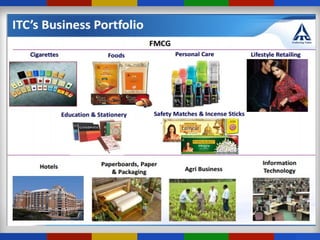
• Diversified into FMCG, Hotels, Paperboards &
Packaging, Agri Business and IT.
• Transformed into leading cigarette
manufacturer to diversified umbrella brand.
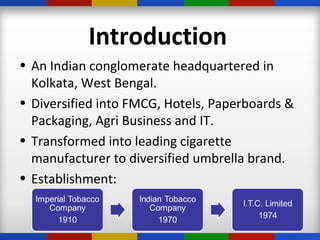
• Establishment:
Financials
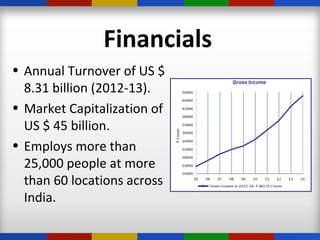
• Annual Turnover of US $
8.31 billion (2012-13).
• Market Capitalization of
US $ 45 billion.
• Employs more than
25,000 people at more
than 60 locations across
India.
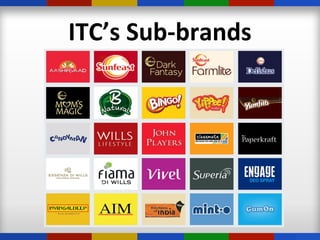
ITC’s Sub-brands
Diversification Strategies
Internal Analysis:
• Leveraging more
resources
• Upgrading financial
management
• Investing in people
• Improving
communication &
information system
External Analysis:
• Facing the bad
economical
conditions
• Challenging the new
entries
• Overcoming the
market conditions in
cigarettes
Vertical Integration
E-Choupal
• In June 2000, introducing an IT based kiosks called
E-Choupal.
• E-Choupal combines web portal in local language
and PCs with internet access.
• Creating channel between ITC and villagers.
• Operated by farmers.
• Information related to weather, crop prices &
conditions, best practices in farming, international
prices, etc.
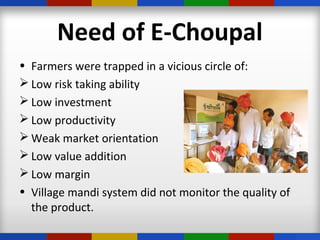
Need of E-Choupal
• Farmers were trapped in a vicious circle of:
 Low risk taking ability
 Low investment
 Low productivity
 Weak market orientation
 Low value addition
 Low margin
• Village mandi system did not monitor the quality of
the product.
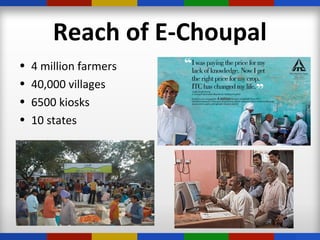
Reach of E-Choupal
• 4 million farmers
• 40,000 villages
• 6500 kiosks
• 10 states
Impact of E-Choupal
Advantages to farmer:
•Relevant and Real time information.
•Paying better for better quality.
Advantages to ITC:
•Customizing its products accordingly.
Eg: Aashirvaad aata.
•Delivering immense value across the Agri Business
Division ranking India’s second largest exporter with
exports of over Rs. 1000 crores.
Advantages & Disadvantages of
Vertical Integration Decision
• Increased control.
• Improved the brand image of the company.
• Matched quality and quantity specifications of
international markets.
• Need to have end to end control over its supply chain.
• The company was able to highly invest in other assets
creating a competitive edge.
• ITC faced challenge from large, low-cost suppliers of
agricultural products in the United States, Brazil, and
other countries.
3 Tests for Judging a
Diversification Move
• The industry attractiveness test
• The cost-of-entry test
• The better-off test
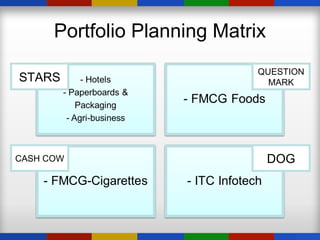
Portfolio Planning Matrix
QUESTION
MARKSTARS
CASH COW DOG
4 concepts of
Corporate Strategies
Portfolio management
• It creates multiple driver of growth with opportunities in
domestic and export markets
• Focuses on FMCG, Hotels, Paper, Paperboards &
Packaging, Agri Business and Information Technology
• Creates the benchmark for each business by Market
Position, Profitability and Internal Vitality
• Enhances the competitive power via synergies derived by
diverse skills and capabilities of ITC’s various businesses
• Continuously refining Corporate Governance processes and
systems to speed up entrepreneurial energies by balancing
executive freedom and effective control and accountability
Transferring skills
• For the entry in paperboard business, printing and
packaging business skills were used
• Acquisitions of various companies expanded FMCG
business with the help of FMCG knowledge and
expertise
• These were also used to enter into Agarbatti and
personal care product segment
• Hospitality sectorial business is considered to be a
welcome move because of utilizing its other business
products internally
Sharing Activities
• This strategy of using distribution and
procurement systems in businesses like
paper products, stationary, Personal care
products, packaged food products and
many other products helps in exploiting the
relationship between businesses in the
organization
• At its root, all ITC’s efforts will seek to
improve the international competitiveness
of SMEs
Restructuring
• ITC restructured its portfolio of businesses based on
the strategic fit between market opportunities and
its core capabilities
• The challenge was to enable transition from
competing in intensely competitive and rapidly
globalizing market
• A paradigm shift- acquiring international
competitiveness in cost and quality in each of ITC
businesses
• Through investments in technology, processes,
innovation and branding, supported by leaders.
Mergers and Acquisitions
FMCG Sector
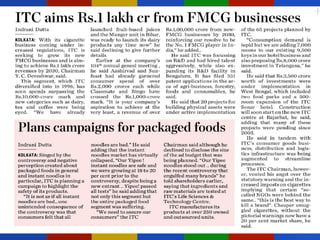
• Acquired Shower To Shower, Savlon brands from J&J
in February 2015
• This is ITC's first major acquisition in personal care
product domain
• Reason: ITC's aspiration to achieve revenue of Rs
100,000 crore from the new FMCG businesses by
2030
• Savlon and Shower to Shower are Small but well-
known brands and will improve ITC's overall personal
care prospects if its distribution and marketing
strengths are applied right
FMCG sector
• This is ITC's first major acquisition in personal care product
domain
• ITC's aspiration to achieve revenue of Rs 100,000 crore
from the new FMCG businesses by 2030
• Savlon and Shower to Shower are Small but well-known
brands and will improve ITC's overall personal care
prospects if its distribution and marketing strengths are
applied right
Food and Beverage segment
• Acquired Bangalore-based Balan Natural Food Pvt Ltd’s B
Natural brand in May 2014 to roll out packaged fruit juices
under its foods category.
• To enter a new segment — branded ready-to-drink juices.
• Established leader in the market is Dabur India Ltd. PepsiCo
India also has a high market share.
• Reason: India’s branded packaged juice market is estimated
at Rs. 1,000 crore and growing annually at 15-20 per cent.
Food and Beverage segment
• The B Natural acquisition also marks a
significant step in fulfilling ITC’s dream of No
1 non-cigarette FMCG player in India.
• The company is eyeing a turnover of Rs.
15,000 crore from its non-cigarette FMCG
business by 2017-18 against Rs. 7,000 crore in
2012-13.
• Last fiscal, its non-FMCG segment revenue
grew 26.5 per cent.
JV with SRD Group
• Set up a joint venture with Sunanda Ram Deka
(SRD) Group- a local food major.
• The products manufactured would be biscuits
and other items under the Sunfeast brand of
the ITC.
• The biscuit market in the Northeast is growing
at 15 to 20 per cent.
Paperboards & Specialty Papers
• In 1990, ITC acquired Tribeni Tissues Limited, a Specialty
paper manufacturing company and a major supplier of
tissue paper to the cigarette industry.
• The merged entity was named the Tribeni Tissues
Division (TTD).
• In November 2002 TTD was merged with the
Bhadrachalam Paperboards Division in order to harness
strategic and operational synergies.
Backward Integration
Hospitality sector
• In 1975, the Company launched its Hotels
business with the acquisition of a hotel in
Chennai which was rechristened 'ITC-Welcom
Group Hotel Chola’
• ITC chose the Hotels business for its potential
to earn high levels of foreign exchange, create
tourism infrastructure and generate large
scale direct and indirect employment.
Recent Acquisition in
hospitality sector
• Emerging as the highest bidder, ITC
Limited has acquired 250 room Park Hyatt
Hotel located in Goa for INR 515.44 Cr.
• The purchase is significant for ITC, too,
because it did not have any property in
Goa under its luxury brand.
Acquisition vs Organic growth
• ITC has chosen to expand its portfolio very intelligently and
rapidly.
• FMCG Sector:
– Has already entered the biscuits, ready to eat foods and
personal care segment
– The acquisition of niche brands from J&J is better than
organic growth as these brands will help immediate entry
into the antiseptic and talcum powder segment
– Savlon and shower to shower are popular global brands
with following in India
– This move will help ITC in forward diversification into
products like sanitary napkins and adhesive bandages
Acquisition vs Organic growth
• Food and Beverage segment:
– Has already entered the biscuits market and is
leader in the cream biscuit category
– Acquiring the manufacturing capabilities of
manufacturing through acquisition of SRD group is
a welcome leap in this category
– In the beverage category since ITC has no prior
experience, starting with the acquisition of a
smaller brand makes more sense than organic
growth
• Paper Industry:
– ITC plans organic growth in paper
– ITC Ltd has decided to expand capacities in
its paper and board division
– Doubling the paper mill capacity to one
million tonnes.
– The company has looked at several paper
mills which were in the market but none
were found to be a good investment
Acquisition vs Organic growth
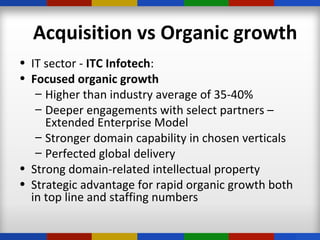
• IT sector - ITC Infotech:
• Focused organic growth
– Higher than industry average of 35-40%
– Deeper engagements with select partners –
Extended Enterprise Model
– Stronger domain capability in chosen verticals
– Perfected global delivery
• Strong domain-related intellectual property
• Strategic advantage for rapid organic growth both
in top line and staffing numbers
Acquisition vs Organic growth
ITC

ITC

  • 1.
    Firm Analysis on: Presentedby: Group No. 1: Ruchi Bavishi | Sagar Chande | Ishan Bhasker | Shreyas Desai 02 04 106 113
  • 2.
    Introduction • An Indianconglomerate headquartered in Kolkata, West Bengal. • Diversified into FMCG, Hotels, Paperboards & Packaging, Agri Business and IT. • Transformed into leading cigarette manufacturer to diversified umbrella brand. • Establishment:
  • 3.
    Financials • Annual Turnoverof US $ 8.31 billion (2012-13). • Market Capitalization of US $ 45 billion. • Employs more than 25,000 people at more than 60 locations across India.
  • 5.
  • 6.
    Diversification Strategies Internal Analysis: •Leveraging more resources • Upgrading financial management • Investing in people • Improving communication & information system External Analysis: • Facing the bad economical conditions • Challenging the new entries • Overcoming the market conditions in cigarettes
  • 7.
    Vertical Integration E-Choupal • InJune 2000, introducing an IT based kiosks called E-Choupal. • E-Choupal combines web portal in local language and PCs with internet access. • Creating channel between ITC and villagers. • Operated by farmers. • Information related to weather, crop prices & conditions, best practices in farming, international prices, etc.
  • 8.
    Need of E-Choupal •Farmers were trapped in a vicious circle of:  Low risk taking ability  Low investment  Low productivity  Weak market orientation  Low value addition  Low margin • Village mandi system did not monitor the quality of the product.
  • 9.
    Reach of E-Choupal •4 million farmers • 40,000 villages • 6500 kiosks • 10 states
  • 10.
    Impact of E-Choupal Advantagesto farmer: •Relevant and Real time information. •Paying better for better quality. Advantages to ITC: •Customizing its products accordingly. Eg: Aashirvaad aata. •Delivering immense value across the Agri Business Division ranking India’s second largest exporter with exports of over Rs. 1000 crores.
  • 11.
    Advantages & Disadvantagesof Vertical Integration Decision • Increased control. • Improved the brand image of the company. • Matched quality and quantity specifications of international markets. • Need to have end to end control over its supply chain. • The company was able to highly invest in other assets creating a competitive edge. • ITC faced challenge from large, low-cost suppliers of agricultural products in the United States, Brazil, and other countries.
  • 15.
    3 Tests forJudging a Diversification Move • The industry attractiveness test • The cost-of-entry test • The better-off test
  • 21.
  • 22.
  • 23.
    Portfolio management • Itcreates multiple driver of growth with opportunities in domestic and export markets • Focuses on FMCG, Hotels, Paper, Paperboards & Packaging, Agri Business and Information Technology • Creates the benchmark for each business by Market Position, Profitability and Internal Vitality • Enhances the competitive power via synergies derived by diverse skills and capabilities of ITC’s various businesses • Continuously refining Corporate Governance processes and systems to speed up entrepreneurial energies by balancing executive freedom and effective control and accountability
  • 24.
    Transferring skills • Forthe entry in paperboard business, printing and packaging business skills were used • Acquisitions of various companies expanded FMCG business with the help of FMCG knowledge and expertise • These were also used to enter into Agarbatti and personal care product segment • Hospitality sectorial business is considered to be a welcome move because of utilizing its other business products internally
  • 25.
    Sharing Activities • Thisstrategy of using distribution and procurement systems in businesses like paper products, stationary, Personal care products, packaged food products and many other products helps in exploiting the relationship between businesses in the organization • At its root, all ITC’s efforts will seek to improve the international competitiveness of SMEs
  • 26.
    Restructuring • ITC restructuredits portfolio of businesses based on the strategic fit between market opportunities and its core capabilities • The challenge was to enable transition from competing in intensely competitive and rapidly globalizing market • A paradigm shift- acquiring international competitiveness in cost and quality in each of ITC businesses • Through investments in technology, processes, innovation and branding, supported by leaders.
  • 28.
  • 29.
    FMCG Sector • AcquiredShower To Shower, Savlon brands from J&J in February 2015 • This is ITC's first major acquisition in personal care product domain • Reason: ITC's aspiration to achieve revenue of Rs 100,000 crore from the new FMCG businesses by 2030 • Savlon and Shower to Shower are Small but well- known brands and will improve ITC's overall personal care prospects if its distribution and marketing strengths are applied right
  • 30.
    FMCG sector • Thisis ITC's first major acquisition in personal care product domain • ITC's aspiration to achieve revenue of Rs 100,000 crore from the new FMCG businesses by 2030 • Savlon and Shower to Shower are Small but well-known brands and will improve ITC's overall personal care prospects if its distribution and marketing strengths are applied right
  • 31.
    Food and Beveragesegment • Acquired Bangalore-based Balan Natural Food Pvt Ltd’s B Natural brand in May 2014 to roll out packaged fruit juices under its foods category. • To enter a new segment — branded ready-to-drink juices. • Established leader in the market is Dabur India Ltd. PepsiCo India also has a high market share. • Reason: India’s branded packaged juice market is estimated at Rs. 1,000 crore and growing annually at 15-20 per cent.
  • 32.
    Food and Beveragesegment • The B Natural acquisition also marks a significant step in fulfilling ITC’s dream of No 1 non-cigarette FMCG player in India. • The company is eyeing a turnover of Rs. 15,000 crore from its non-cigarette FMCG business by 2017-18 against Rs. 7,000 crore in 2012-13. • Last fiscal, its non-FMCG segment revenue grew 26.5 per cent.
  • 33.
    JV with SRDGroup • Set up a joint venture with Sunanda Ram Deka (SRD) Group- a local food major. • The products manufactured would be biscuits and other items under the Sunfeast brand of the ITC. • The biscuit market in the Northeast is growing at 15 to 20 per cent.
  • 34.
    Paperboards & SpecialtyPapers • In 1990, ITC acquired Tribeni Tissues Limited, a Specialty paper manufacturing company and a major supplier of tissue paper to the cigarette industry. • The merged entity was named the Tribeni Tissues Division (TTD). • In November 2002 TTD was merged with the Bhadrachalam Paperboards Division in order to harness strategic and operational synergies. Backward Integration
  • 35.
    Hospitality sector • In1975, the Company launched its Hotels business with the acquisition of a hotel in Chennai which was rechristened 'ITC-Welcom Group Hotel Chola’ • ITC chose the Hotels business for its potential to earn high levels of foreign exchange, create tourism infrastructure and generate large scale direct and indirect employment.
  • 36.
    Recent Acquisition in hospitalitysector • Emerging as the highest bidder, ITC Limited has acquired 250 room Park Hyatt Hotel located in Goa for INR 515.44 Cr. • The purchase is significant for ITC, too, because it did not have any property in Goa under its luxury brand.
  • 37.
    Acquisition vs Organicgrowth • ITC has chosen to expand its portfolio very intelligently and rapidly. • FMCG Sector: – Has already entered the biscuits, ready to eat foods and personal care segment – The acquisition of niche brands from J&J is better than organic growth as these brands will help immediate entry into the antiseptic and talcum powder segment – Savlon and shower to shower are popular global brands with following in India – This move will help ITC in forward diversification into products like sanitary napkins and adhesive bandages
  • 38.
    Acquisition vs Organicgrowth • Food and Beverage segment: – Has already entered the biscuits market and is leader in the cream biscuit category – Acquiring the manufacturing capabilities of manufacturing through acquisition of SRD group is a welcome leap in this category – In the beverage category since ITC has no prior experience, starting with the acquisition of a smaller brand makes more sense than organic growth
  • 39.
    • Paper Industry: –ITC plans organic growth in paper – ITC Ltd has decided to expand capacities in its paper and board division – Doubling the paper mill capacity to one million tonnes. – The company has looked at several paper mills which were in the market but none were found to be a good investment Acquisition vs Organic growth
  • 40.
    • IT sector- ITC Infotech: • Focused organic growth – Higher than industry average of 35-40% – Deeper engagements with select partners – Extended Enterprise Model – Stronger domain capability in chosen verticals – Perfected global delivery • Strong domain-related intellectual property • Strategic advantage for rapid organic growth both in top line and staffing numbers Acquisition vs Organic growth