INTERMEZZO
Now, given what we know about the context deaf
learners learn in, and deaf learners’ characteristics, can
we improve how to teach deaf learners via technology? If
yes, how? See the next part of the presentation….
1st International Conference onTeaching Deaf Learners Amsterdam, NL, 19-21 March 2014
OUTLINE
1. Technology enhanced learning: what
2. From requirements to design guidelines
3. Evaluation by examples
4. Conclusions
TECHNOLOGY ENHANCED LEARNING:
WHAT
PART I
1st International Conference onTeaching Deaf Learners Amsterdam, NL, 19-21 March 2014
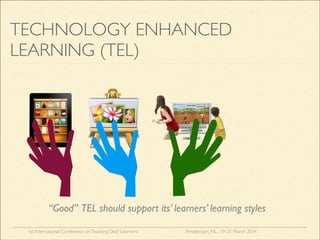
TECHNOLOGY ENHANCED
LEARNING (TEL)
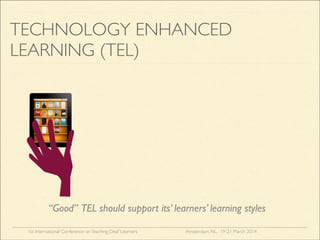
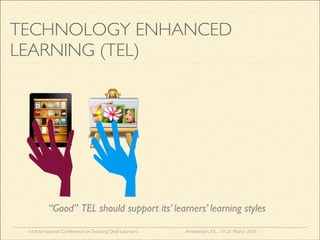
“Good” TEL should support its’ learners’ learning styles
1st International Conference onTeaching Deaf Learners Amsterdam, NL, 19-21 March 2014
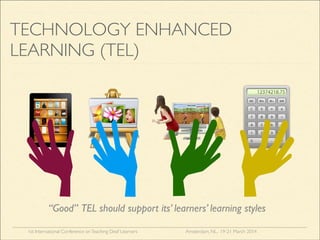
TECHNOLOGY ENHANCED
LEARNING (TEL)
“Good” TEL should support its’ learners’ learning styles
1st International Conference onTeaching Deaf Learners Amsterdam, NL, 19-21 March 2014
TECHNOLOGY ENHANCED
LEARNING (TEL)
“Good” TEL should support its’ learners’ learning styles
1st International Conference onTeaching Deaf Learners Amsterdam, NL, 19-21 March 2014
TECHNOLOGY ENHANCED
LEARNING (TEL)
“Good” TEL should support its’ learners’ learning styles
1st International Conference onTeaching Deaf Learners Amsterdam, NL, 19-21 March 2014
TECHNOLOGY ENHANCED
LEARNING (TEL)
“Good” TEL should support its’ learners’ learning styles
1st International Conference onTeaching Deaf Learners Amsterdam, NL, 19-21 March 2014
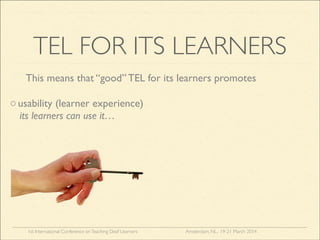
TEL FOR ITS LEARNERS
This means that “good” TEL for its learners promotes
its learners can use it…
ousability (learner experience)
1st International Conference onTeaching Deaf Learners Amsterdam, NL, 19-21 March 2014
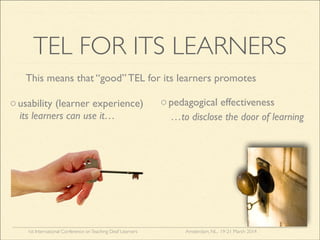
TEL FOR ITS LEARNERS
This means that “good” TEL for its learners promotes
its learners can use it…
ousability (learner experience)
…to disclose the door of learning
opedagogical effectiveness
1st International Conference onTeaching Deaf Learners Amsterdam, NL, 19-21 March 2014
HOW TO DESIGN USABLE AND
PEDAGOGICALLY EFFECTIVETEL
1st International Conference onTeaching Deaf Learners Amsterdam, NL, 19-21 March 2014
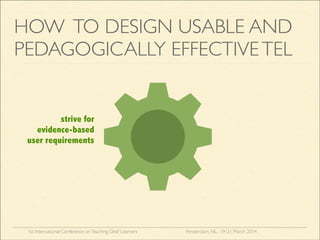
HOW TO DESIGN USABLE AND
PEDAGOGICALLY EFFECTIVETEL
strive for
evidence-based
user requirements
1st International Conference onTeaching Deaf Learners Amsterdam, NL, 19-21 March 2014
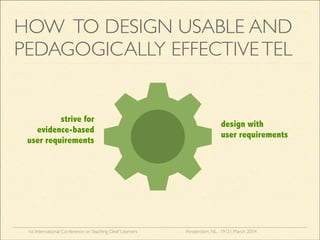
HOW TO DESIGN USABLE AND
PEDAGOGICALLY EFFECTIVETEL
strive for
evidence-based
user requirements
design with
user requirements
1st International Conference onTeaching Deaf Learners Amsterdam, NL, 19-21 March 2014
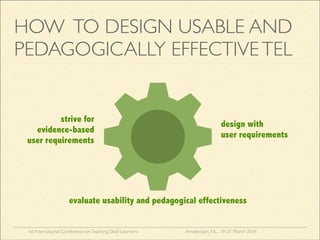
HOW TO DESIGN USABLE AND
PEDAGOGICALLY EFFECTIVETEL
strive for
evidence-based
user requirements
design with
user requirements
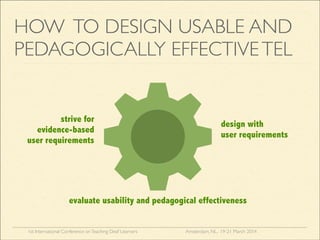
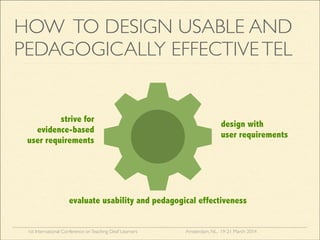
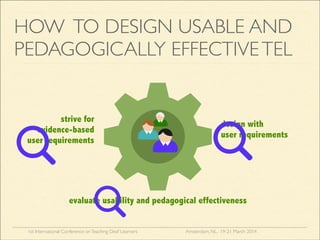
evaluate usability and pedagogical effectiveness
1st International Conference onTeaching Deaf Learners Amsterdam, NL, 19-21 March 2014
HOW TO DESIGN USABLE AND
PEDAGOGICALLY EFFECTIVETEL
strive for
evidence-based
user requirements
design with
user requirements
evaluate usability and pedagogical effectiveness
1st International Conference onTeaching Deaf Learners Amsterdam, NL, 19-21 March 2014
HOW TO DESIGN USABLE AND
PEDAGOGICALLY EFFECTIVETEL
strive for
evidence-based
user requirements
design with
user requirements
evaluate usability and pedagogical effectiveness
1st International Conference onTeaching Deaf Learners Amsterdam, NL, 19-21 March 2014
HOW TO DESIGN USABLE AND
PEDAGOGICALLY EFFECTIVETEL
strive for
evidence-based
user requirements
design with
user requirements
evaluate usability and pedagogical effectiveness
HOW TO DESIGN USABLE AND
PEDAGOGICALLY EFFECTIVETEL
strive for
evidence-based
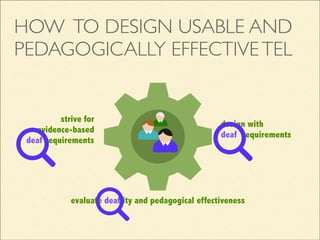
deaf requirements
design with
deaf requirements
evaluate deaflity and pedagogical effectiveness
From requirements to design
PART II
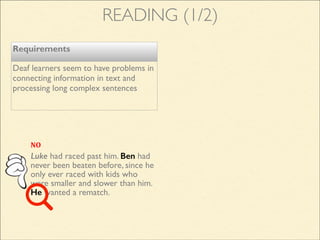
READING (1/2)
Requirements
Deaf learners seem to have problems in
connecting information in text and
processing long complex sentences
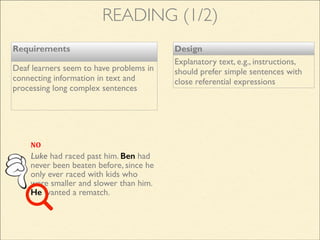
Luke had raced past him. Ben had
never been beaten before, since he
only ever raced with kids who
were smaller and slower than him.
He wanted a rematch.
NO
Design
Explanatory text, e.g., instructions,
should prefer simple sentences with
close referential expressions
READING (1/2)
Requirements
Deaf learners seem to have problems in
connecting information in text and
processing long complex sentences
Luke had raced past him. Ben had
never been beaten before, since he
only ever raced with kids who
were smaller and slower than him.
He wanted a rematch.
NO
Design
Explanatory text, e.g., instructions,
should prefer simple sentences with
close referential expressions
READING (1/2)
Requirements
Deaf learners seem to have problems in
connecting information in text and
processing long complex sentences
Luke had raced past him. Ben had
never been beaten before, since he
only ever raced with kids who
were smaller and slower than him.
He wanted a rematch.
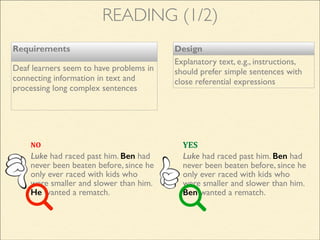
NO YES
Luke had raced past him. Ben had
never been beaten before, since he
only ever raced with kids who
were smaller and slower than him.
Ben wanted a rematch.
READING (2/2)
Requirements
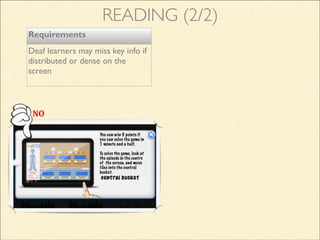
Deaf learners may miss key info if
distributed or dense on the
screen
You can win 5 points if
you can solve the game in
1 minute and a half.
!
To solve the game, look at
the episode in the centre
of the screen, and move
tiles into the central
bucket.
NO
READING (2/2)
Requirements
Deaf learners may miss key info if
distributed or dense on the
screen
You can win 5 points if
you can solve the game in
1 minute and a half.
!
To solve the game, look at
the episode in the centre
of the screen, and move
tiles into the central
bucket.
NO
Design
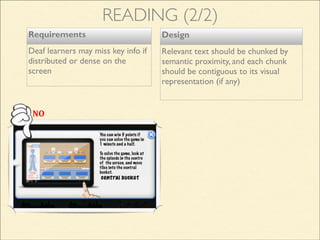
Relevant text should be chunked by
semantic proximity, and each chunk
should be contiguous to its visual
representation (if any)
READING (2/2)
Requirements
Deaf learners may miss key info if
distributed or dense on the
screen
You can win 5 points if
you can solve the game in
1 minute and a half.
!
To solve the game, look at
the episode in the centre
of the screen, and move
tiles into the central
bucket.
NO
Design
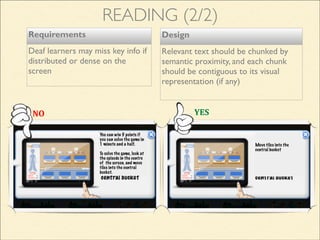
Relevant text should be chunked by
semantic proximity, and each chunk
should be contiguous to its visual
representation (if any)
!
!
Move tiles into the
central bucket
!
!
!
!
YES
READING (2/2)
Requirements
Deaf learners may miss key info if
distributed or dense on the
screen
ATTENTION (1/2)
Requirements
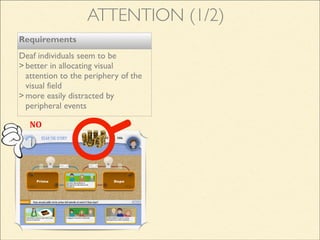
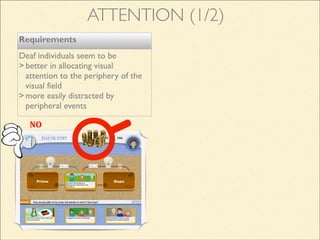
Deaf individuals seem to be
> better in allocating visual
attention to the periphery of the
visual field
> more easily distracted by
peripheral events
NO
ATTENTION (1/2)
Requirements
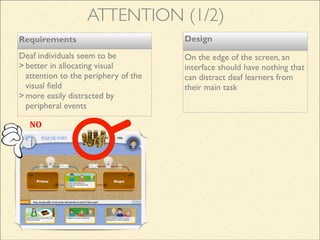
Deaf individuals seem to be
> better in allocating visual
attention to the periphery of the
visual field
> more easily distracted by
peripheral events
NO
Design
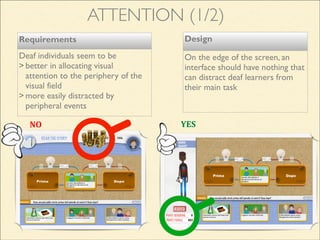
On the edge of the screen, an
interface should have nothing that
can distract deaf learners from
their main task
ATTENTION (1/2)
Requirements
Deaf individuals seem to be
> better in allocating visual
attention to the periphery of the
visual field
> more easily distracted by
peripheral events
NO
Design
On the edge of the screen, an
interface should have nothing that
can distract deaf learners from
their main task
ATTENTION (1/2)
Requirements
Deaf individuals seem to be
> better in allocating visual
attention to the periphery of the
visual field
> more easily distracted by
peripheral events
NO YES
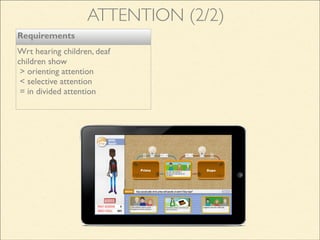
Requirements
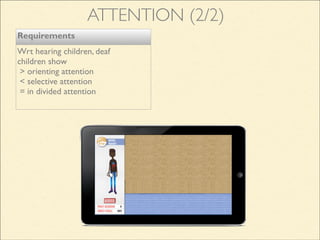
Wrt hearing children, deaf
children show
> orienting attention
< selective attention
= in divided attention
ATTENTION (2/2)
Requirements
Wrt hearing children, deaf
children show
> orienting attention
< selective attention
= in divided attention
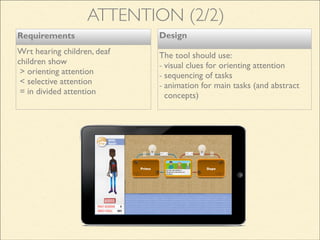
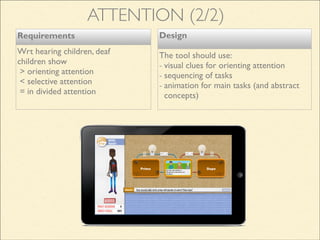
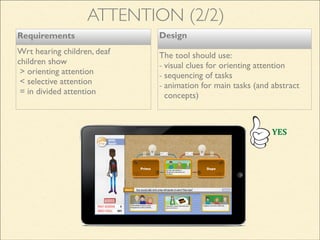
ATTENTION (2/2)
Requirements
Wrt hearing children, deaf
children show
> orienting attention
< selective attention
= in divided attention
ATTENTION (2/2)
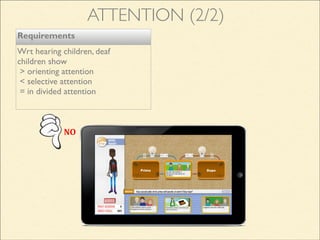
NO
Requirements
Wrt hearing children, deaf
children show
> orienting attention
< selective attention
= in divided attention
ATTENTION (2/2)
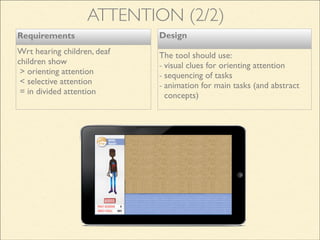
Design
The tool should use:
- visual clues for orienting attention
- sequencing of tasks
- animation for main tasks (and abstract
concepts)
Requirements
Wrt hearing children, deaf
children show
> orienting attention
< selective attention
= in divided attention
ATTENTION (2/2)
Design
The tool should use:
- visual clues for orienting attention
- sequencing of tasks
- animation for main tasks (and abstract
concepts)
Requirements
Wrt hearing children, deaf
children show
> orienting attention
< selective attention
= in divided attention
ATTENTION (2/2)
Design
The tool should use:
- visual clues for orienting attention
- sequencing of tasks
- animation for main tasks (and abstract
concepts)
Requirements
Wrt hearing children, deaf
children show
> orienting attention
< selective attention
= in divided attention
ATTENTION (2/2)
Design
The tool should use:
- visual clues for orienting attention
- sequencing of tasks
- animation for main tasks (and abstract
concepts)
Requirements
Wrt hearing children, deaf
children show
> orienting attention
< selective attention
= in divided attention
ATTENTION (2/2)
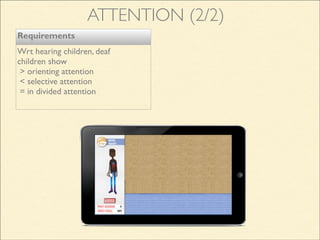
YES
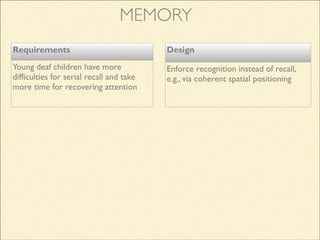
Requirements
Young deaf children have more
difficulties for serial recall and take
more time for recovering attention
MEMORY
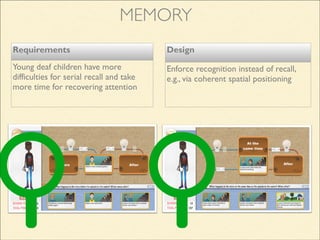
Requirements
Young deaf children have more
difficulties for serial recall and take
more time for recovering attention
Design
Enforce recognition instead of recall,
e.g., via coherent spatial positioning
MEMORY
Requirements
Young deaf children have more
difficulties for serial recall and take
more time for recovering attention
Design
Enforce recognition instead of recall,
e.g., via coherent spatial positioning
MEMORY
Evaluation ofTEL by examples
Part III
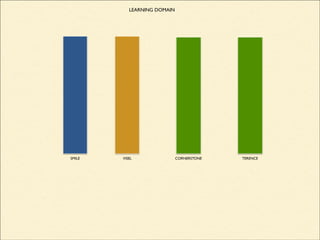
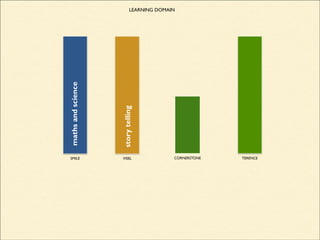
CORNERSTONE TERENCESMILE VISEL
LEARNING DOMAIN
SMILE CORNERSTONE TERENCEVISEL
SMILE
mathsandscience
CORNERSTONE TERENCEVISEL
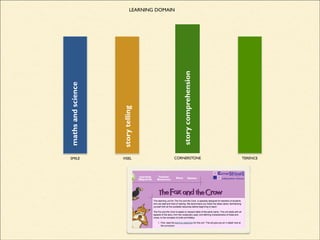
VISEL CORNERSTONE TERENCESMILE
LEARNING DOMAIN
mathsandscience
VISEL CORNERSTONE TERENCESMILE
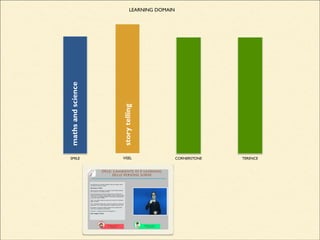
LEARNING DOMAIN
mathsandscience
storytelling
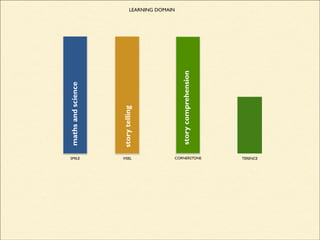
CORNERSTONE
mathsandscience
SMILE VISEL
LEARNING DOMAIN
storytelling
mathsandscience
TERENCE
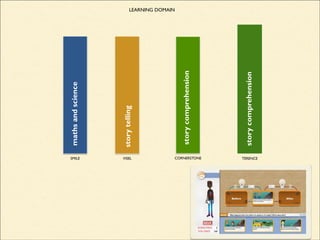
CORNERSTONE
mathsandscience
SMILE VISEL
LEARNING DOMAIN
storytelling
mathsandscience
TERENCE
storycomprehension
TERENCE
mathsandscience
SMILE VISEL
LEARNING DOMAIN
storytelling
mathsandscience
CORNERSTONE
storycomprehension
TERENCE
mathsandscience
SMILE VISEL
LEARNING DOMAIN
storytelling
mathsandscience
CORNERSTONE
storycomprehension
storycomprehension
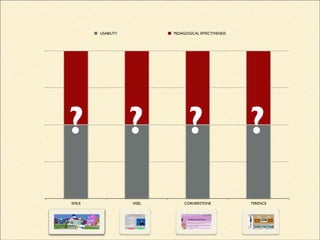
SMILE VISEL CORNERSTONE TERENCE
USABILITY PEDAGOGICAL EFFECTIVENESS
? ? ? ?
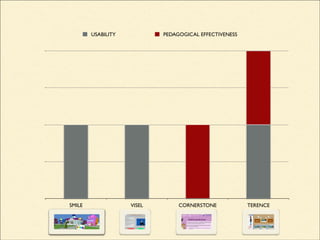
SMILE VISEL CORNERSTONE TERENCE
USABILITY PEDAGOGICAL EFFECTIVENESS
CONCLUSIONS
Part IV
Requirements
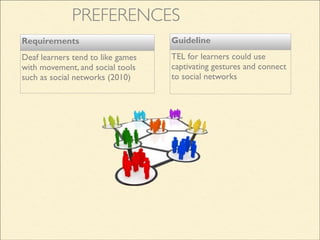
Deaf learners tend to like games
with movement, and social tools
such as social networks (2010)
PREFERENCES
Guideline
TEL for learners could use
captivating gestures and connect
to social networks
Requirements
Deaf learners tend to like games
with movement, and social tools
such as social networks (2010)
PREFERENCES
Guideline
TEL for learners could use
captivating gestures and connect
to social networks
Requirements
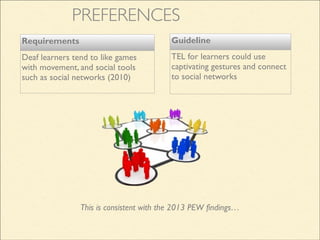
Deaf learners tend to like games
with movement, and social tools
such as social networks (2010)
PREFERENCES
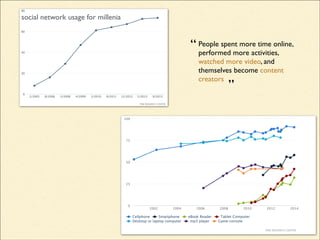
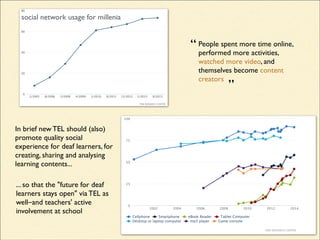
This is consistent with the 2013 PEW findings…
16/03/14 21:5Device Ownership Over Time | Pew Research Center's Internet & American Life Project
CLICK AND DRAG IN THE PLOT AREA TO ZOOM IN
Cellphone Smartphone eBook Reader Tablet Computer
Desktop or laptop computer mp3 player Game console
2002 2004 2006 2008 2010 2012 2014
0
100
25
50
75
PEW RESEARCH CENTER
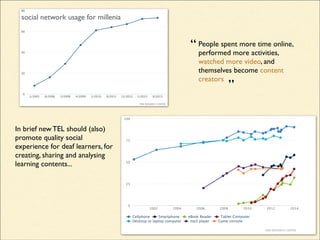
People spent more time online,
performed more activities,
watched more video, and
themselves become content
creators
”
“
social network usage for millenia
16/03/14 21:5Device Ownership Over Time | Pew Research Center's Internet & American Life Project
CLICK AND DRAG IN THE PLOT AREA TO ZOOM IN
Cellphone Smartphone eBook Reader Tablet Computer
Desktop or laptop computer mp3 player Game console
2002 2004 2006 2008 2010 2012 2014
0
100
25
50
75
PEW RESEARCH CENTER
People spent more time online,
performed more activities,
watched more video, and
themselves become content
creators
”
“
In brief new TEL should (also)
promote quality social
experience for deaf learners, for
creating, sharing and analysing
learning contents...
social network usage for millenia
16/03/14 21:5Device Ownership Over Time | Pew Research Center's Internet & American Life Project
CLICK AND DRAG IN THE PLOT AREA TO ZOOM IN
Cellphone Smartphone eBook Reader Tablet Computer
Desktop or laptop computer mp3 player Game console
2002 2004 2006 2008 2010 2012 2014
0
100
25
50
75
PEW RESEARCH CENTER
People spent more time online,
performed more activities,
watched more video, and
themselves become content
creators
”
“
In brief new TEL should (also)
promote quality social
experience for deaf learners, for
creating, sharing and analysing
learning contents...
... so that the "future for deaf
learners stays open" via TEL as
well⎯and teachers' active
involvement at school
social network usage for millenia
1st International Conference onTeaching Deaf Learners Amsterdam, NL, 19-21 March 2014
H. Knoors and M. Marschark (2014).
Multimedia-Enhanced, Computer-Assisted
Learning for Deaf Students. Ch. 10 of
Teaching Deaf Learners. Oxford Press.
!
TERENCE (http://www.terenceproject.eu):
• D1.2 for preferences in 2011, D7.4 for
large-scale evaluation in 2013;
• articles in Proc. of ICALT 2012, IEEE,
ebTEL 2013 and MIS4TEL 2014,
Springer;
• article in IJTEL journal for TERENCE
game design methodology, forthcoming
in 2014.
T. Di Mascio, R. Gennari,A. Melonio, P.
Vittorini (2014). Designing Games for Deaf
Children: First Guidelines. Accepted in
Journal of Technology Enhanced Learning
(IJTEL).
!
T. di Mascio and R. Gennari (2009). A Usability
Guide to IntelligentWebTools for the Literacy
of Deaf People. In Book “Integrating
Usability Engineering for Designing the
Web Experience: Methodologies and
Principles”, ICI Global.
MAIN REFERENCES FORTHE 2nd PART

Teaching Deaf Learners

  • 20.
    INTERMEZZO Now, given whatwe know about the context deaf learners learn in, and deaf learners’ characteristics, can we improve how to teach deaf learners via technology? If yes, how? See the next part of the presentation….
  • 21.
    1st International ConferenceonTeaching Deaf Learners Amsterdam, NL, 19-21 March 2014 OUTLINE 1. Technology enhanced learning: what 2. From requirements to design guidelines 3. Evaluation by examples 4. Conclusions
  • 22.
  • 23.
    1st International ConferenceonTeaching Deaf Learners Amsterdam, NL, 19-21 March 2014 TECHNOLOGY ENHANCED LEARNING (TEL) “Good” TEL should support its’ learners’ learning styles
  • 24.
    1st International ConferenceonTeaching Deaf Learners Amsterdam, NL, 19-21 March 2014 TECHNOLOGY ENHANCED LEARNING (TEL) “Good” TEL should support its’ learners’ learning styles
  • 25.
    1st International ConferenceonTeaching Deaf Learners Amsterdam, NL, 19-21 March 2014 TECHNOLOGY ENHANCED LEARNING (TEL) “Good” TEL should support its’ learners’ learning styles
  • 26.
    1st International ConferenceonTeaching Deaf Learners Amsterdam, NL, 19-21 March 2014 TECHNOLOGY ENHANCED LEARNING (TEL) “Good” TEL should support its’ learners’ learning styles
  • 27.
    1st International ConferenceonTeaching Deaf Learners Amsterdam, NL, 19-21 March 2014 TECHNOLOGY ENHANCED LEARNING (TEL) “Good” TEL should support its’ learners’ learning styles
  • 28.
    1st International ConferenceonTeaching Deaf Learners Amsterdam, NL, 19-21 March 2014 TEL FOR ITS LEARNERS This means that “good” TEL for its learners promotes its learners can use it… ousability (learner experience)
  • 29.
    1st International ConferenceonTeaching Deaf Learners Amsterdam, NL, 19-21 March 2014 TEL FOR ITS LEARNERS This means that “good” TEL for its learners promotes its learners can use it… ousability (learner experience) …to disclose the door of learning opedagogical effectiveness
  • 30.
    1st International ConferenceonTeaching Deaf Learners Amsterdam, NL, 19-21 March 2014 HOW TO DESIGN USABLE AND PEDAGOGICALLY EFFECTIVETEL
  • 31.
    1st International ConferenceonTeaching Deaf Learners Amsterdam, NL, 19-21 March 2014 HOW TO DESIGN USABLE AND PEDAGOGICALLY EFFECTIVETEL strive for evidence-based user requirements
  • 32.
    1st International ConferenceonTeaching Deaf Learners Amsterdam, NL, 19-21 March 2014 HOW TO DESIGN USABLE AND PEDAGOGICALLY EFFECTIVETEL strive for evidence-based user requirements design with user requirements
  • 33.
    1st International ConferenceonTeaching Deaf Learners Amsterdam, NL, 19-21 March 2014 HOW TO DESIGN USABLE AND PEDAGOGICALLY EFFECTIVETEL strive for evidence-based user requirements design with user requirements evaluate usability and pedagogical effectiveness
  • 34.
    1st International ConferenceonTeaching Deaf Learners Amsterdam, NL, 19-21 March 2014 HOW TO DESIGN USABLE AND PEDAGOGICALLY EFFECTIVETEL strive for evidence-based user requirements design with user requirements evaluate usability and pedagogical effectiveness
  • 35.
    1st International ConferenceonTeaching Deaf Learners Amsterdam, NL, 19-21 March 2014 HOW TO DESIGN USABLE AND PEDAGOGICALLY EFFECTIVETEL strive for evidence-based user requirements design with user requirements evaluate usability and pedagogical effectiveness
  • 36.
    1st International ConferenceonTeaching Deaf Learners Amsterdam, NL, 19-21 March 2014 HOW TO DESIGN USABLE AND PEDAGOGICALLY EFFECTIVETEL strive for evidence-based user requirements design with user requirements evaluate usability and pedagogical effectiveness
  • 37.
    HOW TO DESIGNUSABLE AND PEDAGOGICALLY EFFECTIVETEL strive for evidence-based deaf requirements design with deaf requirements evaluate deaflity and pedagogical effectiveness
  • 38.
    From requirements todesign PART II
  • 39.
    READING (1/2) Requirements Deaf learnersseem to have problems in connecting information in text and processing long complex sentences Luke had raced past him. Ben had never been beaten before, since he only ever raced with kids who were smaller and slower than him. He wanted a rematch. NO
  • 40.
    Design Explanatory text, e.g.,instructions, should prefer simple sentences with close referential expressions READING (1/2) Requirements Deaf learners seem to have problems in connecting information in text and processing long complex sentences Luke had raced past him. Ben had never been beaten before, since he only ever raced with kids who were smaller and slower than him. He wanted a rematch. NO
  • 41.
    Design Explanatory text, e.g.,instructions, should prefer simple sentences with close referential expressions READING (1/2) Requirements Deaf learners seem to have problems in connecting information in text and processing long complex sentences Luke had raced past him. Ben had never been beaten before, since he only ever raced with kids who were smaller and slower than him. He wanted a rematch. NO YES Luke had raced past him. Ben had never been beaten before, since he only ever raced with kids who were smaller and slower than him. Ben wanted a rematch.
  • 42.
    READING (2/2) Requirements Deaf learnersmay miss key info if distributed or dense on the screen
  • 43.
    You can win5 points if you can solve the game in 1 minute and a half. ! To solve the game, look at the episode in the centre of the screen, and move tiles into the central bucket. NO READING (2/2) Requirements Deaf learners may miss key info if distributed or dense on the screen
  • 44.
    You can win5 points if you can solve the game in 1 minute and a half. ! To solve the game, look at the episode in the centre of the screen, and move tiles into the central bucket. NO Design Relevant text should be chunked by semantic proximity, and each chunk should be contiguous to its visual representation (if any) READING (2/2) Requirements Deaf learners may miss key info if distributed or dense on the screen
  • 45.
    You can win5 points if you can solve the game in 1 minute and a half. ! To solve the game, look at the episode in the centre of the screen, and move tiles into the central bucket. NO Design Relevant text should be chunked by semantic proximity, and each chunk should be contiguous to its visual representation (if any) ! ! Move tiles into the central bucket ! ! ! ! YES READING (2/2) Requirements Deaf learners may miss key info if distributed or dense on the screen
  • 46.
    ATTENTION (1/2) Requirements Deaf individualsseem to be > better in allocating visual attention to the periphery of the visual field > more easily distracted by peripheral events NO
  • 47.
    ATTENTION (1/2) Requirements Deaf individualsseem to be > better in allocating visual attention to the periphery of the visual field > more easily distracted by peripheral events NO
  • 48.
    Design On the edgeof the screen, an interface should have nothing that can distract deaf learners from their main task ATTENTION (1/2) Requirements Deaf individuals seem to be > better in allocating visual attention to the periphery of the visual field > more easily distracted by peripheral events NO
  • 49.
    Design On the edgeof the screen, an interface should have nothing that can distract deaf learners from their main task ATTENTION (1/2) Requirements Deaf individuals seem to be > better in allocating visual attention to the periphery of the visual field > more easily distracted by peripheral events NO YES
  • 50.
    Requirements Wrt hearing children,deaf children show > orienting attention < selective attention = in divided attention ATTENTION (2/2)
  • 51.
    Requirements Wrt hearing children,deaf children show > orienting attention < selective attention = in divided attention ATTENTION (2/2)
  • 52.
    Requirements Wrt hearing children,deaf children show > orienting attention < selective attention = in divided attention ATTENTION (2/2) NO
  • 53.
    Requirements Wrt hearing children,deaf children show > orienting attention < selective attention = in divided attention ATTENTION (2/2)
  • 54.
    Design The tool shoulduse: - visual clues for orienting attention - sequencing of tasks - animation for main tasks (and abstract concepts) Requirements Wrt hearing children, deaf children show > orienting attention < selective attention = in divided attention ATTENTION (2/2)
  • 55.
    Design The tool shoulduse: - visual clues for orienting attention - sequencing of tasks - animation for main tasks (and abstract concepts) Requirements Wrt hearing children, deaf children show > orienting attention < selective attention = in divided attention ATTENTION (2/2)
  • 56.
    Design The tool shoulduse: - visual clues for orienting attention - sequencing of tasks - animation for main tasks (and abstract concepts) Requirements Wrt hearing children, deaf children show > orienting attention < selective attention = in divided attention ATTENTION (2/2)
  • 57.
    Design The tool shoulduse: - visual clues for orienting attention - sequencing of tasks - animation for main tasks (and abstract concepts) Requirements Wrt hearing children, deaf children show > orienting attention < selective attention = in divided attention ATTENTION (2/2) YES
  • 58.
    Requirements Young deaf childrenhave more difficulties for serial recall and take more time for recovering attention MEMORY
  • 59.
    Requirements Young deaf childrenhave more difficulties for serial recall and take more time for recovering attention Design Enforce recognition instead of recall, e.g., via coherent spatial positioning MEMORY
  • 60.
    Requirements Young deaf childrenhave more difficulties for serial recall and take more time for recovering attention Design Enforce recognition instead of recall, e.g., via coherent spatial positioning MEMORY
  • 61.
    Evaluation ofTEL byexamples Part III
  • 62.
  • 63.
  • 64.
  • 65.
  • 66.
    VISEL CORNERSTONE TERENCESMILE LEARNINGDOMAIN mathsandscience storytelling
  • 67.
  • 68.
  • 69.
  • 70.
  • 71.
    SMILE VISEL CORNERSTONETERENCE USABILITY PEDAGOGICAL EFFECTIVENESS ? ? ? ?
  • 72.
    SMILE VISEL CORNERSTONETERENCE USABILITY PEDAGOGICAL EFFECTIVENESS
  • 73.
  • 74.
    Requirements Deaf learners tendto like games with movement, and social tools such as social networks (2010) PREFERENCES
  • 75.
    Guideline TEL for learnerscould use captivating gestures and connect to social networks Requirements Deaf learners tend to like games with movement, and social tools such as social networks (2010) PREFERENCES
  • 76.
    Guideline TEL for learnerscould use captivating gestures and connect to social networks Requirements Deaf learners tend to like games with movement, and social tools such as social networks (2010) PREFERENCES This is consistent with the 2013 PEW findings…
  • 77.
    16/03/14 21:5Device OwnershipOver Time | Pew Research Center's Internet & American Life Project CLICK AND DRAG IN THE PLOT AREA TO ZOOM IN Cellphone Smartphone eBook Reader Tablet Computer Desktop or laptop computer mp3 player Game console 2002 2004 2006 2008 2010 2012 2014 0 100 25 50 75 PEW RESEARCH CENTER People spent more time online, performed more activities, watched more video, and themselves become content creators ” “ social network usage for millenia
  • 78.
    16/03/14 21:5Device OwnershipOver Time | Pew Research Center's Internet & American Life Project CLICK AND DRAG IN THE PLOT AREA TO ZOOM IN Cellphone Smartphone eBook Reader Tablet Computer Desktop or laptop computer mp3 player Game console 2002 2004 2006 2008 2010 2012 2014 0 100 25 50 75 PEW RESEARCH CENTER People spent more time online, performed more activities, watched more video, and themselves become content creators ” “ In brief new TEL should (also) promote quality social experience for deaf learners, for creating, sharing and analysing learning contents... social network usage for millenia
  • 79.
    16/03/14 21:5Device OwnershipOver Time | Pew Research Center's Internet & American Life Project CLICK AND DRAG IN THE PLOT AREA TO ZOOM IN Cellphone Smartphone eBook Reader Tablet Computer Desktop or laptop computer mp3 player Game console 2002 2004 2006 2008 2010 2012 2014 0 100 25 50 75 PEW RESEARCH CENTER People spent more time online, performed more activities, watched more video, and themselves become content creators ” “ In brief new TEL should (also) promote quality social experience for deaf learners, for creating, sharing and analysing learning contents... ... so that the "future for deaf learners stays open" via TEL as well⎯and teachers' active involvement at school social network usage for millenia
  • 80.
    1st International ConferenceonTeaching Deaf Learners Amsterdam, NL, 19-21 March 2014 H. Knoors and M. Marschark (2014). Multimedia-Enhanced, Computer-Assisted Learning for Deaf Students. Ch. 10 of Teaching Deaf Learners. Oxford Press. ! TERENCE (http://www.terenceproject.eu): • D1.2 for preferences in 2011, D7.4 for large-scale evaluation in 2013; • articles in Proc. of ICALT 2012, IEEE, ebTEL 2013 and MIS4TEL 2014, Springer; • article in IJTEL journal for TERENCE game design methodology, forthcoming in 2014. T. Di Mascio, R. Gennari,A. Melonio, P. Vittorini (2014). Designing Games for Deaf Children: First Guidelines. Accepted in Journal of Technology Enhanced Learning (IJTEL). ! T. di Mascio and R. Gennari (2009). A Usability Guide to IntelligentWebTools for the Literacy of Deaf People. In Book “Integrating Usability Engineering for Designing the Web Experience: Methodologies and Principles”, ICI Global. MAIN REFERENCES FORTHE 2nd PART