T. Di Mascio
UnivAQ
Gamify your Field Studies
for Learning about Your Learners
R. Gennari, A. Melonio
UniBZ
http://www.terenceproject.eu
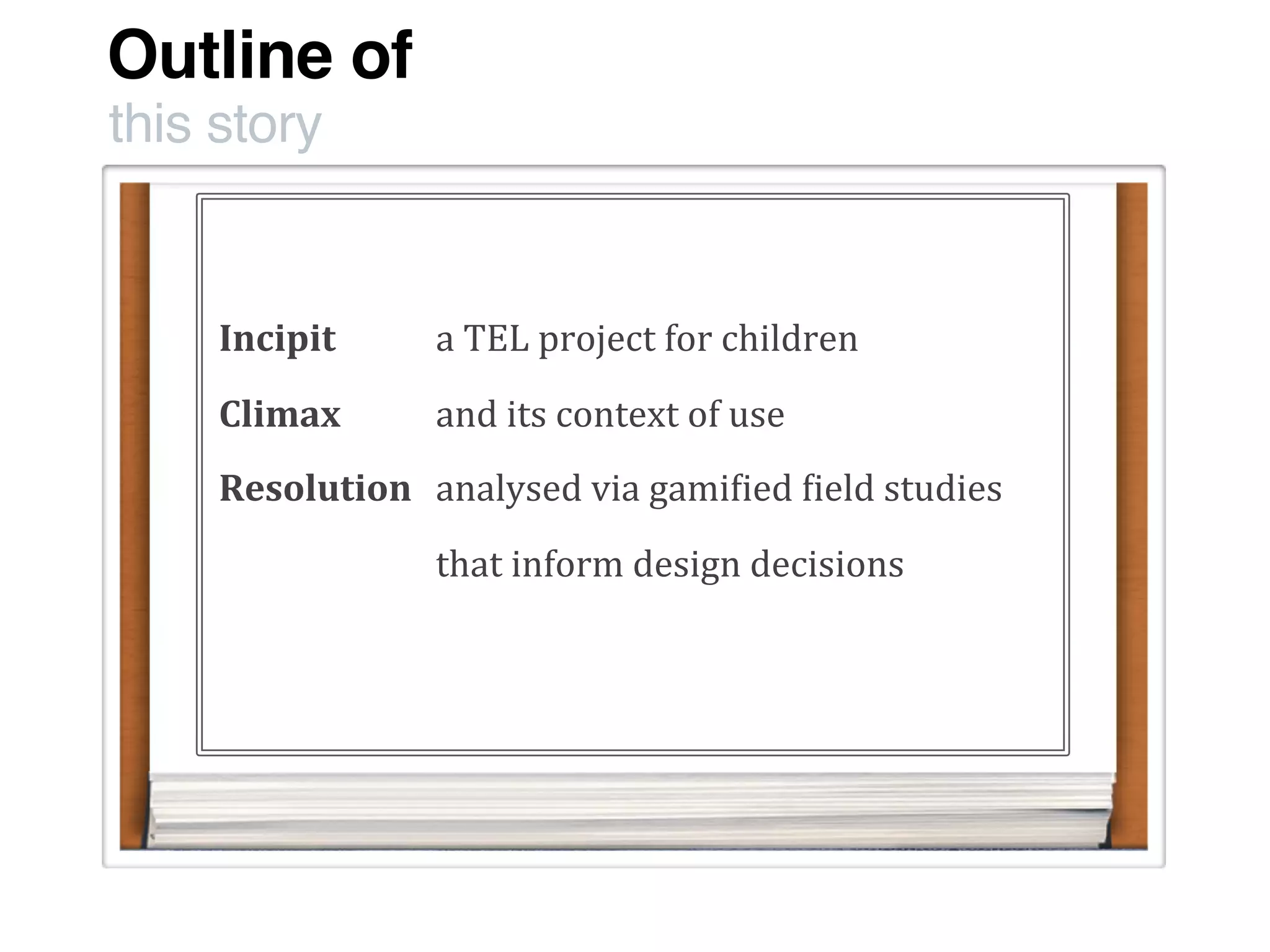
Outline of
this story
Incipit
Climax
Resolution
a	
  TEL	
  project	
  for	
  children
and	
  its	
  context	
  of	
  use
analysed	
  via	
  gami:ied	
  :ield	
  studies
that	
  inform	
  design	
  decisions	
  
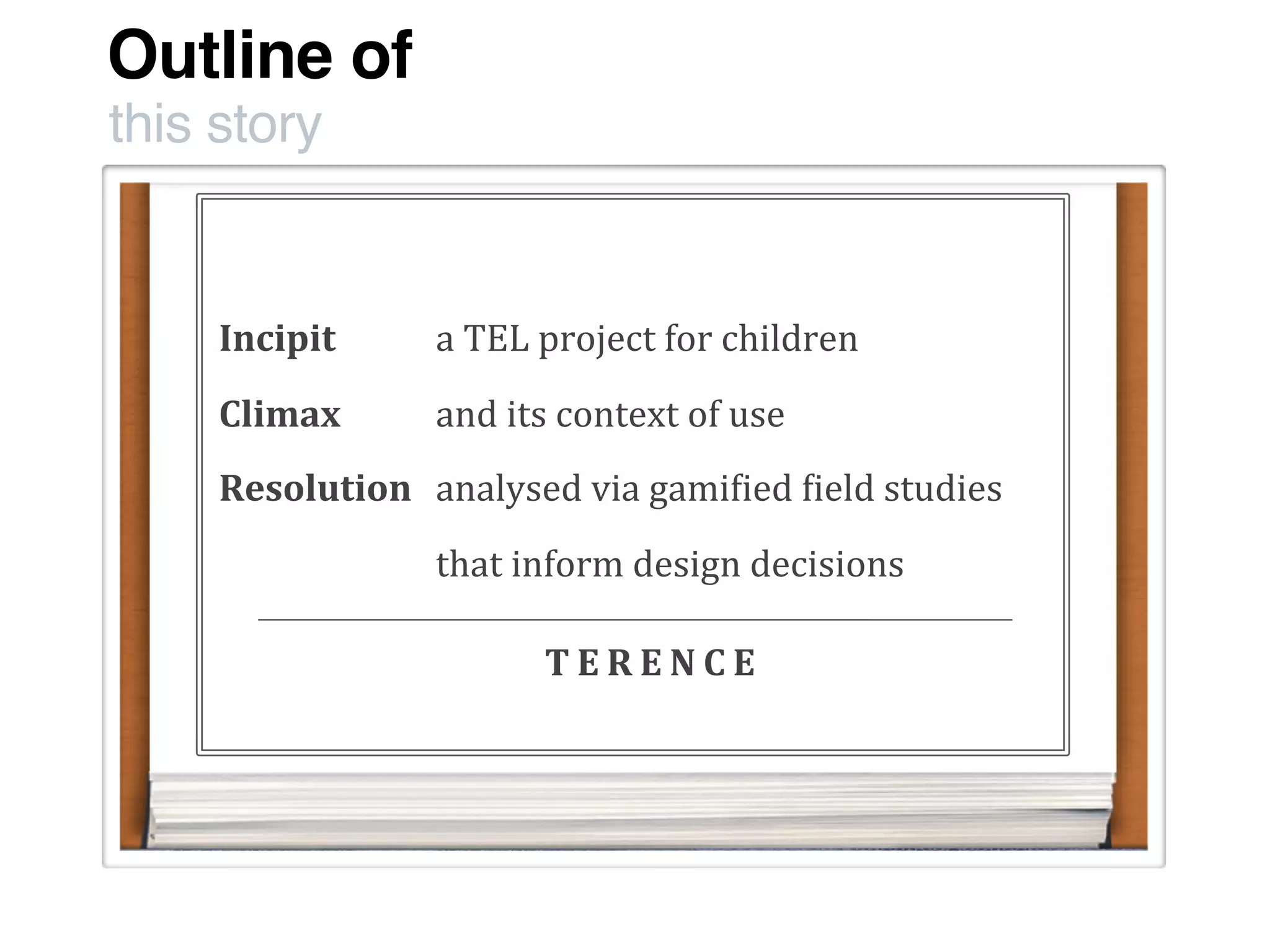
Outline of
this story
Incipit
Climax
Resolution
a	
  TEL	
  project	
  for	
  children
and	
  its	
  context	
  of	
  use
analysed	
  via	
  gami:ied	
  :ield	
  studies
that	
  inform	
  design	
  decisions	
  
T E R E N C E
Outline of
this story
Incipit
Climax
Resolution
a	
  TEL	
  project	
  for	
  children
and	
  its	
  context	
  of	
  use
analysed	
  via	
  gami:ied	
  :ield	
  studies
that	
  inform	
  design	
  decisions	
  
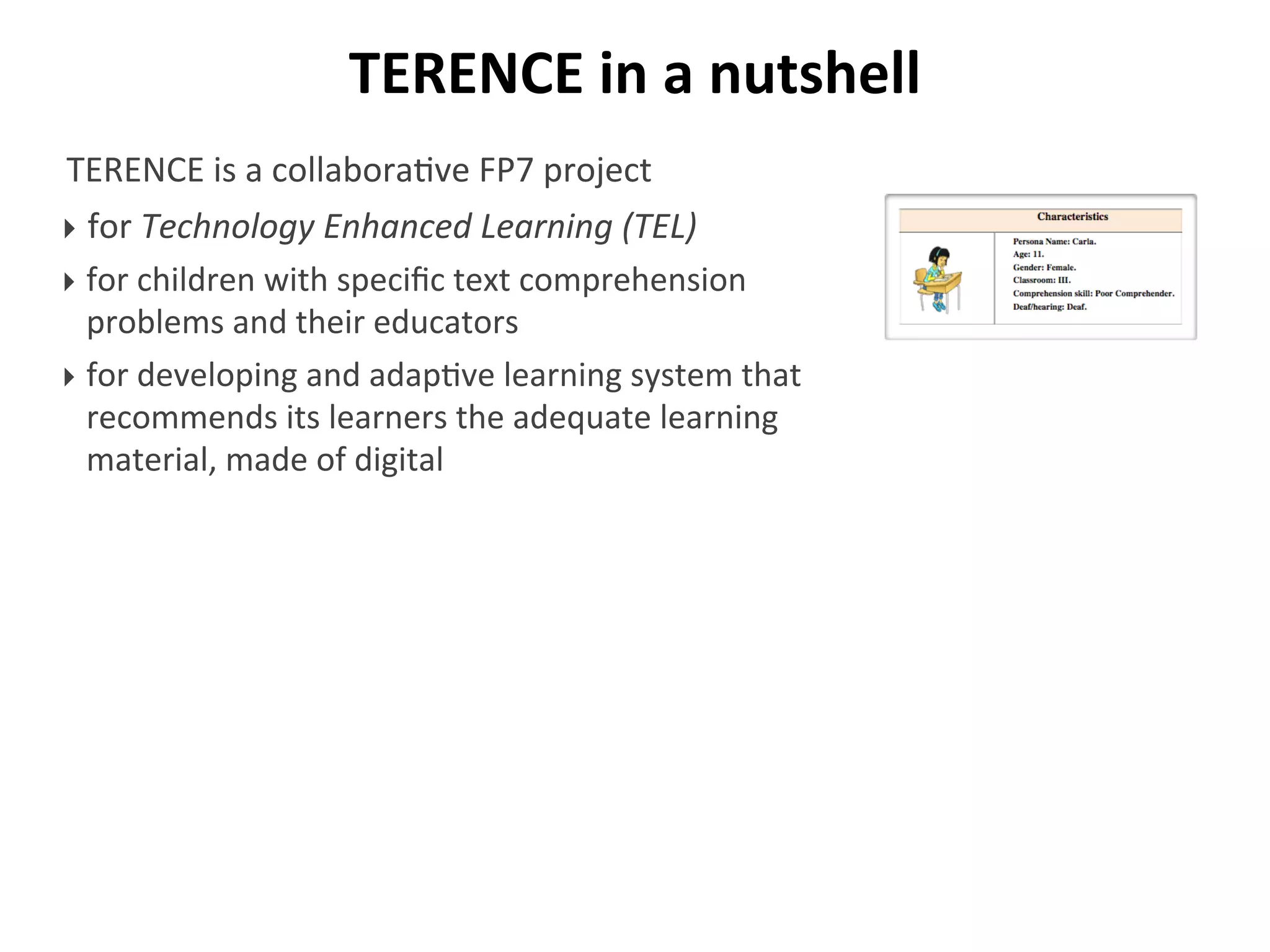
TERENCE	
  in	
  a	
  nutshell
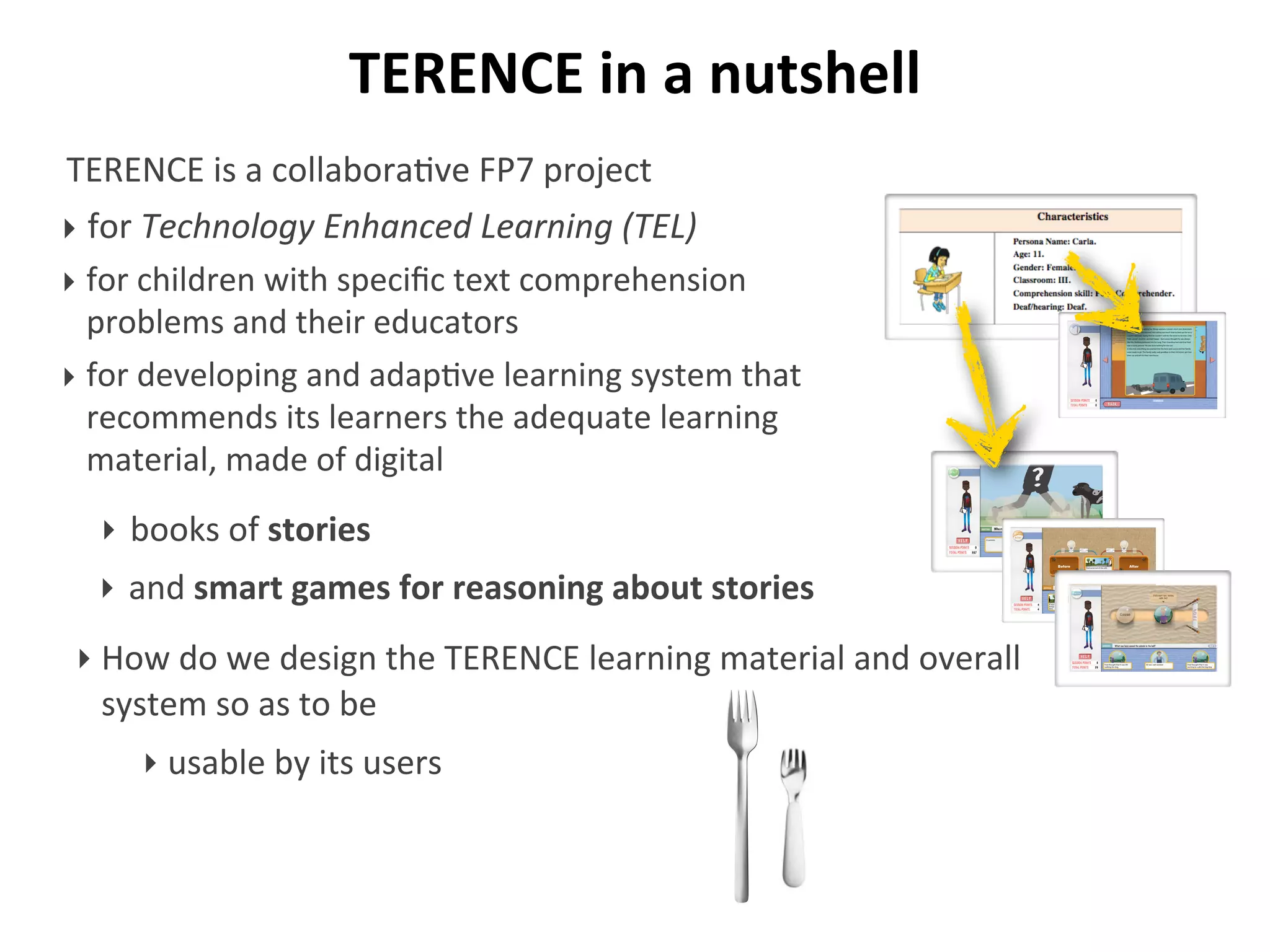
TERENCE	
  is	
  a	
  collabora/ve	
  FP7	
  project	
  
‣ for	
  Technology	
  Enhanced	
  Learning	
  (TEL)
‣ for	
  children	
  with	
  specific	
  text	
  comprehension	
  
problems	
  and	
  their	
  educators
‣ for	
  developing	
  and	
  adap/ve	
  learning	
  system	
  that	
  
recommends	
  its	
  learners	
  the	
  adequate	
  learning	
  
material,	
  made	
  of	
  digital
TERENCE	
  in	
  a	
  nutshell
TERENCE	
  is	
  a	
  collabora/ve	
  FP7	
  project	
  
‣ for	
  Technology	
  Enhanced	
  Learning	
  (TEL)
‣ for	
  children	
  with	
  specific	
  text	
  comprehension	
  
problems	
  and	
  their	
  educators
‣ for	
  developing	
  and	
  adap/ve	
  learning	
  system	
  that	
  
recommends	
  its	
  learners	
  the	
  adequate	
  learning	
  
material,	
  made	
  of	
  digital
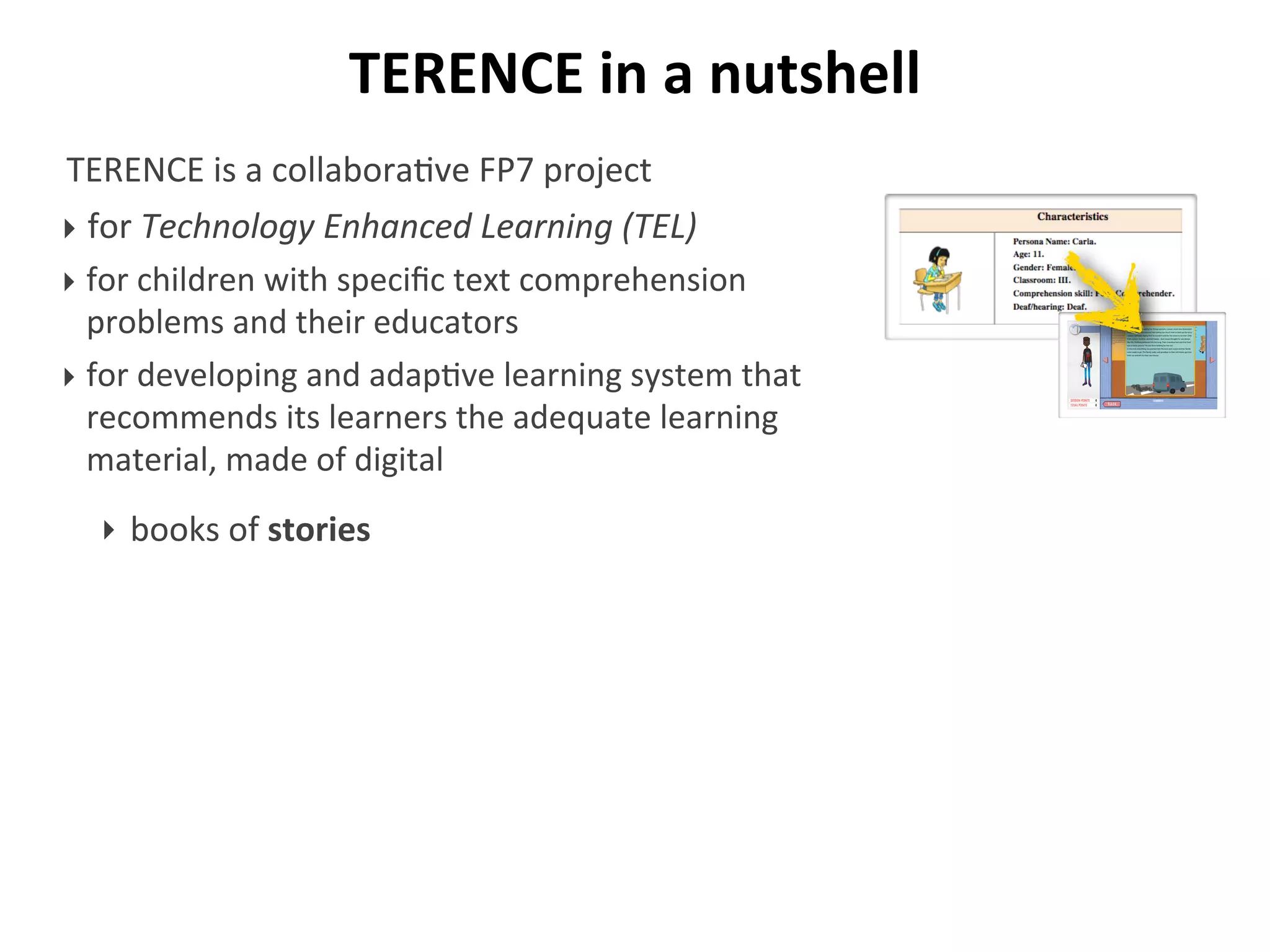
‣ books	
  of	
  stories
TERENCE	
  in	
  a	
  nutshell
TERENCE	
  is	
  a	
  collabora/ve	
  FP7	
  project	
  
‣ for	
  Technology	
  Enhanced	
  Learning	
  (TEL)
‣ for	
  children	
  with	
  specific	
  text	
  comprehension	
  
problems	
  and	
  their	
  educators
‣ for	
  developing	
  and	
  adap/ve	
  learning	
  system	
  that	
  
recommends	
  its	
  learners	
  the	
  adequate	
  learning	
  
material,	
  made	
  of	
  digital
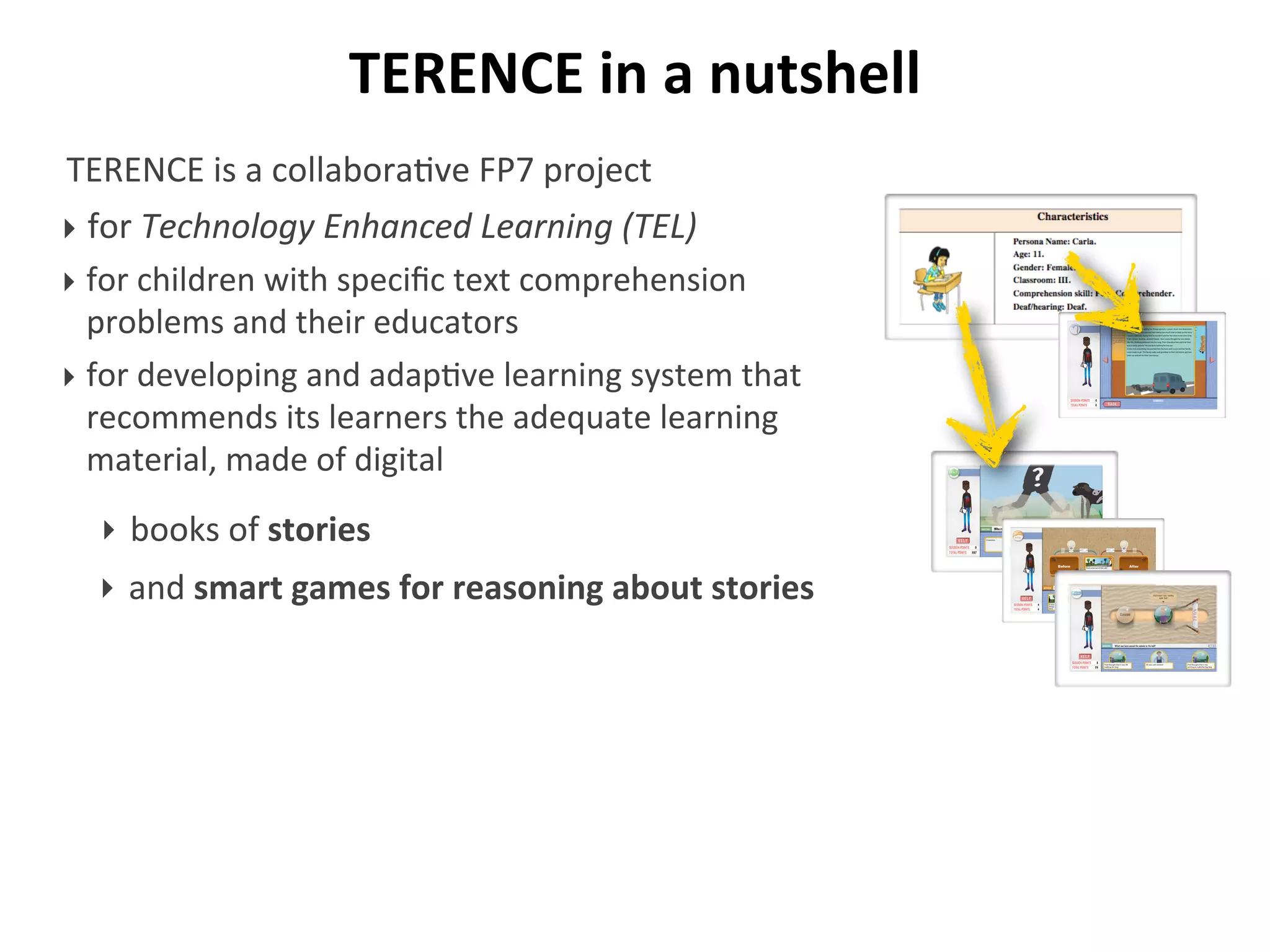
Who runs fast?
‣ books	
  of	
  stories
‣ and	
  smart	
  games	
  for	
  reasoning	
  about	
  stories
TERENCE	
  in	
  a	
  nutshell
TERENCE	
  is	
  a	
  collabora/ve	
  FP7	
  project	
  
‣ for	
  Technology	
  Enhanced	
  Learning	
  (TEL)
‣ for	
  children	
  with	
  specific	
  text	
  comprehension	
  
problems	
  and	
  their	
  educators
‣ for	
  developing	
  and	
  adap/ve	
  learning	
  system	
  that	
  
recommends	
  its	
  learners	
  the	
  adequate	
  learning	
  
material,	
  made	
  of	
  digital
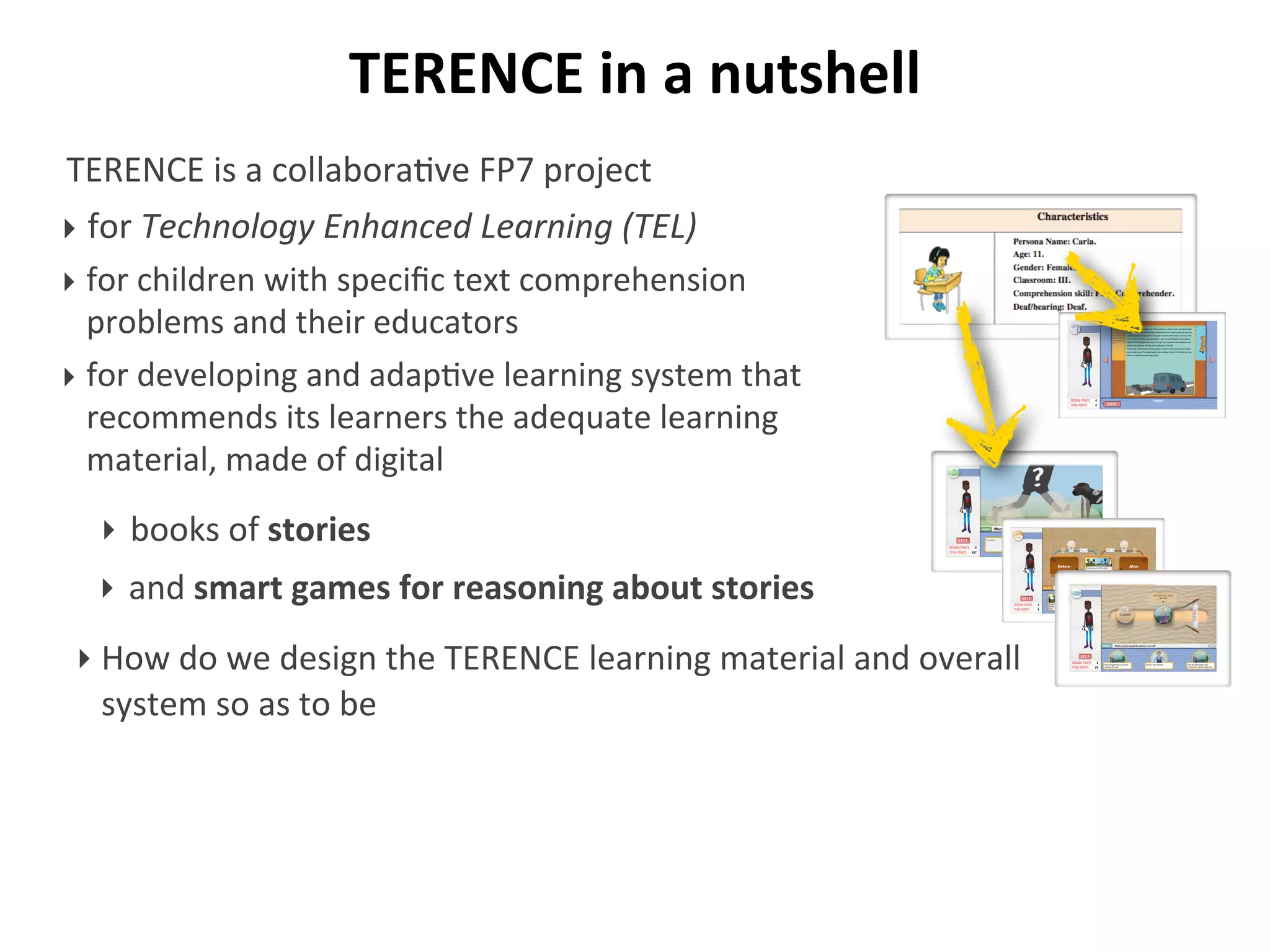
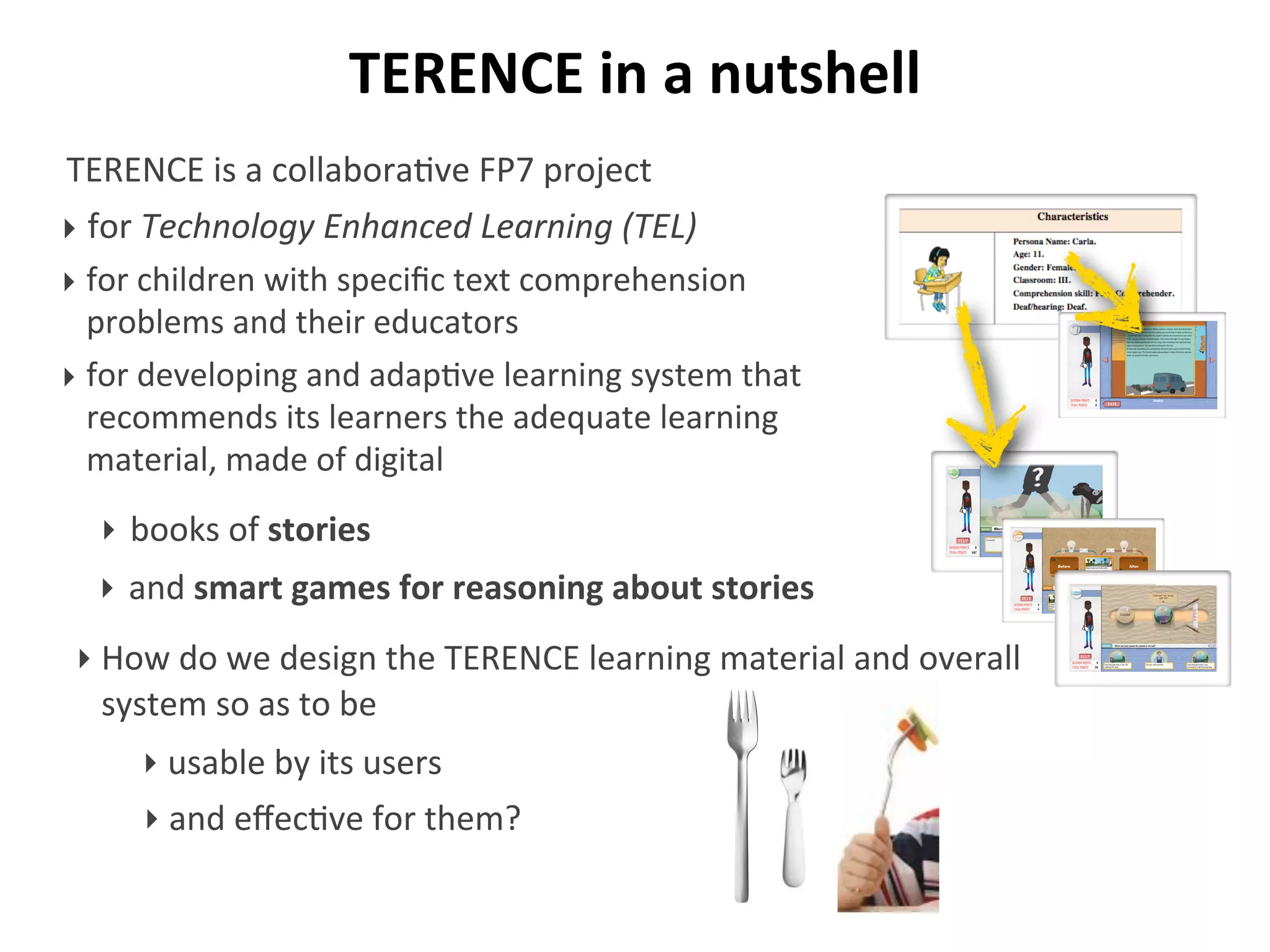
‣ How	
  do	
  we	
  design	
  the	
  TERENCE	
  learning	
  material	
  and	
  overall	
  
system	
  so	
  as	
  to	
  be
Who runs fast?
‣ books	
  of	
  stories
‣ and	
  smart	
  games	
  for	
  reasoning	
  about	
  stories
TERENCE	
  in	
  a	
  nutshell
TERENCE	
  is	
  a	
  collabora/ve	
  FP7	
  project	
  
‣ for	
  Technology	
  Enhanced	
  Learning	
  (TEL)
‣ for	
  children	
  with	
  specific	
  text	
  comprehension	
  
problems	
  and	
  their	
  educators
‣ for	
  developing	
  and	
  adap/ve	
  learning	
  system	
  that	
  
recommends	
  its	
  learners	
  the	
  adequate	
  learning	
  
material,	
  made	
  of	
  digital
‣ How	
  do	
  we	
  design	
  the	
  TERENCE	
  learning	
  material	
  and	
  overall	
  
system	
  so	
  as	
  to	
  be
Who runs fast?
‣ books	
  of	
  stories
‣ and	
  smart	
  games	
  for	
  reasoning	
  about	
  stories
‣ usable	
  by	
  its	
  users
TERENCE	
  in	
  a	
  nutshell
TERENCE	
  is	
  a	
  collabora/ve	
  FP7	
  project	
  
‣ for	
  Technology	
  Enhanced	
  Learning	
  (TEL)
‣ for	
  children	
  with	
  specific	
  text	
  comprehension	
  
problems	
  and	
  their	
  educators
‣ for	
  developing	
  and	
  adap/ve	
  learning	
  system	
  that	
  
recommends	
  its	
  learners	
  the	
  adequate	
  learning	
  
material,	
  made	
  of	
  digital
‣ How	
  do	
  we	
  design	
  the	
  TERENCE	
  learning	
  material	
  and	
  overall	
  
system	
  so	
  as	
  to	
  be
Who runs fast?
‣ books	
  of	
  stories
‣ and	
  smart	
  games	
  for	
  reasoning	
  about	
  stories
‣ and	
  effec>ve	
  for	
  them?
‣ usable	
  by	
  its	
  users
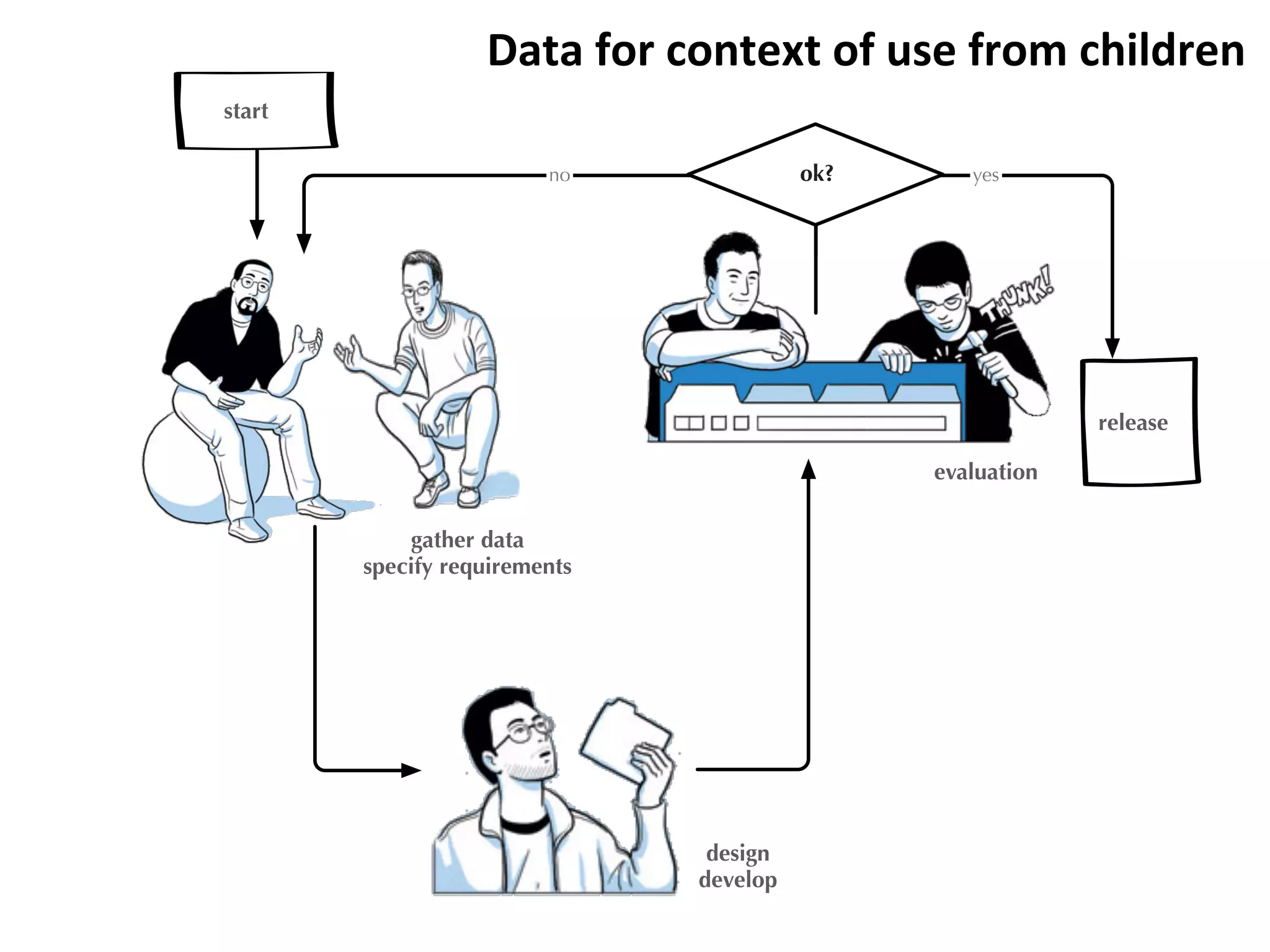
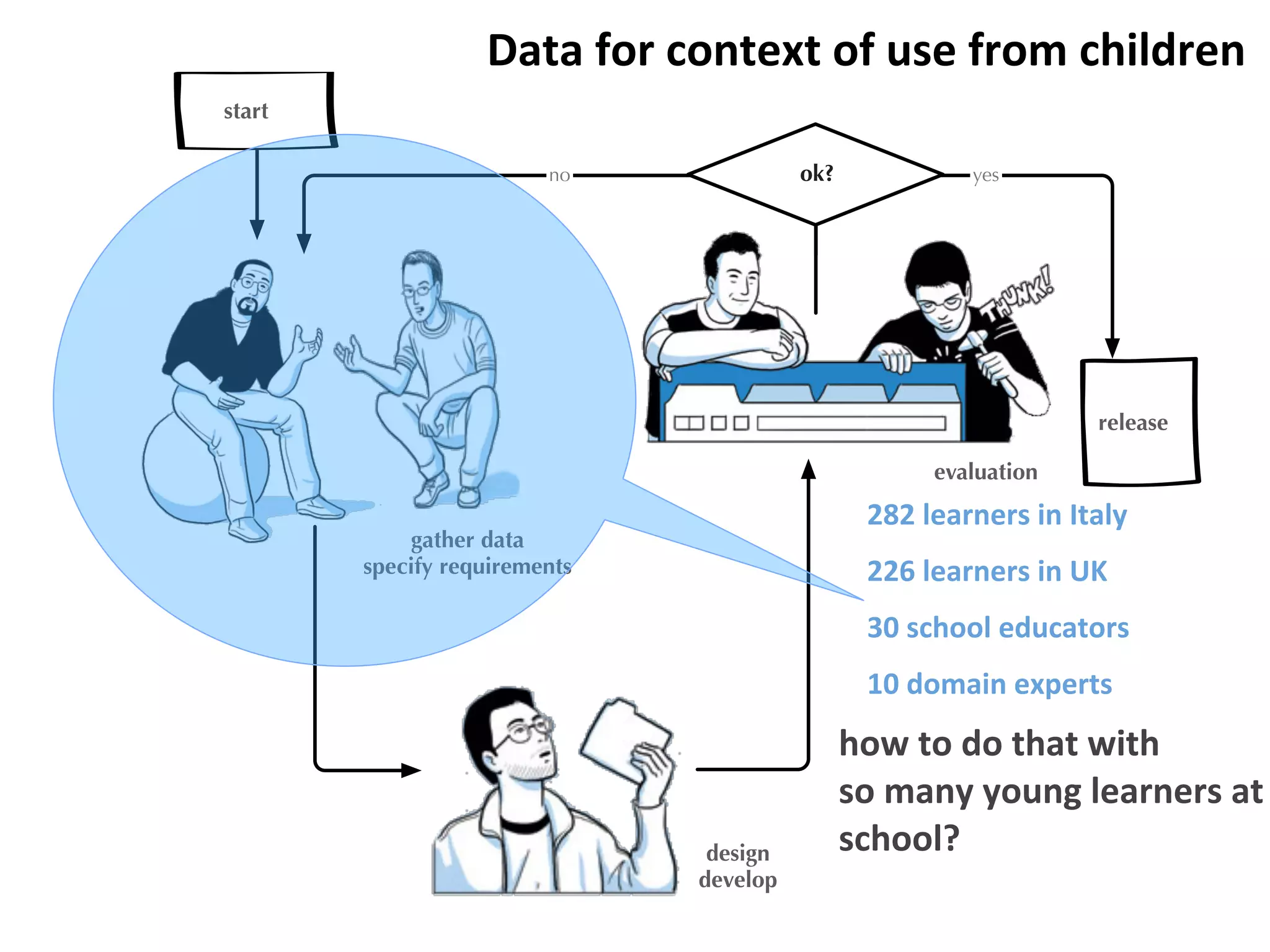
Data	
  for	
  context	
  of	
  use	
  from	
  children
start
no
release
yesok?
gather data
specify requirements
design
develop
evaluation
Data	
  for	
  context	
  of	
  use	
  from	
  children
start
no
release
yesok?
gather data
specify requirements
design
develop
evaluation
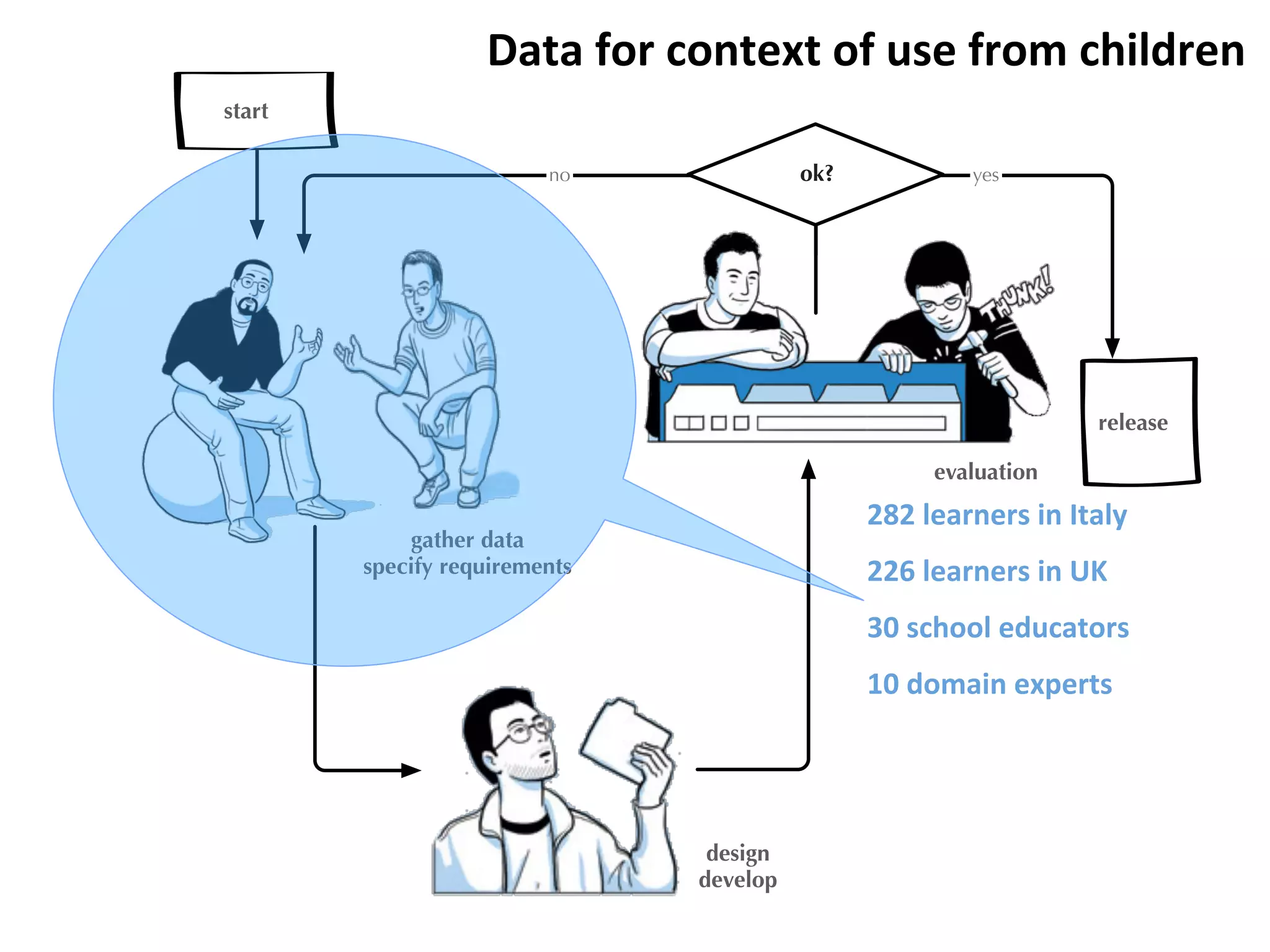
282	
  learners	
  in	
  Italy
226	
  learners	
  in	
  UK
30	
  school	
  educators
10	
  domain	
  experts
Data	
  for	
  context	
  of	
  use	
  from	
  children
start
no
release
yesok?
gather data
specify requirements
design
develop
evaluation
282	
  learners	
  in	
  Italy
226	
  learners	
  in	
  UK
30	
  school	
  educators
10	
  domain	
  experts
how	
  to	
  do	
  that	
  with	
  
so	
  many	
  young	
  learners	
  at	
  
school?
Outline of
this story
Incipit
Climax
Resolution
a	
  TEL	
  project	
  for	
  children
and	
  its	
  context	
  of	
  use
analysed	
  via	
  gami:ied	
  :ield	
  studies
that	
  inform	
  design	
  decisions	
  
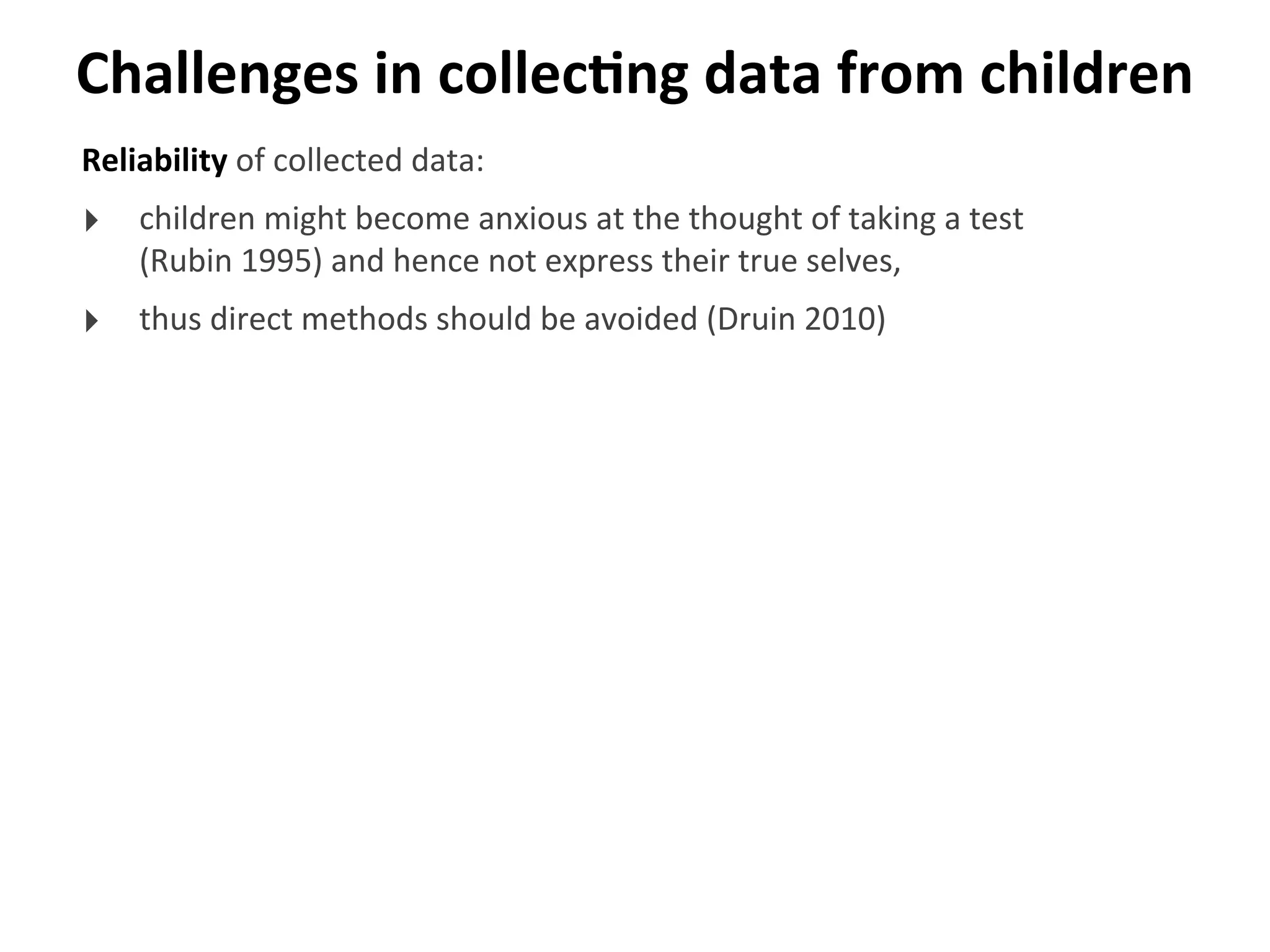
Challenges	
  in	
  collecGng	
  data	
  from	
  children
Reliability	
  of	
  collected	
  data:
‣ children	
  might	
  become	
  anxious	
  at	
  the	
  thought	
  of	
  taking	
  a	
  test	
  
(Rubin	
  1995)	
  and	
  hence	
  not	
  express	
  their	
  true	
  selves,	
  
‣ thus	
  direct	
  methods	
  should	
  be	
  avoided	
  (Druin	
  2010)
Challenges	
  in	
  collecGng	
  data	
  from	
  children
Reliability	
  of	
  collected	
  data:
‣ children	
  might	
  become	
  anxious	
  at	
  the	
  thought	
  of	
  taking	
  a	
  test	
  
(Rubin	
  1995)	
  and	
  hence	
  not	
  express	
  their	
  true	
  selves,	
  
‣ thus	
  direct	
  methods	
  should	
  be	
  avoided	
  (Druin	
  2010)
Drop-­‐outs	
  easily	
  occur	
  ‘cause	
  for	
  children	
  (Chiasson	
  and	
  Gutwin	
  2005)
‣ “mo>va>on	
  and	
  engagement	
  are	
  [...]	
  important”
‣ “children	
  [need]	
  to	
  see	
  the	
  results	
  of	
  their	
  ac>ons	
  immediately”
Challenges	
  in	
  collecGng	
  data	
  from	
  children
Reliability	
  of	
  collected	
  data:
‣ children	
  might	
  become	
  anxious	
  at	
  the	
  thought	
  of	
  taking	
  a	
  test	
  
(Rubin	
  1995)	
  and	
  hence	
  not	
  express	
  their	
  true	
  selves,	
  
‣ thus	
  direct	
  methods	
  should	
  be	
  avoided	
  (Druin	
  2010)
Drop-­‐outs	
  easily	
  occur	
  ‘cause	
  for	
  children	
  (Chiasson	
  and	
  Gutwin	
  2005)
‣ “mo>va>on	
  and	
  engagement	
  are	
  [...]	
  important”
‣ “children	
  [need]	
  to	
  see	
  the	
  results	
  of	
  their	
  ac>ons	
  immediately”
School/environment	
  constraints:	
  ac>vi>es	
  should
‣ involve	
  an	
  en>re	
  class,
‣ respect	
  school	
  >me-­‐tables,	
  e.g.,	
  each	
  session	
  should	
  last	
  no	
  longer	
  
than	
  2	
  hours
Outline of
this story
Incipit
Climax
Resolution
a	
  TEL	
  project	
  for	
  children
and	
  its	
  context	
  of	
  use
analysed	
  via	
  gami:ied	
  :ield	
  studies
that	
  inform	
  design	
  decisions	
  
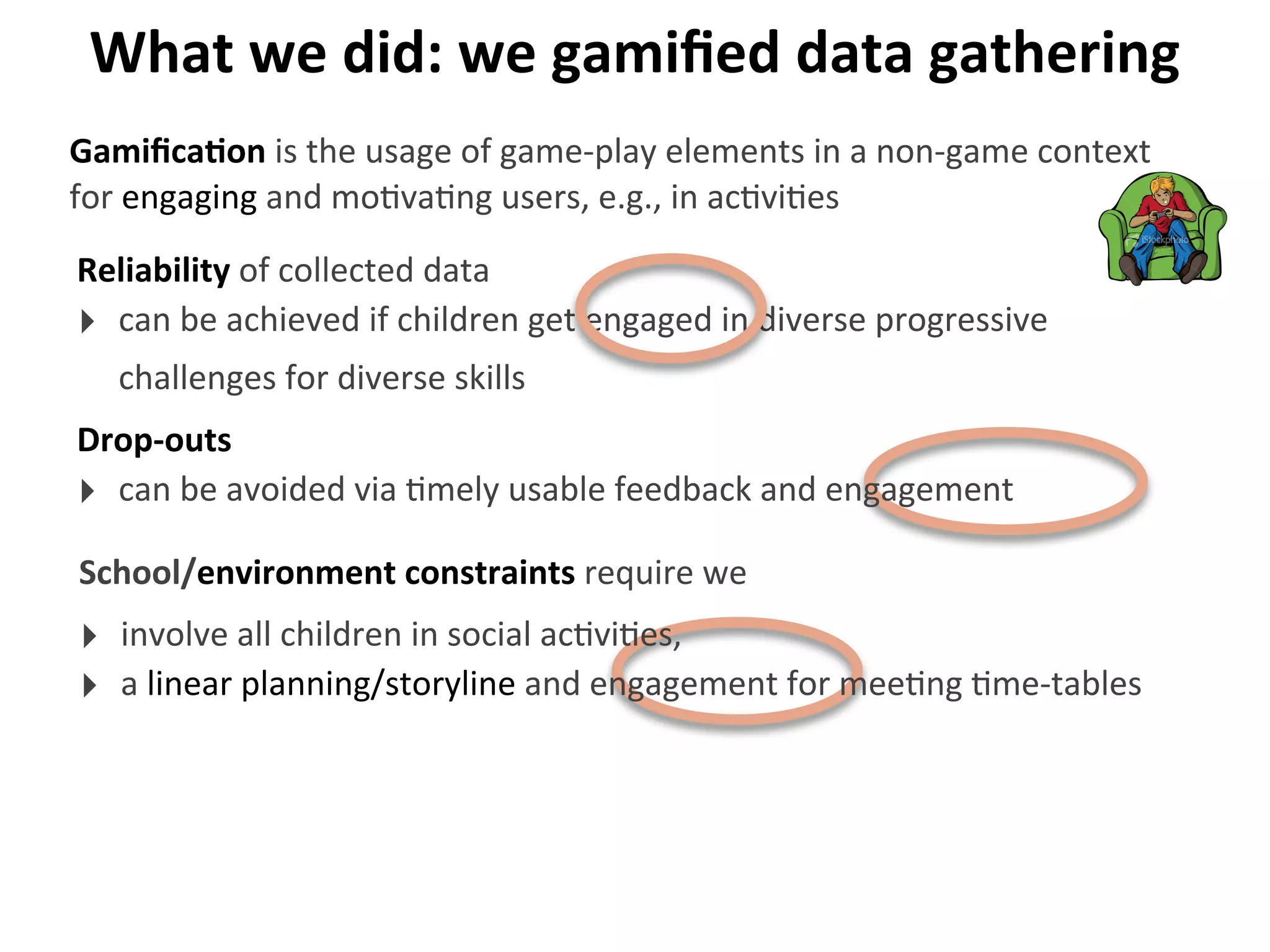
What	
  we	
  did:	
  we	
  gamified	
  data	
  gathering
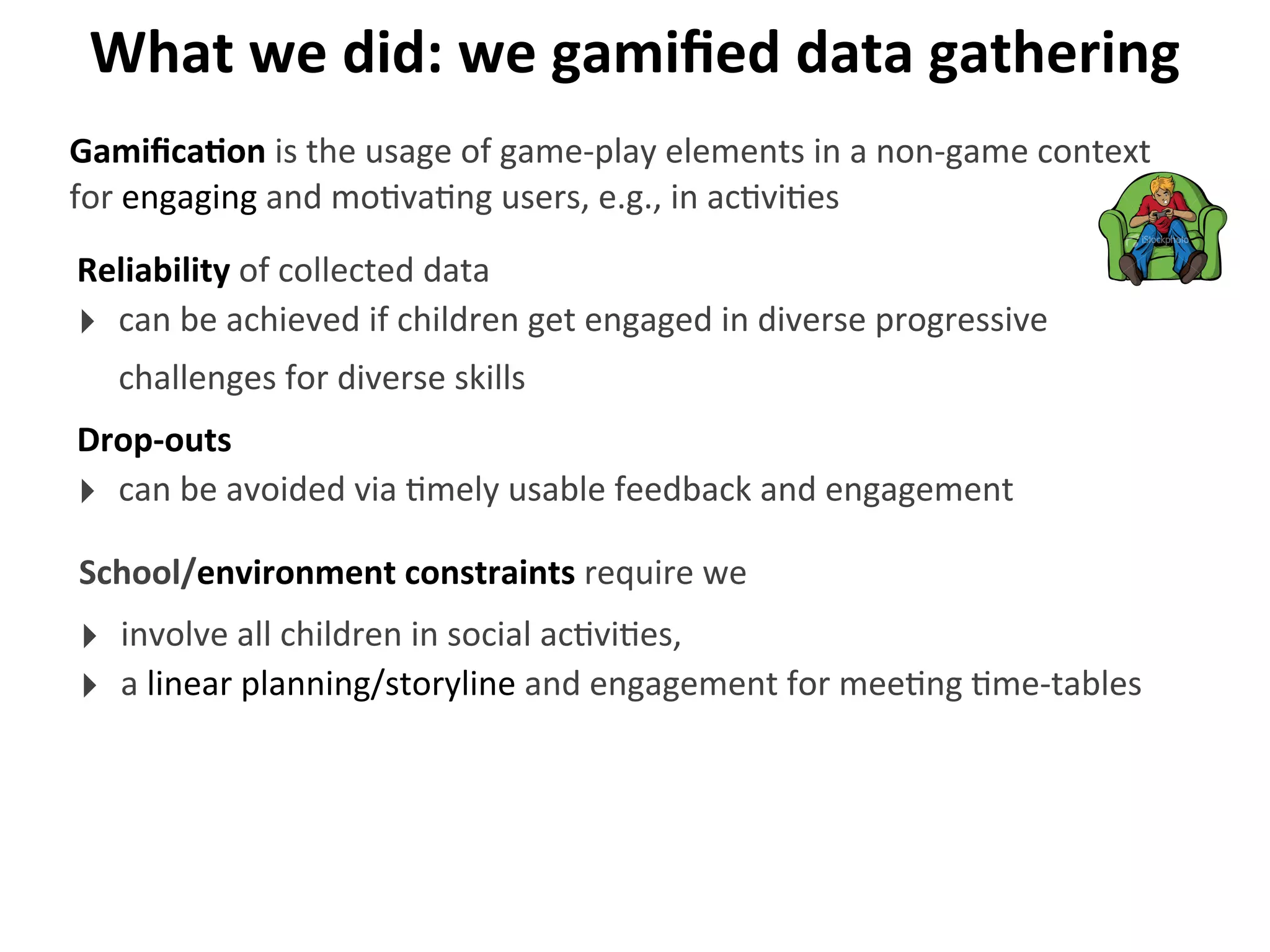
GamificaGon	
  is	
  the	
  usage	
  of	
  game-­‐play	
  elements	
  in	
  a	
  non-­‐game	
  context	
  
for	
  engaging	
  and	
  mo>va>ng	
  users,	
  e.g.,	
  in	
  ac>vi>es
What	
  we	
  did:	
  we	
  gamified	
  data	
  gathering
Reliability	
  of	
  collected	
  data
‣ can	
  be	
  achieved	
  if	
  children	
  get	
  engaged	
  in	
  diverse	
  progressive	
  
challenges	
  for	
  diverse	
  skills
GamificaGon	
  is	
  the	
  usage	
  of	
  game-­‐play	
  elements	
  in	
  a	
  non-­‐game	
  context	
  
for	
  engaging	
  and	
  mo>va>ng	
  users,	
  e.g.,	
  in	
  ac>vi>es
What	
  we	
  did:	
  we	
  gamified	
  data	
  gathering
Reliability	
  of	
  collected	
  data
‣ can	
  be	
  achieved	
  if	
  children	
  get	
  engaged	
  in	
  diverse	
  progressive	
  
challenges	
  for	
  diverse	
  skills
GamificaGon	
  is	
  the	
  usage	
  of	
  game-­‐play	
  elements	
  in	
  a	
  non-­‐game	
  context	
  
for	
  engaging	
  and	
  mo>va>ng	
  users,	
  e.g.,	
  in	
  ac>vi>es
Drop-­‐outs
‣ can	
  be	
  avoided	
  via	
  >mely	
  usable	
  feedback	
  and	
  engagement
What	
  we	
  did:	
  we	
  gamified	
  data	
  gathering
Reliability	
  of	
  collected	
  data
‣ can	
  be	
  achieved	
  if	
  children	
  get	
  engaged	
  in	
  diverse	
  progressive	
  
challenges	
  for	
  diverse	
  skills
GamificaGon	
  is	
  the	
  usage	
  of	
  game-­‐play	
  elements	
  in	
  a	
  non-­‐game	
  context	
  
for	
  engaging	
  and	
  mo>va>ng	
  users,	
  e.g.,	
  in	
  ac>vi>es
Drop-­‐outs
‣ can	
  be	
  avoided	
  via	
  >mely	
  usable	
  feedback	
  and	
  engagement
School/environment	
  constraints	
  require	
  we
‣ involve	
  all	
  children	
  in	
  social	
  ac>vi>es,
‣ a	
  linear	
  planning/storyline	
  and	
  engagement	
  for	
  mee>ng	
  >me-­‐tables
What	
  we	
  did:	
  we	
  gamified	
  data	
  gathering
Reliability	
  of	
  collected	
  data
‣ can	
  be	
  achieved	
  if	
  children	
  get	
  engaged	
  in	
  diverse	
  progressive	
  
challenges	
  for	
  diverse	
  skills
GamificaGon	
  is	
  the	
  usage	
  of	
  game-­‐play	
  elements	
  in	
  a	
  non-­‐game	
  context	
  
for	
  engaging	
  and	
  mo>va>ng	
  users,	
  e.g.,	
  in	
  ac>vi>es
Drop-­‐outs
‣ can	
  be	
  avoided	
  via	
  >mely	
  usable	
  feedback	
  and	
  engagement
School/environment	
  constraints	
  require	
  we
‣ involve	
  all	
  children	
  in	
  social	
  ac>vi>es,
‣ a	
  linear	
  planning/storyline	
  and	
  engagement	
  for	
  mee>ng	
  >me-­‐tables
What	
  we	
  did:	
  we	
  gamified	
  data	
  gathering
Reliability	
  of	
  collected	
  data
‣ can	
  be	
  achieved	
  if	
  children	
  get	
  engaged	
  in	
  diverse	
  progressive	
  
challenges	
  for	
  diverse	
  skills
GamificaGon	
  is	
  the	
  usage	
  of	
  game-­‐play	
  elements	
  in	
  a	
  non-­‐game	
  context	
  
for	
  engaging	
  and	
  mo>va>ng	
  users,	
  e.g.,	
  in	
  ac>vi>es
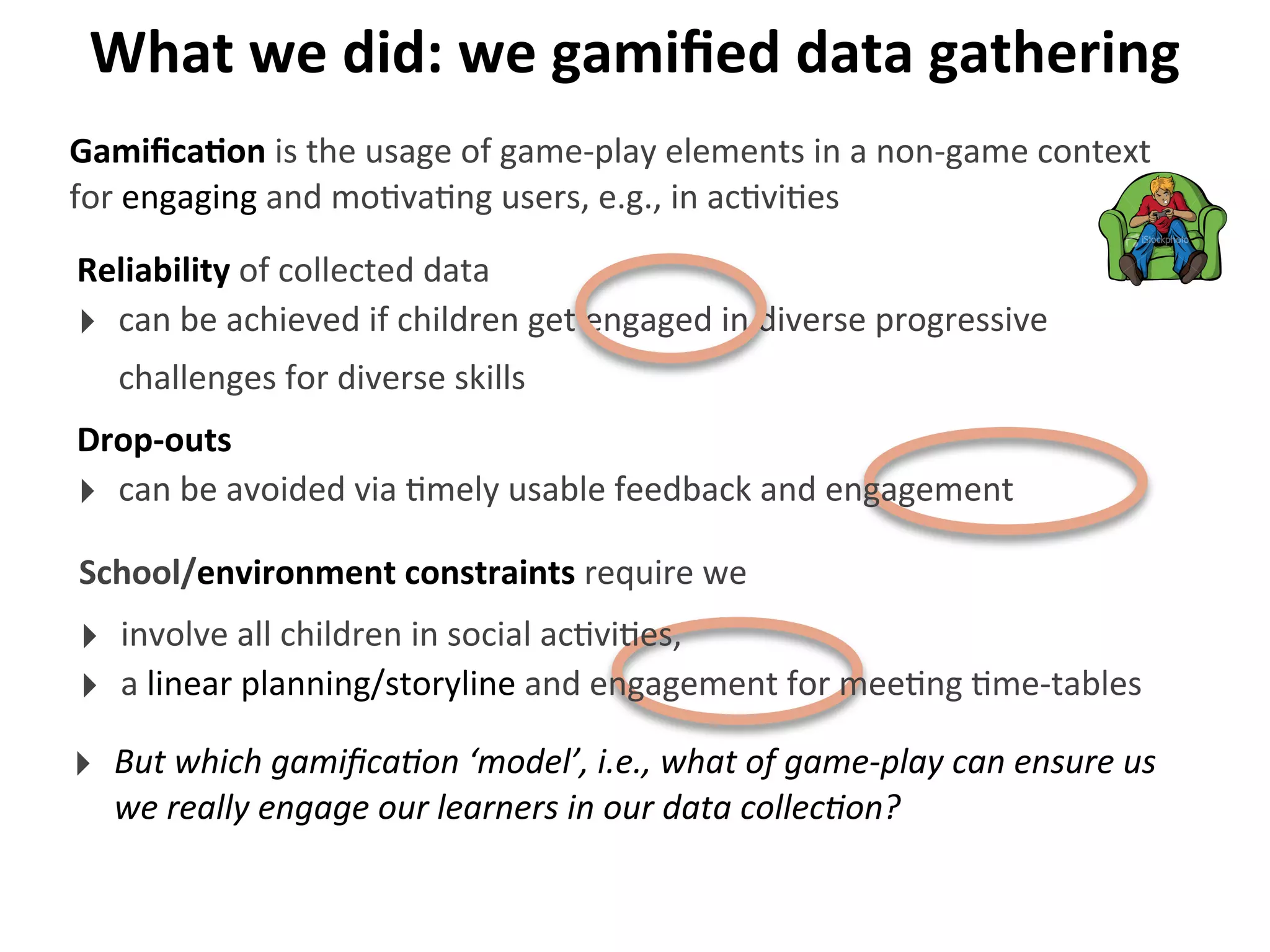
‣ But	
  which	
  gamifica9on	
  ‘model’,	
  i.e.,	
  what	
  of	
  game-­‐play	
  can	
  ensure	
  us	
  
we	
  really	
  engage	
  our	
  learners	
  in	
  our	
  data	
  collec9on?
Drop-­‐outs
‣ can	
  be	
  avoided	
  via	
  >mely	
  usable	
  feedback	
  and	
  engagement
School/environment	
  constraints	
  require	
  we
‣ involve	
  all	
  children	
  in	
  social	
  ac>vi>es,
‣ a	
  linear	
  planning/storyline	
  and	
  engagement	
  for	
  mee>ng	
  >me-­‐tables
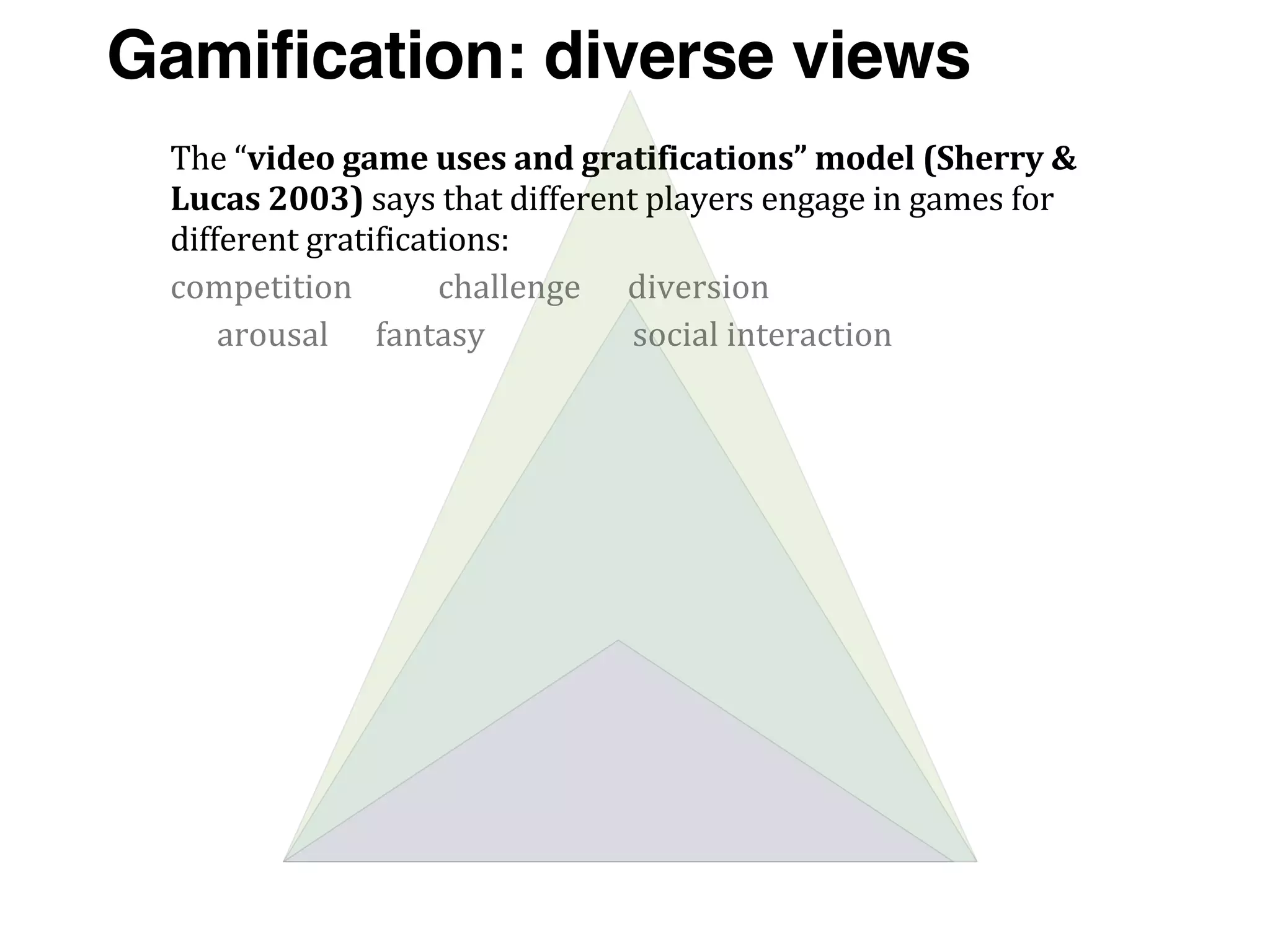
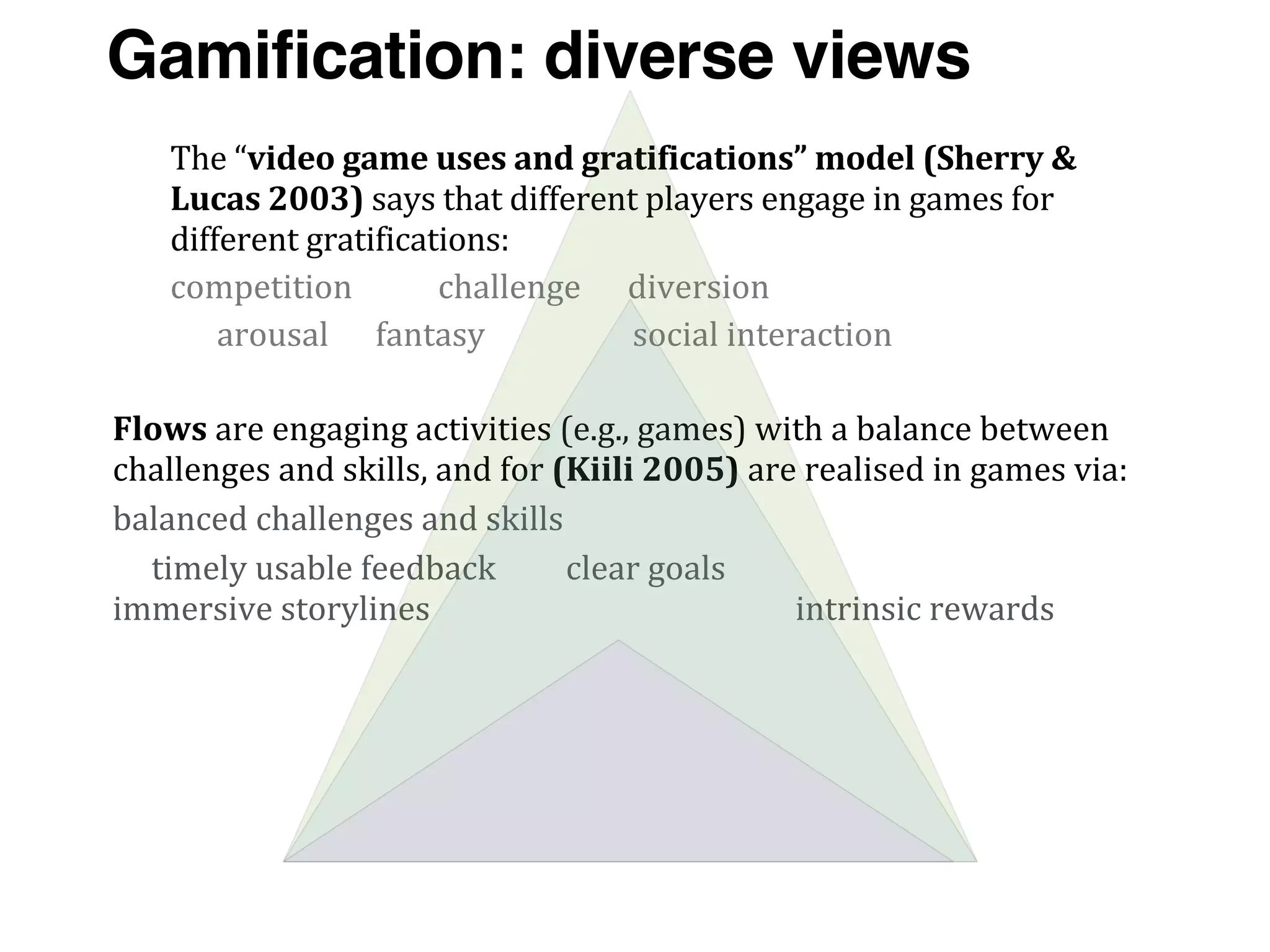
Gamification: diverse views
The	
  “video	
  game	
  uses	
  and	
  gratifications”	
  model	
  (Sherry	
  &	
  
Lucas	
  2003)	
  says	
  that	
  different	
  players	
  engage	
  in	
  games	
  for	
  
different	
  gratifications:	
  
competition	


  challenge	


  diversion


  arousal	


  fantasy	


  social	
  interaction
Gamification: diverse views
Flows	
  are	
  engaging	
  activities	
  (e.g.,	
  games)	
  with	
  a	
  balance	
  between	
  
challenges	
  and	
  skills,	
  and	
  for	
  (Kiili	
  2005)	
  are	
  realised	
  in	
  games	
  via:
balanced	
  challenges	
  and	
  skills


  timely	
  usable	
  feedback	


  clear	
  goals	


immersive	
  storylines	


  intrinsic	
  rewards
The	
  “video	
  game	
  uses	
  and	
  gratifications”	
  model	
  (Sherry	
  &	
  
Lucas	
  2003)	
  says	
  that	
  different	
  players	
  engage	
  in	
  games	
  for	
  
different	
  gratifications:	
  
competition	


  challenge	


  diversion


  arousal	


  fantasy	


  social	
  interaction
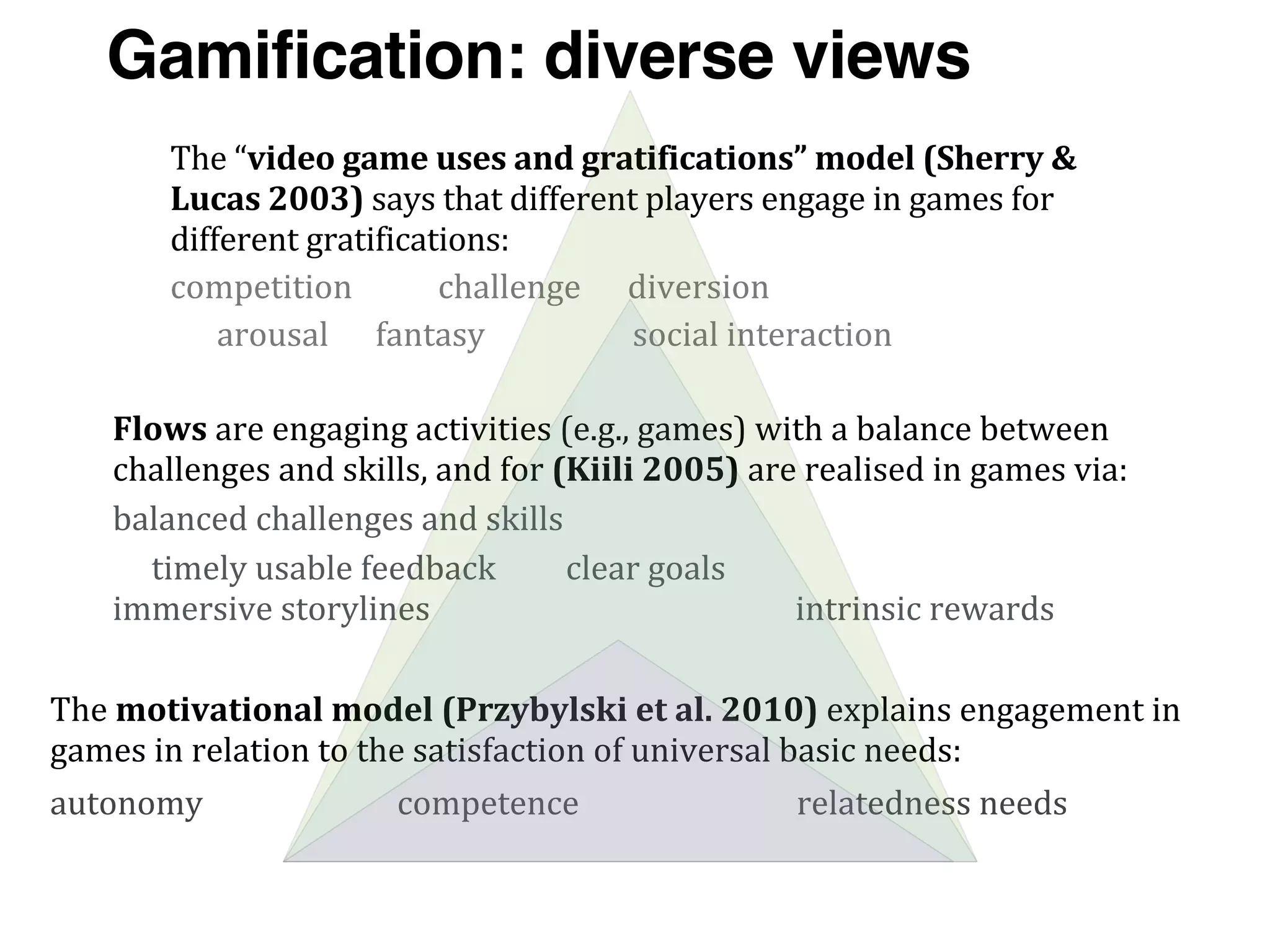
Gamification: diverse views
The	
  motivational	
  model	
  (Przybylski	
  et	
  al.	
  2010)	
  explains	
  engagement	
  in	
  
games	
  in	
  relation	
  to	
  the	
  satisfaction	
  of	
  universal	
  basic	
  needs:
autonomy	


  competence	


  relatedness	
  needs
Flows	
  are	
  engaging	
  activities	
  (e.g.,	
  games)	
  with	
  a	
  balance	
  between	
  
challenges	
  and	
  skills,	
  and	
  for	
  (Kiili	
  2005)	
  are	
  realised	
  in	
  games	
  via:
balanced	
  challenges	
  and	
  skills


  timely	
  usable	
  feedback	


  clear	
  goals	


immersive	
  storylines	


  intrinsic	
  rewards
The	
  “video	
  game	
  uses	
  and	
  gratifications”	
  model	
  (Sherry	
  &	
  
Lucas	
  2003)	
  says	
  that	
  different	
  players	
  engage	
  in	
  games	
  for	
  
different	
  gratifications:	
  
competition	


  challenge	


  diversion


  arousal	


  fantasy	


  social	
  interaction
Gamification: diverse views
Which	
  are	
  the	
  preferred	
  avatars?Which	
  are	
  the	
  preferred	
  avatars?
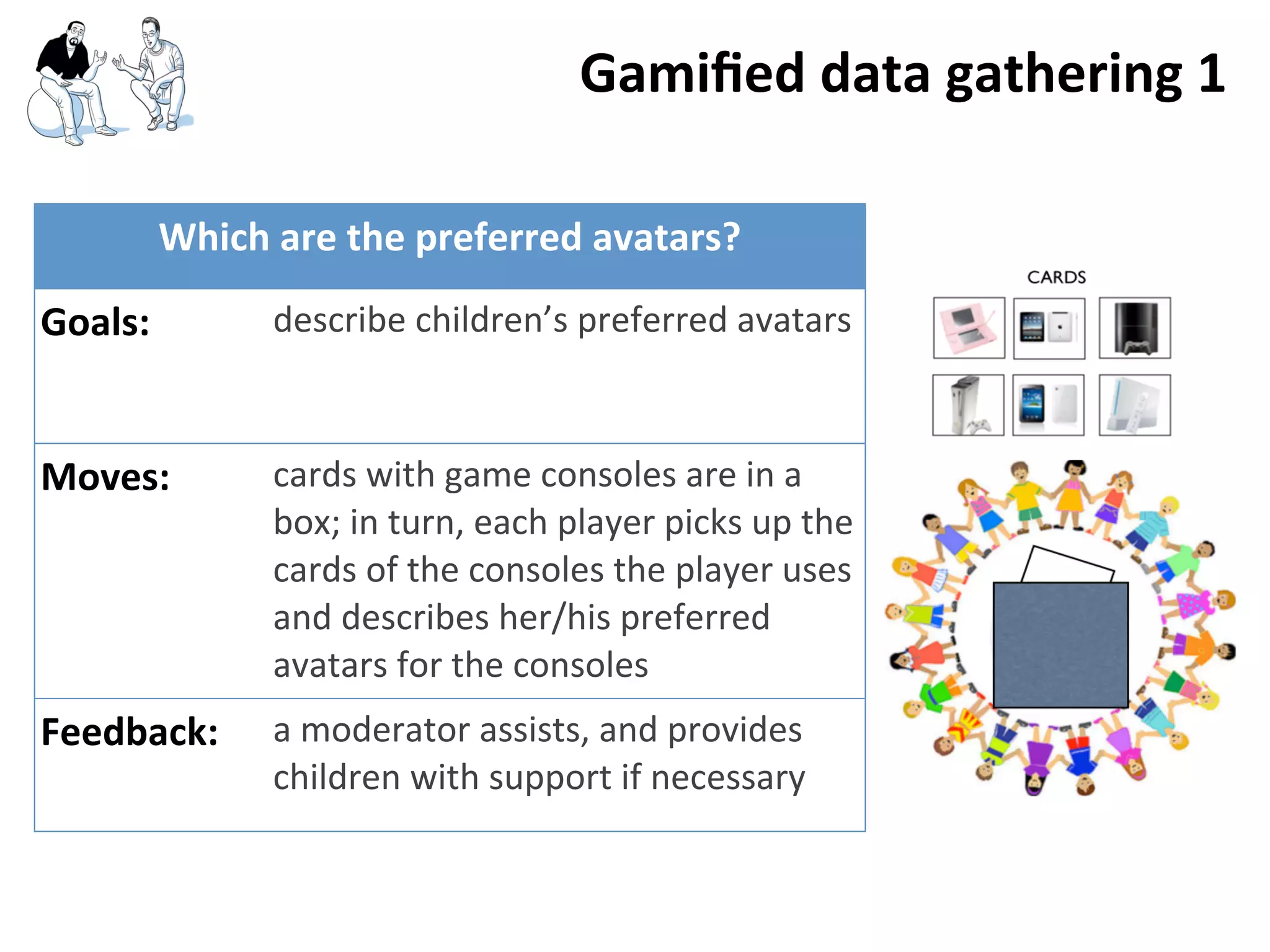
Goals: describe	
  children’s	
  preferred	
  avatars
Moves: cards	
  with	
  game	
  consoles	
  are	
  in	
  a	
  
box;	
  in	
  turn,	
  each	
  player	
  picks	
  up	
  the	
  
cards	
  of	
  the	
  consoles	
  the	
  player	
  uses	
  
and	
  describes	
  her/his	
  preferred	
  
avatars	
  for	
  the	
  consoles
Feedback: a	
  moderator	
  assists,	
  and	
  provides	
  
children	
  with	
  support	
  if	
  necessary	
  
Gamified	
  data	
  gathering	
  1
Which	
  are	
  the	
  preferred	
  avatars?Which	
  are	
  the	
  preferred	
  avatars?
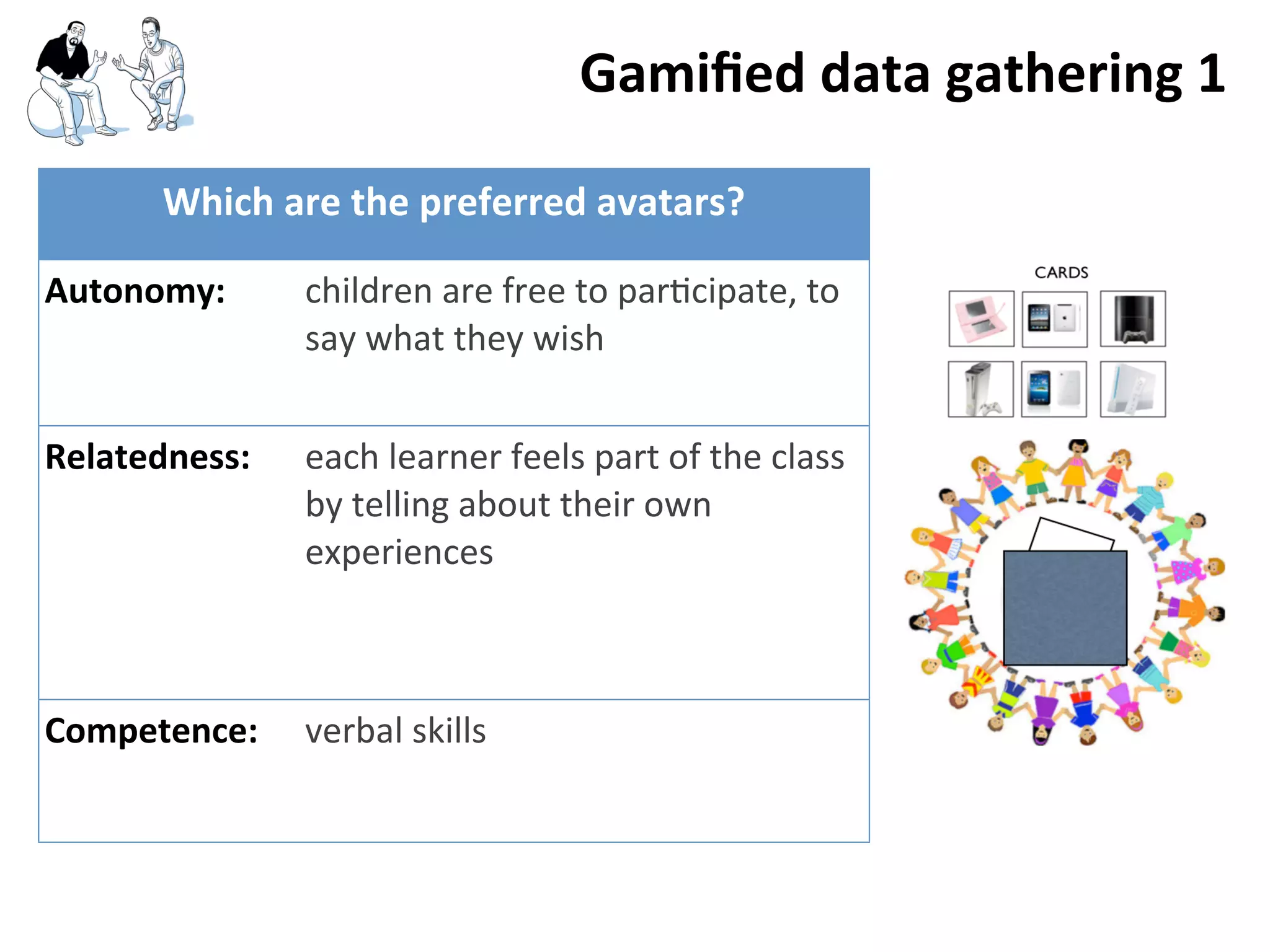
Autonomy: children	
  are	
  free	
  to	
  par/cipate,	
  to	
  
say	
  what	
  they	
  wish
Relatedness: each	
  learner	
  feels	
  part	
  of	
  the	
  class	
  
by	
  telling	
  about	
  their	
  own	
  
experiences
Competence: verbal	
  skills
Gamified	
  data	
  gathering	
  1
Which	
  are	
  the	
  preferred	
  acGviGes?Which	
  are	
  the	
  preferred	
  acGviGes?
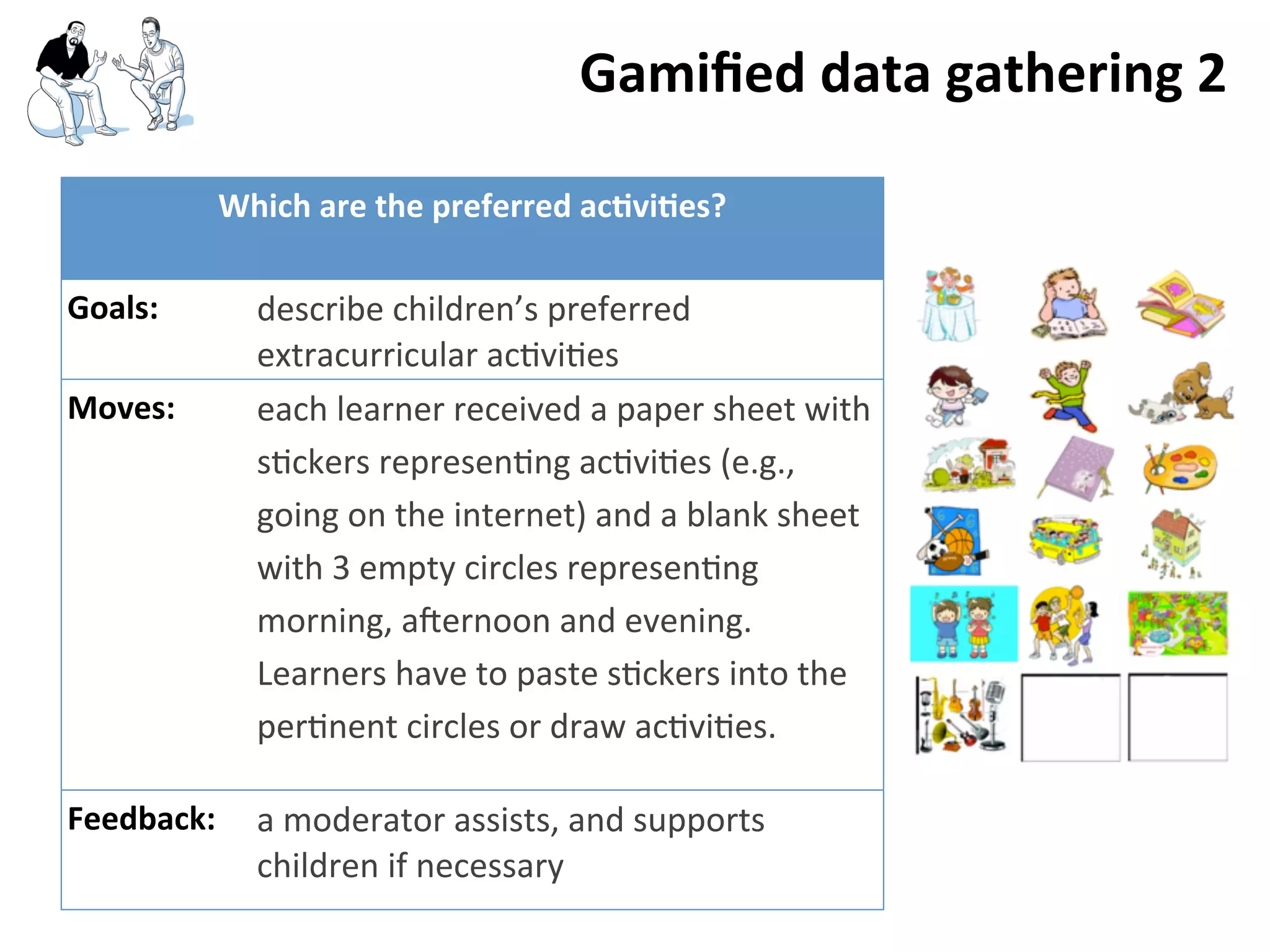
Goals: describe	
  children’s	
  preferred	
  
extracurricular	
  ac>vi>es
Moves: each	
  learner	
  received	
  a	
  paper	
  sheet	
  with	
  
s>ckers	
  represen>ng	
  ac>vi>es	
  (e.g.,	
  
going	
  on	
  the	
  internet)	
  and	
  a	
  blank	
  sheet	
  
with	
  3	
  empty	
  circles	
  represen>ng	
  
morning,	
  aYernoon	
  and	
  evening.	
  
Learners	
  have	
  to	
  paste	
  s>ckers	
  into	
  the	
  
per>nent	
  circles	
  or	
  draw	
  ac>vi>es.
Feedback: a	
  moderator	
  assists,	
  and	
  supports	
  
children	
  if	
  necessary
Gamified	
  data	
  gathering	
  2
Which	
  are	
  the	
  preferred	
  acGviGes?Which	
  are	
  the	
  preferred	
  acGviGes?
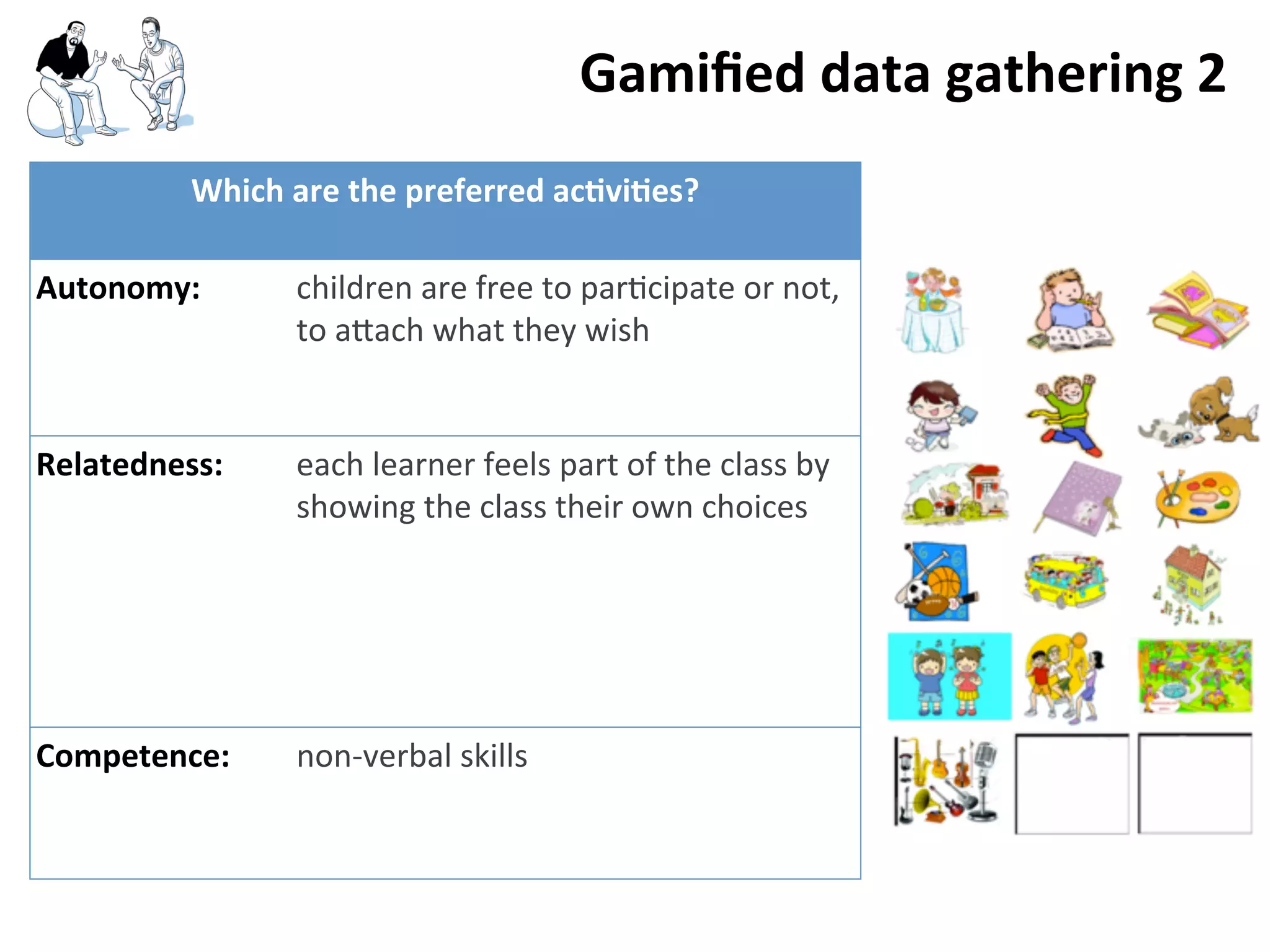
Autonomy: children	
  are	
  free	
  to	
  par>cipate	
  or	
  not,	
  
to	
  a[ach	
  what	
  they	
  wish
Relatedness: each	
  learner	
  feels	
  part	
  of	
  the	
  class	
  by	
  
showing	
  the	
  class	
  their	
  own	
  choices
Competence: non-­‐verbal	
  skills
Gamified	
  data	
  gathering	
  2
Morale: game over
Pros:
– reliable	
  and	
  dependable	
  data	
  for	
  creating	
  fine-­‐grained	
  learner	
  profiles	
  as	
  
triangulated	
  with	
  data	
  from	
  domain	
  experts	
  or	
  referent	
  adults
– gamifica>on	
  of	
  data	
  gathering	
  with	
  learners	
  was	
  engaging	
  for	
  children	
  and	
  
their	
  teachers	
  to	
  the	
  point	
  that	
  
– schools	
  par>cipated	
  in	
  the	
  prosecu>on	
  of	
  TERENCE	
  ac>vi>es	
  (“let’s	
  
play	
  again”	
  effect)
– there	
  were	
  no	
  drop-­‐outs
– school	
  constraints	
  were	
  respected
Morale: game over
Pros:
– reliable	
  and	
  dependable	
  data	
  for	
  creating	
  fine-­‐grained	
  learner	
  profiles	
  as	
  
triangulated	
  with	
  data	
  from	
  domain	
  experts	
  or	
  referent	
  adults
– gamifica>on	
  of	
  data	
  gathering	
  with	
  learners	
  was	
  engaging	
  for	
  children	
  and	
  
their	
  teachers	
  to	
  the	
  point	
  that	
  
– schools	
  par>cipated	
  in	
  the	
  prosecu>on	
  of	
  TERENCE	
  ac>vi>es	
  (“let’s	
  
play	
  again”	
  effect)
– there	
  were	
  no	
  drop-­‐outs
– school	
  constraints	
  were	
  respected
Contras:
– considerable	
  resources	
  and	
  personnel	
  for	
  construc>ng	
  data	
  gathering	
  
material	
  and	
  specifying	
  protocols/storyline
– the	
  method	
  leads	
  to	
  collec>ng	
  poorly	
  structured	
  huge	
  diversified	
  data	
  
which	
  requires	
  considerable	
  analysis	
  >mes
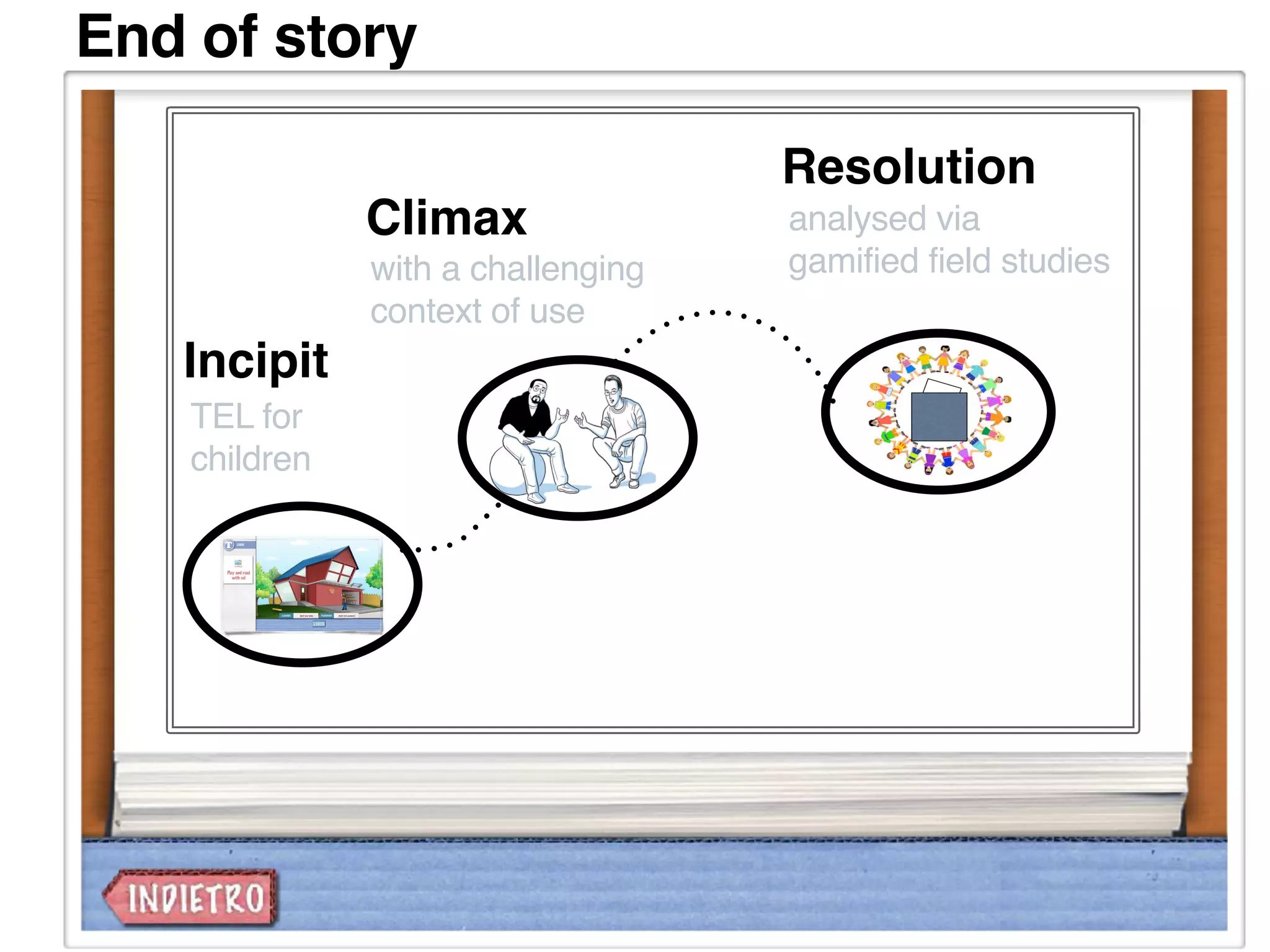
Incipit
TEL for
children
Climax
with a challenging
context of use
Resolution
analysed via
gamified field studies
End of story
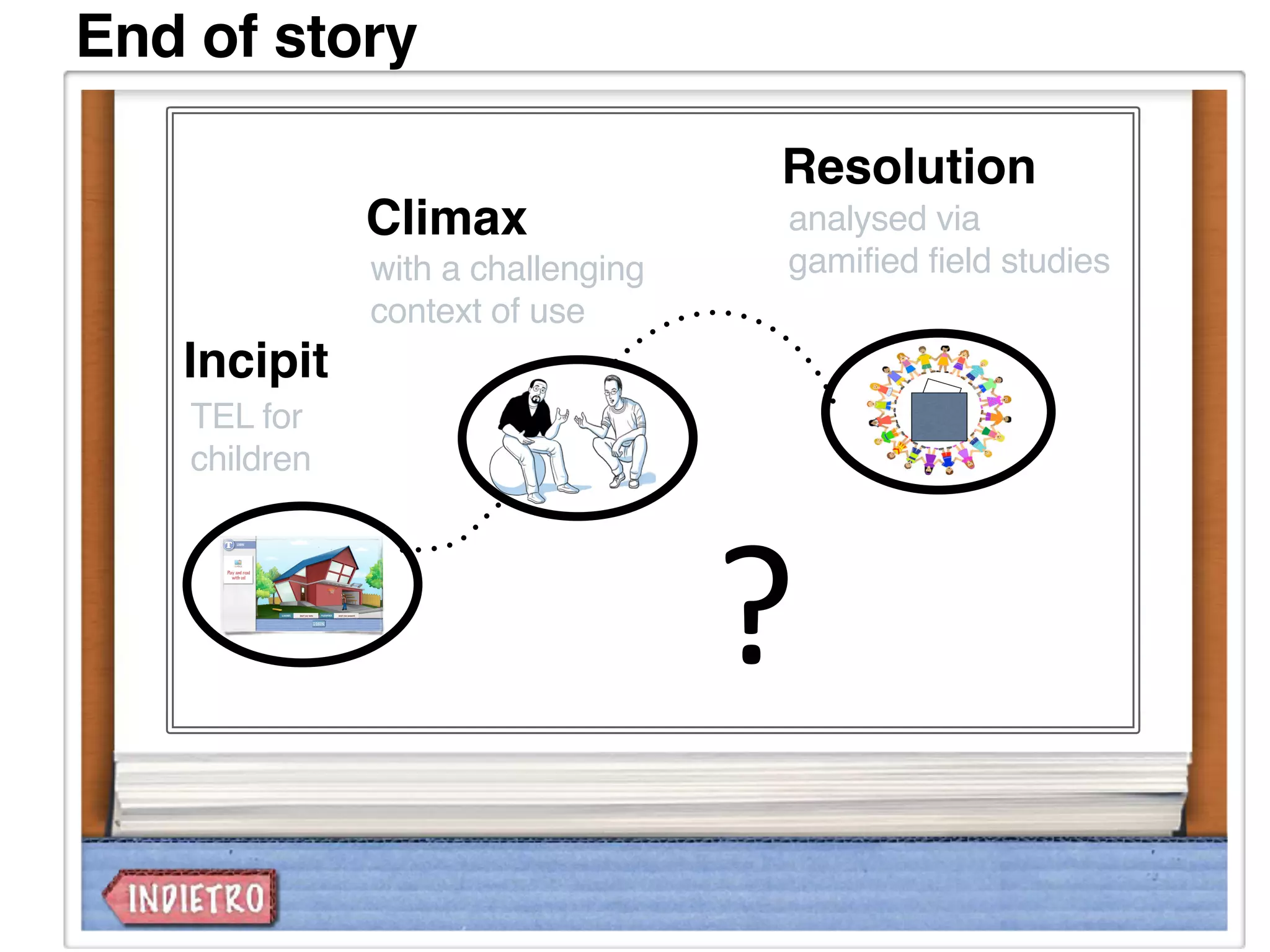
Incipit
TEL for
children
Climax
with a challenging
context of use
Resolution
analysed via
gamified field studies
End of story
?

Play to Collect Data with Children at School

  • 1.
    T. Di Mascio UnivAQ Gamifyyour Field Studies for Learning about Your Learners R. Gennari, A. Melonio UniBZ http://www.terenceproject.eu
  • 2.
    Outline of this story Incipit Climax Resolution a  TEL  project  for  children and  its  context  of  use analysed  via  gami:ied  :ield  studies that  inform  design  decisions  
  • 3.
    Outline of this story Incipit Climax Resolution a  TEL  project  for  children and  its  context  of  use analysed  via  gami:ied  :ield  studies that  inform  design  decisions   T E R E N C E
  • 4.
    Outline of this story Incipit Climax Resolution a  TEL  project  for  children and  its  context  of  use analysed  via  gami:ied  :ield  studies that  inform  design  decisions  
  • 5.
    TERENCE  in  a  nutshell TERENCE  is  a  collabora/ve  FP7  project   ‣ for  Technology  Enhanced  Learning  (TEL) ‣ for  children  with  specific  text  comprehension   problems  and  their  educators ‣ for  developing  and  adap/ve  learning  system  that   recommends  its  learners  the  adequate  learning   material,  made  of  digital
  • 6.
    TERENCE  in  a  nutshell TERENCE  is  a  collabora/ve  FP7  project   ‣ for  Technology  Enhanced  Learning  (TEL) ‣ for  children  with  specific  text  comprehension   problems  and  their  educators ‣ for  developing  and  adap/ve  learning  system  that   recommends  its  learners  the  adequate  learning   material,  made  of  digital ‣ books  of  stories
  • 7.
    TERENCE  in  a  nutshell TERENCE  is  a  collabora/ve  FP7  project   ‣ for  Technology  Enhanced  Learning  (TEL) ‣ for  children  with  specific  text  comprehension   problems  and  their  educators ‣ for  developing  and  adap/ve  learning  system  that   recommends  its  learners  the  adequate  learning   material,  made  of  digital Who runs fast? ‣ books  of  stories ‣ and  smart  games  for  reasoning  about  stories
  • 8.
    TERENCE  in  a  nutshell TERENCE  is  a  collabora/ve  FP7  project   ‣ for  Technology  Enhanced  Learning  (TEL) ‣ for  children  with  specific  text  comprehension   problems  and  their  educators ‣ for  developing  and  adap/ve  learning  system  that   recommends  its  learners  the  adequate  learning   material,  made  of  digital ‣ How  do  we  design  the  TERENCE  learning  material  and  overall   system  so  as  to  be Who runs fast? ‣ books  of  stories ‣ and  smart  games  for  reasoning  about  stories
  • 9.
    TERENCE  in  a  nutshell TERENCE  is  a  collabora/ve  FP7  project   ‣ for  Technology  Enhanced  Learning  (TEL) ‣ for  children  with  specific  text  comprehension   problems  and  their  educators ‣ for  developing  and  adap/ve  learning  system  that   recommends  its  learners  the  adequate  learning   material,  made  of  digital ‣ How  do  we  design  the  TERENCE  learning  material  and  overall   system  so  as  to  be Who runs fast? ‣ books  of  stories ‣ and  smart  games  for  reasoning  about  stories ‣ usable  by  its  users
  • 10.
    TERENCE  in  a  nutshell TERENCE  is  a  collabora/ve  FP7  project   ‣ for  Technology  Enhanced  Learning  (TEL) ‣ for  children  with  specific  text  comprehension   problems  and  their  educators ‣ for  developing  and  adap/ve  learning  system  that   recommends  its  learners  the  adequate  learning   material,  made  of  digital ‣ How  do  we  design  the  TERENCE  learning  material  and  overall   system  so  as  to  be Who runs fast? ‣ books  of  stories ‣ and  smart  games  for  reasoning  about  stories ‣ and  effec>ve  for  them? ‣ usable  by  its  users
  • 11.
    Data  for  context  of  use  from  children start no release yesok? gather data specify requirements design develop evaluation
  • 12.
    Data  for  context  of  use  from  children start no release yesok? gather data specify requirements design develop evaluation 282  learners  in  Italy 226  learners  in  UK 30  school  educators 10  domain  experts
  • 13.
    Data  for  context  of  use  from  children start no release yesok? gather data specify requirements design develop evaluation 282  learners  in  Italy 226  learners  in  UK 30  school  educators 10  domain  experts how  to  do  that  with   so  many  young  learners  at   school?
  • 14.
    Outline of this story Incipit Climax Resolution a  TEL  project  for  children and  its  context  of  use analysed  via  gami:ied  :ield  studies that  inform  design  decisions  
  • 15.
    Challenges  in  collecGng  data  from  children Reliability  of  collected  data: ‣ children  might  become  anxious  at  the  thought  of  taking  a  test   (Rubin  1995)  and  hence  not  express  their  true  selves,   ‣ thus  direct  methods  should  be  avoided  (Druin  2010)
  • 16.
    Challenges  in  collecGng  data  from  children Reliability  of  collected  data: ‣ children  might  become  anxious  at  the  thought  of  taking  a  test   (Rubin  1995)  and  hence  not  express  their  true  selves,   ‣ thus  direct  methods  should  be  avoided  (Druin  2010) Drop-­‐outs  easily  occur  ‘cause  for  children  (Chiasson  and  Gutwin  2005) ‣ “mo>va>on  and  engagement  are  [...]  important” ‣ “children  [need]  to  see  the  results  of  their  ac>ons  immediately”
  • 17.
    Challenges  in  collecGng  data  from  children Reliability  of  collected  data: ‣ children  might  become  anxious  at  the  thought  of  taking  a  test   (Rubin  1995)  and  hence  not  express  their  true  selves,   ‣ thus  direct  methods  should  be  avoided  (Druin  2010) Drop-­‐outs  easily  occur  ‘cause  for  children  (Chiasson  and  Gutwin  2005) ‣ “mo>va>on  and  engagement  are  [...]  important” ‣ “children  [need]  to  see  the  results  of  their  ac>ons  immediately” School/environment  constraints:  ac>vi>es  should ‣ involve  an  en>re  class, ‣ respect  school  >me-­‐tables,  e.g.,  each  session  should  last  no  longer   than  2  hours
  • 18.
    Outline of this story Incipit Climax Resolution a  TEL  project  for  children and  its  context  of  use analysed  via  gami:ied  :ield  studies that  inform  design  decisions  
  • 19.
    What  we  did:  we  gamified  data  gathering GamificaGon  is  the  usage  of  game-­‐play  elements  in  a  non-­‐game  context   for  engaging  and  mo>va>ng  users,  e.g.,  in  ac>vi>es
  • 20.
    What  we  did:  we  gamified  data  gathering Reliability  of  collected  data ‣ can  be  achieved  if  children  get  engaged  in  diverse  progressive   challenges  for  diverse  skills GamificaGon  is  the  usage  of  game-­‐play  elements  in  a  non-­‐game  context   for  engaging  and  mo>va>ng  users,  e.g.,  in  ac>vi>es
  • 21.
    What  we  did:  we  gamified  data  gathering Reliability  of  collected  data ‣ can  be  achieved  if  children  get  engaged  in  diverse  progressive   challenges  for  diverse  skills GamificaGon  is  the  usage  of  game-­‐play  elements  in  a  non-­‐game  context   for  engaging  and  mo>va>ng  users,  e.g.,  in  ac>vi>es Drop-­‐outs ‣ can  be  avoided  via  >mely  usable  feedback  and  engagement
  • 22.
    What  we  did:  we  gamified  data  gathering Reliability  of  collected  data ‣ can  be  achieved  if  children  get  engaged  in  diverse  progressive   challenges  for  diverse  skills GamificaGon  is  the  usage  of  game-­‐play  elements  in  a  non-­‐game  context   for  engaging  and  mo>va>ng  users,  e.g.,  in  ac>vi>es Drop-­‐outs ‣ can  be  avoided  via  >mely  usable  feedback  and  engagement School/environment  constraints  require  we ‣ involve  all  children  in  social  ac>vi>es, ‣ a  linear  planning/storyline  and  engagement  for  mee>ng  >me-­‐tables
  • 23.
    What  we  did:  we  gamified  data  gathering Reliability  of  collected  data ‣ can  be  achieved  if  children  get  engaged  in  diverse  progressive   challenges  for  diverse  skills GamificaGon  is  the  usage  of  game-­‐play  elements  in  a  non-­‐game  context   for  engaging  and  mo>va>ng  users,  e.g.,  in  ac>vi>es Drop-­‐outs ‣ can  be  avoided  via  >mely  usable  feedback  and  engagement School/environment  constraints  require  we ‣ involve  all  children  in  social  ac>vi>es, ‣ a  linear  planning/storyline  and  engagement  for  mee>ng  >me-­‐tables
  • 24.
    What  we  did:  we  gamified  data  gathering Reliability  of  collected  data ‣ can  be  achieved  if  children  get  engaged  in  diverse  progressive   challenges  for  diverse  skills GamificaGon  is  the  usage  of  game-­‐play  elements  in  a  non-­‐game  context   for  engaging  and  mo>va>ng  users,  e.g.,  in  ac>vi>es ‣ But  which  gamifica9on  ‘model’,  i.e.,  what  of  game-­‐play  can  ensure  us   we  really  engage  our  learners  in  our  data  collec9on? Drop-­‐outs ‣ can  be  avoided  via  >mely  usable  feedback  and  engagement School/environment  constraints  require  we ‣ involve  all  children  in  social  ac>vi>es, ‣ a  linear  planning/storyline  and  engagement  for  mee>ng  >me-­‐tables
  • 25.
  • 26.
    The  “video  game  uses  and  gratifications”  model  (Sherry  &   Lucas  2003)  says  that  different  players  engage  in  games  for   different  gratifications:   competition                      challenge            diversion            arousal            fantasy                                      social  interaction Gamification: diverse views
  • 27.
    Flows  are  engaging  activities  (e.g.,  games)  with  a  balance  between   challenges  and  skills,  and  for  (Kiili  2005)  are  realised  in  games  via: balanced  challenges  and  skills          timely  usable  feedback                  clear  goals                                                                           immersive  storylines                                                                                              intrinsic  rewards The  “video  game  uses  and  gratifications”  model  (Sherry  &   Lucas  2003)  says  that  different  players  engage  in  games  for   different  gratifications:   competition                      challenge            diversion            arousal            fantasy                                      social  interaction Gamification: diverse views
  • 28.
    The  motivational  model  (Przybylski  et  al.  2010)  explains  engagement  in   games  in  relation  to  the  satisfaction  of  universal  basic  needs: autonomy                                                  competence                                                        relatedness  needs Flows  are  engaging  activities  (e.g.,  games)  with  a  balance  between   challenges  and  skills,  and  for  (Kiili  2005)  are  realised  in  games  via: balanced  challenges  and  skills          timely  usable  feedback                  clear  goals                                                                           immersive  storylines                                                                                              intrinsic  rewards The  “video  game  uses  and  gratifications”  model  (Sherry  &   Lucas  2003)  says  that  different  players  engage  in  games  for   different  gratifications:   competition                      challenge            diversion            arousal            fantasy                                      social  interaction Gamification: diverse views
  • 29.
    Which  are  the  preferred  avatars?Which  are  the  preferred  avatars? Goals: describe  children’s  preferred  avatars Moves: cards  with  game  consoles  are  in  a   box;  in  turn,  each  player  picks  up  the   cards  of  the  consoles  the  player  uses   and  describes  her/his  preferred   avatars  for  the  consoles Feedback: a  moderator  assists,  and  provides   children  with  support  if  necessary   Gamified  data  gathering  1
  • 30.
    Which  are  the  preferred  avatars?Which  are  the  preferred  avatars? Autonomy: children  are  free  to  par/cipate,  to   say  what  they  wish Relatedness: each  learner  feels  part  of  the  class   by  telling  about  their  own   experiences Competence: verbal  skills Gamified  data  gathering  1
  • 31.
    Which  are  the  preferred  acGviGes?Which  are  the  preferred  acGviGes? Goals: describe  children’s  preferred   extracurricular  ac>vi>es Moves: each  learner  received  a  paper  sheet  with   s>ckers  represen>ng  ac>vi>es  (e.g.,   going  on  the  internet)  and  a  blank  sheet   with  3  empty  circles  represen>ng   morning,  aYernoon  and  evening.   Learners  have  to  paste  s>ckers  into  the   per>nent  circles  or  draw  ac>vi>es. Feedback: a  moderator  assists,  and  supports   children  if  necessary Gamified  data  gathering  2
  • 32.
    Which  are  the  preferred  acGviGes?Which  are  the  preferred  acGviGes? Autonomy: children  are  free  to  par>cipate  or  not,   to  a[ach  what  they  wish Relatedness: each  learner  feels  part  of  the  class  by   showing  the  class  their  own  choices Competence: non-­‐verbal  skills Gamified  data  gathering  2
  • 33.
    Morale: game over Pros: –reliable  and  dependable  data  for  creating  fine-­‐grained  learner  profiles  as   triangulated  with  data  from  domain  experts  or  referent  adults – gamifica>on  of  data  gathering  with  learners  was  engaging  for  children  and   their  teachers  to  the  point  that   – schools  par>cipated  in  the  prosecu>on  of  TERENCE  ac>vi>es  (“let’s   play  again”  effect) – there  were  no  drop-­‐outs – school  constraints  were  respected
  • 34.
    Morale: game over Pros: –reliable  and  dependable  data  for  creating  fine-­‐grained  learner  profiles  as   triangulated  with  data  from  domain  experts  or  referent  adults – gamifica>on  of  data  gathering  with  learners  was  engaging  for  children  and   their  teachers  to  the  point  that   – schools  par>cipated  in  the  prosecu>on  of  TERENCE  ac>vi>es  (“let’s   play  again”  effect) – there  were  no  drop-­‐outs – school  constraints  were  respected Contras: – considerable  resources  and  personnel  for  construc>ng  data  gathering   material  and  specifying  protocols/storyline – the  method  leads  to  collec>ng  poorly  structured  huge  diversified  data   which  requires  considerable  analysis  >mes
  • 35.
    Incipit TEL for children Climax with achallenging context of use Resolution analysed via gamified field studies End of story
  • 36.
    Incipit TEL for children Climax with achallenging context of use Resolution analysed via gamified field studies End of story ?