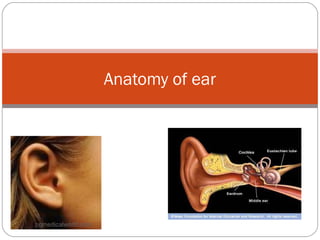
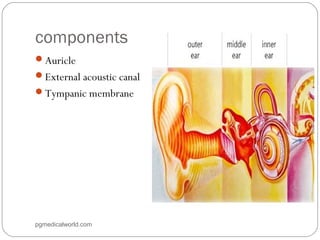
Anatomy of ear
pgmedicalworld.com
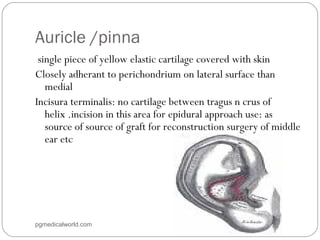
components
Auricle
External acoustic canal
Tympanic membrane
pgmedicalworld.com
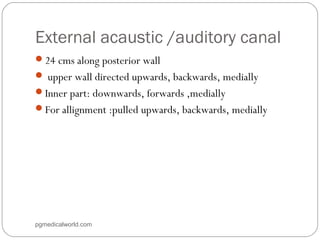
Auricle /pinna
single piece of yellow elastic cartilage covered with skin
Closely adherant to perichondrium on lateral surface than
medial
Incisura terminalis: no cartilage between tragus n crus of
helix .incision in this area for epidural approach use: as
source of source of graft for reconstruction surgery of middle
ear etc
pgmedicalworld.com
External acaustic /auditory canal
24 cms along posterior wall
 upper wall directed upwards, backwards, medially
Inner part: downwards, forwards ,medially
For allignment :pulled upwards, backwards, medially
pgmedicalworld.com
(a)Cartilagenous part
8mm
has 2 deficiencies:fissure of santorini; part through which
parotid or superior mastoid infection occur
Furuncles(staphylococcal infection) in outer 1/3 of canal due
to hair follicles

pgmedicalworld.com
(b)Bony part
16mm devoid of hair, ceruminous glands
6mm lateral to tympanic membrane bony meatus presents
narrowing :”isthmus”
Anteroinferior part of deep meatus beyond isthmus presents
recess-”ant recess”
Anteeroinferior part of bony canal may presents deficiency
(foramen of huschke)
pgmedicalworld.com
pgmedicalworld.com
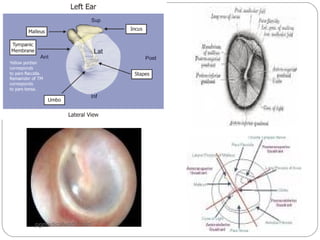
Tympanic memb/ear drum
9-10mm tall,8-9mm wide,.1mm thick
Divided into 2 parts
(a) pars tensa
Thick perifery ,form fibrocartlagenous ring called ”annulus
tympanicus”
Central part tensed inwards at tip of malleus ‘UMBO’
pgmedicalworld.com
(b)Pars flacida /shrapnels membrane
Between notch of rivinus n anterior n posterior malleal folds
LAYERS OF TYMPANIC MEMBRANE
Outer epIthelial layer
Inner mocosal layer
Middle fibrous layer
pgmedicalworld.com
Nerve supply of external ear
Greater auricular nerve
Lesser occipital nerve
Auriculo temporal nerve
Auricular branch of vagus
EXTERNAL AUDITORY CANAL
Facial nerve
Auriculo temporal nerve
Auricular br of vagus nerve
TYMPANIC MEMBRANE
Auriculo temporal nerve
Auri br of vagus nerve
Jacobsons nerve
pgmedicalworld.com
MIDDLE EAR
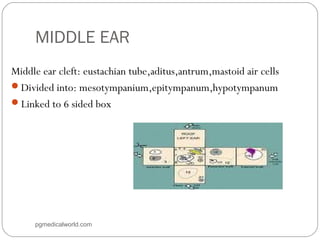
Middle ear cleft: eustachian tube,aditus,antrum,mastoid air cells
Divided into: mesotympanium,epitympanum,hypotympanum
Linked to 6 sided box
pgmedicalworld.com
roof
Formed by thin plate of bone : tegmen tympani,forms
roof of aditus n antrum
FLOOR
Thin plate of bone seperates tympanic cavity from jug bulb
ANTERIOR WALL
Thin plate of bone seperates cavity from internal carotid
art
2 openings: eustachian tube, tensor tympani muscle
pgmedicalworld.com
Posterior wall
Close to mastoid air cells
Presents bony progectn”pyramid”,tendon of stapedius is
attachad to neck of stapes
Surgically important as direct access can be made through
middle ear
Facial recess/ posteauor sinus: depression in post wall lateral
to pyramid
pgmedicalworld.com
Medial wall
Formed by labyrinth
Presents bulge” promontary”
Oval window fixed to foot plate
Round window covered by sec tympanic membrane
Over oval window is canal for facial n
Just anterior to oval window, hook like progection” pocessus
cochleariformis”
pgmedicalworld.com
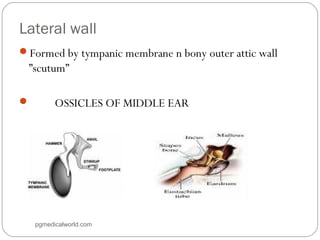
Lateral wall
Formed by tympanic membrane n bony outer attic wall
”scutum”
 OSSICLES OF MIDDLE EAR
pgmedicalworld.com
Malleus:head,neck,handle,lateral and anterior process
Incus:body,short and long process
Stapes: head, neck, anterioe and posterior crura, foot plate
INTRA TYMPANIC MUSCLES
Tensor tympani
stapedius
pgmedicalworld.com
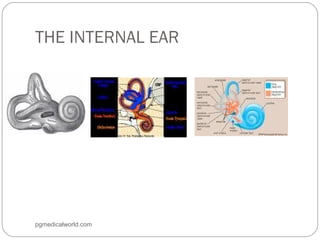
THE INTERNAL EAR
pgmedicalworld.com
Bony and membranous labyrinth filled with endolymph and
perylymph respectively
 Bony labyrinth
3 parts:vestibule,semicircular canals,cochlea
Vestibule:the central canal of labrynth
Latwral wall:oval window
Medial wall: 2 recess: spherical and elliptical
Below opening of elliptical recess is opening of aqueous duct
through which passes endolymphatic duct
Posterior part of vestibule:5 openings of semisircular canals
pgmedicalworld.com
Semicircular canals3 in number: lateral,posterior,superior at right angles to each
other
Has amputated n nonamputated end,
Nonamputated ends of posterior n superior canals unite to form
channel ”crus commune”
 conchae
Coiled tube making2.5-2.75 turns round central pyranid
”modiolus”
“osseous spiral lamina”:around modiolus winding spirally like
thread of screw
3 componants:
 scala vestibuli
 Scala tympani
 Scala mediapgmedicalworld.com
THANK YOU
pgmedicalworld.com

Anatomy of ear

  • 1.
  • 2.
  • 3.
    Auricle /pinna single pieceof yellow elastic cartilage covered with skin Closely adherant to perichondrium on lateral surface than medial Incisura terminalis: no cartilage between tragus n crus of helix .incision in this area for epidural approach use: as source of source of graft for reconstruction surgery of middle ear etc pgmedicalworld.com
  • 4.
    External acaustic /auditorycanal 24 cms along posterior wall  upper wall directed upwards, backwards, medially Inner part: downwards, forwards ,medially For allignment :pulled upwards, backwards, medially pgmedicalworld.com
  • 5.
    (a)Cartilagenous part 8mm has 2deficiencies:fissure of santorini; part through which parotid or superior mastoid infection occur Furuncles(staphylococcal infection) in outer 1/3 of canal due to hair follicles  pgmedicalworld.com
  • 6.
    (b)Bony part 16mm devoidof hair, ceruminous glands 6mm lateral to tympanic membrane bony meatus presents narrowing :”isthmus” Anteroinferior part of deep meatus beyond isthmus presents recess-”ant recess” Anteeroinferior part of bony canal may presents deficiency (foramen of huschke) pgmedicalworld.com
  • 7.
  • 8.
    Tympanic memb/ear drum 9-10mmtall,8-9mm wide,.1mm thick Divided into 2 parts (a) pars tensa Thick perifery ,form fibrocartlagenous ring called ”annulus tympanicus” Central part tensed inwards at tip of malleus ‘UMBO’ pgmedicalworld.com
  • 9.
    (b)Pars flacida /shrapnelsmembrane Between notch of rivinus n anterior n posterior malleal folds LAYERS OF TYMPANIC MEMBRANE Outer epIthelial layer Inner mocosal layer Middle fibrous layer pgmedicalworld.com
  • 10.
    Nerve supply ofexternal ear Greater auricular nerve Lesser occipital nerve Auriculo temporal nerve Auricular branch of vagus EXTERNAL AUDITORY CANAL Facial nerve Auriculo temporal nerve Auricular br of vagus nerve TYMPANIC MEMBRANE Auriculo temporal nerve Auri br of vagus nerve Jacobsons nerve pgmedicalworld.com
  • 11.
    MIDDLE EAR Middle earcleft: eustachian tube,aditus,antrum,mastoid air cells Divided into: mesotympanium,epitympanum,hypotympanum Linked to 6 sided box pgmedicalworld.com
  • 12.
    roof Formed by thinplate of bone : tegmen tympani,forms roof of aditus n antrum FLOOR Thin plate of bone seperates tympanic cavity from jug bulb ANTERIOR WALL Thin plate of bone seperates cavity from internal carotid art 2 openings: eustachian tube, tensor tympani muscle pgmedicalworld.com
  • 13.
    Posterior wall Close tomastoid air cells Presents bony progectn”pyramid”,tendon of stapedius is attachad to neck of stapes Surgically important as direct access can be made through middle ear Facial recess/ posteauor sinus: depression in post wall lateral to pyramid pgmedicalworld.com
  • 14.
    Medial wall Formed bylabyrinth Presents bulge” promontary” Oval window fixed to foot plate Round window covered by sec tympanic membrane Over oval window is canal for facial n Just anterior to oval window, hook like progection” pocessus cochleariformis” pgmedicalworld.com
  • 15.
    Lateral wall Formed bytympanic membrane n bony outer attic wall ”scutum”  OSSICLES OF MIDDLE EAR pgmedicalworld.com
  • 16.
    Malleus:head,neck,handle,lateral and anteriorprocess Incus:body,short and long process Stapes: head, neck, anterioe and posterior crura, foot plate INTRA TYMPANIC MUSCLES Tensor tympani stapedius pgmedicalworld.com
  • 17.
  • 18.
    Bony and membranouslabyrinth filled with endolymph and perylymph respectively  Bony labyrinth 3 parts:vestibule,semicircular canals,cochlea Vestibule:the central canal of labrynth Latwral wall:oval window Medial wall: 2 recess: spherical and elliptical Below opening of elliptical recess is opening of aqueous duct through which passes endolymphatic duct Posterior part of vestibule:5 openings of semisircular canals pgmedicalworld.com
  • 19.
    Semicircular canals3 innumber: lateral,posterior,superior at right angles to each other Has amputated n nonamputated end, Nonamputated ends of posterior n superior canals unite to form channel ”crus commune”  conchae Coiled tube making2.5-2.75 turns round central pyranid ”modiolus” “osseous spiral lamina”:around modiolus winding spirally like thread of screw 3 componants:  scala vestibuli  Scala tympani  Scala mediapgmedicalworld.com
  • 20.