String TheoryBasic Properties
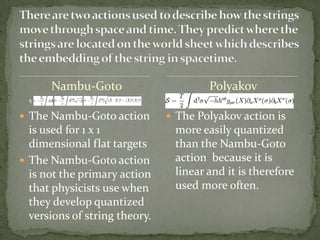
There are two actions used to describe how the strings move through space and time. They predict where the strings are located on the world sheet which describes the embedding of the string in spacetime.Nambu-GotoPolyakovThe Nambu-Goto action is used for 1 x 1 dimensional flat targetsThe Nambu-Goto action is not the primary action that physicists use when they develop quantized versions of string theory.The Polyakov action is more easily quantized than the Nambu-Goto action  because it is linear and it is therefore used more often.
Characteristics of the stringsThe strings oscillate because of tension and kinetic energyThe quantum mechanics of strings states that these oscillations take on vibrational modes.These modes behave differently from particles. The String’s mass, spin, and charge is determined by the string’s dynamics.
Characteristics of the stringsIn a guitar string, the different notes that sound when the string is plucked are a result of the properties of the string: tension, length, thickness. The notes coming out of the guitar are excitation modes of the string.The particles that are observed in particle accelerators can be thought of as musical notes, or excitations modes of strings.Different excitation modes make the strings appear as electrons, photons, and so on.Strings have a miniscule length that is known as the Planck length. The Planck length is about 10-33 centimeters
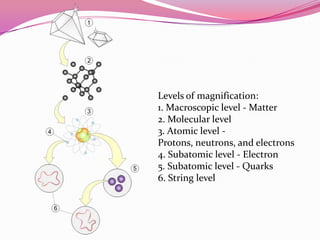
Levels of magnification:1. Macroscopic level - Matter2. Molecular level3. Atomic level - Protons, neutrons, and electrons4. Subatomic level - Electron5. Subatomic level - Quarks6. String level
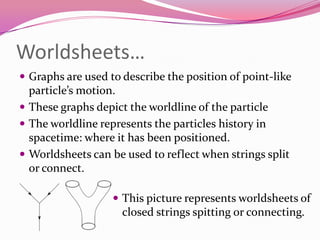
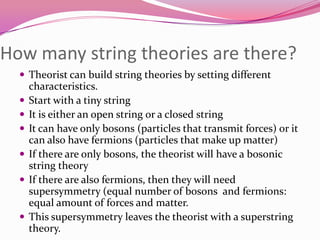
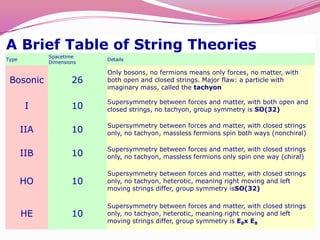
Worldsheets…Graphs are used to describe the position of point-like particle’s motion. These graphs depict the worldline of the particleThe worldline represents the particles history in spacetime: where it has been positioned.Worldsheets can be used to reflect when strings split or connect.This picture represents worldsheets of closed strings spitting or connecting.How many string theories are there?Theorist can build string theories by setting different characteristics.Start with a tiny stringIt is either an open string or a closed stringIt can have only bosons (particles that transmit forces) or it can also have fermions (particles that make up matter)If there are only bosons, the theorist will have a bosonic string theoryIf there are also fermions, then they will need supersymmetry (equal number of bosons  and fermions: equal amount of forces and matter.This supersymmetry leaves the theorist with a superstring theory.
String Theory
String Theory

String Theory

  • 1.
  • 2.
    There are twoactions used to describe how the strings move through space and time. They predict where the strings are located on the world sheet which describes the embedding of the string in spacetime.Nambu-GotoPolyakovThe Nambu-Goto action is used for 1 x 1 dimensional flat targetsThe Nambu-Goto action is not the primary action that physicists use when they develop quantized versions of string theory.The Polyakov action is more easily quantized than the Nambu-Goto action because it is linear and it is therefore used more often.
  • 3.
    Characteristics of thestringsThe strings oscillate because of tension and kinetic energyThe quantum mechanics of strings states that these oscillations take on vibrational modes.These modes behave differently from particles. The String’s mass, spin, and charge is determined by the string’s dynamics.
  • 4.
    Characteristics of thestringsIn a guitar string, the different notes that sound when the string is plucked are a result of the properties of the string: tension, length, thickness. The notes coming out of the guitar are excitation modes of the string.The particles that are observed in particle accelerators can be thought of as musical notes, or excitations modes of strings.Different excitation modes make the strings appear as electrons, photons, and so on.Strings have a miniscule length that is known as the Planck length. The Planck length is about 10-33 centimeters
  • 5.
    Levels of magnification:1.Macroscopic level - Matter2. Molecular level3. Atomic level - Protons, neutrons, and electrons4. Subatomic level - Electron5. Subatomic level - Quarks6. String level
  • 6.
    Worldsheets…Graphs are usedto describe the position of point-like particle’s motion. These graphs depict the worldline of the particleThe worldline represents the particles history in spacetime: where it has been positioned.Worldsheets can be used to reflect when strings split or connect.This picture represents worldsheets of closed strings spitting or connecting.How many string theories are there?Theorist can build string theories by setting different characteristics.Start with a tiny stringIt is either an open string or a closed stringIt can have only bosons (particles that transmit forces) or it can also have fermions (particles that make up matter)If there are only bosons, the theorist will have a bosonic string theoryIf there are also fermions, then they will need supersymmetry (equal number of bosons and fermions: equal amount of forces and matter.This supersymmetry leaves the theorist with a superstring theory.