Marketing
assignment
Presented
    By
Topic
Introduction
 India is the fastest growing free market
  democracy in the world. India has the largest
  knowledge workforce in the world and with
  more and more people moving to the higher
  income strata,
 India is a market that the world cannot
  ignore. The opening up of the Indian economy
  has given a level playing field for foreign
  brands against Indian brands.
 Several multinational companies have begun to
  focus their attention on Indian markets.
  Global brands are threatening the existence
  of several Indian brands. These brands have
  strong presence in the minds of the
  customers globally and have performed
  consistently for a long time.
What Is Brand?

   Are you sure you know?
   We’re continually amazed at how many people simply
    answer, “a company’s name” or “a corporate logo.” Let me
    show you how branding can be understood—as easy as pie.
   Just like we know people by their names, we know
    hundreds of brands by name. But, like people too, the
    more you know about a brand, the more it seems to have
    its own individual personality.
   But while we know people by their names, we don’t say
    they “are” their names. Here’s where we get to what
    branding really is. Branding is the sum total of a
    company’s identity—from its name and logo to every piece
    of communication, internal or external—to every
    encounter every customer or potential customer has with
    it.
Concept of Brand
   Brand is the personality that identifies a product,
    service or company (name, term, sign, symbol, or
    design, or combination of them) and how it relates to
    key constituencies: customers, staff, partners,
    investors etc.
   Some people distinguish the psychological
    aspect, brand associations like thoughts,
    feelings, perceptions, images, experiences,
    beliefs, attitudes, and so on that become linked
    to the brand, of a brand from the experiential
    aspect.
Branding -a different
perspective
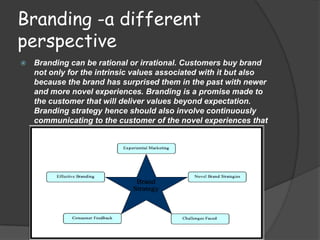
   Branding can be rational or irrational. Customers buy brand
    not only for the intrinsic values associated with it but also
    because the brand has surprised them in the past with newer
    and more novel experiences. Branding is a promise made to
    the customer that will deliver values beyond expectation.
    Branding strategy hence should also involve continuously
    communicating to the customer of the novel experiences that
    he/she has had with the brand.
Elements of Brand
   Brand elements
   Brands are communicated through various elements[8]:
   Name: The word or words used to identify the company, product,
    service, concept
   Logo: The visual trademark that identifies the brand
   Tagline or Catchphrase: "The Quicker Picker Upper" is
    associated with Bounty; "Can you hear me now" is an important
    part of the Verizon brand.
   Shapes: The distinctive shape of the Coca-Cola bottle or the
    Volkswagen Beetle are trademarked elements of those brands.
   Graphics: The dynamic ribbon is also a trademarked part of Coca-
    Cola's brand.
   Colour: Owens-Corning is the only brand of fibreglass insulation
    that can be pink.
   Sounds: A unique tune or set of notes can "denote" a brand:
    NBC's chimes are one of the most famous examples.
   Movement: Lamborghini has trademarked the upward motion of its
    car doors.
   Smells: Scents, such as the rose-jasmine-musk of Chanel No. 5 is
    trademarked.
   Taste: KFC has trademarked its special recipe of 11 herbs and
    spices for fried chicken
Global brand and Local brand
 Global brand --A global brand is one which is perceived to
  reflect the same set of values around the world. Global
  brands transcend their origins and create strong enduring
  relationships with consumers across countries and cultures.
  They are brands sold in international markets. Examples of
  global brands include Facebook, Apple, Pepsi, McDonald's,
  Mastercard, Gap, Sony and Nike. These brands are used to
  sell the same product across multiple markets and could be
  considered successful to the extent that the associated
  products are easily recognizable by the diverse set of
  consumers.
 Local brand --A brand that is sold and marketed
  (distributed and promoted) in a relatively small and
  restricted geographical area. A local brand is a brand that
  can be found in only one country or region. It may be called a
  regional brand if the area encompasses more than one
  metropolitan market. It may also be a brand that is
  developed for a specific national market, however an
  interesting thing about local brand is that the local branding
Benefits of Global Brand
   Economies of scale (production and distribution)
   Lower marketing costs
   Laying the groundwork for future extensions
    worldwide
   Maintaining consistent brand imagery
   Quicker identification and integration of
    innovations (discovered worldwide)
   Preempting international competitors from
    entering domestic markets or locking you out of
    other geographic markets
   Increasing international media reach (especially
    with the explosion of the Internet) is an enabler
   Increases in international business and tourism
    are also enablers
Benefits of Local Brand
 Local brand offers greater selection and
  higher equility
 Scope for expansion
 Meeting the local needs of the people and
  tastes
 Strong community ties
 Cultural identity
 Local operational or logistical
  advantages
Five reasons local brands have the home-field
advantage
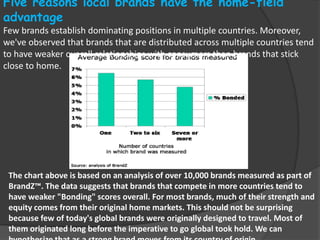
Few brands establish dominating positions in multiple countries. Moreover,
we've observed that brands that are distributed across multiple countries tend
to have weaker overall relationships with consumers than brands that stick
close to home.


 The chart above is based on an analysis of over 10,000 brands measured as part of
 BrandZ™. The data suggests that brands that compete in more countries tend to
 have weaker "Bonding" scores overall. For most brands, much of their strength and
 equity comes from their original home markets. This should not be surprising
 because few of today's global brands were originally designed to travel. Most of
 them originated long before the imperative to go global took hold. We can
Brand strategy
 As I see it, a company’s brand strategy describes how
  the brand intends to create customers and advance
  them beyond the reach of competitors.
 Specifically, it sets forth the creative, social and moral
  steps that the brand will take to create the customers
  that will drive the business forward.
 A brand strategy will position customers as a key
  part of the company’s competitive edge—and keep
  moving that edge. The customer wins through
  progressively added value, and the company wins
  through customers who won’t settle for second best.
 In brand strategy we don’t focus on “positioning the
  brand.” We focus on positioning the customer—to
  win. In other words, the brand wins through the
  customer.
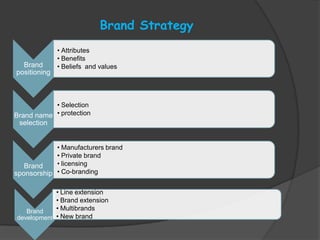
Brand Strategy
              • Attributes
              • Benefits
  Brand       • Beliefs and values
positioning


           • Selection
Brand name • protection
 selection


            • Manufacturers brand
            • Private brand
   Brand    • licensing
sponsorship • Co-branding

            • Line extension
            • Brand extension
   Brand    • Multibrands
development • New brand
Brand strategy contd….

 Brand positioning:-
 Marketers need to position their brands and target
  customer’s mind.
 Positioning refers to the act of designing the
  company’s offerings and image in such a way that it
  occupies a distinctive places in the minds of target
  customers.
 The strongest brand go beyond attribute or benefit
  positioning.They are positioned on strong beliefs
  and values.
Brand strategy contd ….
   Brand name selection:-
   A good name can greatly add to products
    success. Desirable qualities of brand name
    include
   It should suggest something about the
    products benefits and qualities.
   It should be easy to pronounce,recognize and
    remember.
   The brand name should be distinctive.
   It should be extendable.
   The brand name should translate easily into
    foreign language.
   It should be capable of registration and
    legal protection.
Brand strategy contd….
 Brand sponsorship:-
 A manufacturer has four
  sponsership.The product may be launched
  as :-
• national brand
• private brand
• licensed brand and
• co-brand
Brand stategy contd…

 Brand development:-
 A company has four chances when it
  comes to developing brands. It can
  introduce :
• Line extensions
• Brand extensions
• Multi brands
• New brands
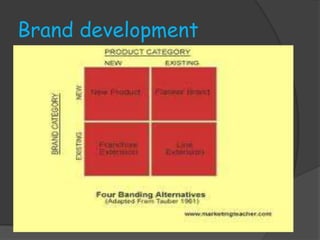
Brand development
Let’s discuss
   Brand development and strategies of
    two famous brand

                Allen Solly

                   Levi’s
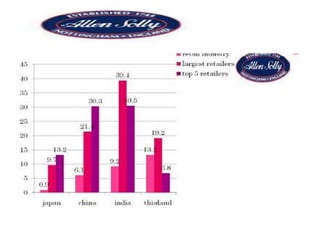
Brand –Allen Solly
    Brand is the most valuable asset of the
    company. It is the driving force behind the
    business. In order to plan and implement a
    brand strategy, the current state of the
    business must first be analyzed to uncover
    the needs and issues that are unique to the
    industry. It’s only by gaining this
    understanding, and comparing it with your
    vision, that the brand strategy can be
    revealed.
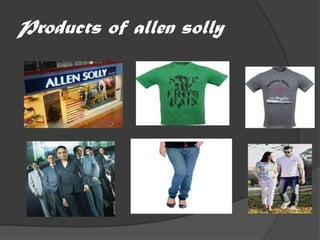
    Allen solly Came in India in 1990.
    Launched the concept of Friday Dressing.
    Introduced women wear in corporate world.
   Known as most dominating brand.
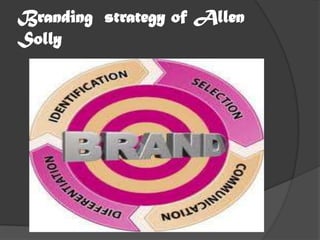
Branding strategy of Allen
Solly
Products of allen solly
Brand Levi’s
 Levi's Fashions a New Strategy
 A dynamic new team looks to stamp
  innovation on an old brand.
 Hanson, who, along with his designer
  muse, was brought back from Europe to
  Levi's San Francisco headquarters last
  year to reverse the seriously sagging
  fortunes of the company's brand in
  America. "It has a bold, confident statue
  that doesn't say, Levi's is back. It says,
  Levi's is leading."
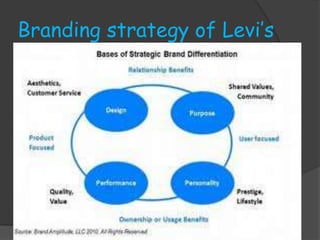
Branding strategy of Levi’s
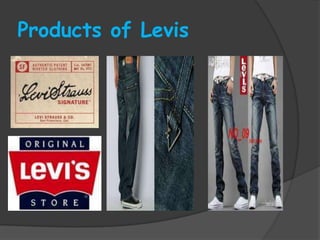
Products of Levis
CONCLUSION

   In today’s world brand has a major role in
    the markets of developing economy. Good
    brand act as a king pin in the business. So
    company must manage their brand. Brand
    positioning must be continuously
    communicated to consumers. Above
    all,however,a powerful brand forms the
    basis for building strong and profitable
    customer relationships .Brand are
    powerful assets that must be carefully
    developed and managed.
Marketing ppt

Marketing ppt

  • 1.
  • 2.
  • 3.
    Introduction  India isthe fastest growing free market democracy in the world. India has the largest knowledge workforce in the world and with more and more people moving to the higher income strata,  India is a market that the world cannot ignore. The opening up of the Indian economy has given a level playing field for foreign brands against Indian brands.  Several multinational companies have begun to focus their attention on Indian markets. Global brands are threatening the existence of several Indian brands. These brands have strong presence in the minds of the customers globally and have performed consistently for a long time.
  • 4.
    What Is Brand?  Are you sure you know?  We’re continually amazed at how many people simply answer, “a company’s name” or “a corporate logo.” Let me show you how branding can be understood—as easy as pie.  Just like we know people by their names, we know hundreds of brands by name. But, like people too, the more you know about a brand, the more it seems to have its own individual personality.  But while we know people by their names, we don’t say they “are” their names. Here’s where we get to what branding really is. Branding is the sum total of a company’s identity—from its name and logo to every piece of communication, internal or external—to every encounter every customer or potential customer has with it.
  • 5.
    Concept of Brand  Brand is the personality that identifies a product, service or company (name, term, sign, symbol, or design, or combination of them) and how it relates to key constituencies: customers, staff, partners, investors etc.  Some people distinguish the psychological aspect, brand associations like thoughts, feelings, perceptions, images, experiences, beliefs, attitudes, and so on that become linked to the brand, of a brand from the experiential aspect.
  • 6.
    Branding -a different perspective  Branding can be rational or irrational. Customers buy brand not only for the intrinsic values associated with it but also because the brand has surprised them in the past with newer and more novel experiences. Branding is a promise made to the customer that will deliver values beyond expectation. Branding strategy hence should also involve continuously communicating to the customer of the novel experiences that he/she has had with the brand.
  • 7.
    Elements of Brand  Brand elements  Brands are communicated through various elements[8]:  Name: The word or words used to identify the company, product, service, concept  Logo: The visual trademark that identifies the brand  Tagline or Catchphrase: "The Quicker Picker Upper" is associated with Bounty; "Can you hear me now" is an important part of the Verizon brand.  Shapes: The distinctive shape of the Coca-Cola bottle or the Volkswagen Beetle are trademarked elements of those brands.  Graphics: The dynamic ribbon is also a trademarked part of Coca- Cola's brand.  Colour: Owens-Corning is the only brand of fibreglass insulation that can be pink.  Sounds: A unique tune or set of notes can "denote" a brand: NBC's chimes are one of the most famous examples.  Movement: Lamborghini has trademarked the upward motion of its car doors.  Smells: Scents, such as the rose-jasmine-musk of Chanel No. 5 is trademarked.  Taste: KFC has trademarked its special recipe of 11 herbs and spices for fried chicken
  • 8.
    Global brand andLocal brand  Global brand --A global brand is one which is perceived to reflect the same set of values around the world. Global brands transcend their origins and create strong enduring relationships with consumers across countries and cultures. They are brands sold in international markets. Examples of global brands include Facebook, Apple, Pepsi, McDonald's, Mastercard, Gap, Sony and Nike. These brands are used to sell the same product across multiple markets and could be considered successful to the extent that the associated products are easily recognizable by the diverse set of consumers.  Local brand --A brand that is sold and marketed (distributed and promoted) in a relatively small and restricted geographical area. A local brand is a brand that can be found in only one country or region. It may be called a regional brand if the area encompasses more than one metropolitan market. It may also be a brand that is developed for a specific national market, however an interesting thing about local brand is that the local branding
  • 9.
    Benefits of GlobalBrand  Economies of scale (production and distribution)  Lower marketing costs  Laying the groundwork for future extensions worldwide  Maintaining consistent brand imagery  Quicker identification and integration of innovations (discovered worldwide)  Preempting international competitors from entering domestic markets or locking you out of other geographic markets  Increasing international media reach (especially with the explosion of the Internet) is an enabler  Increases in international business and tourism are also enablers
  • 10.
    Benefits of LocalBrand  Local brand offers greater selection and higher equility  Scope for expansion  Meeting the local needs of the people and tastes  Strong community ties  Cultural identity  Local operational or logistical advantages
  • 11.
    Five reasons localbrands have the home-field advantage Few brands establish dominating positions in multiple countries. Moreover, we've observed that brands that are distributed across multiple countries tend to have weaker overall relationships with consumers than brands that stick close to home. The chart above is based on an analysis of over 10,000 brands measured as part of BrandZ™. The data suggests that brands that compete in more countries tend to have weaker "Bonding" scores overall. For most brands, much of their strength and equity comes from their original home markets. This should not be surprising because few of today's global brands were originally designed to travel. Most of them originated long before the imperative to go global took hold. We can
  • 12.
    Brand strategy  AsI see it, a company’s brand strategy describes how the brand intends to create customers and advance them beyond the reach of competitors.  Specifically, it sets forth the creative, social and moral steps that the brand will take to create the customers that will drive the business forward.  A brand strategy will position customers as a key part of the company’s competitive edge—and keep moving that edge. The customer wins through progressively added value, and the company wins through customers who won’t settle for second best.  In brand strategy we don’t focus on “positioning the brand.” We focus on positioning the customer—to win. In other words, the brand wins through the customer.
  • 13.
    Brand Strategy • Attributes • Benefits Brand • Beliefs and values positioning • Selection Brand name • protection selection • Manufacturers brand • Private brand Brand • licensing sponsorship • Co-branding • Line extension • Brand extension Brand • Multibrands development • New brand
  • 14.
    Brand strategy contd…. Brand positioning:-  Marketers need to position their brands and target customer’s mind.  Positioning refers to the act of designing the company’s offerings and image in such a way that it occupies a distinctive places in the minds of target customers.  The strongest brand go beyond attribute or benefit positioning.They are positioned on strong beliefs and values.
  • 15.
    Brand strategy contd….  Brand name selection:-  A good name can greatly add to products success. Desirable qualities of brand name include  It should suggest something about the products benefits and qualities.  It should be easy to pronounce,recognize and remember.  The brand name should be distinctive.  It should be extendable.  The brand name should translate easily into foreign language.  It should be capable of registration and legal protection.
  • 16.
    Brand strategy contd…. Brand sponsorship:-  A manufacturer has four sponsership.The product may be launched as :- • national brand • private brand • licensed brand and • co-brand
  • 17.
    Brand stategy contd… Brand development:-  A company has four chances when it comes to developing brands. It can introduce : • Line extensions • Brand extensions • Multi brands • New brands
  • 18.
  • 19.
    Let’s discuss  Brand development and strategies of two famous brand Allen Solly Levi’s
  • 20.
    Brand –Allen Solly  Brand is the most valuable asset of the company. It is the driving force behind the business. In order to plan and implement a brand strategy, the current state of the business must first be analyzed to uncover the needs and issues that are unique to the industry. It’s only by gaining this understanding, and comparing it with your vision, that the brand strategy can be revealed.  Allen solly Came in India in 1990.  Launched the concept of Friday Dressing.  Introduced women wear in corporate world.  Known as most dominating brand.
  • 22.
  • 23.
  • 24.
    Brand Levi’s  Levi'sFashions a New Strategy  A dynamic new team looks to stamp innovation on an old brand.  Hanson, who, along with his designer muse, was brought back from Europe to Levi's San Francisco headquarters last year to reverse the seriously sagging fortunes of the company's brand in America. "It has a bold, confident statue that doesn't say, Levi's is back. It says, Levi's is leading."
  • 25.
  • 26.
  • 27.
    CONCLUSION  In today’s world brand has a major role in the markets of developing economy. Good brand act as a king pin in the business. So company must manage their brand. Brand positioning must be continuously communicated to consumers. Above all,however,a powerful brand forms the basis for building strong and profitable customer relationships .Brand are powerful assets that must be carefully developed and managed.

Editor's Notes