

Integrating and
Curating TED talks for
EAPS
Lauren Scheel
Lauren.Scheel@oregonstate.edu
Randy Rebman
Randy.Rebman@oregonstate.edu
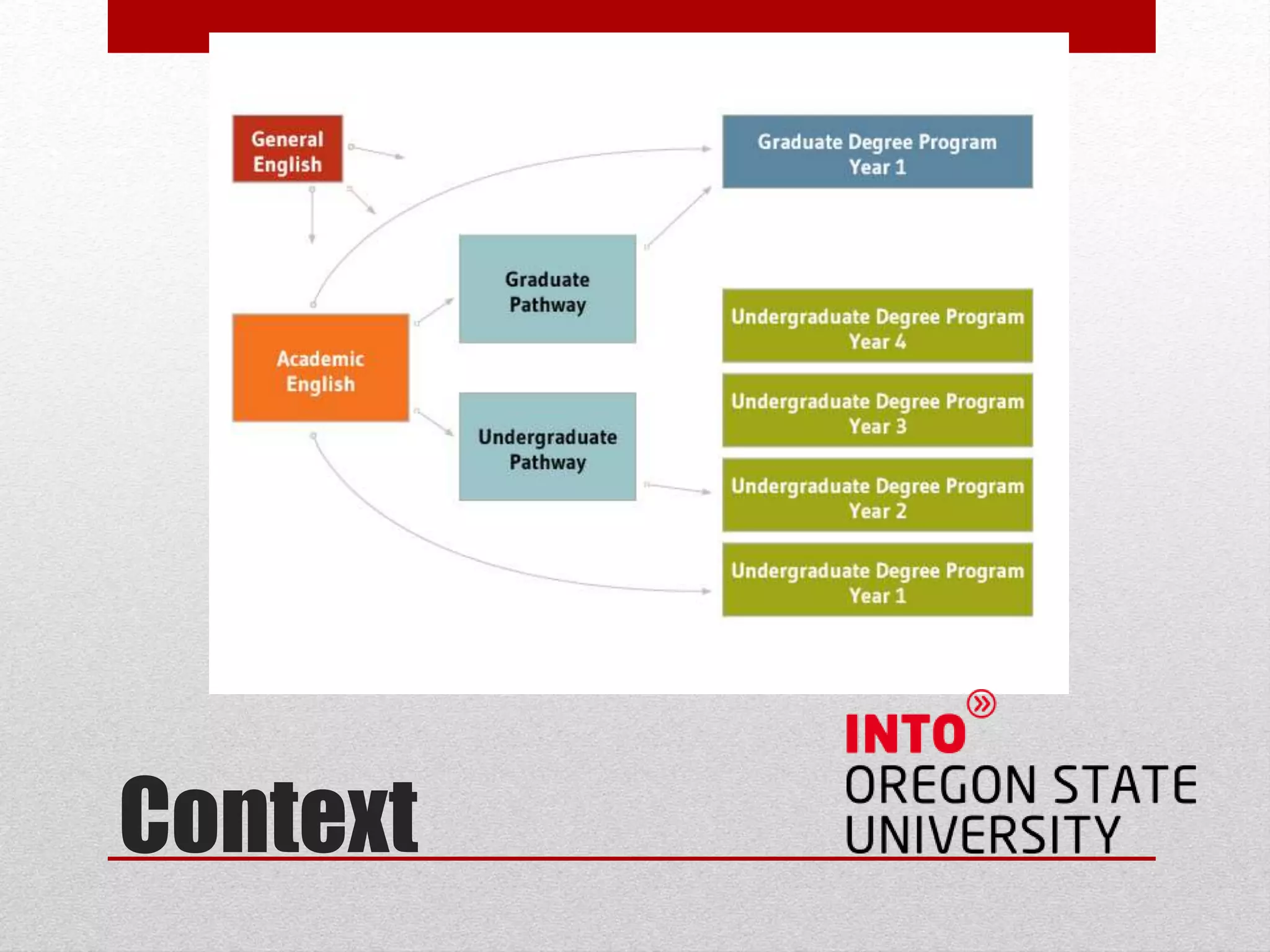
Context
Overview
• Goals of our action research project
• About TED talks
• Analyzing TED talks
• Curating
• Activities
• Reflections
• Discussion
Goals of our Action
Research Project
• Find a way to include more speaking activities in our
high-intermediate Listening/Speaking class.
• Create/curate a list of TED talks that are level and/or
topic appropriate.
• Create and pilot activities that integrate listening,
speaking, and notetaking skills.
• Reflect and revise the activities used in class.
Discussion
• Have you used TED talks in any of your
classes?
• When you select a TED talk, what criteria
do you use?
About TED Talks
• “Ideas Worth Spreading”
• Topics of global issues, societal challenges, scientific
questions
• More than 2,000 videos available with new talks
everyday
• Ordered by topics, language, duration, ratings, event,
speaker
• http://www.ted.com/talks?event=ted+conference&sort=ne
west
• Some have transcripts, English captions, and have been
translated
Benefits of Using TED talks
in the Classroom
• Promote comprehension skills
• Provide examples of effective presentation skills
• Show pronunciation in context
• Introduce new vocabulary
• Provide authentic presentations
• Expose learners to different voices in English
• Provide great discussion starters
• Springboard for further language practice
What does curating mean in
the context of English Language
Learning?
• Curator’s role for language learning
• Collect content
• Organize/sequence
• Provide language level information
• Add pedagogical support
Reference: Phil Hubbard
FACTORS TO CONSIDER WHEN
CHOOSING THE RIGHT TED
TALK FOR YOUR CLASS.
Speech Rate
• Shawn Anchor: “The Happy Secret to Better Work”
• 2:05-2:40 min.
http://www.ted.com/playlists/137/shawn_achor_work_happier
• Kenneth Cukier: “Big Data is Better Data”
• 7:26 - 8:01min.
http://www.ted.com/talkskenneth_cukier_big_data_is_better_data
**approximate words per second range 2.21 – 3.55
Examples of Speech Rates
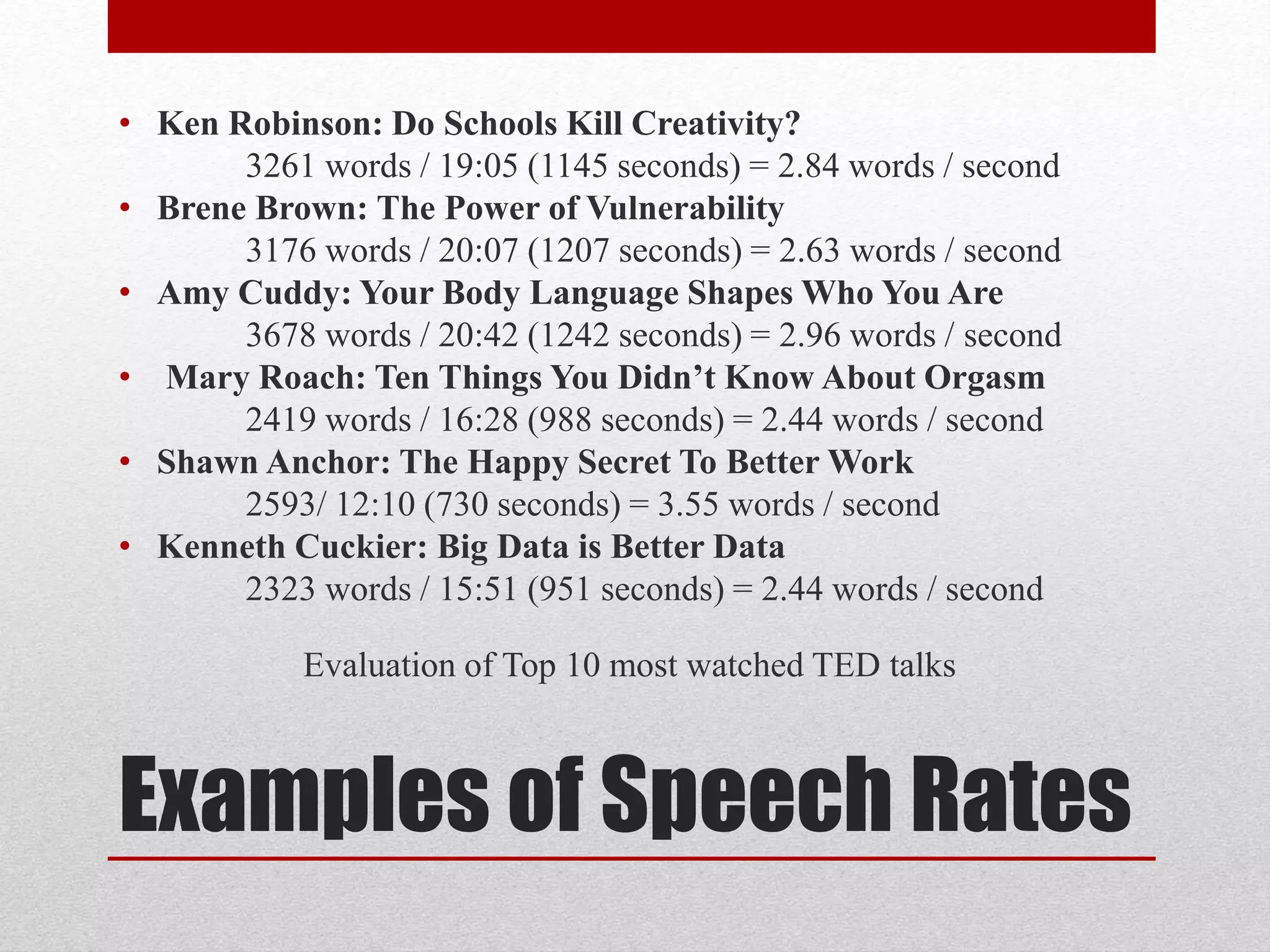
• Ken Robinson: Do Schools Kill Creativity?
3261 words / 19:05 (1145 seconds) = 2.84 words / second
• Brene Brown: The Power of Vulnerability
3176 words / 20:07 (1207 seconds) = 2.63 words / second
• Amy Cuddy: Your Body Language Shapes Who You Are
3678 words / 20:42 (1242 seconds) = 2.96 words / second
• Mary Roach: Ten Things You Didn’t Know About Orgasm
2419 words / 16:28 (988 seconds) = 2.44 words / second
• Shawn Anchor: The Happy Secret To Better Work
2593/ 12:10 (730 seconds) = 3.55 words / second
• Kenneth Cuckier: Big Data is Better Data
2323 words / 15:51 (951 seconds) = 2.44 words / second
Evaluation of Top 10 most watched TED talks
Vocabulary Load
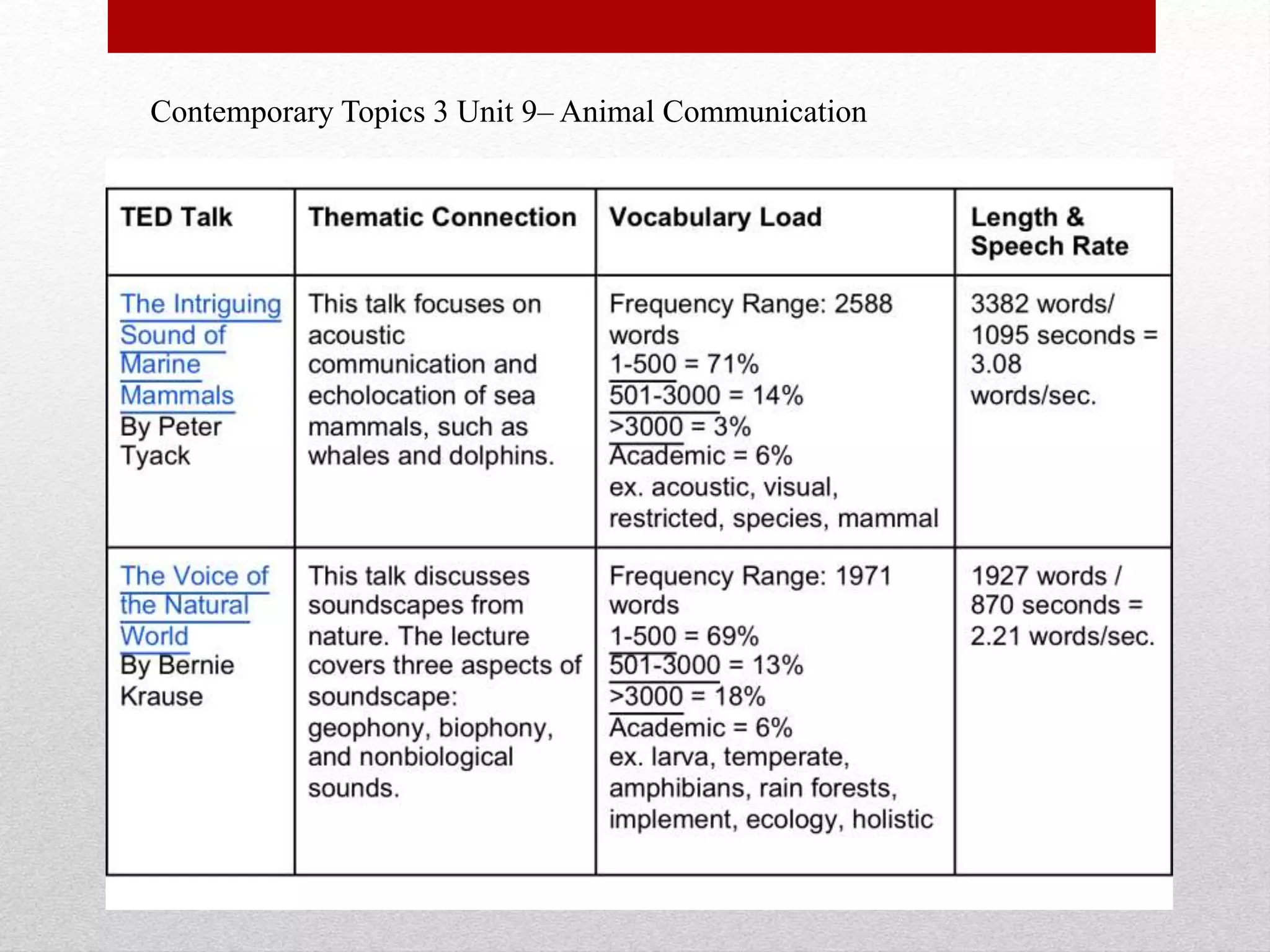
• How can you better determine if a talk is level
appropriate?
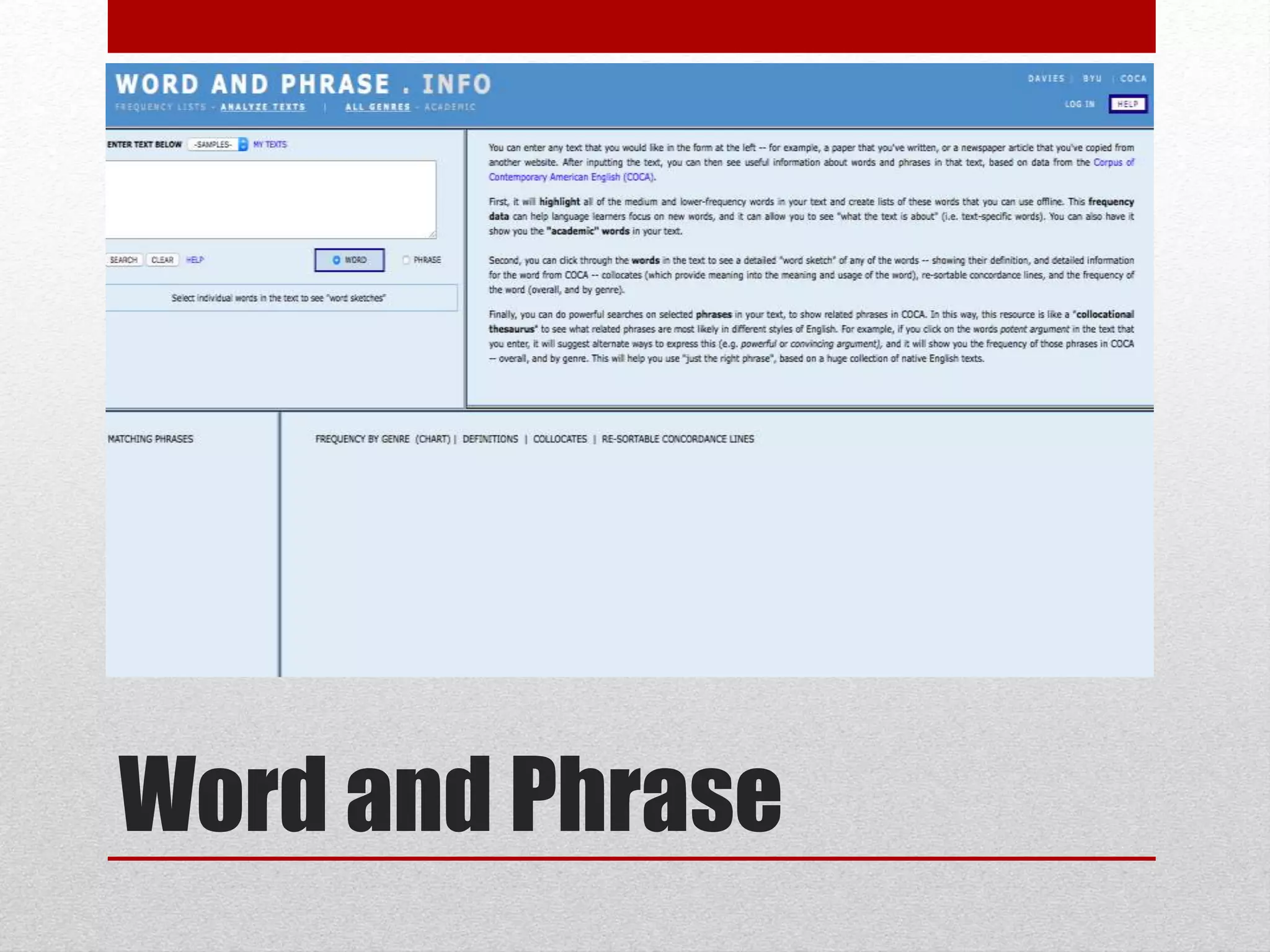
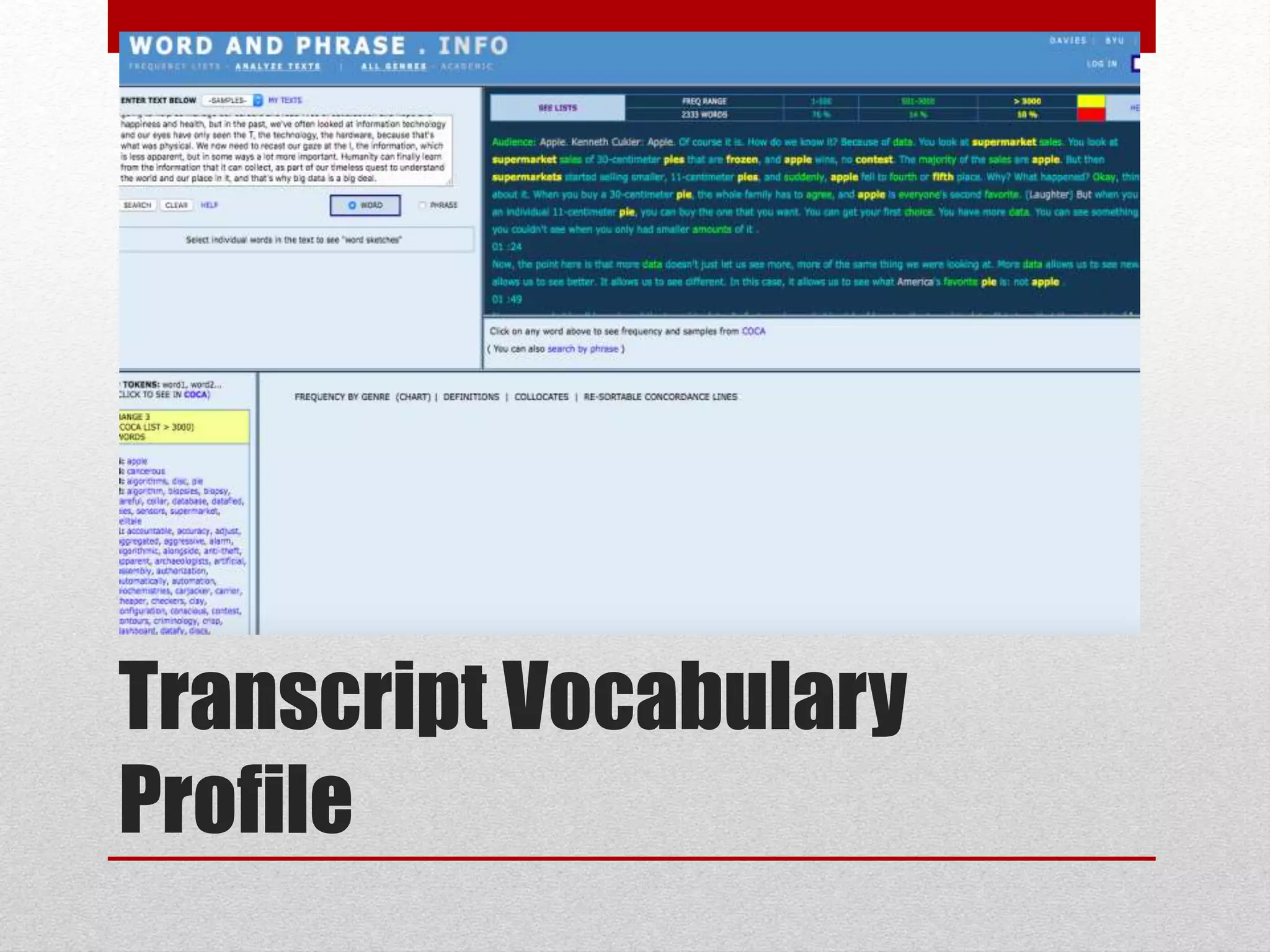
• Word and Phrase
• http://www.wordandphrase.info/
• Evaluate level of difficulty of the talk based on the
percentage of words in the different word frequency
ranges.
• Pre-teach the academic words
Word and Phrase
Transcript Vocabulary
Profile
Contemporary Topics 3 Unit 9– Animal Communication
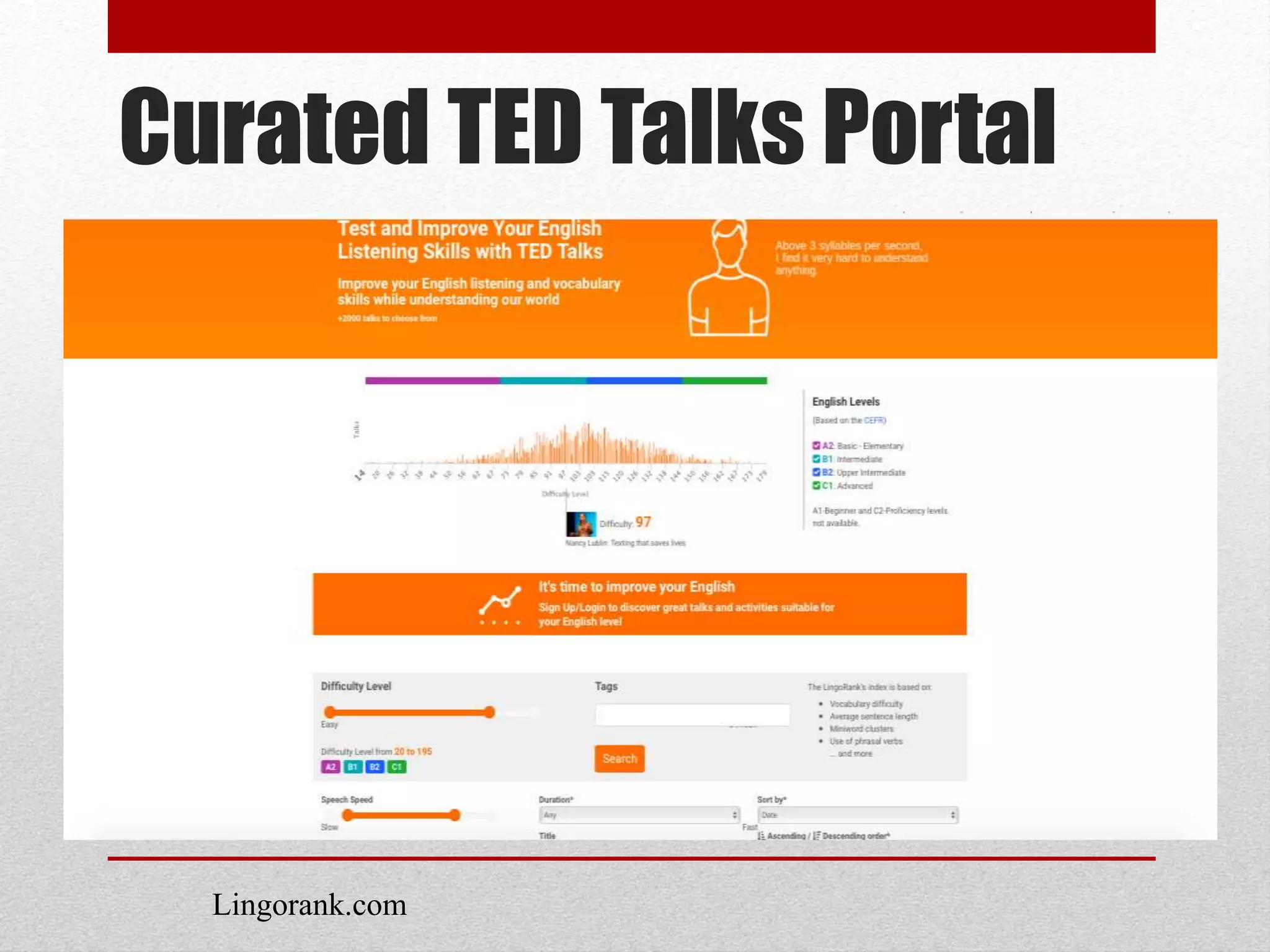
Lingorank.com
Curated TED Talks Portal
SAMPLE ACTIVITIES
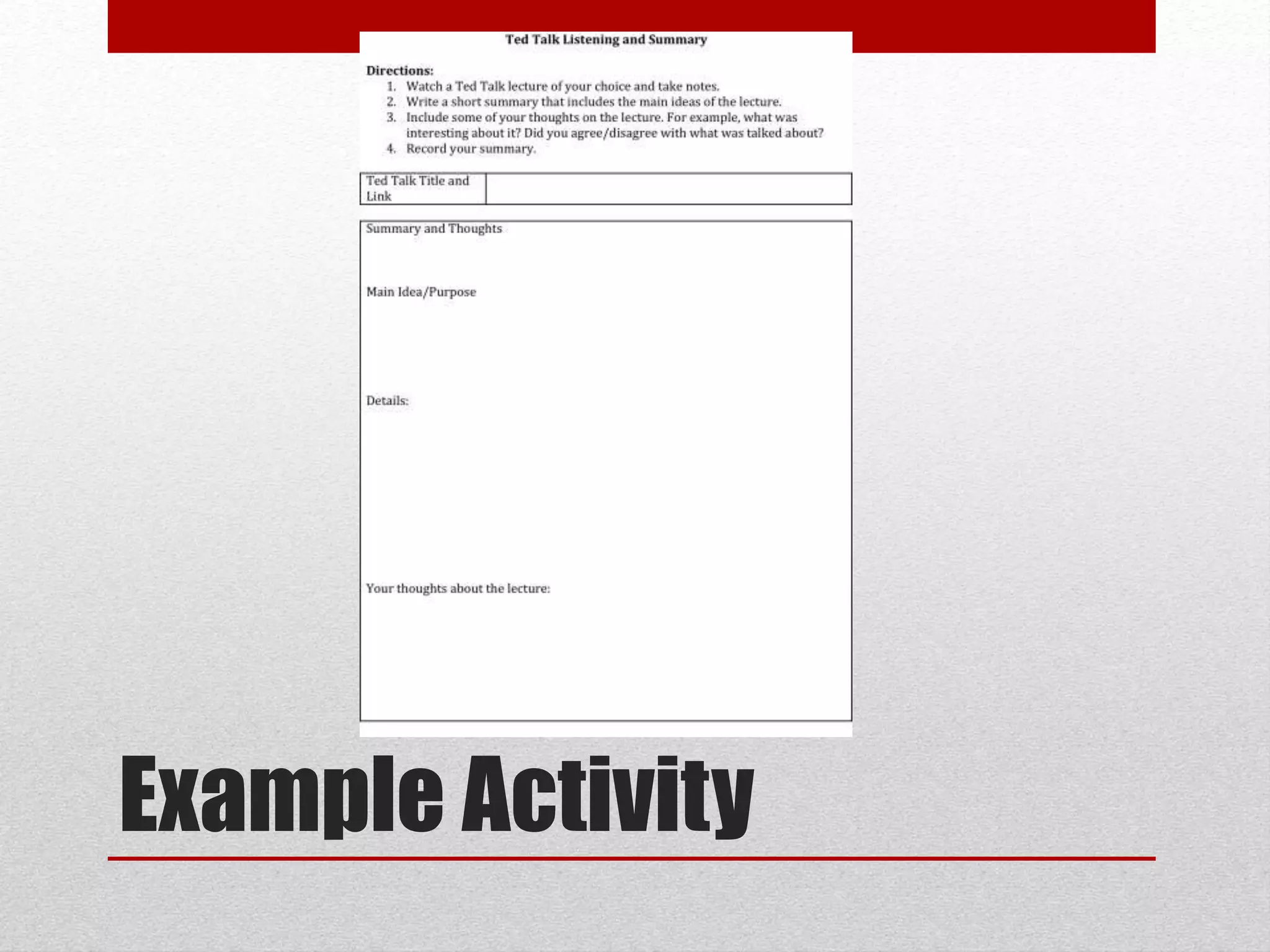
Activities…Moving away from
basic comprehension questions
• Goals
• Provide students with extra opportunities to practice their
listening and note-taking skills, as well as include some
speaking practice.
Example Activity
Speaking Activities
• One minute presentation of TED talk
• Students share the main ideas of the TED talk and comments/
thoughts on the talk.
• Goal:
• To give students a low stakes way to practice speaking in front of
the class
• Give feedback on what to work on for future presentations
• Audio Journal
• Students record their summary and thoughts of the TED talk
• Group Discussion (3-4 students)
• Students prepare a discussion question relating to their talk, give
their group a summary of their talk, and facilitate a short
discussion
Lessons Learned/Suggestions
• From the implementation of these activities we learned…
• Students need to be aware of basic notetaking strategies
first.
• Provide enough context for the material being covered in
talks.
• Preteach difficult/academic vocabulary.
• Familiarize students with TED talks in class before
assigning them to choose their own.
• Students enjoy choosing talks based on topics they are
interested in.
Quotations for Reflection
Journal
• “One positive thing about the summaries was that when I
asked them to share their summaries with the class it gave
me a chance to ask students what they thought the speaker’s
purpose was (inform, persuade, or entertain). This is a skill
that often gets overlooked in the adapted course lectures
from Contemporary Topics.”
• “In general, I feel like this activity was a success. Students
were able to practice both listening and speaking.”
CLOSING DISCUSSION
Discuss
• How can TED talks be used to promote other
language learning skills?
• How would you curate TED talks for your own
teaching context?
References
• Hubbard, P. (2013). Digital Content Curation for CALL.
4th WorldCALL Conference Glasgow: July 13, 2013.
• Floyd, M. and Jeschull, L. (2012). Teaching with TED
talks: Authentic and motivational language instruction.
November 15, 2012.

TESOL 2016 Integrating and Curating TED talks for EAPs

  • 1.
    Integrating and Curating TEDtalks for EAPS Lauren Scheel Lauren.Scheel@oregonstate.edu Randy Rebman Randy.Rebman@oregonstate.edu
  • 2.
  • 3.
    Overview • Goals ofour action research project • About TED talks • Analyzing TED talks • Curating • Activities • Reflections • Discussion
  • 4.
    Goals of ourAction Research Project • Find a way to include more speaking activities in our high-intermediate Listening/Speaking class. • Create/curate a list of TED talks that are level and/or topic appropriate. • Create and pilot activities that integrate listening, speaking, and notetaking skills. • Reflect and revise the activities used in class.
  • 5.
    Discussion • Have youused TED talks in any of your classes? • When you select a TED talk, what criteria do you use?
  • 6.
    About TED Talks •“Ideas Worth Spreading” • Topics of global issues, societal challenges, scientific questions • More than 2,000 videos available with new talks everyday • Ordered by topics, language, duration, ratings, event, speaker • http://www.ted.com/talks?event=ted+conference&sort=ne west • Some have transcripts, English captions, and have been translated
  • 7.
    Benefits of UsingTED talks in the Classroom • Promote comprehension skills • Provide examples of effective presentation skills • Show pronunciation in context • Introduce new vocabulary • Provide authentic presentations • Expose learners to different voices in English • Provide great discussion starters • Springboard for further language practice
  • 8.
    What does curatingmean in the context of English Language Learning? • Curator’s role for language learning • Collect content • Organize/sequence • Provide language level information • Add pedagogical support Reference: Phil Hubbard
  • 9.
    FACTORS TO CONSIDERWHEN CHOOSING THE RIGHT TED TALK FOR YOUR CLASS.
  • 10.
    Speech Rate • ShawnAnchor: “The Happy Secret to Better Work” • 2:05-2:40 min. http://www.ted.com/playlists/137/shawn_achor_work_happier • Kenneth Cukier: “Big Data is Better Data” • 7:26 - 8:01min. http://www.ted.com/talkskenneth_cukier_big_data_is_better_data **approximate words per second range 2.21 – 3.55
  • 11.
    Examples of SpeechRates • Ken Robinson: Do Schools Kill Creativity? 3261 words / 19:05 (1145 seconds) = 2.84 words / second • Brene Brown: The Power of Vulnerability 3176 words / 20:07 (1207 seconds) = 2.63 words / second • Amy Cuddy: Your Body Language Shapes Who You Are 3678 words / 20:42 (1242 seconds) = 2.96 words / second • Mary Roach: Ten Things You Didn’t Know About Orgasm 2419 words / 16:28 (988 seconds) = 2.44 words / second • Shawn Anchor: The Happy Secret To Better Work 2593/ 12:10 (730 seconds) = 3.55 words / second • Kenneth Cuckier: Big Data is Better Data 2323 words / 15:51 (951 seconds) = 2.44 words / second Evaluation of Top 10 most watched TED talks
  • 12.
    Vocabulary Load • Howcan you better determine if a talk is level appropriate? • Word and Phrase • http://www.wordandphrase.info/ • Evaluate level of difficulty of the talk based on the percentage of words in the different word frequency ranges. • Pre-teach the academic words
  • 13.
  • 14.
  • 15.
    Contemporary Topics 3Unit 9– Animal Communication
  • 16.
  • 17.
  • 18.
    Activities…Moving away from basiccomprehension questions • Goals • Provide students with extra opportunities to practice their listening and note-taking skills, as well as include some speaking practice.
  • 19.
  • 20.
    Speaking Activities • Oneminute presentation of TED talk • Students share the main ideas of the TED talk and comments/ thoughts on the talk. • Goal: • To give students a low stakes way to practice speaking in front of the class • Give feedback on what to work on for future presentations • Audio Journal • Students record their summary and thoughts of the TED talk • Group Discussion (3-4 students) • Students prepare a discussion question relating to their talk, give their group a summary of their talk, and facilitate a short discussion
  • 21.
    Lessons Learned/Suggestions • Fromthe implementation of these activities we learned… • Students need to be aware of basic notetaking strategies first. • Provide enough context for the material being covered in talks. • Preteach difficult/academic vocabulary. • Familiarize students with TED talks in class before assigning them to choose their own. • Students enjoy choosing talks based on topics they are interested in.
  • 22.
    Quotations for Reflection Journal •“One positive thing about the summaries was that when I asked them to share their summaries with the class it gave me a chance to ask students what they thought the speaker’s purpose was (inform, persuade, or entertain). This is a skill that often gets overlooked in the adapted course lectures from Contemporary Topics.” • “In general, I feel like this activity was a success. Students were able to practice both listening and speaking.”
  • 23.
  • 24.
    Discuss • How canTED talks be used to promote other language learning skills? • How would you curate TED talks for your own teaching context?
  • 25.
    References • Hubbard, P.(2013). Digital Content Curation for CALL. 4th WorldCALL Conference Glasgow: July 13, 2013. • Floyd, M. and Jeschull, L. (2012). Teaching with TED talks: Authentic and motivational language instruction. November 15, 2012.