WHAT IS YOUR STORY?
For this assignment, I want to take you back to the beginning of public speaking and have
you do what the ancient Greeks did: orate. The Greeks were known as the fathers of
rhetoric. They studied rhetoric first not in its written form but as a basis for oration (speech).
For this assignment, you will be speaking, creating your own Ted Talk.
!
STEP 1: WATCH at least 6 TED TALKS and
fill out 6 TED TALK WORKSHEETS
!
Go to LeonTheatre.com, click on Ted Talks and browse some of the talks that I have selected as my
favorites. But if you don’t want to see my favorites, there are 54 pages and almost 2,000 talks, on the
Ted Talk website. Go to that website (click on the link from the LeonTheatre.com Ted Talk page) and
choose any to watch. They are presented by all kinds of folk, famous and not, and they cover a
HUGE range of topics. Some of the presenters are professionals and some are just like you.
!
You can listen to as many as you like, and you can listen to parts of as many as you like, but for this
assignment you need to select SIX to report on. Some are longer than others, so you may wish to
factor time into the equation. For each of the talks you select, please fill out a TED TALK
WORKSHEET. SIX thoughtfully and completely filled out worksheets is an A. Extra worksheets will
count for EXTRA CREDIT.
!
Once you have an idea of how a casual yet well-prepared presentation can be delivered, it’s time for
you to create one yourself. Some of these talks are very long, but yours will only be a minimum of
two minutes and a maximum of three minutes.
!
STEP 2: CREATE YOUR OWN TED TALK
What in the world should you talk about? The one thing all Ted Talks have in common is that
they are delivered by people who are passionate about and believe in what they are saying.
So find something you are passionate about. It could be a particular belief you hold, a
political event, an experience you had, a person in your life, a pet, dietary choices, a class
you took, a place you visited, a hobby, music you enjoy, an expectation you have for people,
etc. You do not have to persuade someone to do something; you may simply present
something beautiful.
!
!
!
STEP 3: PREPARE YOUR
PLANNING SHEET & A VISUAL
You will not be handing in an essay. You may write your talk out as if it was an essay, but you will not
be able to read it word for word. So outline your talk on the PREPARATION sheet, and that will
be a PAPERWORK grade. What you do to elaborate upon your outline is up to you. If necessary,
you may use note cards during your talk. You will also prepare a visual to go with your talk. This
could be a PowerPoint presentation, a poster, a photo, a prop, a chart/graph, whatever visual you
think works best with your talk.
!
STEP 4: PRACTICE, PRACTICE, PRACTICE
Even if you are a practiced orator, you must practice, practice, practice. You will be graded on the
quality of your content and also the quality of your talk. What makes a good speech? Well, beyond
the obvious (content), it's presentation. You must speak at an even pace (not too fast and not too
slow), you must speak clearly, you must use inflection, you must rid your speech of “like,” “um,” “ya
know,” etc. The only way to make sure you are addressing all of these elements is to practice. You
also need to be attentive to body language and posture: what you do with your face, your hands,
and posture—they all speak volumes (pun intended). Watch yourself perform in a mirror, record
yourself with your phone and that will help you to get it ready for evaluation and performance!
!
STEP 5: TWO PEER EVALUATIONS
You will need 2 peer evaluations. These will come from 2 of your group members. You will do your
speech for them and they will evaluate you. You must also do 2 peer evaluations for other students
in your group. So if they watch yours and evaluate you, then you watch theirs and evaluate them!
Completed and well thought out peer evaluations will count as a PARTICIPATION GRADE for you!
!
STEP 6: PERFORM
Performances will be May 20th-23rd in class. Once all
performances are done, WE ARE FINISHED FOR THE YEAR!!!
Ethos
Ethos is the credibility of the speaker or writer. In order to engage an audience on a particular topic,
the person presenting the information must first establish him or herself as someone that can be
trusted, or as someone who has a lot of experience with the topic. This is also known as ethics.
THINK ETHICAL APPEAL (It’s the right thing, trust me, I’m an expert…)
Ethos appeals to:
• Intelligence
• Virtue
• Morals
• Perception of trustworthiness
Pathos
Pathos accesses the emotions and deeply held beliefs of the audience to draw them into the subject
matter. Pathos often makes audiences feel like they have a personal stake in the information being
provided and is often the catalyst that drives them into action. THINK EMOTIONAL (It will make you
happy, popular, safe, full, awesome…)
Pathos appeals to:
• Emotions and feelings
• Biases and prejudices
• Senses
• Motivations
Logos
Logos uses logic, reasoning, evidence, and facts to support an argument. Logos appeals to the more
rational side of the audience’s minds, and provides support for the subject matter. Logos strategies
can often be used to strengthen the impact pathos has on the audience. THINK LOGICAL (It’s smart
to choose this because…)
Logos utilizes:
• Evidence
• Testimony
• Statistics and Data
• Universal truths
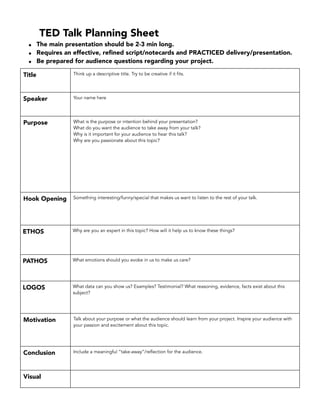
TED Talk Planning Sheet
• The main presentation should be 2-3 min long.
• Requires an effective, refined script/notecards and PRACTICED delivery/presentation.
• Be prepared for audience questions regarding your project.
Title Think up a descriptive title. Try to be creative if it fits.
Speaker Your name here
Purpose What is the purpose or intention behind your presentation?
What do you want the audience to take away from your talk?
Why is it important for your audience to hear this talk?
Why are you passionate about this topic?
Hook Opening Something interesting/funny/special that makes us want to listen to the rest of your talk.
ETHOS Why are you an expert in this topic? How will it help us to know these things?
PATHOS What emotions should you evoke in us to make us care?
LOGOS What data can you show us? Examples? Testimonial? What reasoning, evidence, facts exist about this
subject?
!
Motivation Talk about your purpose or what the audience should learn from your project. Inspire your audience with
your passion and excitement about this topic.
Conclusion Include a meaningful “take-away”/reflection for the audience.
Visual
!
PEER EVALUATION
!
!
EVALUATED BY Name_______________________________ Date____/______/2019
!
!
Description 4
Excellent
3
Good
2
Progressing
1
Not Yet
Eye Contact
with
Audience
Holds attention of entire audience with the use of
direct eye contact, rarely looking at notes.
Volume,
Articulation,
Clarity
Speaks with variations in volume and inflection to
maintain audience interest and emphasize key
points.
Body
Language
“Works” the room without fidgeting or swaying.
Gestures are helpful in delivering content
information.
Information
was well
Organized
Provides clear purpose and subject; important
examples, facts; demonstrates full knowledge by
answering all audience questions with
explanations and elaboration (if applicable).
Visuals Visual information is interesting and useful.
ETHOS The presenter establishes a persuasive reason why
they have chosen this topic and why you should
listen to them speaking.
PATHOS The presentation has an emotional tone that
engages the audience in some way.
LOGOS There is logical information delivered in the
speech.
Hook
Opening and
Solid
Conclusion
Presentation opens in a creative and interesting
way and is wrapped up with a strong summary.
Evidence of
Rehearsal
The student, not the visuals, drives the talk. It is
evident that this speech has been well rehearsed.
!
Time Frame The presentation was properly timed, 2-3 minutes.
PEER EVALUATION
!
!
!
EVALUATED BY Name___________________________________ Date____/______/2019
Description 4
Excellent
3
Good
2
Progressing
1
Not Yet
Eye Contact
with
Audience
Holds attention of entire audience with the use of
direct eye contact, rarely looking at notes.
Volume,
Articulation,
Clarity
Speaks with variations in volume and inflection to
maintain audience interest and emphasize key
points.
Body
Language
“Works” the room without fidgeting or swaying.
Gestures are helpful in delivering content
information.
Information
was well
Organized
Provides clear purpose and subject; important
examples, facts; demonstrates full knowledge by
answering all audience questions with
explanations and elaboration (if applicable).
Visuals Visual information is interesting and useful.
ETHOS The presenter establishes a persuasive reason why
they have chosen this topic and why you should
listen to them speaking.
PATHOS The presentation has an emotional tone that
engages the audience in some way.
LOGOS There is logical information delivered in the
speech.
Hook
Opening and
Solid
Conclusion
Presentation opens in a creative and interesting
way and is wrapped up with a strong summary.
Evidence of
Rehearsal
The student, not the visuals, drives the talk. It is
evident that this speech has been well rehearsed.
!
Time Frame The presentation was properly timed, 2-3 minutes.

TED Talk

  • 1.
    WHAT IS YOURSTORY? For this assignment, I want to take you back to the beginning of public speaking and have you do what the ancient Greeks did: orate. The Greeks were known as the fathers of rhetoric. They studied rhetoric first not in its written form but as a basis for oration (speech). For this assignment, you will be speaking, creating your own Ted Talk. ! STEP 1: WATCH at least 6 TED TALKS and fill out 6 TED TALK WORKSHEETS ! Go to LeonTheatre.com, click on Ted Talks and browse some of the talks that I have selected as my favorites. But if you don’t want to see my favorites, there are 54 pages and almost 2,000 talks, on the Ted Talk website. Go to that website (click on the link from the LeonTheatre.com Ted Talk page) and choose any to watch. They are presented by all kinds of folk, famous and not, and they cover a HUGE range of topics. Some of the presenters are professionals and some are just like you. ! You can listen to as many as you like, and you can listen to parts of as many as you like, but for this assignment you need to select SIX to report on. Some are longer than others, so you may wish to factor time into the equation. For each of the talks you select, please fill out a TED TALK WORKSHEET. SIX thoughtfully and completely filled out worksheets is an A. Extra worksheets will count for EXTRA CREDIT. ! Once you have an idea of how a casual yet well-prepared presentation can be delivered, it’s time for you to create one yourself. Some of these talks are very long, but yours will only be a minimum of two minutes and a maximum of three minutes. ! STEP 2: CREATE YOUR OWN TED TALK What in the world should you talk about? The one thing all Ted Talks have in common is that they are delivered by people who are passionate about and believe in what they are saying. So find something you are passionate about. It could be a particular belief you hold, a political event, an experience you had, a person in your life, a pet, dietary choices, a class you took, a place you visited, a hobby, music you enjoy, an expectation you have for people, etc. You do not have to persuade someone to do something; you may simply present something beautiful. ! ! !
  • 2.
    STEP 3: PREPAREYOUR PLANNING SHEET & A VISUAL You will not be handing in an essay. You may write your talk out as if it was an essay, but you will not be able to read it word for word. So outline your talk on the PREPARATION sheet, and that will be a PAPERWORK grade. What you do to elaborate upon your outline is up to you. If necessary, you may use note cards during your talk. You will also prepare a visual to go with your talk. This could be a PowerPoint presentation, a poster, a photo, a prop, a chart/graph, whatever visual you think works best with your talk. ! STEP 4: PRACTICE, PRACTICE, PRACTICE Even if you are a practiced orator, you must practice, practice, practice. You will be graded on the quality of your content and also the quality of your talk. What makes a good speech? Well, beyond the obvious (content), it's presentation. You must speak at an even pace (not too fast and not too slow), you must speak clearly, you must use inflection, you must rid your speech of “like,” “um,” “ya know,” etc. The only way to make sure you are addressing all of these elements is to practice. You also need to be attentive to body language and posture: what you do with your face, your hands, and posture—they all speak volumes (pun intended). Watch yourself perform in a mirror, record yourself with your phone and that will help you to get it ready for evaluation and performance! ! STEP 5: TWO PEER EVALUATIONS You will need 2 peer evaluations. These will come from 2 of your group members. You will do your speech for them and they will evaluate you. You must also do 2 peer evaluations for other students in your group. So if they watch yours and evaluate you, then you watch theirs and evaluate them! Completed and well thought out peer evaluations will count as a PARTICIPATION GRADE for you! ! STEP 6: PERFORM Performances will be May 20th-23rd in class. Once all performances are done, WE ARE FINISHED FOR THE YEAR!!!
  • 3.
    Ethos Ethos is thecredibility of the speaker or writer. In order to engage an audience on a particular topic, the person presenting the information must first establish him or herself as someone that can be trusted, or as someone who has a lot of experience with the topic. This is also known as ethics. THINK ETHICAL APPEAL (It’s the right thing, trust me, I’m an expert…) Ethos appeals to: • Intelligence • Virtue • Morals • Perception of trustworthiness Pathos Pathos accesses the emotions and deeply held beliefs of the audience to draw them into the subject matter. Pathos often makes audiences feel like they have a personal stake in the information being provided and is often the catalyst that drives them into action. THINK EMOTIONAL (It will make you happy, popular, safe, full, awesome…) Pathos appeals to: • Emotions and feelings • Biases and prejudices • Senses • Motivations Logos Logos uses logic, reasoning, evidence, and facts to support an argument. Logos appeals to the more rational side of the audience’s minds, and provides support for the subject matter. Logos strategies can often be used to strengthen the impact pathos has on the audience. THINK LOGICAL (It’s smart to choose this because…) Logos utilizes: • Evidence • Testimony • Statistics and Data • Universal truths
  • 4.
    TED Talk PlanningSheet • The main presentation should be 2-3 min long. • Requires an effective, refined script/notecards and PRACTICED delivery/presentation. • Be prepared for audience questions regarding your project. Title Think up a descriptive title. Try to be creative if it fits. Speaker Your name here Purpose What is the purpose or intention behind your presentation? What do you want the audience to take away from your talk? Why is it important for your audience to hear this talk? Why are you passionate about this topic? Hook Opening Something interesting/funny/special that makes us want to listen to the rest of your talk. ETHOS Why are you an expert in this topic? How will it help us to know these things? PATHOS What emotions should you evoke in us to make us care? LOGOS What data can you show us? Examples? Testimonial? What reasoning, evidence, facts exist about this subject? ! Motivation Talk about your purpose or what the audience should learn from your project. Inspire your audience with your passion and excitement about this topic. Conclusion Include a meaningful “take-away”/reflection for the audience. Visual
  • 5.
    ! PEER EVALUATION ! ! EVALUATED BYName_______________________________ Date____/______/2019 ! ! Description 4 Excellent 3 Good 2 Progressing 1 Not Yet Eye Contact with Audience Holds attention of entire audience with the use of direct eye contact, rarely looking at notes. Volume, Articulation, Clarity Speaks with variations in volume and inflection to maintain audience interest and emphasize key points. Body Language “Works” the room without fidgeting or swaying. Gestures are helpful in delivering content information. Information was well Organized Provides clear purpose and subject; important examples, facts; demonstrates full knowledge by answering all audience questions with explanations and elaboration (if applicable). Visuals Visual information is interesting and useful. ETHOS The presenter establishes a persuasive reason why they have chosen this topic and why you should listen to them speaking. PATHOS The presentation has an emotional tone that engages the audience in some way. LOGOS There is logical information delivered in the speech. Hook Opening and Solid Conclusion Presentation opens in a creative and interesting way and is wrapped up with a strong summary. Evidence of Rehearsal The student, not the visuals, drives the talk. It is evident that this speech has been well rehearsed. ! Time Frame The presentation was properly timed, 2-3 minutes.
  • 6.
    PEER EVALUATION ! ! ! EVALUATED BYName___________________________________ Date____/______/2019 Description 4 Excellent 3 Good 2 Progressing 1 Not Yet Eye Contact with Audience Holds attention of entire audience with the use of direct eye contact, rarely looking at notes. Volume, Articulation, Clarity Speaks with variations in volume and inflection to maintain audience interest and emphasize key points. Body Language “Works” the room without fidgeting or swaying. Gestures are helpful in delivering content information. Information was well Organized Provides clear purpose and subject; important examples, facts; demonstrates full knowledge by answering all audience questions with explanations and elaboration (if applicable). Visuals Visual information is interesting and useful. ETHOS The presenter establishes a persuasive reason why they have chosen this topic and why you should listen to them speaking. PATHOS The presentation has an emotional tone that engages the audience in some way. LOGOS There is logical information delivered in the speech. Hook Opening and Solid Conclusion Presentation opens in a creative and interesting way and is wrapped up with a strong summary. Evidence of Rehearsal The student, not the visuals, drives the talk. It is evident that this speech has been well rehearsed. ! Time Frame The presentation was properly timed, 2-3 minutes.