Tracking compliance of the REF2021
policy with the CORE Repository
Dashboard
PRESENTERS
26 March 2020
Big Scientific Data and Text Analytics Group
Knowledge Media Institute, The Open University
ToC
• Introducing CORE – Nancy
• CORE and REF2021 audit – Petr
• Where is CORE mentioned
• How CORE collects data
• CORE Repository Dashboard demonstration - David
• Getting access to the Dashboard
1
CORE’s mission
2
Aggregate all open access research articles worldwide …
… enrich this content and provide seamless access to it through a set
of data services …
Types of content providers
CORE harvests from everywhere:
• Repositories
• Institutional
• Includes repository and CRIS platforms
• Disciplinary
• Journals
• Pure Open Access
• Gold Open Access
3
Introducing CORE
4
World’s largest dataset of Open Access
full texts
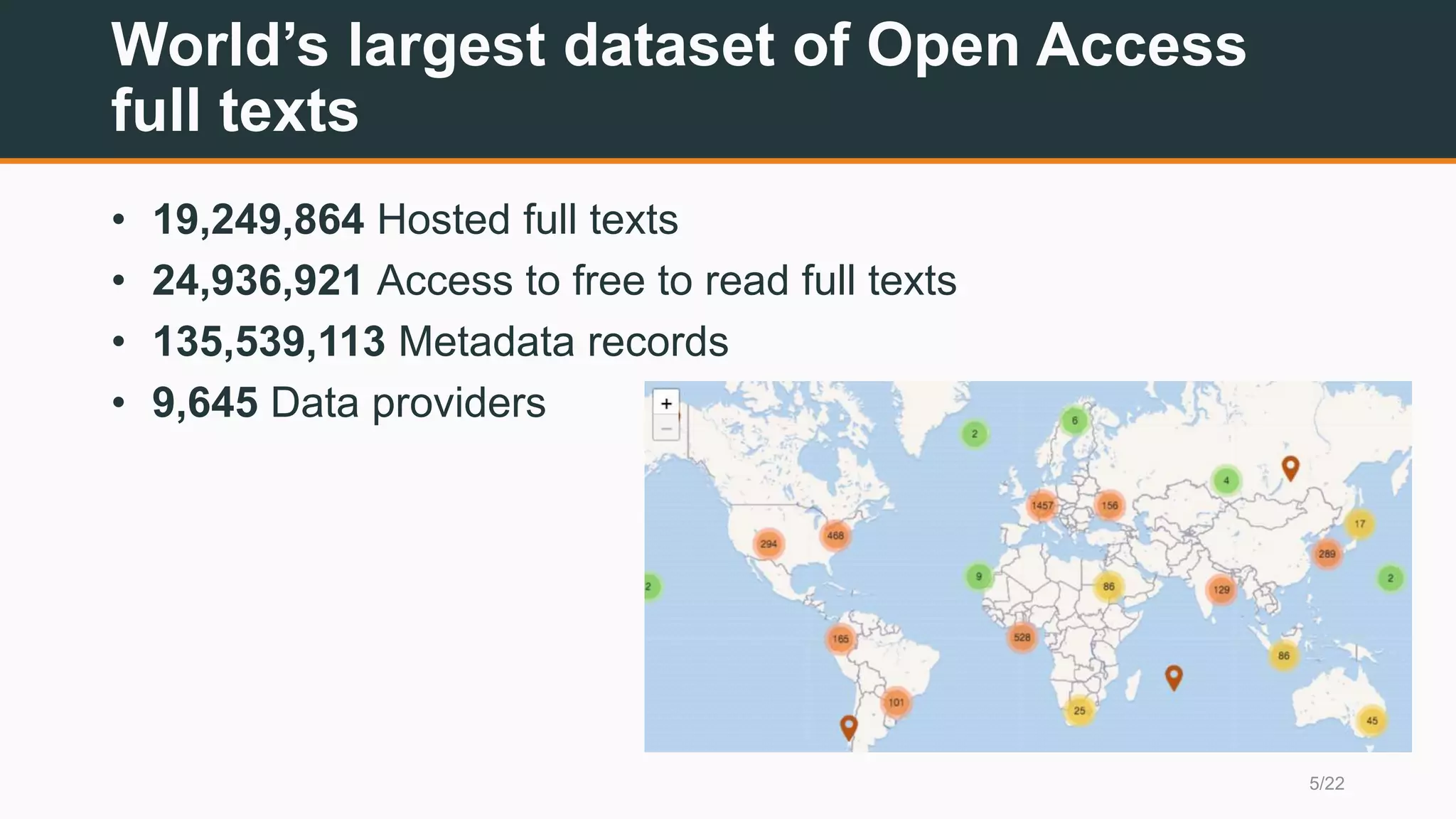
• 19,249,864 Hosted full texts
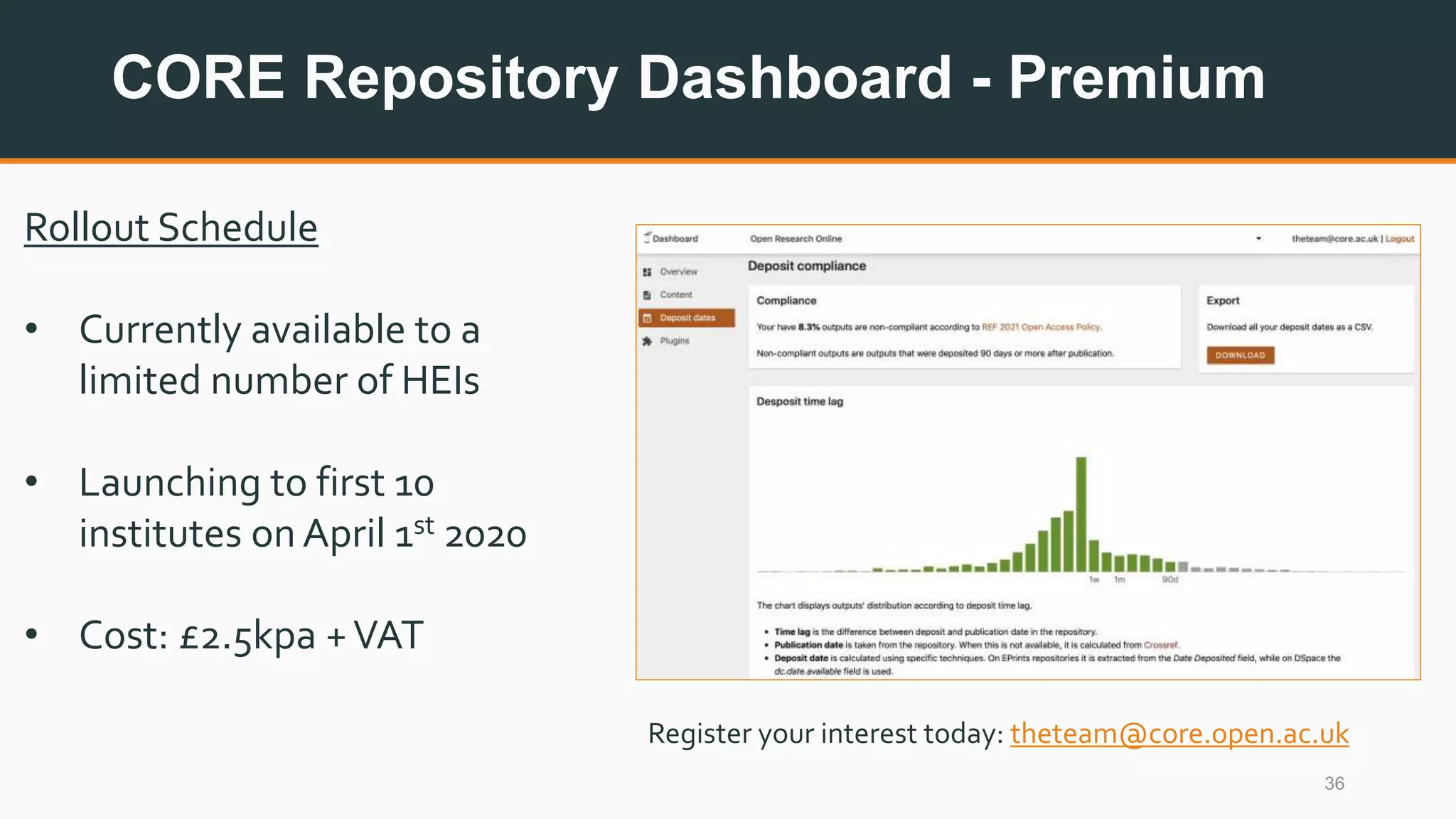
• 24,936,921 Access to free to read full texts
• 135,539,113 Metadata records
• 9,645 Data providers
5/22
Papers OA sooner and sooner
6/22https://physicstoday.scitation.org/do/10.1063/PT.6.2.20190418a/full/
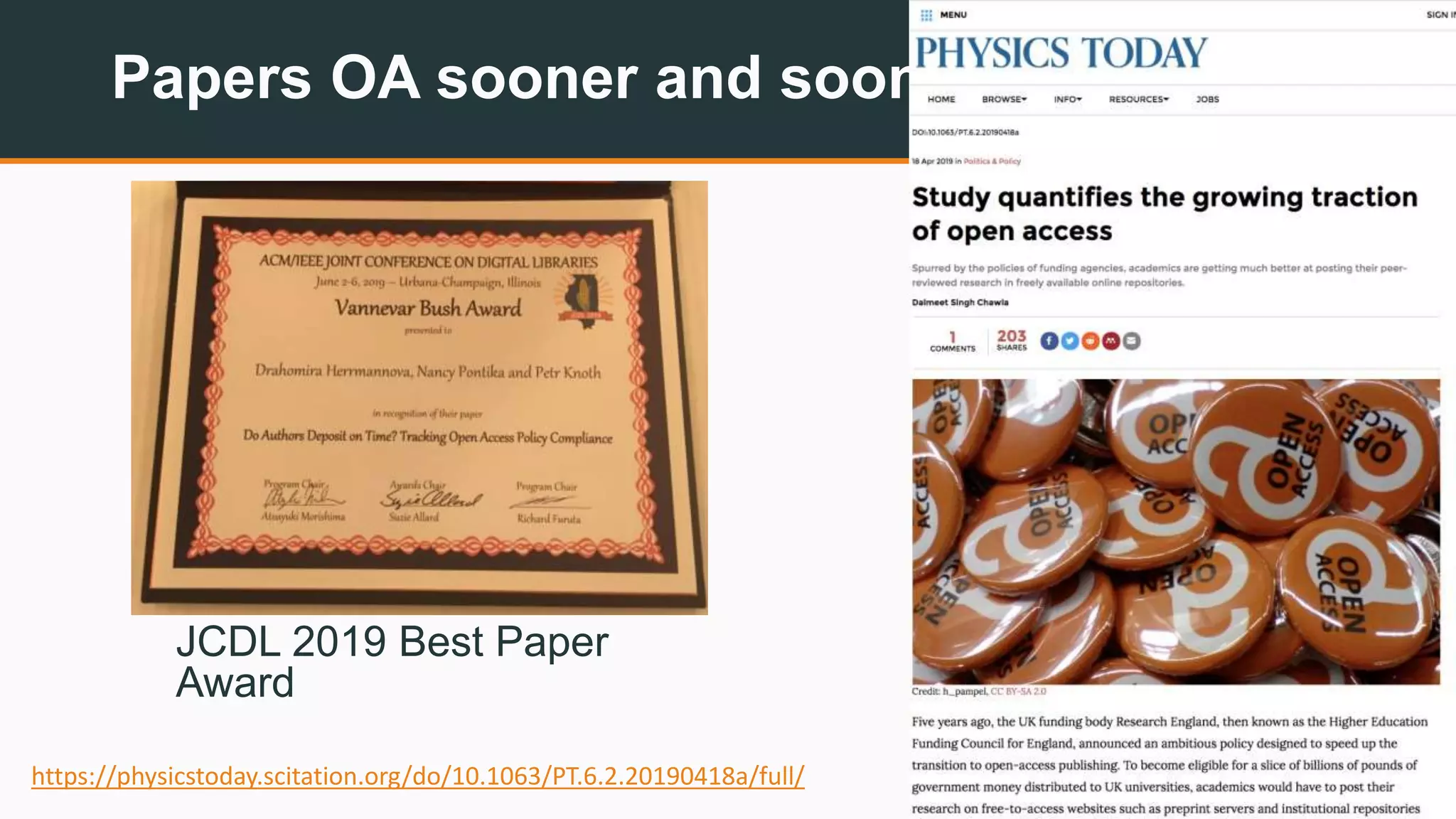
JCDL 2019 Best Paper
Award
Papers OA sooner and sooner
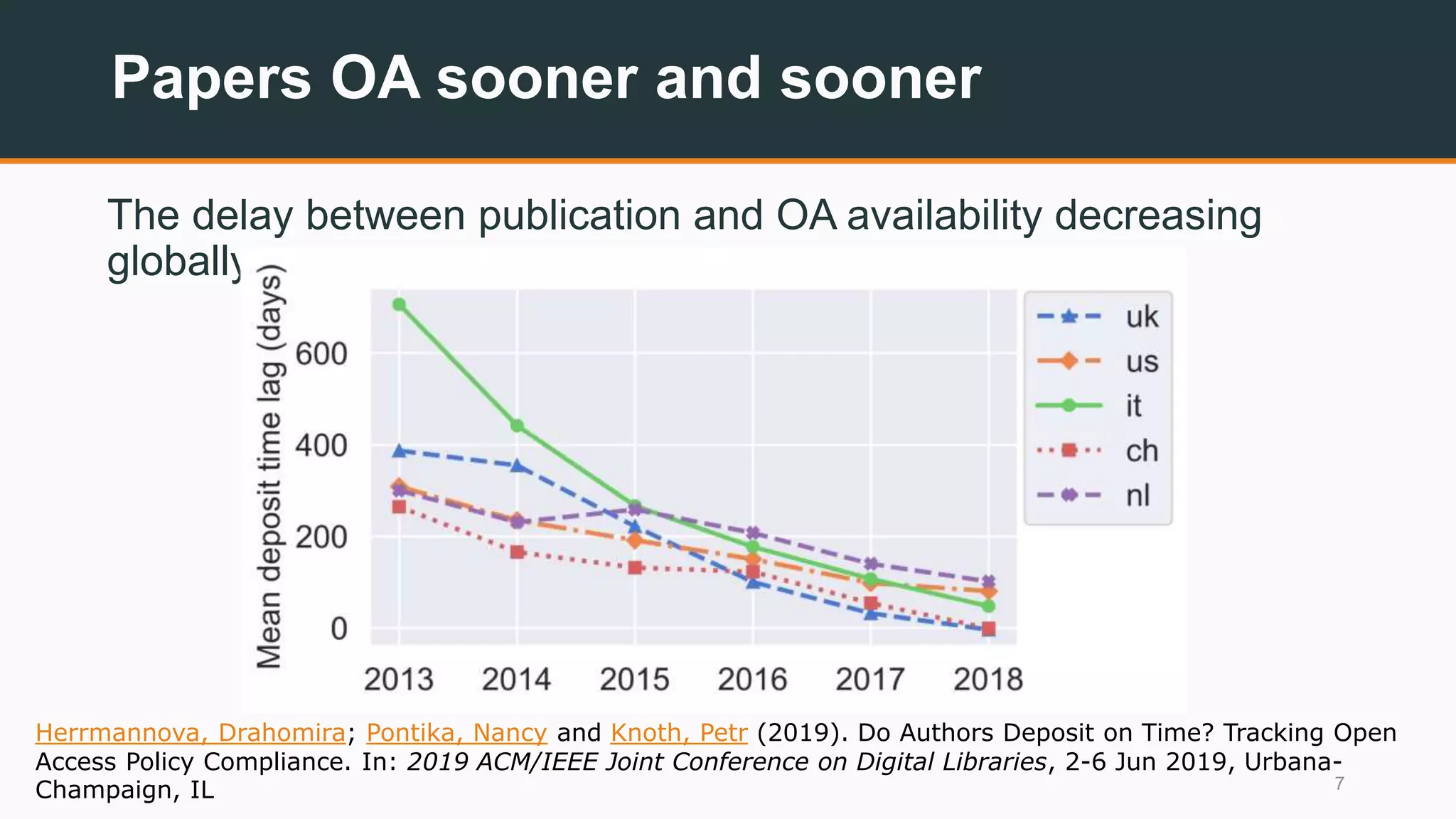
The delay between publication and OA availability decreasing
globally
7
Herrmannova, Drahomira; Pontika, Nancy and Knoth, Petr (2019). Do Authors Deposit on Time? Tracking Open
Access Policy Compliance. In: 2019 ACM/IEEE Joint Conference on Digital Libraries, 2-6 Jun 2019, Urbana-
Champaign, IL
Faster open access makes repository
infrastructure more important
8
We don’t need just open access
we need fast open access
9
This study was only possible to conduct because
of repositories and aggregators working together
10
Need for more interoperability across systems
11
CORE and REF2021 audit
• Introducing CORE
• CORE and REF2021 audit
• Where is CORE mentioned
• How CORE collects data
• CORE Repository Dashboard demonstration
• Getting access to the Dashboard
12
CORE’s work on REF2021 audit
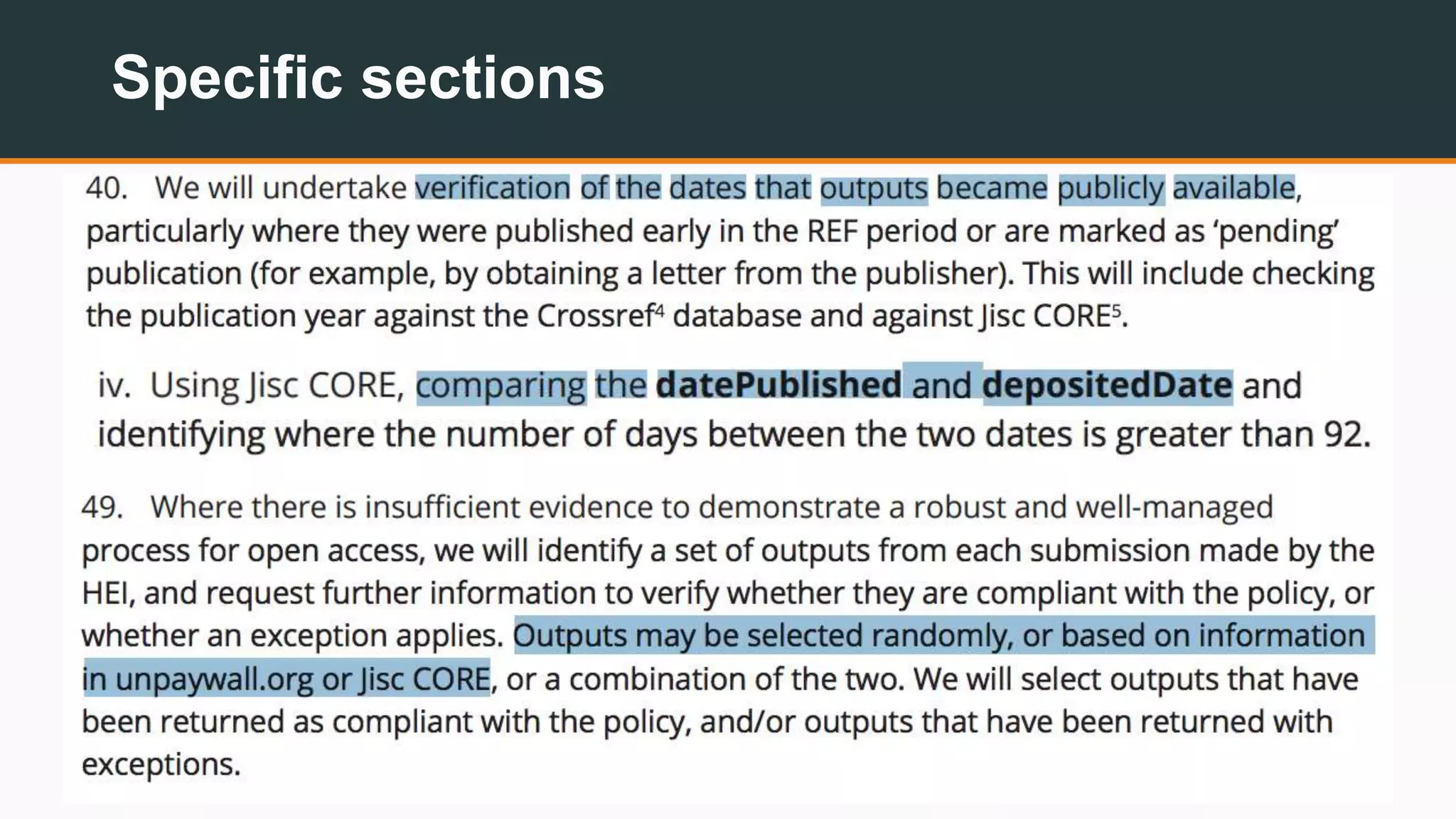
CORE data will be used in the REF 2021 Open Access Policy
Audit
Related sections: 40, 46 and 49.
13
Specific sections
14
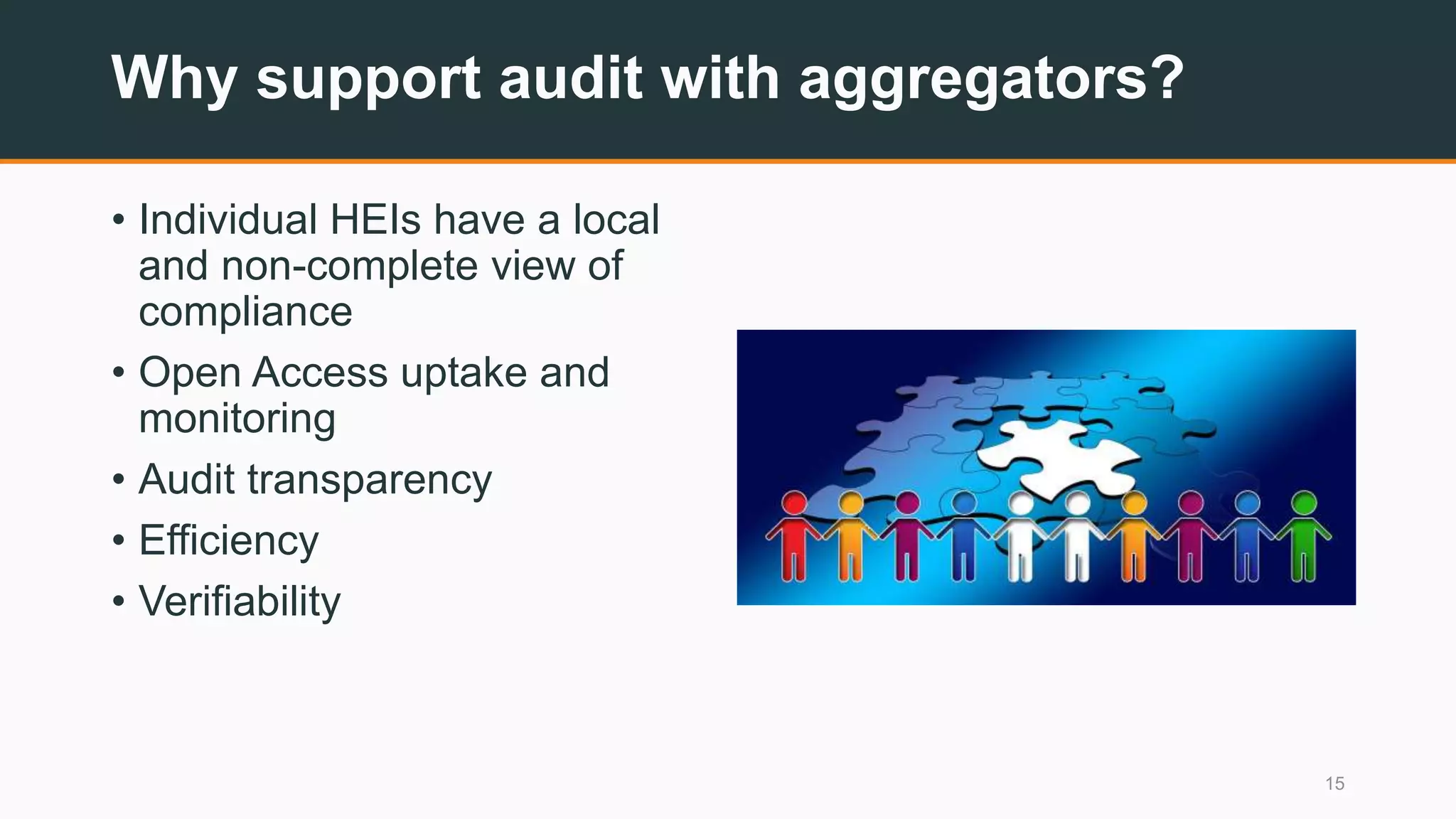
Why support audit with aggregators?
• Individual HEIs have a local
and non-complete view of
compliance
• Open Access uptake and
monitoring
• Audit transparency
• Efficiency
• Verifiability
15
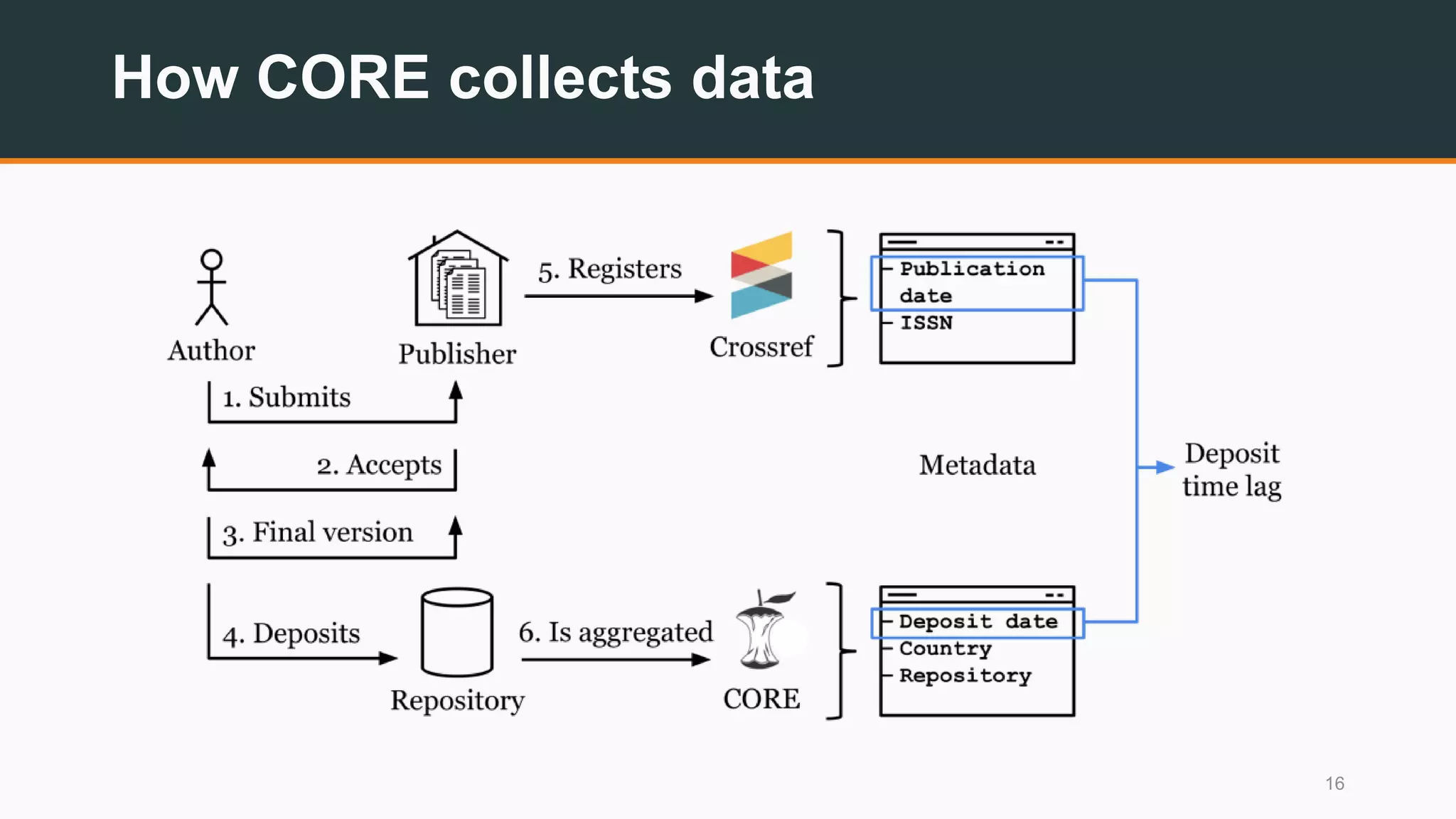
How CORE collects data
16
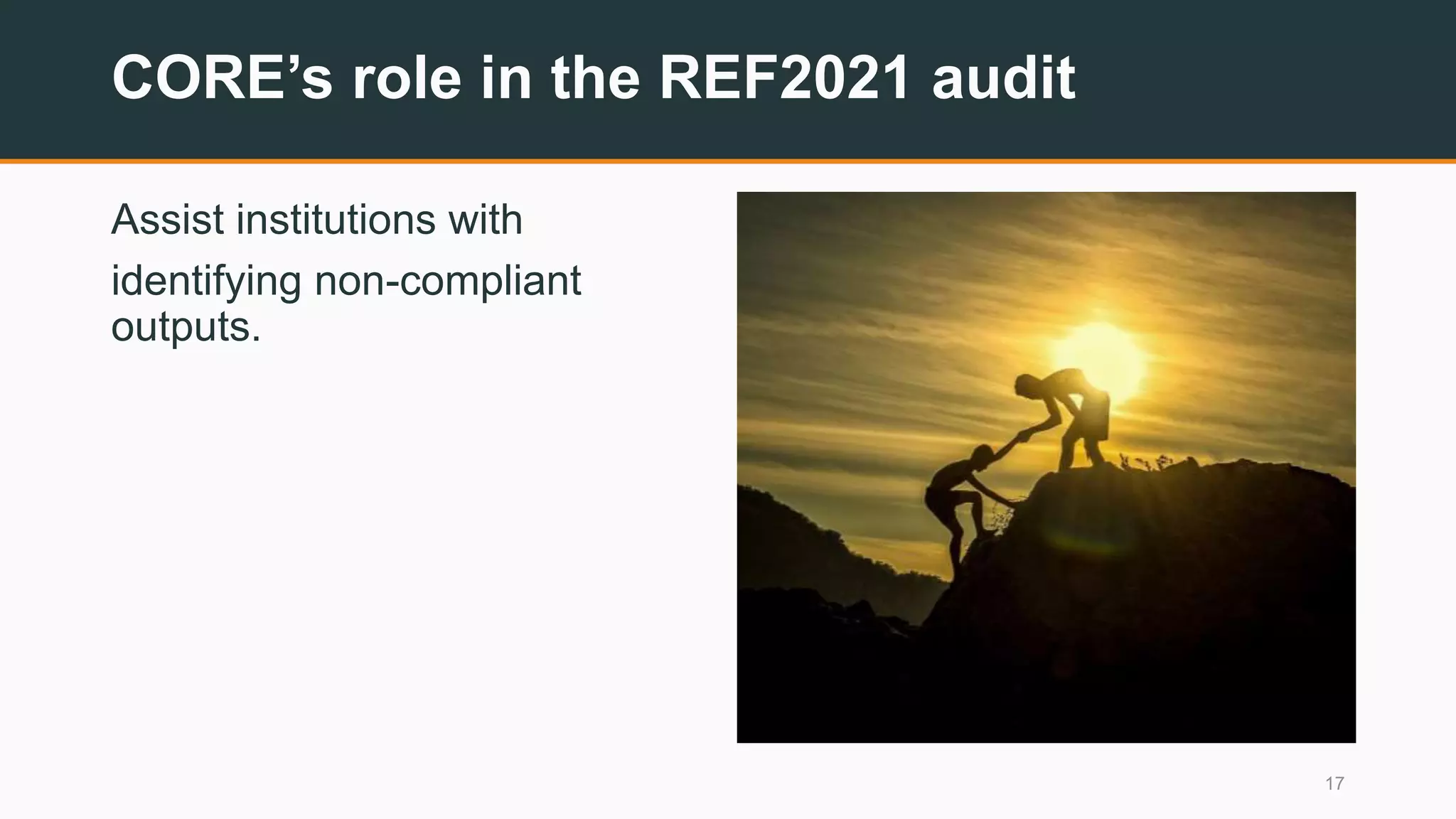
CORE’s role in the REF2021 audit
Assist institutions with
identifying non-compliant
outputs.
17
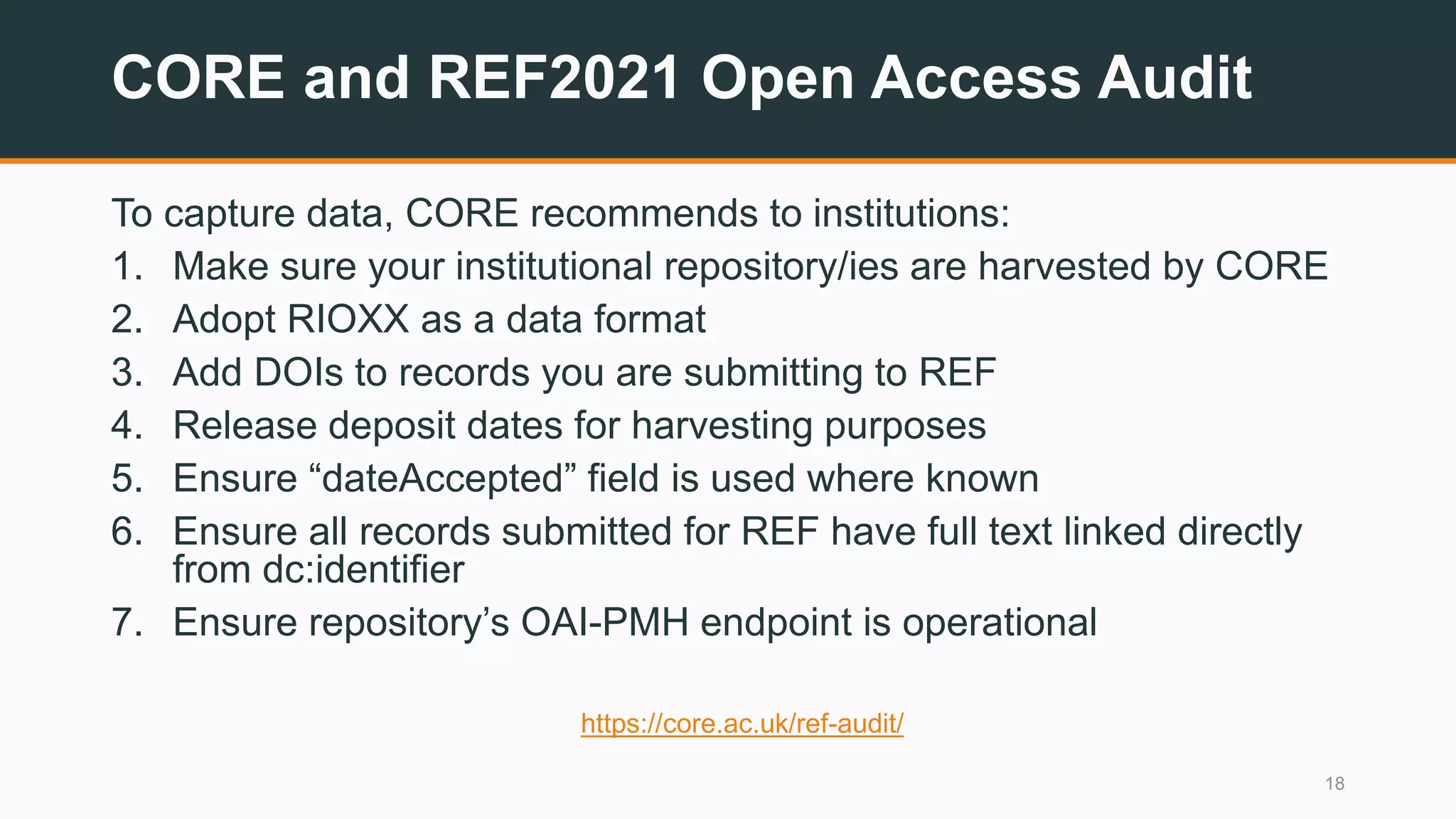
CORE and REF2021 Open Access Audit
To capture data, CORE recommends to institutions:
1. Make sure your institutional repository/ies are harvested by CORE
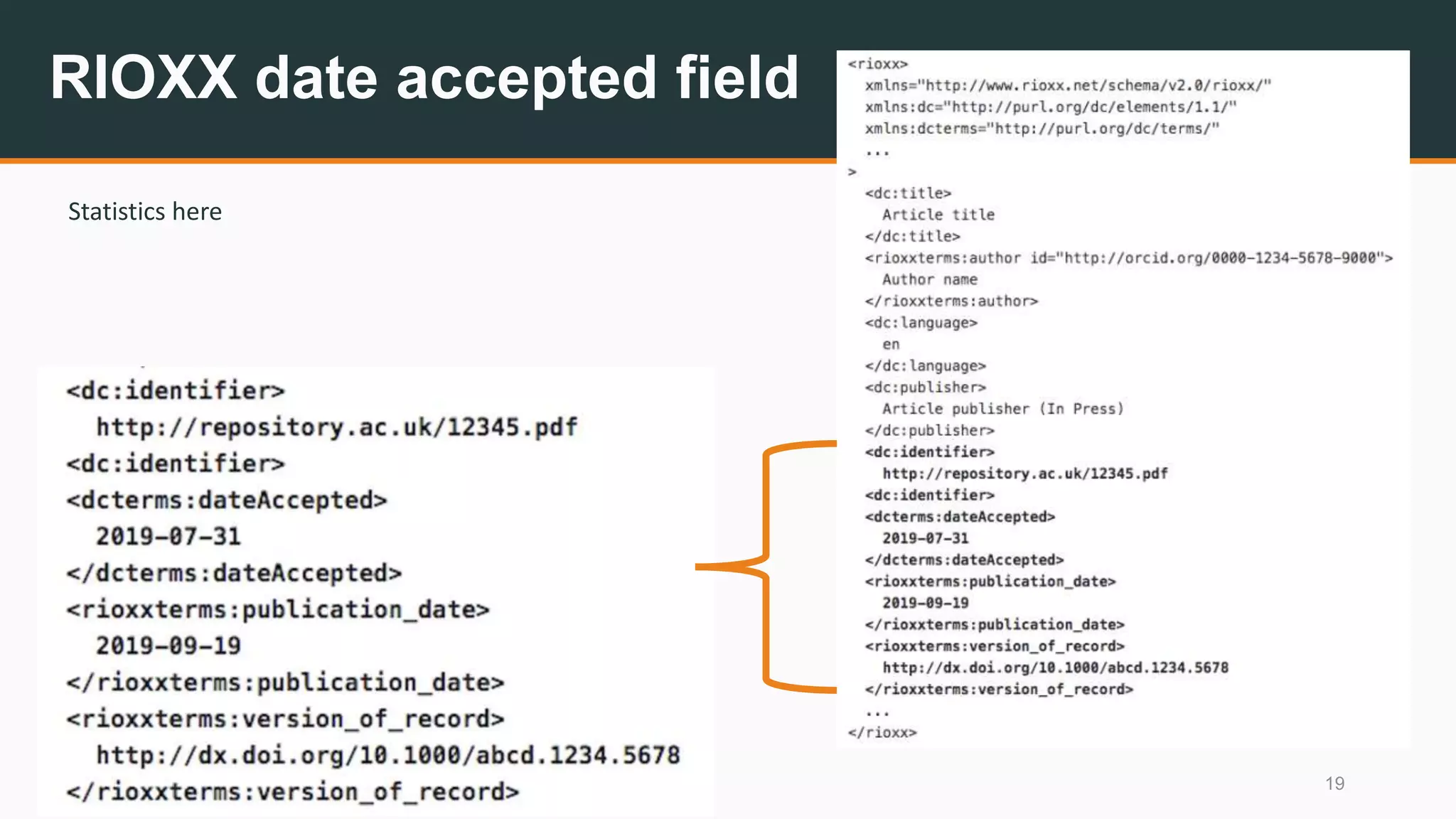
2. Adopt RIOXX as a data format
3. Add DOIs to records you are submitting to REF
4. Release deposit dates for harvesting purposes
5. Ensure “dateAccepted” field is used where known
6. Ensure all records submitted for REF have full text linked directly
from dc:identifier
7. Ensure repository’s OAI-PMH endpoint is operational
https://core.ac.uk/ref-audit/
18
RIOXX date accepted field
19
Statistics here
Deposit time lag
20
What is “deposit time lag”?
•The difference between date of
publication and date of deposit in a
repository expressed in days.
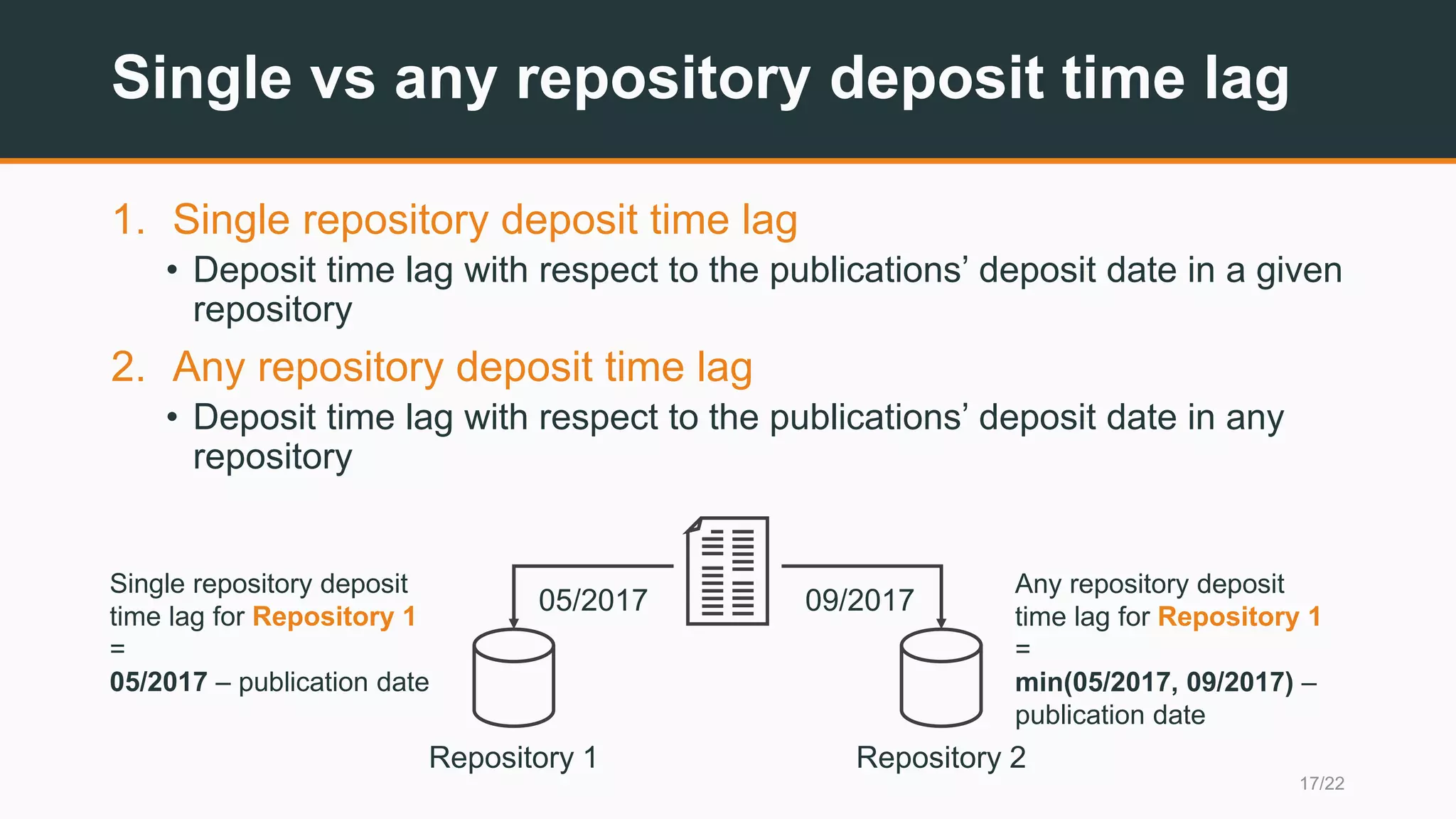
Single vs any repository deposit time lag
1. Single repository deposit time lag
• Deposit time lag with respect to the publications’ deposit date in a given
repository
2. Any repository deposit time lag
• Deposit time lag with respect to the publications’ deposit date in any
repository
Repository 1 Repository 2
05/2017 09/2017
Single repository deposit
time lag for Repository 1
=
05/2017 – publication date
Any repository deposit
time lag for Repository 1
=
min(05/2017, 09/2017) –
publication date
17/22
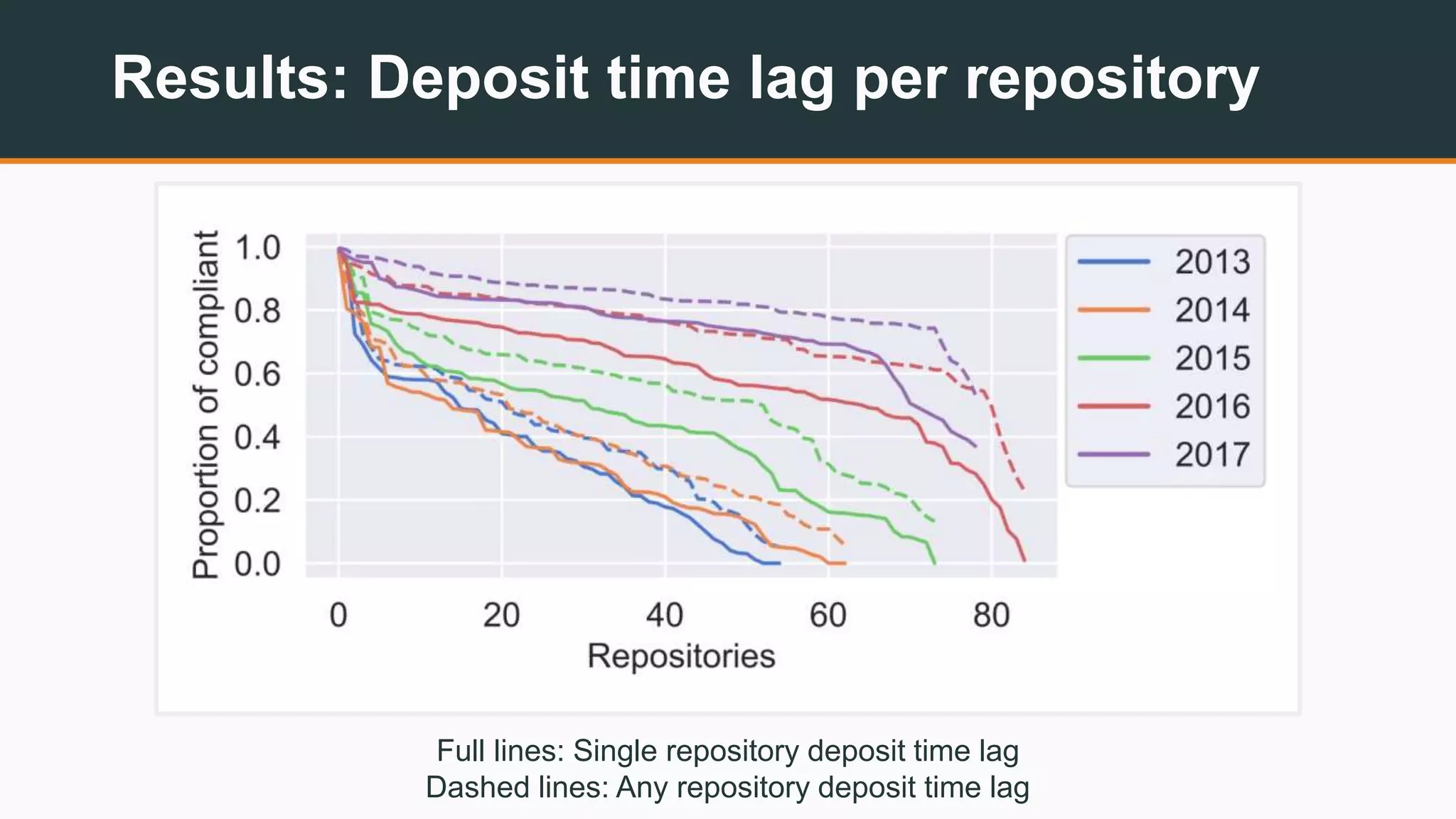
Results: Deposit time lag per repository
Full lines: Single repository deposit time lag
Dashed lines: Any repository deposit time lag
Publication date
23
What is “publication date”?
•If the date of publication is not supplied
by the repository or it doesn’t have the
desired format: YYYY-MM-DD, CORE will
collect the publication date from Crossref.
Deposit date
24
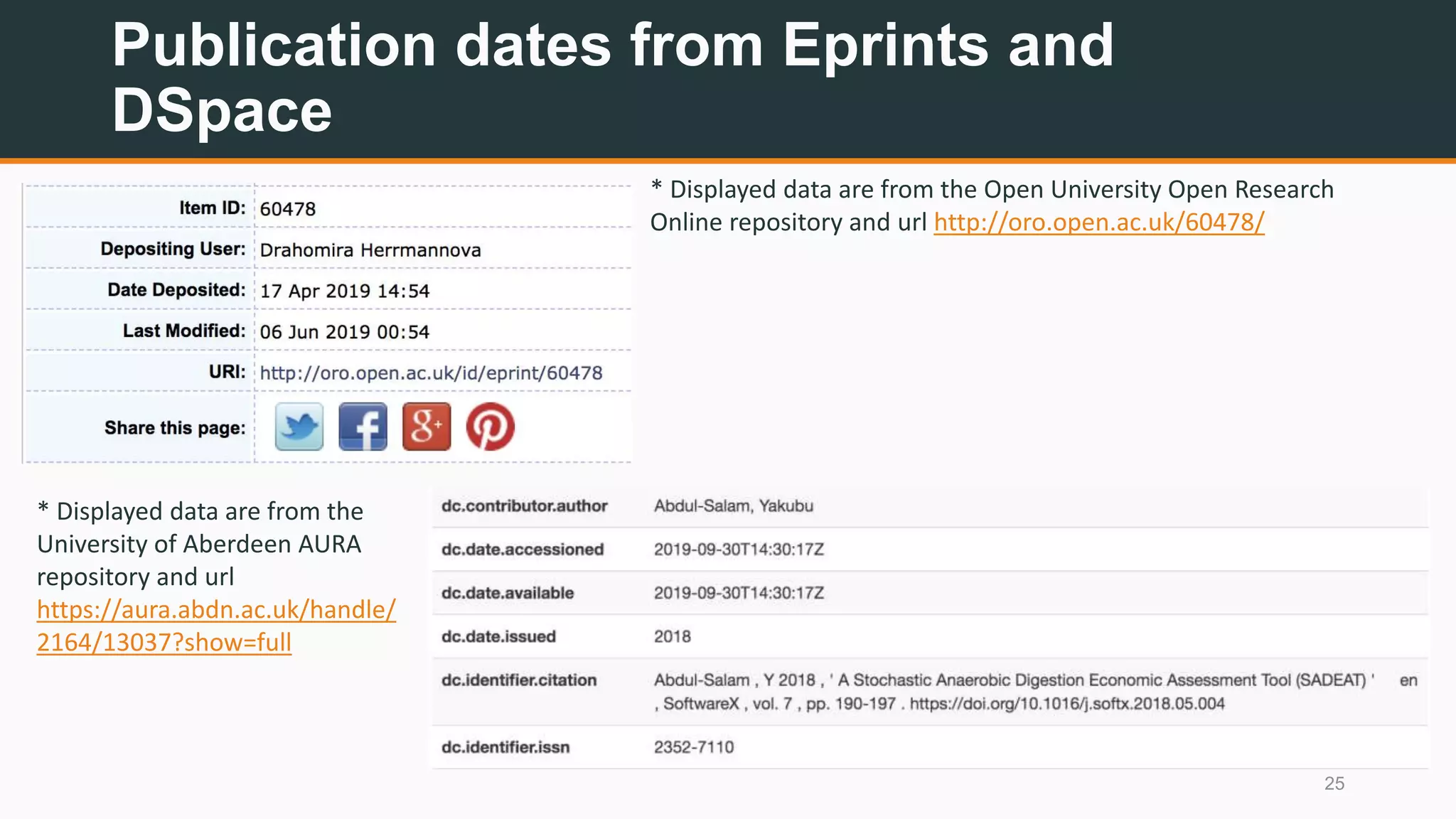
What is “deposit date”?
•Where deposit dates are visible through the web
pages in the repository CORE attempts to collect
them by scraping them
•Where deposit dates cannot be obtained using
scraping, CORE makes use of the record’s
Datestamp provided in the record’s metadata.
Publication dates from Eprints and
DSpace
25
* Displayed data are from the Open University Open Research
Online repository and url http://oro.open.ac.uk/60478/
* Displayed data are from the
University of Aberdeen AURA
repository and url
https://aura.abdn.ac.uk/handle/
2164/13037?show=full
CORE and REF2021 audit
• Introducing CORE
• CORE and REF2021 audit
• Where is CORE mentioned
• How CORE collects data
• What is deposit time-lag?
• CORE Repository Dashboard demonstration
• Getting access to the Dashboard
26
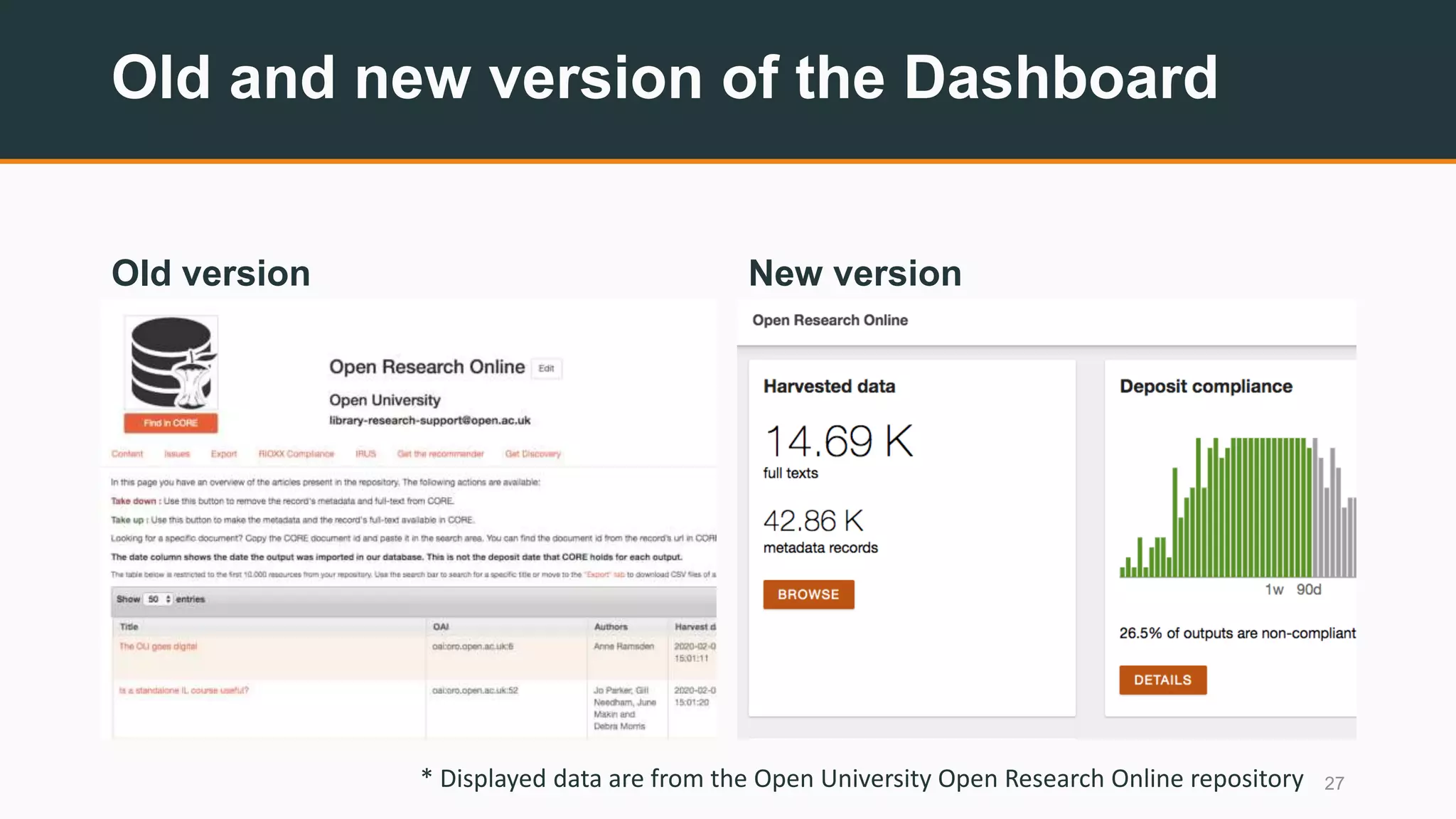
Old and new version of the Dashboard
Old version New version
27* Displayed data are from the Open University Open Research Online repository
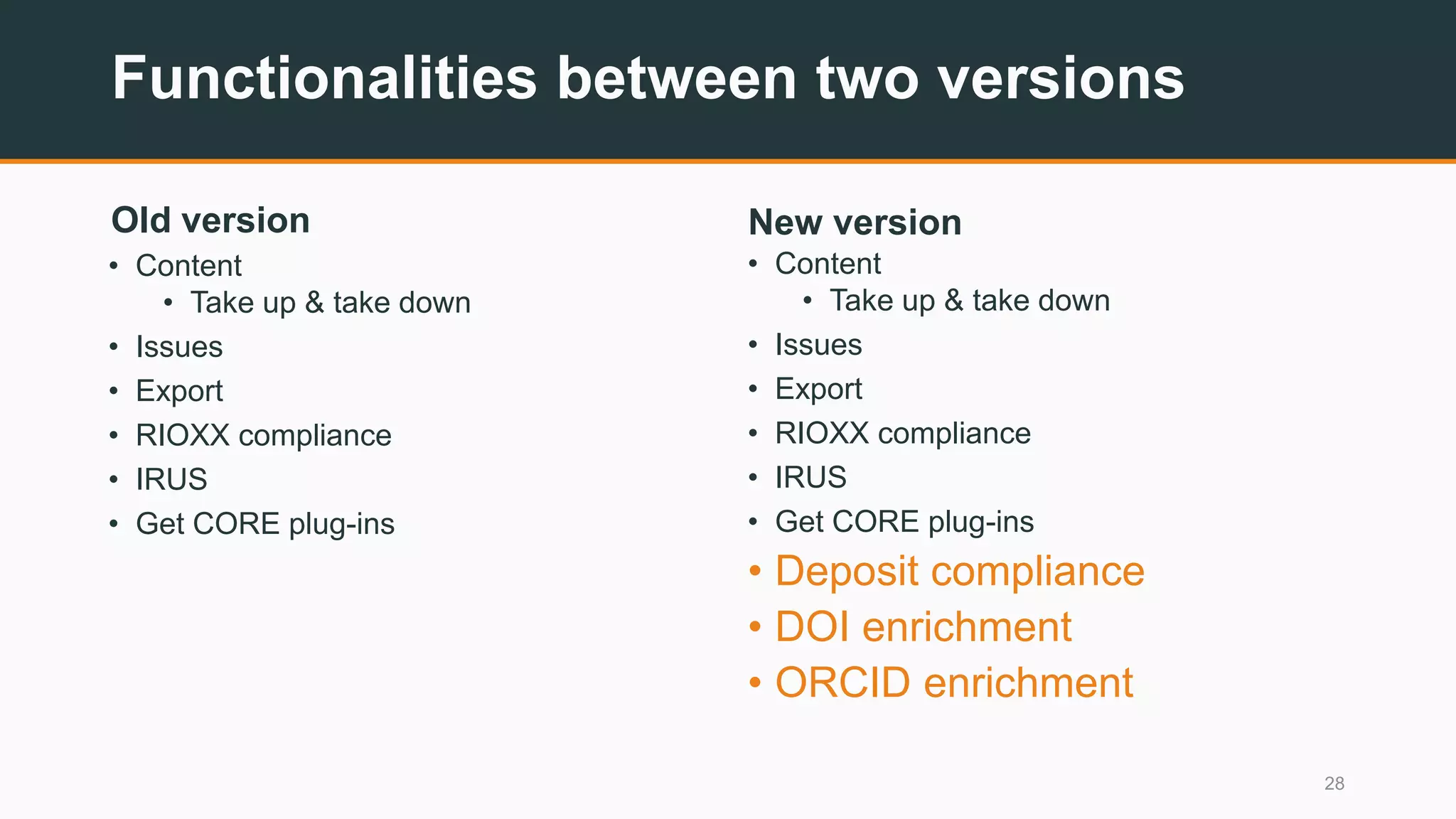
Functionalities between two versions
Old version
• Content
• Take up & take down
• Issues
• Export
• RIOXX compliance
• IRUS
• Get CORE plug-ins
New version
• Content
• Take up & take down
• Issues
• Export
• RIOXX compliance
• IRUS
• Get CORE plug-ins
• Deposit compliance
• DOI enrichment
• ORCID enrichment
28
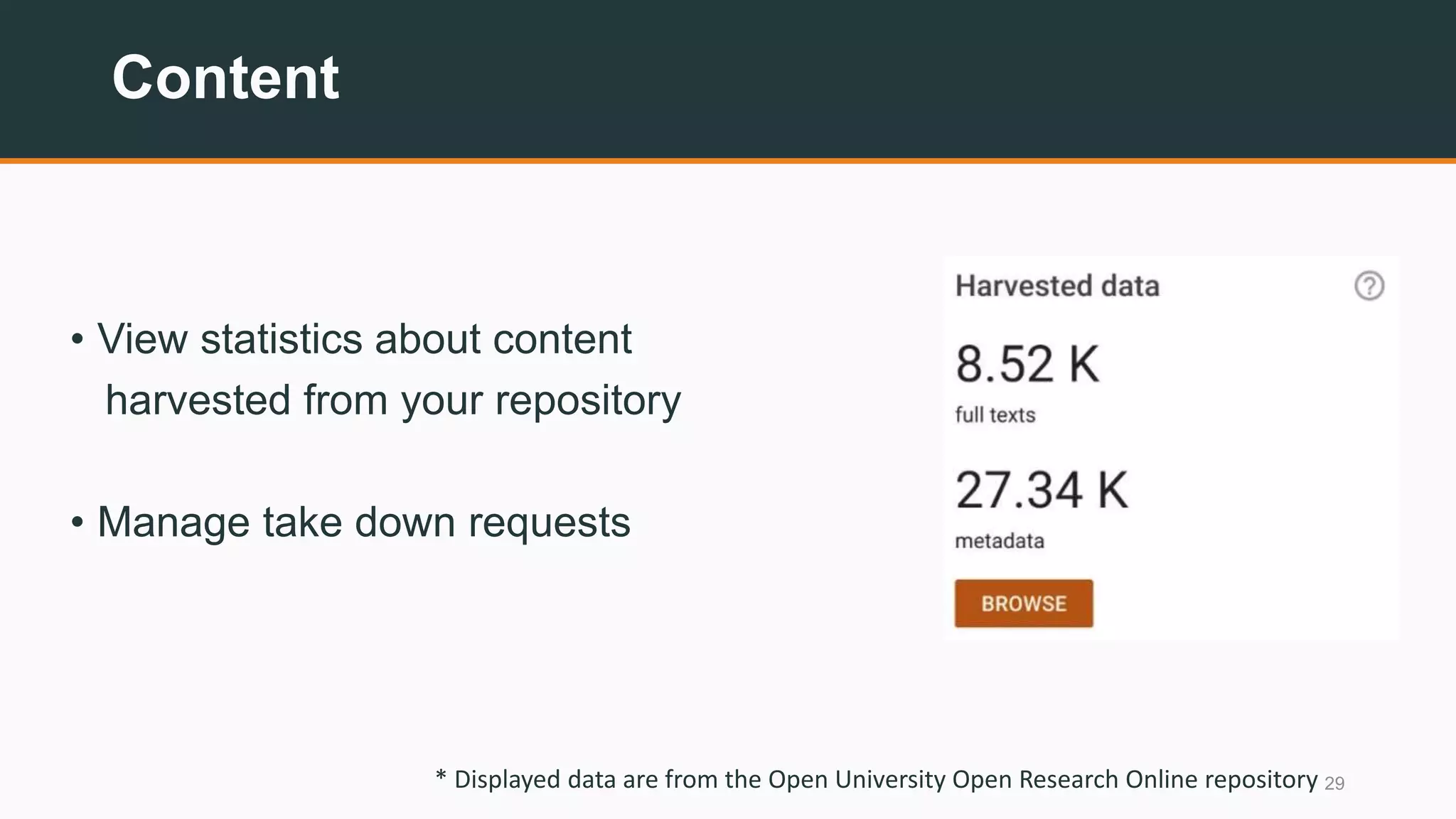
Content
• View statistics about content
harvested from your repository
• Manage take down requests
29* Displayed data are from the Open University Open Research Online repository
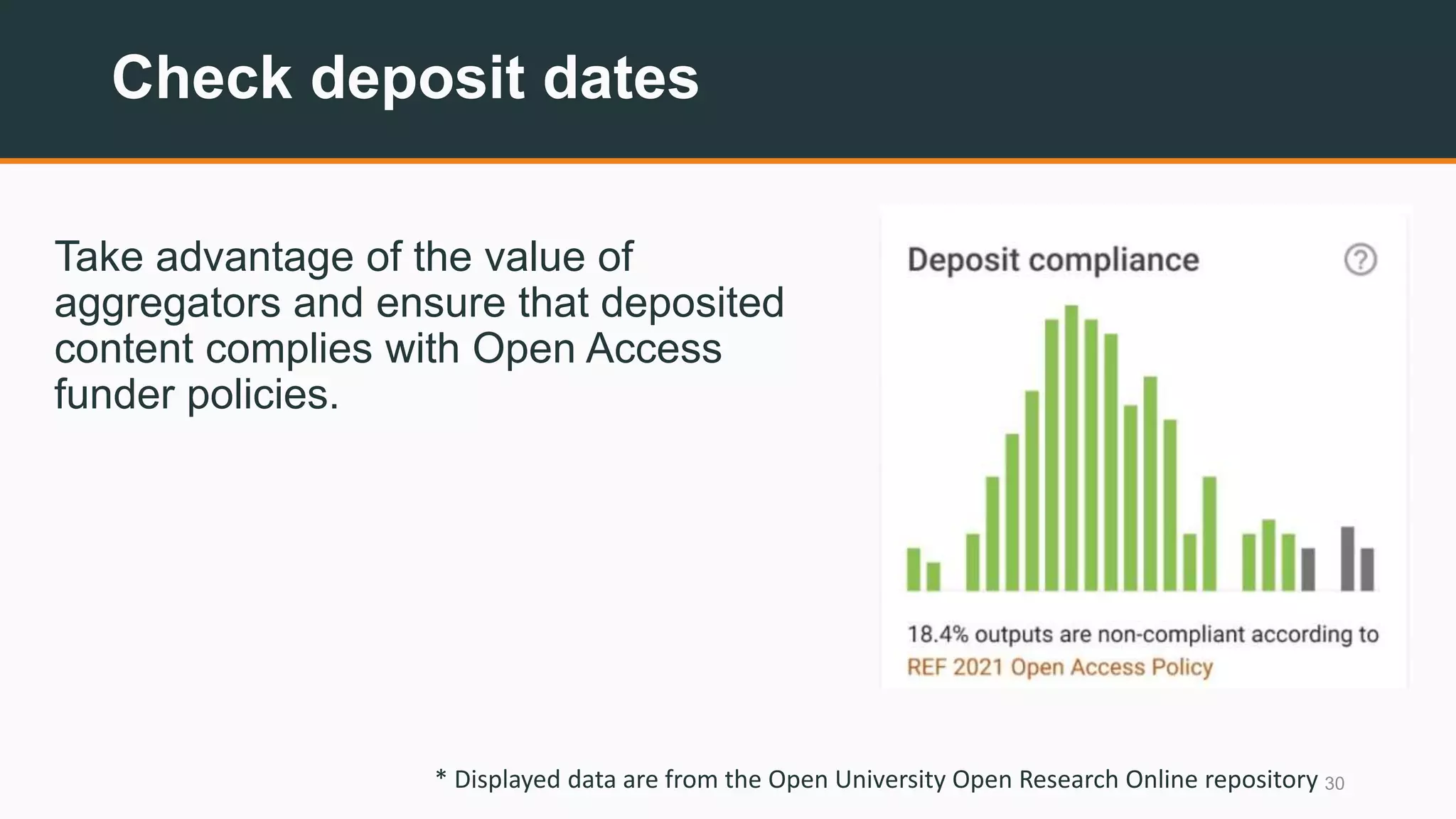
Check deposit dates
Take advantage of the value of
aggregators and ensure that deposited
content complies with Open Access
funder policies.
30* Displayed data are from the Open University Open Research Online repository
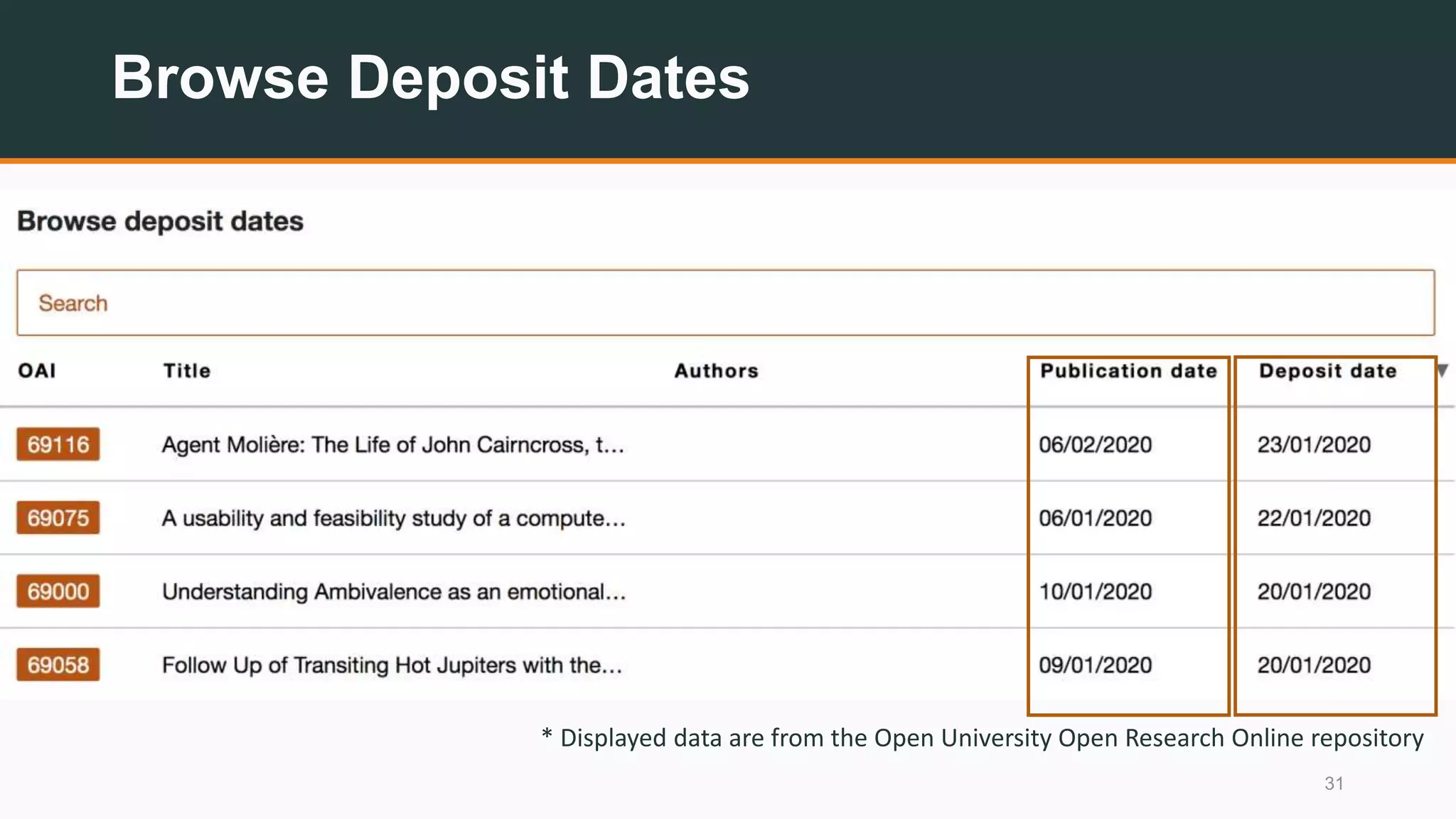
Browse Deposit Dates
31
* Displayed data are from the Open University Open Research Online repository
CORE Repository Dashboard
32
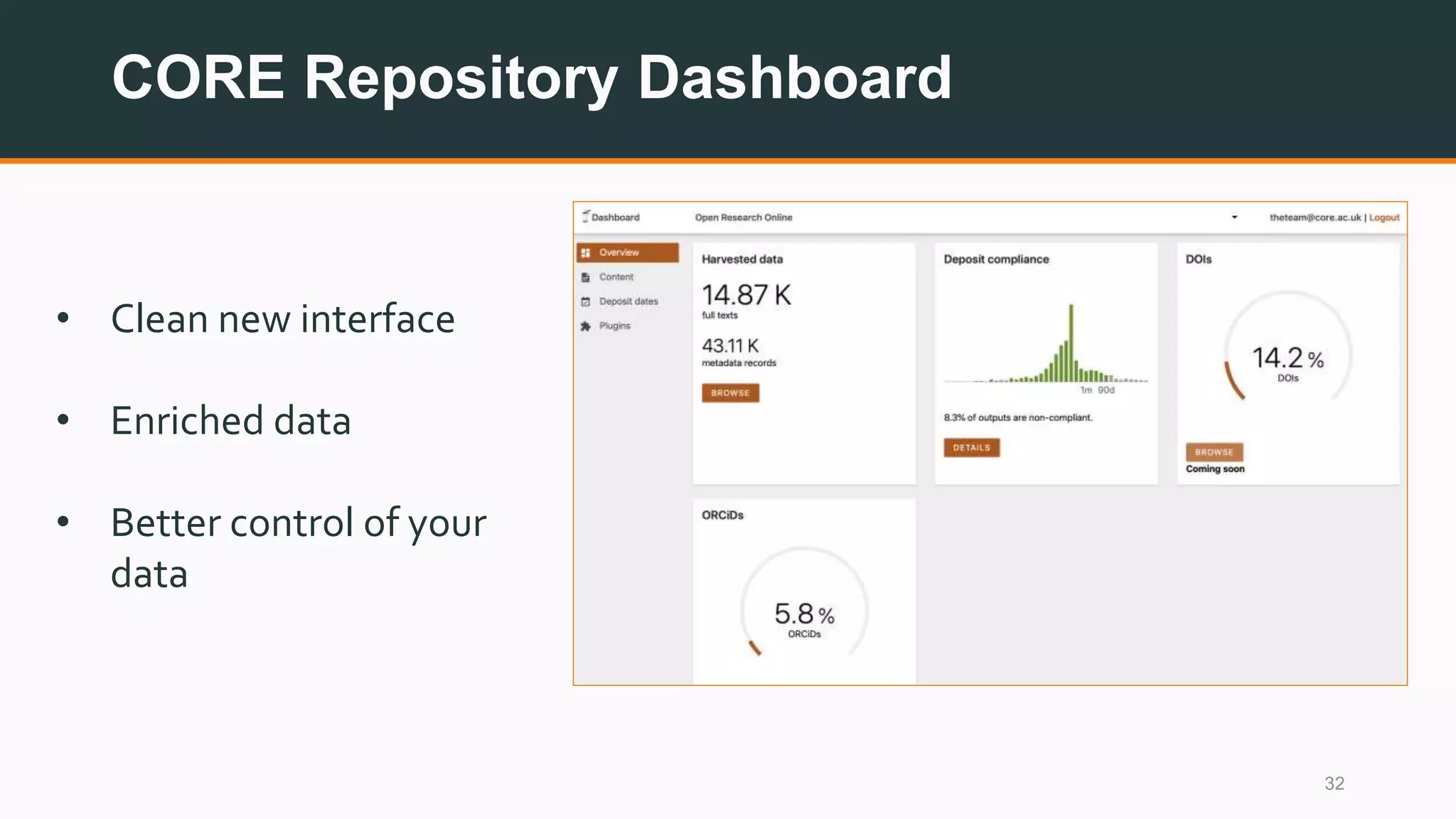
• Clean new interface
• Enriched data
• Better control of your
data
CORE Repository Dashboard
33
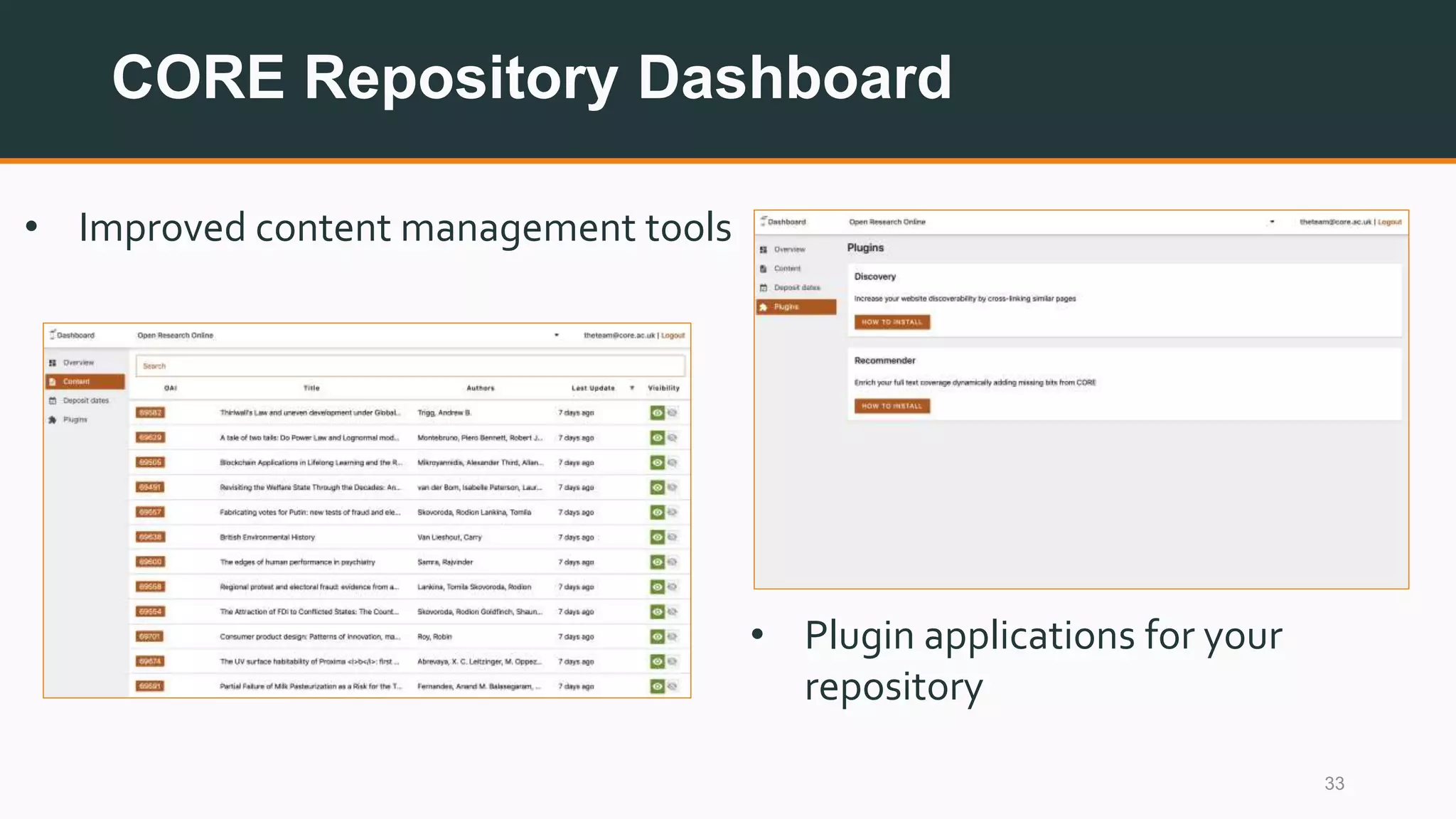
• Improved content management tools
• Plugin applications for your
repository
CORE Repository Dashboard - Premium
34
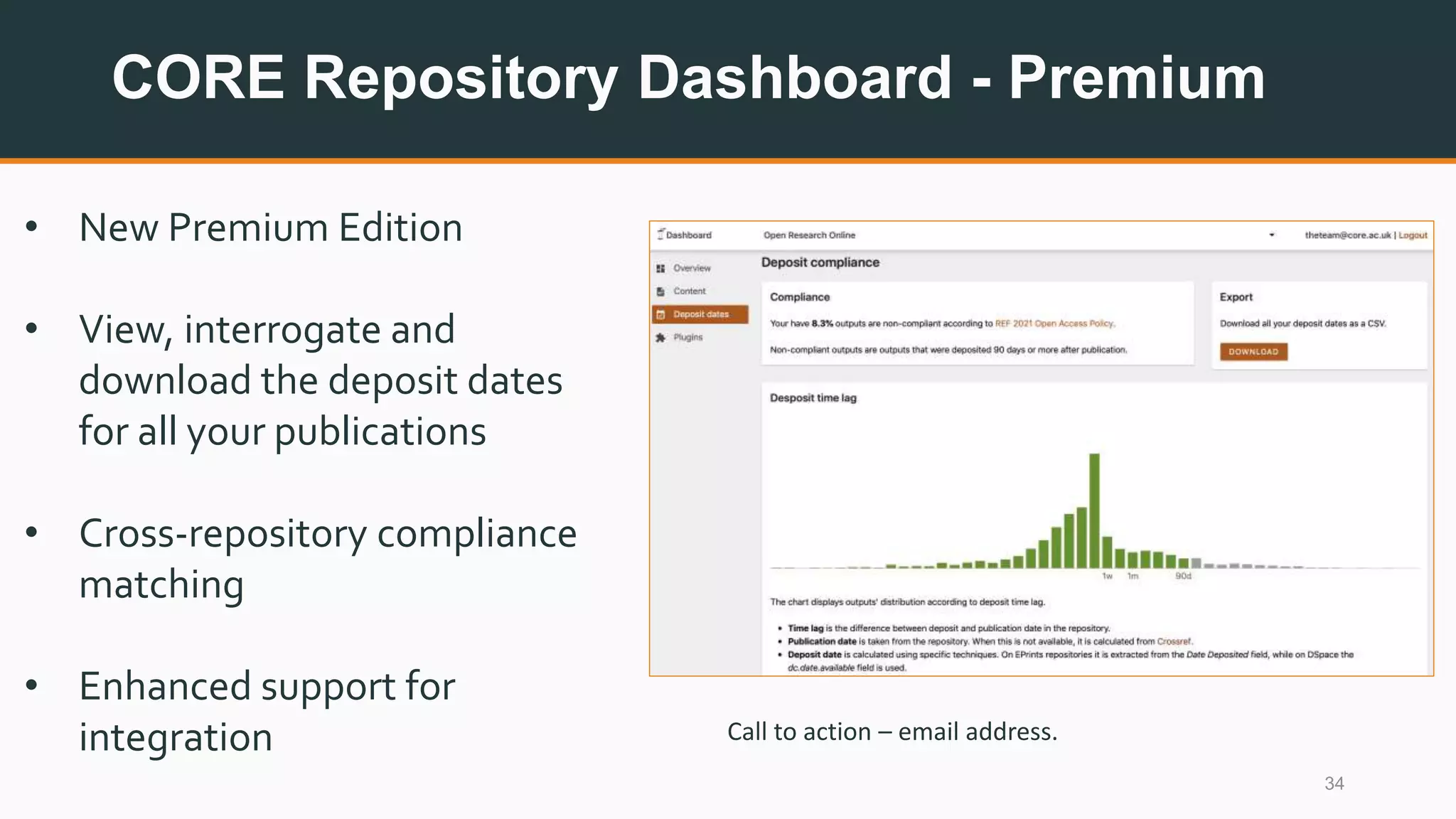
• New Premium Edition
• View, interrogate and
download the deposit dates
for all your publications
• Cross-repository compliance
matching
• Enhanced support for
integration Call to action – email address.
CORE Repository Dashboard - Premium
35
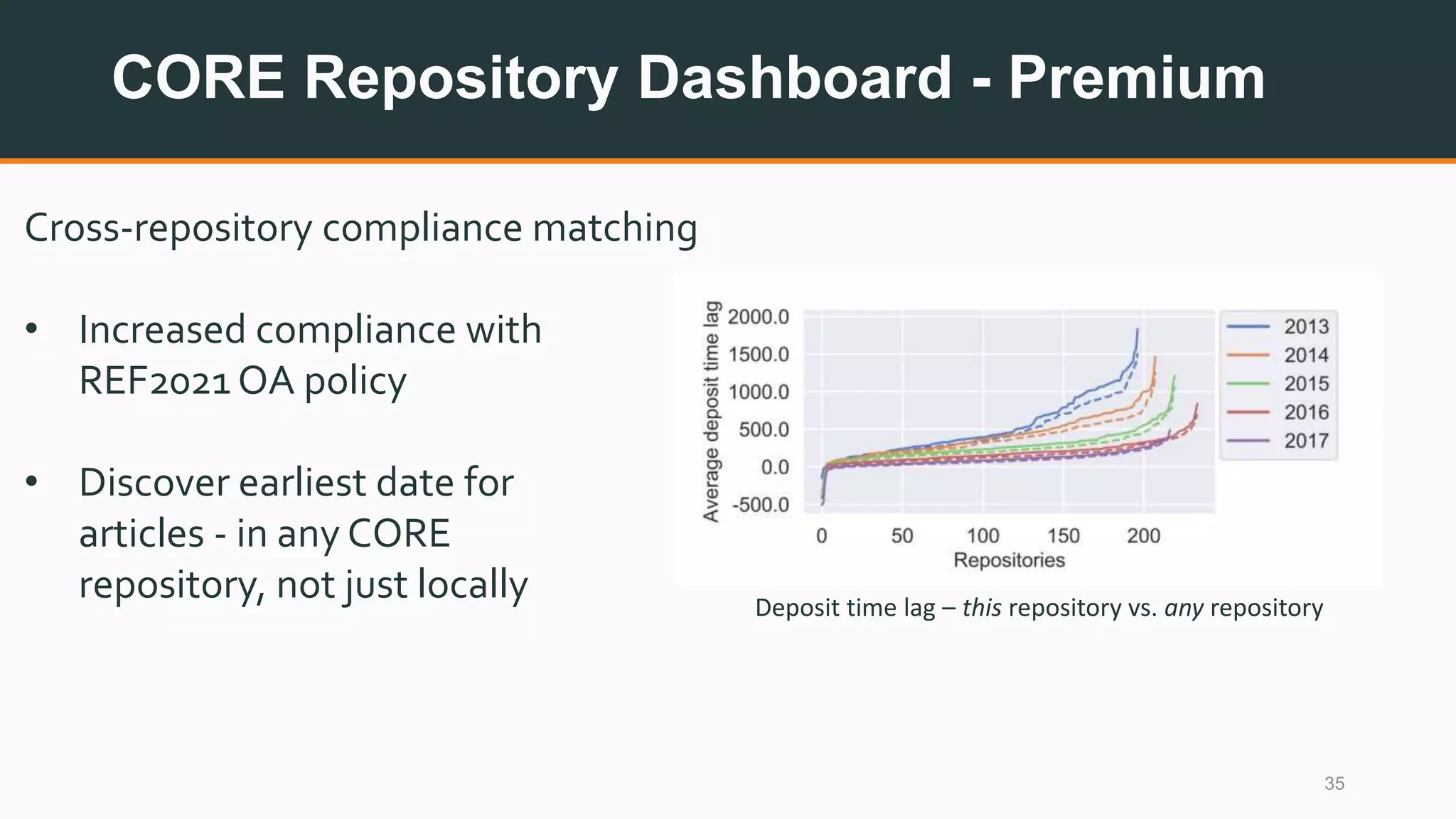
Cross-repository compliance matching
• Increased compliance with
REF2021 OA policy
• Discover earliest date for
articles - in any CORE
repository, not just locally Deposit time lag – this repository vs. any repository
CORE Repository Dashboard - Premium
36
Rollout Schedule
• Currently available to a
limited number of HEIs
• Launching to first 10
institutes on April 1st 2020
• Cost: £2.5kpa +VAT
Register your interest today: theteam@core.open.ac.uk
Thank you!
https://core.ac.uk

Tracking compliance of the REF2021 policy with the CORE Repository Dashboard

  • 1.
    Tracking compliance ofthe REF2021 policy with the CORE Repository Dashboard PRESENTERS 26 March 2020 Big Scientific Data and Text Analytics Group Knowledge Media Institute, The Open University
  • 2.
    ToC • Introducing CORE– Nancy • CORE and REF2021 audit – Petr • Where is CORE mentioned • How CORE collects data • CORE Repository Dashboard demonstration - David • Getting access to the Dashboard 1
  • 3.
    CORE’s mission 2 Aggregate allopen access research articles worldwide … … enrich this content and provide seamless access to it through a set of data services …
  • 4.
    Types of contentproviders CORE harvests from everywhere: • Repositories • Institutional • Includes repository and CRIS platforms • Disciplinary • Journals • Pure Open Access • Gold Open Access 3
  • 5.
  • 6.
    World’s largest datasetof Open Access full texts • 19,249,864 Hosted full texts • 24,936,921 Access to free to read full texts • 135,539,113 Metadata records • 9,645 Data providers 5/22
  • 7.
    Papers OA soonerand sooner 6/22https://physicstoday.scitation.org/do/10.1063/PT.6.2.20190418a/full/ JCDL 2019 Best Paper Award
  • 8.
    Papers OA soonerand sooner The delay between publication and OA availability decreasing globally 7 Herrmannova, Drahomira; Pontika, Nancy and Knoth, Petr (2019). Do Authors Deposit on Time? Tracking Open Access Policy Compliance. In: 2019 ACM/IEEE Joint Conference on Digital Libraries, 2-6 Jun 2019, Urbana- Champaign, IL
  • 9.
    Faster open accessmakes repository infrastructure more important 8
  • 10.
    We don’t needjust open access we need fast open access 9
  • 11.
    This study wasonly possible to conduct because of repositories and aggregators working together 10
  • 12.
    Need for moreinteroperability across systems 11
  • 13.
    CORE and REF2021audit • Introducing CORE • CORE and REF2021 audit • Where is CORE mentioned • How CORE collects data • CORE Repository Dashboard demonstration • Getting access to the Dashboard 12
  • 14.
    CORE’s work onREF2021 audit CORE data will be used in the REF 2021 Open Access Policy Audit Related sections: 40, 46 and 49. 13
  • 15.
  • 16.
    Why support auditwith aggregators? • Individual HEIs have a local and non-complete view of compliance • Open Access uptake and monitoring • Audit transparency • Efficiency • Verifiability 15
  • 17.
  • 18.
    CORE’s role inthe REF2021 audit Assist institutions with identifying non-compliant outputs. 17
  • 19.
    CORE and REF2021Open Access Audit To capture data, CORE recommends to institutions: 1. Make sure your institutional repository/ies are harvested by CORE 2. Adopt RIOXX as a data format 3. Add DOIs to records you are submitting to REF 4. Release deposit dates for harvesting purposes 5. Ensure “dateAccepted” field is used where known 6. Ensure all records submitted for REF have full text linked directly from dc:identifier 7. Ensure repository’s OAI-PMH endpoint is operational https://core.ac.uk/ref-audit/ 18
  • 20.
    RIOXX date acceptedfield 19 Statistics here
  • 21.
    Deposit time lag 20 Whatis “deposit time lag”? •The difference between date of publication and date of deposit in a repository expressed in days.
  • 22.
    Single vs anyrepository deposit time lag 1. Single repository deposit time lag • Deposit time lag with respect to the publications’ deposit date in a given repository 2. Any repository deposit time lag • Deposit time lag with respect to the publications’ deposit date in any repository Repository 1 Repository 2 05/2017 09/2017 Single repository deposit time lag for Repository 1 = 05/2017 – publication date Any repository deposit time lag for Repository 1 = min(05/2017, 09/2017) – publication date 17/22
  • 23.
    Results: Deposit timelag per repository Full lines: Single repository deposit time lag Dashed lines: Any repository deposit time lag
  • 24.
    Publication date 23 What is“publication date”? •If the date of publication is not supplied by the repository or it doesn’t have the desired format: YYYY-MM-DD, CORE will collect the publication date from Crossref.
  • 25.
    Deposit date 24 What is“deposit date”? •Where deposit dates are visible through the web pages in the repository CORE attempts to collect them by scraping them •Where deposit dates cannot be obtained using scraping, CORE makes use of the record’s Datestamp provided in the record’s metadata.
  • 26.
    Publication dates fromEprints and DSpace 25 * Displayed data are from the Open University Open Research Online repository and url http://oro.open.ac.uk/60478/ * Displayed data are from the University of Aberdeen AURA repository and url https://aura.abdn.ac.uk/handle/ 2164/13037?show=full
  • 27.
    CORE and REF2021audit • Introducing CORE • CORE and REF2021 audit • Where is CORE mentioned • How CORE collects data • What is deposit time-lag? • CORE Repository Dashboard demonstration • Getting access to the Dashboard 26
  • 28.
    Old and newversion of the Dashboard Old version New version 27* Displayed data are from the Open University Open Research Online repository
  • 29.
    Functionalities between twoversions Old version • Content • Take up & take down • Issues • Export • RIOXX compliance • IRUS • Get CORE plug-ins New version • Content • Take up & take down • Issues • Export • RIOXX compliance • IRUS • Get CORE plug-ins • Deposit compliance • DOI enrichment • ORCID enrichment 28
  • 30.
    Content • View statisticsabout content harvested from your repository • Manage take down requests 29* Displayed data are from the Open University Open Research Online repository
  • 31.
    Check deposit dates Takeadvantage of the value of aggregators and ensure that deposited content complies with Open Access funder policies. 30* Displayed data are from the Open University Open Research Online repository
  • 32.
    Browse Deposit Dates 31 *Displayed data are from the Open University Open Research Online repository
  • 33.
    CORE Repository Dashboard 32 •Clean new interface • Enriched data • Better control of your data
  • 34.
    CORE Repository Dashboard 33 •Improved content management tools • Plugin applications for your repository
  • 35.
    CORE Repository Dashboard- Premium 34 • New Premium Edition • View, interrogate and download the deposit dates for all your publications • Cross-repository compliance matching • Enhanced support for integration Call to action – email address.
  • 36.
    CORE Repository Dashboard- Premium 35 Cross-repository compliance matching • Increased compliance with REF2021 OA policy • Discover earliest date for articles - in any CORE repository, not just locally Deposit time lag – this repository vs. any repository
  • 37.
    CORE Repository Dashboard- Premium 36 Rollout Schedule • Currently available to a limited number of HEIs • Launching to first 10 institutes on April 1st 2020 • Cost: £2.5kpa +VAT Register your interest today: theteam@core.open.ac.uk
  • 38.

Editor's Notes

  • #23 Explain example Any repository deposit time lag – looking at everywhere the paper was deposited, taking the first deposit date and using that to analyse the repository we are looking at We do it this way because once a publication is in an OA repository, it’s already OA, so doing this we want to see if aggregating data from all repositories helps to get access faster
  • #24 Results per repository, each point on each line is one repository, value represents proportion of publications in that repository that are compliant with the REF OA policy Explain the rest of figure Key message – significant differences between institutions, institutional policies matter (more than subject) “This is not a game of medicine vs physics or mathematics, this is a game of institutional policies and practices.” Some institutions make sure it happens and some don’t, It’s in the hands of institutions
  • #25 Where the publication date is supplied by the repository but the date is not the same as in Crossref, the decision as to which one will be used in the audit will be up to the discretion of Research England.
  • #26 Where the publication date is supplied by the repository but the date is not the same as in Crossref, the decision as to which one will be used in the audit will be up to the discretion of Research England.