Voter Petitions For Term Limits In Illinois:
A Conflict Between Popular Desire and
Constitutional Constraints
Presented By:
Paul R. Hale
JD Candidate
Law & Policy Extern
Summary of Topics
• Article of the Illinois Constitution that applies
legislative term limits.
• Methods of amending the Illinois Constitution.
• Illinois Supreme Court Case Law.
o Chicago Bar Association v. Illinois State Board
of Elections (Il. 1994).
o Coalition for Political Honesty v. State Board of
Elections (Il. 1980).
• What is the likelihood of amending the Illinois
Constitution to enact term limits?
Term Limits Are At Issue In Illinois
• Legislative term limits have been a popular
response to perceived corruption or inaction in state
government.
• Paul Simon Public Policy Institute polling indicates
that 78.7 percent of voters favor term limits (2012).
• Illinois Governor Candidate Bruce Rauner and The
Committee for Legislative Reform and Term Limits
are supporting a petition concerning term limits.
o Reduces senate seats from 59 to 41.
o Increases house seats from 118 to 123.
o Imposes an 8 year term limit on all legislators.
Art. IV Sec. 2(c) of the IL Constitution
• Article IV is the Legislative (Leg.) Article of the
Illinois Constitution.
• Personal Qualifications for Leg. Service
o United States citizen.
o At least 21 years old.
o A resident of the district which he/she is to represent for
two years preceding election or appointment.
• Term limit language would add a disqualifier
to this list.
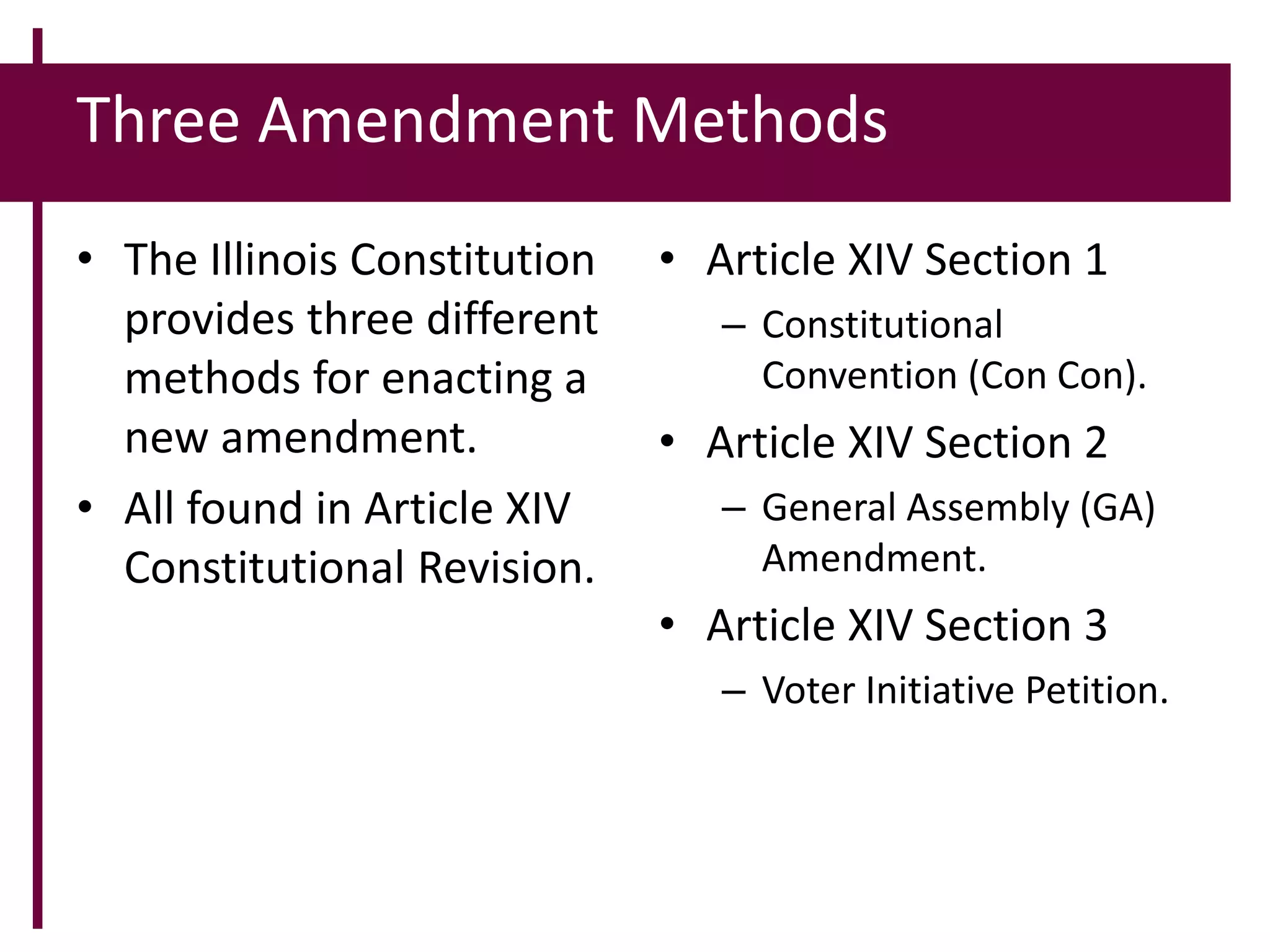
Three Amendment Methods
• The Illinois Constitution
provides three different
methods for enacting a
new amendment.
• All found in Article XIV
Constitutional Revision.
• Article XIV Section 1
– Constitutional
Convention (Con Con).
• Article XIV Section 2
– General Assembly (GA)
Amendment.
• Article XIV Section 3
– Voter Initiative Petition.
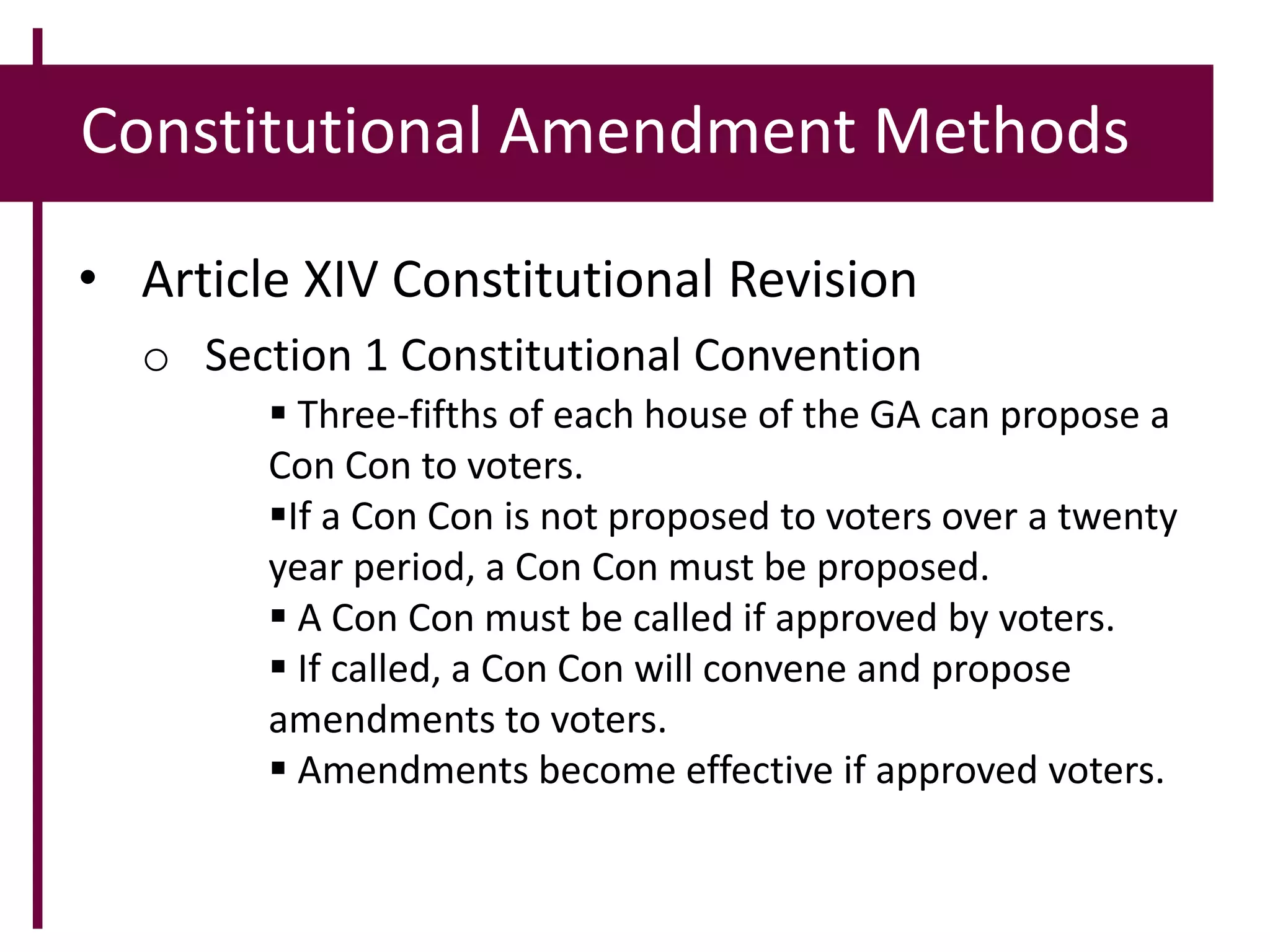
Constitutional Amendment Methods
• Article XIV Constitutional Revision
o Section 1 Constitutional Convention
 Three-fifths of each house of the GA can propose a
Con Con to voters.
If a Con Con is not proposed to voters over a twenty
year period, a Con Con must be proposed.
 A Con Con must be called if approved by voters.
 If called, a Con Con will convene and propose
amendments to voters.
 Amendments become effective if approved voters.
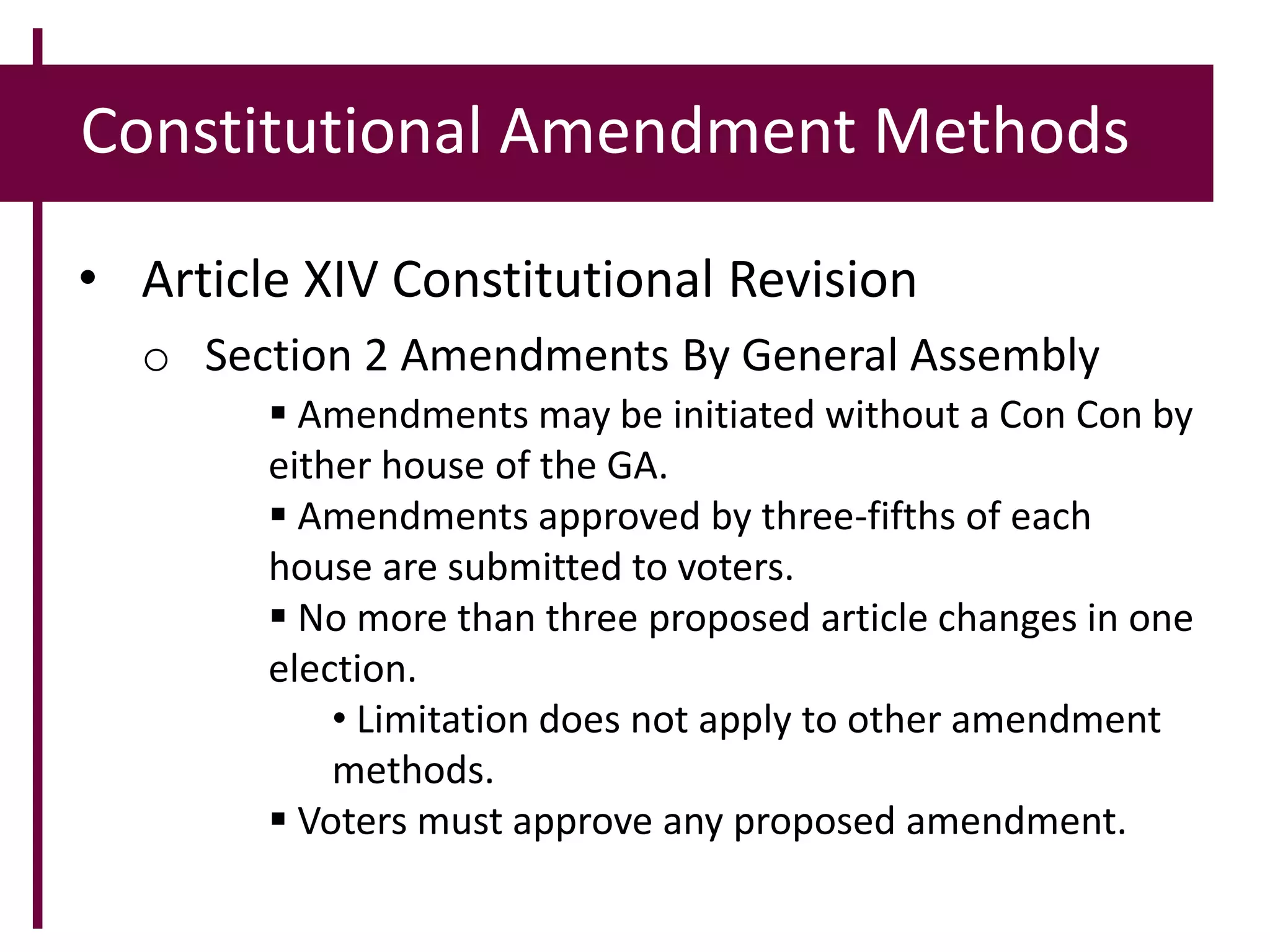
Constitutional Amendment Methods
• Article XIV Constitutional Revision
o Section 2 Amendments By General Assembly
 Amendments may be initiated without a Con Con by
either house of the GA.
 Amendments approved by three-fifths of each
house are submitted to voters.
 No more than three proposed article changes in one
election.
• Limitation does not apply to other amendment
methods.
 Voters must approve any proposed amendment.
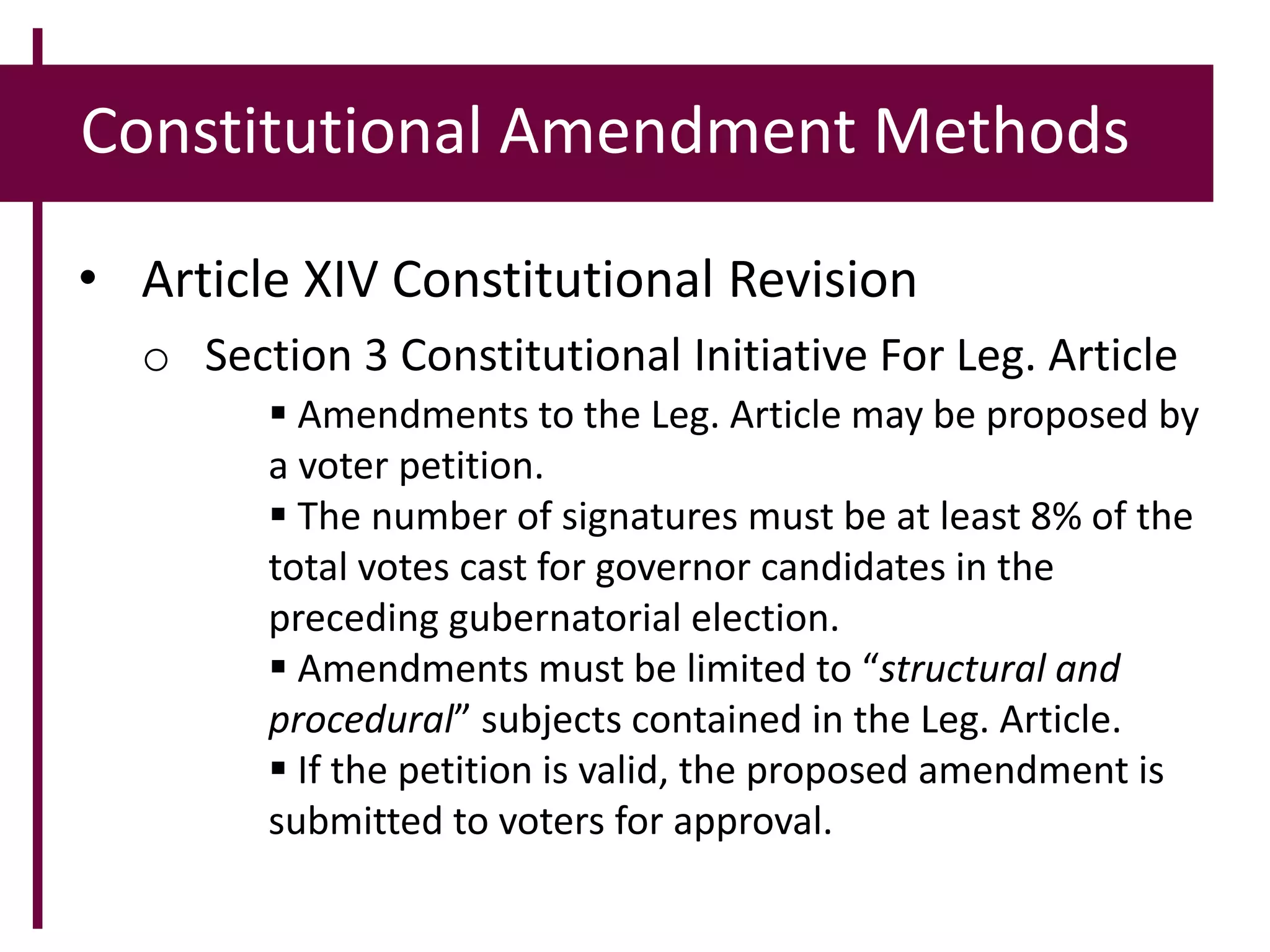
Constitutional Amendment Methods
• Article XIV Constitutional Revision
o Section 3 Constitutional Initiative For Leg. Article
 Amendments to the Leg. Article may be proposed by
a voter petition.
 The number of signatures must be at least 8% of the
total votes cast for governor candidates in the
preceding gubernatorial election.
 Amendments must be limited to “structural and
procedural” subjects contained in the Leg. Article.
 If the petition is valid, the proposed amendment is
submitted to voters for approval.
Which Method For Term Limits?
• Since 1970, there have been twenty-one
amendment proposals to the Illinois
Constitution.
o Term limits have never been proposed as a
possible amendment by the GA.
• Voter petition method of Article XIV Section 3 is
most likely to implement term limits.
Illinois Case Law
• Illinois Supreme Court caselaw imposes
limitations on the voter petition method.
o Chicago Bar Association v. Illinois State Board of
Elections (Il. 1994).
o Coalition for Political Honesty v. State Board of
Elections (Il. 1980).
Chicago Bar Association v. Illinois State
Board of Elections (Il. 1994)
• Factual Background of the Case
o Voters drafted a valid voter petition.
o The petition amended Leg. Article Section 2 (a-c)
by adding an eight year legislative term limit.
o The petition added the language “No person shall
be eligible to serve as a member of the General
Assembly for more than eight years.”
o The validity of the petition is challenged.
Chicago Bar Association v. Illinois State
Board of Elections (Il. 1994)
• The Court’s Legal Analysis
o Is the subject matter of the voter petition within
the scope of the Constitutional Revision Article?
o Not Structural- The eligibility of an individual
legislator does not change the overall legislature.
o Not Procedural- Term limits do not change
process by which the GA makes law.
o Amendment is not procedural, not structural, and
certainly not both at the same time.
Chicago Bar Association v. Illinois State
Board of Elections (Il. 1994)
• The Petition is Invalid.
• Dissenting Opinion
o The petition changes the composition of the
legislature in Leg. Article Section 2.
o Constitutional drafters stated that legislature
composition changes are valid voter petition
subject matter.
o The court’s construction of “and” is incorrect.
o Petition is not a substantive amendment.
Coalition for Political Honesty v. State Board of
Elections (Il. 1980)
• Factual Background of the Case
o Voters drafted a valid voter petition.
o The petition amended Leg. Article Section (1-3)
by enacting voting reform and abolishing multi-
member districts in the Illinois House.
o The petition changed language of Leg. Article
Section 1 to call for an Illinois House of 118 Reps,
instead of 177 (The Cutback Amendment).
o The validity of the petition is challenged.
Coalition for Political Honesty v. State Board of
Elections (Il. 1980)
• The Court’s Legal Analysis and Ruling
o The voter petition can regulate the legislature's
self-interest.
o Serves as a check on “debilitating legislation.”
o The voter petition should not be restrained if it is
being applied as the drafters intended.
o The Court acknowledges the limited scope of the
voter petition.
o The Cutback Amendment is a valid voter petition
and was later approved by voters.
Analysis of Case Law
• Cutback petition is distinguishable from the
term limits petition.
• Cutback Amendment changes existing text of
the Leg. Article, whereas the term limits
petition adds language to the Leg. Article.
• Term limits are not mentioned in the Leg.
Article, therefore language must be added.
o The structural and procedural requirement limits
the scope of voter petitions.
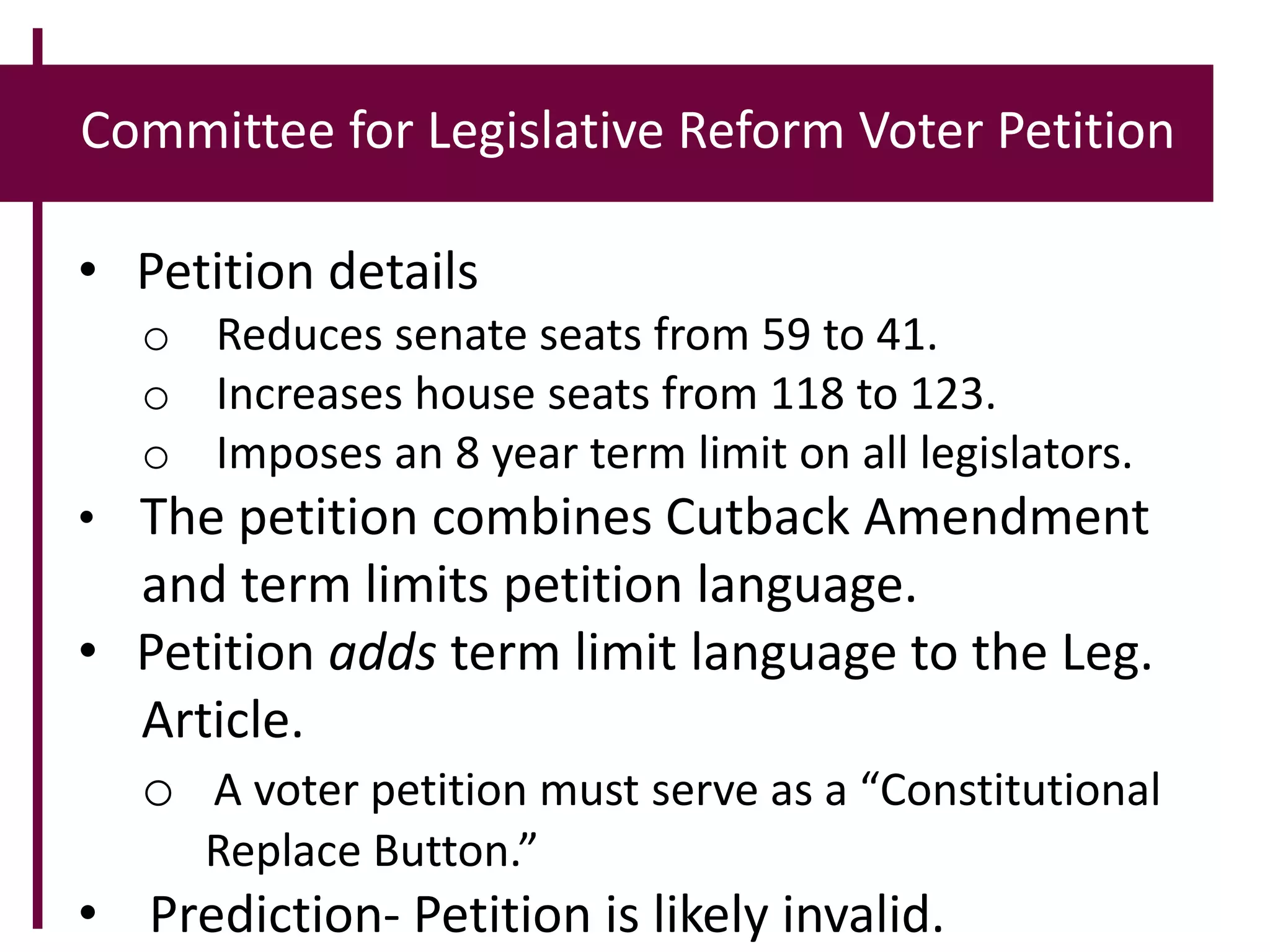
Committee for Legislative Reform Voter Petition
• Petition details
o Reduces senate seats from 59 to 41.
o Increases house seats from 118 to 123.
o Imposes an 8 year term limit on all legislators.
• The petition combines Cutback Amendment
and term limits petition language.
• Petition adds term limit language to the Leg.
Article.
o A voter petition must serve as a “Constitutional
Replace Button.”
• Prediction- Petition is likely invalid.
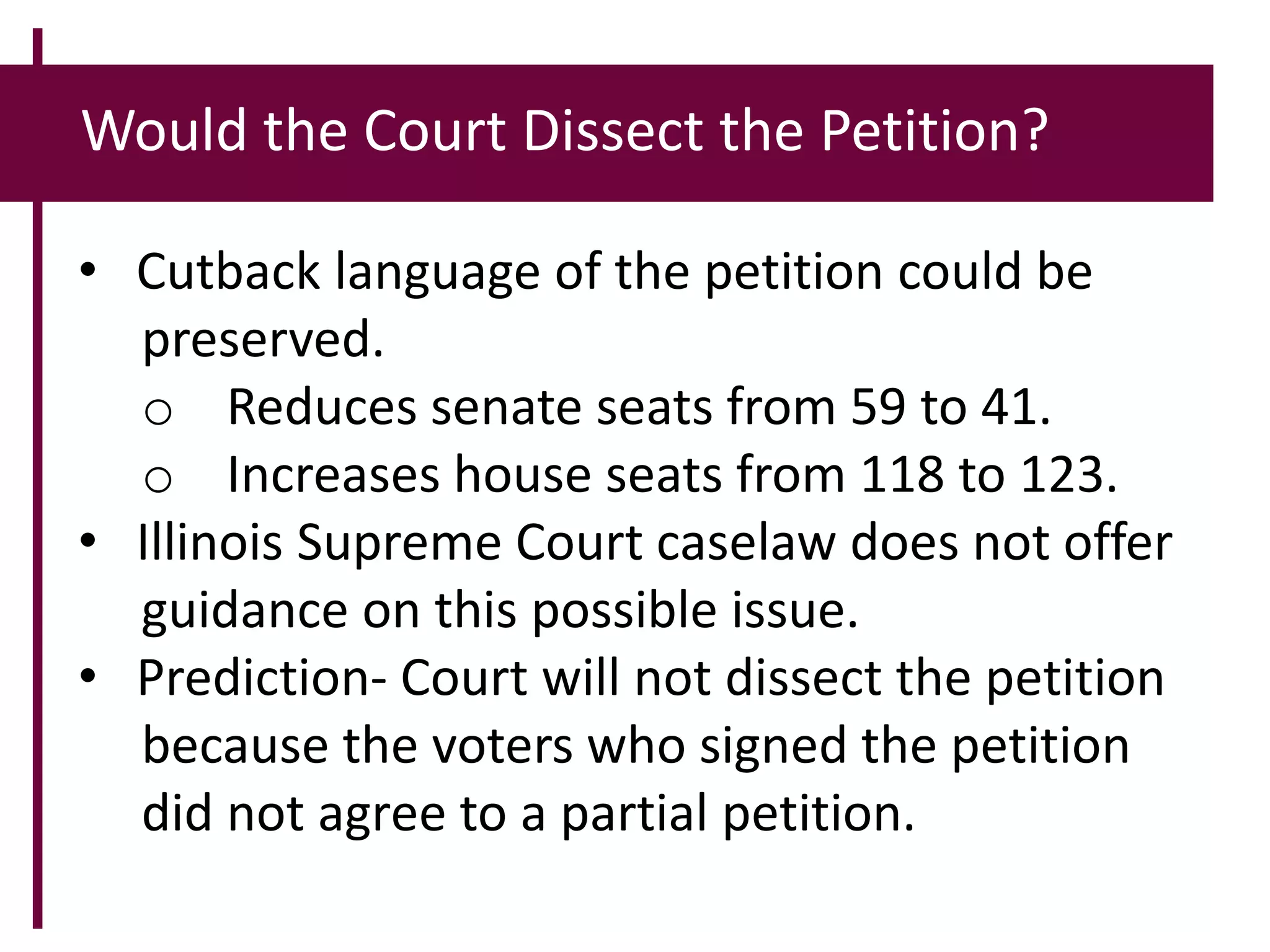
Would the Court Dissect the Petition?
• Cutback language of the petition could be
preserved.
o Reduces senate seats from 59 to 41.
o Increases house seats from 118 to 123.
• Illinois Supreme Court caselaw does not offer
guidance on this possible issue.
• Prediction- Court will not dissect the petition
because the voters who signed the petition
did not agree to a partial petition.
Thank You For Your Attention
Special Thanks To
David Yepsen
Delio Calzolari, Esq.
Dr. Charles Leonard
Dr. John S. Jackson
• Please feel free to address questions or
comments to paul.hale@siu.edu.

Voter Petitions for Term Limits in Illinois: A Conflict Between Popular Desire and Constitutional Constraints

  • 1.
    Voter Petitions ForTerm Limits In Illinois: A Conflict Between Popular Desire and Constitutional Constraints Presented By: Paul R. Hale JD Candidate Law & Policy Extern
  • 2.
    Summary of Topics •Article of the Illinois Constitution that applies legislative term limits. • Methods of amending the Illinois Constitution. • Illinois Supreme Court Case Law. o Chicago Bar Association v. Illinois State Board of Elections (Il. 1994). o Coalition for Political Honesty v. State Board of Elections (Il. 1980). • What is the likelihood of amending the Illinois Constitution to enact term limits?
  • 3.
    Term Limits AreAt Issue In Illinois • Legislative term limits have been a popular response to perceived corruption or inaction in state government. • Paul Simon Public Policy Institute polling indicates that 78.7 percent of voters favor term limits (2012). • Illinois Governor Candidate Bruce Rauner and The Committee for Legislative Reform and Term Limits are supporting a petition concerning term limits. o Reduces senate seats from 59 to 41. o Increases house seats from 118 to 123. o Imposes an 8 year term limit on all legislators.
  • 4.
    Art. IV Sec.2(c) of the IL Constitution • Article IV is the Legislative (Leg.) Article of the Illinois Constitution. • Personal Qualifications for Leg. Service o United States citizen. o At least 21 years old. o A resident of the district which he/she is to represent for two years preceding election or appointment. • Term limit language would add a disqualifier to this list.
  • 5.
    Three Amendment Methods •The Illinois Constitution provides three different methods for enacting a new amendment. • All found in Article XIV Constitutional Revision. • Article XIV Section 1 – Constitutional Convention (Con Con). • Article XIV Section 2 – General Assembly (GA) Amendment. • Article XIV Section 3 – Voter Initiative Petition.
  • 6.
    Constitutional Amendment Methods •Article XIV Constitutional Revision o Section 1 Constitutional Convention  Three-fifths of each house of the GA can propose a Con Con to voters. If a Con Con is not proposed to voters over a twenty year period, a Con Con must be proposed.  A Con Con must be called if approved by voters.  If called, a Con Con will convene and propose amendments to voters.  Amendments become effective if approved voters.
  • 7.
    Constitutional Amendment Methods •Article XIV Constitutional Revision o Section 2 Amendments By General Assembly  Amendments may be initiated without a Con Con by either house of the GA.  Amendments approved by three-fifths of each house are submitted to voters.  No more than three proposed article changes in one election. • Limitation does not apply to other amendment methods.  Voters must approve any proposed amendment.
  • 8.
    Constitutional Amendment Methods •Article XIV Constitutional Revision o Section 3 Constitutional Initiative For Leg. Article  Amendments to the Leg. Article may be proposed by a voter petition.  The number of signatures must be at least 8% of the total votes cast for governor candidates in the preceding gubernatorial election.  Amendments must be limited to “structural and procedural” subjects contained in the Leg. Article.  If the petition is valid, the proposed amendment is submitted to voters for approval.
  • 9.
    Which Method ForTerm Limits? • Since 1970, there have been twenty-one amendment proposals to the Illinois Constitution. o Term limits have never been proposed as a possible amendment by the GA. • Voter petition method of Article XIV Section 3 is most likely to implement term limits.
  • 10.
    Illinois Case Law •Illinois Supreme Court caselaw imposes limitations on the voter petition method. o Chicago Bar Association v. Illinois State Board of Elections (Il. 1994). o Coalition for Political Honesty v. State Board of Elections (Il. 1980).
  • 11.
    Chicago Bar Associationv. Illinois State Board of Elections (Il. 1994) • Factual Background of the Case o Voters drafted a valid voter petition. o The petition amended Leg. Article Section 2 (a-c) by adding an eight year legislative term limit. o The petition added the language “No person shall be eligible to serve as a member of the General Assembly for more than eight years.” o The validity of the petition is challenged.
  • 12.
    Chicago Bar Associationv. Illinois State Board of Elections (Il. 1994) • The Court’s Legal Analysis o Is the subject matter of the voter petition within the scope of the Constitutional Revision Article? o Not Structural- The eligibility of an individual legislator does not change the overall legislature. o Not Procedural- Term limits do not change process by which the GA makes law. o Amendment is not procedural, not structural, and certainly not both at the same time.
  • 13.
    Chicago Bar Associationv. Illinois State Board of Elections (Il. 1994) • The Petition is Invalid. • Dissenting Opinion o The petition changes the composition of the legislature in Leg. Article Section 2. o Constitutional drafters stated that legislature composition changes are valid voter petition subject matter. o The court’s construction of “and” is incorrect. o Petition is not a substantive amendment.
  • 14.
    Coalition for PoliticalHonesty v. State Board of Elections (Il. 1980) • Factual Background of the Case o Voters drafted a valid voter petition. o The petition amended Leg. Article Section (1-3) by enacting voting reform and abolishing multi- member districts in the Illinois House. o The petition changed language of Leg. Article Section 1 to call for an Illinois House of 118 Reps, instead of 177 (The Cutback Amendment). o The validity of the petition is challenged.
  • 15.
    Coalition for PoliticalHonesty v. State Board of Elections (Il. 1980) • The Court’s Legal Analysis and Ruling o The voter petition can regulate the legislature's self-interest. o Serves as a check on “debilitating legislation.” o The voter petition should not be restrained if it is being applied as the drafters intended. o The Court acknowledges the limited scope of the voter petition. o The Cutback Amendment is a valid voter petition and was later approved by voters.
  • 16.
    Analysis of CaseLaw • Cutback petition is distinguishable from the term limits petition. • Cutback Amendment changes existing text of the Leg. Article, whereas the term limits petition adds language to the Leg. Article. • Term limits are not mentioned in the Leg. Article, therefore language must be added. o The structural and procedural requirement limits the scope of voter petitions.
  • 17.
    Committee for LegislativeReform Voter Petition • Petition details o Reduces senate seats from 59 to 41. o Increases house seats from 118 to 123. o Imposes an 8 year term limit on all legislators. • The petition combines Cutback Amendment and term limits petition language. • Petition adds term limit language to the Leg. Article. o A voter petition must serve as a “Constitutional Replace Button.” • Prediction- Petition is likely invalid.
  • 18.
    Would the CourtDissect the Petition? • Cutback language of the petition could be preserved. o Reduces senate seats from 59 to 41. o Increases house seats from 118 to 123. • Illinois Supreme Court caselaw does not offer guidance on this possible issue. • Prediction- Court will not dissect the petition because the voters who signed the petition did not agree to a partial petition.
  • 19.
    Thank You ForYour Attention Special Thanks To David Yepsen Delio Calzolari, Esq. Dr. Charles Leonard Dr. John S. Jackson • Please feel free to address questions or comments to paul.hale@siu.edu.