R esponse t o  I ntervention Paula R. Ulloa ED656 Advanced Techniques For the Learning Disabled Julie Fee, July 9, 2008
Response to Intervention (RtI) Began in the 1960s Has been used as a progress-monitoring tool for students with and without disabilities This decade RtI has been explored as a primary way to identify students with special needs Continuous research
Why are we here? Define RtI RtI Process How RtI impacts general & special education Federal, State, Local positions on RtI Implications
Response to Intervention (RtI) “… systematic  application of  data-based  decision making to enhance outcomes for  ALL students .” (Vaughn, 2009) “… multi-tiered system  of intervention, data collection system that informs decision making, and ongoing progress monitoring…” (Vaughn, 2009) “… number of tiers, what data are collected, and the measures are what determine if a child is  “responding”  to an intervention…” (Vaughn, 2009)
Response to Intervention (RtI) Four Key Elements to RtI: High-quality,  research-based instruction  matched to student needs (GE) Monitoring  student learning over a period of time to determine their level and rate of performance for constant decision-making Provide  interventions  of increasing intensity Make important educational  decisions  based on data (Vaughn, 2009) 4
Response to Intervention (RtI) Video
Response to Intervention (RtI) There are 3 primary types of RtI approaches: Standard Treatment:  Curriculum (research)-based measurements with intervention plans for remediation (Bender, 2007) Problem-Solving Response:  Interpreted data (not research-based) establishes goals for personal performance (Bender, 2007) Pre-referral:  Steps prior Special Education  (Baker, PEC 2006 & NCLD) ** SEA/LEA use the RtI method as it applies to their district **
RtI: Standard Treatment Protocol: Screening & baseline: indicates concern Tier 1 data indicates little to no response Observation notes of scientifically-based curriculum  Tier 2 data indicates little to no response Observation data of research-based intervention Summary report
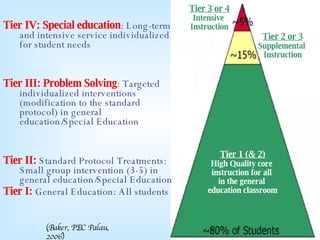
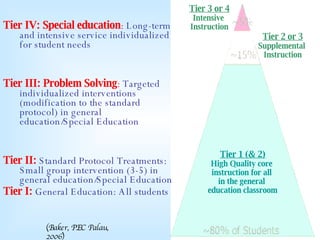
Tier IV: Special education :  Long-term and intensive service individualized for student needs Tier III: Problem Solving :  Targeted individualized interventions (modification to the standard protocol) in general education/Special Education Tier II:  Standard Protocol Treatments: Small group intervention (3-5) in general education/Special Education Tier I:  General Education: All students Tier 1 (& 2) High Quality core  instruction for all  in the general  education classroom Tier 2 or 3 Supplemental  Instruction Tier 3 or 4 Intensive  Instruction (Baker, PEC Palau, 2006)
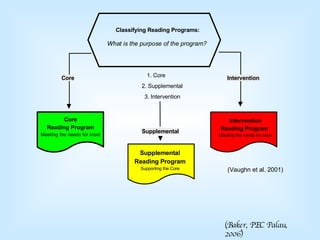
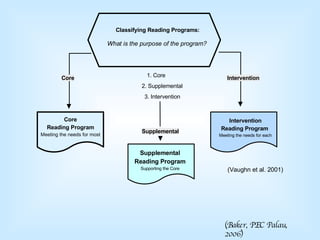
Classifying Reading Programs: What is the purpose of the program? 1. Core 2. Supplemental 3. Intervention Supplemental Reading Program Supporting the Core Core Supplemental Intervention Intervention Reading Program  Meeting the needs for each (Vaughn et al. 2001) (Baker, PEC Palau, 2006) Core Reading Program Meeting the needs for most
RtI: Problem Solving Based on individual student data Flexibility Team approach Five part process (variable) Define the problem Analyze the problem Develop a plan Implement a plan Evaluate the plan (Vaughn, 2009) ?
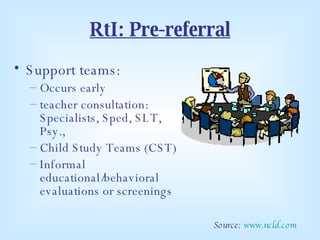
RtI: Pre-referral Support teams:  Occurs early teacher consultation: Specialists, Sped, SLT, Psy., Child Study Teams (CST) Informal educational/behavioral evaluations or screenings Source:  www.ncld.com
RtI Video
RtI Positions Federal position:   IDEA ’04 National Association of State Directors of Special Education (NASDE) 2005 State position: Determines use & develops tier system Local position: Determines use & develops tier system
 
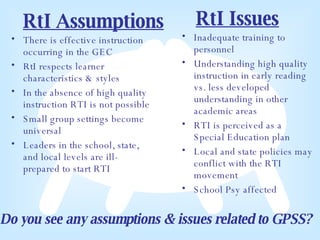
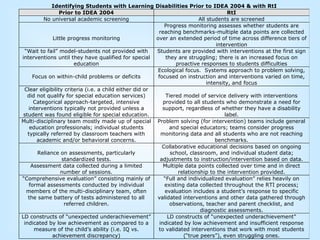
RtI Assumptions There is effective instruction occurring in the GEC RtI respects learner characteristics & styles In the absence of high quality instruction RTI is not possible Small group settings become universal Leaders in the school, state, and local levels are ill-prepared to start RTI Inadequate training to personnel Understanding high quality instruction in early reading vs. less developed understanding in other academic areas RTI is perceived as a Special Education plan  Local and state policies may conflict with the RTI movement School Psy affected RtI Issues Do you see any assumptions & issues related to GPSS?
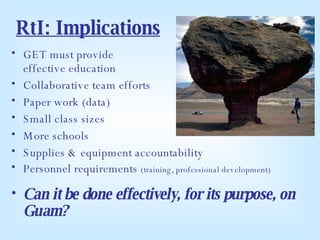
RtI: Implications GET must provide  effective education Collaborative team efforts Paper work (data) Small class sizes More schools Supplies & equipment accountability Personnel requirements  (training, professional development) Can it be done effectively, for its purpose, on Guam?
The bottom line in a nutshell… NCLB, IDEA, NCLD, etc. support RtI, yet do not mandate it’s methodology SEA/LEA are still in charge of their education RtI is for ALL students RtI can be used as a Special Education Process RtI can be used in ANY district RtI is a process for General & Special education What needs to be done to implement this program, District-wide, on Guam?   (no superintendent jokes)
References Baker, Scott K., Ph.D., Eugenia Coronado Pacific Institutes for  Research, University of Oregon,  23 rd  Pacific Education Conference, July 11-14, 2006, Koror, Palau Bender, W. & Shores, C.  Response to Intervention: A Practical  Guide to Every Teacher.   Thousand Oaks, CA: Corwin  Press Vaughn, S. & Bos C.  Teaching Students with Learning &  Behavior Problems.   Upper Saddle River, NJ: Pearson  Press National Center for Learning Disabilities:  http:// www.ncld.org   National Center on Response to Intervention:  http://www.rti4success.org   US Department of Education:  http://idea.ed.gov   Wrightslaw:  http:// www.wrightslaw.com/info/rti.index.htm
Tier IV: Special education :  Long-term and intensive service individualized for student needs Tier III: Problem Solving :  Targeted individualized interventions (modification to the standard protocol) in general education/Special Education Tier II:  Standard Protocol Treatments: Small group intervention (3-5) in general education/Special Education Tier I:  General Education: All students Tier 1 (& 2) High Quality core  instruction for all  in the general  education classroom Tier 2 or 3 Supplemental  Instruction Tier 3 or 4 Intensive  Instruction (Baker, PEC Palau, 2006)
Classifying Reading Programs: What is the purpose of the program? 1. Core 2. Supplemental 3. Intervention Supplemental Reading Program Supporting the Core Core Supplemental Intervention Intervention Reading Program  Meeting the needs for each (Vaughn et al. 2001) (Baker, PEC Palau, 2006) Core Reading Program Meeting the needs for most
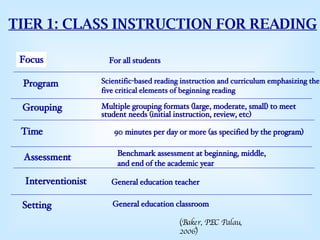
TIER 1: CLASS INSTRUCTION FOR READING Focus Program Interventionist Setting Grouping Time Assessment For all students  Scientific-based reading instruction and curriculum emphasizing the five critical elements of beginning reading General education teacher  General education classroom Multiple grouping formats (large, moderate, small) to meet student needs (initial instruction, review, etc) 90 minutes per day or more (as specified by the program) Benchmark assessment at beginning, middle,  and end of the academic year  (Baker, PEC Palau, 2006)
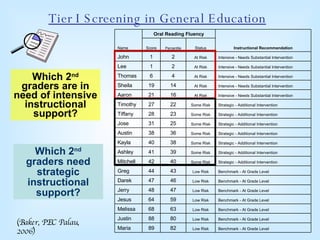
Tier I Screening in General Education (Baker, PEC Palau, 2006) Which 2 nd  graders are in need of intensive instructional support? Which 2 nd  graders need strategic instructional support? Benchmark - At Grade Level Low Risk 82 89 Maria Benchmark - At Grade Level Low Risk 80 88 Justin Benchmark - At Grade Level Low Risk 63 68 Melissa Benchmark - At Grade Level Low Risk 59 64 Jesus Benchmark - At Grade Level Low Risk 47 48 Jerry Benchmark - At Grade Level Low Risk 46 47 Darek Benchmark - At Grade Level Low Risk 43 44 Greg Strategic - Additional Intervention Some Risk 40 42 Mitchell Strategic - Additional Intervention Some Risk 39 41 Ashley Strategic - Additional Intervention Some Risk 38 40 Kayla Strategic - Additional Intervention Some Risk 36 38 Austin Strategic - Additional Intervention Some Risk 25 31 Jose Strategic - Additional Intervention Some Risk 23 28 Tiffany Strategic - Additional Intervention Some Risk 22 27 Timothy Intensive - Needs Substantial Intervention At Risk 16 21 Aaron Intensive - Needs Substantial Intervention At Risk 14 19 Sheila Intensive - Needs Substantial Intervention At Risk 4 6 Thomas Intensive - Needs Substantial Intervention At Risk 2 1 Lee Intensive - Needs Substantial Intervention At Risk 2 1 John Status Percentile Score Instructional Recommendation Oral Reading Fluency Name
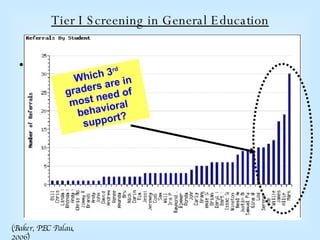
Tier I Screening in General Education Students in Third Grade with Office Referrals Which 3 rd  graders are in most need of behavioral support? (Baker, PEC Palau, 2006)
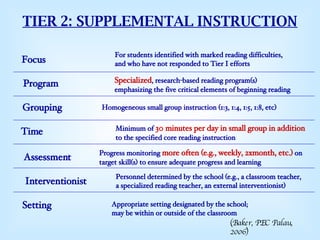
TIER 2: SUPPLEMENTAL INSTRUCTION Focus Program Setting Grouping Time Assessment For students identified with marked reading difficulties,  and who have not responded to Tier I efforts Personnel determined by the school (e.g., a classroom teacher,  a specialized reading teacher, an external interventionist) Appropriate setting designated by the school; may be within or outside of the classroom Homogeneous small group instruction (1:3, 1:4, 1:5, 1:8, etc) Minimum of  30 minutes per day in small group   in addition to the specified core reading instruction Progress monitoring  more often (e.g., weekly, 2xmonth, etc.)  on target skill(s) to ensure adequate progress and learning Specialized , research-based reading program(s)  emphasizing the five critical elements of beginning reading Interventionist (Baker, PEC Palau, 2006)
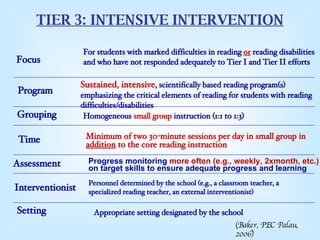
Program Focus Interventionist Setting Grouping Time Assessment For students with marked difficulties in reading  or  reading disabilities and who have not responded adequately to Tier I and Tier II efforts Appropriate setting designated by the school Homogeneous  small group  instruction (1:1 to 1:3) Minimum of two 30-minute sessions per day in small group in  addition  to the core reading instruction  Sustained, intensive , scientifically based reading program(s) emphasizing the critical elements of reading for students with reading difficulties/disabilities  Personnel determined by the school (e.g., a classroom teacher, a specialized reading teacher, an external interventionist) TIER 3: INTENSIVE INTERVENTION Progress monitoring  more often (e.g., weekly, 2xmonth, etc.)   on target skills to ensure adequate progress and learning (Baker, PEC Palau, 2006)
 

Response to Intervention: What is it?

  • 1.
    R esponse to I ntervention Paula R. Ulloa ED656 Advanced Techniques For the Learning Disabled Julie Fee, July 9, 2008
  • 2.
    Response to Intervention(RtI) Began in the 1960s Has been used as a progress-monitoring tool for students with and without disabilities This decade RtI has been explored as a primary way to identify students with special needs Continuous research
  • 3.
    Why are wehere? Define RtI RtI Process How RtI impacts general & special education Federal, State, Local positions on RtI Implications
  • 4.
    Response to Intervention(RtI) “… systematic application of data-based decision making to enhance outcomes for ALL students .” (Vaughn, 2009) “… multi-tiered system of intervention, data collection system that informs decision making, and ongoing progress monitoring…” (Vaughn, 2009) “… number of tiers, what data are collected, and the measures are what determine if a child is “responding” to an intervention…” (Vaughn, 2009)
  • 5.
    Response to Intervention(RtI) Four Key Elements to RtI: High-quality, research-based instruction matched to student needs (GE) Monitoring student learning over a period of time to determine their level and rate of performance for constant decision-making Provide interventions of increasing intensity Make important educational decisions based on data (Vaughn, 2009) 4
  • 6.
  • 7.
    Response to Intervention(RtI) There are 3 primary types of RtI approaches: Standard Treatment: Curriculum (research)-based measurements with intervention plans for remediation (Bender, 2007) Problem-Solving Response: Interpreted data (not research-based) establishes goals for personal performance (Bender, 2007) Pre-referral: Steps prior Special Education (Baker, PEC 2006 & NCLD) ** SEA/LEA use the RtI method as it applies to their district **
  • 8.
    RtI: Standard TreatmentProtocol: Screening & baseline: indicates concern Tier 1 data indicates little to no response Observation notes of scientifically-based curriculum Tier 2 data indicates little to no response Observation data of research-based intervention Summary report
  • 9.
    Tier IV: Specialeducation : Long-term and intensive service individualized for student needs Tier III: Problem Solving : Targeted individualized interventions (modification to the standard protocol) in general education/Special Education Tier II: Standard Protocol Treatments: Small group intervention (3-5) in general education/Special Education Tier I: General Education: All students Tier 1 (& 2) High Quality core instruction for all in the general education classroom Tier 2 or 3 Supplemental Instruction Tier 3 or 4 Intensive Instruction (Baker, PEC Palau, 2006)
  • 10.
    Classifying Reading Programs:What is the purpose of the program? 1. Core 2. Supplemental 3. Intervention Supplemental Reading Program Supporting the Core Core Supplemental Intervention Intervention Reading Program Meeting the needs for each (Vaughn et al. 2001) (Baker, PEC Palau, 2006) Core Reading Program Meeting the needs for most
  • 11.
    RtI: Problem SolvingBased on individual student data Flexibility Team approach Five part process (variable) Define the problem Analyze the problem Develop a plan Implement a plan Evaluate the plan (Vaughn, 2009) ?
  • 12.
    RtI: Pre-referral Supportteams: Occurs early teacher consultation: Specialists, Sped, SLT, Psy., Child Study Teams (CST) Informal educational/behavioral evaluations or screenings Source: www.ncld.com
  • 13.
  • 14.
    RtI Positions Federalposition: IDEA ’04 National Association of State Directors of Special Education (NASDE) 2005 State position: Determines use & develops tier system Local position: Determines use & develops tier system
  • 15.
  • 16.
    RtI Assumptions Thereis effective instruction occurring in the GEC RtI respects learner characteristics & styles In the absence of high quality instruction RTI is not possible Small group settings become universal Leaders in the school, state, and local levels are ill-prepared to start RTI Inadequate training to personnel Understanding high quality instruction in early reading vs. less developed understanding in other academic areas RTI is perceived as a Special Education plan Local and state policies may conflict with the RTI movement School Psy affected RtI Issues Do you see any assumptions & issues related to GPSS?
  • 17.
    RtI: Implications GETmust provide effective education Collaborative team efforts Paper work (data) Small class sizes More schools Supplies & equipment accountability Personnel requirements (training, professional development) Can it be done effectively, for its purpose, on Guam?
  • 18.
    The bottom linein a nutshell… NCLB, IDEA, NCLD, etc. support RtI, yet do not mandate it’s methodology SEA/LEA are still in charge of their education RtI is for ALL students RtI can be used as a Special Education Process RtI can be used in ANY district RtI is a process for General & Special education What needs to be done to implement this program, District-wide, on Guam? (no superintendent jokes)
  • 19.
    References Baker, ScottK., Ph.D., Eugenia Coronado Pacific Institutes for Research, University of Oregon, 23 rd Pacific Education Conference, July 11-14, 2006, Koror, Palau Bender, W. & Shores, C. Response to Intervention: A Practical Guide to Every Teacher. Thousand Oaks, CA: Corwin Press Vaughn, S. & Bos C. Teaching Students with Learning & Behavior Problems. Upper Saddle River, NJ: Pearson Press National Center for Learning Disabilities: http:// www.ncld.org National Center on Response to Intervention: http://www.rti4success.org US Department of Education: http://idea.ed.gov Wrightslaw: http:// www.wrightslaw.com/info/rti.index.htm
  • 20.
    Tier IV: Specialeducation : Long-term and intensive service individualized for student needs Tier III: Problem Solving : Targeted individualized interventions (modification to the standard protocol) in general education/Special Education Tier II: Standard Protocol Treatments: Small group intervention (3-5) in general education/Special Education Tier I: General Education: All students Tier 1 (& 2) High Quality core instruction for all in the general education classroom Tier 2 or 3 Supplemental Instruction Tier 3 or 4 Intensive Instruction (Baker, PEC Palau, 2006)
  • 21.
    Classifying Reading Programs:What is the purpose of the program? 1. Core 2. Supplemental 3. Intervention Supplemental Reading Program Supporting the Core Core Supplemental Intervention Intervention Reading Program Meeting the needs for each (Vaughn et al. 2001) (Baker, PEC Palau, 2006) Core Reading Program Meeting the needs for most
  • 22.
    TIER 1: CLASSINSTRUCTION FOR READING Focus Program Interventionist Setting Grouping Time Assessment For all students Scientific-based reading instruction and curriculum emphasizing the five critical elements of beginning reading General education teacher General education classroom Multiple grouping formats (large, moderate, small) to meet student needs (initial instruction, review, etc) 90 minutes per day or more (as specified by the program) Benchmark assessment at beginning, middle, and end of the academic year (Baker, PEC Palau, 2006)
  • 23.
    Tier I Screeningin General Education (Baker, PEC Palau, 2006) Which 2 nd graders are in need of intensive instructional support? Which 2 nd graders need strategic instructional support? Benchmark - At Grade Level Low Risk 82 89 Maria Benchmark - At Grade Level Low Risk 80 88 Justin Benchmark - At Grade Level Low Risk 63 68 Melissa Benchmark - At Grade Level Low Risk 59 64 Jesus Benchmark - At Grade Level Low Risk 47 48 Jerry Benchmark - At Grade Level Low Risk 46 47 Darek Benchmark - At Grade Level Low Risk 43 44 Greg Strategic - Additional Intervention Some Risk 40 42 Mitchell Strategic - Additional Intervention Some Risk 39 41 Ashley Strategic - Additional Intervention Some Risk 38 40 Kayla Strategic - Additional Intervention Some Risk 36 38 Austin Strategic - Additional Intervention Some Risk 25 31 Jose Strategic - Additional Intervention Some Risk 23 28 Tiffany Strategic - Additional Intervention Some Risk 22 27 Timothy Intensive - Needs Substantial Intervention At Risk 16 21 Aaron Intensive - Needs Substantial Intervention At Risk 14 19 Sheila Intensive - Needs Substantial Intervention At Risk 4 6 Thomas Intensive - Needs Substantial Intervention At Risk 2 1 Lee Intensive - Needs Substantial Intervention At Risk 2 1 John Status Percentile Score Instructional Recommendation Oral Reading Fluency Name
  • 24.
    Tier I Screeningin General Education Students in Third Grade with Office Referrals Which 3 rd graders are in most need of behavioral support? (Baker, PEC Palau, 2006)
  • 25.
    TIER 2: SUPPLEMENTALINSTRUCTION Focus Program Setting Grouping Time Assessment For students identified with marked reading difficulties, and who have not responded to Tier I efforts Personnel determined by the school (e.g., a classroom teacher, a specialized reading teacher, an external interventionist) Appropriate setting designated by the school; may be within or outside of the classroom Homogeneous small group instruction (1:3, 1:4, 1:5, 1:8, etc) Minimum of 30 minutes per day in small group in addition to the specified core reading instruction Progress monitoring more often (e.g., weekly, 2xmonth, etc.) on target skill(s) to ensure adequate progress and learning Specialized , research-based reading program(s) emphasizing the five critical elements of beginning reading Interventionist (Baker, PEC Palau, 2006)
  • 26.
    Program Focus InterventionistSetting Grouping Time Assessment For students with marked difficulties in reading or reading disabilities and who have not responded adequately to Tier I and Tier II efforts Appropriate setting designated by the school Homogeneous small group instruction (1:1 to 1:3) Minimum of two 30-minute sessions per day in small group in addition to the core reading instruction Sustained, intensive , scientifically based reading program(s) emphasizing the critical elements of reading for students with reading difficulties/disabilities Personnel determined by the school (e.g., a classroom teacher, a specialized reading teacher, an external interventionist) TIER 3: INTENSIVE INTERVENTION Progress monitoring more often (e.g., weekly, 2xmonth, etc.) on target skills to ensure adequate progress and learning (Baker, PEC Palau, 2006)
  • 27.