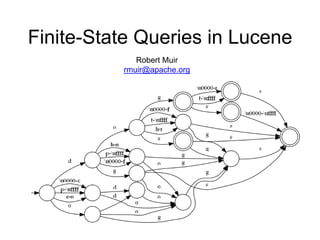
Finite-State Queries in Lucene
             Robert Muir
          rmuir@apache.org
Agenda
• Introduction to Lucene
• Improving inexact matching:
  – Background
  – Regular Expression, Wildcard, Fuzzy Queries
• Additional use cases:
  – Language support: expansion versus
    stemming
  – Improved spellchecking
• Other ongoing developments in Lucene
Introduction to Lucene
• Open Source Search Engine Library
  – Not just Java, ported to other languages too.
  – Commercial support via several companies
• Just the library
  – Embed for your own uses, e.g. Eclipse
  – For a search server, see Solr
  – For web search + crawler, see Nutch
• Website: http://lucene.apache.org
Inverted Index
• Like a TreeMap<Terms, Documents>
• Before 2.9, queries only operate on one
  “subtree”.
  – For example, Regex and Fuzzy exhaustively
    evaluate all terms, unless you give them a
    “constant prefix”.
• TermQuery is just a special case, looks at
  one leaf node.
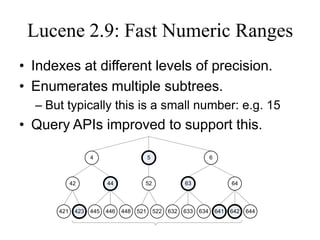
Lucene 2.9: Fast Numeric Ranges
• Indexes at different levels of precision.
• Enumerates multiple subtrees.
  – But typically this is a small number: e.g. 15
• Query APIs improved to support this.

                   4                       5                           6


            42           44            52                  63                    64


      421    423   445   446   448   521       522   632   633   634       641   642   644
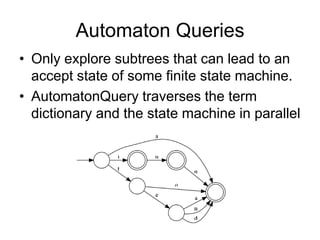
Automaton Queries
• Only explore subtrees that can lead to an
  accept state of some finite state machine.
• AutomatonQuery traverses the term
  dictionary and the state machine in parallel
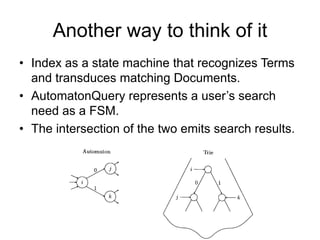
Another way to think of it
• Index as a state machine that recognizes Terms
  and transduces matching Documents.
• AutomatonQuery represents a user’s search
  need as a FSM.
• The intersection of the two emits search results.
Query API improvements
• Automata might need to do many seeks
  around the term dictionary.
  – Depends on what is in term dictionary
  – Depends on state machine structure
• MultiTermQuery API further improved
  – Easier and more efficient to skip around.
  – Explicitly supports seeking.
Regex, Wildcard, Fuzzy
• Without constant prefix, exhaustive
  – Regex: (http|ftp)://foo.com
  – Wildcard: ?oo?ar
  – Fuzzy: foobar~
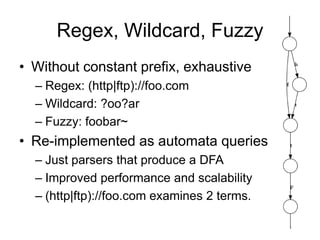
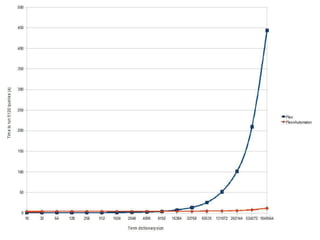
• Re-implemented as automata queries
  – Just parsers that produce a DFA
  – Improved performance and scalability
  – (http|ftp)://foo.com examines 2 terms.
Additional/Advanced Use Cases
Stemming
• Stemmers work at index and query time
  – walked, walking -> walk
  – Can increase retrieval effectiveness
• Some problems
  – Mistakes: international -> intern
  – Must determine language of documents
  – Multilingual cases can get messy
  – Tuning is difficult: must re-index
  – Unfriendly: wildcards on stemmed terms…
Expansion instead
• Don’t remove data at index time
  – Expand the query instead.
  – Single field now works well for all queries:
    exact match, wildcard, expanded, etc.
• Simplifies search configuration
  – Tuning relevance is easier, no re-indexing.
  – No need to worry about language ID for docs.
  – Multilingual case is much simpler.
Automata expansion
• Natural fit for morphology
• Use set intersection operators
  – Minus to subtract exact match case
  – Union to search multiple languages
• Efficient operation
  – Doesn’t explode for languages with complex
    morphology
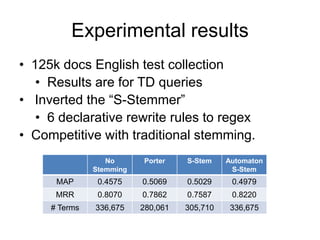
Experimental results
• 125k docs English test collection
   • Results are for TD queries
• Inverted the “S-Stemmer”
   • 6 declarative rewrite rules to regex
• Competitive with traditional stemming.
                  No      Porter    S-Stem    Automaton
               Stemming                        S-Stem
      MAP       0.4575    0.5069    0.5029     0.4979
      MRR       0.8070    0.7862    0.7587     0.8220
     # Terms   336,675    280,061   305,710    336,675
TODO:
• Support expansion models, too in Lucene.
• Language-specific resources
  – lucene-hunspell could provide these
• Language-independent tokenization
  – Unicode rules go a long way.
• Scoring that doesn’t need stopwords
  – For now, use CommonGrams!
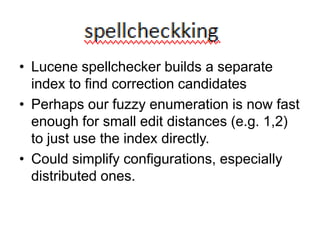
Spellchecking


• Lucene spellchecker builds a separate
  index to find correction candidates
• Perhaps our fuzzy enumeration is now fast
  enough for small edit distances (e.g. 1,2)
  to just use the index directly.
• Could simplify configurations, especially
  distributed ones.
Ongoing developments in Lucene
Community
• Merging Lucene and Solr development
  – Still two separate released “products”!!!
  – Share mailing list and code repository
  – Solr dev code in sync with Lucene dev code
• Benefits to both Lucene and Solr users
  – Lucene features exposed to Solr faster
  – Solr features available to Lucene users
Indexing
• Flexible Indexing
  – Customize the format of the index
  – Decreased RAM usage
  – Faster IndexReader open and faster seeking
• Future
  – Serialize custom attributes to the index
  – More RAM savings
  – Improved index compression
  – Faster Near-Real-Time performance
Text Analysis
• Improved Unicode Support
  – Unicode 4/Supplementary support
  – ICU integration (to support Unicode 5.2)
• Improved Language Support
  – More languages
  – Faster indexing performance
  – Easier packaging and ease-of-use
• Improvements to Analysis API
Relevance and Scoring
• Improved relevance benchmarking
  – Open Relevance Project
  – Quality Benchmarking Package
• Future: More flexible scoring
  – How to support BM25, DFR, more vector
    space?
  – Some packages/patches available, but
     • Additional index statistics needed to be simple
Other
• Improvements to Spatial support
  – See Chris Male’s talk here:
    http://vimeo.com/10204365
  – Progress in both Lucene and Solr
• Steps towards a more modular
  architecture
  – Smaller Lucene core
  – Separate modules with more functionality
Questions?
Backup slides
Finite State Queries In Lucene

Finite State Queries In Lucene

  • 1.
    Finite-State Queries inLucene Robert Muir rmuir@apache.org
  • 2.
    Agenda • Introduction toLucene • Improving inexact matching: – Background – Regular Expression, Wildcard, Fuzzy Queries • Additional use cases: – Language support: expansion versus stemming – Improved spellchecking • Other ongoing developments in Lucene
  • 3.
    Introduction to Lucene •Open Source Search Engine Library – Not just Java, ported to other languages too. – Commercial support via several companies • Just the library – Embed for your own uses, e.g. Eclipse – For a search server, see Solr – For web search + crawler, see Nutch • Website: http://lucene.apache.org
  • 4.
    Inverted Index • Likea TreeMap<Terms, Documents> • Before 2.9, queries only operate on one “subtree”. – For example, Regex and Fuzzy exhaustively evaluate all terms, unless you give them a “constant prefix”. • TermQuery is just a special case, looks at one leaf node.
  • 5.
    Lucene 2.9: FastNumeric Ranges • Indexes at different levels of precision. • Enumerates multiple subtrees. – But typically this is a small number: e.g. 15 • Query APIs improved to support this. 4 5 6 42 44 52 63 64 421 423 445 446 448 521 522 632 633 634 641 642 644
  • 6.
    Automaton Queries • Onlyexplore subtrees that can lead to an accept state of some finite state machine. • AutomatonQuery traverses the term dictionary and the state machine in parallel
  • 7.
    Another way tothink of it • Index as a state machine that recognizes Terms and transduces matching Documents. • AutomatonQuery represents a user’s search need as a FSM. • The intersection of the two emits search results.
  • 8.
    Query API improvements •Automata might need to do many seeks around the term dictionary. – Depends on what is in term dictionary – Depends on state machine structure • MultiTermQuery API further improved – Easier and more efficient to skip around. – Explicitly supports seeking.
  • 9.
    Regex, Wildcard, Fuzzy •Without constant prefix, exhaustive – Regex: (http|ftp)://foo.com – Wildcard: ?oo?ar – Fuzzy: foobar~ • Re-implemented as automata queries – Just parsers that produce a DFA – Improved performance and scalability – (http|ftp)://foo.com examines 2 terms.
  • 10.
  • 11.
    Stemming • Stemmers workat index and query time – walked, walking -> walk – Can increase retrieval effectiveness • Some problems – Mistakes: international -> intern – Must determine language of documents – Multilingual cases can get messy – Tuning is difficult: must re-index – Unfriendly: wildcards on stemmed terms…
  • 12.
    Expansion instead • Don’tremove data at index time – Expand the query instead. – Single field now works well for all queries: exact match, wildcard, expanded, etc. • Simplifies search configuration – Tuning relevance is easier, no re-indexing. – No need to worry about language ID for docs. – Multilingual case is much simpler.
  • 13.
    Automata expansion • Naturalfit for morphology • Use set intersection operators – Minus to subtract exact match case – Union to search multiple languages • Efficient operation – Doesn’t explode for languages with complex morphology
  • 14.
    Experimental results • 125kdocs English test collection • Results are for TD queries • Inverted the “S-Stemmer” • 6 declarative rewrite rules to regex • Competitive with traditional stemming. No Porter S-Stem Automaton Stemming S-Stem MAP 0.4575 0.5069 0.5029 0.4979 MRR 0.8070 0.7862 0.7587 0.8220 # Terms 336,675 280,061 305,710 336,675
  • 15.
    TODO: • Support expansionmodels, too in Lucene. • Language-specific resources – lucene-hunspell could provide these • Language-independent tokenization – Unicode rules go a long way. • Scoring that doesn’t need stopwords – For now, use CommonGrams!
  • 16.
    Spellchecking • Lucene spellcheckerbuilds a separate index to find correction candidates • Perhaps our fuzzy enumeration is now fast enough for small edit distances (e.g. 1,2) to just use the index directly. • Could simplify configurations, especially distributed ones.
  • 17.
  • 18.
    Community • Merging Luceneand Solr development – Still two separate released “products”!!! – Share mailing list and code repository – Solr dev code in sync with Lucene dev code • Benefits to both Lucene and Solr users – Lucene features exposed to Solr faster – Solr features available to Lucene users
  • 19.
    Indexing • Flexible Indexing – Customize the format of the index – Decreased RAM usage – Faster IndexReader open and faster seeking • Future – Serialize custom attributes to the index – More RAM savings – Improved index compression – Faster Near-Real-Time performance
  • 20.
    Text Analysis • ImprovedUnicode Support – Unicode 4/Supplementary support – ICU integration (to support Unicode 5.2) • Improved Language Support – More languages – Faster indexing performance – Easier packaging and ease-of-use • Improvements to Analysis API
  • 21.
    Relevance and Scoring •Improved relevance benchmarking – Open Relevance Project – Quality Benchmarking Package • Future: More flexible scoring – How to support BM25, DFR, more vector space? – Some packages/patches available, but • Additional index statistics needed to be simple
  • 22.
    Other • Improvements toSpatial support – See Chris Male’s talk here: http://vimeo.com/10204365 – Progress in both Lucene and Solr • Steps towards a more modular architecture – Smaller Lucene core – Separate modules with more functionality
  • 23.
  • 24.