Telecom Cloud Computing
   SCOPE Alliance Perspective


          András Vajda
    Whitepaper Editor, Ericsson
OpenSAF Conference, May 17th, 2011
About Scope Alliance

     Industry alliance committed to
      accelerating the deployment of
      carrier grade base platforms for
      service providers

     Founded in 2006 by leading
      network equipment manufacturers

     Close co-operation with PICMG,
      SAF, Linux Foundation


                                         www.scope-alliance.org

2
Cloud Computing – a telecom perspective
 Based on a successful Scope Alliance workshop in May 2010

 Whitepaper focus is on issues relevant for the telecom industry and Scope
  Alliance’s goals
       Define and publicize the differentiating factors
       Telecom perspective for standardization efforts
       Define a common work agenda for the Scope Alliance
       Available at
          http://scope-alliance.org/sites/default/files/documents/CloudComputing_Scope_1.0.pdf


 Editorial team
       Ericsson (coordinator)
       Alcatel-Lucent
       Huawei
       NEC
       Nokia Siemens Networks


3
Outline
     Cloud computing and the telecom industry

     Telecom grade cloud computing infrastructure

     Differentiating factors for telecom grade cloud infrastructure

     Principles for telecom grade cloud infrastructure

     Foundation for standardization efforts– Scope Alliance
      agenda

     The way forward
4
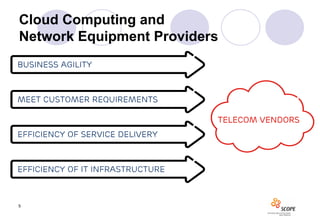
Cloud Computing and
Network Equipment Providers
Business Agility


Meet customer requirements

                                  Telecom vendors
Efficiency of Service delivery


Efficiency of IT INFRASTRUCTURE


5
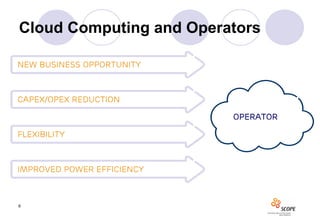
Cloud Computing and Operators

new business opportunity


CAPEX/OPEX reduction

                            Operator

Flexibility


Improved Power efficiency


6
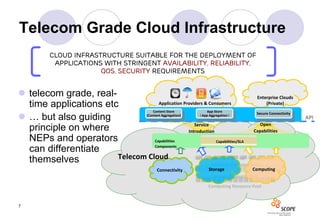
Telecom Grade Cloud Infrastructure
           CLOUD Infrastructure Suitable for the deployment of
            Applications with stringent Availability, Reliability,
                        QoS, Security requirements


 telecom grade, real-                                                            Enterprise Clouds 
  time applications etc            Application Providers & Consumers                   (Private)
                                                   Content Store            App Store
 … but also guiding                                 Content Store
                                               (Content Aggregation)
                                                                                  Secure Connectivity
                                                                              App Store
                                                                         (App Aggregation)
                                                                                   Secure Connectivity
                                                 (Content Aggregation)    (App Aggregation)                   API
                                                    Service                         Open 
  principle on where                             Introduction                    Capabilities
  NEPs and operators             Capabilities                  Capabilities/SLA 
                                 Components
  can differentiate
  themselves           Telecom Cloud
                                                             Network Resource Pool
                                                     Connectivity             Storage             Computing
                                                                                Storage Resource Pool

                                                                              Computing Resource Pool


7
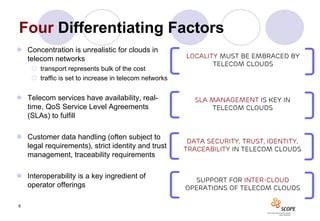
Four Differentiating Factors
 Concentration is unrealistic for clouds in
  telecom networks                                     Locality must be embraced by
                                                              telecom clouds
     transport represents bulk of the cost
     traffic is set to increase in telecom networks


 Telecom services have availability, real-               SLA Management is key in
  time, QoS Service Level Agreements                          telecom clouds
  (SLAs) to fulfill

 Customer data handling (often subject to
                                                        DaTA Security, trust, iDENTITY,
  legal requirements), strict identity and trust       TRACEABILITY in telecom clouds
  management, traceability requirements

 Interoperability is a key ingredient of
                                                          Support for Inter-Cloud
  operator offerings                                   Operations of telecom clouds

8
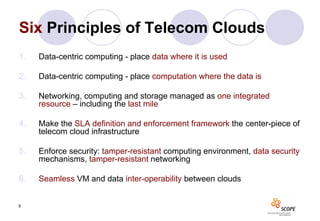
Six Principles of Telecom Clouds
1.   Data-centric computing - place data where it is used

2.   Data-centric computing - place computation where the data is

3.   Networking, computing and storage managed as one integrated
     resource – including the last mile

4.   Make the SLA definition and enforcement framework the center-piece of
     telecom cloud infrastructure

5.   Enforce security: tamper-resistant computing environment, data security
     mechanisms, tamper-resistant networking

6.   Seamless VM and data inter-operability between clouds


9
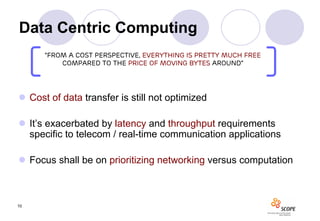
Data Centric Computing
      “From a cost perspective, everything is pretty much free
          compared to the price of moving bytes around”


 Cost of data transfer is still not optimized

 It’s exacerbated by latency and throughput requirements
  specific to telecom / real-time communication applications

 Focus shall be on prioritizing networking versus computation


10
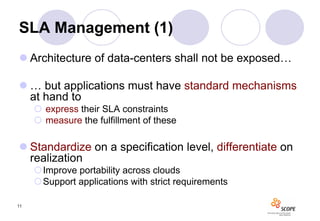
SLA Management (1)
 Architecture of data-centers shall not be exposed…

 … but applications must have standard mechanisms
  at hand to
      express their SLA constraints
      measure the fulfillment of these

 Standardize on a specification level, differentiate on
  realization
     Improve portability across clouds
     Support applications with strict requirements

11
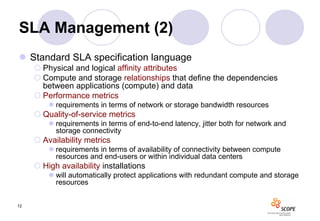
SLA Management (2)
 Standard SLA specification language
      Physical and logical affinity attributes
      Compute and storage relationships that define the dependencies
       between applications (compute) and data
      Performance metrics
          requirements in terms of network or storage bandwidth resources
      Quality-of-service metrics
          requirements in terms of end-to-end latency, jitter both for network and
           storage connectivity
      Availability metrics
          requirements in terms of availability of connectivity between compute
           resources and end-users or within individual data centers
      High availability installations
          will automatically protect applications with redundant compute and storage
           resources


12
SLA Management (3)

Standard SLA fulfillment monitoring metrics
      End-to-end bandwidth allocation
      Latency and jitter encountered by a particular application
         spanning both compute and network resources
      Computational load as seen by hypervisors
      Storage load as seen by storage devices and/or dedicated storage
       networks
      Faults in compute, storage or network infrastructure components


13
Networking
 Virtualization exacerbates the scale of networking
     Number of virtual switches, MACs etc

 There’s a need to rethink networking in the context of
  large scale, virtualized, distributed data centers

 Promising approach: Open Networking Foundation
      OpenFlow based programmable switches
      Separation of simple packet switching mechanisms and
      control functions
      Opportunity for a new way of coupling cloud computing and
      the network fabric
14
Inter-cloud
 Learn from successful examples: re-use the
  experience from Internet for inter-operability of
  clouds

 Need to establish a common set of Inter-Cloud
  Protocols for VM and storage interoperability and
  migration

 We believe OVF is a good foundation to build on for
  enhanced inter-operability
15
Security (1)
 There’s no shortage of security related standards

 … but we lack bundling and profiling of these for the cloud
  computing context
      Secure data management
      Data lifecycle
      Enforcement and tracking of data placement
      Data partitioning within the cloud and outside of it
      Compliance with legal requirements, specific to the telecom sector
      Integration of security SLAs with the rest of the SLA framework


16
Security (2)
 Need for overall security schema that defines security needs
  and requirements at different layers
      Network, hardware, hypervisor, VMs, OS, middleware

 Standards for secure management of cloud infrastructures

 Standards for auditing of cloud operations
      E.g. based on ISO 27001

 Security attestation framework – similar to other security
  critical industries
           Telecom Companies have the right track
                  record for achieving this
17
Conclusions

             Cloud computing has Unresolved issues related to
     Networking, security, interoperability, soft real-time Characteristics


     Support for SLA Management, integrated cloud networking, Security
        and cloud interoperability are key from telecom perspective


          There’s a need to address these issues through standards
                        that can gain Wide acceptance


18
Thank YOU!


           András Vajda
     Andras.vajda@ericsson.com
     Blog: www.a-vajda.eu/blog

19

Carrier Grade Requirements for Cloud Computing: A SCOPE Alliance Perspective 5.17.2011

  • 1.
    Telecom Cloud Computing SCOPE Alliance Perspective András Vajda Whitepaper Editor, Ericsson OpenSAF Conference, May 17th, 2011
  • 2.
    About Scope Alliance  Industry alliance committed to accelerating the deployment of carrier grade base platforms for service providers  Founded in 2006 by leading network equipment manufacturers  Close co-operation with PICMG, SAF, Linux Foundation www.scope-alliance.org 2
  • 3.
    Cloud Computing –a telecom perspective  Based on a successful Scope Alliance workshop in May 2010  Whitepaper focus is on issues relevant for the telecom industry and Scope Alliance’s goals  Define and publicize the differentiating factors  Telecom perspective for standardization efforts  Define a common work agenda for the Scope Alliance  Available at  http://scope-alliance.org/sites/default/files/documents/CloudComputing_Scope_1.0.pdf  Editorial team  Ericsson (coordinator)  Alcatel-Lucent  Huawei  NEC  Nokia Siemens Networks 3
  • 4.
    Outline  Cloud computing and the telecom industry  Telecom grade cloud computing infrastructure  Differentiating factors for telecom grade cloud infrastructure  Principles for telecom grade cloud infrastructure  Foundation for standardization efforts– Scope Alliance agenda  The way forward 4
  • 5.
    Cloud Computing and NetworkEquipment Providers Business Agility Meet customer requirements Telecom vendors Efficiency of Service delivery Efficiency of IT INFRASTRUCTURE 5
  • 6.
    Cloud Computing andOperators new business opportunity CAPEX/OPEX reduction Operator Flexibility Improved Power efficiency 6
  • 7.
    Telecom Grade CloudInfrastructure CLOUD Infrastructure Suitable for the deployment of Applications with stringent Availability, Reliability, QoS, Security requirements  telecom grade, real- Enterprise Clouds  time applications etc Application Providers & Consumers  (Private) Content Store App Store  … but also guiding Content Store (Content Aggregation) Secure Connectivity App Store (App Aggregation) Secure Connectivity (Content Aggregation) (App Aggregation) API Service  Open  principle on where Introduction Capabilities NEPs and operators Capabilities  Capabilities/SLA  Components can differentiate themselves Telecom Cloud Network Resource Pool Connectivity Storage Computing Storage Resource Pool Computing Resource Pool 7
  • 8.
    Four Differentiating Factors Concentration is unrealistic for clouds in telecom networks Locality must be embraced by telecom clouds  transport represents bulk of the cost  traffic is set to increase in telecom networks  Telecom services have availability, real- SLA Management is key in time, QoS Service Level Agreements telecom clouds (SLAs) to fulfill  Customer data handling (often subject to DaTA Security, trust, iDENTITY, legal requirements), strict identity and trust TRACEABILITY in telecom clouds management, traceability requirements  Interoperability is a key ingredient of Support for Inter-Cloud operator offerings Operations of telecom clouds 8
  • 9.
    Six Principles ofTelecom Clouds 1. Data-centric computing - place data where it is used 2. Data-centric computing - place computation where the data is 3. Networking, computing and storage managed as one integrated resource – including the last mile 4. Make the SLA definition and enforcement framework the center-piece of telecom cloud infrastructure 5. Enforce security: tamper-resistant computing environment, data security mechanisms, tamper-resistant networking 6. Seamless VM and data inter-operability between clouds 9
  • 10.
    Data Centric Computing “From a cost perspective, everything is pretty much free compared to the price of moving bytes around”  Cost of data transfer is still not optimized  It’s exacerbated by latency and throughput requirements specific to telecom / real-time communication applications  Focus shall be on prioritizing networking versus computation 10
  • 11.
    SLA Management (1) Architecture of data-centers shall not be exposed…  … but applications must have standard mechanisms at hand to  express their SLA constraints  measure the fulfillment of these  Standardize on a specification level, differentiate on realization Improve portability across clouds Support applications with strict requirements 11
  • 12.
    SLA Management (2) Standard SLA specification language  Physical and logical affinity attributes  Compute and storage relationships that define the dependencies between applications (compute) and data  Performance metrics  requirements in terms of network or storage bandwidth resources  Quality-of-service metrics  requirements in terms of end-to-end latency, jitter both for network and storage connectivity  Availability metrics  requirements in terms of availability of connectivity between compute resources and end-users or within individual data centers  High availability installations  will automatically protect applications with redundant compute and storage resources 12
  • 13.
    SLA Management (3) StandardSLA fulfillment monitoring metrics  End-to-end bandwidth allocation  Latency and jitter encountered by a particular application  spanning both compute and network resources  Computational load as seen by hypervisors  Storage load as seen by storage devices and/or dedicated storage networks  Faults in compute, storage or network infrastructure components 13
  • 14.
    Networking  Virtualization exacerbatesthe scale of networking Number of virtual switches, MACs etc  There’s a need to rethink networking in the context of large scale, virtualized, distributed data centers  Promising approach: Open Networking Foundation  OpenFlow based programmable switches  Separation of simple packet switching mechanisms and control functions  Opportunity for a new way of coupling cloud computing and the network fabric 14
  • 15.
    Inter-cloud  Learn fromsuccessful examples: re-use the experience from Internet for inter-operability of clouds  Need to establish a common set of Inter-Cloud Protocols for VM and storage interoperability and migration  We believe OVF is a good foundation to build on for enhanced inter-operability 15
  • 16.
    Security (1)  There’sno shortage of security related standards  … but we lack bundling and profiling of these for the cloud computing context  Secure data management  Data lifecycle  Enforcement and tracking of data placement  Data partitioning within the cloud and outside of it  Compliance with legal requirements, specific to the telecom sector  Integration of security SLAs with the rest of the SLA framework 16
  • 17.
    Security (2)  Needfor overall security schema that defines security needs and requirements at different layers  Network, hardware, hypervisor, VMs, OS, middleware  Standards for secure management of cloud infrastructures  Standards for auditing of cloud operations  E.g. based on ISO 27001  Security attestation framework – similar to other security critical industries Telecom Companies have the right track record for achieving this 17
  • 18.
    Conclusions Cloud computing has Unresolved issues related to Networking, security, interoperability, soft real-time Characteristics Support for SLA Management, integrated cloud networking, Security and cloud interoperability are key from telecom perspective There’s a need to address these issues through standards that can gain Wide acceptance 18
  • 19.
    Thank YOU! András Vajda Andras.vajda@ericsson.com Blog: www.a-vajda.eu/blog 19