OER-Enabled Pedagogy
David Wiley, PhD
Lumen Learning / Creative Commons / BYU
@opencontent
Unless otherwise noted
this presentation is licensed CC BY 4.0
http://slideshare.net/opencontent/
A Word About Lumen
• Founded in 2012 here in Portland, OR
• 30 people
• Services and tools to make OER adoption
(1) simple and (2) effective
• CC BY license all content we create
• Saved 110k+ students $10M in 2016
• Will save 160k+ students $15M in 2017
• Focus on at-risk students
Why not “open pedagogy?”
“OER-enabled Pedagogy”
Open Educational Resources (OER)
Which “open”?
open ≈ free
the internet is already free to
read / watch / listen to
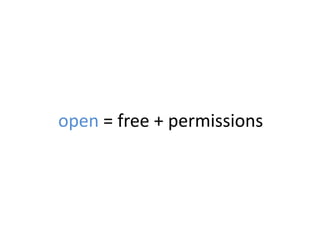
open = free + permissions
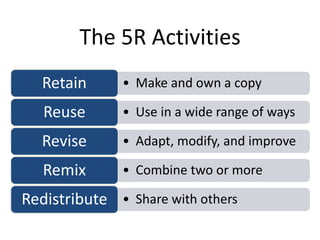
• Make and own a copyRetain
• Use in a wide range of waysReuse
• Adapt, modify, and improveRevise
• Combine two or moreRemix
• Share with othersRedistribute
The 5R Activities
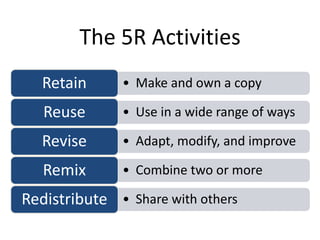
• Make and own a copyRetain
• Use in a wide range of waysReuse
• Adapt, modify, and improveRevise
• Combine two or moreRemix
• Share with othersRedistribute
The 5R Activities
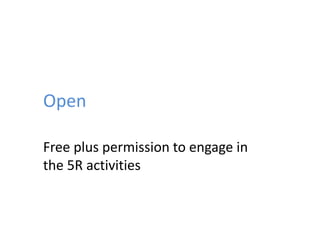
Open
Free plus permission to engage in
the 5R activities
“Faux-pen”
1. Free (but gated) access
2. All Rights Reserved plus draconian
Terms of Use
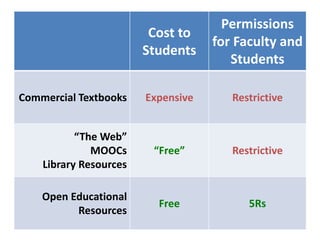
Cost to
Students
Permissions
for Faculty and
Students
Commercial Textbooks Expensive Restrictive
“The Web”
MOOCs
Library Resources
“Free” Restrictive
Open Educational
Resources
Free 5Rs
OER Examples
Full courses, complete textbooks,
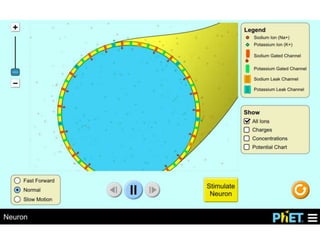
chapters, modules, videos, simulations,
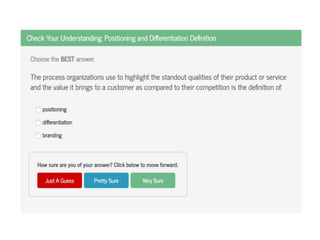
assessments, syllabi, etc.
Pedagogy
The theory and practice of teaching
OER-Enabled Pedagogy
The set of teaching and learning
practices only possible or practical
when you have permission to engage
in the 5R activities.
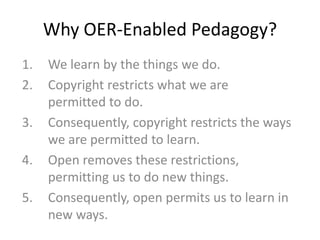
Why OER-Enabled Pedagogy?
1. We learn by the things we do.
2. Copyright restricts what we are
permitted to do.
3. Consequently, copyright restricts the ways
we are permitted to learn.
4. Open removes these restrictions,
permitting us to do new things.
5. Consequently, open permits us to learn in
new ways.
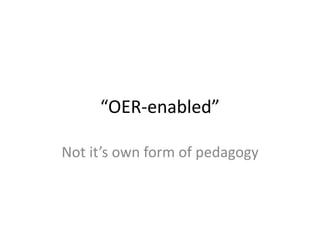
“OER-enabled”
Not it’s own form of pedagogy
“OER-enabled”
What do the 5R activities enable in the
context of your preferred pedagogy?
“OER-enabled”
Should be used as a modifier with
“real” pedagogies
“OER-enabled”
OER-enabled constructionist pedagogy
Constructionist Pedagogy
We learn best when we’re “actively
engaged in constructing something that
has personal meaning to [us] - be it a
poem, a robot, a sandcastle, or a
computer program.”
- Seymour Papert
Constructionist Pedagogy
Learning “happens especially felicitously
in a context where the learner is
consciously engaged in constructing a
public entity.”
- Seymour Papert
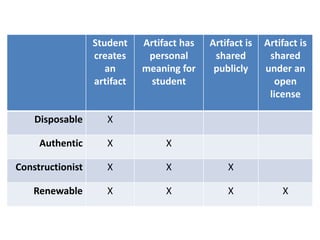
Student
creates
an
artifact
Artifact has
personal
meaning for
student
Artifact is
shared
publicly
Artifact is
shared
under an
open
license
Disposable X
Authentic X X
Constructionist X X X
Renewable X X X X
OER-E Constructivist Pedagogy
From knowledge “consumers” to
knowledge creators
OER-E Constructivist Pedagogy
From knowledge “consumers” to
knowledge creators
From knowledge creators to
enabling other knowledge creators
OER-ECP
Examples
Medical School Students
• UCSF Expanding WikiProject Medicine -
https://en.wikipedia.org/wiki/Wikipedia:WikiP
roject_Medicine/UCSF_Elective_2013
Graduate Students
• District Policies Regarding Blogs and Wikis -
https://www.youtube.com/watch?v=4_Lk2uU
_elU
• PM4ID - https://pm4id.org/
• Open Ed Reader- https://openedreader.org/
Undergraduate Students
• Murder, Madness, Mayhem: Latin American
Literature in Translation -
https://en.wikipedia.org/wiki/Wikipedia:WikiP
roject_Murder_Madness_and_Mayhem
• Robin's work
Middle and High School Students
A Preliminary Exploration of the
Relationships Between Student-
Created OER, Sustainability, and
Student Success at the Secondary
Level
David Wiley, DeLaina Tonks,
Sarah Weston, and Ashley Webb
IRRODL, forthcoming
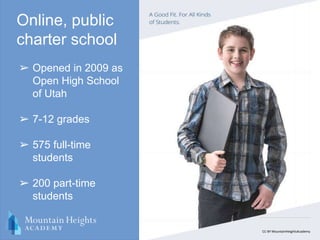
Online, public
charter school
➢ Opened in 2009 as
Open High School
of Utah
➢ 7-12 grades
➢ 575 full-time
students
➢ 200 part-time
students
CC-BY MountainHeightsAcademy
Research Context
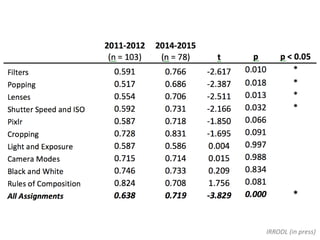
• Course on Digital Photography
• Data covering 181 middle and high school
students over 4 years
• Teacher, course assignments, and grading
rubrics remained stable over the four years
IRRODL (in press)
Methodology
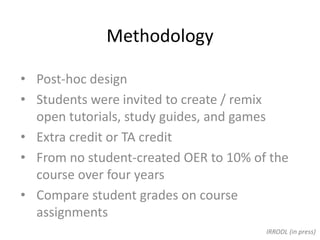
• Post-hoc design
• Students were invited to create / remix
open tutorials, study guides, and games
• Extra credit or TA credit
• From no student-created OER to 10% of the
course over four years
• Compare student grades on course
assignments
IRRODL (in press)
IRRODL (in press)
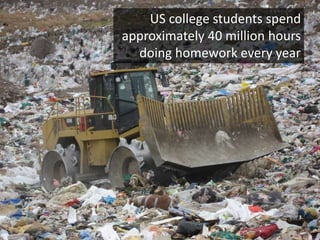
US college students spend
approximately 40 million hours
doing homework every year
Reclaiming and Sustaining
1. Our current model of producing OER is
unsustainable (e.g., $500k - $1M / textbook).
2. In the US alone, undergraduates spend about
40M hours per year on homework that is
mostly thrown away.
3. Can students sustainably create OER that
supports learning both by them and other
students? YES.
Practical Considerations, 1
• Talking to students about open licensing
• Providing alternatives
• Talking to students about digital identity
• Merging student OER into the "official"
course OER
Practical Considerations, 2
• Keeping your course OER outside the LMS
(public!)
• Managing attribution
• Time, time, time
• Prioritizing contributions -
http://lumenlearning.com/how/learning-
lab/oer2/
Conversation!
david@lumenlearning.com
@opencontent

OER-Enabled Pedagogy