Opening Up The British Library’s
Metadata
Neil Wilson
Head of Metadata Services
2
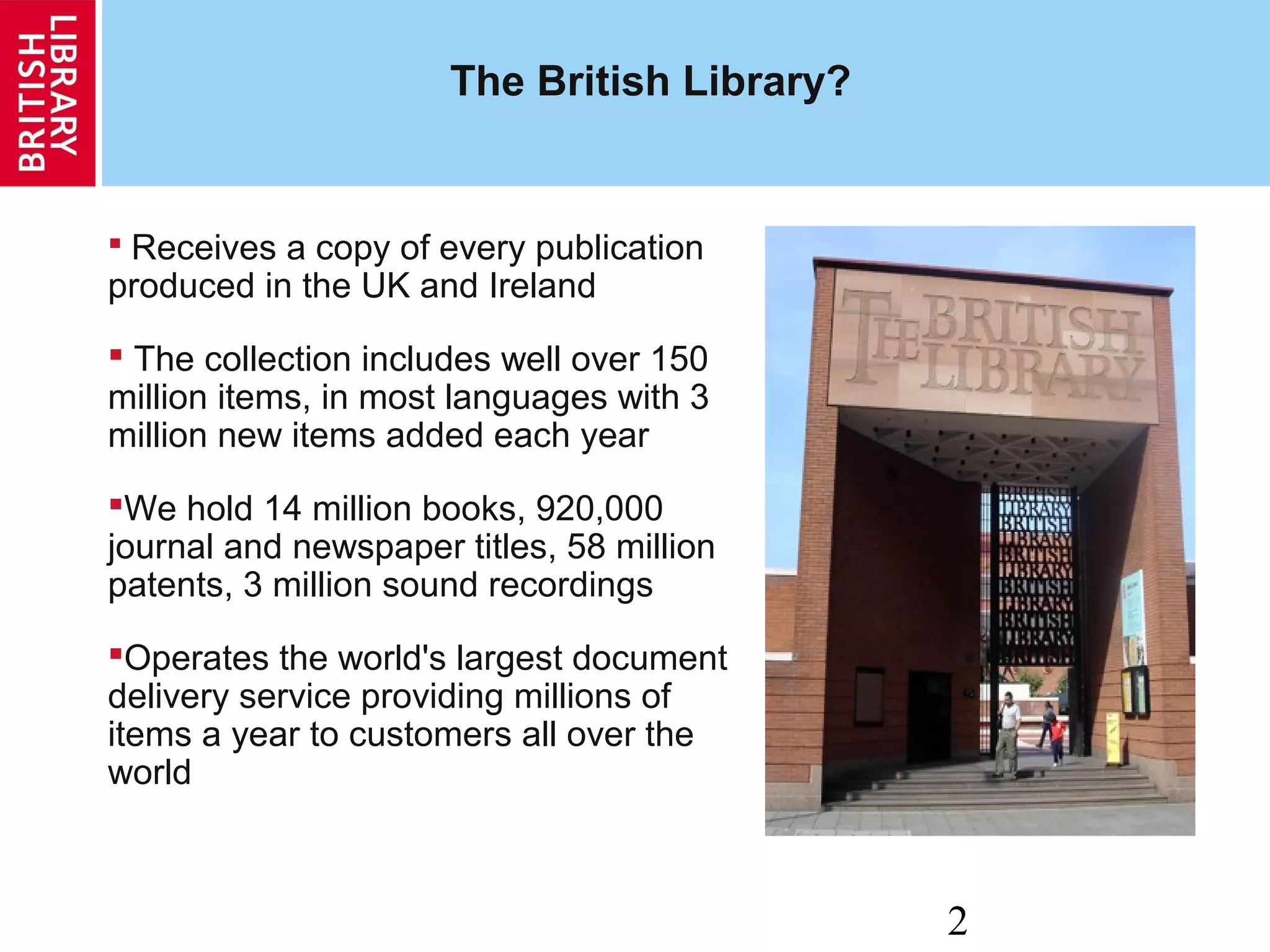
The British Library?
 Receives a copy of every publication
produced in the UK and Ireland
 The collection includes well over 150
million items, in most languages with 3
million new items added each year
We hold 14 million books, 920,000
journal and newspaper titles, 58 million
patents, 3 million sound recordings
Operates the world's largest document
delivery service providing millions of
items a year to customers all over the
world
3
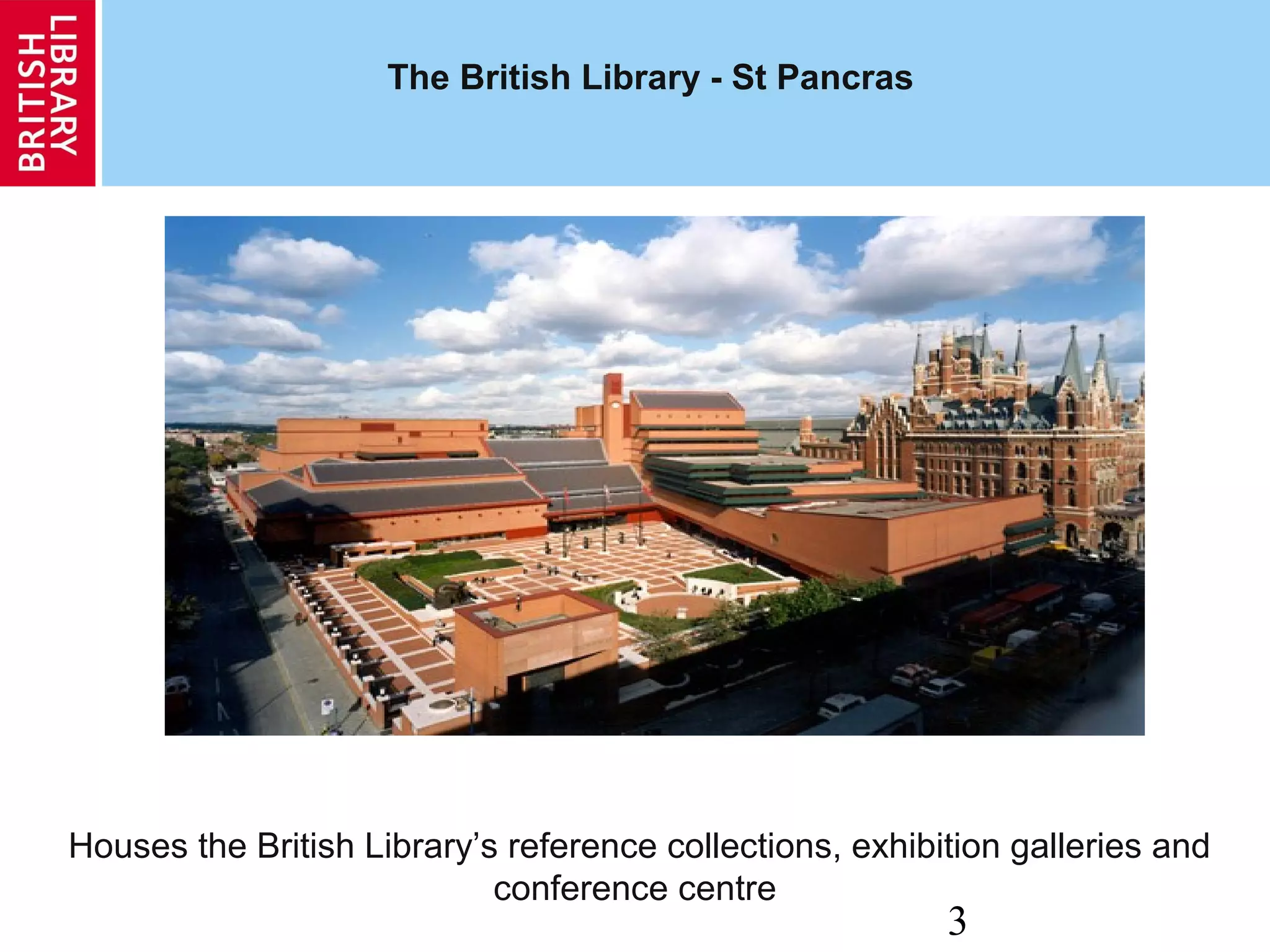
The British Library - St Pancras
Houses the British Library’s reference collections, exhibition galleries and
conference centre
4
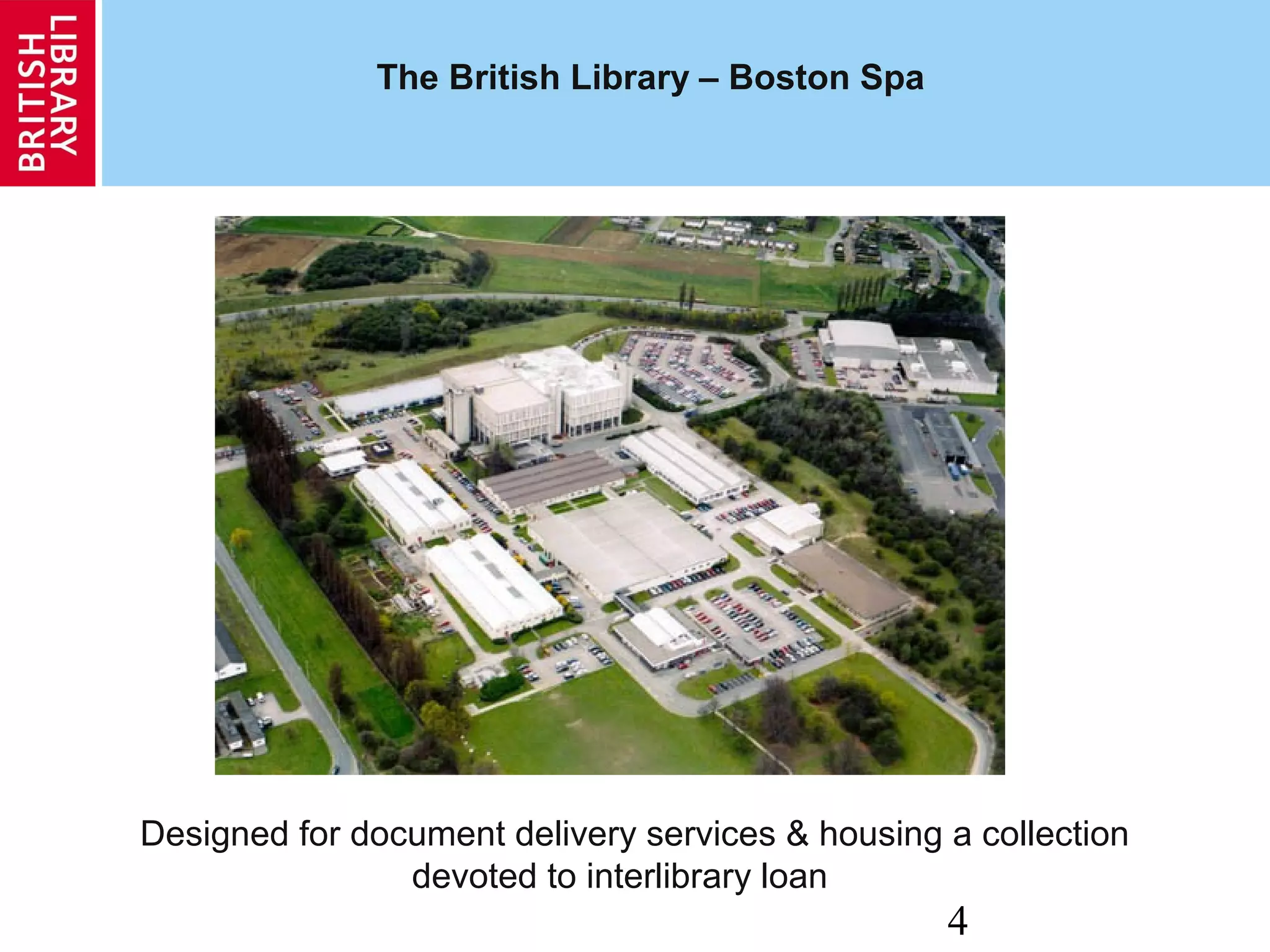
The British Library – Boston Spa
Designed for document delivery services & housing a collection
devoted to interlibrary loan
5
British Library Metadata Services
Origins
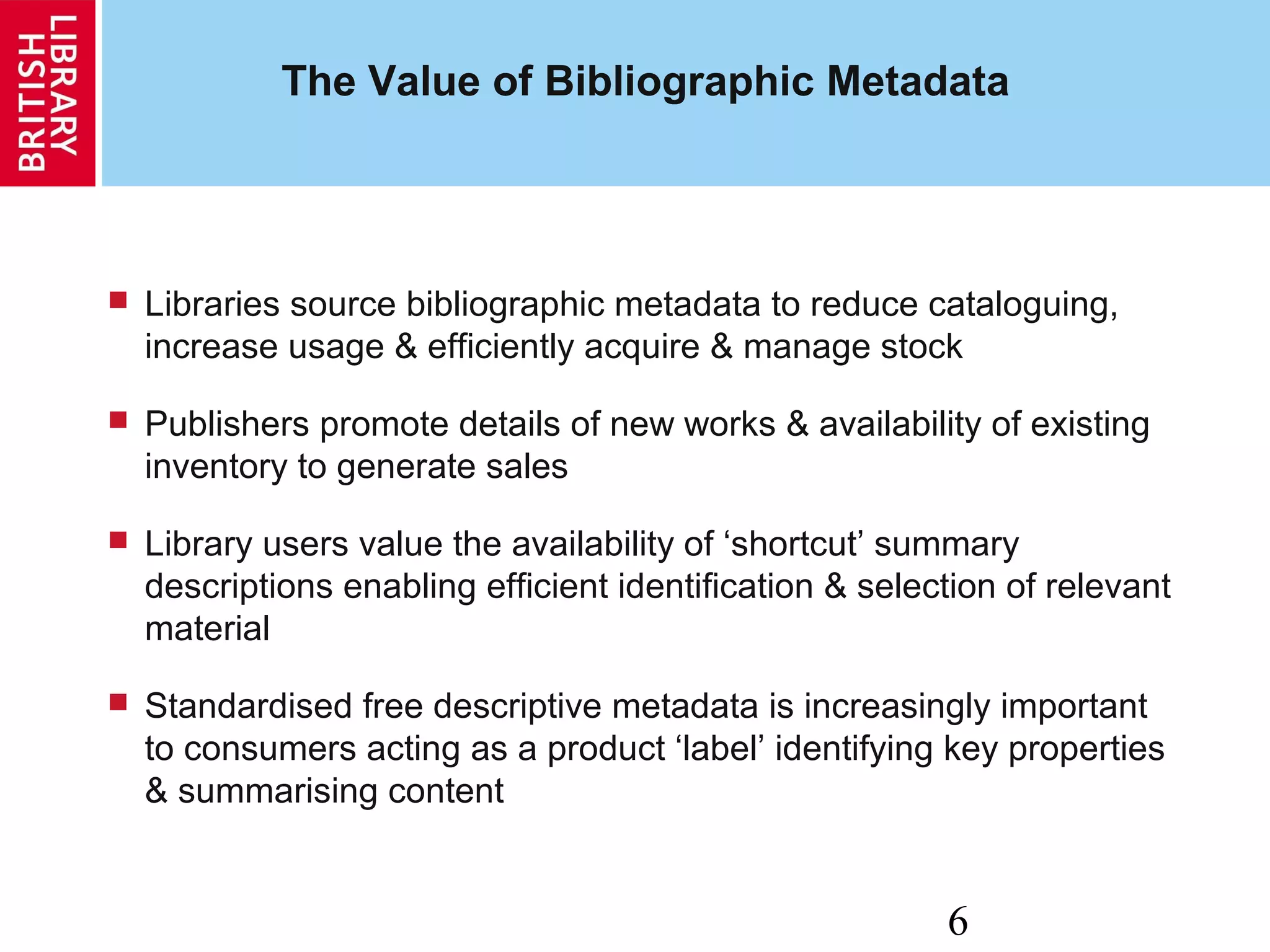
 Operated prior to the BL’s
foundation as ‘The British
National Bibliography’ (BNB)
since 1950
 Originally a service to the
national and international library
communities
 Has evolved through many
changes in technology: Print,
CD-ROM, Online, Data file etc
6
The Value of Bibliographic Metadata
 Libraries source bibliographic metadata to reduce cataloguing,
increase usage & efficiently acquire & manage stock
 Publishers promote details of new works & availability of existing
inventory to generate sales
 Library users value the availability of ‘shortcut’ summary
descriptions enabling efficient identification & selection of relevant
material
 Standardised free descriptive metadata is increasingly important
to consumers acting as a product ‘label’ identifying key properties
& summarising content
7
The Evolving Information Landscape
 Traditional library metadata derives from static & self contained library
catalogue cards
 The ‘Semantic Web’ uses a more dynamic model using linking to
establish relationships between data elements & enabling users to
navigate from one resource to related data within others
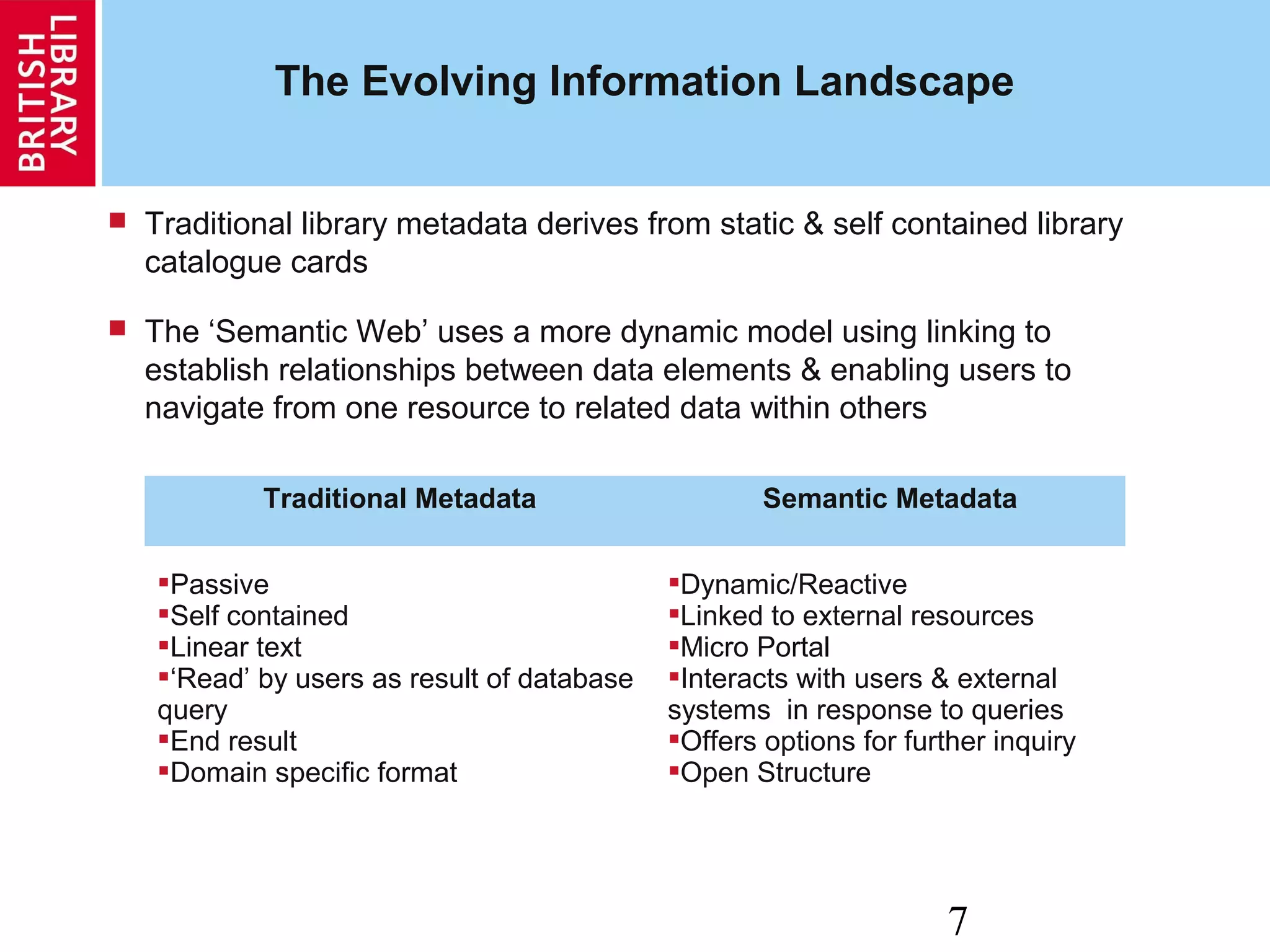
Traditional Metadata Semantic Metadata
Passive
Self contained
Linear text
‘Read’ by users as result of database
query
End result
Domain specific format
Dynamic/Reactive
Linked to external resources
Micro Portal
Interacts with users & external
systems in response to queries
Offers options for further inquiry
Open Structure
8
Public Sector Data - Changing Expectations
 The advent of the Web accelerated
the development of a collaboration
culture & fostered an expectation that
information, metadata & content
should be as freely available as the
Internet itself
 Many wider benefit arguments have
been advanced for public bodies to
make their data freely available
 2009 saw an increasing Government
commitment to the principle of opening
up public data for wider re-use. The
Putting the Frontline First: smarter government
report requires “the majority of
government-published information to be
reusable, linked data by June 2011”
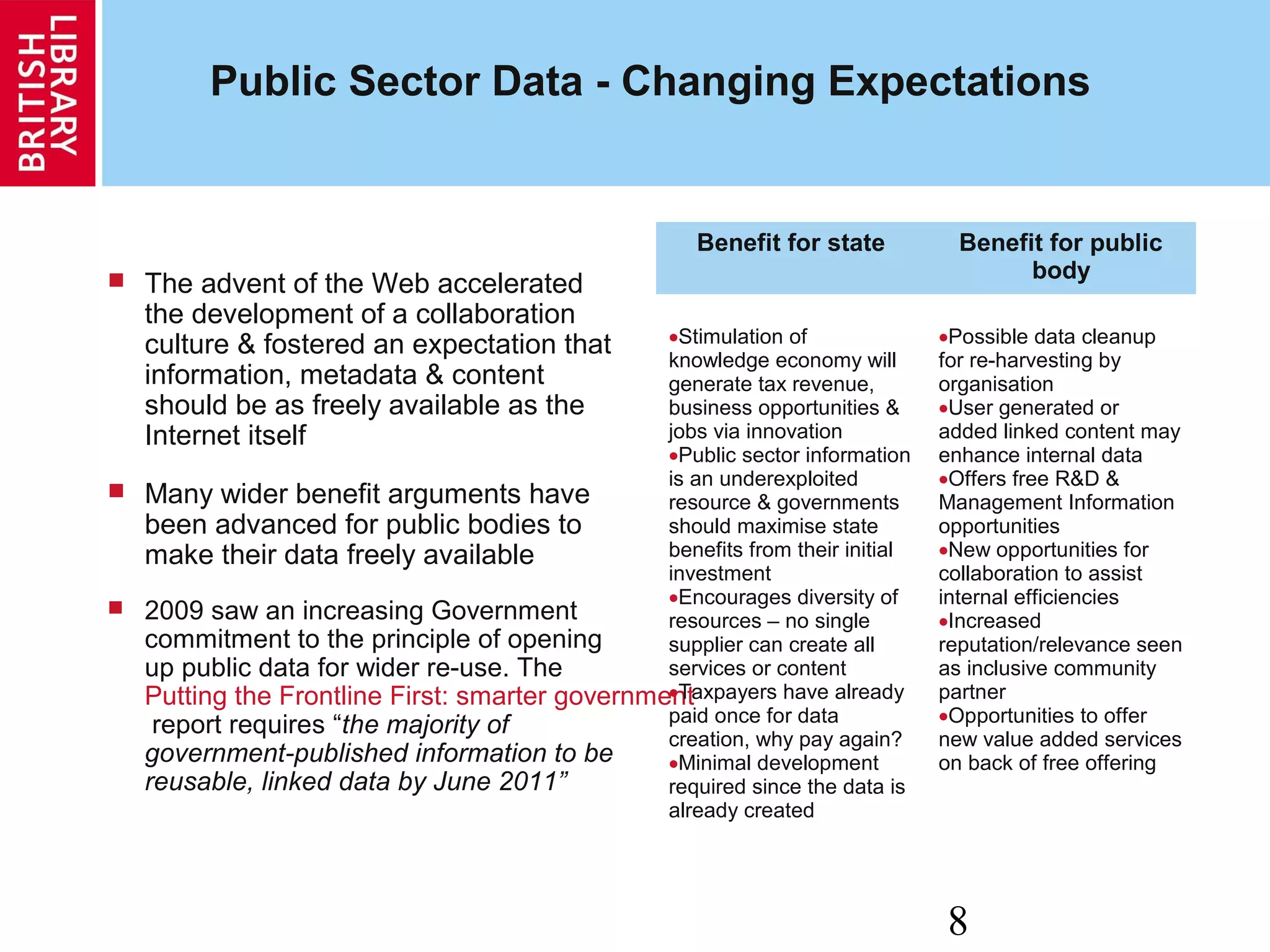
Benefit for state Benefit for public
body
•Stimulation of
knowledge economy will
generate tax revenue,
business opportunities &
jobs via innovation
•Public sector information
is an underexploited
resource & governments
should maximise state
benefits from their initial
investment
•Encourages diversity of
resources – no single
supplier can create all
services or content
•Taxpayers have already
paid once for data
creation, why pay again?
•Minimal development
required since the data is
already created
•Possible data cleanup
for re-harvesting by
organisation
•User generated or
added linked content may
enhance internal data
•Offers free R&D &
Management Information
opportunities
•New opportunities for
collaboration to assist
internal efficiencies
•Increased
reputation/relevance seen
as inclusive community
partner
•Opportunities to offer
new value added services
on back of free offering
9
Libraries - Changing Perceptions
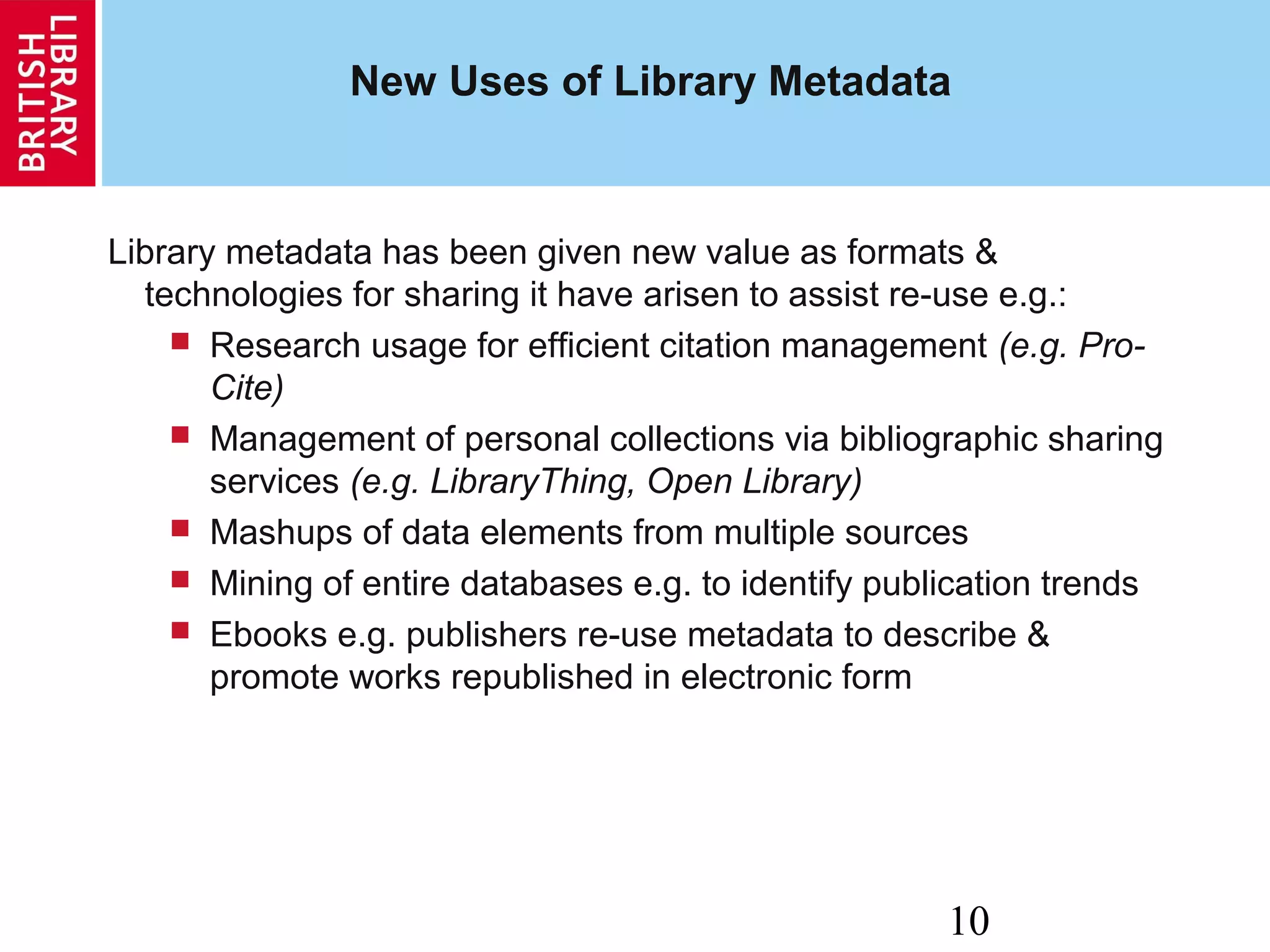
 “Librarians are book jailers locking
knowledge away from users”
 “I did my PhD with only 12 visits to
the library. That was 5 years ago;
things have improved since then,
now you don’t need to use it at all!”
 “The library world is far too insular;
using formats that nobody outside
understands, libraries must be more
open and stop perpetuating
unnecessary barriers”
 “90% of users no longer use library
catalogues. Instead they just use
Google as a starting point for their
research.”
10
New Uses of Library Metadata
Library metadata has been given new value as formats &
technologies for sharing it have arisen to assist re-use e.g.:
 Research usage for efficient citation management (e.g. Pro-
Cite)
 Management of personal collections via bibliographic sharing
services (e.g. LibraryThing, Open Library)
 Mashups of data elements from multiple sources
 Mining of entire databases e.g. to identify publication trends
 Ebooks e.g. publishers re-use metadata to describe &
promote works republished in electronic form
11
The British Library’s 2020 Vision
2020 Themes relevant to the
metadata strategy:
 Lead and collaborate in
growing the world’s knowledge
base
 Enable access to everyone
who wants to do research
 Support research
communities in key areas for
social and economic benefit
12
Creating an Open Metadata Strategy
Developing an open metadata strategy presented us with some issues we
needed to manage e.g. :
 Financial and legal - loss of revenue from traditional bibliographic
services, increasingly complex copyright and licensing frameworks
 Reputational – perception that the BL is not keeping up with technology or
meeting government & community expectations due to differing
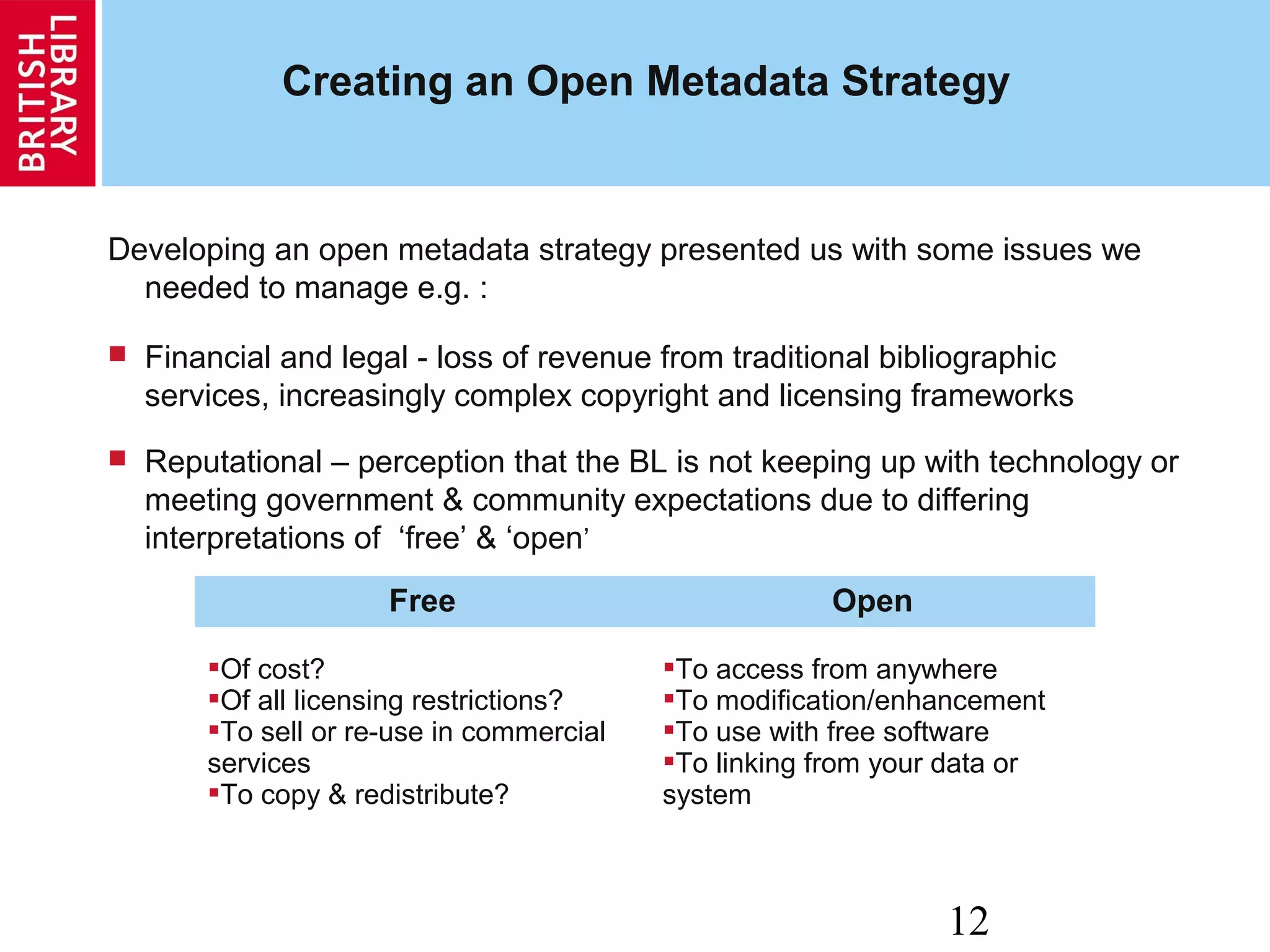
interpretations of ‘free’ & ‘open’
Free Open
Of cost?
Of all licensing restrictions?
To sell or re-use in commercial
services
To copy & redistribute?
To access from anywhere
To modification/enhancement
To use with free software
To linking from your data or
system
13
Creating an Open Metadata Strategy
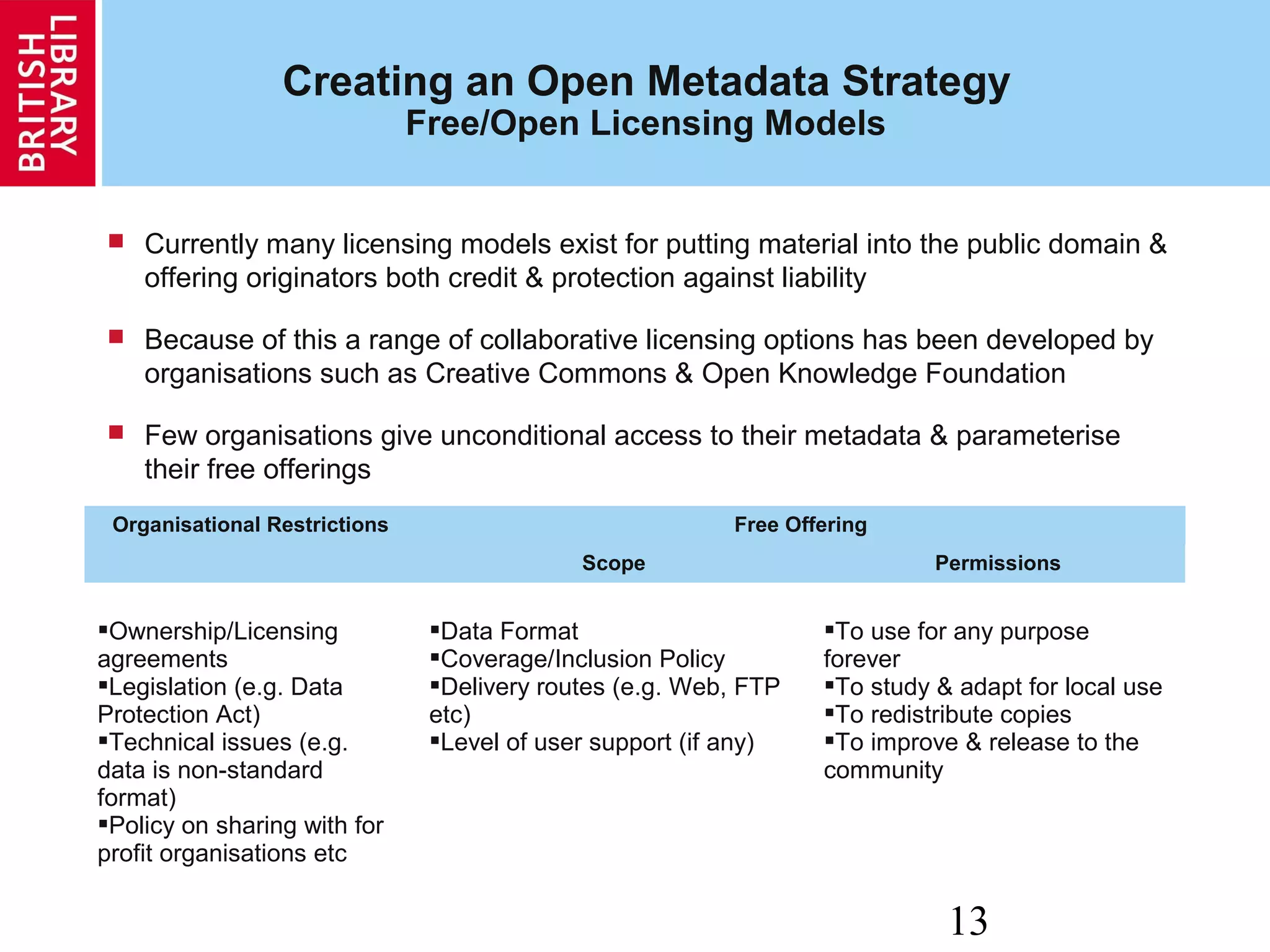
Free/Open Licensing Models
 Currently many licensing models exist for putting material into the public domain &
offering originators both credit & protection against liability
 Because of this a range of collaborative licensing options has been developed by
organisations such as Creative Commons & Open Knowledge Foundation
 Few organisations give unconditional access to their metadata & parameterise
their free offerings
Organisational Restrictions Free Offering
Scope Permissions
Ownership/Licensing
agreements
Legislation (e.g. Data
Protection Act)
Technical issues (e.g.
data is non-standard
format)
Policy on sharing with for
profit organisations etc
Data Format
Coverage/Inclusion Policy
Delivery routes (e.g. Web, FTP
etc)
Level of user support (if any)
To use for any purpose
forever
To study & adapt for local use
To redistribute copies
To improve & release to the
community
14
Creating an Open Metadata Strategy
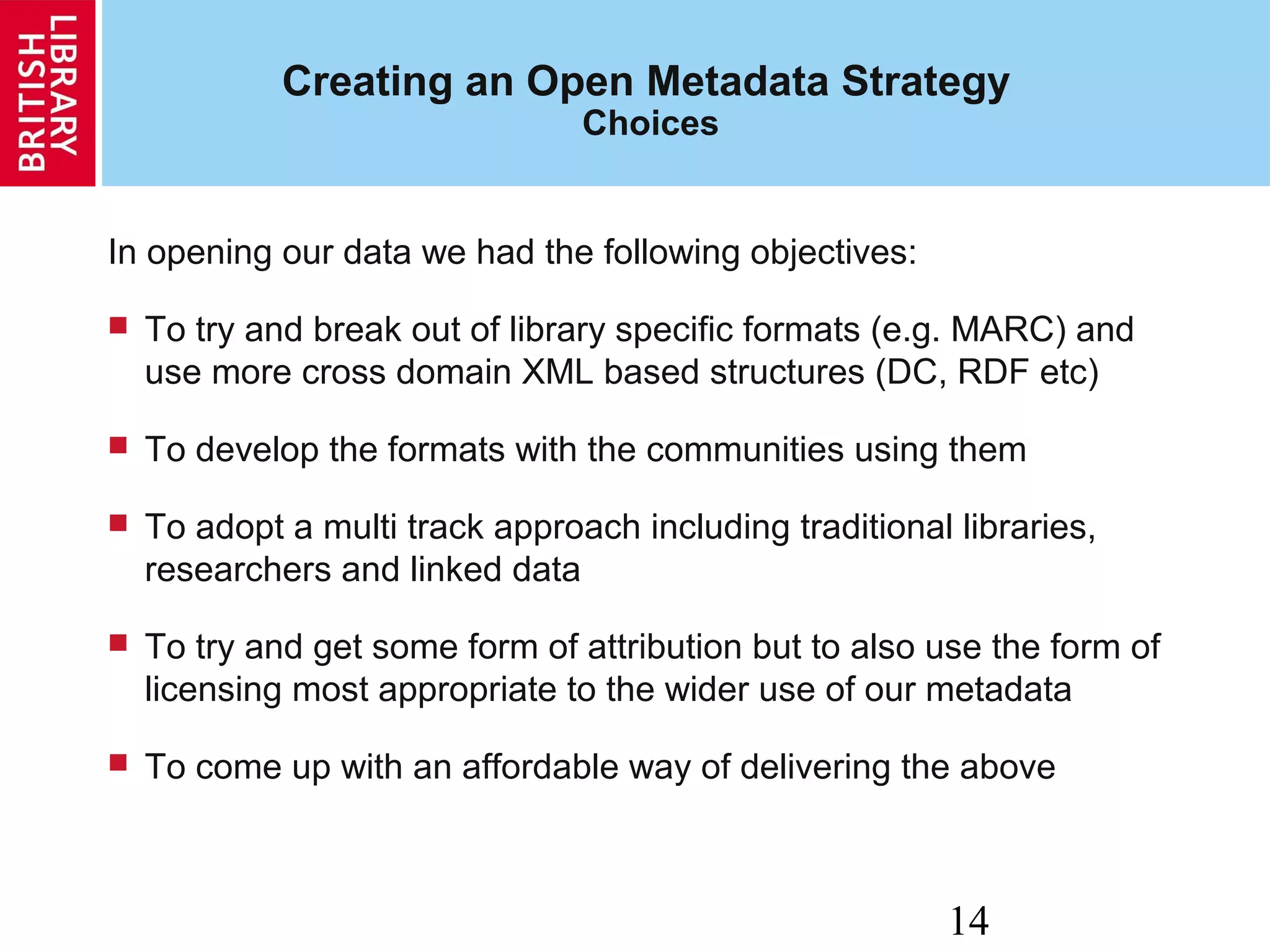
Choices
In opening our data we had the following objectives:
 To try and break out of library specific formats (e.g. MARC) and
use more cross domain XML based structures (DC, RDF etc)
 To develop the formats with the communities using them
 To adopt a multi track approach including traditional libraries,
researchers and linked data
 To try and get some form of attribution but to also use the form of
licensing most appropriate to the wider use of our metadata
 To come up with an affordable way of delivering the above
15
Creating an Open Metadata Strategy
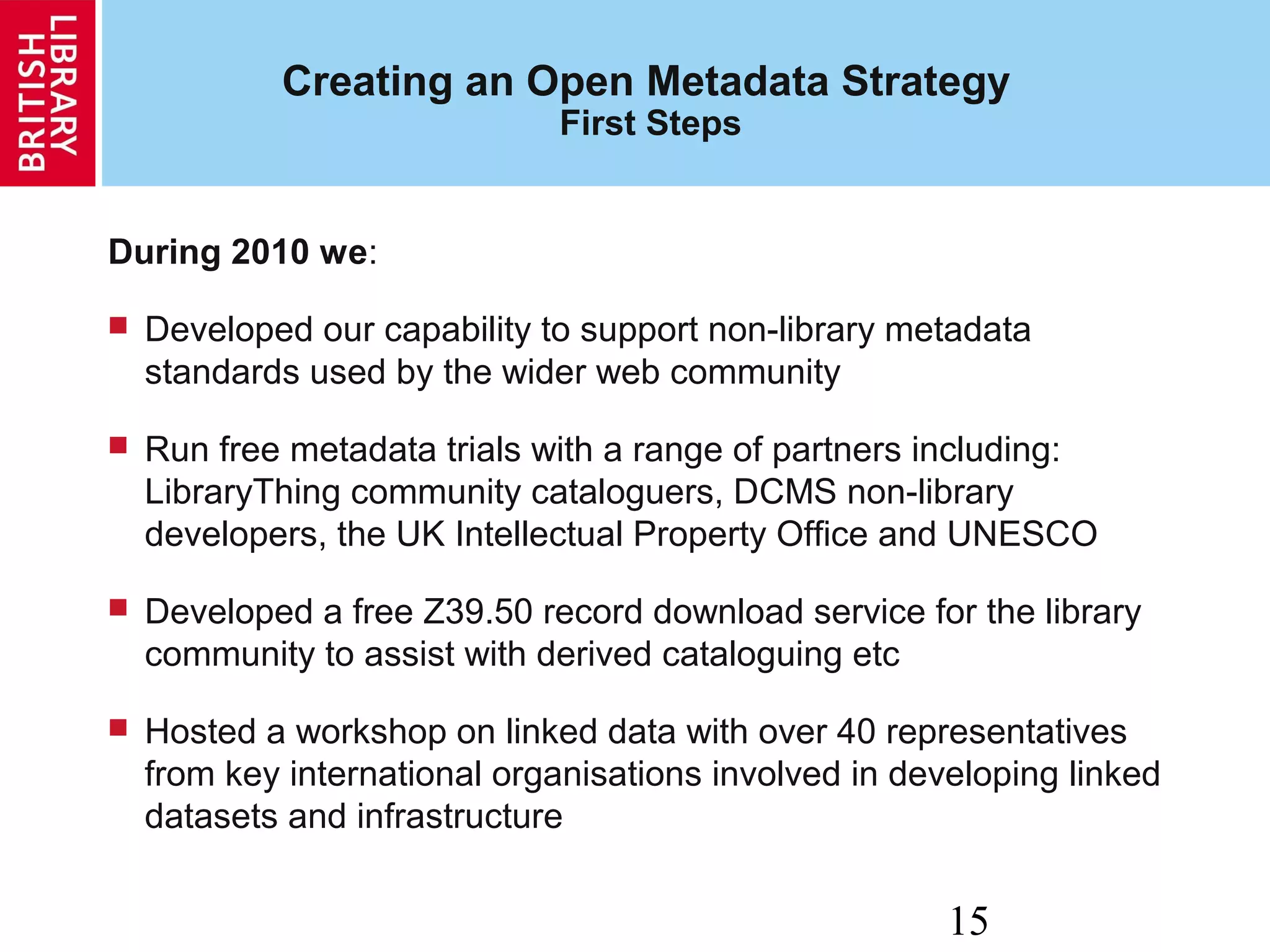
First Steps
During 2010 we:
 Developed our capability to support non-library metadata
standards used by the wider web community
 Run free metadata trials with a range of partners including:
LibraryThing community cataloguers, DCMS non-library
developers, the UK Intellectual Property Office and UNESCO
 Developed a free Z39.50 record download service for the library
community to assist with derived cataloguing etc
 Hosted a workshop on linked data with over 40 representatives
from key international organisations involved in developing linked
datasets and infrastructure
16
Creating an Open Metadata Strategy
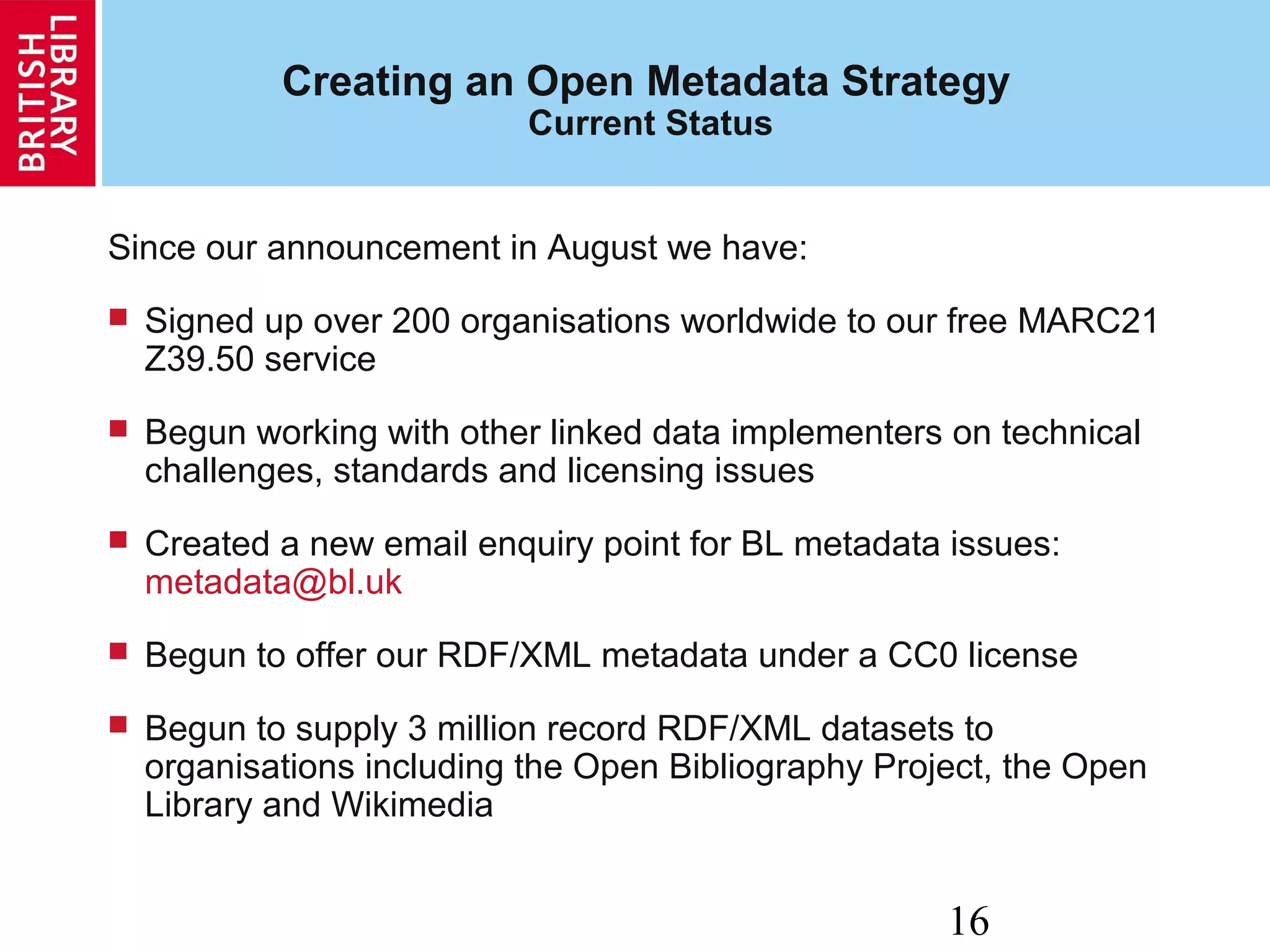
Current Status
Since our announcement in August we have:
 Signed up over 200 organisations worldwide to our free MARC21
Z39.50 service
 Begun working with other linked data implementers on technical
challenges, standards and licensing issues
 Created a new email enquiry point for BL metadata issues:
metadata@bl.uk
 Begun to offer our RDF/XML metadata under a CC0 license
 Begun to supply 3 million record RDF/XML datasets to
organisations including the Open Bibliography Project, the Open
Library and Wikimedia
17
Creating an Open Metadata Strategy
Next Steps
During the next 6 months we intend to:
 Create a prototype version of our catalogue with embedded URIs
to linked data resources including DBpedia for experimental use in
linked data initiatives
 Extend coverage of our RDF/XML data to non-book materials (e.g.
maps , printed music etc)
 Co-operate with JISC to encourage wider experimentation with
new BL RDF/XML bibliographic metadata
 Examine collaborative options for creating and presenting linked
data resources (e.g. with German National Library).
 Find out more about how people are beginning to use our data
18
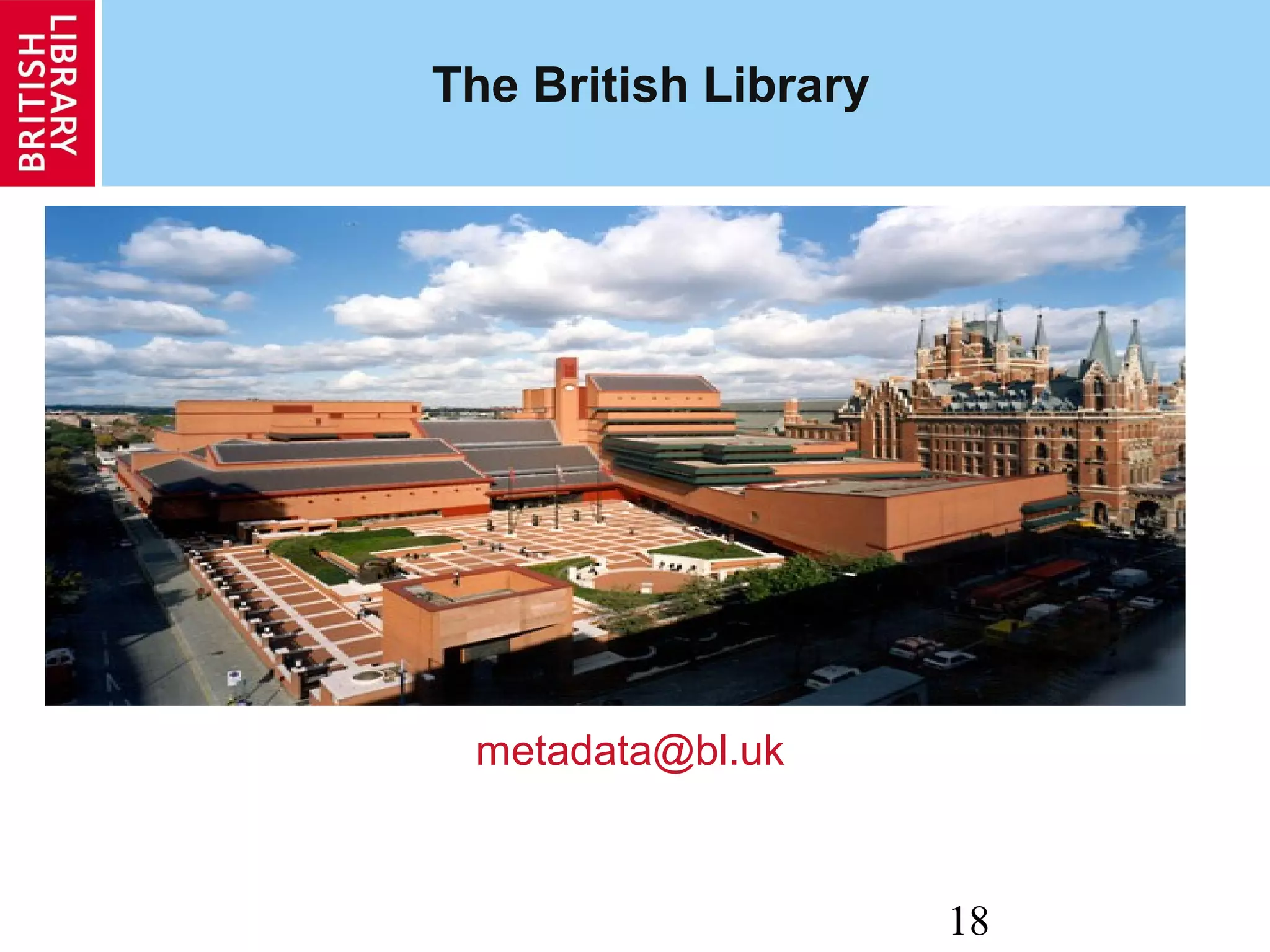
The British Library
metadata@bl.uk

Opening Up The BL's Metadata

  • 1.
    Opening Up TheBritish Library’s Metadata Neil Wilson Head of Metadata Services
  • 2.
    2 The British Library? Receives a copy of every publication produced in the UK and Ireland  The collection includes well over 150 million items, in most languages with 3 million new items added each year We hold 14 million books, 920,000 journal and newspaper titles, 58 million patents, 3 million sound recordings Operates the world's largest document delivery service providing millions of items a year to customers all over the world
  • 3.
    3 The British Library- St Pancras Houses the British Library’s reference collections, exhibition galleries and conference centre
  • 4.
    4 The British Library– Boston Spa Designed for document delivery services & housing a collection devoted to interlibrary loan
  • 5.
    5 British Library MetadataServices Origins  Operated prior to the BL’s foundation as ‘The British National Bibliography’ (BNB) since 1950  Originally a service to the national and international library communities  Has evolved through many changes in technology: Print, CD-ROM, Online, Data file etc
  • 6.
    6 The Value ofBibliographic Metadata  Libraries source bibliographic metadata to reduce cataloguing, increase usage & efficiently acquire & manage stock  Publishers promote details of new works & availability of existing inventory to generate sales  Library users value the availability of ‘shortcut’ summary descriptions enabling efficient identification & selection of relevant material  Standardised free descriptive metadata is increasingly important to consumers acting as a product ‘label’ identifying key properties & summarising content
  • 7.
    7 The Evolving InformationLandscape  Traditional library metadata derives from static & self contained library catalogue cards  The ‘Semantic Web’ uses a more dynamic model using linking to establish relationships between data elements & enabling users to navigate from one resource to related data within others Traditional Metadata Semantic Metadata Passive Self contained Linear text ‘Read’ by users as result of database query End result Domain specific format Dynamic/Reactive Linked to external resources Micro Portal Interacts with users & external systems in response to queries Offers options for further inquiry Open Structure
  • 8.
    8 Public Sector Data- Changing Expectations  The advent of the Web accelerated the development of a collaboration culture & fostered an expectation that information, metadata & content should be as freely available as the Internet itself  Many wider benefit arguments have been advanced for public bodies to make their data freely available  2009 saw an increasing Government commitment to the principle of opening up public data for wider re-use. The Putting the Frontline First: smarter government report requires “the majority of government-published information to be reusable, linked data by June 2011” Benefit for state Benefit for public body •Stimulation of knowledge economy will generate tax revenue, business opportunities & jobs via innovation •Public sector information is an underexploited resource & governments should maximise state benefits from their initial investment •Encourages diversity of resources – no single supplier can create all services or content •Taxpayers have already paid once for data creation, why pay again? •Minimal development required since the data is already created •Possible data cleanup for re-harvesting by organisation •User generated or added linked content may enhance internal data •Offers free R&D & Management Information opportunities •New opportunities for collaboration to assist internal efficiencies •Increased reputation/relevance seen as inclusive community partner •Opportunities to offer new value added services on back of free offering
  • 9.
    9 Libraries - ChangingPerceptions  “Librarians are book jailers locking knowledge away from users”  “I did my PhD with only 12 visits to the library. That was 5 years ago; things have improved since then, now you don’t need to use it at all!”  “The library world is far too insular; using formats that nobody outside understands, libraries must be more open and stop perpetuating unnecessary barriers”  “90% of users no longer use library catalogues. Instead they just use Google as a starting point for their research.”
  • 10.
    10 New Uses ofLibrary Metadata Library metadata has been given new value as formats & technologies for sharing it have arisen to assist re-use e.g.:  Research usage for efficient citation management (e.g. Pro- Cite)  Management of personal collections via bibliographic sharing services (e.g. LibraryThing, Open Library)  Mashups of data elements from multiple sources  Mining of entire databases e.g. to identify publication trends  Ebooks e.g. publishers re-use metadata to describe & promote works republished in electronic form
  • 11.
    11 The British Library’s2020 Vision 2020 Themes relevant to the metadata strategy:  Lead and collaborate in growing the world’s knowledge base  Enable access to everyone who wants to do research  Support research communities in key areas for social and economic benefit
  • 12.
    12 Creating an OpenMetadata Strategy Developing an open metadata strategy presented us with some issues we needed to manage e.g. :  Financial and legal - loss of revenue from traditional bibliographic services, increasingly complex copyright and licensing frameworks  Reputational – perception that the BL is not keeping up with technology or meeting government & community expectations due to differing interpretations of ‘free’ & ‘open’ Free Open Of cost? Of all licensing restrictions? To sell or re-use in commercial services To copy & redistribute? To access from anywhere To modification/enhancement To use with free software To linking from your data or system
  • 13.
    13 Creating an OpenMetadata Strategy Free/Open Licensing Models  Currently many licensing models exist for putting material into the public domain & offering originators both credit & protection against liability  Because of this a range of collaborative licensing options has been developed by organisations such as Creative Commons & Open Knowledge Foundation  Few organisations give unconditional access to their metadata & parameterise their free offerings Organisational Restrictions Free Offering Scope Permissions Ownership/Licensing agreements Legislation (e.g. Data Protection Act) Technical issues (e.g. data is non-standard format) Policy on sharing with for profit organisations etc Data Format Coverage/Inclusion Policy Delivery routes (e.g. Web, FTP etc) Level of user support (if any) To use for any purpose forever To study & adapt for local use To redistribute copies To improve & release to the community
  • 14.
    14 Creating an OpenMetadata Strategy Choices In opening our data we had the following objectives:  To try and break out of library specific formats (e.g. MARC) and use more cross domain XML based structures (DC, RDF etc)  To develop the formats with the communities using them  To adopt a multi track approach including traditional libraries, researchers and linked data  To try and get some form of attribution but to also use the form of licensing most appropriate to the wider use of our metadata  To come up with an affordable way of delivering the above
  • 15.
    15 Creating an OpenMetadata Strategy First Steps During 2010 we:  Developed our capability to support non-library metadata standards used by the wider web community  Run free metadata trials with a range of partners including: LibraryThing community cataloguers, DCMS non-library developers, the UK Intellectual Property Office and UNESCO  Developed a free Z39.50 record download service for the library community to assist with derived cataloguing etc  Hosted a workshop on linked data with over 40 representatives from key international organisations involved in developing linked datasets and infrastructure
  • 16.
    16 Creating an OpenMetadata Strategy Current Status Since our announcement in August we have:  Signed up over 200 organisations worldwide to our free MARC21 Z39.50 service  Begun working with other linked data implementers on technical challenges, standards and licensing issues  Created a new email enquiry point for BL metadata issues: metadata@bl.uk  Begun to offer our RDF/XML metadata under a CC0 license  Begun to supply 3 million record RDF/XML datasets to organisations including the Open Bibliography Project, the Open Library and Wikimedia
  • 17.
    17 Creating an OpenMetadata Strategy Next Steps During the next 6 months we intend to:  Create a prototype version of our catalogue with embedded URIs to linked data resources including DBpedia for experimental use in linked data initiatives  Extend coverage of our RDF/XML data to non-book materials (e.g. maps , printed music etc)  Co-operate with JISC to encourage wider experimentation with new BL RDF/XML bibliographic metadata  Examine collaborative options for creating and presenting linked data resources (e.g. with German National Library).  Find out more about how people are beginning to use our data
  • 18.

Editor's Notes

  • #13 Organisational Restrictions Free Offering Ownership/Licensing agreements Legislation (e.g. Data Protection Act) Technical issues (e.g. data is non-standard format) Policy on sharing with for profit organisations etc Scope Permissions Data Format Coverage/Inclusion Policy Delivery routes (e.g. Web, FTP etc) Level of user support (if any) To use for any purpose forever To study & adapt for local use To redistribute copies To improve & release to the community