Fatigue & Fracture
of
Safety Critical Equipment
Simon Walker
MSc CEng FIMechE
Founder & CEO Jesmond Engineering
Steve Penniment
BE Mech (Hons), FIEAust, CPEng, RPEQ, MEMMES Member
NER (Mechanical, Structural, Aerospace), APEC Engineer, IntPE(Aus)
1
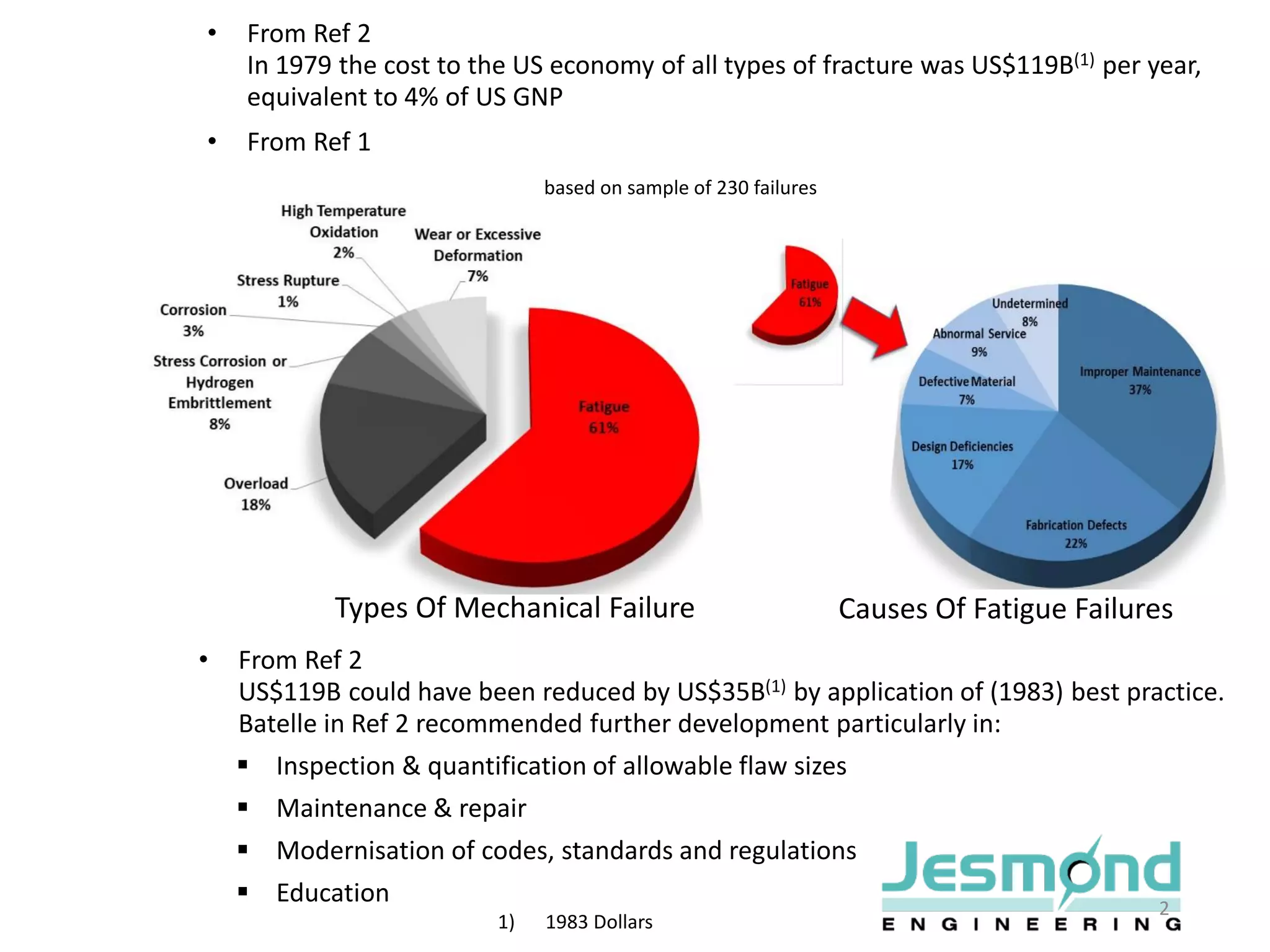
• From Ref 2
In 1979 the cost to the US economy of all types of fracture was US$119B(1) per year,
equivalent to 4% of US GNP
Types Of Mechanical Failure Causes Of Fatigue Failures
based on sample of 230 failures
• From Ref 2
US$119B could have been reduced by US$35B(1) by application of (1983) best practice.
Batelle in Ref 2 recommended further development particularly in:
 Inspection & quantification of allowable flaw sizes
 Maintenance & repair
 Modernisation of codes, standards and regulations
 Education
1) 1983 Dollars
2
• From Ref 1
3
Specification
• Use of Standards:
• Steel Structures
• BS 7608 : 2014
Guide To Fatigue Design And Assessment Of Steel Products
• BS 7910 : 2013
Guide To Methods For Assessing The Acceptability Of Flaws In Metallic
Structures
• Eurocode 3
Design Of Steel Structures
• AS 4100 : 1998
Steel Structures
• AS 3990 : 1993
Mechanical Equipment - Steelwork
• Bolting (Including Hold Down Bolting)
• AS 5216:2018
Design of post-installed and cast-in fastenings in concrete
• VDI 2230-1 : 2015 & -2 : 2014
Systematic Calculation of High Duty Bolted Joints
4
Specification
• Machine Shafts
• AS 1403 : 2004
Design Of Rotating Steel Shafts
• DIN 743
Calculation of Load Capacity In Shafts and Axles
• Gears
• AGMA 2001
Fundamental Rating Factors and Calculation Methods for Involute
Spur and Helical Gear Teeth
• ISO 6336
Calculation of Load Capacity for Spur and Helical Teeth
5
Design
Remove/Reduce/Optimise Welds
Typical details found in
AS4100, BS 7608 and
similar standards.
6
Design
Remove/Reduce/Optimise Welds
From Journal of Constructional Steel Research 133 (2017) 499–509
Fatigue life assessment of large scale T-jointed steel truss bridge components
7
Design
Remove/Reduce Stress Raisers Road Header Hydraulic
Cylinder Mount
Advitech Pty Ltd
design eliminated
recurring fatigue
failures
Photo Courtesy Coal Mine Services
8
Design
Get Full Benefit from Preloaded Joints
From Ref [8]
9
Design
Lock nuts (Jam Nuts)
• Should only be necessary to prevent loosening if
snug tight conditions apply and there is high
vibration (Ref 5).
• Won’t restore preload after “settling in” of joint
(Ref 4).
• If used:
o The thin nut goes on first
o Correct tightening procedure essential
o Ref 4) provides authoritative guidance on design
o Ref 5) provides practical advice
10
Manufacture
Fasteners
• Correct tightening (clamp up)
• Substitution (in particular with PC 12.9)
From Ref
[6]
• BS EN 1993-1-8:2005, Design Of Steel Structures –
Design Of Joints, cl. 3.1.2 allows only class 8.8 & 10.9
bolt assemblies as preloaded bolted connections 11
Dendritic Pattern
Stress Corrosion Cracking
Manufacture
Welds
From J. Energy Resour. Technol 106(1), 24-31 (Mar 01, 1984)
Investigation of the Alexander L. Kielland Failure Metallurgical
and Fracture Analysis
From US National Cooperative Highway Research Program (NCHRP)
HCHRP-RPT-469b Fatigue Test of Hwy Pole
From:
WTIA Report 150902BH
12
Installation
Levelling Nut
Grout
Concrete
• Jointing & Fastener Tightening
o Clean contact surfaces.
o Use specified tightening method,
lubricant and sequence.
o Check for tilted heads.
o Seal the joint as specified to avoid
corrosion (and cracks).
• Alignment, Levelling, Gaps
o Enforced displacement :
- Stress in structure.
- Accelerated wear and loading of
couplings, gearboxes etc.
o Correct preload & fitment of bearings.
• Tool damage
o Surface nicks and dents can be stress
raisers
• Lifting lugs and temporary fixtures
o Obtain OEM advice
(weld procedure, materials, size, removal
after lift)
13
Footing designer must be given documented :
• Hold down and pad locations
• Static loads, preloads & maximum loads (e.g. emergency)
• Alignment requirements
In-Service
Inspection & NDT
US DOT/FAA/AR-05/15
Fatigue Crack Growth Database for
Damage Tolerance Analysis
US DOT Pub No. FHWA-NHI-16-016
Design and Evaluation Of Bridges for
Fatigue and Fracture
�𝑑𝑑𝑑𝑑
𝑑𝑑𝑑𝑑 = 𝐴𝐴 ∆𝐾𝐾 𝑛𝑛
∆𝐾𝐾 = ∆𝑆𝑆 𝛼𝛼 𝜋𝜋𝜋𝜋
(Paris Eq)
14
In-Service
Inspection & NDT
15
Inspections: 1 2 3 4
Period of Inspections
Minimum
Detectable
Crack Size
Maximum
Allowable
Crack Size
Flaw (or crack) size
Time (or number of cycles)
Middle two inspections
are the most likely to
find a crack
Markham
Brake Failure - 30th July 1973
From
1) Case Histories Involving Fatigue and Fracture,
Vol 1 Iss 918 C.M.Hudson and T.P.Rich
2) UK Dept Of Energy Report – Accident at Markham
Colliery Derbyshire by J.W.Calder ISBM 0 10 155570 9
Centre Rod
Trunnion
Centre Rod
Trunnion Detail
16
17
• Fatigue and fracture is a HUGE and growing subject.
• Estimated 20,000 papers published on the subject by 1983*
• Many considerations to be made in fatigue assessments.
• We hope our presentation was helpful.
• It covers only the tip of an iceberg!
* Ref 9
References
1) ASM International
“Fatigue and Durability of Structural Materials” Published March 2006
2) US National Bureau of Standards
The Economic Effects of Fracture In The United States
Special Publication 647-Pts 1 & 2 Published 1983
Part 1, NBS Synopsis of Part 2
Part 2, Battelle Columbus Laboratories Report
3) Gear Technology July 2018 Article by John M. Rinaldo
“A Comparison of AGMA, ISO and API Gear Rating Methods”
4) ESDU Data Sheet 14002 dated Nov 2012,
“Locknuts and Other Thread Locking Devices”
Endorsed by the Institution Of Mechanical Engineers
5) Hobson Technical Bulletin, dated Sept 2013,
“Advice on Lock-nuts for AS1252 Structural Bolt Assemblies”
6) Electric Power Research Institute Journal, Vol 1, dated April 1988
“Degradation and Failure of Bolting in Nuclear Power Plants”
7) Paper by P. Gray presented to 1998 Coal Operators Conference hosted by University of Wollongong & the
Australasian Institute of Mining and Metallurgy
“Stress Corrosion Cracking Of Rock Bolts”
8) HERON Journal, Vol. 53 (2008) No. 1 / 2, Paper by Wald, Sokol, Jaspart entitled
“Base Plate In Bending And Anchor Bolts In Tension”
9) Pook L (1983) The role of crack growth in metal fatigue. The Metals Society, London
18

Fatigue and fracture of safety critical equipment Walker Penniment

  • 1.
    Fatigue & Fracture of SafetyCritical Equipment Simon Walker MSc CEng FIMechE Founder & CEO Jesmond Engineering Steve Penniment BE Mech (Hons), FIEAust, CPEng, RPEQ, MEMMES Member NER (Mechanical, Structural, Aerospace), APEC Engineer, IntPE(Aus) 1
  • 2.
    • From Ref2 In 1979 the cost to the US economy of all types of fracture was US$119B(1) per year, equivalent to 4% of US GNP Types Of Mechanical Failure Causes Of Fatigue Failures based on sample of 230 failures • From Ref 2 US$119B could have been reduced by US$35B(1) by application of (1983) best practice. Batelle in Ref 2 recommended further development particularly in:  Inspection & quantification of allowable flaw sizes  Maintenance & repair  Modernisation of codes, standards and regulations  Education 1) 1983 Dollars 2 • From Ref 1
  • 3.
  • 4.
    Specification • Use ofStandards: • Steel Structures • BS 7608 : 2014 Guide To Fatigue Design And Assessment Of Steel Products • BS 7910 : 2013 Guide To Methods For Assessing The Acceptability Of Flaws In Metallic Structures • Eurocode 3 Design Of Steel Structures • AS 4100 : 1998 Steel Structures • AS 3990 : 1993 Mechanical Equipment - Steelwork • Bolting (Including Hold Down Bolting) • AS 5216:2018 Design of post-installed and cast-in fastenings in concrete • VDI 2230-1 : 2015 & -2 : 2014 Systematic Calculation of High Duty Bolted Joints 4
  • 5.
    Specification • Machine Shafts •AS 1403 : 2004 Design Of Rotating Steel Shafts • DIN 743 Calculation of Load Capacity In Shafts and Axles • Gears • AGMA 2001 Fundamental Rating Factors and Calculation Methods for Involute Spur and Helical Gear Teeth • ISO 6336 Calculation of Load Capacity for Spur and Helical Teeth 5
  • 6.
    Design Remove/Reduce/Optimise Welds Typical detailsfound in AS4100, BS 7608 and similar standards. 6
  • 7.
    Design Remove/Reduce/Optimise Welds From Journalof Constructional Steel Research 133 (2017) 499–509 Fatigue life assessment of large scale T-jointed steel truss bridge components 7
  • 8.
    Design Remove/Reduce Stress RaisersRoad Header Hydraulic Cylinder Mount Advitech Pty Ltd design eliminated recurring fatigue failures Photo Courtesy Coal Mine Services 8
  • 9.
    Design Get Full Benefitfrom Preloaded Joints From Ref [8] 9
  • 10.
    Design Lock nuts (JamNuts) • Should only be necessary to prevent loosening if snug tight conditions apply and there is high vibration (Ref 5). • Won’t restore preload after “settling in” of joint (Ref 4). • If used: o The thin nut goes on first o Correct tightening procedure essential o Ref 4) provides authoritative guidance on design o Ref 5) provides practical advice 10
  • 11.
    Manufacture Fasteners • Correct tightening(clamp up) • Substitution (in particular with PC 12.9) From Ref [6] • BS EN 1993-1-8:2005, Design Of Steel Structures – Design Of Joints, cl. 3.1.2 allows only class 8.8 & 10.9 bolt assemblies as preloaded bolted connections 11 Dendritic Pattern Stress Corrosion Cracking
  • 12.
    Manufacture Welds From J. EnergyResour. Technol 106(1), 24-31 (Mar 01, 1984) Investigation of the Alexander L. Kielland Failure Metallurgical and Fracture Analysis From US National Cooperative Highway Research Program (NCHRP) HCHRP-RPT-469b Fatigue Test of Hwy Pole From: WTIA Report 150902BH 12
  • 13.
    Installation Levelling Nut Grout Concrete • Jointing& Fastener Tightening o Clean contact surfaces. o Use specified tightening method, lubricant and sequence. o Check for tilted heads. o Seal the joint as specified to avoid corrosion (and cracks). • Alignment, Levelling, Gaps o Enforced displacement : - Stress in structure. - Accelerated wear and loading of couplings, gearboxes etc. o Correct preload & fitment of bearings. • Tool damage o Surface nicks and dents can be stress raisers • Lifting lugs and temporary fixtures o Obtain OEM advice (weld procedure, materials, size, removal after lift) 13 Footing designer must be given documented : • Hold down and pad locations • Static loads, preloads & maximum loads (e.g. emergency) • Alignment requirements
  • 14.
    In-Service Inspection & NDT USDOT/FAA/AR-05/15 Fatigue Crack Growth Database for Damage Tolerance Analysis US DOT Pub No. FHWA-NHI-16-016 Design and Evaluation Of Bridges for Fatigue and Fracture �𝑑𝑑𝑑𝑑 𝑑𝑑𝑑𝑑 = 𝐴𝐴 ∆𝐾𝐾 𝑛𝑛 ∆𝐾𝐾 = ∆𝑆𝑆 𝛼𝛼 𝜋𝜋𝜋𝜋 (Paris Eq) 14
  • 15.
    In-Service Inspection & NDT 15 Inspections:1 2 3 4 Period of Inspections Minimum Detectable Crack Size Maximum Allowable Crack Size Flaw (or crack) size Time (or number of cycles) Middle two inspections are the most likely to find a crack
  • 16.
    Markham Brake Failure -30th July 1973 From 1) Case Histories Involving Fatigue and Fracture, Vol 1 Iss 918 C.M.Hudson and T.P.Rich 2) UK Dept Of Energy Report – Accident at Markham Colliery Derbyshire by J.W.Calder ISBM 0 10 155570 9 Centre Rod Trunnion Centre Rod Trunnion Detail 16
  • 17.
    17 • Fatigue andfracture is a HUGE and growing subject. • Estimated 20,000 papers published on the subject by 1983* • Many considerations to be made in fatigue assessments. • We hope our presentation was helpful. • It covers only the tip of an iceberg! * Ref 9
  • 18.
    References 1) ASM International “Fatigueand Durability of Structural Materials” Published March 2006 2) US National Bureau of Standards The Economic Effects of Fracture In The United States Special Publication 647-Pts 1 & 2 Published 1983 Part 1, NBS Synopsis of Part 2 Part 2, Battelle Columbus Laboratories Report 3) Gear Technology July 2018 Article by John M. Rinaldo “A Comparison of AGMA, ISO and API Gear Rating Methods” 4) ESDU Data Sheet 14002 dated Nov 2012, “Locknuts and Other Thread Locking Devices” Endorsed by the Institution Of Mechanical Engineers 5) Hobson Technical Bulletin, dated Sept 2013, “Advice on Lock-nuts for AS1252 Structural Bolt Assemblies” 6) Electric Power Research Institute Journal, Vol 1, dated April 1988 “Degradation and Failure of Bolting in Nuclear Power Plants” 7) Paper by P. Gray presented to 1998 Coal Operators Conference hosted by University of Wollongong & the Australasian Institute of Mining and Metallurgy “Stress Corrosion Cracking Of Rock Bolts” 8) HERON Journal, Vol. 53 (2008) No. 1 / 2, Paper by Wald, Sokol, Jaspart entitled “Base Plate In Bending And Anchor Bolts In Tension” 9) Pook L (1983) The role of crack growth in metal fatigue. The Metals Society, London 18