11/9/2019
Industry Performance
2018 - 2019
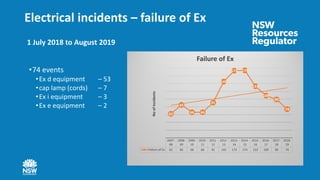
Electrical incidents – failure of Ex
•74 events
•Ex d equipment – 53
•cap lamp (cords) – 7
•Ex i equipment – 3
•Ex e equipment – 2
1 July 2018 to August 2019
2007-
08
2008-
09
2009-
10
2010-
11
2011-
12
2012-
13
2013-
14
2014-
15
2015-
16
2016-
17
2017-
18
2018-
19
Failure of Ex 62 85 66 66 91 145 173 174 133 109 99 74
62
85
66 66
91
145
173 174
133
109
99
74
NoofIncidents
Failure of Ex
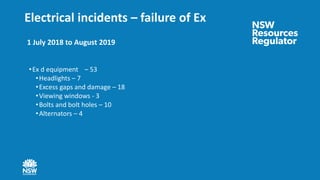
Electrical incidents – failure of Ex
•Ex d equipment – 53
•Headlights – 7
•Excess gaps and damage – 18
•Viewing windows - 3
•Bolts and bolt holes – 10
•Alternators – 4
1 July 2018 to August 2019
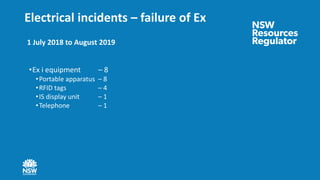
Electrical incidents – failure of Ex
•Ex i equipment – 8
•Portable apparatus – 8
•RFID tags – 4
•IS display unit – 1
•Telephone – 1
1 July 2018 to August 2019
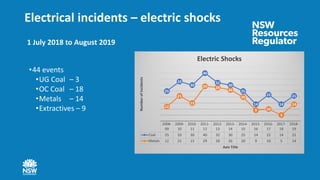
Electrical incidents – electric shocks
•44 events
•UG Coal – 3
•OC Coal – 18
•Metals – 14
•Extractives – 9
1 July 2018 to August 2019
2008-
09
2009-
10
2010-
11
2011-
12
2012-
13
2013-
14
2014-
15
2015-
16
2016-
17
2017-
18
2018-
19
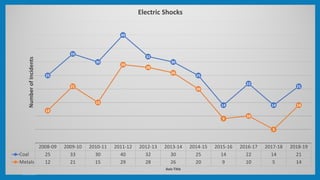
Coal 25 33 30 40 32 30 25 14 22 14 21
Metals 12 21 15 29 28 26 20 9 10 5 14
25
33
30
40
32
30
25
14
22
14
21
12
21
15
29 28
26
20
9 10
5
14
NumberofIncidents
Axis Title
Electric Shocks
Electrical incidents – electric shocks
•35 events
•UG Coal – 2
•OC Coal – 14
•Metals – 10
•Extractives – 9
1 July 2018 to 15 May 2019
2008-09 2009-10 2010-11 2011-12 2012-13 2013-14 2014-15 2015-16 2016-17 2017-18 2018-19
Coal 25 33 30 40 32 30 25 14 22 14 21
Metals 12 21 15 29 28 26 20 9 10 5 14
25
33
30
40
32
30
25
14
22
14
21
12
21
15
29
28
26
20
9
10
5
14
NumberofIncidents
Axis Title
Electric Shocks
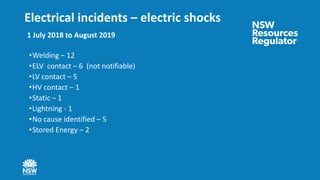
Electrical incidents – electric shocks
•Welding – 12
•ELV contact – 6 (not notifiable)
•LV contact – 5
•HV contact – 1
•Static – 1
•Lightning - 1
•No cause identified – 5
•Stored Energy – 2
1 July 2018 to August 2019
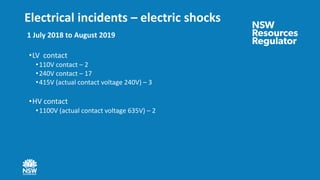
Electrical incidents – electric shocks
•LV contact
•110V contact – 2
•240V contact – 17
•415V (actual contact voltage 240V) – 3
•HV contact
•1100V (actual contact voltage 635V) – 2
1 July 2018 to August 2019
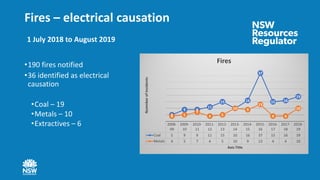
Fires – electrical causation
•190 fires notified
•36 identified as electrical
causation
•Coal – 19
•Metals – 10
•Extractives – 6
1 July 2018 to August 2019
2008-
09
2009-
10
2010-
11
2011-
12
2012-
13
2013-
14
2014-
15
2015-
16
2016-
17
2017-
18
2018-
19
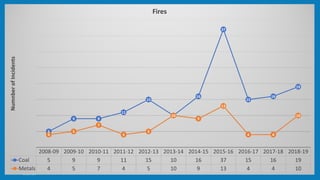
Coal 5 9 9 11 15 10 16 37 15 16 19
Metals 4 5 7 4 5 10 9 13 4 4 10
5
9 9
11
15
10
16
37
15 16
19
4 5
7
4 5
10 9
13
4 4
10
NumnberofIncidents Axis Title
Fires
Fires – electrical causation
•151 fires notified
•30 identified as electrical
causation
•Coal – 14
•Metals – 10
•Extractives – 6
1 July 2018 to 15 May 2019
2008-09 2009-10 2010-11 2011-12 2012-13 2013-14 2014-15 2015-16 2016-17 2017-18 2018-19
Coal 5 9 9 11 15 10 16 37 15 16 19
Metals 4 5 7 4 5 10 9 13 4 4 10
5
9 9
11
15
10
16
37
15
16
19
4
5
7
4
5
10
9
13
4 4
10
NumnberofIncidents Fires
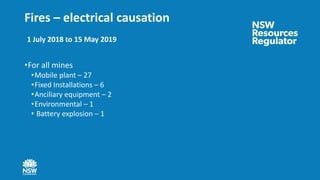
Fires – electrical causation
•For all mines
•Mobile plant – 27
•Fixed Installations – 6
•Anciliary equipment – 2
•Environmental – 1
• Battery explosion – 1
1 July 2018 to 15 May 2019
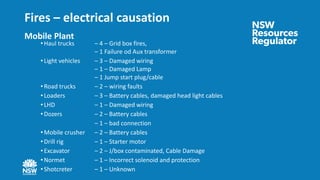
Fires – electrical causation
Mobile Plant
• Haul trucks – 4 – Grid box fires,
– 1 Failure od Aux transformer
• Light vehicles – 3 – Damaged wiring
– 1 – Damaged Lamp
– 1 Jump start plug/cable
• Road trucks – 2 – wiring faults
• Loaders – 3 – Battery cables, damaged head light cables
• LHD – 1 – Damaged wiring
• Dozers – 2 – Battery cables
– 1 – bad connection
• Mobile crusher – 2 – Battery cables
• Drill rig – 1 – Starter motor
• Excavator – 2 – J/box contaminated, Cable Damage
• Normet – 1 – Incorrect solenoid and protection
• Shotcreter – 1 – Unknown
Fires – electrical causation
Fixed installation
•Switchboard – Faulty capacitor unit
•OHL – Lightning
•OHL – Goanna
•Fire pump – Battery explosion
•Cable tray – Damage
• Circuit Breaker – failure during start up of motor
Identifying risk controls
From the ICMM Health And Safety Critical Control
Management Good Practice Guide
•Control
• An act, object (engineered) or system (combination of act and object) intended to
prevent or mitigate an unwanted event.
•Critical control
• A control that is crucial to preventing the event or mitigating the consequences of the
event. The absence or failure of a critical control would significantly increase the risk
despite the existence of the other controls. In addition, a control that prevents more
than one unwanted event or mitigates more than one consequence is normally
classified as critical.
Identifying risk controls
Examples from risk assessments
Are the following risk controls?
• Caused By
• Non Explosion protected Burnbrite coupler AUSEx 3902U – Presence of explosive
concentrations of methane
• Existing control description
• Low inherent gas content in seam
• Removal and Restoration of Power Procedures
• Mines Inspection Program (XXX SD PRO 0005)
• Ventilation Arrangements (XXX TS PLN 0014)
• Monitoring Arrangements (XXX TS PLN 0015)
• Not an arcing or sparking component under normal conditions
• Equipment complies with the standard under which it was certified (AS2380.2)
• Equipment is maintained to standard under which it was certified (AS2380.2)
• TG Methane Monitoring Interlocking removes power to Hazardous Area
• Electrical maintenance schedule
Identifying risk controls
Examples from risk assessments
Are the following risk controls?
• Potential incident
• There is a risk from coal dust ignition/fire caused by non conformant equipment resulting in
equipment damage or personal injury.
• Existing control description
• Low Gas make
• Coal Dust Explosion PHMP
• Fire & Explosion PHMP
• Fire Fighting Equipment
• Gas Monitoring - Real Time
• Inspection program
• Monitoring Arrangements
• Electrical Engineering Control Plan
Design Registration
What must be design registered ?
•WHS Regulations
• Schedule 5, Part 1 Plant requiring registration of design
•WHS (M&PS) Regulations
• Clause 177 Registration of plant designs and items of plant
Design Registration
What general plant must be design registered ?
• vehicle hoists
• amusement devices covered by section 2.1 of AS
3533.1:2009, with some exceptions.
• building maintenance units
• concrete placing booms
• prefabricated scaffolding
• mast climbing work platforms
• work boxes suspended from cranes
• boom type elevating work platforms
• lifts, escalators and moving walkways
• mobile cranes with a rated capacity of greater than
10 tonnes
• tower crane including self erecting tower cranes
• boilers and pressure vessels with a hazard level of
A, B, C or D
• hoists with platform movement of more than 2.4
metres designed to lift people
• passenger ropeways
• gantry cranes with a safe working load greater than
five tonnes or bridge cranes with a safe working
load of greater than 10 tonnes, and any gantry
crane or bridge crane which is designed to handle
molten metal or schedule 11 hazardous chemicals.
Design Registration
What mining specific plant must be design registered ?
•For an underground coal mine:
• diesel engine systems,
• booster fans,
• braking systems on plant used in underground transport,
• canopies on continuous miners,
• electrically powered hand-held plant, fixed installations and installations on mobile
plant (but not tube bundle systems where the analyser is installed at the surface)
used to determine or monitor the presence of gas,
• breathing apparatus to assist escape (including self-rescuers),
• shotfiring apparatus (including exploders and circuit testers),
• detonators,
• explosive-powered tools,
• conveyor belting.
Design Registration
What is the purpose of design registration ?
•For WHS(M&PS) regulations
•Where plant presents a high risk to health and safety, or the plant is
crucial to the control of a significant hazard, the plant must be designed
to achieve at least minimum performance levels
•Minimum performance levels identified in design orders
•There is a peer review of the design
• By a person who is independent of the design process
• By a person who has the skills, qualifications, competence and experience to
design the plant or verify the design
Design Registration
Does this make plant fit-for purpose?
•No
Design Registration
Fit-for-purpose
•Identify the risks
•Identify effective controls
•In accordance with the hierarchy of risk controls
•Identify what controls are actually provided in the registered plant design
•Undertake gap analysis to determine what, if any, additional controls are
required
• If changes required to plant design, you need to ask if it is the correct plant for the
activity
Design Registration
Fit-for-purpose
•Design registration helps to establish a higher level of certainty that the
plant will perform in a certain way
•Must understand the design constraints of the registered plant
•Must understand all risk to be controlled
•Additional controls may be required in particular situations
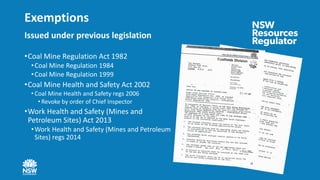
Exemptions
Issued under previous legislation
•Coal Mine Regulation Act 1982
•Coal Mine Regulation 1984
•Coal Mine Regulation 1999
•Coal Mine Health and Safety Act 2002
• Coal Mine Health and Safety regs 2006
• Revoke by order of Chief Inspector
•Work Health and Safety (Mines and
Petroleum Sites) Act 2013
•Work Health and Safety (Mines and Petroleum
Sites) regs 2014
Exemptions
Issued under previous legislation
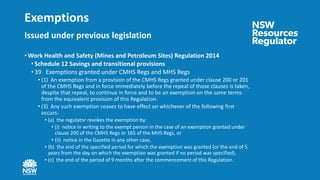
• Work Health and Safety (Mines and Petroleum Sites) Regulation 2014
• Schedule 12 Savings and transitional provisions
• 39 Exemptions granted under CMHS Regs and MHS Regs
• (1) An exemption from a provision of the CMHS Regs granted under clause 200 or 201
of the CMHS Regs and in force immediately before the repeal of those clauses is taken,
despite that repeal, to continue in force and to be an exemption on the same terms
from the equivalent provision of this Regulation.
• (3) Any such exemption ceases to have effect on whichever of the following first
occurs:
• (a) the regulator revokes the exemption by:
• (i) notice in writing to the exempt person in the case of an exemption granted under
clause 200 of the CMHS Regs or 165 of the MHS Regs, or
• (ii) notice in the Gazette in any other case,
• (b) the end of the specified period for which the exemption was granted (or the end of 5
years from the day on which the exemption was granted if no period was specified),
• (c) the end of the period of 9 months after the commencement of this Regulation.
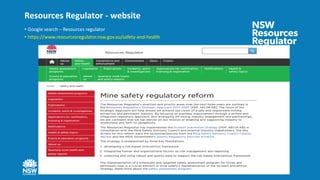
Resources Regulator - website
• Google search – Resources regulator
• https://www.resourcesregulator.nsw.gov.au/safety-and-health
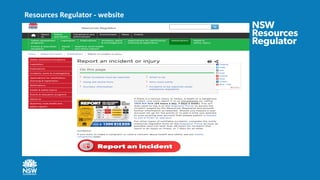
Resources Regulator - website

Electrical performance presentation (Craig Harris)

  • 1.
  • 2.
    Electrical incidents –failure of Ex •74 events •Ex d equipment – 53 •cap lamp (cords) – 7 •Ex i equipment – 3 •Ex e equipment – 2 1 July 2018 to August 2019 2007- 08 2008- 09 2009- 10 2010- 11 2011- 12 2012- 13 2013- 14 2014- 15 2015- 16 2016- 17 2017- 18 2018- 19 Failure of Ex 62 85 66 66 91 145 173 174 133 109 99 74 62 85 66 66 91 145 173 174 133 109 99 74 NoofIncidents Failure of Ex
  • 3.
    Electrical incidents –failure of Ex •Ex d equipment – 53 •Headlights – 7 •Excess gaps and damage – 18 •Viewing windows - 3 •Bolts and bolt holes – 10 •Alternators – 4 1 July 2018 to August 2019
  • 4.
    Electrical incidents –failure of Ex •Ex i equipment – 8 •Portable apparatus – 8 •RFID tags – 4 •IS display unit – 1 •Telephone – 1 1 July 2018 to August 2019
  • 5.
    Electrical incidents –electric shocks •44 events •UG Coal – 3 •OC Coal – 18 •Metals – 14 •Extractives – 9 1 July 2018 to August 2019 2008- 09 2009- 10 2010- 11 2011- 12 2012- 13 2013- 14 2014- 15 2015- 16 2016- 17 2017- 18 2018- 19 Coal 25 33 30 40 32 30 25 14 22 14 21 Metals 12 21 15 29 28 26 20 9 10 5 14 25 33 30 40 32 30 25 14 22 14 21 12 21 15 29 28 26 20 9 10 5 14 NumberofIncidents Axis Title Electric Shocks
  • 6.
    Electrical incidents –electric shocks •35 events •UG Coal – 2 •OC Coal – 14 •Metals – 10 •Extractives – 9 1 July 2018 to 15 May 2019 2008-09 2009-10 2010-11 2011-12 2012-13 2013-14 2014-15 2015-16 2016-17 2017-18 2018-19 Coal 25 33 30 40 32 30 25 14 22 14 21 Metals 12 21 15 29 28 26 20 9 10 5 14 25 33 30 40 32 30 25 14 22 14 21 12 21 15 29 28 26 20 9 10 5 14 NumberofIncidents Axis Title Electric Shocks
  • 7.
    Electrical incidents –electric shocks •Welding – 12 •ELV contact – 6 (not notifiable) •LV contact – 5 •HV contact – 1 •Static – 1 •Lightning - 1 •No cause identified – 5 •Stored Energy – 2 1 July 2018 to August 2019
  • 8.
    Electrical incidents –electric shocks •LV contact •110V contact – 2 •240V contact – 17 •415V (actual contact voltage 240V) – 3 •HV contact •1100V (actual contact voltage 635V) – 2 1 July 2018 to August 2019
  • 9.
    Fires – electricalcausation •190 fires notified •36 identified as electrical causation •Coal – 19 •Metals – 10 •Extractives – 6 1 July 2018 to August 2019 2008- 09 2009- 10 2010- 11 2011- 12 2012- 13 2013- 14 2014- 15 2015- 16 2016- 17 2017- 18 2018- 19 Coal 5 9 9 11 15 10 16 37 15 16 19 Metals 4 5 7 4 5 10 9 13 4 4 10 5 9 9 11 15 10 16 37 15 16 19 4 5 7 4 5 10 9 13 4 4 10 NumnberofIncidents Axis Title Fires
  • 10.
    Fires – electricalcausation •151 fires notified •30 identified as electrical causation •Coal – 14 •Metals – 10 •Extractives – 6 1 July 2018 to 15 May 2019 2008-09 2009-10 2010-11 2011-12 2012-13 2013-14 2014-15 2015-16 2016-17 2017-18 2018-19 Coal 5 9 9 11 15 10 16 37 15 16 19 Metals 4 5 7 4 5 10 9 13 4 4 10 5 9 9 11 15 10 16 37 15 16 19 4 5 7 4 5 10 9 13 4 4 10 NumnberofIncidents Fires
  • 11.
    Fires – electricalcausation •For all mines •Mobile plant – 27 •Fixed Installations – 6 •Anciliary equipment – 2 •Environmental – 1 • Battery explosion – 1 1 July 2018 to 15 May 2019
  • 12.
    Fires – electricalcausation Mobile Plant • Haul trucks – 4 – Grid box fires, – 1 Failure od Aux transformer • Light vehicles – 3 – Damaged wiring – 1 – Damaged Lamp – 1 Jump start plug/cable • Road trucks – 2 – wiring faults • Loaders – 3 – Battery cables, damaged head light cables • LHD – 1 – Damaged wiring • Dozers – 2 – Battery cables – 1 – bad connection • Mobile crusher – 2 – Battery cables • Drill rig – 1 – Starter motor • Excavator – 2 – J/box contaminated, Cable Damage • Normet – 1 – Incorrect solenoid and protection • Shotcreter – 1 – Unknown
  • 13.
    Fires – electricalcausation Fixed installation •Switchboard – Faulty capacitor unit •OHL – Lightning •OHL – Goanna •Fire pump – Battery explosion •Cable tray – Damage • Circuit Breaker – failure during start up of motor
  • 14.
    Identifying risk controls Fromthe ICMM Health And Safety Critical Control Management Good Practice Guide •Control • An act, object (engineered) or system (combination of act and object) intended to prevent or mitigate an unwanted event. •Critical control • A control that is crucial to preventing the event or mitigating the consequences of the event. The absence or failure of a critical control would significantly increase the risk despite the existence of the other controls. In addition, a control that prevents more than one unwanted event or mitigates more than one consequence is normally classified as critical.
  • 15.
    Identifying risk controls Examplesfrom risk assessments Are the following risk controls? • Caused By • Non Explosion protected Burnbrite coupler AUSEx 3902U – Presence of explosive concentrations of methane • Existing control description • Low inherent gas content in seam • Removal and Restoration of Power Procedures • Mines Inspection Program (XXX SD PRO 0005) • Ventilation Arrangements (XXX TS PLN 0014) • Monitoring Arrangements (XXX TS PLN 0015) • Not an arcing or sparking component under normal conditions • Equipment complies with the standard under which it was certified (AS2380.2) • Equipment is maintained to standard under which it was certified (AS2380.2) • TG Methane Monitoring Interlocking removes power to Hazardous Area • Electrical maintenance schedule
  • 16.
    Identifying risk controls Examplesfrom risk assessments Are the following risk controls? • Potential incident • There is a risk from coal dust ignition/fire caused by non conformant equipment resulting in equipment damage or personal injury. • Existing control description • Low Gas make • Coal Dust Explosion PHMP • Fire & Explosion PHMP • Fire Fighting Equipment • Gas Monitoring - Real Time • Inspection program • Monitoring Arrangements • Electrical Engineering Control Plan
  • 17.
    Design Registration What mustbe design registered ? •WHS Regulations • Schedule 5, Part 1 Plant requiring registration of design •WHS (M&PS) Regulations • Clause 177 Registration of plant designs and items of plant
  • 18.
    Design Registration What generalplant must be design registered ? • vehicle hoists • amusement devices covered by section 2.1 of AS 3533.1:2009, with some exceptions. • building maintenance units • concrete placing booms • prefabricated scaffolding • mast climbing work platforms • work boxes suspended from cranes • boom type elevating work platforms • lifts, escalators and moving walkways • mobile cranes with a rated capacity of greater than 10 tonnes • tower crane including self erecting tower cranes • boilers and pressure vessels with a hazard level of A, B, C or D • hoists with platform movement of more than 2.4 metres designed to lift people • passenger ropeways • gantry cranes with a safe working load greater than five tonnes or bridge cranes with a safe working load of greater than 10 tonnes, and any gantry crane or bridge crane which is designed to handle molten metal or schedule 11 hazardous chemicals.
  • 19.
    Design Registration What miningspecific plant must be design registered ? •For an underground coal mine: • diesel engine systems, • booster fans, • braking systems on plant used in underground transport, • canopies on continuous miners, • electrically powered hand-held plant, fixed installations and installations on mobile plant (but not tube bundle systems where the analyser is installed at the surface) used to determine or monitor the presence of gas, • breathing apparatus to assist escape (including self-rescuers), • shotfiring apparatus (including exploders and circuit testers), • detonators, • explosive-powered tools, • conveyor belting.
  • 20.
    Design Registration What isthe purpose of design registration ? •For WHS(M&PS) regulations •Where plant presents a high risk to health and safety, or the plant is crucial to the control of a significant hazard, the plant must be designed to achieve at least minimum performance levels •Minimum performance levels identified in design orders •There is a peer review of the design • By a person who is independent of the design process • By a person who has the skills, qualifications, competence and experience to design the plant or verify the design
  • 21.
    Design Registration Does thismake plant fit-for purpose? •No
  • 22.
    Design Registration Fit-for-purpose •Identify therisks •Identify effective controls •In accordance with the hierarchy of risk controls •Identify what controls are actually provided in the registered plant design •Undertake gap analysis to determine what, if any, additional controls are required • If changes required to plant design, you need to ask if it is the correct plant for the activity
  • 23.
    Design Registration Fit-for-purpose •Design registrationhelps to establish a higher level of certainty that the plant will perform in a certain way •Must understand the design constraints of the registered plant •Must understand all risk to be controlled •Additional controls may be required in particular situations
  • 24.
    Exemptions Issued under previouslegislation •Coal Mine Regulation Act 1982 •Coal Mine Regulation 1984 •Coal Mine Regulation 1999 •Coal Mine Health and Safety Act 2002 • Coal Mine Health and Safety regs 2006 • Revoke by order of Chief Inspector •Work Health and Safety (Mines and Petroleum Sites) Act 2013 •Work Health and Safety (Mines and Petroleum Sites) regs 2014
  • 25.
    Exemptions Issued under previouslegislation • Work Health and Safety (Mines and Petroleum Sites) Regulation 2014 • Schedule 12 Savings and transitional provisions • 39 Exemptions granted under CMHS Regs and MHS Regs • (1) An exemption from a provision of the CMHS Regs granted under clause 200 or 201 of the CMHS Regs and in force immediately before the repeal of those clauses is taken, despite that repeal, to continue in force and to be an exemption on the same terms from the equivalent provision of this Regulation. • (3) Any such exemption ceases to have effect on whichever of the following first occurs: • (a) the regulator revokes the exemption by: • (i) notice in writing to the exempt person in the case of an exemption granted under clause 200 of the CMHS Regs or 165 of the MHS Regs, or • (ii) notice in the Gazette in any other case, • (b) the end of the specified period for which the exemption was granted (or the end of 5 years from the day on which the exemption was granted if no period was specified), • (c) the end of the period of 9 months after the commencement of this Regulation.
  • 26.
    Resources Regulator -website • Google search – Resources regulator • https://www.resourcesregulator.nsw.gov.au/safety-and-health
  • 27.