1
SUPPORTING STUDENTS WITH
AUTISM SPECTRUM DISORDERS IN
AN INCLUDED SETTING: 5 TOOLS
YOU CAN USE TOMORROW
April 17, 2015
Presented by Christine Peck, Psy.D., BCBA-D
Cooperative Educational Services
2
WORKSHOP GOALS
Introduction
to autism
ASD in the
classroom
Build your
tool box of
strategies
3
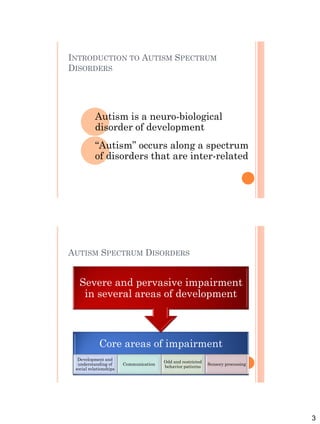
INTRODUCTION TO AUTISM SPECTRUM
DISORDERS
Autism is a neuro-biological
disorder of development
“Autism” occurs along a spectrum
of disorders that are inter-related
AUTISM SPECTRUM DISORDERS
Core areas of impairment
Development and
understanding of
social relationships
Communication
Odd and restricted
behavior patterns
Sensory processing
Severe and pervasive impairment
in several areas of development
4
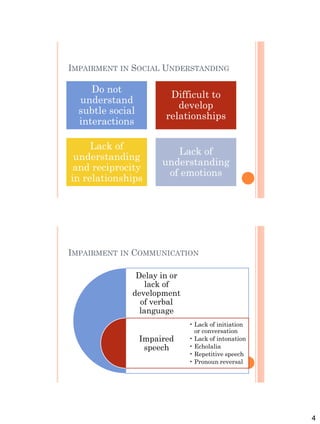
IMPAIRMENT IN SOCIAL UNDERSTANDING
Do not
understand
subtle social
interactions
Difficult to
develop
relationships
Lack of
understanding
and reciprocity
in relationships
Lack of
understanding
of emotions
IMPAIRMENT IN COMMUNICATION
Delay in or
lack of
development
of verbal
language
Impaired
speech
• Lack of initiation
or conversation
• Lack of intonation
• Echolalia
• Repetitive speech
• Pronoun reversal
5
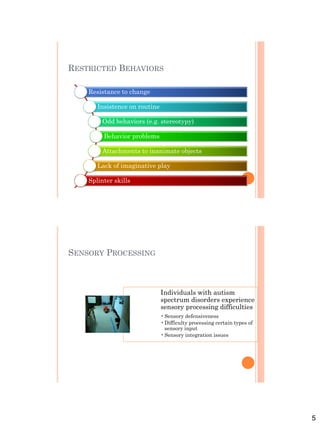
RESTRICTED BEHAVIORS
Resistance to change
Insistence on routine
Odd behaviors (e.g. stereotypy)
Behavior problems
Attachments to inanimate objects
Lack of imaginative play
Splinter skills
SENSORY PROCESSING
Individuals with autism
spectrum disorders experience
sensory processing difficulties
•Sensory defensiveness
•Difficulty processing certain types of
sensory input
•Sensory integration issues
6
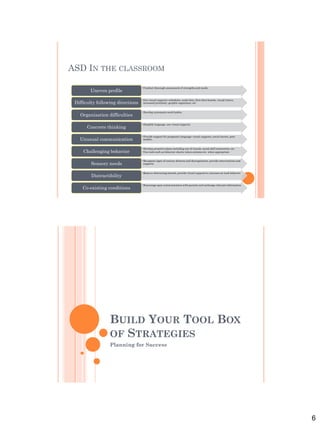
ASD IN THE CLASSROOM
•Conduct thorough assessment of strengths and needs
Uneven profile
•Use visual supports: schedules, tasks lists, first-then boards, visual timers,
increased proximity, graphic organizers, etcDifficulty following directions
•Develop systematic work habits
Organization difficulties
•Simplify language, use visual supports
Concrete thinking
•Provide support for pragmatic language: visual supports, social stories, peer
models,Unusual communication
•Develop proactive plans including use of visuals, social skill instruction, etc.
•Use tools such as behavior charts, token systems etc. when appropriateChallenging behavior
•Recognize signs of sensory distress and dysregulation, provide interventions and
supportsSensory needs
•Remove distracting stimuli, provide visual supports to increase on-task behavior
Distractibility
•Encourage open communication with parents and exchange relevant information
Co-existing conditions
BUILD YOUR TOOL BOX
OF STRATEGIES
Planning for Success
7
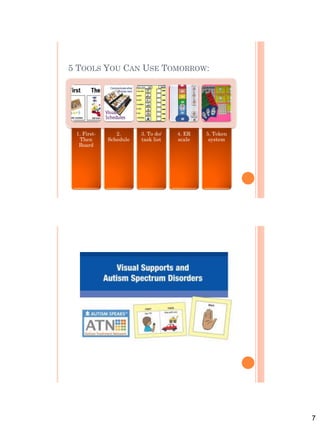
5 TOOLS YOU CAN USE TOMORROW:
1. First-
Then
Board
2.
Schedule
3. To do/
task list
4. ER
scale
5. Token
system
8
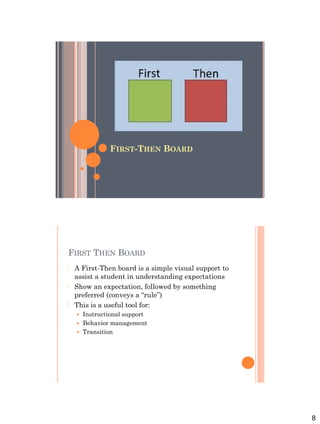
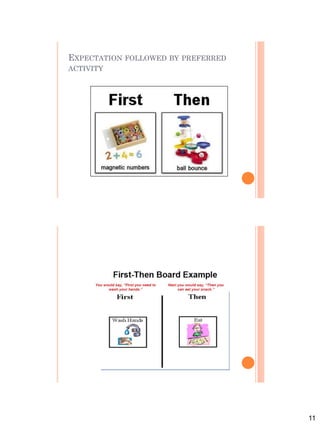
FIRST-THEN BOARD
FIRST THEN BOARD
 A First-Then board is a simple visual support to
assist a student in understanding expectations
 Show an expectation, followed by something
preferred (conveys a “rule”)
 This is a useful tool for:
 Instructional support
 Behavior management
 Transition
9
FIRST THEN BOARD
 Teach logical sequence of events (e.g., “First tidy
up, then go outside”)
 Visually clarify step-by-step instructions
 Assist with skill-building by motivating an
individual to first engage in a less-preferred
activity, knowing that a preferred activity will
follow (e.g., “first puzzle, then train”).
FIRST THEN BOARD
 The “first” picture is always an activity that you
want the individual to engage in, such as a
transition, or a skill-building activity
 The “then” picture reinforces the “first” activity
by being an activity or object that the person
enjoys
10
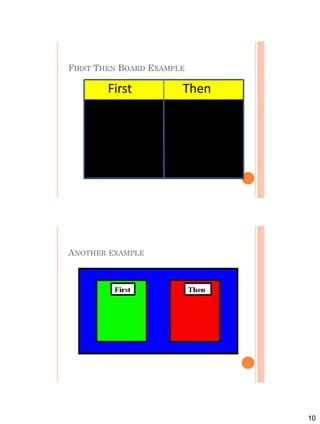
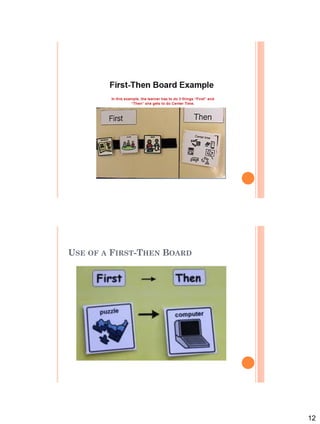
FIRST THEN BOARD EXAMPLE
First Then
ANOTHER EXAMPLE
11
EXPECTATION FOLLOWED BY PREFERRED
ACTIVITY
12
USE OF A FIRST-THEN BOARD
13
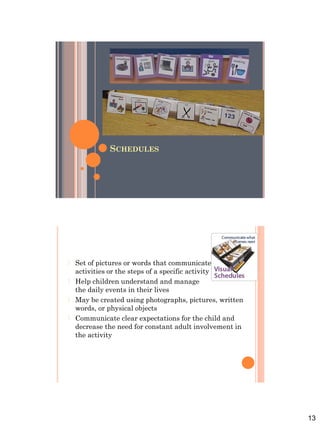
SCHEDULES
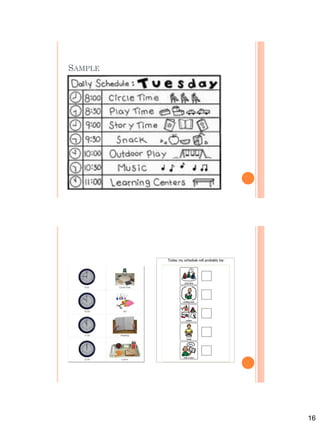
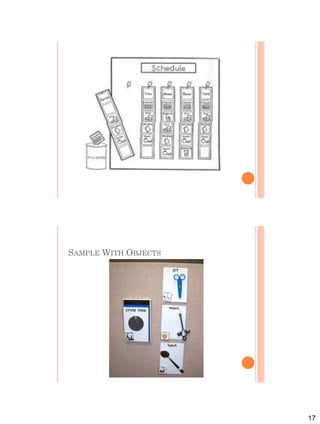
 Set of pictures or words that communicates a series of
activities or the steps of a specific activity
 Help children understand and manage
the daily events in their lives
 May be created using photographs, pictures, written
words, or physical objects
 Communicate clear expectations for the child and
decrease the need for constant adult involvement in
the activity
14
 Children with autism frequently have
trouble paying attention to, adapting to,
and understanding auditory input
 Tend to have strengths in rote memory
and the ability to understand visual
information
 Visual schedules take advantage of these
strengths by efficiently communicating
information that allows children to better
predict and plan within their environment
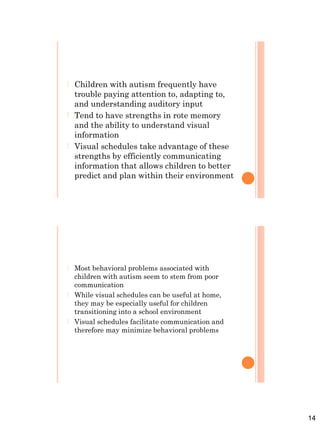
 Most behavioral problems associated with
children with autism seem to stem from poor
communication
 While visual schedules can be useful at home,
they may be especially useful for children
transitioning into a school environment
 Visual schedules facilitate communication and
therefore may minimize behavioral problems
15
 Effective in helping children to gain independence and
increase on-task behavior at school, at home, and in
community settings
 Specifically, use of visual schedules has been
associated with a decrease in disruptive behavior,
aggression, tantrums, and property destruction
 Enhance learning and improve a child's ability to
perform the skills required for daily living
 With time, some children are able to
independently use visual schedules to achieve on-
task behavior and self-management without
supervision
 The most effective way to use visual schedules is
to have them readily available and used
consistently
16
SAMPLE
17
SAMPLE WITH OBJECTS
18
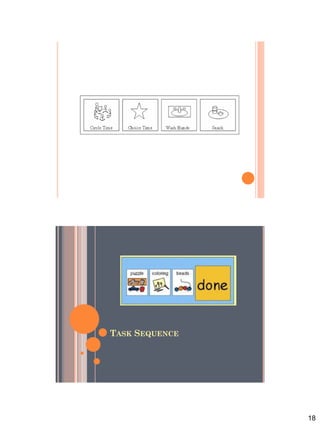
TASK SEQUENCE
19
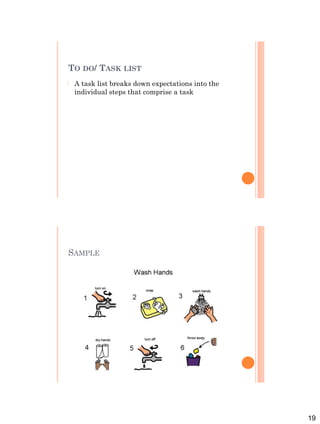
TO DO/ TASK LIST
 A task list breaks down expectations into the
individual steps that comprise a task
SAMPLE
20
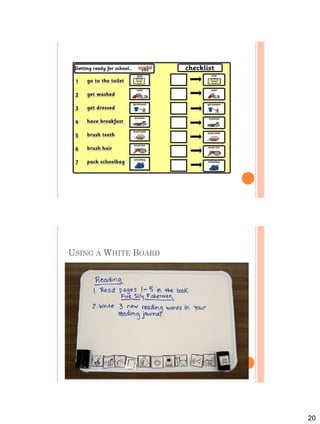
USING A WHITE BOARD
21
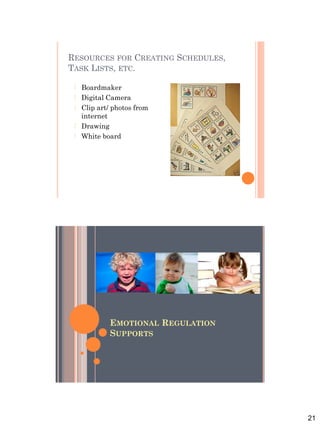
RESOURCES FOR CREATING SCHEDULES,
TASK LISTS, ETC.
 Boardmaker
 Digital Camera
 Clip art/ photos from
internet
 Drawing
 White board
EMOTIONAL REGULATION
SUPPORTS
22
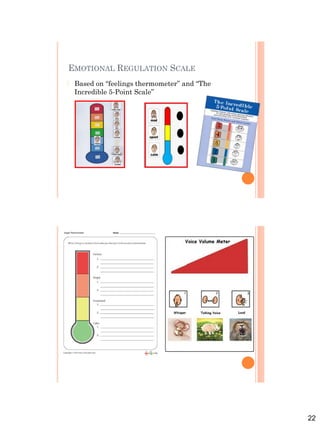
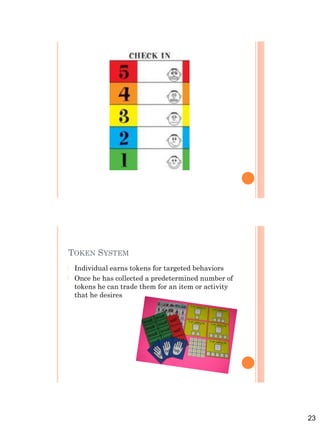
EMOTIONAL REGULATION SCALE
 Based on “feelings thermometer” and “The
Incredible 5-Point Scale”
23
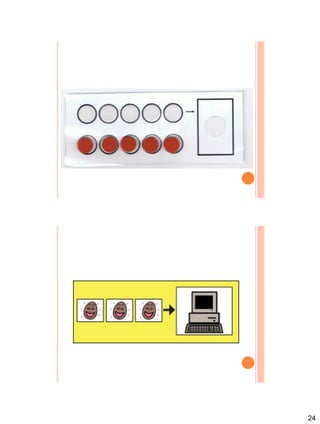
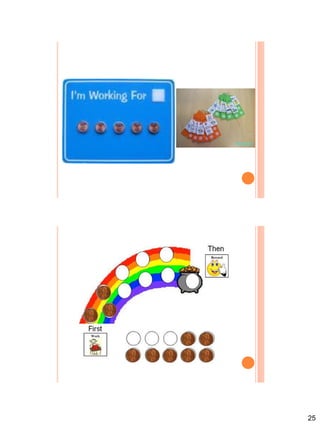
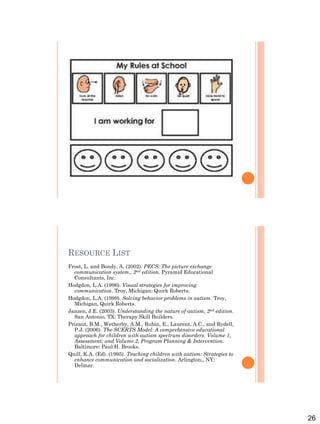
TOKEN SYSTEM
 Individual earns tokens for targeted behaviors
 Once he has collected a predetermined number of
tokens he can trade them for an item or activity
that he desires
24
25
26
RESOURCE LIST
Frost, L. and Bondy, A. (2002). PECS: The picture exchange
communication system., 2nd edition. Pyramid Educational
Consultants, Inc.
Hodgdon, L.A. (1996). Visual strategies for improving
communication. Troy, Michigan: Quirk Roberts.
Hodgdon, L.A. (1999). Solving behavior problems in autism. Troy,
Michigan, Quirk Roberts.
Janzen, J.E. (2003). Understanding the nature of autism, 2nd edition.
San Antonio, TX: Therapy Skill Builders.
Prizant, B.M., Wetherby, A.M., Rubin, E., Laurent, A.C., and Rydell,
P.J. (2006). The SCERTS Model: A comprehensive educational
approach for children with autism spectrum disorders. Volume 1,
Assessment; and Volume 2, Program Planning & Intervention.
Baltimore: Paul H. Brooks.
Quill, K.A. (Ed). (1995). Teaching children with autism: Strategies to
enhance communication and socialization. Arlington,, NY:
Delmar.
27
FOR MORE INFORMATION
Dr. Christine Peck
Cooperative Educational Services
25 Oakview Drive
Trumbull, CT 06611
(203) 365-8842
peckc@ces.k12.ct.us

Supporting Students with ASD in the Classroom: 5 Tools You Can Use Tomorrow

  • 1.
    1 SUPPORTING STUDENTS WITH AUTISMSPECTRUM DISORDERS IN AN INCLUDED SETTING: 5 TOOLS YOU CAN USE TOMORROW April 17, 2015 Presented by Christine Peck, Psy.D., BCBA-D Cooperative Educational Services
  • 2.
    2 WORKSHOP GOALS Introduction to autism ASDin the classroom Build your tool box of strategies
  • 3.
    3 INTRODUCTION TO AUTISMSPECTRUM DISORDERS Autism is a neuro-biological disorder of development “Autism” occurs along a spectrum of disorders that are inter-related AUTISM SPECTRUM DISORDERS Core areas of impairment Development and understanding of social relationships Communication Odd and restricted behavior patterns Sensory processing Severe and pervasive impairment in several areas of development
  • 4.
    4 IMPAIRMENT IN SOCIALUNDERSTANDING Do not understand subtle social interactions Difficult to develop relationships Lack of understanding and reciprocity in relationships Lack of understanding of emotions IMPAIRMENT IN COMMUNICATION Delay in or lack of development of verbal language Impaired speech • Lack of initiation or conversation • Lack of intonation • Echolalia • Repetitive speech • Pronoun reversal
  • 5.
    5 RESTRICTED BEHAVIORS Resistance tochange Insistence on routine Odd behaviors (e.g. stereotypy) Behavior problems Attachments to inanimate objects Lack of imaginative play Splinter skills SENSORY PROCESSING Individuals with autism spectrum disorders experience sensory processing difficulties •Sensory defensiveness •Difficulty processing certain types of sensory input •Sensory integration issues
  • 6.
    6 ASD IN THECLASSROOM •Conduct thorough assessment of strengths and needs Uneven profile •Use visual supports: schedules, tasks lists, first-then boards, visual timers, increased proximity, graphic organizers, etcDifficulty following directions •Develop systematic work habits Organization difficulties •Simplify language, use visual supports Concrete thinking •Provide support for pragmatic language: visual supports, social stories, peer models,Unusual communication •Develop proactive plans including use of visuals, social skill instruction, etc. •Use tools such as behavior charts, token systems etc. when appropriateChallenging behavior •Recognize signs of sensory distress and dysregulation, provide interventions and supportsSensory needs •Remove distracting stimuli, provide visual supports to increase on-task behavior Distractibility •Encourage open communication with parents and exchange relevant information Co-existing conditions BUILD YOUR TOOL BOX OF STRATEGIES Planning for Success
  • 7.
    7 5 TOOLS YOUCAN USE TOMORROW: 1. First- Then Board 2. Schedule 3. To do/ task list 4. ER scale 5. Token system
  • 8.
    8 FIRST-THEN BOARD FIRST THENBOARD  A First-Then board is a simple visual support to assist a student in understanding expectations  Show an expectation, followed by something preferred (conveys a “rule”)  This is a useful tool for:  Instructional support  Behavior management  Transition
  • 9.
    9 FIRST THEN BOARD Teach logical sequence of events (e.g., “First tidy up, then go outside”)  Visually clarify step-by-step instructions  Assist with skill-building by motivating an individual to first engage in a less-preferred activity, knowing that a preferred activity will follow (e.g., “first puzzle, then train”). FIRST THEN BOARD  The “first” picture is always an activity that you want the individual to engage in, such as a transition, or a skill-building activity  The “then” picture reinforces the “first” activity by being an activity or object that the person enjoys
  • 10.
    10 FIRST THEN BOARDEXAMPLE First Then ANOTHER EXAMPLE
  • 11.
    11 EXPECTATION FOLLOWED BYPREFERRED ACTIVITY
  • 12.
    12 USE OF AFIRST-THEN BOARD
  • 13.
    13 SCHEDULES  Set ofpictures or words that communicates a series of activities or the steps of a specific activity  Help children understand and manage the daily events in their lives  May be created using photographs, pictures, written words, or physical objects  Communicate clear expectations for the child and decrease the need for constant adult involvement in the activity
  • 14.
    14  Children withautism frequently have trouble paying attention to, adapting to, and understanding auditory input  Tend to have strengths in rote memory and the ability to understand visual information  Visual schedules take advantage of these strengths by efficiently communicating information that allows children to better predict and plan within their environment  Most behavioral problems associated with children with autism seem to stem from poor communication  While visual schedules can be useful at home, they may be especially useful for children transitioning into a school environment  Visual schedules facilitate communication and therefore may minimize behavioral problems
  • 15.
    15  Effective inhelping children to gain independence and increase on-task behavior at school, at home, and in community settings  Specifically, use of visual schedules has been associated with a decrease in disruptive behavior, aggression, tantrums, and property destruction  Enhance learning and improve a child's ability to perform the skills required for daily living  With time, some children are able to independently use visual schedules to achieve on- task behavior and self-management without supervision  The most effective way to use visual schedules is to have them readily available and used consistently
  • 16.
  • 17.
  • 18.
  • 19.
    19 TO DO/ TASKLIST  A task list breaks down expectations into the individual steps that comprise a task SAMPLE
  • 20.
  • 21.
    21 RESOURCES FOR CREATINGSCHEDULES, TASK LISTS, ETC.  Boardmaker  Digital Camera  Clip art/ photos from internet  Drawing  White board EMOTIONAL REGULATION SUPPORTS
  • 22.
    22 EMOTIONAL REGULATION SCALE Based on “feelings thermometer” and “The Incredible 5-Point Scale”
  • 23.
    23 TOKEN SYSTEM  Individualearns tokens for targeted behaviors  Once he has collected a predetermined number of tokens he can trade them for an item or activity that he desires
  • 24.
  • 25.
  • 26.
    26 RESOURCE LIST Frost, L.and Bondy, A. (2002). PECS: The picture exchange communication system., 2nd edition. Pyramid Educational Consultants, Inc. Hodgdon, L.A. (1996). Visual strategies for improving communication. Troy, Michigan: Quirk Roberts. Hodgdon, L.A. (1999). Solving behavior problems in autism. Troy, Michigan, Quirk Roberts. Janzen, J.E. (2003). Understanding the nature of autism, 2nd edition. San Antonio, TX: Therapy Skill Builders. Prizant, B.M., Wetherby, A.M., Rubin, E., Laurent, A.C., and Rydell, P.J. (2006). The SCERTS Model: A comprehensive educational approach for children with autism spectrum disorders. Volume 1, Assessment; and Volume 2, Program Planning & Intervention. Baltimore: Paul H. Brooks. Quill, K.A. (Ed). (1995). Teaching children with autism: Strategies to enhance communication and socialization. Arlington,, NY: Delmar.
  • 27.
    27 FOR MORE INFORMATION Dr.Christine Peck Cooperative Educational Services 25 Oakview Drive Trumbull, CT 06611 (203) 365-8842 peckc@ces.k12.ct.us