War Photographer
Carol Ann Duffy
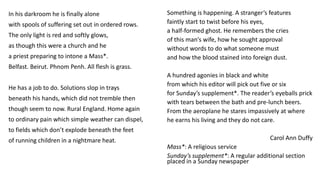
In his darkroom he is finally alone
with spools of suffering set out in ordered rows.
The only light is red and softly glows,
as though this were a church and he
a priest preparing to intone a Mass*.
Belfast. Beirut. Phnom Penh. All flesh is grass.
He has a job to do. Solutions slop in trays
beneath his hands, which did not tremble then
though seem to now. Rural England. Home again
to ordinary pain which simple weather can dispel,
to fields which don’t explode beneath the feet
of running children in a nightmare heat.
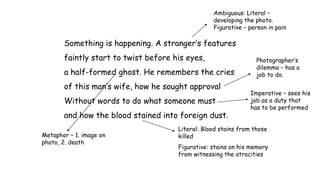
Something is happening. A stranger’s features
faintly start to twist before his eyes,
a half-formed ghost. He remembers the cries
of this man’s wife, how he sought approval
without words to do what someone must
and how the blood stained into foreign dust.
A hundred agonies in black and white
from which his editor will pick out five or six
for Sunday’s supplement*. The reader’s eyeballs prick
with tears between the bath and pre-lunch beers.
From the aeroplane he stares impassively at where
he earns his living and they do not care.
Carol Ann Duffy
Mass*: A religious service
Sunday’s supplement*: A regular additional section
placed in a Sunday newspaper
Carol Ann Duffy
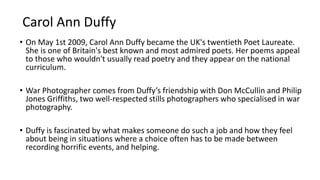
• On May 1st 2009, Carol Ann Duffy became the UK's twentieth Poet Laureate.
She is one of Britain's best known and most admired poets. Her poems appeal
to those who wouldn't usually read poetry and they appear on the national
curriculum.
• War Photographer comes from Duffy’s friendship with Don McCullin and Philip
Jones Griffiths, two well-respected stills photographers who specialised in war
photography.
• Duffy is fascinated by what makes someone do such a job and how they feel
about being in situations where a choice often has to be made between
recording horrific events, and helping.
War Photographer
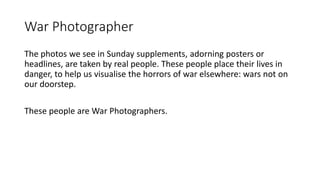
The photos we see in Sunday supplements, adorning posters or
headlines, are taken by real people. These people place their lives in
danger, to help us visualise the horrors of war elsewhere: wars not on
our doorstep.
These people are War Photographers.
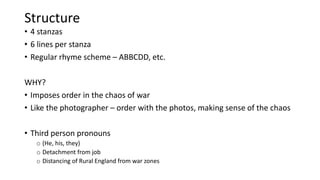
Structure
• 4 stanzas
• 6 lines per stanza
• Regular rhyme scheme – ABBCDD, etc.
WHY?
• Imposes order in the chaos of war
• Like the photographer – order with the photos, making sense of the chaos
• Third person pronouns
o (He, his, they)
o Detachment from job
o Distancing of Rural England from war zones
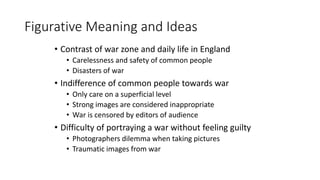
Figurative Meaning and Ideas
• Contrast of war zone and daily life in England
• Carelessness and safety of common people
• Disasters of war
• Indifference of common people towards war
• Only care on a superficial level
• Strong images are considered inappropriate
• War is censored by editors of audience
• Difficulty of portraying a war without feeling guilty
• Photographers dilemma when taking pictures
• Traumatic images from war
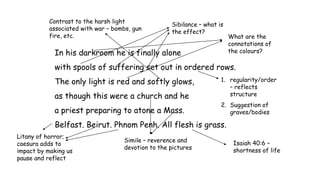
In his darkroom he is finally alone
with spools of suffering set out in ordered rows.
The only light is red and softly glows,
as though this were a church and he
a priest preparing to atone a Mass.
Belfast. Beirut. Phnom Penh. All flesh is grass.
Sibilance – what is
the effect?
What are the
connotations of
the colours?
1. regularity/order
– reflects
structure
2. Suggestion of
graves/bodies
Litany of horror;
caesura adds to
impact by making us
pause and reflect
Isaiah 40:6 –
shortness of life
Simile – reverence and
devotion to the pictures
Contrast to the harsh light
associated with war – bombs, gun
fire, etc.
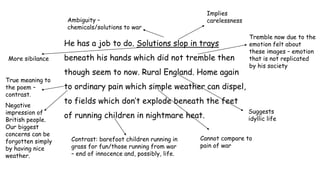
He has a job to do. Solutions slop in trays
beneath his hands which did not tremble then
though seem to now. Rural England. Home again
to ordinary pain which simple weather can dispel,
to fields which don’t explode beneath the feet
of running children in nightmare heat.
Ambiguity –
chemicals/solutions to war
Implies
carelessness
Tremble now due to the
emotion felt about
these images – emotion
that is not replicated
by his society
True meaning to
the poem –
contrast.
Negative
impression of
British people.
Our biggest
concerns can be
forgotten simply
by having nice
weather.
Cannot compare to
pain of war
Contrast: barefoot children running in
grass for fun/those running from war
– end of innocence and, possibly, life.
Suggests
idyllic life
More sibilance
Something is happening. A stranger’s features
faintly start to twist before his eyes,
a half-formed ghost. He remembers the cries
of this man’s wife, how he sought approval
Without words to do what someone must
and how the blood stained into foreign dust.
Ambiguous: Literal –
developing the photo.
Figurative – person in pain
Metaphor – 1. image on
photo, 2. death
Photographer’s
dilemma – has a
job to do.
Literal: Blood stains from those
killed
Figurative: stains on his memory
from witnessing the atrocities
Imperative – sees his
job as a duty that
has to be performed
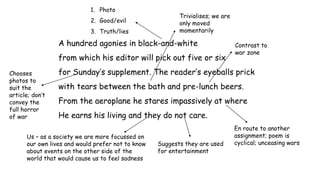
A hundred agonies in black-and-white
from which his editor will pick out five or six
for Sunday’s supplement. The reader’s eyeballs prick
with tears between the bath and pre-lunch beers.
From the aeroplane he stares impassively at where
He earns his living and they do not care.
1. Photo
2. Good/evil
3. Truth/lies
Chooses
photos to
suit the
article; don’t
convey the
full horror
of war
Trivialises; we are
only moved
momentarily
Us – as a society we are more focussed on
our own lives and would prefer not to know
about events on the other side of the
world that would cause us to feel sadness
Suggests they are used
for entertainment
Contrast to
war zone
En route to another
assignment; poem is
cyclical; unceasing wars
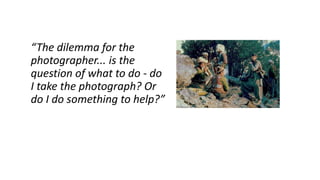
“The dilemma for the
photographer... is the
question of what to do - do
I take the photograph? Or
do I do something to help?”

War photographer

  • 1.
  • 2.
    In his darkroomhe is finally alone with spools of suffering set out in ordered rows. The only light is red and softly glows, as though this were a church and he a priest preparing to intone a Mass*. Belfast. Beirut. Phnom Penh. All flesh is grass. He has a job to do. Solutions slop in trays beneath his hands, which did not tremble then though seem to now. Rural England. Home again to ordinary pain which simple weather can dispel, to fields which don’t explode beneath the feet of running children in a nightmare heat. Something is happening. A stranger’s features faintly start to twist before his eyes, a half-formed ghost. He remembers the cries of this man’s wife, how he sought approval without words to do what someone must and how the blood stained into foreign dust. A hundred agonies in black and white from which his editor will pick out five or six for Sunday’s supplement*. The reader’s eyeballs prick with tears between the bath and pre-lunch beers. From the aeroplane he stares impassively at where he earns his living and they do not care. Carol Ann Duffy Mass*: A religious service Sunday’s supplement*: A regular additional section placed in a Sunday newspaper
  • 3.
    Carol Ann Duffy •On May 1st 2009, Carol Ann Duffy became the UK's twentieth Poet Laureate. She is one of Britain's best known and most admired poets. Her poems appeal to those who wouldn't usually read poetry and they appear on the national curriculum. • War Photographer comes from Duffy’s friendship with Don McCullin and Philip Jones Griffiths, two well-respected stills photographers who specialised in war photography. • Duffy is fascinated by what makes someone do such a job and how they feel about being in situations where a choice often has to be made between recording horrific events, and helping.
  • 4.
    War Photographer The photoswe see in Sunday supplements, adorning posters or headlines, are taken by real people. These people place their lives in danger, to help us visualise the horrors of war elsewhere: wars not on our doorstep. These people are War Photographers.
  • 5.
    Structure • 4 stanzas •6 lines per stanza • Regular rhyme scheme – ABBCDD, etc. WHY? • Imposes order in the chaos of war • Like the photographer – order with the photos, making sense of the chaos • Third person pronouns o (He, his, they) o Detachment from job o Distancing of Rural England from war zones
  • 6.
    Figurative Meaning andIdeas • Contrast of war zone and daily life in England • Carelessness and safety of common people • Disasters of war • Indifference of common people towards war • Only care on a superficial level • Strong images are considered inappropriate • War is censored by editors of audience • Difficulty of portraying a war without feeling guilty • Photographers dilemma when taking pictures • Traumatic images from war
  • 7.
    In his darkroomhe is finally alone with spools of suffering set out in ordered rows. The only light is red and softly glows, as though this were a church and he a priest preparing to atone a Mass. Belfast. Beirut. Phnom Penh. All flesh is grass. Sibilance – what is the effect? What are the connotations of the colours? 1. regularity/order – reflects structure 2. Suggestion of graves/bodies Litany of horror; caesura adds to impact by making us pause and reflect Isaiah 40:6 – shortness of life Simile – reverence and devotion to the pictures Contrast to the harsh light associated with war – bombs, gun fire, etc.
  • 8.
    He has ajob to do. Solutions slop in trays beneath his hands which did not tremble then though seem to now. Rural England. Home again to ordinary pain which simple weather can dispel, to fields which don’t explode beneath the feet of running children in nightmare heat. Ambiguity – chemicals/solutions to war Implies carelessness Tremble now due to the emotion felt about these images – emotion that is not replicated by his society True meaning to the poem – contrast. Negative impression of British people. Our biggest concerns can be forgotten simply by having nice weather. Cannot compare to pain of war Contrast: barefoot children running in grass for fun/those running from war – end of innocence and, possibly, life. Suggests idyllic life More sibilance
  • 9.
    Something is happening.A stranger’s features faintly start to twist before his eyes, a half-formed ghost. He remembers the cries of this man’s wife, how he sought approval Without words to do what someone must and how the blood stained into foreign dust. Ambiguous: Literal – developing the photo. Figurative – person in pain Metaphor – 1. image on photo, 2. death Photographer’s dilemma – has a job to do. Literal: Blood stains from those killed Figurative: stains on his memory from witnessing the atrocities Imperative – sees his job as a duty that has to be performed
  • 10.
    A hundred agoniesin black-and-white from which his editor will pick out five or six for Sunday’s supplement. The reader’s eyeballs prick with tears between the bath and pre-lunch beers. From the aeroplane he stares impassively at where He earns his living and they do not care. 1. Photo 2. Good/evil 3. Truth/lies Chooses photos to suit the article; don’t convey the full horror of war Trivialises; we are only moved momentarily Us – as a society we are more focussed on our own lives and would prefer not to know about events on the other side of the world that would cause us to feel sadness Suggests they are used for entertainment Contrast to war zone En route to another assignment; poem is cyclical; unceasing wars
  • 11.
    “The dilemma forthe photographer... is the question of what to do - do I take the photograph? Or do I do something to help?”