Downloaded 36 times





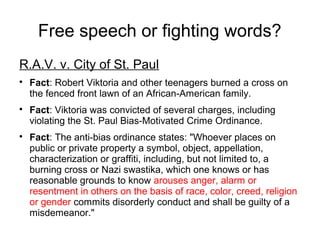







![Advocacy of violence
What Brandenburg said in front of TV cameras:
“We’re not a revengent organization, but if our
president, our Congress, our Supreme Court,
continues to suppress the white, Caucasian
race, it’s possible that there might have to be
some revengeance [sic] taken.”
While Brandenburg was not evidently armed,
other Klansmen at the rally were.](https://image.slidesharecdn.com/violence-and-threats-140120203231-phpapp02/85/Fighting-words-incitement-true-threats-and-the-First-Amendment-26-320.jpg)






The document explores legal interpretations of free speech versus 'fighting words' through various court cases, starting with Chaplinsky v. New Hampshire, which established that fighting words are not protected under free speech. It discusses subsequent cases, such as Terminiello v. Chicago and Cohen v. California, which further clarify the boundaries of free speech and the conditions under which speech can be restricted. The document also addresses 'true threats' as defined in cases like Watts v. United States and Black v. Virginia, emphasizing the legal nuance in distinguishing between protected speech and threats of violence.


