Surface Web
 The surface web is that portion of the world wide web
that is index able by conventional search engines.
 It is also known as the Clear net, the visible web or index
able web.
 96% of web users use search engines to find needed
information, but nearly as high a percentage cite the
inability to find desired information as one of their biggest
frustration.
 A traditional search engine sees only a small amount of
the information that’s available – a measly 0.03%
[source: OEDB]
Deep Web – Introduction
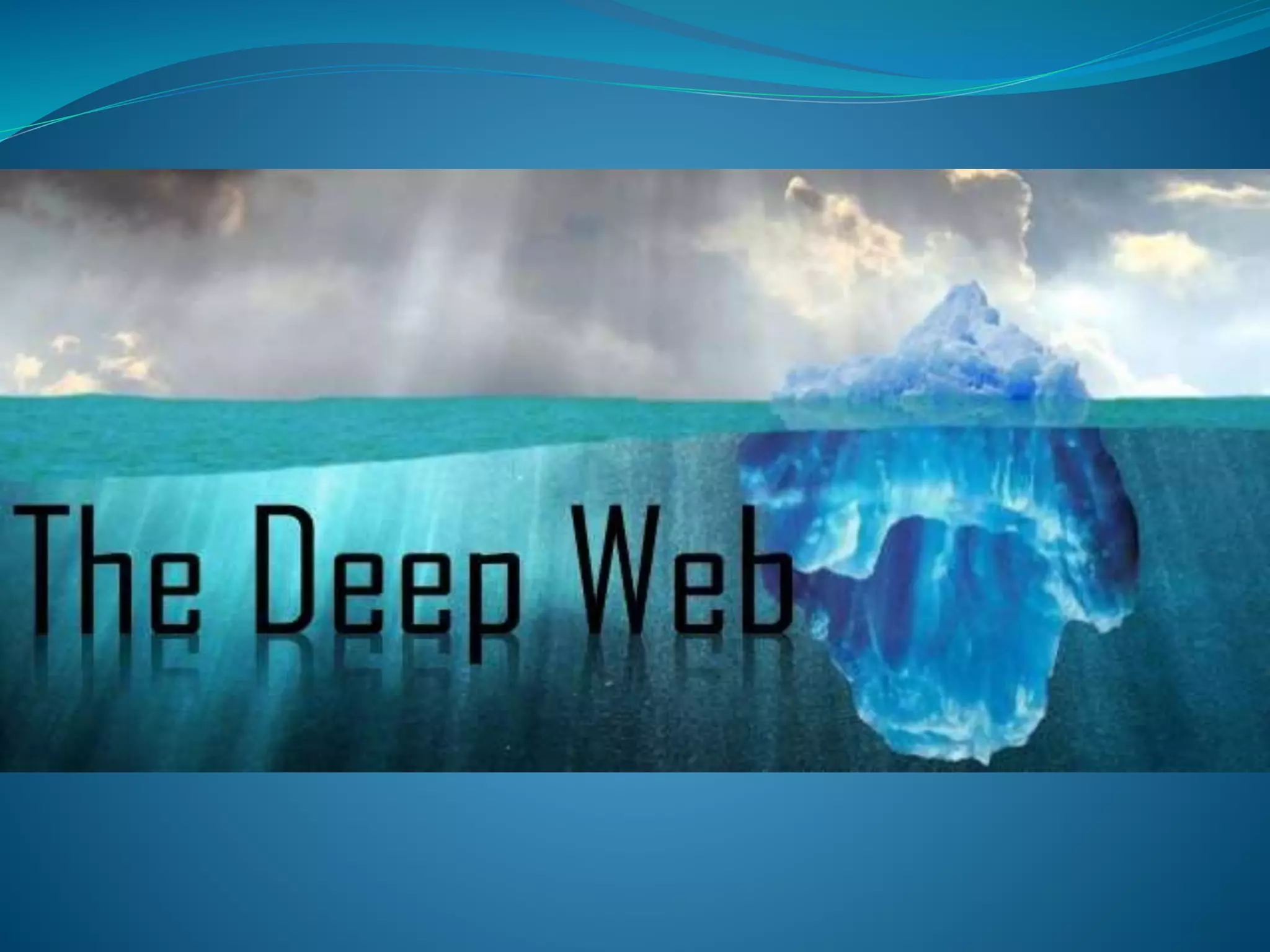
 The deep web is world wide web content that is not part
of the surface web, which is indexed by standard search
engines.
 It also called the Deep net, Invisible Web or Hidden Web.
 Largest growing category of new information on the
internet.
 400 - 500X more public information than the Surface
Web.
 Total quality 1000 – 2000X greater than the quality of the
Surface Web.
History
 Jill Ellsworth used the term invisible Web in 1994 to refer
to websites that were not registered with any search
engine.
 Mike Bergman cited a January 1996 article by Frank
Garcia: “It would be a site that’s possibly reasonably
designed, but they didn’t brother to register it with any of
the search engines. So, no one can find them! You’re
hidden. I call that Invisible Web.”
 Another early use of them Invisible Web was Bruce
Mount and Matthew B. Koll of Personal Library Software
in 1996.
 The first use of the specific term Deep Web, now
How Search Engines Work
 Search engines construct a database of the Web by
using programs called Spiders or Web Crawlers that
being with a list of known Web pages.
 The spider gets a copy of each page and indexes, it
storing useful information that will let the page be quickly
retrieved again later.
 Any hyperlinks to new pages are added to the list of
pages to be crawled.
 Eventually all reachable pages are indexed, unless the
spider runs out of time or disk space.
 The collection of reachable pages defines the Surface
Web.
Contents
 Dynamic Content
 Unlinked Content
 Private Web
 Contextual Web
 Limited Access Content
 Non-Scripted Content
 Non-HTML/Text Content
Dynamic Content
 Dynamic pages which are returned in response to a
submitted query or accessed only through a from.
 Especially if Open-Domain input elements(such as text
fields) are used.
 Such fields are hard to navigate without Domain
knowledge
Unlinked Content
 Pages which are not linked to by other pages.
 Which may prevent web crawling programs from
accessing the content.
 This content is referred to as pages without backlinks( or
inlinks).
Private Web
 Sites that require registration and login( password-
protected resources).
Contextual Web
 Pages with content varying for different access
contexts(e.g. ranges of client IP addresses or previous
navigation sequence).
Limited Access Content
 Sites that limit access to their pages in a technical
way(e.g. using the Robots Exclusion Standard,
CAPTCHAs, or No-Cache Pragma HTTP Headers which
prohibit search engines from browsing them and creating
cached copies).
Scripted Content
 Pages that are only accessible through links produced by
Java Script as well as content dynamically downloaded
from Web servers via Flash or Ajax Solutions.
Non-HTML/Text Content
 Textual content encoded in multimedia(image or video)
files or specific file formats not handled by search
engines.
Deep Potential
 The Deep Web is an endless repository for a mind-
reeling amount of information.
 It’s powerful. It unleashes human nature in all its forms,
both good and bad.
 There are engineering databases, financial information of
all kinds, medical papers, pictures, illustrations … the list
goes on, basically, forever.
 For example, construction engineers could potentially
search research papers at multiple universities in order to
find the latest and greatest in bridge-building materials.
 Doctors could swiftly locate the latest research on a
specific disease.
 The potential is unlimited. The technical challenges are
daunting. That’s the draw of the Deep Wep.
Shadow Land
 The Deep Web may be a shadow land of untapped potential.
 The bad stuff, as always, gets most of the headlines.
 You can find illegal goods and activities of all kinds through the
Dark Web.
 That includes illicit drugs, child pornography, stolen credit card
numbers, human trafficking, weapons, exotic animals,
copyrighted media and anything else you can think of.
 Theoretically, you could even, say, hire a hit man to kill
someone you don’t like.
 But you won’t find this information with Google search.
 These kinds of Web sites require you to use special Software,
such as The Onion Router, more commonly known as Tor .
The Onion Router(TOR)
 TOR is software that installs into your browser and sets up the
specific connections you need to access Dark Web sites.
 Critically it is free software for enabling online Anonymity and
Censorship resistance.
 Onion routing refers to the process of removing encryption
layers from internet communication, similar to peeling back the
layers of an onion.
 Using TOR makes it more difficult to trace internet activity,
including “visits to Web sites, online posts, instant messages
and other communication forms”, back to user.
 It is intended to protect the personal privacy of users, as well
as their freedom and ability to conduct confidential business
by keeping their internet activities from being monitored.
Cont….
 Instead of seeing Domains that end in .com or .org, these
hidden sites end in .onion.
 The most infamous of these onion sites was the now-defunct
Silk Road, an online marketplace where users could buy
drugs, guns and all sorts of other illegal items.
 The FBI eventually captured Ross Ulbricht, who operated Silk
Road, but copycat sites like Black Market Reloaded are still
readily available.
 TOR is the result of research done by the U.S. Naval
Research Laboratory, which created TOR for political
dissidents and whistleblowers, allowing them to communicate
without fear of reprisal.
 TOR was so effective in providing anonymity for these groups
Money-Related
Transactions
 You may wonder how any money-related transactions
can happen when sellers and buyers can’t identify each
other.
 That’s where Bitcoin comes in.
 Bitcoin, it’s basically an encrypted digital currency.
 Like regular cash, Bitcoin is good for transactions of all
kinds and notably. It also allows for anonymity; no one
can trace a purchase, illegal or otherwise.
 When paired properly with TOR, it’s perhaps the closest
thing to a foolproof way to buy and sell on the Web.
The Brighter Side of
Darkness
 The Deep Web is home to, alternate search engines, social e-
mail services, file storage, file sharing, media, chat sites, news
outlets and whistle blowing sites, as well as sites that provide
a safe meeting ground for political dissidents and anyone else
who may find themselves on the fringes of society.
 In an age where NSA-type surveillance is omnipresent and
privacy seems like a thing of the past, the Dark Web offers
some relief to people who prize their anonymity.
 Bitcoin may not be entirely stable, but it offers privacy, which is
something your credit card company most certainly does not.
 For citizens living in countries with violent or oppressive, the
Dark Web offers a more secure way to communicate with like-
minded individuals.
Future
 The lines between search engine content and the Deep
Web have begun to blur, as search services start to
provide access to part or all of once-restricted content.
 An increasing amount of Deep Web content is opening
up to free search as publishers and libraries make
agreements with large search engines.
 In the future, Deep Web content may be defined less by
opportunity for search than by access fees or other types
of authentication.
Conclusion
 The Deep Web will continue to perplex and fascinate who
uses the internet.
 It contains an enthralling amount of knowledge that could
help us evolve technologically and as a species when
connected to other bits of information.
 And of course, its darker side will always be lurking too,
just as it always does in human nature.
 The Deep Web speaks to the fathomless, scattered
potential of not only the internet but also the human race.
Thank You

Dark web presentation

  • 2.
    Surface Web  Thesurface web is that portion of the world wide web that is index able by conventional search engines.  It is also known as the Clear net, the visible web or index able web.  96% of web users use search engines to find needed information, but nearly as high a percentage cite the inability to find desired information as one of their biggest frustration.  A traditional search engine sees only a small amount of the information that’s available – a measly 0.03% [source: OEDB]
  • 3.
    Deep Web –Introduction  The deep web is world wide web content that is not part of the surface web, which is indexed by standard search engines.  It also called the Deep net, Invisible Web or Hidden Web.  Largest growing category of new information on the internet.  400 - 500X more public information than the Surface Web.  Total quality 1000 – 2000X greater than the quality of the Surface Web.
  • 4.
    History  Jill Ellsworthused the term invisible Web in 1994 to refer to websites that were not registered with any search engine.  Mike Bergman cited a January 1996 article by Frank Garcia: “It would be a site that’s possibly reasonably designed, but they didn’t brother to register it with any of the search engines. So, no one can find them! You’re hidden. I call that Invisible Web.”  Another early use of them Invisible Web was Bruce Mount and Matthew B. Koll of Personal Library Software in 1996.  The first use of the specific term Deep Web, now
  • 5.
    How Search EnginesWork  Search engines construct a database of the Web by using programs called Spiders or Web Crawlers that being with a list of known Web pages.  The spider gets a copy of each page and indexes, it storing useful information that will let the page be quickly retrieved again later.  Any hyperlinks to new pages are added to the list of pages to be crawled.  Eventually all reachable pages are indexed, unless the spider runs out of time or disk space.  The collection of reachable pages defines the Surface Web.
  • 6.
    Contents  Dynamic Content Unlinked Content  Private Web  Contextual Web  Limited Access Content  Non-Scripted Content  Non-HTML/Text Content
  • 7.
    Dynamic Content  Dynamicpages which are returned in response to a submitted query or accessed only through a from.  Especially if Open-Domain input elements(such as text fields) are used.  Such fields are hard to navigate without Domain knowledge Unlinked Content  Pages which are not linked to by other pages.  Which may prevent web crawling programs from accessing the content.  This content is referred to as pages without backlinks( or inlinks).
  • 8.
    Private Web  Sitesthat require registration and login( password- protected resources). Contextual Web  Pages with content varying for different access contexts(e.g. ranges of client IP addresses or previous navigation sequence). Limited Access Content  Sites that limit access to their pages in a technical way(e.g. using the Robots Exclusion Standard, CAPTCHAs, or No-Cache Pragma HTTP Headers which prohibit search engines from browsing them and creating cached copies).
  • 9.
    Scripted Content  Pagesthat are only accessible through links produced by Java Script as well as content dynamically downloaded from Web servers via Flash or Ajax Solutions. Non-HTML/Text Content  Textual content encoded in multimedia(image or video) files or specific file formats not handled by search engines.
  • 10.
    Deep Potential  TheDeep Web is an endless repository for a mind- reeling amount of information.  It’s powerful. It unleashes human nature in all its forms, both good and bad.  There are engineering databases, financial information of all kinds, medical papers, pictures, illustrations … the list goes on, basically, forever.  For example, construction engineers could potentially search research papers at multiple universities in order to find the latest and greatest in bridge-building materials.  Doctors could swiftly locate the latest research on a specific disease.  The potential is unlimited. The technical challenges are daunting. That’s the draw of the Deep Wep.
  • 11.
    Shadow Land  TheDeep Web may be a shadow land of untapped potential.  The bad stuff, as always, gets most of the headlines.  You can find illegal goods and activities of all kinds through the Dark Web.  That includes illicit drugs, child pornography, stolen credit card numbers, human trafficking, weapons, exotic animals, copyrighted media and anything else you can think of.  Theoretically, you could even, say, hire a hit man to kill someone you don’t like.  But you won’t find this information with Google search.  These kinds of Web sites require you to use special Software, such as The Onion Router, more commonly known as Tor .
  • 12.
    The Onion Router(TOR) TOR is software that installs into your browser and sets up the specific connections you need to access Dark Web sites.  Critically it is free software for enabling online Anonymity and Censorship resistance.  Onion routing refers to the process of removing encryption layers from internet communication, similar to peeling back the layers of an onion.  Using TOR makes it more difficult to trace internet activity, including “visits to Web sites, online posts, instant messages and other communication forms”, back to user.  It is intended to protect the personal privacy of users, as well as their freedom and ability to conduct confidential business by keeping their internet activities from being monitored.
  • 13.
    Cont….  Instead ofseeing Domains that end in .com or .org, these hidden sites end in .onion.  The most infamous of these onion sites was the now-defunct Silk Road, an online marketplace where users could buy drugs, guns and all sorts of other illegal items.  The FBI eventually captured Ross Ulbricht, who operated Silk Road, but copycat sites like Black Market Reloaded are still readily available.  TOR is the result of research done by the U.S. Naval Research Laboratory, which created TOR for political dissidents and whistleblowers, allowing them to communicate without fear of reprisal.  TOR was so effective in providing anonymity for these groups
  • 14.
    Money-Related Transactions  You maywonder how any money-related transactions can happen when sellers and buyers can’t identify each other.  That’s where Bitcoin comes in.  Bitcoin, it’s basically an encrypted digital currency.  Like regular cash, Bitcoin is good for transactions of all kinds and notably. It also allows for anonymity; no one can trace a purchase, illegal or otherwise.  When paired properly with TOR, it’s perhaps the closest thing to a foolproof way to buy and sell on the Web.
  • 15.
    The Brighter Sideof Darkness  The Deep Web is home to, alternate search engines, social e- mail services, file storage, file sharing, media, chat sites, news outlets and whistle blowing sites, as well as sites that provide a safe meeting ground for political dissidents and anyone else who may find themselves on the fringes of society.  In an age where NSA-type surveillance is omnipresent and privacy seems like a thing of the past, the Dark Web offers some relief to people who prize their anonymity.  Bitcoin may not be entirely stable, but it offers privacy, which is something your credit card company most certainly does not.  For citizens living in countries with violent or oppressive, the Dark Web offers a more secure way to communicate with like- minded individuals.
  • 16.
    Future  The linesbetween search engine content and the Deep Web have begun to blur, as search services start to provide access to part or all of once-restricted content.  An increasing amount of Deep Web content is opening up to free search as publishers and libraries make agreements with large search engines.  In the future, Deep Web content may be defined less by opportunity for search than by access fees or other types of authentication.
  • 17.
    Conclusion  The DeepWeb will continue to perplex and fascinate who uses the internet.  It contains an enthralling amount of knowledge that could help us evolve technologically and as a species when connected to other bits of information.  And of course, its darker side will always be lurking too, just as it always does in human nature.  The Deep Web speaks to the fathomless, scattered potential of not only the internet but also the human race.
  • 18.