Your logo
Your logo

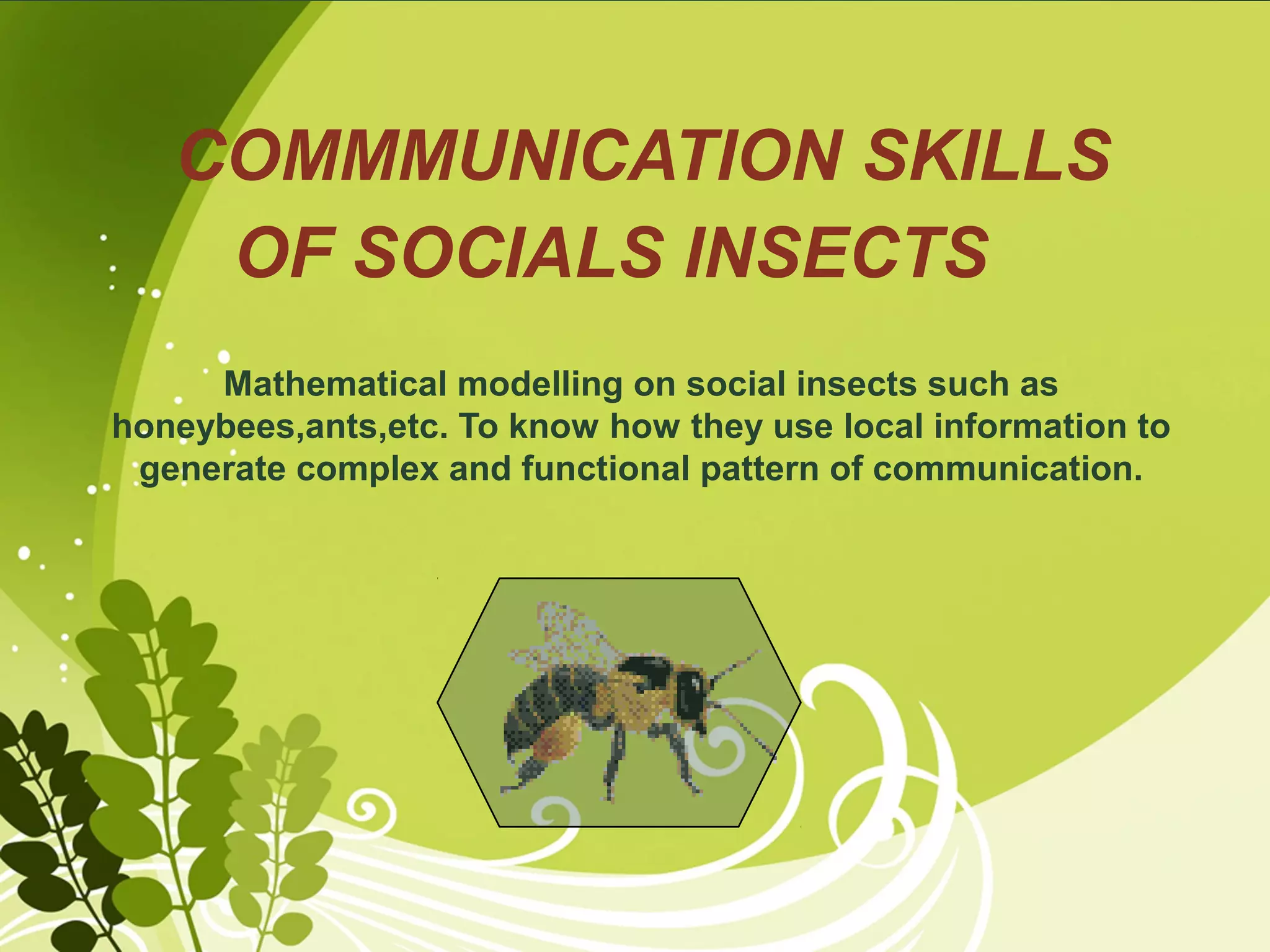
COMMMUNICATION SKILLS
OF SOCIALS INSECTS

Mathematical modelling on social insects such as
honeybees,ants,etc. To know how they use local information to
generate complex and functional pattern of communication.
INTRODUCTION
 Many
insects
exhibit
"social"
behaviors
(e.g. feeding aggregations, parental care of the
young, and communal nest sites).  In a broad
sense, any insect that interacts with another
member of its own species could be called a
social insect.  But as a rule, entomologists do
not regard these behaviors as sufficient
justification for classifying a species as truly
social (i.e. eusocial).  In order to qualify
as eusocial, a species must exhibit the
following characteristics:
TOWER OF HANOI
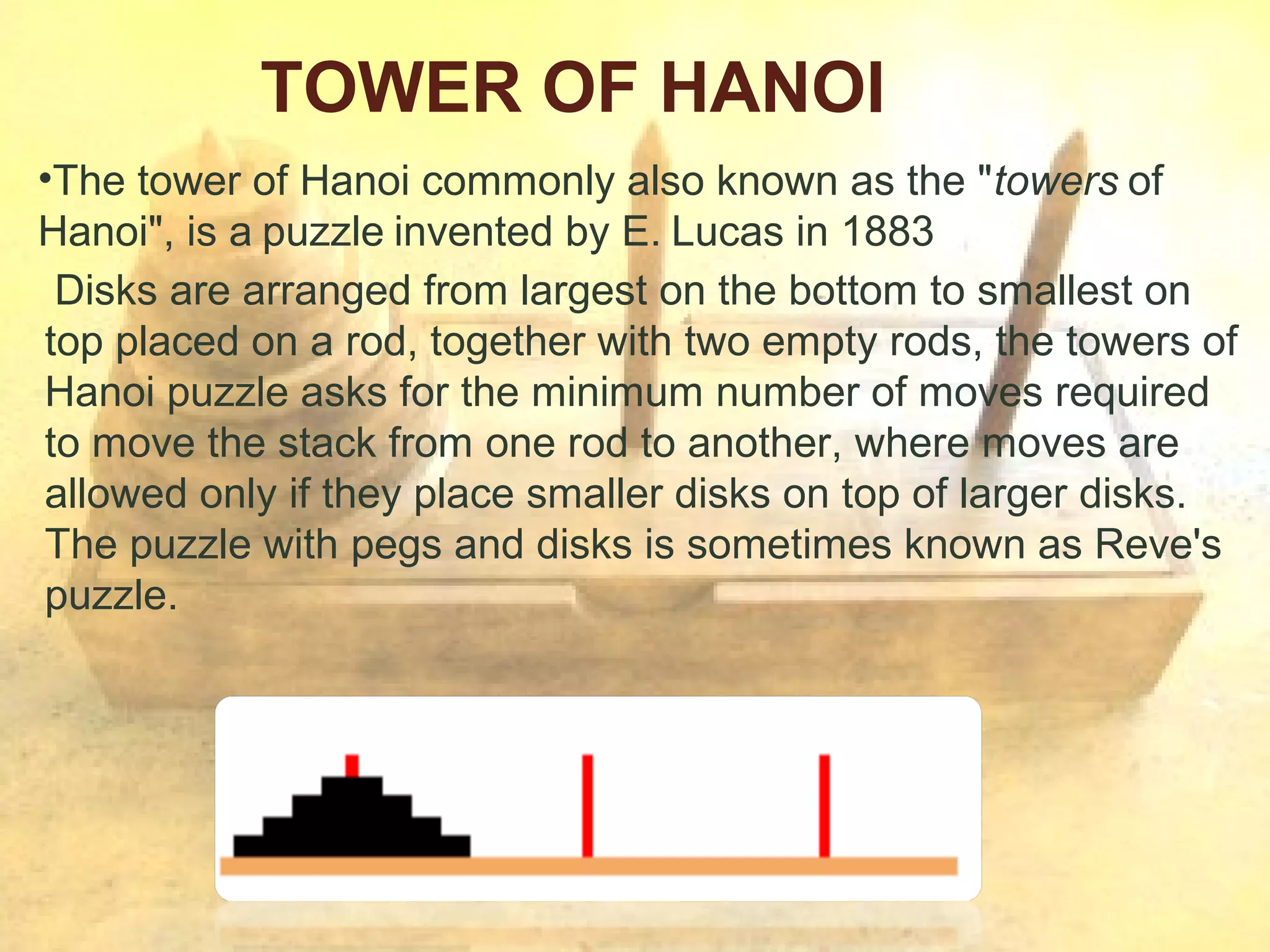
•The tower of Hanoi commonly also known as the "towers of
Hanoi", is a puzzle invented by E. Lucas in 1883
Disks are arranged from largest on the bottom to smallest on
top placed on a rod, together with two empty rods, the towers of
Hanoi puzzle asks for the minimum number of moves required
to move the stack from one rod to another, where moves are
allowed only if they place smaller disks on top of larger disks.
The puzzle with pegs and disks is sometimes known as Reve's
puzzle.
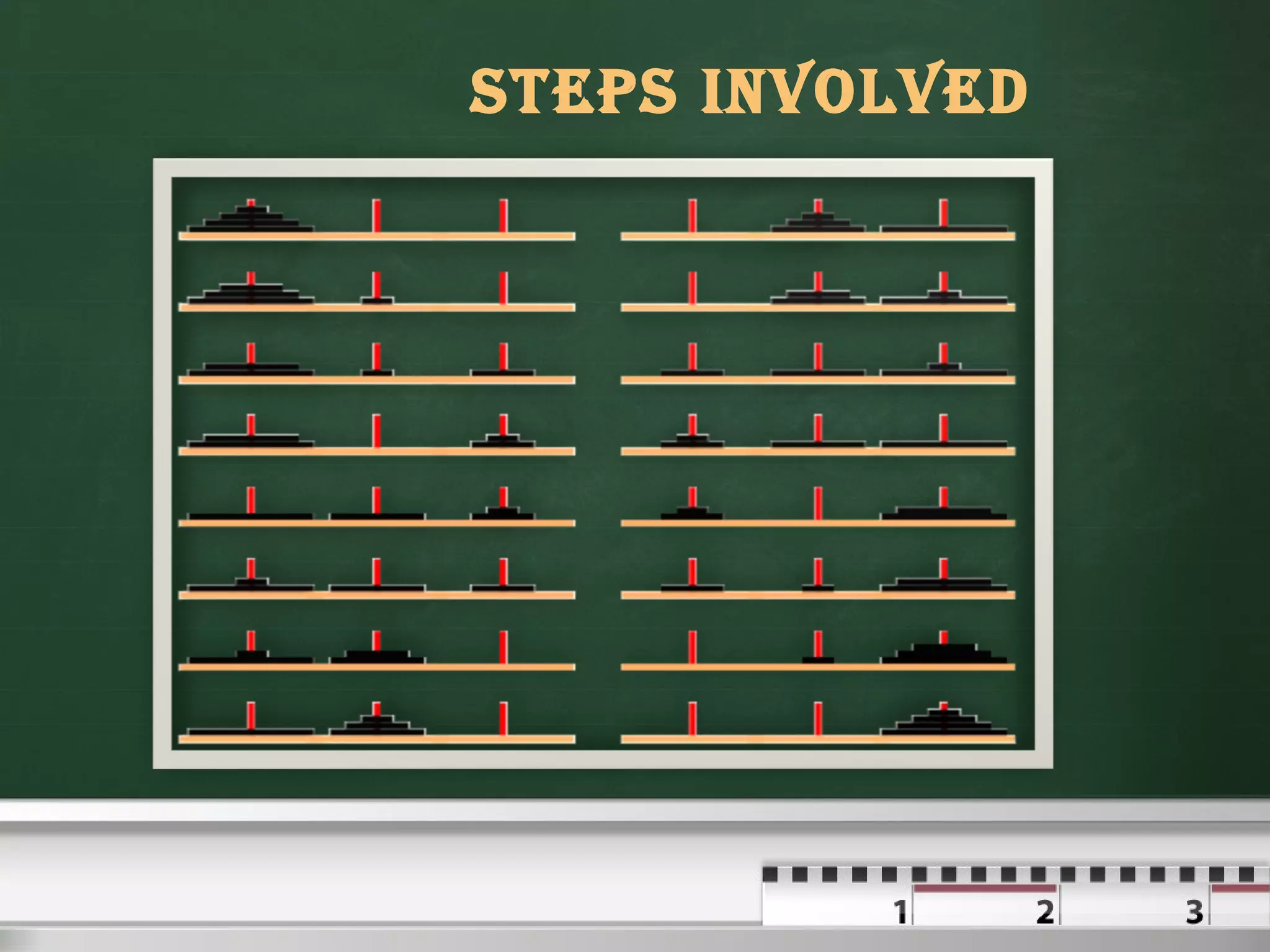
STEPS INVOLVED
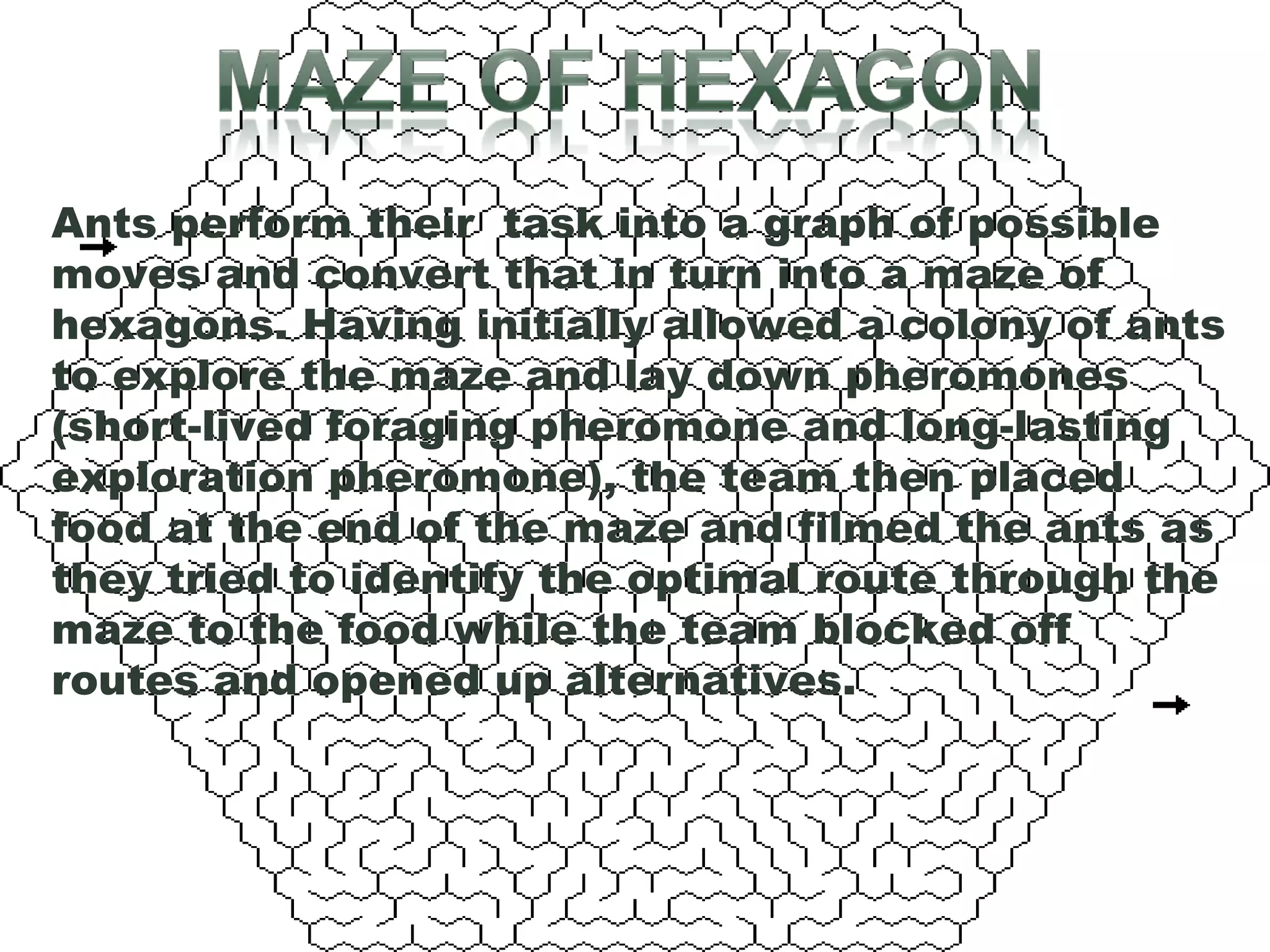
Ants perform their task into a graph of possible
moves and convert that in turn into a maze of
hexagons. Having initially allowed a colony of ants
to explore the maze and lay down pheromones
(short-lived foraging pheromone and long-lasting
exploration pheromone), the team then placed
food at the end of the maze and filmed the ants as
they tried to identify the optimal route through the
maze to the food while the team blocked off
routes and opened up alternatives.
MAZE OF HEXAGON
The ants had little problem coping with change. Initially, the
insects found the shortest route, scurrying along the outer edge
of the maze to the food source. However, when the team blocked
this route and opened up another through the middle of the maze,
the ants changed course, zigzagging across the maze,
perpendicular to their original route until they found the
alternative.

The team suspects that both pheromones played critical roles,
with short-lived foraging pheromone allowing the ants to respond
quickly.
Here comes your footer  Page 9
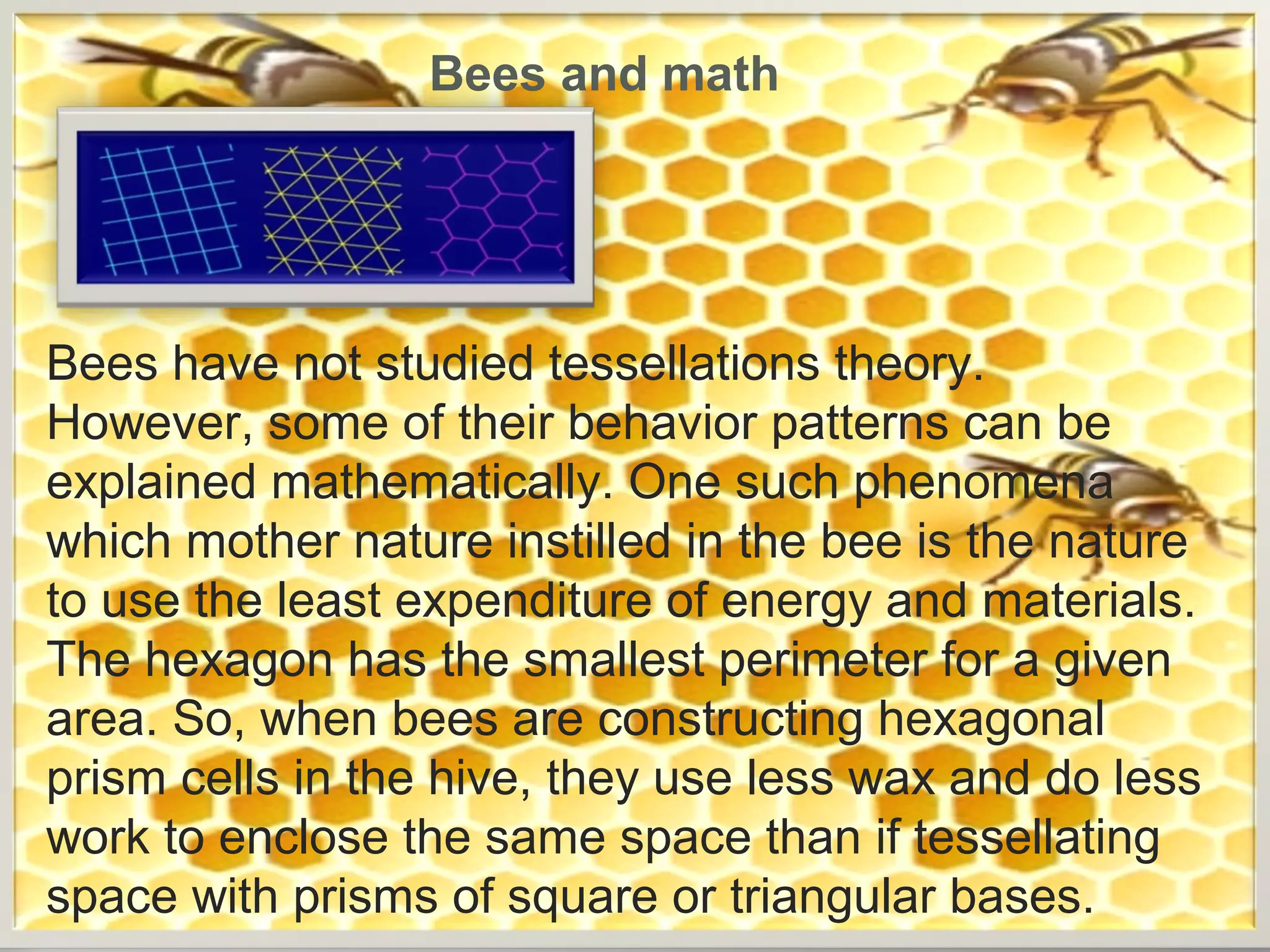
Bees and math

Bees have not studied tessellations theory.
However, some of their behavior patterns can be
explained mathematically. One such phenomena
which mother nature instilled in the bee is the nature
to use the least expenditure of energy and materials.
The hexagon has the smallest perimeter for a given
area. So, when bees are constructing hexagonal
prism cells in the hive, they use less wax and do less
work to enclose the same space than if tessellating
space with prisms of square or triangular bases.
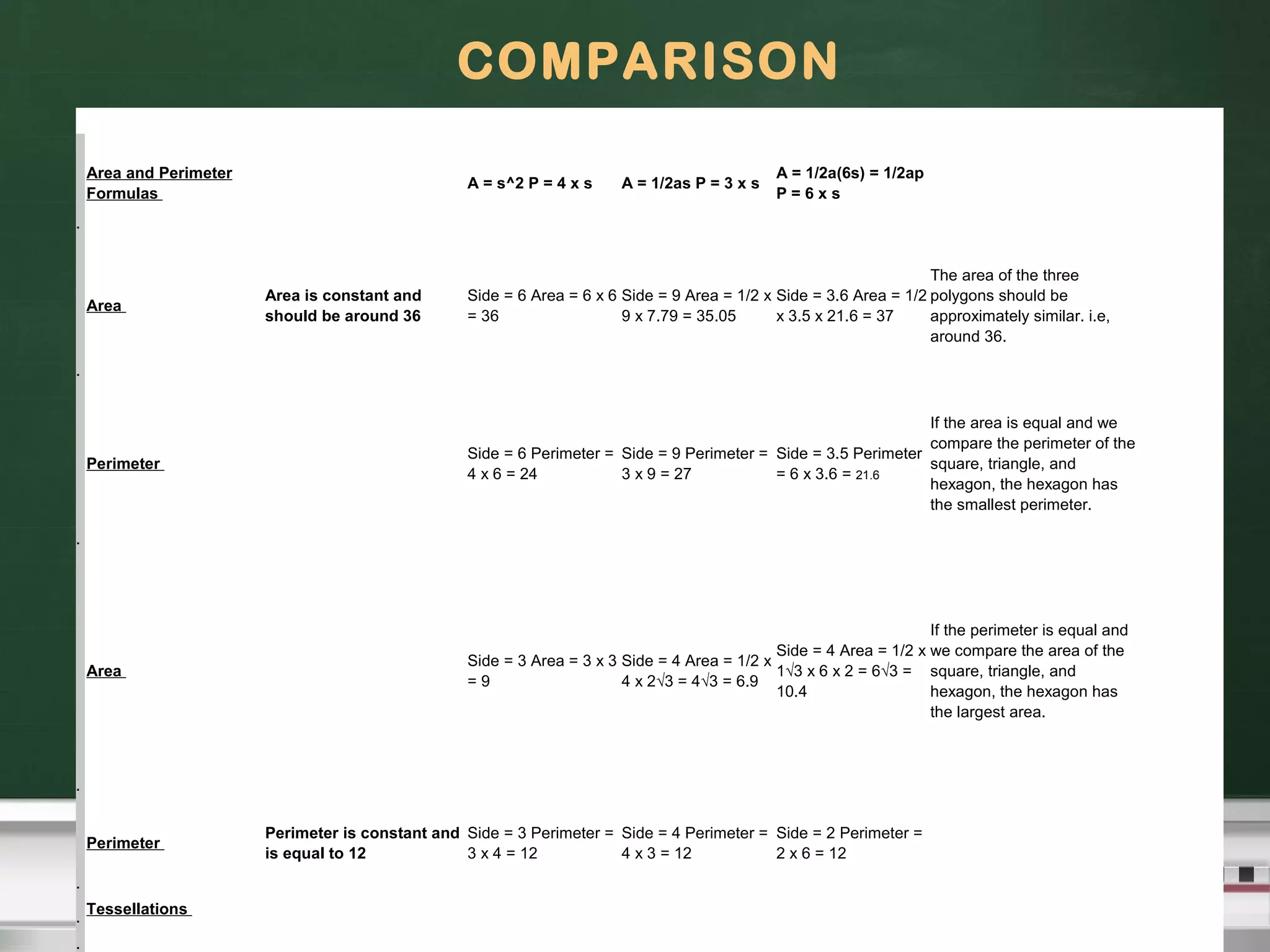
COMPARISON
Area and Perimeter
Formulas

A = s^2 P = 4 x s

A = 1/2as P = 3 x s

A = 1/2a(6s) = 1/2ap
P=6xs

.

Area

Area is constant and
should be around 36

The area of the three
Side = 6 Area = 6 x 6 Side = 9 Area = 1/2 x Side = 3.6 Area = 1/2 polygons should be
= 36
9 x 7.79 = 35.05
x 3.5 x 21.6 = 37
approximately similar. i.e,
around 36.

.

Perimeter

If the area is equal and we
compare the perimeter of the
Side = 6 Perimeter = Side = 9 Perimeter = Side = 3.5 Perimeter
square, triangle, and
4 x 6 = 24
3 x 9 = 27
= 6 x 3.6 = 21.6
hexagon, the hexagon has
the smallest perimeter.

Area

If the perimeter is equal and
Side = 4 Area = 1/2 x we compare the area of the
Side = 3 Area = 3 x 3 Side = 4 Area = 1/2 x
1√3 x 6 x 2 = 6√3 = square, triangle, and
=9
4 x 2√3 = 4√3 = 6.9
10.4
hexagon, the hexagon has
the largest area.

.

.

Perimeter
.
.
.

Tessellations

Perimeter is constant and Side = 3 Perimeter = Side = 4 Perimeter = Side = 2 Perimeter =
is equal to 12
3 x 4 = 12
4 x 3 = 12
2 x 6 = 12
VECTOR DANCE
 Honeybees have a unique
 When the distance of resource
communication style called dance
location is closer to the hive,forger
language. The dance communication
bees dance rapidly.the waggle
is revealed in detail since CARLVON
dance thus have two kind of
FRISCH‘S work and the dance of
information for food direction and
honeybees is a body language to
distance to the nectar resource.
communicating the resource direction
and distance.a forager be seeks
flower for her nectar and returns to
the hive.when she arouses the other
colleagues bees for the location of
flowers.she uses her waggle dance by
walking in a straight line and wagging
her abdomen from side to side.
More about bee
dance.... by dance
Bees communicate
language.
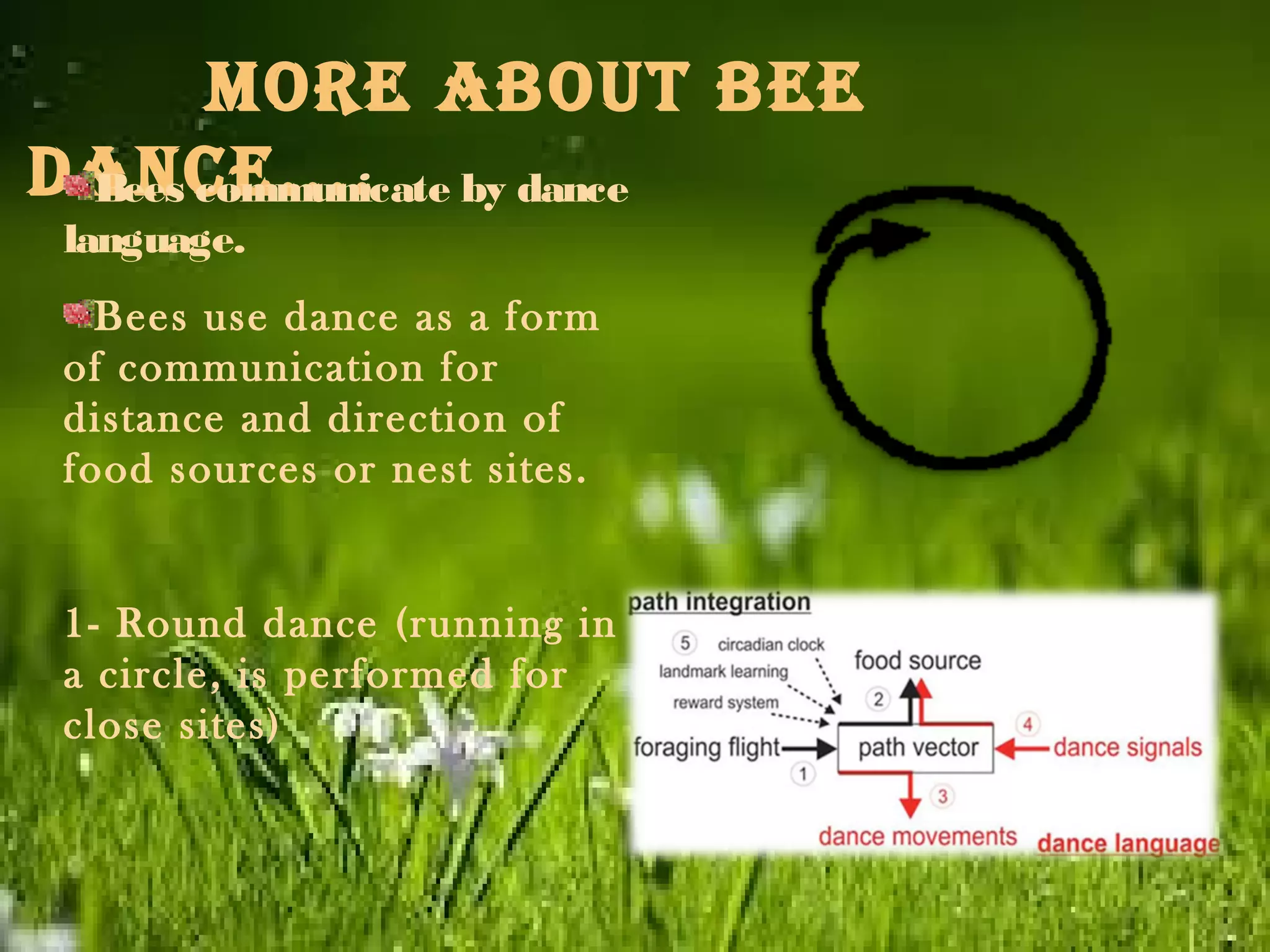
Bees use dance as a form
of communication for
distance and direction of
food sources or nest sites.

1- Round dance (running in
a circle, is performed for
close sites)
DISTANCE
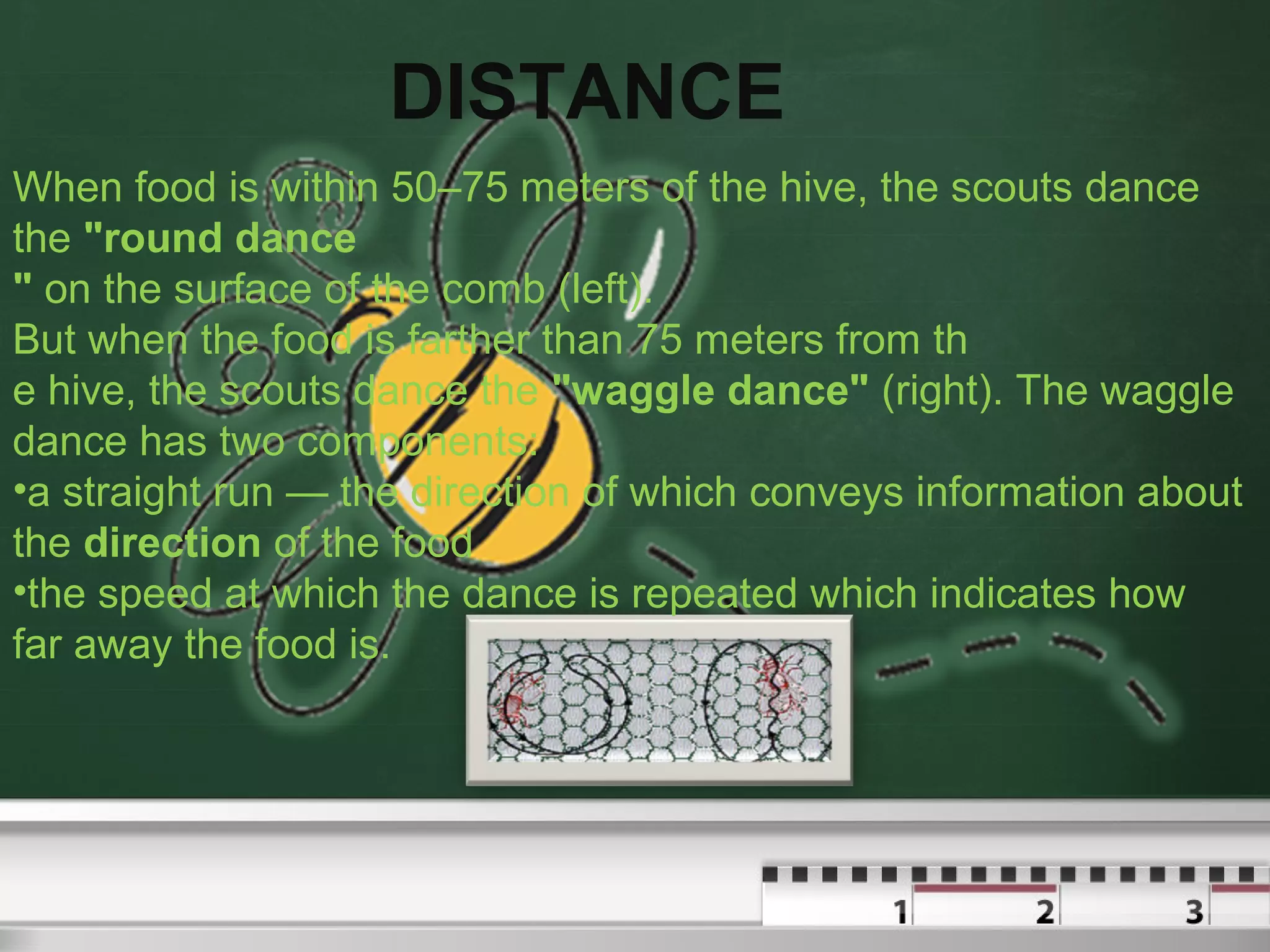
When food is within 50–75 meters of the hive, the scouts dance
the "round dance
" on the surface of the comb (left).
But when the food is farther than 75 meters from th
e hive, the scouts dance the "waggle dance" (right). The waggle
dance has two components:
•a straight run — the direction of which conveys information about
the direction of the food
•the speed at which the dance is repeated which indicates how
far away the food is.
CREATION :
 SHAGUN UPPAL
 SUKRITI RAMPAL

BMOUNT ABU PUBLIC SCHOOL
SECTOR-5, ROHINI
NEW DELHI-85
Here comes your footer  Page 15
Thank You
We look for your suggestions and remarks
NAME OF PERSON/
ORGANISATION

Here comes your footer  Page 16

Suggestions

Signature

Maths1

  • 1.
  • 2.
    Your logo COMMMUNICATION SKILLS OFSOCIALS INSECTS Mathematical modelling on social insects such as honeybees,ants,etc. To know how they use local information to generate complex and functional pattern of communication.
  • 5.
    INTRODUCTION  Many insects exhibit "social" behaviors (e.g. feeding aggregations,parental care of the young, and communal nest sites).  In a broad sense, any insect that interacts with another member of its own species could be called a social insect.  But as a rule, entomologists do not regard these behaviors as sufficient justification for classifying a species as truly social (i.e. eusocial).  In order to qualify as eusocial, a species must exhibit the following characteristics:
  • 6.
    TOWER OF HANOI •Thetower of Hanoi commonly also known as the "towers of Hanoi", is a puzzle invented by E. Lucas in 1883 Disks are arranged from largest on the bottom to smallest on top placed on a rod, together with two empty rods, the towers of Hanoi puzzle asks for the minimum number of moves required to move the stack from one rod to another, where moves are allowed only if they place smaller disks on top of larger disks. The puzzle with pegs and disks is sometimes known as Reve's puzzle.
  • 7.
  • 8.
    Ants perform theirtask into a graph of possible moves and convert that in turn into a maze of hexagons. Having initially allowed a colony of ants to explore the maze and lay down pheromones (short-lived foraging pheromone and long-lasting exploration pheromone), the team then placed food at the end of the maze and filmed the ants as they tried to identify the optimal route through the maze to the food while the team blocked off routes and opened up alternatives.
  • 9.
    MAZE OF HEXAGON Theants had little problem coping with change. Initially, the insects found the shortest route, scurrying along the outer edge of the maze to the food source. However, when the team blocked this route and opened up another through the middle of the maze, the ants changed course, zigzagging across the maze, perpendicular to their original route until they found the alternative. The team suspects that both pheromones played critical roles, with short-lived foraging pheromone allowing the ants to respond quickly. Here comes your footer  Page 9
  • 10.
    Bees and math Beeshave not studied tessellations theory. However, some of their behavior patterns can be explained mathematically. One such phenomena which mother nature instilled in the bee is the nature to use the least expenditure of energy and materials. The hexagon has the smallest perimeter for a given area. So, when bees are constructing hexagonal prism cells in the hive, they use less wax and do less work to enclose the same space than if tessellating space with prisms of square or triangular bases.
  • 11.
    COMPARISON Area and Perimeter Formulas A= s^2 P = 4 x s A = 1/2as P = 3 x s A = 1/2a(6s) = 1/2ap P=6xs . Area Area is constant and should be around 36 The area of the three Side = 6 Area = 6 x 6 Side = 9 Area = 1/2 x Side = 3.6 Area = 1/2 polygons should be = 36 9 x 7.79 = 35.05 x 3.5 x 21.6 = 37 approximately similar. i.e, around 36. . Perimeter If the area is equal and we compare the perimeter of the Side = 6 Perimeter = Side = 9 Perimeter = Side = 3.5 Perimeter square, triangle, and 4 x 6 = 24 3 x 9 = 27 = 6 x 3.6 = 21.6 hexagon, the hexagon has the smallest perimeter. Area If the perimeter is equal and Side = 4 Area = 1/2 x we compare the area of the Side = 3 Area = 3 x 3 Side = 4 Area = 1/2 x 1√3 x 6 x 2 = 6√3 = square, triangle, and =9 4 x 2√3 = 4√3 = 6.9 10.4 hexagon, the hexagon has the largest area. . . Perimeter . . . Tessellations Perimeter is constant and Side = 3 Perimeter = Side = 4 Perimeter = Side = 2 Perimeter = is equal to 12 3 x 4 = 12 4 x 3 = 12 2 x 6 = 12
  • 12.
    VECTOR DANCE  Honeybeeshave a unique  When the distance of resource communication style called dance location is closer to the hive,forger language. The dance communication bees dance rapidly.the waggle is revealed in detail since CARLVON dance thus have two kind of FRISCH‘S work and the dance of information for food direction and honeybees is a body language to distance to the nectar resource. communicating the resource direction and distance.a forager be seeks flower for her nectar and returns to the hive.when she arouses the other colleagues bees for the location of flowers.she uses her waggle dance by walking in a straight line and wagging her abdomen from side to side.
  • 13.
    More about bee dance....by dance Bees communicate language. Bees use dance as a form of communication for distance and direction of food sources or nest sites. 1- Round dance (running in a circle, is performed for close sites)
  • 14.
    DISTANCE When food iswithin 50–75 meters of the hive, the scouts dance the "round dance " on the surface of the comb (left). But when the food is farther than 75 meters from th e hive, the scouts dance the "waggle dance" (right). The waggle dance has two components: •a straight run — the direction of which conveys information about the direction of the food •the speed at which the dance is repeated which indicates how far away the food is.
  • 15.
    CREATION :  SHAGUNUPPAL  SUKRITI RAMPAL BMOUNT ABU PUBLIC SCHOOL SECTOR-5, ROHINI NEW DELHI-85 Here comes your footer  Page 15
  • 16.
    Thank You We lookfor your suggestions and remarks NAME OF PERSON/ ORGANISATION Here comes your footer  Page 16 Suggestions Signature

Editor's Notes