Keeping the Sharks at BayResolving Disputes with Co-Inventors, Investors, Licensees and Third PartiesJane LambertLeeds Inventors Group21 July 2010
Co-InventorsInvestorsLicenseesThird Parties
Co-InventorsAn  inventor  who had spent a lifetime in textile manufacturing and had lectured on the subject at a local university acted as a consultant for local manufacturers after he retired. One of his clients won a contract to make components for a large US manufacturer and asked him to help it to meet the order.In carrying out his instructions he invented a machine that he and his client decided to patent. He and his client agreed orally that they should jointly apply for a patent.However, unbeknown to the inventor, his client applied for the patent in its own name stating incorrectly on the application that it had acquired all the rights to the invention
Co-InventorsS.7 (2) Patents ActA patent for an invention may be granted -(a) primarily to the inventor or joint inventors;(b) in preference to the foregoing, to any person or persons who, by virtue of any enactment or rule of law, or any foreign law or treaty or international convention, or by virtue of an enforceable term of any agreement entered into with the inventor before the making of the invention, was or were at the time of the making of the invention entitled to the whole of the property in it (other than equitable interests) in the United Kingdom;(c) in any event, to the successor or successors in title of any person or persons mentioned in paragraph (a) or (b) above or any person so mentioned and the successor or successors in title of another person so mentioned; and to no other person.
Co-InventorsS.8 (1) Patents Act 1977At any time before a patent has been granted for an invention (whether or not an application has been made for it) -(a) any person may refer to the comptroller the question whether he is entitled to be granted (alone or with any other persons) a patent for that invention or has or would have any right in or under any patent so, granted or any application for such a patent; or(b) any of two or more co-proprietors of an application for a patent for that invention may so refer the question whether any right in or under the application should be transferred or granted to any other person;. and the comptroller shall determine the question and may make such order as he thinks fit to give effect to the determination.
Co-InventorsS.8 (2) Patents ActWhere a person refers a question relating to an invention under subsection (1)(a) above to the comptroller after an application for a patent for the invention has been filed and before a patent is granted in pursuance of the application, then, unless the application is refused or withdrawn before the reference is disposed of by the comptroller, the comptroller may, without prejudice to the generality of subsection (1) above and subject to subsection (6) below -(a) order that the application shall proceed in the name of that person, either solely or jointly with that of any other applicant, instead of in the name of the applicant or any specified applicant;(b) where the reference was made by two or more persons, order that the application shall proceed in all their names jointly; (c) refuse to grant a patent in pursuance of the application or order the application to be amended so as to exclude any of the matter in respect of which the question was referred;(d) make an order transferring or granting any licence or other right in or under the application and give directions to any person for carrying out the provisions of any such order.
Co-InventorsS.37 Patents ActAfter a patent has been granted for an invention any person having or claiming a proprietary interest in or under the patent may refer to the comptroller the question -(a) who is or are the true proprietor or proprietors of the patent,(b) whether the patent should have been granted to the person or persons to whom it was granted, or(c) whether any right in or under the patent should be transferred or granted to any other person or persons;and the comptroller shall determine the question and make such order as he thinks fit to give effect to the determination.
Co-InventorsApplication is brought before an official representing the Comptroller (Chief Executive of the IP Office) known as a “hearing officer”.As far as possible, applications are disposed of in writing or by telephone though sometimes it is necessary to hold an oral hearing.Hearing officers usually sit in Newport with a video link to the IPO’s Bloomsbury office.Hearing officers occasionally sit outside London.
Co-InventorsProcedure is a bit like a court:Each side presents written documents setting out their case known as “statements of case” which should really be drafted by counsel or at least a patent agent;Hearing officers review the pleadings and directs evidence;Evidence is served in written statements known as “witness statements”;Hearing officers can order disclosure of documents and attendance of witnesses;Parties or their counsel can cross-examine each other’s witnesses;Each party files and exchanges skeleton arguments.
Co-InventorsBig difference is that costs are limited to a scale in most circumstances.Typical award is £1,350 as in Leonard Stockley v HusqvarnaUK Ltd., 1 July 2010.Appeals lie to the Patents Court where costs are unlimited.
Co-InventorsBefore you start to collaborate, agree the terms with your partner in advance and reduce those terms to writing.
Co-Inventors.Think about what should happen in each of the following possible scenarios:   invention flops
0ne of the parties dies or falls ill
one of the parties loses interest
the parties disagree how the invention is to be exploited
the invention is a success
0ne of the parties wants to introduce another collaborator
one of the parties wants to exploit the invention but other does not
   athird party infringes the patent or other IPR
  improvements are made to the invention.Co-InventorsRemediesAgreement should contain a dispute resolution provision.mediation by IP specialist
documents only arbitration by an arbitrator trained in IP lawInvestorCase HistoryAn inventor approached a wealthy businessman and asked for his help in developing his invention.   The businessman saw the possibility and invested large sums of money in the project. Neither party drew up a formal agreement.One of the businessman’s contacts saw an opportunity and offered him a deal whereby they would each take a half share of the invention offering the inventor a royalty on sales.The inventor refused the offer insisting on a “proper cut”.  The businessman threatened to withdraw his support making clear that he and his new partner could exploit the market opportunity addressed by the invention by using a different technology which would not breach the inventor’s confidence or infringe any patent that the inventor might be granted.What is the inventor to do?  Take a royalty or lose everything?Was the businessman acting unreasonably? After all, he had bankrolled the inventor and made the invention possible.
InvestorRemedyAgain, make an agreement in writing with the investor agreeing:  the vehicle by which the project is to be advanced (company, partnership etc)
the shares each party should hold
  what is to happen if a third party wants to exploit the invention
  who is to own any improvements to the invention

Keeping the sharks at bay

  • 1.
    Keeping the Sharksat BayResolving Disputes with Co-Inventors, Investors, Licensees and Third PartiesJane LambertLeeds Inventors Group21 July 2010
  • 2.
  • 3.
    Co-InventorsAn inventor who had spent a lifetime in textile manufacturing and had lectured on the subject at a local university acted as a consultant for local manufacturers after he retired. One of his clients won a contract to make components for a large US manufacturer and asked him to help it to meet the order.In carrying out his instructions he invented a machine that he and his client decided to patent. He and his client agreed orally that they should jointly apply for a patent.However, unbeknown to the inventor, his client applied for the patent in its own name stating incorrectly on the application that it had acquired all the rights to the invention
  • 4.
    Co-InventorsS.7 (2) PatentsActA patent for an invention may be granted -(a) primarily to the inventor or joint inventors;(b) in preference to the foregoing, to any person or persons who, by virtue of any enactment or rule of law, or any foreign law or treaty or international convention, or by virtue of an enforceable term of any agreement entered into with the inventor before the making of the invention, was or were at the time of the making of the invention entitled to the whole of the property in it (other than equitable interests) in the United Kingdom;(c) in any event, to the successor or successors in title of any person or persons mentioned in paragraph (a) or (b) above or any person so mentioned and the successor or successors in title of another person so mentioned; and to no other person.
  • 5.
    Co-InventorsS.8 (1) PatentsAct 1977At any time before a patent has been granted for an invention (whether or not an application has been made for it) -(a) any person may refer to the comptroller the question whether he is entitled to be granted (alone or with any other persons) a patent for that invention or has or would have any right in or under any patent so, granted or any application for such a patent; or(b) any of two or more co-proprietors of an application for a patent for that invention may so refer the question whether any right in or under the application should be transferred or granted to any other person;. and the comptroller shall determine the question and may make such order as he thinks fit to give effect to the determination.
  • 6.
    Co-InventorsS.8 (2) PatentsActWhere a person refers a question relating to an invention under subsection (1)(a) above to the comptroller after an application for a patent for the invention has been filed and before a patent is granted in pursuance of the application, then, unless the application is refused or withdrawn before the reference is disposed of by the comptroller, the comptroller may, without prejudice to the generality of subsection (1) above and subject to subsection (6) below -(a) order that the application shall proceed in the name of that person, either solely or jointly with that of any other applicant, instead of in the name of the applicant or any specified applicant;(b) where the reference was made by two or more persons, order that the application shall proceed in all their names jointly; (c) refuse to grant a patent in pursuance of the application or order the application to be amended so as to exclude any of the matter in respect of which the question was referred;(d) make an order transferring or granting any licence or other right in or under the application and give directions to any person for carrying out the provisions of any such order.
  • 7.
    Co-InventorsS.37 Patents ActAftera patent has been granted for an invention any person having or claiming a proprietary interest in or under the patent may refer to the comptroller the question -(a) who is or are the true proprietor or proprietors of the patent,(b) whether the patent should have been granted to the person or persons to whom it was granted, or(c) whether any right in or under the patent should be transferred or granted to any other person or persons;and the comptroller shall determine the question and make such order as he thinks fit to give effect to the determination.
  • 8.
    Co-InventorsApplication is broughtbefore an official representing the Comptroller (Chief Executive of the IP Office) known as a “hearing officer”.As far as possible, applications are disposed of in writing or by telephone though sometimes it is necessary to hold an oral hearing.Hearing officers usually sit in Newport with a video link to the IPO’s Bloomsbury office.Hearing officers occasionally sit outside London.
  • 9.
    Co-InventorsProcedure is abit like a court:Each side presents written documents setting out their case known as “statements of case” which should really be drafted by counsel or at least a patent agent;Hearing officers review the pleadings and directs evidence;Evidence is served in written statements known as “witness statements”;Hearing officers can order disclosure of documents and attendance of witnesses;Parties or their counsel can cross-examine each other’s witnesses;Each party files and exchanges skeleton arguments.
  • 10.
    Co-InventorsBig difference isthat costs are limited to a scale in most circumstances.Typical award is £1,350 as in Leonard Stockley v HusqvarnaUK Ltd., 1 July 2010.Appeals lie to the Patents Court where costs are unlimited.
  • 11.
    Co-InventorsBefore you startto collaborate, agree the terms with your partner in advance and reduce those terms to writing.
  • 12.
    Co-Inventors.Think about whatshould happen in each of the following possible scenarios: invention flops
  • 13.
    0ne of theparties dies or falls ill
  • 14.
    one of theparties loses interest
  • 15.
    the parties disagreehow the invention is to be exploited
  • 16.
  • 17.
    0ne of theparties wants to introduce another collaborator
  • 18.
    one of theparties wants to exploit the invention but other does not
  • 19.
    athird party infringes the patent or other IPR
  • 20.
    improvementsare made to the invention.Co-InventorsRemediesAgreement should contain a dispute resolution provision.mediation by IP specialist
  • 21.
    documents only arbitrationby an arbitrator trained in IP lawInvestorCase HistoryAn inventor approached a wealthy businessman and asked for his help in developing his invention. The businessman saw the possibility and invested large sums of money in the project. Neither party drew up a formal agreement.One of the businessman’s contacts saw an opportunity and offered him a deal whereby they would each take a half share of the invention offering the inventor a royalty on sales.The inventor refused the offer insisting on a “proper cut”. The businessman threatened to withdraw his support making clear that he and his new partner could exploit the market opportunity addressed by the invention by using a different technology which would not breach the inventor’s confidence or infringe any patent that the inventor might be granted.What is the inventor to do? Take a royalty or lose everything?Was the businessman acting unreasonably? After all, he had bankrolled the inventor and made the invention possible.
  • 22.
    InvestorRemedyAgain, make anagreement in writing with the investor agreeing: the vehicle by which the project is to be advanced (company, partnership etc)
  • 23.
    the shares eachparty should hold
  • 24.
    whatis to happen if a third party wants to exploit the invention
  • 25.
    whois to own any improvements to the invention

Editor's Notes

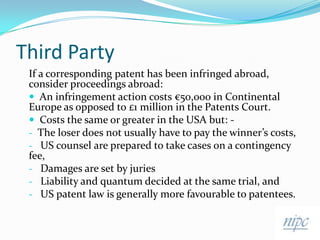
  • #22 RemediesConsider an application to the IPO for an advisory opinion on infringement under s.74A 0f the Patents Act 1977 for £200:(1) The proprietor of a patent or any otherperson may request the comptroller to issue anopinion –(a) as to whether a particular act constitutes,or (if done) would constitute, aninfringement of the patent;(b) as to whether, or to what extent, theinvention in question is not patentablebecause the condition in section.If corresponding patent has been infringed abroad, consider proceedings abroad: costs €50,000 in Continental Europe; costs the same or greater in the USA but loser does not usually have to pay the winner’s costs, counsel are prepared to take cases on a contingency fee, damages are set by juries, proceedings are in one stage and law more favourable to patentees.