Staffing and Nursing Care Delivery
              Models
Key Concepts

   Staffing for health care organizations
   Patient classification systems
   Nursing care delivery models
   Critical pathways
   Nursing case management
Staffing

    Activities to ensure an adequate number
     and mix of team members
    Staffing considerations
        Patient needs
        Staff satisfaction
        Organizational needs
Meeting Patient Needs

    Primary considerations
        Number of patients
        Intensity of care required
        Staff experience and preparation
    Patient classification systems/acuity level
        Categorize patients according to care needs
Classification System Considerations

   Age and functional ability
   Communication skills
   Cultural and linguistic diversities
   Severity/urgency of the admitting condition
   Scheduled procedures
   Ability to meet health care requisites
   Availability of social supports
   Other specific needs
                (Recommended by the American Nurses Association)
Meeting Staff Needs

    Satisfied nurses provide higher quality,
     more cost-effective care
    24 hour/day, 365 day/year staffing needs
     create staffing challenges
        Creative staffing options
        Staff input about staffing
Meeting Organizational Needs

    Budget and financial management
        Number of staff
        Staff mix
    Licensing and accreditation
    Customer satisfaction
    Quality care
The Number One Challenge

    Appropriate staffing within budget
     constraints with well-trained, competent,
     professional staff members who are
     committed to providing safe, high-quality
     care
Nursing Care Delivery Models

    Detail assignments, responsibility, and
     authority to accomplish patient care
    Determine who is going to perform what
     tasks, who is responsible, and who
     makes decisions
    Match number and type of caregivers to
     patient care needs
Classic Nursing Care Models

   Total patient care
   Functional nursing
   Team nursing
   Primary nursing
   Variations have been adopted to improve
    care
Total Patient Care

    Nurse is responsible for planning,
     organizing, and performing all care
    Oldest method of organizing patient care
    Typically performed by nursing students
    Common use areas—intensive care unit
     (ICU) and postanesthetic care unit
     (PACU)
Total Patient Care—cont’d
   Advantages
       High degree of autonomy
       Lines of responsibility and accountability are
        clear
       Patient receives holistic, unfragmented care
   Disadvantages
       Each RN may have a different approach to care
       Not cost-effective
       Lack of RN availability
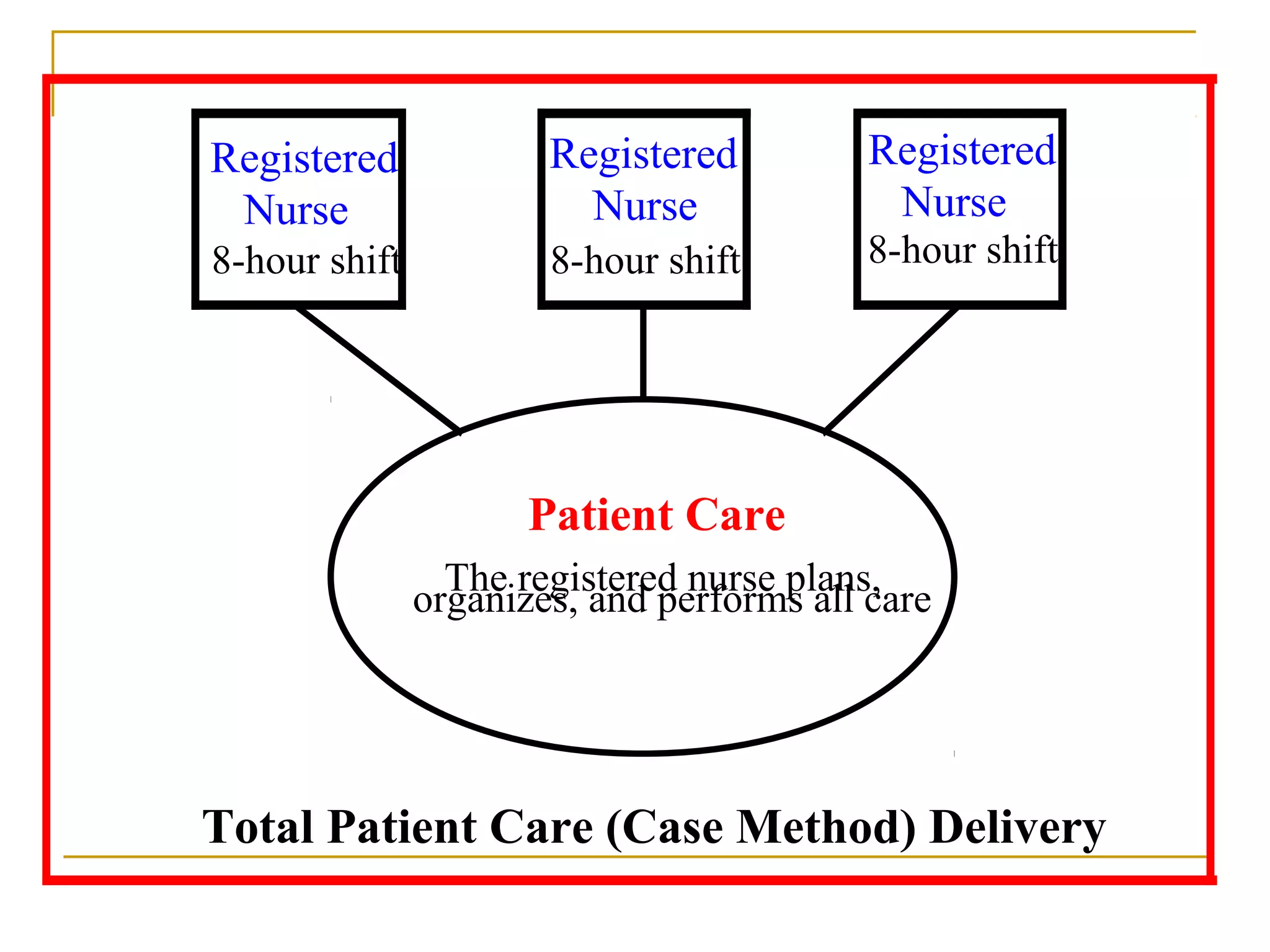
Registered             Registered          Registered
 Nurse                   Nurse              Nurse
8-hour shift           8-hour shift        8-hour shift


                      Patient Care
                 The registered nurse plans,
               organizes, and performs all care


Total Patient Care (Case Method) Delivery
Functional Nursing

     Staff members assigned to complete
      specific tasks for a group of patients
     Evolved during World War II as a result
      of a nursing shortage
     Unskilled workers trained to perform
      routine, simple tasks
     Common use area—operating room
Functional Nursing—cont’d

   Advantages
       Care is provided economically and efficiently
       Minimum number of RNs required
       Tasks are completed quickly
   Disadvantages
       Care may be fragmented
       Patient may be confused with many care
        providers
       Caregivers feel unchallenged
Nurse Manager


LPN             RN         Nurse Aide    Nurse Aide
 PO Meds     Assessments   Vital signs    Hygiene
Treatments   Care Plans     Hygiene       Stocking


              Assigned Patient Group


   Functional Nursing Care Delivery Model
Team Nursing

   RN as team leader coordinates care for a
    group of patients
   Evolved in the 1950s to improve patient
    satisfaction
   Goal was to reduce fragmented care
   Common use areas—most inpatient and
    outpatient areas
Team Nursing—cont’d
   Advantages
       High-quality, comprehensive care with a high
        proportion of ancillary staff
       Team members participate in decision making
        and contribute their own expertise
   Disadvantages
       Continuity suffers if daily team assignments
        vary
       Team leader must have good leadership skills
       Insufficient time for planning and
        communication
Nurse Manager


   RN Team Leader              RN Team Leader
         RN                         RN
     LPNs/LVNs                  LPNs/LVNs
   Nursing Assistants         Nursing Assistants


Assigned Patient Group       Assigned Patient Group


               Team Nursing Model
Modular Nursing
   Modification of team nursing
   Patient unit is divided into modules or units
    with an RN as team leader
   The same team of caregivers is assigned
    consistently to the same geographic area
   Concept evolved to increase RN
    involvement in care
Modular Nursing—cont’d
   Advantages
       Continuity of care is improved
       RN more involved in planning and coordinating
        care
       Geographic closeness and efficient
        communication
   Disadvantages
       Increased costs to stock each module
       Long corridors not conducive to modular
        nursing
Nurse Manager


Geographic        Geographic        Geographic
 Patient Unit      Patient Unit      Patient Unit
 Patient Care      Patient Care      Patient Care
    Team:             Team:             Team:
     RNs               RNs               RNs
 LPNs/LVNs         LPNs/LVNs         LPNs/LVNs
 Nurse Aides       Nurse Aides       Nurse Aides
    Meds              Meds              Meds
   Supplies          Supplies          Supplies
    Linens            Linens            Linens


            Modular Nursing Model
Primary Nursing

   RN “primary nurse” assumes 24-hour
    responsibility for planning, directing, and
    evaluating care
   Evolved in the 1970s to improve RN
    autonomy
   Common use areas—hospice, home
    health, and long-term care settings
Primary Nursing—cont’d
   Advantages
       High-quality, holistic patient care
       Establish rapport with patient
       RN feels challenged and rewarded
   Disadvantages
       Primary nurse must be able to practice with a
        high degree of responsibility and autonomy
       RN must accept 24-hour responsibility
       More RNs needed; not cost-effective
Primary Nurse
                       24-hour responsibility for
                         planning, directing &      Associate Nurses
  Physician and
 other members          evaluating patient care       Provide care
of the health care                                   when primary
       team                                         nurse is off duty


                                Patient


                     Primary Nursing Model
Partnership Model
(Co-Primary Nursing)
   RN is partnered with an licensed practical
    nurse/licensed vocational nurse (LPN/LVN)
    or nursing assistant to work together
    consistently
   Modification of primary nursing to make more
    efficient use of the RN
Partnership Model
(Co-Primary Nursing)—cont’d
   Advantages
       More cost-effective than primary nursing
       RN can encourage training and growth of
        partner
   Disadvantages
       RN may have difficulty delegating to partner
       Consistent partnerships difficult to maintain
        due to varied schedules
Patient-Centered Care
(Patient-Focused Care)
   Cross-functional teams of professionals and
    assistive personnel work together as a unit-
    based team
   Recent development in nursing care delivery
    models
   More patient oriented than department
    oriented
   Models vary considerably among facilities
Patient-Centered Care
(Patient-Focused Care)—cont’d
   Advantages
       Patient comes into contact with fewer workers
       Workers are unit based and spend more time
        in direct-care activities
       Team is supervised by an RN
       RN is accountable for a wide range of services
        and functions at a higher level
       Cost-effective
Patient-Centered Care
(Patient-Focused Care)—cont’d
   Disadvantages
       Major change in organizational structure is
        required
       Departments other than nursing must be willing
        to accept nursing leadership
       Nurse manager supervises many types of
        workers
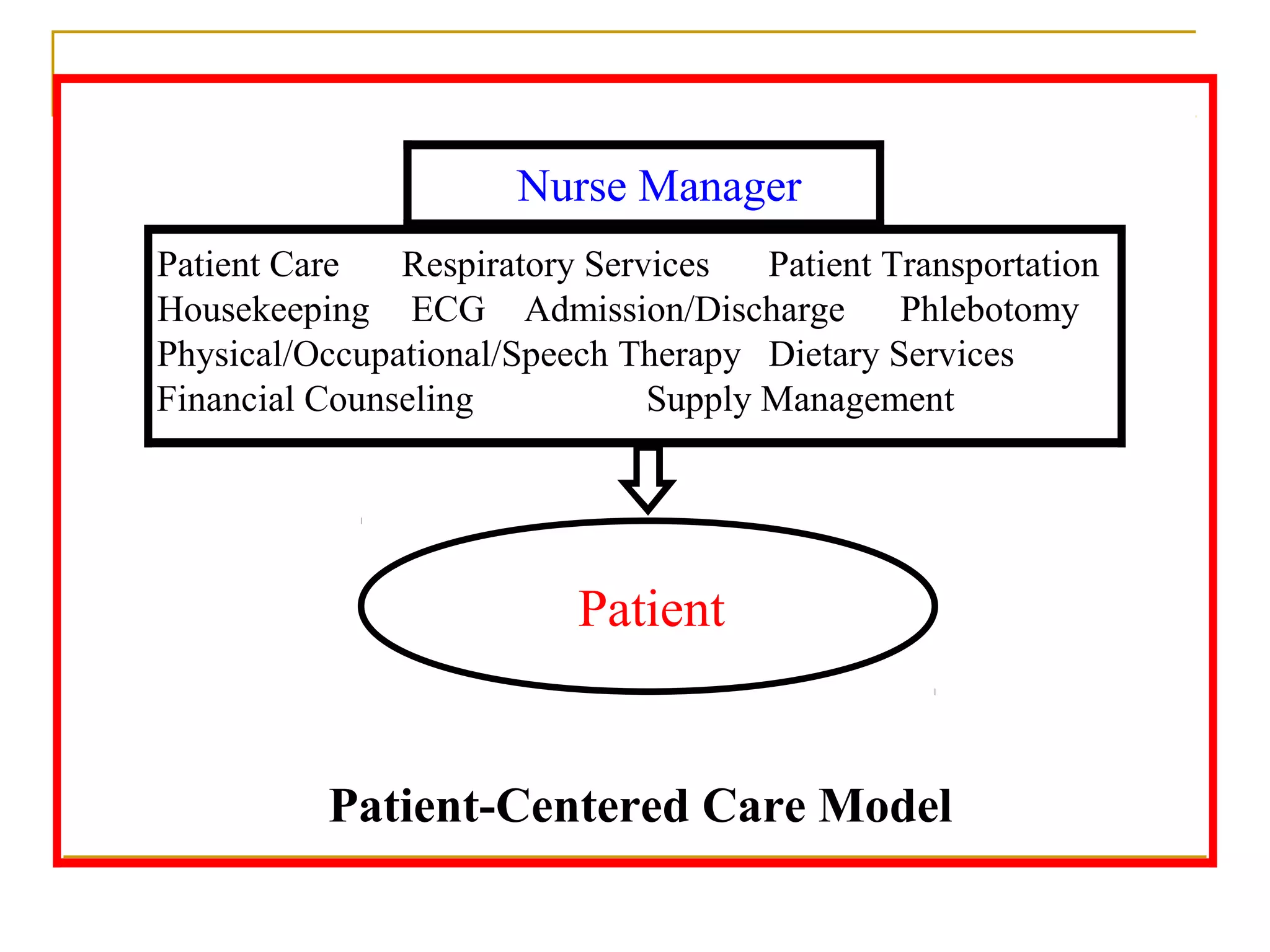
Nurse Manager
Patient Care   Respiratory Services   Patient Transportation
Housekeeping ECG Admission/Discharge Phlebotomy
Physical/Occupational/Speech Therapy Dietary Services
Financial Counseling           Supply Management


                          Patient


          Patient-Centered Care Model
Case Management
   First introduced in the 1970s by insurance
    companies
   Hospitals adopted the model in the 1980s
   Value demonstrated through research
   Components include:
       Assessment, planning, implementation,
        evaluation, and interaction
Case Management—cont’d
   Variations are found in most health care
    organizations
   Reserved for chronically ill patients,
    seriously ill patients, or long-term,
    expensive cases
   RN assumes a planning and evaluative
    role; usually not responsible for direct-care
    duties
   Supplemental form of care delivery; does
    not replace direct-care model
RN Case Manager

   Coordinates the patient’s care throughout the
    course of an illness from a payer or facility
    perspective
       Employee of the payer (external case
        management)
       Employee of the health care facility (internal case
        management)
Collaborates With
                            Patient and Family


                        NURSE CASE MANAGER
Onset of                                                         Resolution of
                  Assesses, plans, implements, coordinates,
 Illness                                                            Illness
                      monitors, and evaluates patient care
                  options and services to meet health needs


       Collaborates with Nursing,           Coordinates Services:
       Physicians, Physical/Speech/         Home Care, Hospice,
     Occupational Therapists, Dietary,    Extended /Long-term Care
         and Ancillary Services           Ambulatory Care Services


           Nursing Case Management Model
Clinical Pathways

   Delineate a predetermined written plan of
    care for a particular health problem
   Specify desired outcomes and
    transdisciplinary intervention
   Address a common medical diagnosis
   Dictate the type and amount of care given
    and thus have financial implications
Clinical Pathways
Terminology
   Patient outcomes
   Transdisciplinary intervention
   Variance
   Trigger
Clinical Pathways
Essential Components
   Consults              Self-care activities
   Laboratory and        Nutrition
    diagnostic tests      Patient and family
   Treatments             education
   Medications           Discharge planning
   Safety                Triggers
Choosing a Nursing Care Delivery
Model
   What staff mix is required?
   Who should make work assignments?
   Work assigned by task? By patient?
   How will communication be handled?
   Who will make decisions?
   Who will be responsible and accountable?
   Fit with unit/facility/organization
    management?
Influences on Nursing Care
Delivery Model Selection
   Health care setting
       Acute care, long-term care, ambulatory care,
        home care, and hospice
   Organizational structure and resources
       Management, staffing, supplies, and physical
        layout
   Patient needs
       Acute, long-term, and chronic
Evaluation of Nursing Care
Delivery Models
    Timely, cost-effective outcomes
     achieved?
    Patient and families happy with care?
    Team members satisfied with care?
    Good communication among all team
     members?
    RNs utilized and challenged
     appropriately?

Nursing care delivery

  • 1.
    Staffing and NursingCare Delivery Models
  • 2.
    Key Concepts  Staffing for health care organizations  Patient classification systems  Nursing care delivery models  Critical pathways  Nursing case management
  • 3.
    Staffing  Activities to ensure an adequate number and mix of team members  Staffing considerations  Patient needs  Staff satisfaction  Organizational needs
  • 4.
    Meeting Patient Needs  Primary considerations  Number of patients  Intensity of care required  Staff experience and preparation  Patient classification systems/acuity level  Categorize patients according to care needs
  • 5.
    Classification System Considerations  Age and functional ability  Communication skills  Cultural and linguistic diversities  Severity/urgency of the admitting condition  Scheduled procedures  Ability to meet health care requisites  Availability of social supports  Other specific needs (Recommended by the American Nurses Association)
  • 6.
    Meeting Staff Needs  Satisfied nurses provide higher quality, more cost-effective care  24 hour/day, 365 day/year staffing needs create staffing challenges  Creative staffing options  Staff input about staffing
  • 7.
    Meeting Organizational Needs  Budget and financial management  Number of staff  Staff mix  Licensing and accreditation  Customer satisfaction  Quality care
  • 8.
    The Number OneChallenge  Appropriate staffing within budget constraints with well-trained, competent, professional staff members who are committed to providing safe, high-quality care
  • 9.
    Nursing Care DeliveryModels  Detail assignments, responsibility, and authority to accomplish patient care  Determine who is going to perform what tasks, who is responsible, and who makes decisions  Match number and type of caregivers to patient care needs
  • 10.
    Classic Nursing CareModels  Total patient care  Functional nursing  Team nursing  Primary nursing  Variations have been adopted to improve care
  • 11.
    Total Patient Care  Nurse is responsible for planning, organizing, and performing all care  Oldest method of organizing patient care  Typically performed by nursing students  Common use areas—intensive care unit (ICU) and postanesthetic care unit (PACU)
  • 12.
    Total Patient Care—cont’d  Advantages  High degree of autonomy  Lines of responsibility and accountability are clear  Patient receives holistic, unfragmented care  Disadvantages  Each RN may have a different approach to care  Not cost-effective  Lack of RN availability
  • 13.
    Registered Registered Registered Nurse Nurse Nurse 8-hour shift 8-hour shift 8-hour shift Patient Care The registered nurse plans, organizes, and performs all care Total Patient Care (Case Method) Delivery
  • 14.
    Functional Nursing  Staff members assigned to complete specific tasks for a group of patients  Evolved during World War II as a result of a nursing shortage  Unskilled workers trained to perform routine, simple tasks  Common use area—operating room
  • 15.
    Functional Nursing—cont’d  Advantages  Care is provided economically and efficiently  Minimum number of RNs required  Tasks are completed quickly  Disadvantages  Care may be fragmented  Patient may be confused with many care providers  Caregivers feel unchallenged
  • 16.
    Nurse Manager LPN RN Nurse Aide Nurse Aide PO Meds Assessments Vital signs Hygiene Treatments Care Plans Hygiene Stocking Assigned Patient Group Functional Nursing Care Delivery Model
  • 17.
    Team Nursing  RN as team leader coordinates care for a group of patients  Evolved in the 1950s to improve patient satisfaction  Goal was to reduce fragmented care  Common use areas—most inpatient and outpatient areas
  • 18.
    Team Nursing—cont’d  Advantages  High-quality, comprehensive care with a high proportion of ancillary staff  Team members participate in decision making and contribute their own expertise  Disadvantages  Continuity suffers if daily team assignments vary  Team leader must have good leadership skills  Insufficient time for planning and communication
  • 19.
    Nurse Manager RN Team Leader RN Team Leader RN RN LPNs/LVNs LPNs/LVNs Nursing Assistants Nursing Assistants Assigned Patient Group Assigned Patient Group Team Nursing Model
  • 20.
    Modular Nursing  Modification of team nursing  Patient unit is divided into modules or units with an RN as team leader  The same team of caregivers is assigned consistently to the same geographic area  Concept evolved to increase RN involvement in care
  • 21.
    Modular Nursing—cont’d  Advantages  Continuity of care is improved  RN more involved in planning and coordinating care  Geographic closeness and efficient communication  Disadvantages  Increased costs to stock each module  Long corridors not conducive to modular nursing
  • 22.
    Nurse Manager Geographic Geographic Geographic Patient Unit Patient Unit Patient Unit Patient Care Patient Care Patient Care Team: Team: Team: RNs RNs RNs LPNs/LVNs LPNs/LVNs LPNs/LVNs Nurse Aides Nurse Aides Nurse Aides Meds Meds Meds Supplies Supplies Supplies Linens Linens Linens Modular Nursing Model
  • 23.
    Primary Nursing  RN “primary nurse” assumes 24-hour responsibility for planning, directing, and evaluating care  Evolved in the 1970s to improve RN autonomy  Common use areas—hospice, home health, and long-term care settings
  • 24.
    Primary Nursing—cont’d  Advantages  High-quality, holistic patient care  Establish rapport with patient  RN feels challenged and rewarded  Disadvantages  Primary nurse must be able to practice with a high degree of responsibility and autonomy  RN must accept 24-hour responsibility  More RNs needed; not cost-effective
  • 25.
    Primary Nurse 24-hour responsibility for planning, directing & Associate Nurses Physician and other members evaluating patient care Provide care of the health care when primary team nurse is off duty Patient Primary Nursing Model
  • 26.
    Partnership Model (Co-Primary Nursing)  RN is partnered with an licensed practical nurse/licensed vocational nurse (LPN/LVN) or nursing assistant to work together consistently  Modification of primary nursing to make more efficient use of the RN
  • 27.
    Partnership Model (Co-Primary Nursing)—cont’d  Advantages  More cost-effective than primary nursing  RN can encourage training and growth of partner  Disadvantages  RN may have difficulty delegating to partner  Consistent partnerships difficult to maintain due to varied schedules
  • 28.
    Patient-Centered Care (Patient-Focused Care)  Cross-functional teams of professionals and assistive personnel work together as a unit- based team  Recent development in nursing care delivery models  More patient oriented than department oriented  Models vary considerably among facilities
  • 29.
    Patient-Centered Care (Patient-Focused Care)—cont’d  Advantages  Patient comes into contact with fewer workers  Workers are unit based and spend more time in direct-care activities  Team is supervised by an RN  RN is accountable for a wide range of services and functions at a higher level  Cost-effective
  • 30.
    Patient-Centered Care (Patient-Focused Care)—cont’d  Disadvantages  Major change in organizational structure is required  Departments other than nursing must be willing to accept nursing leadership  Nurse manager supervises many types of workers
  • 31.
    Nurse Manager Patient Care Respiratory Services Patient Transportation Housekeeping ECG Admission/Discharge Phlebotomy Physical/Occupational/Speech Therapy Dietary Services Financial Counseling Supply Management Patient Patient-Centered Care Model
  • 32.
    Case Management  First introduced in the 1970s by insurance companies  Hospitals adopted the model in the 1980s  Value demonstrated through research  Components include:  Assessment, planning, implementation, evaluation, and interaction
  • 33.
    Case Management—cont’d  Variations are found in most health care organizations  Reserved for chronically ill patients, seriously ill patients, or long-term, expensive cases  RN assumes a planning and evaluative role; usually not responsible for direct-care duties  Supplemental form of care delivery; does not replace direct-care model
  • 34.
    RN Case Manager  Coordinates the patient’s care throughout the course of an illness from a payer or facility perspective  Employee of the payer (external case management)  Employee of the health care facility (internal case management)
  • 35.
    Collaborates With Patient and Family NURSE CASE MANAGER Onset of Resolution of Assesses, plans, implements, coordinates, Illness Illness monitors, and evaluates patient care options and services to meet health needs Collaborates with Nursing, Coordinates Services: Physicians, Physical/Speech/ Home Care, Hospice, Occupational Therapists, Dietary, Extended /Long-term Care and Ancillary Services Ambulatory Care Services Nursing Case Management Model
  • 36.
    Clinical Pathways  Delineate a predetermined written plan of care for a particular health problem  Specify desired outcomes and transdisciplinary intervention  Address a common medical diagnosis  Dictate the type and amount of care given and thus have financial implications
  • 37.
    Clinical Pathways Terminology  Patient outcomes  Transdisciplinary intervention  Variance  Trigger
  • 38.
    Clinical Pathways Essential Components  Consults  Self-care activities  Laboratory and  Nutrition diagnostic tests  Patient and family  Treatments education  Medications  Discharge planning  Safety  Triggers
  • 39.
    Choosing a NursingCare Delivery Model  What staff mix is required?  Who should make work assignments?  Work assigned by task? By patient?  How will communication be handled?  Who will make decisions?  Who will be responsible and accountable?  Fit with unit/facility/organization management?
  • 40.
    Influences on NursingCare Delivery Model Selection  Health care setting  Acute care, long-term care, ambulatory care, home care, and hospice  Organizational structure and resources  Management, staffing, supplies, and physical layout  Patient needs  Acute, long-term, and chronic
  • 41.
    Evaluation of NursingCare Delivery Models  Timely, cost-effective outcomes achieved?  Patient and families happy with care?  Team members satisfied with care?  Good communication among all team members?  RNs utilized and challenged appropriately?