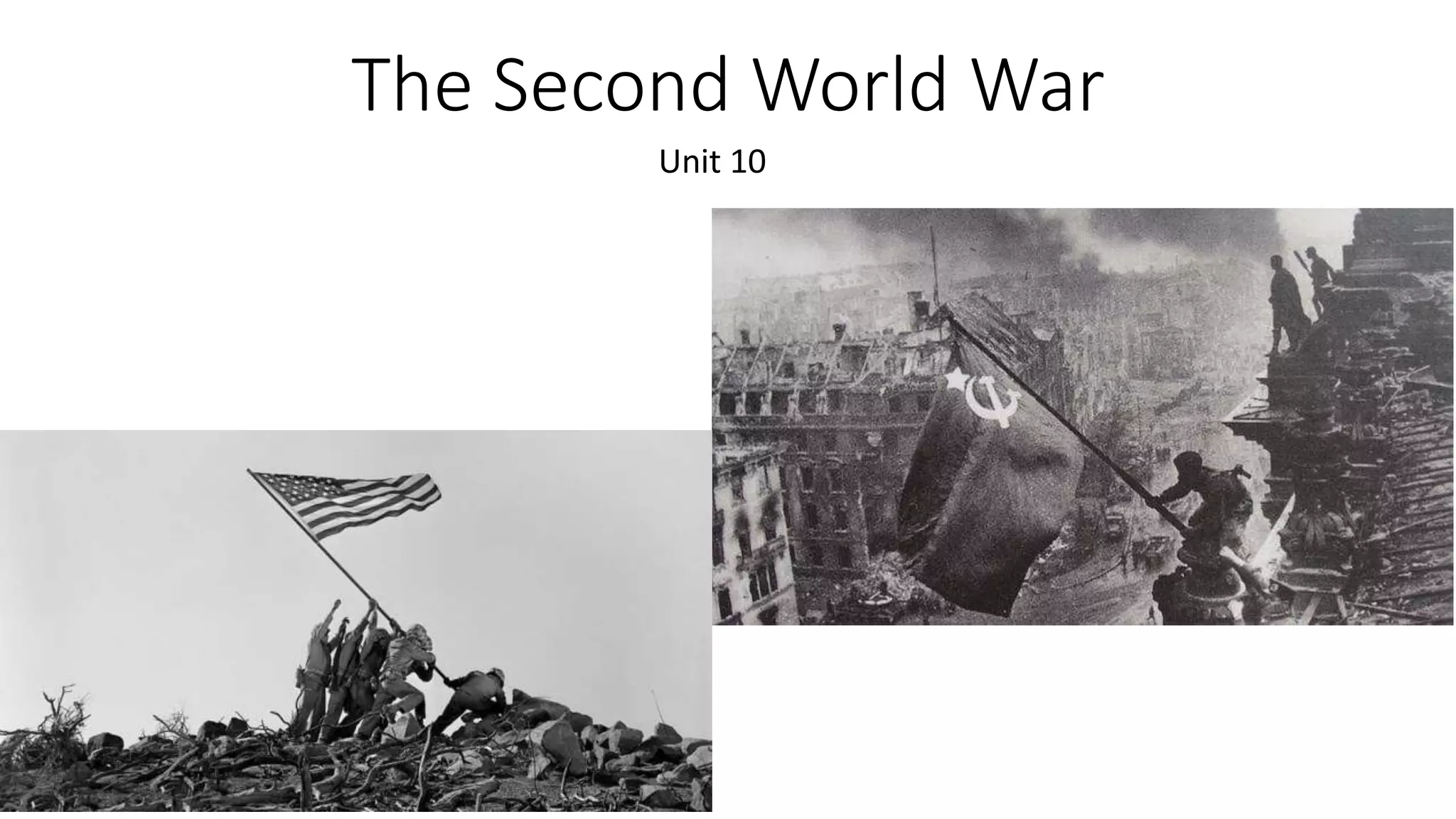
The Second World War
Unit 10
Causes
• Expansionist policies of the totalitarian Regimes:
• Italy, Germany and Japan aspired to expand territorial boundaries.
• They broke the consensus of the LN.
• Escalating of hostilities:
• Japan occupied: Manchuria in 1931 and invaded China in 1937.
• Italy: In Africa invaded Abyssinia (current Ethiopia). In Europe invaded
Albania.
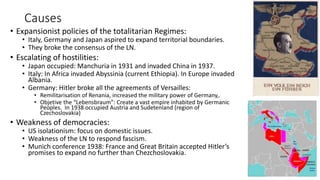
• Germany: Hitler broke all the agreements of Versailles:
• Remilitarisation of Renania, increased the military power of Germany,.
• Objetive the “Lebensbraum”: Create a vast empire inhabited by Germanic
Peoples. In 1938 occupied Austria and Sudetenland (region of
Czechoslovakia)
• Weakness of democracies:
• US isolationism: focus on domestic issues.
• Weakness of the LN to respond fascism.
• Munich conference 1938: France and Great Britain accepted Hitler’s
promises to expand no further than Chezchoslovakia.
Text analysis
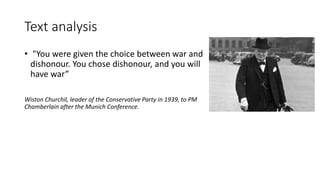
• "You were given the choice between war and
dishonour. You chose dishonour, and you will
have war”
Wiston Churchil, leader of the Conservative Party in 1939, to PM
Chamberlain after the Munich Conference.
Causes
• The formation of alliances:
• Germany led the International Relationships:
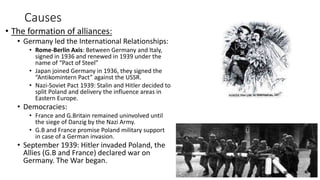
• Rome-Berlin Axis: Between Germany and Italy,
signed in 1936 and renewed in 1939 under the
name of “Pact of Steel”
• Japan joined Germany in 1936, they signed the
“Antikomintern Pact” against the USSR.
• Nazi-Soviet Pact 1939: Stalin and Hitler decided to
split Poland and delivery the influence areas in
Eastern Europe.
• Democracies:
• France and G.Britain remained uninvolved until
the siege of Danzig by the Nazi Army.
• G.B and France promise Poland military support
in case of a German invasion.
• September 1939: Hitler invaded Poland, the
Allies (G.B and France) declared war on
Germany. The War began.
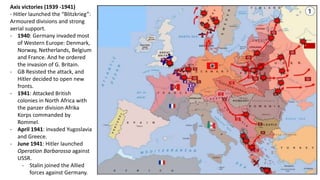
Axis victories (1939 -1941)
- Hitler launched the “Blitzkrieg”:
Armoured divisions and strong
aerial support.
- 1940: Germany invaded most
of Western Europe: Denmark,
Norway, Netherlands, Belgium
and France. And he ordered
the invasion of G. Britain.
- GB Resisted the attack, and
Hitler decided to open new
fronts.
- 1941: Attacked British
colonies in North Africa with
the panzer division Afrika
Korps commanded by
Rommel.
- April 1941: invaded Yugoslavia
and Greece.
- June 1941: Hitler launched
Operation Barbarossa against
USSR.
- Stalin joined the Allied
forces against Germany.
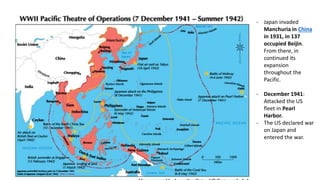
- Japan invaded
Manchuria in China
in 1931, in 137
occupied Beijin.
From there, in
continued its
expansion
throughout the
Pacific.
- December 1941:
Attacked the US
fleet in Pearl
Harbor.
- The US declared war
on Japan and
entered the war.
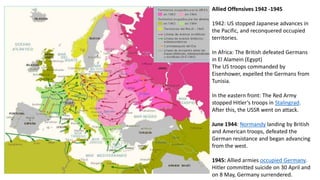
Allied Offensives 1942 -1945
1942: US stopped Japanese advances in
the Pacific, and reconquered occupied
territories.
In Africa: The British defeated Germans
in El Alamein (Egypt)
The US troops commanded by
Eisenhower, expelled the Germans from
Tunisia.
In the eastern front: The Red Army
stopped Hitler’s troops in Stalingrad.
After this, the USSR went on attack.
June 1944: Normandy landing by British
and American troops, defeated the
German resistance and began advancing
from the west.
1945: Allied armies occupied Germany.
Hitler committed suicide on 30 April and
on 8 May, Germany surrendered.
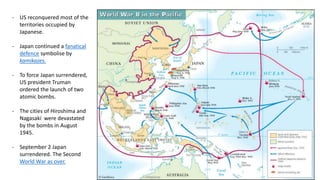
- US reconquered most of the
territories occupied by
Japanese.
- Japan continued a fanatical
defence symbolise by
kamikazes.
- To force Japan surrendered,
US president Truman
ordered the launch of two
atomic bombs.
- The cities of Hiroshima and
Nagasaki were devastated
by the bombs in August
1945.
- September 2 Japan
surrendered. The Second
World War as over.
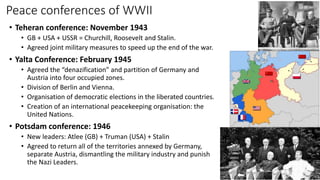
Peace conferences of WWII
• Teheran conference: November 1943
• GB + USA + USSR = Churchill, Roosevelt and Stalin.
• Agreed joint military measures to speed up the end of the war.
• Yalta Conference: February 1945
• Agreed the “denazification” and partition of Germany and
Austria into four occupied zones.
• Division of Berlin and Vienna.
• Organisation of democratic elections in the liberated countries.
• Creation of an international peacekeeping organisation: the
United Nations.
• Potsdam conference: 1946
• New leaders: Atlee (GB) + Truman (USA) + Stalin
• Agreed to return all of the territories annexed by Germany,
separate Austria, dismantling the military industry and punish
the Nazi Leaders.
Consequences of the war
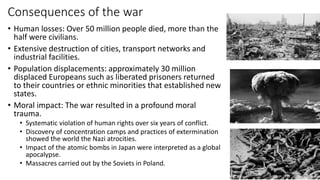
• Human losses: Over 50 million people died, more than the
half were civilians.
• Extensive destruction of cities, transport networks and
industrial facilities.
• Population displacements: approximately 30 million
displaced Europeans such as liberated prisoners returned
to their countries or ethnic minorities that established new
states.
• Moral impact: The war resulted in a profound moral
trauma.
• Systematic violation of human rights over six years of conflict.
• Discovery of concentration camps and practices of extermination
showed the world the Nazi atrocities.
• Impact of the atomic bombs in Japan were interpreted as a global
apocalypse.
• Massacres carried out by the Soviets in Poland.
Consequences of the war
• Confrontation between USSR and the USA:
• Political differences arose in Potsdam Conference.
• US represented capitalist economy and
parliamentary democracy, while the USSR defended
communism and single party political system.
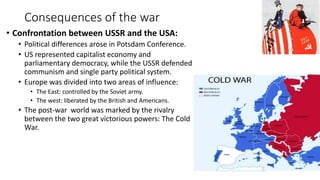
• Europe was divided into two areas of influence:
• The East: controlled by the Soviet army.
• The west: liberated by the British and Americans.
• The post-war world was marked by the rivalry
between the two great victorious powers: The Cold
War.

The second world war

  • 1.
    The Second WorldWar Unit 10
  • 2.
    Causes • Expansionist policiesof the totalitarian Regimes: • Italy, Germany and Japan aspired to expand territorial boundaries. • They broke the consensus of the LN. • Escalating of hostilities: • Japan occupied: Manchuria in 1931 and invaded China in 1937. • Italy: In Africa invaded Abyssinia (current Ethiopia). In Europe invaded Albania. • Germany: Hitler broke all the agreements of Versailles: • Remilitarisation of Renania, increased the military power of Germany,. • Objetive the “Lebensbraum”: Create a vast empire inhabited by Germanic Peoples. In 1938 occupied Austria and Sudetenland (region of Czechoslovakia) • Weakness of democracies: • US isolationism: focus on domestic issues. • Weakness of the LN to respond fascism. • Munich conference 1938: France and Great Britain accepted Hitler’s promises to expand no further than Chezchoslovakia.
  • 3.
    Text analysis • "Youwere given the choice between war and dishonour. You chose dishonour, and you will have war” Wiston Churchil, leader of the Conservative Party in 1939, to PM Chamberlain after the Munich Conference.
  • 4.
    Causes • The formationof alliances: • Germany led the International Relationships: • Rome-Berlin Axis: Between Germany and Italy, signed in 1936 and renewed in 1939 under the name of “Pact of Steel” • Japan joined Germany in 1936, they signed the “Antikomintern Pact” against the USSR. • Nazi-Soviet Pact 1939: Stalin and Hitler decided to split Poland and delivery the influence areas in Eastern Europe. • Democracies: • France and G.Britain remained uninvolved until the siege of Danzig by the Nazi Army. • G.B and France promise Poland military support in case of a German invasion. • September 1939: Hitler invaded Poland, the Allies (G.B and France) declared war on Germany. The War began.
  • 5.
    Axis victories (1939-1941) - Hitler launched the “Blitzkrieg”: Armoured divisions and strong aerial support. - 1940: Germany invaded most of Western Europe: Denmark, Norway, Netherlands, Belgium and France. And he ordered the invasion of G. Britain. - GB Resisted the attack, and Hitler decided to open new fronts. - 1941: Attacked British colonies in North Africa with the panzer division Afrika Korps commanded by Rommel. - April 1941: invaded Yugoslavia and Greece. - June 1941: Hitler launched Operation Barbarossa against USSR. - Stalin joined the Allied forces against Germany.
  • 6.
    - Japan invaded Manchuriain China in 1931, in 137 occupied Beijin. From there, in continued its expansion throughout the Pacific. - December 1941: Attacked the US fleet in Pearl Harbor. - The US declared war on Japan and entered the war.
  • 7.
    Allied Offensives 1942-1945 1942: US stopped Japanese advances in the Pacific, and reconquered occupied territories. In Africa: The British defeated Germans in El Alamein (Egypt) The US troops commanded by Eisenhower, expelled the Germans from Tunisia. In the eastern front: The Red Army stopped Hitler’s troops in Stalingrad. After this, the USSR went on attack. June 1944: Normandy landing by British and American troops, defeated the German resistance and began advancing from the west. 1945: Allied armies occupied Germany. Hitler committed suicide on 30 April and on 8 May, Germany surrendered.
  • 8.
    - US reconqueredmost of the territories occupied by Japanese. - Japan continued a fanatical defence symbolise by kamikazes. - To force Japan surrendered, US president Truman ordered the launch of two atomic bombs. - The cities of Hiroshima and Nagasaki were devastated by the bombs in August 1945. - September 2 Japan surrendered. The Second World War as over.
  • 9.
    Peace conferences ofWWII • Teheran conference: November 1943 • GB + USA + USSR = Churchill, Roosevelt and Stalin. • Agreed joint military measures to speed up the end of the war. • Yalta Conference: February 1945 • Agreed the “denazification” and partition of Germany and Austria into four occupied zones. • Division of Berlin and Vienna. • Organisation of democratic elections in the liberated countries. • Creation of an international peacekeeping organisation: the United Nations. • Potsdam conference: 1946 • New leaders: Atlee (GB) + Truman (USA) + Stalin • Agreed to return all of the territories annexed by Germany, separate Austria, dismantling the military industry and punish the Nazi Leaders.
  • 10.
    Consequences of thewar • Human losses: Over 50 million people died, more than the half were civilians. • Extensive destruction of cities, transport networks and industrial facilities. • Population displacements: approximately 30 million displaced Europeans such as liberated prisoners returned to their countries or ethnic minorities that established new states. • Moral impact: The war resulted in a profound moral trauma. • Systematic violation of human rights over six years of conflict. • Discovery of concentration camps and practices of extermination showed the world the Nazi atrocities. • Impact of the atomic bombs in Japan were interpreted as a global apocalypse. • Massacres carried out by the Soviets in Poland.
  • 11.
    Consequences of thewar • Confrontation between USSR and the USA: • Political differences arose in Potsdam Conference. • US represented capitalist economy and parliamentary democracy, while the USSR defended communism and single party political system. • Europe was divided into two areas of influence: • The East: controlled by the Soviet army. • The west: liberated by the British and Americans. • The post-war world was marked by the rivalry between the two great victorious powers: The Cold War.