Privacy Mindset for Developing Internet of Things
Applications for Social Sensing:
Software Engineering Challenges
Charith Perera, Thanos Vasilakos
The 2nd International Workshop in Social Sensing (SocialSens 2017) April 21st, in Pittsburgh, PA, USA
Social Sensing
• Social sensing has emerged as a new paradigm for collecting sensory
measurements by means of "crowd-sourcing" sensory data collection
tasks to a human population.
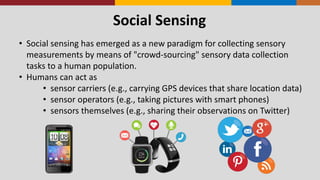
• Humans can act as
• sensor carriers (e.g., carrying GPS devices that share location data)
• sensor operators (e.g., taking pictures with smart phones)
• sensors themselves (e.g., sharing their observations on Twitter)
Internet of Things
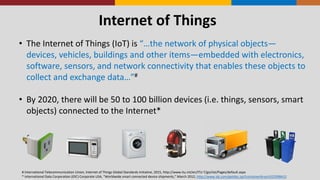
• The Internet of Things (IoT) is “…the network of physical objects—
devices, vehicles, buildings and other items—embedded with electronics,
software, sensors, and network connectivity that enables these objects to
collect and exchange data…”#
• By 2020, there will be 50 to 100 billion devices (i.e. things, sensors, smart
objects) connected to the Internet*
# International Telecommunication Union, Internet of Things Global Standards Initiative, 2015, http://www.itu.int/en/ITU-T/gsi/iot/Pages/default.aspx
* International Data Corporation (IDC) Corporate USA, “Worldwide smart connected device shipments,” March 2012, http://www.idc.com/getdoc.jsp?containerId=prUS23398412
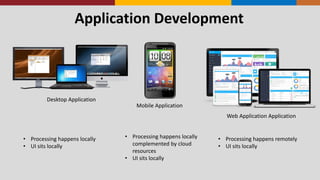
Application Development
Desktop Application
Mobile Application
Web Application Application
• Processing happens locally
• UI sits locally
• Processing happens locally
complemented by cloud
resources
• UI sits locally
• Processing happens remotely
• UI sits locally
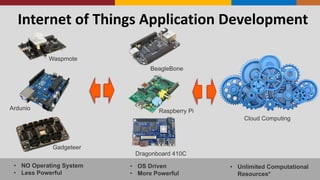
Internet of Things Application Development
BeagleBone
Waspmote
Raspberry PiArdunio
Gadgeteer
Dragonboard 410C
• NO Operating System
• Less Powerful
• OS Driven
• More Powerful
Cloud Computing
• Unlimited Computational
Resources*
Privacy Challenges
• IoT applications are complex by nature as
they involve both software and hardware as
well as many different types of computational
devices (e.g., sensors, gateways, cloud)
• Privacy is a significant problem in IoT
applications, especially when used for social
sensing tasks, because they handle data that
can be used to derive very sensitive personal
information
Why not Privacy is a concern
• IoT (applications, service, platforms) is still new; Not mature enough
• Most IoT platforms follow the philosophy “You feed your data our platform, we do
the processing and give back you the results”
• IoT engineering complexities have forced software engineers to put most of their
efforts towards addressing other challenges such as interoperability and
modifiability, resulting in privacy concerns being often overlooked. Privacy is not a
major concern for them.
• In order to address this issue, it is important to develop Privacy mindset among
software engineers.
Developing Privacy Mindset
• Privacy mindset encourages software engineers to think about privacy awareness of
their IoT applications at early design phases, not as an after thought.
• Privacy need to be treated as a first class citizen in IoT application development
processes. Privacy mindset can only be developed by providing strong guidance to
the software engineers and by reducing the effort and time required to embed
privacy protecting measures into IoT applications.
• There isn’t any process/methodology/framework to help software engineers in
designing privacy aware IoT applications
Developing Privacy Mindset
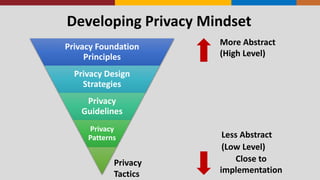
Privacy Foundation
Principles
Privacy Design
Strategies
Privacy
Guidelines
Privacy
Patterns
Privacy
Tactics
More Abstract
(High Level)
Less Abstract
(Low Level)
Close to
implementation
Developing Privacy Mindset
• We need to build an unified PbD design framework that incorporates not only high
level principles, but all the way to patterns and tactics.
• We need to build automated (or at least semi-automated) tools that can help
software engineers to apply privacy protecting measures into their IoT applications.
• Different types of tools will be required to support different phases of the IoT
application life-cycle (e.g., design, runtime) and different components (e.g., edge
nodes, gateway nodes, cloud nodes).
Thank You

Privacy Mindset for Developing Internet of Things Applications for Social Sensing: Software Engineering Challenges

  • 1.
    Privacy Mindset forDeveloping Internet of Things Applications for Social Sensing: Software Engineering Challenges Charith Perera, Thanos Vasilakos The 2nd International Workshop in Social Sensing (SocialSens 2017) April 21st, in Pittsburgh, PA, USA
  • 2.
    Social Sensing • Socialsensing has emerged as a new paradigm for collecting sensory measurements by means of "crowd-sourcing" sensory data collection tasks to a human population. • Humans can act as • sensor carriers (e.g., carrying GPS devices that share location data) • sensor operators (e.g., taking pictures with smart phones) • sensors themselves (e.g., sharing their observations on Twitter)
  • 3.
    Internet of Things •The Internet of Things (IoT) is “…the network of physical objects— devices, vehicles, buildings and other items—embedded with electronics, software, sensors, and network connectivity that enables these objects to collect and exchange data…”# • By 2020, there will be 50 to 100 billion devices (i.e. things, sensors, smart objects) connected to the Internet* # International Telecommunication Union, Internet of Things Global Standards Initiative, 2015, http://www.itu.int/en/ITU-T/gsi/iot/Pages/default.aspx * International Data Corporation (IDC) Corporate USA, “Worldwide smart connected device shipments,” March 2012, http://www.idc.com/getdoc.jsp?containerId=prUS23398412
  • 4.
    Application Development Desktop Application MobileApplication Web Application Application • Processing happens locally • UI sits locally • Processing happens locally complemented by cloud resources • UI sits locally • Processing happens remotely • UI sits locally
  • 5.
    Internet of ThingsApplication Development BeagleBone Waspmote Raspberry PiArdunio Gadgeteer Dragonboard 410C • NO Operating System • Less Powerful • OS Driven • More Powerful Cloud Computing • Unlimited Computational Resources*
  • 6.
    Privacy Challenges • IoTapplications are complex by nature as they involve both software and hardware as well as many different types of computational devices (e.g., sensors, gateways, cloud) • Privacy is a significant problem in IoT applications, especially when used for social sensing tasks, because they handle data that can be used to derive very sensitive personal information
  • 7.
    Why not Privacyis a concern • IoT (applications, service, platforms) is still new; Not mature enough • Most IoT platforms follow the philosophy “You feed your data our platform, we do the processing and give back you the results” • IoT engineering complexities have forced software engineers to put most of their efforts towards addressing other challenges such as interoperability and modifiability, resulting in privacy concerns being often overlooked. Privacy is not a major concern for them. • In order to address this issue, it is important to develop Privacy mindset among software engineers.
  • 8.
    Developing Privacy Mindset •Privacy mindset encourages software engineers to think about privacy awareness of their IoT applications at early design phases, not as an after thought. • Privacy need to be treated as a first class citizen in IoT application development processes. Privacy mindset can only be developed by providing strong guidance to the software engineers and by reducing the effort and time required to embed privacy protecting measures into IoT applications. • There isn’t any process/methodology/framework to help software engineers in designing privacy aware IoT applications
  • 9.
    Developing Privacy Mindset PrivacyFoundation Principles Privacy Design Strategies Privacy Guidelines Privacy Patterns Privacy Tactics More Abstract (High Level) Less Abstract (Low Level) Close to implementation
  • 10.
    Developing Privacy Mindset •We need to build an unified PbD design framework that incorporates not only high level principles, but all the way to patterns and tactics. • We need to build automated (or at least semi-automated) tools that can help software engineers to apply privacy protecting measures into their IoT applications. • Different types of tools will be required to support different phases of the IoT application life-cycle (e.g., design, runtime) and different components (e.g., edge nodes, gateway nodes, cloud nodes).
  • 11.