MADE BY:MADE BY:
Sofía Latorre RedoliSofía Latorre Redoli
IndexIndex
● Glossary
● The parts of the boat
● How boats travel
● In Colombus' times
● Other importants
sailors on history
● How to sail (points to
sail)
● The end
GlosaryGlosary
● Bow: Proa
●Tack: Armura
●Starboad tack: Babor
●Port tack: Estribor
●Fin: Aleta
●Stern: Popa
●Rudder: Timón
●Keel: Quilla
●Centreboard: Orza de sable
●Main sail: Vela Mayor
●Jib: Foque
●Beam reach leg: Través
●To beat to windward: Ceñir
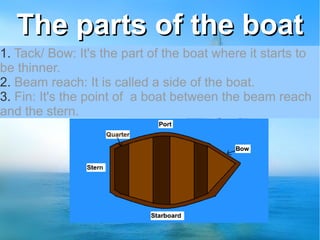
1. Tack/ Bow: It's the part of the boat where it starts to
be thinner.
2. Beam reach: It is called a side of the boat.
3. Fin: It's the point of a boat between the beam reach
and the stern.
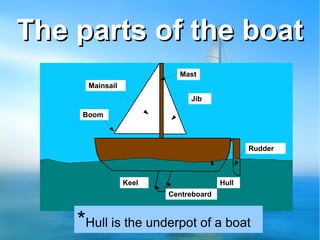
The parts of the boatThe parts of the boat
Mainsail
Mast
Jib
Boom
Keel
Rudder
Hull
*Hull is the underpot of a boat
Centreboard
Problems tha we can find atProblems tha we can find at
the moment to sailthe moment to sail
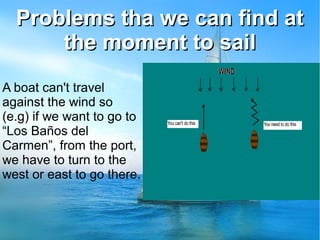
A boat can't travel
against the wind so
(e.g) if we want to go to
“Los Baños del
Carmen”, from the port,
we have to turn to the
west or east to go there.
When wind goes againtsWhen wind goes againts
the boatthe boat
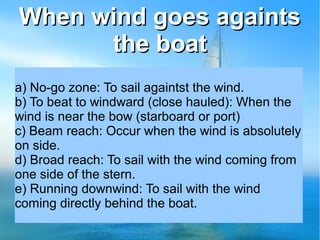
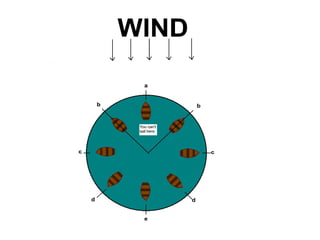
a) No-go zone: To sail againtst the wind.
b) To beat to windward (close hauled): When the
wind is near the bow (starboard or port)
c) Beam reach: Occur when the wind is absolutely
on side.
d) Broad reach: To sail with the wind coming from
one side of the stern.
e) Running downwind: To sail with the wind
coming directly behind the boat.
In Colombus' timesIn Colombus' times
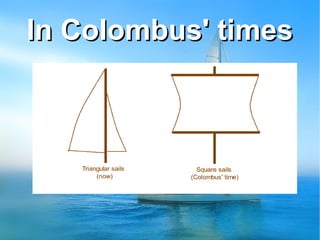
● Colombus travelled by a caravel, a ship with
triangular sails.
● The didn't have centreboard.
● The had square sails.
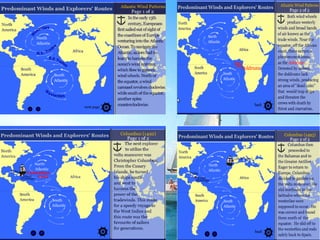
●They travelled without knowing where they went.
● They could travel to America by the Trade
Winds.
● They didn't have jib.
Other importantsOther importants
sailors on historysailors on history
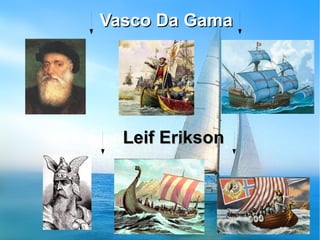
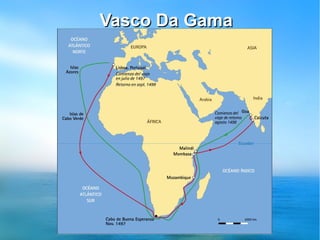
● Vasco Da Gama: In the early ages of discoveries,
Vasco Da Gama was perhaps the most successful
explorer who discovered a direct route from Europe to
India.
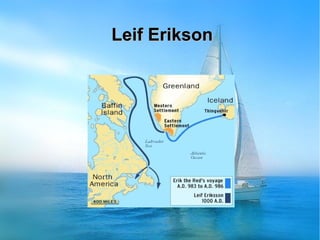
● Leif Erikson: He discovered America about 500 years
before Colombus.
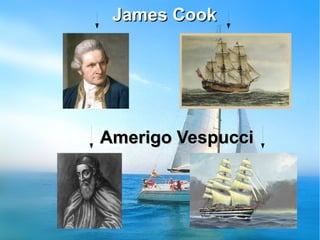
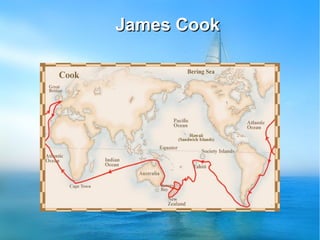
● James Cook: He was a British explorer, cartographer
and navigator, he was the first European to make contact
with the Eastern Australian Coastline.
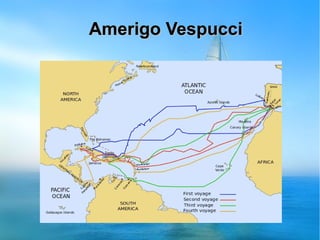
● Amerigo Vespucci: Another great Italian explorer,
cartographer and navigator, he was the first person to
describe these territories as a new continent. And gave
his name: America.
Vasco Da GamaVasco Da Gama
Leif EriksonLeif Erikson
James CookJames Cook
Amerigo VespucciAmerigo Vespucci
Vasco Da GamaVasco Da Gama
Leif EriksonLeif Erikson
James CookJames Cook
Amerigo VespucciAmerigo Vespucci
How to sailHow to sail
(Points to sail)(Points to sail)
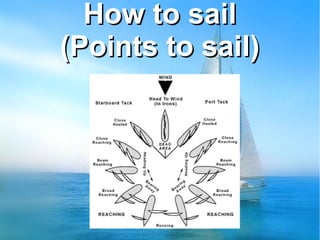
The points of sail, sometimes called sailing
positions, relate to the angle between a sail boat’s
heading, or course, and the direction of the wind.
There are three basic courses:
● Beating (wind is from ahead)
● Reaching (wind is from the side)
● Running (wind is from the stern)
●There are intermediate points of sailing:
● Close reach which is between a beat and a
reach
● Broad reach which is between a reach and a
run.
How to sailHow to sail
(Points to sail)(Points to sail)
Sailing course sofia

Sailing course sofia

  • 1.
    MADE BY:MADE BY: SofíaLatorre RedoliSofía Latorre Redoli
  • 2.
    IndexIndex ● Glossary ● Theparts of the boat ● How boats travel ● In Colombus' times ● Other importants sailors on history ● How to sail (points to sail) ● The end
  • 3.
    GlosaryGlosary ● Bow: Proa ●Tack:Armura ●Starboad tack: Babor ●Port tack: Estribor ●Fin: Aleta ●Stern: Popa ●Rudder: Timón ●Keel: Quilla ●Centreboard: Orza de sable ●Main sail: Vela Mayor ●Jib: Foque ●Beam reach leg: Través ●To beat to windward: Ceñir
  • 4.
    1. Tack/ Bow:It's the part of the boat where it starts to be thinner. 2. Beam reach: It is called a side of the boat. 3. Fin: It's the point of a boat between the beam reach and the stern. The parts of the boatThe parts of the boat
  • 5.
    The parts ofthe boatThe parts of the boat Mainsail Mast Jib Boom Keel Rudder Hull *Hull is the underpot of a boat Centreboard
  • 6.
    Problems tha wecan find atProblems tha we can find at the moment to sailthe moment to sail A boat can't travel against the wind so (e.g) if we want to go to “Los Baños del Carmen”, from the port, we have to turn to the west or east to go there.
  • 7.
    When wind goesagaintsWhen wind goes againts the boatthe boat a) No-go zone: To sail againtst the wind. b) To beat to windward (close hauled): When the wind is near the bow (starboard or port) c) Beam reach: Occur when the wind is absolutely on side. d) Broad reach: To sail with the wind coming from one side of the stern. e) Running downwind: To sail with the wind coming directly behind the boat.
  • 9.
    In Colombus' timesInColombus' times
  • 10.
    In Colombus' timesInColombus' times ● Colombus travelled by a caravel, a ship with triangular sails. ● The didn't have centreboard. ● The had square sails. ●They travelled without knowing where they went. ● They could travel to America by the Trade Winds. ● They didn't have jib.
  • 12.
    Other importantsOther importants sailorson historysailors on history ● Vasco Da Gama: In the early ages of discoveries, Vasco Da Gama was perhaps the most successful explorer who discovered a direct route from Europe to India. ● Leif Erikson: He discovered America about 500 years before Colombus. ● James Cook: He was a British explorer, cartographer and navigator, he was the first European to make contact with the Eastern Australian Coastline. ● Amerigo Vespucci: Another great Italian explorer, cartographer and navigator, he was the first person to describe these territories as a new continent. And gave his name: America.
  • 13.
    Vasco Da GamaVascoDa Gama Leif EriksonLeif Erikson
  • 14.
    James CookJames Cook AmerigoVespucciAmerigo Vespucci
  • 15.
  • 16.
  • 17.
  • 18.
  • 19.
    How to sailHowto sail (Points to sail)(Points to sail) The points of sail, sometimes called sailing positions, relate to the angle between a sail boat’s heading, or course, and the direction of the wind. There are three basic courses: ● Beating (wind is from ahead) ● Reaching (wind is from the side) ● Running (wind is from the stern) ●There are intermediate points of sailing: ● Close reach which is between a beat and a reach ● Broad reach which is between a reach and a run.
  • 20.
    How to sailHowto sail (Points to sail)(Points to sail)