Ukraine Polyana Workshop July 2018
Raha Hakimdavar, Presidential Management Fellow in Hydrology, USDA Forest Service
Indicator 5: Riparian/Wetland
Vegetation Condition
Objectives
1. Mapping riparian areas using a constant buffer
2. Mapping riparian areas using a variable (more detailed)
buffer
Mapping riparian areas using a
constant buffer
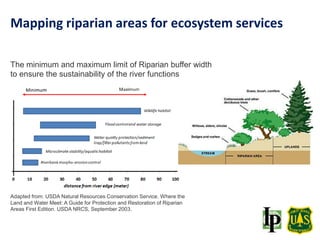
Adapted from: USDA Natural Resources Conservation Service. Where the
Land and Water Meet: A Guide for Protection and Restoration of Riparian
Areas First Edition. USDA NRCS, September 2003.
The minimum and maximum limit of Riparian buffer width
to ensure the sustainability of the river functions
Mapping riparian areas for ecosystem services
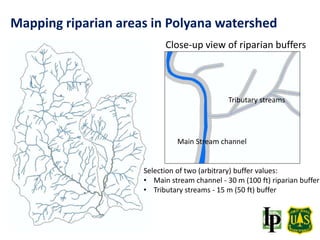
Selection of two (arbitrary) buffer values:
• Main stream channel - 30 m (100 ft) riparian buffer
• Tributary streams - 15 m (50 ft) buffer
Close-up view of riparian buffers
Main Stream channel
Tributary streams
Mapping riparian areas in Polyana watershed
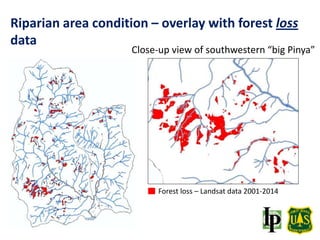
Close-up view of southwestern “big Pinya”
Forest loss – Landsat data 2001-2014
Riparian area condition – overlay with forest loss
data
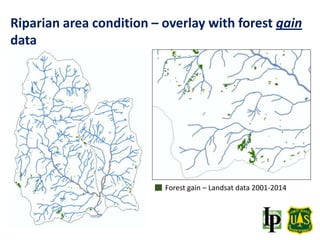
Forest gain – Landsat data 2001-2014
Riparian area condition – overlay with forest gain
data
Mapping riparian areas using a variable
buffer
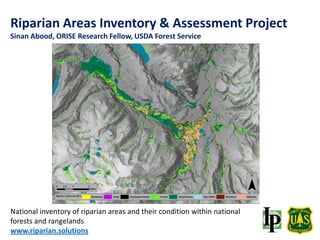
National inventory of riparian areas and their condition within national
forests and rangelands
www.riparian.solutions
Riparian Areas Inventory & Assessment Project
Sinan Abood, ORISE Research Fellow, USDA Forest Service
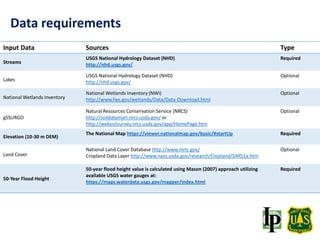
Input Data Sources Type
Streams
USGS National Hydrology Dataset (NHD)
http://nhd.usgs.gov/
Required
Lakes
USGS National Hydrology Dataset (NHD)
http://nhd.usgs.gov/
Optional
National Wetlands Inventory
National Wetlands Inventory (NWI)
http://www.fws.gov/wetlands/Data/Data-Download.html
Optional
gSSURGO
Natural Resources Conservation Service (NRCS)
http://soildatamart.nrcs.usda.gov/ or
http://websoilsurvey.nrcs.usda.gov/app/HomePage.htm
Optional
Elevation (10-30 m DEM)
The National Map https://viewer.nationalmap.gov/basic/#startUp Required
Land Cover
National Land Cover Database http://www.mrlc.gov/
Cropland Data Layer http://www.nass.usda.gov/research/Cropland/SARS1a.htm
Optional
50-Year Flood Height
50-year flood height value is calculated using Mason (2007) approach utilizing
available USGS water gauges at:
https://maps.waterdata.usgs.gov/mapper/index.html
Required
Data requirements
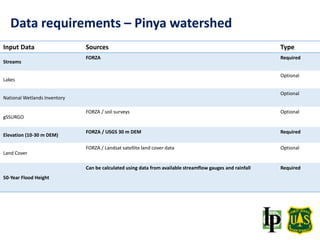
Input Data Sources Type
Streams
FORZA Required
Lakes
Optional
National Wetlands Inventory
Optional
gSSURGO
FORZA / soil surveys Optional
Elevation (10-30 m DEM)
FORZA / USGS 30 m DEM Required
Land Cover
FORZA / Landsat satellite land cover data Optional
50-Year Flood Height
Can be calculated using data from available streamflow gauges and rainfall Required
Data requirements – Pinya watershed
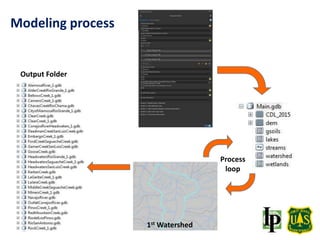
1st Watershed
Output Folder
Process
loop
Modeling process
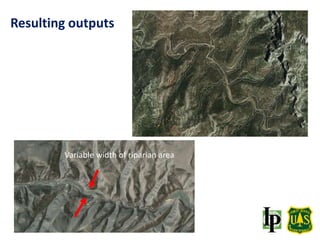
Variable width of riparian area
Resulting outputs
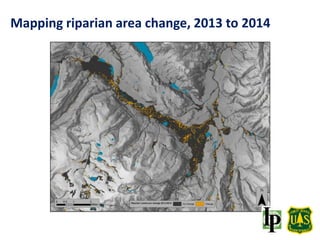
Mapping riparian area change, 2013 to 2014
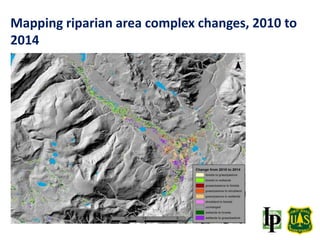
Mapping riparian area complex changes, 2010 to
2014
0
10000
20000
30000
40000
50000
60000ACRES
2010
2011
2012
2013
2014
2015
2016
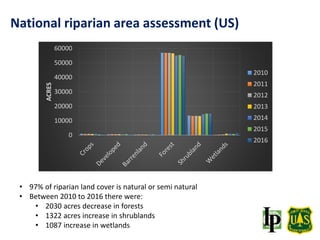
• 97% of riparian land cover is natural or semi natural
• Between 2010 to 2016 there were:
• 2030 acres decrease in forests
• 1322 acres increase in shrublands
• 1087 increase in wetlands
National riparian area assessment (US)

5. riparian vegetation

  • 1.
    Ukraine Polyana WorkshopJuly 2018 Raha Hakimdavar, Presidential Management Fellow in Hydrology, USDA Forest Service Indicator 5: Riparian/Wetland Vegetation Condition
  • 2.
    Objectives 1. Mapping riparianareas using a constant buffer 2. Mapping riparian areas using a variable (more detailed) buffer
  • 3.
    Mapping riparian areasusing a constant buffer
  • 4.
    Adapted from: USDANatural Resources Conservation Service. Where the Land and Water Meet: A Guide for Protection and Restoration of Riparian Areas First Edition. USDA NRCS, September 2003. The minimum and maximum limit of Riparian buffer width to ensure the sustainability of the river functions Mapping riparian areas for ecosystem services
  • 5.
    Selection of two(arbitrary) buffer values: • Main stream channel - 30 m (100 ft) riparian buffer • Tributary streams - 15 m (50 ft) buffer Close-up view of riparian buffers Main Stream channel Tributary streams Mapping riparian areas in Polyana watershed
  • 6.
    Close-up view ofsouthwestern “big Pinya” Forest loss – Landsat data 2001-2014 Riparian area condition – overlay with forest loss data
  • 7.
    Forest gain –Landsat data 2001-2014 Riparian area condition – overlay with forest gain data
  • 8.
    Mapping riparian areasusing a variable buffer
  • 9.
    National inventory ofriparian areas and their condition within national forests and rangelands www.riparian.solutions Riparian Areas Inventory & Assessment Project Sinan Abood, ORISE Research Fellow, USDA Forest Service
  • 10.
    Input Data SourcesType Streams USGS National Hydrology Dataset (NHD) http://nhd.usgs.gov/ Required Lakes USGS National Hydrology Dataset (NHD) http://nhd.usgs.gov/ Optional National Wetlands Inventory National Wetlands Inventory (NWI) http://www.fws.gov/wetlands/Data/Data-Download.html Optional gSSURGO Natural Resources Conservation Service (NRCS) http://soildatamart.nrcs.usda.gov/ or http://websoilsurvey.nrcs.usda.gov/app/HomePage.htm Optional Elevation (10-30 m DEM) The National Map https://viewer.nationalmap.gov/basic/#startUp Required Land Cover National Land Cover Database http://www.mrlc.gov/ Cropland Data Layer http://www.nass.usda.gov/research/Cropland/SARS1a.htm Optional 50-Year Flood Height 50-year flood height value is calculated using Mason (2007) approach utilizing available USGS water gauges at: https://maps.waterdata.usgs.gov/mapper/index.html Required Data requirements
  • 11.
    Input Data SourcesType Streams FORZA Required Lakes Optional National Wetlands Inventory Optional gSSURGO FORZA / soil surveys Optional Elevation (10-30 m DEM) FORZA / USGS 30 m DEM Required Land Cover FORZA / Landsat satellite land cover data Optional 50-Year Flood Height Can be calculated using data from available streamflow gauges and rainfall Required Data requirements – Pinya watershed
  • 12.
  • 13.
    Variable width ofriparian area Resulting outputs
  • 14.
    Mapping riparian areachange, 2013 to 2014
  • 15.
    Mapping riparian areacomplex changes, 2010 to 2014
  • 16.
    0 10000 20000 30000 40000 50000 60000ACRES 2010 2011 2012 2013 2014 2015 2016 • 97% ofriparian land cover is natural or semi natural • Between 2010 to 2016 there were: • 2030 acres decrease in forests • 1322 acres increase in shrublands • 1087 increase in wetlands National riparian area assessment (US)