EFFECTS OF ANGUS SIRE LINE AND
                           BACKGROUNDING DIET ON BEEF CATTLE
                          PROGENY POST WEANING PERFORMANCE
                                  AND CARCASS VALUE
                                                R.R. Mills1, T. DelCurto2, and C.J. Mueller3
                       1Extension  Livestock Agent, Oregon State University Extension Service, Umatilla County, Pendleton, OR 97801
                             2 Director, Eastern Oregon Agricultural Research Center, Oregon State University, Union, OR 97883
                        3Assistant Professor, Eastern Oregon Agricultural Research Center, Oregon State University, Union, OR 97883


                      Abstract                                             Materials and Methods                                                                    Results
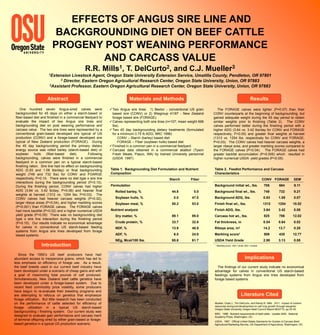
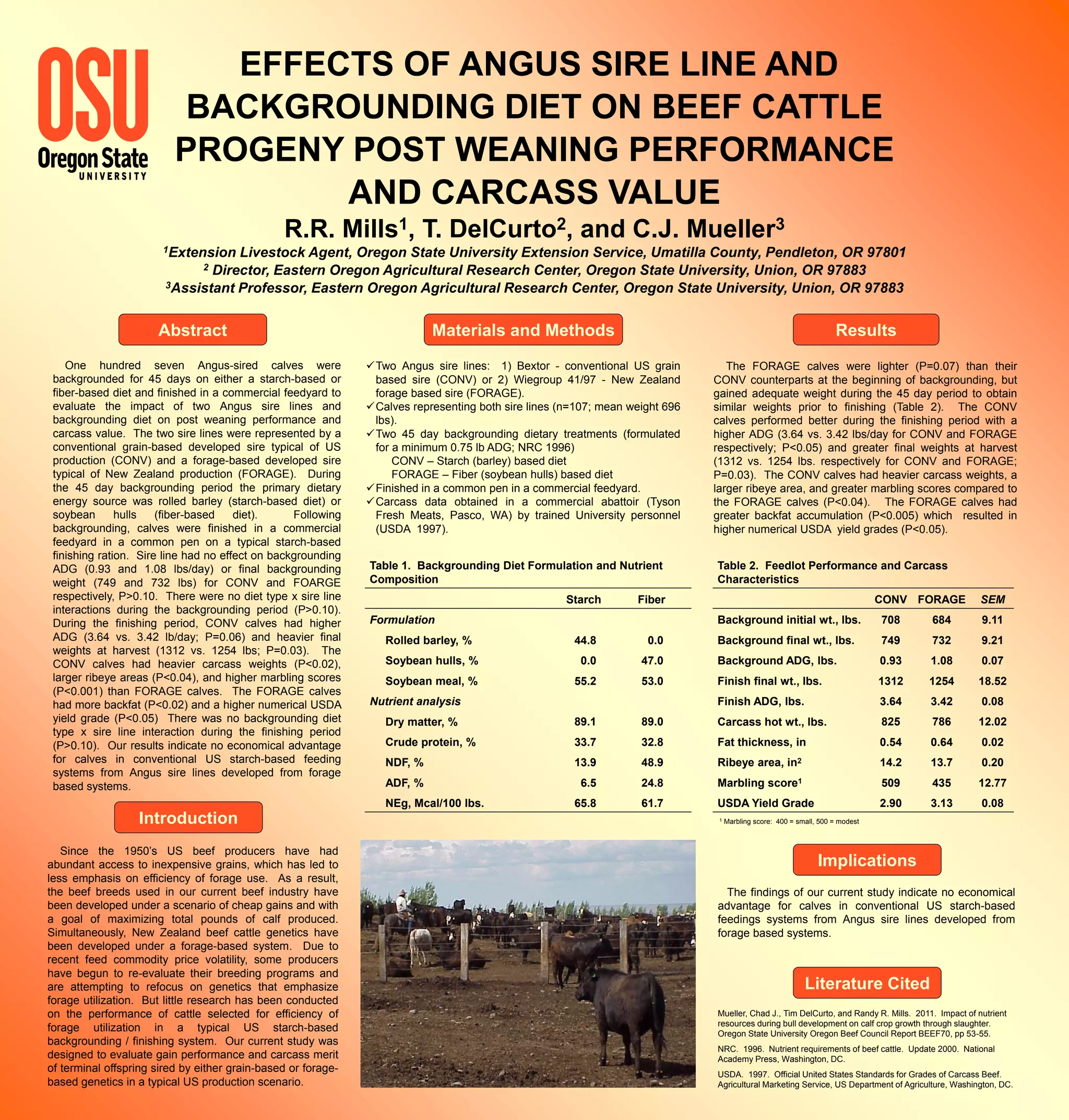
    One hundred seven Angus-sired calves were                  Two Angus sire lines: 1) Bextor - conventional US grain          The FORAGE calves were lighter (P=0.07) than their
 backgrounded for 45 days on either a starch-based or           based sire (CONV) or 2) Wiegroup 41/97 - New Zealand          CONV counterparts at the beginning of backgrounding, but
 fiber-based diet and finished in a commercial feedyard to      forage based sire (FORAGE).                                   gained adequate weight during the 45 day period to obtain
 evaluate the impact of two Angus sire lines and               Calves representing both sire lines (n=107; mean weight 696   similar weights prior to finishing (Table 2). The CONV
 backgrounding diet on post weaning performance and             lbs).                                                         calves performed better during the finishing period with a
 carcass value. The two sire lines were represented by a       Two 45 day backgrounding dietary treatments (formulated       higher ADG (3.64 vs. 3.42 lbs/day for CONV and FORAGE
 conventional grain-based developed sire typical of US          for a minimum 0.75 lb ADG; NRC 1996)                          respectively; P<0.05) and greater final weights at harvest
 production (CONV) and a forage-based developed sire                CONV – Starch (barley) based diet                         (1312 vs. 1254 lbs. respectively for CONV and FORAGE;
 typical of New Zealand production (FORAGE). During                 FORAGE – Fiber (soybean hulls) based diet                 P=0.03). The CONV calves had heavier carcass weights, a
 the 45 day backgrounding period the primary dietary           Finished in a common pen in a commercial feedyard.            larger ribeye area, and greater marbling scores compared to
 energy source was rolled barley (starch-based diet) or        Carcass data obtained in a commercial abattoir (Tyson         the FORAGE calves (P<0.04). The FORAGE calves had
 soybean       hulls   (fiber-based    diet).     Following     Fresh Meats, Pasco, WA) by trained University personnel       greater backfat accumulation (P<0.005) which resulted in
 backgrounding, calves were finished in a commercial            (USDA 1997).                                                  higher numerical USDA yield grades (P<0.05).
 feedyard in a common pen on a typical starch-based
 finishing ration. Sire line had no effect on backgrounding
 ADG (0.93 and 1.08 lbs/day) or final backgrounding            Table 1. Backgrounding Diet Formulation and Nutrient           Table 2. Feedlot Performance and Carcass
 weight (749 and 732 lbs) for CONV and FOARGE                  Composition                                                    Characteristics
 respectively, P>0.10. There were no diet type x sire line                                           Starch       Fiber                                                        CONV FORAGE         SEM
 interactions during the backgrounding period (P>0.10).
 During the finishing period, CONV calves had higher           Formulation                                                    Background initial wt., lbs.                     708    684          9.11
 ADG (3.64 vs. 3.42 lb/day; P=0.06) and heavier final             Rolled barley, %                    44.8          0.0       Background final wt., lbs.                       749    732          9.21
 weights at harvest (1312 vs. 1254 lbs; P=0.03). The
 CONV calves had heavier carcass weights (P<0.02),                Soybean hulls, %                     0.0         47.0       Background ADG, lbs.                             0.93   1.08         0.07
 larger ribeye areas (P<0.04), and higher marbling scores         Soybean meal, %                     55.2         53.0       Finish final wt., lbs.                           1312   1254        18.52
 (P<0.001) than FORAGE calves. The FORAGE calves
 had more backfat (P<0.02) and a higher numerical USDA         Nutrient analysis                                              Finish ADG, lbs.                                 3.64   3.42         0.08
 yield grade (P<0.05) There was no backgrounding diet             Dry matter, %                       89.1         89.0       Carcass hot wt., lbs.                            825    786         12.02
 type x sire line interaction during the finishing period
 (P>0.10). Our results indicate no economical advantage           Crude protein, %                    33.7         32.8       Fat thickness, in                                0.54   0.64         0.02
 for calves in conventional US starch-based feeding               NDF, %                              13.9         48.9       Ribeye area, in2                                 14.2   13.7         0.20
 systems from Angus sire lines developed from forage
 based systems.                                                   ADF, %                               6.5         24.8       Marbling score1                                  509    435         12.77
                                                                  NEg, Mcal/100 lbs.                  65.8         61.7       USDA Yield Grade                                 2.90   3.13         0.08
                  Introduction                                                                                                 1   Marbling score: 400 = small, 500 = modest


   Since the 1950’s US beef producers have had
abundant access to inexpensive grains, which has led to                                                                                                        Implications
less emphasis on efficiency of forage use. As a result,
the beef breeds used in our current beef industry have                                                                          The findings of our current study indicate no economical
been developed under a scenario of cheap gains and with                                                                       advantage for calves in conventional US starch-based
a goal of maximizing total pounds of calf produced.                                                                           feedings systems from Angus sire lines developed from
Simultaneously, New Zealand beef cattle genetics have                                                                         forage based systems.
been developed under a forage-based system. Due to
recent feed commodity price volatility, some producers
have begun to re-evaluate their breeding programs and
are attempting to refocus on genetics that emphasize                                                                                                       Literature Cited
forage utilization. But little research has been conducted
on the performance of cattle selected for efficiency of                                                                       Mueller, Chad J., Tim DelCurto, and Randy R. Mills. 2011. Impact of nutrient
                                                                                                                              resources during bull development on calf crop growth through slaughter.
forage utilization in a typical US starch-based                                                                               Oregon State University Oregon Beef Council Report BEEF70, pp 53-55.
backgrounding / finishing system. Our current study was
                                                                                                                              NRC. 1996. Nutrient requirements of beef cattle. Update 2000. National
designed to evaluate gain performance and carcass merit                                                                       Academy Press, Washington, DC.
of terminal offspring sired by either grain-based or forage-                                                                  USDA. 1997. Official United States Standards for Grades of Carcass Beef.
based genetics in a typical US production scenario.                                                                           Agricultural Marketing Service, US Department of Agriculture, Washington, DC.

2012 nacaa mills sire line backgrounding diet poster

  • 1.
    EFFECTS OF ANGUSSIRE LINE AND BACKGROUNDING DIET ON BEEF CATTLE PROGENY POST WEANING PERFORMANCE AND CARCASS VALUE R.R. Mills1, T. DelCurto2, and C.J. Mueller3 1Extension Livestock Agent, Oregon State University Extension Service, Umatilla County, Pendleton, OR 97801 2 Director, Eastern Oregon Agricultural Research Center, Oregon State University, Union, OR 97883 3Assistant Professor, Eastern Oregon Agricultural Research Center, Oregon State University, Union, OR 97883 Abstract Materials and Methods Results One hundred seven Angus-sired calves were Two Angus sire lines: 1) Bextor - conventional US grain The FORAGE calves were lighter (P=0.07) than their backgrounded for 45 days on either a starch-based or based sire (CONV) or 2) Wiegroup 41/97 - New Zealand CONV counterparts at the beginning of backgrounding, but fiber-based diet and finished in a commercial feedyard to forage based sire (FORAGE). gained adequate weight during the 45 day period to obtain evaluate the impact of two Angus sire lines and Calves representing both sire lines (n=107; mean weight 696 similar weights prior to finishing (Table 2). The CONV backgrounding diet on post weaning performance and lbs). calves performed better during the finishing period with a carcass value. The two sire lines were represented by a Two 45 day backgrounding dietary treatments (formulated higher ADG (3.64 vs. 3.42 lbs/day for CONV and FORAGE conventional grain-based developed sire typical of US for a minimum 0.75 lb ADG; NRC 1996) respectively; P<0.05) and greater final weights at harvest production (CONV) and a forage-based developed sire CONV – Starch (barley) based diet (1312 vs. 1254 lbs. respectively for CONV and FORAGE; typical of New Zealand production (FORAGE). During FORAGE – Fiber (soybean hulls) based diet P=0.03). The CONV calves had heavier carcass weights, a the 45 day backgrounding period the primary dietary Finished in a common pen in a commercial feedyard. larger ribeye area, and greater marbling scores compared to energy source was rolled barley (starch-based diet) or Carcass data obtained in a commercial abattoir (Tyson the FORAGE calves (P<0.04). The FORAGE calves had soybean hulls (fiber-based diet). Following Fresh Meats, Pasco, WA) by trained University personnel greater backfat accumulation (P<0.005) which resulted in backgrounding, calves were finished in a commercial (USDA 1997). higher numerical USDA yield grades (P<0.05). feedyard in a common pen on a typical starch-based finishing ration. Sire line had no effect on backgrounding ADG (0.93 and 1.08 lbs/day) or final backgrounding Table 1. Backgrounding Diet Formulation and Nutrient Table 2. Feedlot Performance and Carcass weight (749 and 732 lbs) for CONV and FOARGE Composition Characteristics respectively, P>0.10. There were no diet type x sire line Starch Fiber CONV FORAGE SEM interactions during the backgrounding period (P>0.10). During the finishing period, CONV calves had higher Formulation Background initial wt., lbs. 708 684 9.11 ADG (3.64 vs. 3.42 lb/day; P=0.06) and heavier final Rolled barley, % 44.8 0.0 Background final wt., lbs. 749 732 9.21 weights at harvest (1312 vs. 1254 lbs; P=0.03). The CONV calves had heavier carcass weights (P<0.02), Soybean hulls, % 0.0 47.0 Background ADG, lbs. 0.93 1.08 0.07 larger ribeye areas (P<0.04), and higher marbling scores Soybean meal, % 55.2 53.0 Finish final wt., lbs. 1312 1254 18.52 (P<0.001) than FORAGE calves. The FORAGE calves had more backfat (P<0.02) and a higher numerical USDA Nutrient analysis Finish ADG, lbs. 3.64 3.42 0.08 yield grade (P<0.05) There was no backgrounding diet Dry matter, % 89.1 89.0 Carcass hot wt., lbs. 825 786 12.02 type x sire line interaction during the finishing period (P>0.10). Our results indicate no economical advantage Crude protein, % 33.7 32.8 Fat thickness, in 0.54 0.64 0.02 for calves in conventional US starch-based feeding NDF, % 13.9 48.9 Ribeye area, in2 14.2 13.7 0.20 systems from Angus sire lines developed from forage based systems. ADF, % 6.5 24.8 Marbling score1 509 435 12.77 NEg, Mcal/100 lbs. 65.8 61.7 USDA Yield Grade 2.90 3.13 0.08 Introduction 1 Marbling score: 400 = small, 500 = modest Since the 1950’s US beef producers have had abundant access to inexpensive grains, which has led to Implications less emphasis on efficiency of forage use. As a result, the beef breeds used in our current beef industry have The findings of our current study indicate no economical been developed under a scenario of cheap gains and with advantage for calves in conventional US starch-based a goal of maximizing total pounds of calf produced. feedings systems from Angus sire lines developed from Simultaneously, New Zealand beef cattle genetics have forage based systems. been developed under a forage-based system. Due to recent feed commodity price volatility, some producers have begun to re-evaluate their breeding programs and are attempting to refocus on genetics that emphasize Literature Cited forage utilization. But little research has been conducted on the performance of cattle selected for efficiency of Mueller, Chad J., Tim DelCurto, and Randy R. Mills. 2011. Impact of nutrient resources during bull development on calf crop growth through slaughter. forage utilization in a typical US starch-based Oregon State University Oregon Beef Council Report BEEF70, pp 53-55. backgrounding / finishing system. Our current study was NRC. 1996. Nutrient requirements of beef cattle. Update 2000. National designed to evaluate gain performance and carcass merit Academy Press, Washington, DC. of terminal offspring sired by either grain-based or forage- USDA. 1997. Official United States Standards for Grades of Carcass Beef. based genetics in a typical US production scenario. Agricultural Marketing Service, US Department of Agriculture, Washington, DC.