!
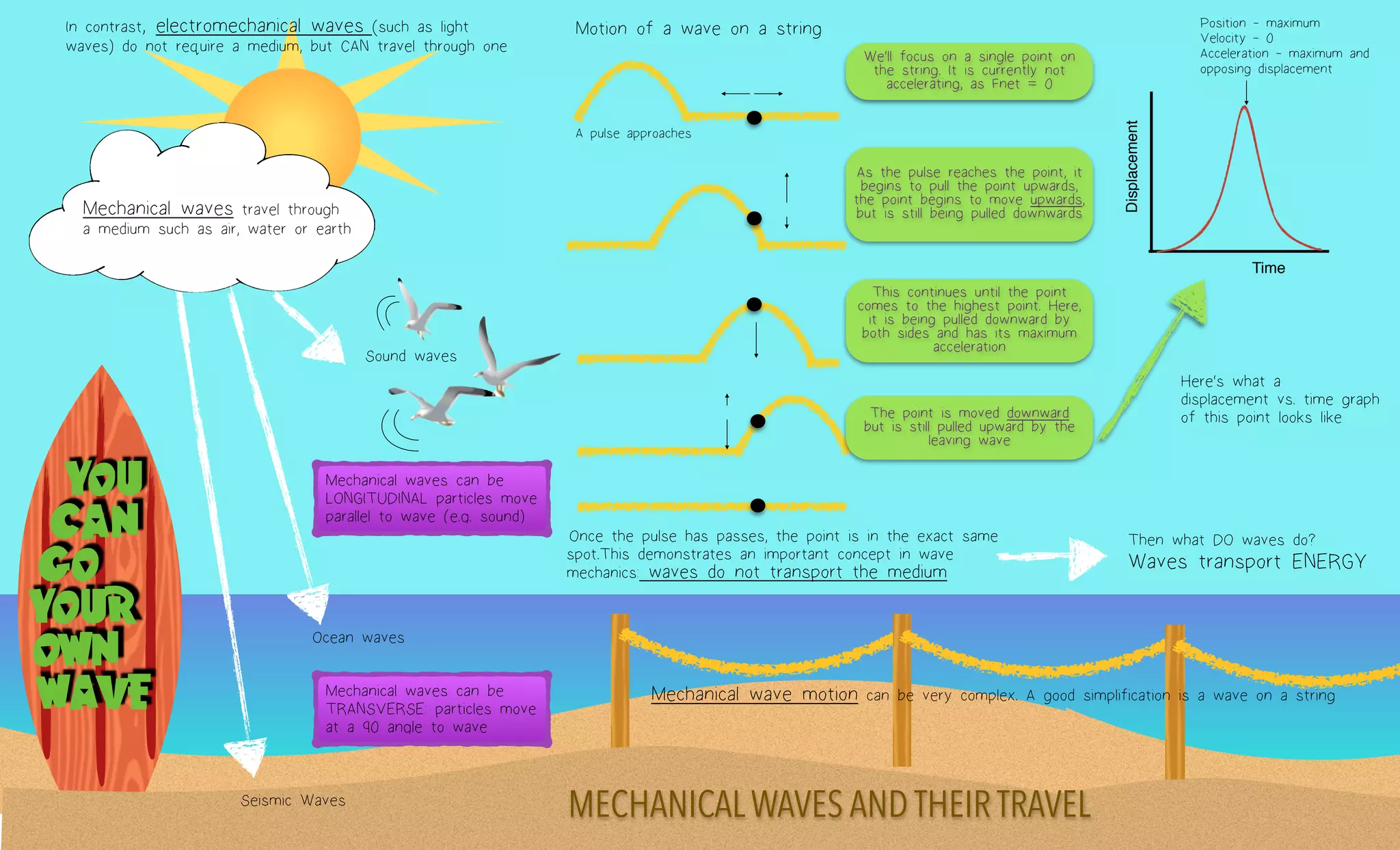
Mechanical waves travel through
a medium such as air, water or earth
Once the pulse has passes, the point is in the exact same
spot.This demonstrates an important concept in wave
mechanics: waves do not transport the medium
In contrast, electromechanical waves (such as light
waves) do not require a medium, but CAN travel through one
Sound waves
Ocean waves
Seismic Waves
Motion of a wave on a string
We’ll focus on a single point on
the string. It is currently not
accelerating, as Fnet = 0
A pulse approaches
!
YOU
CAN
GO
YOUR
OWN
WAVE
As the pulse reaches the point, it
begins to pull the point upwards,
the point begins to move upwards,
but is still being pulled downwards
This continues until the point
comes to the highest point. Here,
it is being pulled downward by
both sides and has its maximum
acceleration
The point is moved downward
but is still pulled upward by the
leaving wave
MECHANICALWAVES AND THEIR TRAVEL
Mechanical wave motion can be very complex. A good simplification is a wave on a string
Then what DO waves do?
Waves transport ENERGY
Here’s what a
displacement vs. time graph
of this point looks like
Time
Displacement
Position - maximum
Velocity - 0
Acceleration - maximum and
opposing displacement
Mechanical waves can be
LONGITUDINAL particles move
parallel to wave (e.g. sound)
Mechanical waves can be
TRANSVERSE: particles move
at a 90 angle to wave

Learning objective 1

  • 1.
    ! Mechanical waves travelthrough a medium such as air, water or earth Once the pulse has passes, the point is in the exact same spot.This demonstrates an important concept in wave mechanics: waves do not transport the medium In contrast, electromechanical waves (such as light waves) do not require a medium, but CAN travel through one Sound waves Ocean waves Seismic Waves Motion of a wave on a string We’ll focus on a single point on the string. It is currently not accelerating, as Fnet = 0 A pulse approaches ! YOU CAN GO YOUR OWN WAVE As the pulse reaches the point, it begins to pull the point upwards, the point begins to move upwards, but is still being pulled downwards This continues until the point comes to the highest point. Here, it is being pulled downward by both sides and has its maximum acceleration The point is moved downward but is still pulled upward by the leaving wave MECHANICALWAVES AND THEIR TRAVEL Mechanical wave motion can be very complex. A good simplification is a wave on a string Then what DO waves do? Waves transport ENERGY Here’s what a displacement vs. time graph of this point looks like Time Displacement Position - maximum Velocity - 0 Acceleration - maximum and opposing displacement Mechanical waves can be LONGITUDINAL particles move parallel to wave (e.g. sound) Mechanical waves can be TRANSVERSE: particles move at a 90 angle to wave