Muhammad Shoyab
1
5th Year MBBS
Sir Salimullah Medical College
May 05, 2009
Revised : July 2015
Surgery is a major stress . . .
2
. . . that not only overwhelms
the patient’s psychology . . .
3
. . . but also overburdens
physiology & homeostasis.
4
But is this what we want?
5
The answer is NO
B&L
6
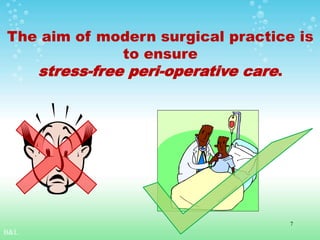
The aim of modern surgical practice is
to ensure
stress-free peri-operative care.
B&L
7
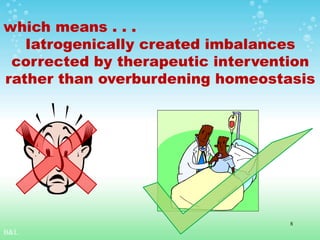
which means . . .
Iatrogenically created imbalances
corrected by therapeutic intervention
rather than overburdening homeostasis
B&L
8
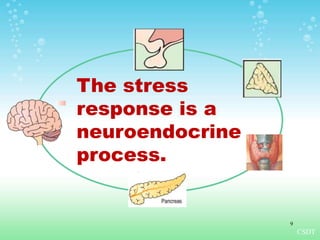
The stress
response is a
neuroendocrine
process.
CSDT
9
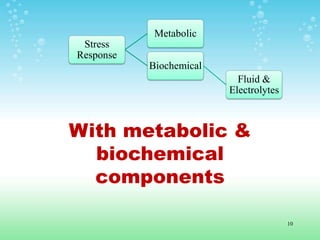
With metabolic &
biochemical
components
10
Stress
Response
Metabolic
Biochemical
Fluid &
Electrolytes
S
Y
M
P
A
T
H
E
T
I
C
C
H
A
I
N
CRH
TRH
GHRH
ACTH TSH
Injury
Sensory
Nerves
THALAMUS
Nociceptors
ADRENAL
PANCREAS
HYPOTHALAMUS
THYROID
PITUITARY
B&L
11
CSDT
12
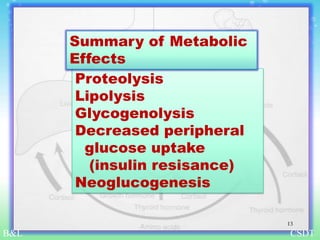
Metabolic Changes
Proteolysis
Lipolysis
Glycogenolysis
Decreased peripheral
glucose uptake
(insulin resisance)
Neoglucogenesis
CSDT
Summary of Metabolic
Effects
B&L
13
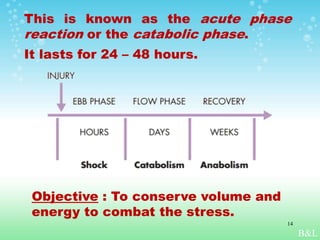
This is known as the acute phase
reaction or the catabolic phase.
It lasts for 24 – 48 hours.
B&L
Objective : To conserve volume and
energy to combat the stress.
14
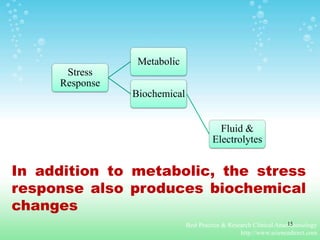
In addition to metabolic, the stress
response also produces biochemical
changes
Best Practice & Research Clinical Anaesthesiology
http://www.sciencedirect.com
Stress
Response
Metabolic
Biochemical
Fluid &
Electrolytes
15
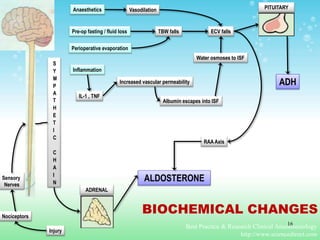
ALDOSTERONE
S
Y
M
P
A
T
H
E
T
I
C
C
H
A
I
N
Injury
Sensory
Nerves
Nociceptors
ADRENAL
ADH
PITUITARYAnaesthetics Vasodilation
ECV falls
Inflammation
IL-1 , TNF
Increased vascular permeability
Albumin escapes into ISF
Water osmoses to ISF
Pre-op fasting / fluid loss
Perioperative evaporation
TBW falls
RAA Axis
Best Practice & Research Clinical Anaesthesiology
http://www.sciencedirect.com
16
BIOCHEMICAL CHANGES
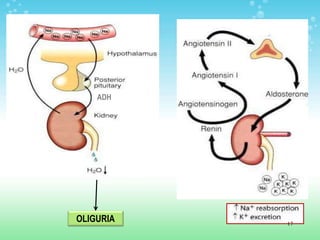
OLIGURIA
ADH
17
OLIGURIA
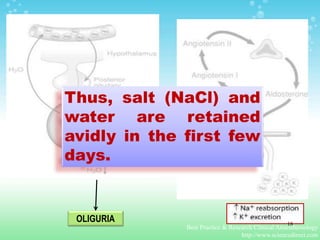
ADHThus, salt (NaCl) and
water are retained
avidly in the first few
days.
Best Practice & Research Clinical Anaesthesiology
http://www.sciencedirect.com
18
Hence, no extra sodium is
needed in the first 24 – 48
hours.
Churchill
19
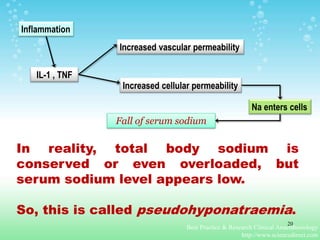
Inflammation
IL-1 , TNF
Increased vascular permeability
Increased cellular permeability
Na enters cells
Fall of serum sodium
In reality, total body sodium is
conserved or even overloaded, but
serum sodium level appears low.
So, this is called pseudohyponatraemia.
Best Practice & Research Clinical Anaesthesiology
http://www.sciencedirect.com
20
This is why, administration of
sodium is restricted over the first
few days after surgery, to avoid
further overloading of sodium.
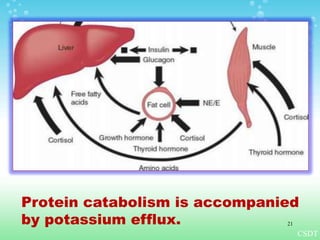
Protein catabolism is accompanied
by potassium efflux.
CSDT
21
Proteins maintain the intracellular
negative charge.

Loss of proteins from the cell creates
an electrical imbalance . . .

. . . which is balanced by potassium
efflux. This may result in
hyperkalaemia.

This potassium is lost in exchange of
sodium during the sodium retention
phase.
Best Practice & Research Clinical Anaesthesiology
http://www.sciencedirect.com
22
B&L
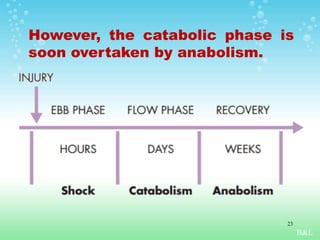
However, the catabolic phase is
soon overtaken by anabolism.
23
During the anabolic phase,
glycogen and protein are
resynthesized.
This causes rapid reuptake of
K+.
This may lead to hypokalaemia
unless carefully supplemented.
Best Practice & Research Clinical Anaesthesiology
http://www.sciencedirect.com
24
Hence, potassium
supplementation must be done
carefully – no excess, no
deficit.
Best Practice & Research Clinical Anaesthesiology
http://www.sciencedirect.com
25
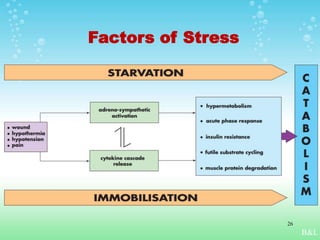
Factors of Stress
B&L
26
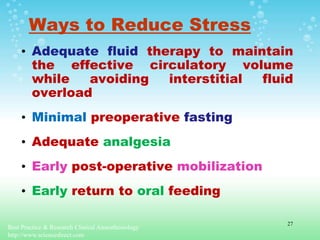
• Adequate fluid therapy to maintain
the effective circulatory volume
while avoiding interstitial fluid
overload
• Minimal preoperative fasting
• Adequate analgesia
• Early post-operative mobilization
• Early return to oral feeding
Best Practice & Research Clinical Anaesthesiology
http://www.sciencedirect.com
Ways to Reduce Stress
27
Stress-free peri-operative care
B&L
28
Stress-free peri-operative care
B&L
29
THANK YOU

Physiological Responses to Surgery & Trauma

Editor's Notes

  • #3 The surgical process constitutes a major stress, not only on the psychology and economy of the patient, but also on the body’s homeostatic mechanism.
  • #4 The surgical process constitutes a major stress, not only on the psychology and economy of the patient, but also on the body’s homeostatic mechanism.
  • #5 The surgical process constitutes a major stress, not only on the psychology and economy of the patient, but also on the body’s homeostatic mechanism.
  • #6 The surgical process constitutes a major stress, not only on the psychology and economy of the patient, but also on the body’s homeostatic mechanism.
  • #9 This means that the iatrogenically created imbalances must be corrected by therapeutic intervention, rather than overburdening the body’s homeostatic mechanism. An understanding of the way the body responds to the stress will enable us to identify the changes that occur and adopt appropriate corrective mechanisms.
  • #10 The response to surgery and trauma is a neuroendocrine process, involving both the peripheral and central nervous systems and the entire endocrine axis starting from the hypothalamus and the pituitary to the thyroid, adrenals and pancreas.
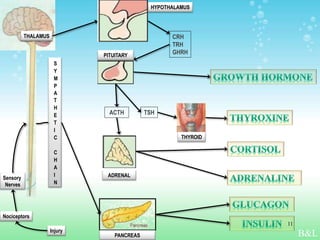
  • #11 The response to surgery and trauma is a neuroendocrine process, involving both the peripheral and central nervous systems and the entire endocrine axis starting from the hypothalamus and the pituitary to the thyroid, adrenals and pancreas.
  • #12 As soon as the first few centimetres of skin are incised, impulses pass along the sensory nerves up the spinal cord and stimulate both the sympathetic system as well as the endocrine axis. As a result, the pituitary gland releases GH, thyroxine comes from the thyroid gland, cortisol and adrenaline from the adrenal and glucagon and insulin from the pancreas.
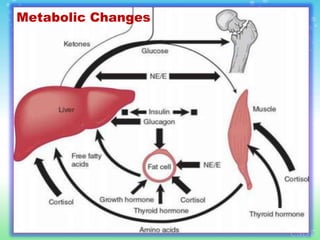
  • #13 This picture shows the effect of these hormones on the body’s metabolic status. Thyroxine and cortisol act on skeletal muscles to induce the breakdown of muscle protein. These are released as free AA into the blood. GH, TH, cortisol, EP and NEP break down the body’s fat stores, releasing large amounts of FFA into the systemic circulation. At the same time, glucagon acts on the liver and releases the glycogen stores in the form of glucose. The released AA and FFA are taken up by the liver.
  • #14 Thus, if we summarise the metabolic effects of stress, we have proteolysis, lipolysis, and glycogenolysis.
  • #15 These constitute the acute phase reaction or the catabolic phase of the stress response. It lasts for 24 – 48 hours and serves to conserve volume and energy to combat the stress.
  • #16 In addition to the metabolic effects that we have discussed till now, the stress response also involves important changes in the fluid and electrolyte balance of the body.
  • #17 Earlier, we have discussed how the painful stimuli passing along sensory nerves and up the spinal cord induce the sympathetic and endocrine axes to release hormones that affect the body’s metabolic processes. In this slide, we have shown the secretion of some hormones affecting the fluid and electrolyte balance. The vasodilatory effect of some anaesthetic agents, plus the fluid loss due to vomiting, bleeding and evaporation during the operation all contribute to a reduction in the ECV. This stimulates the pituitary gland to secrete ADH. At the same time, the fall in ECV activates the RA mechanism. The RA axis and the sympathetic stimulation causes the adrenal to secrete aldosterone. Thus, we have two very important hormones : ADH and aldosterone. ADH level remains elevated upto 4 days after surgery. (Dr. Bob Richardson, Toronto General Hospital)
  • #18 The effect of ADH is well-known to us all. It acts on the renal system to increase the reabsorption of water, leading to oliguria. Likewise, aldosterone leads to retention of salt and water in exchange for K.
  • #20 Simply providing the daily physiological requirement is sufficient.
  • #21 In addition to the metabolic effects and the salt and water retention that we have already covered, the inflammatory reaction accompanying the stress response induces the secretion of inflammatory mediators such as IL-1, TNF alpha, etc. These mediators have widespread effects, including increased vascular and cell membrane permeability. We all know that the concentration of sodium is much higher outside the cell than inside. The increased permeability now allows Na ions to leave the circulation and enter the cell. This produces a state of apparent sodium deficit in the serum. This is called pseudohyponatraemia because in reality total body sodium is conserved or even overloaded, but sodium level in blood and urine appear to be low. ADH level remains elevated upto 4 days after surgery. (Dr. Bob Richardson, Toronto General Hospital)
  • #22 Earlier, we have become familiar with the fact that the stress response involves breakdown of muscle protein, which are then released into the general circulation as AA.
  • #23 We know that proteins maintain the intracellular negative charge. Loss of proteins means loss of negative charges, creating an electrical imbalance. Which is balanced by the efflux of potassium from the cell to the outside. This may lead to hyperkalaemia. The potassium thus released into the circulation is lost in exchange of sodium during the sodium retention phase.
  • #25 Resynthesis of proteins inside the cell increases intracellular negative charge, which has to be balanced by rapid uptake of K.
  • #27 At the beginning of our discussion, we talked about stress free care. I will finish by mentioning the factors that influence the level of stress
  • #28 And ways to reduce the stress.
  • #29 This means that the iatrogenically created imbalances must be corrected by therapeutic intervention, rather than overburdening the body’s homeostatic mechanism. An understanding of the way the body responds to the stress will enable us to identify the changes that occur and adopt appropriate corrective mechanisms.
  • #30 This means that the iatrogenically created imbalances must be corrected by therapeutic intervention, rather than overburdening the body’s homeostatic mechanism. An understanding of the way the body responds to the stress will enable us to identify the changes that occur and adopt appropriate corrective mechanisms.