Functions


Courtsey: University of Pittsburgh-CSD-Khalifa


Autumn             Programming and               1
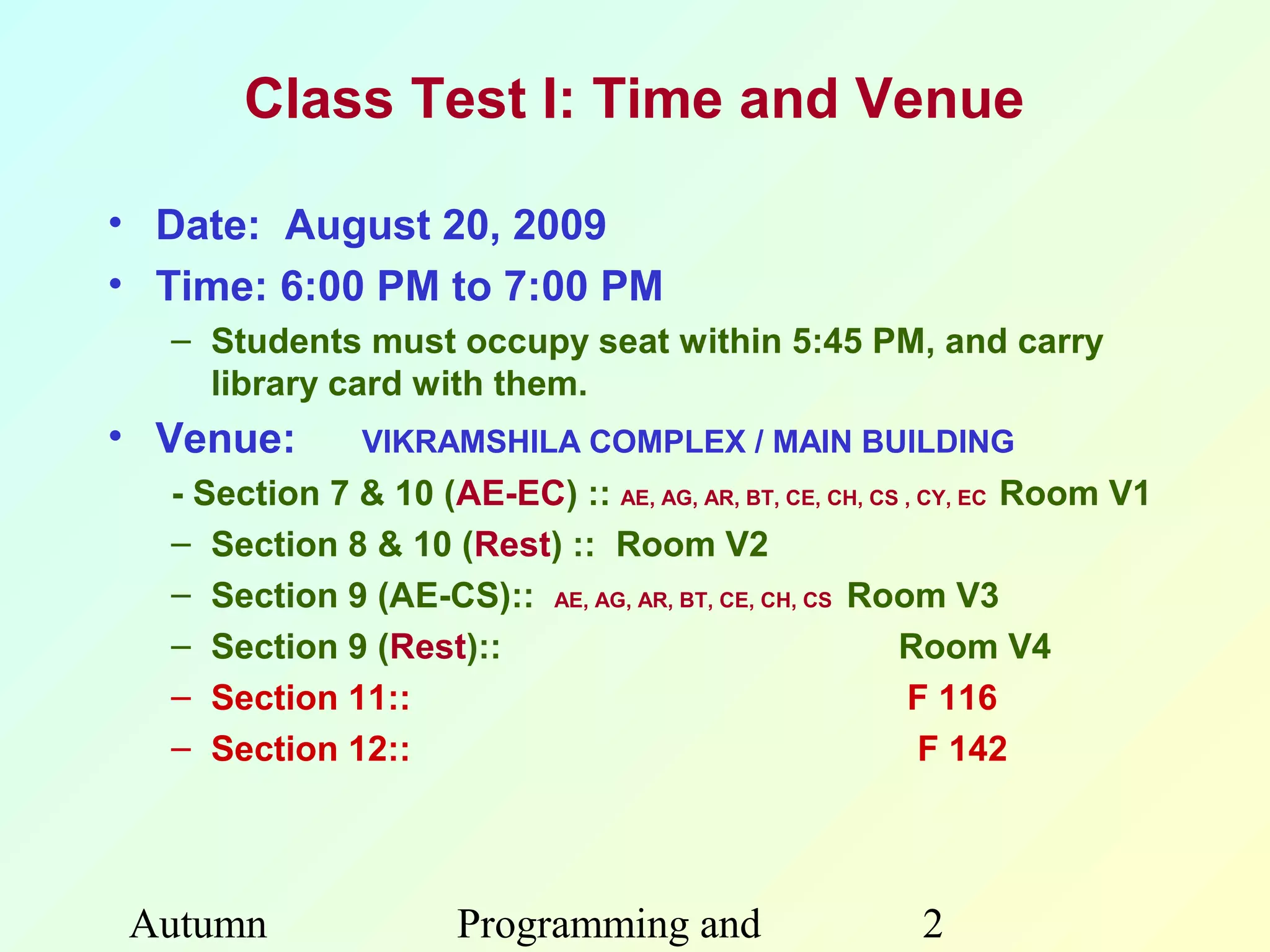
Class Test I: Time and Venue

• Date: August 20, 2009
• Time: 6:00 PM to 7:00 PM
  – Students must occupy seat within 5:45 PM, and carry
    library card with them.
• Venue:       VIKRAMSHILA COMPLEX / MAIN BUILDING
  - Section 7 & 10 (AE-EC) :: AE, AG, AR, BT, CE, CH, CS , CY, EC Room V1
  – Section 8 & 10 (Rest) :: Room V2
  – Section 9 (AE-CS):: AE, AG, AR, BT, CE, CH, CS Room V3
  – Section 9 (Rest)::                                  Room V4
  – Section 11::                                         F 116
  – Section 12::                                           F 142


Autumn                Programming and                   2
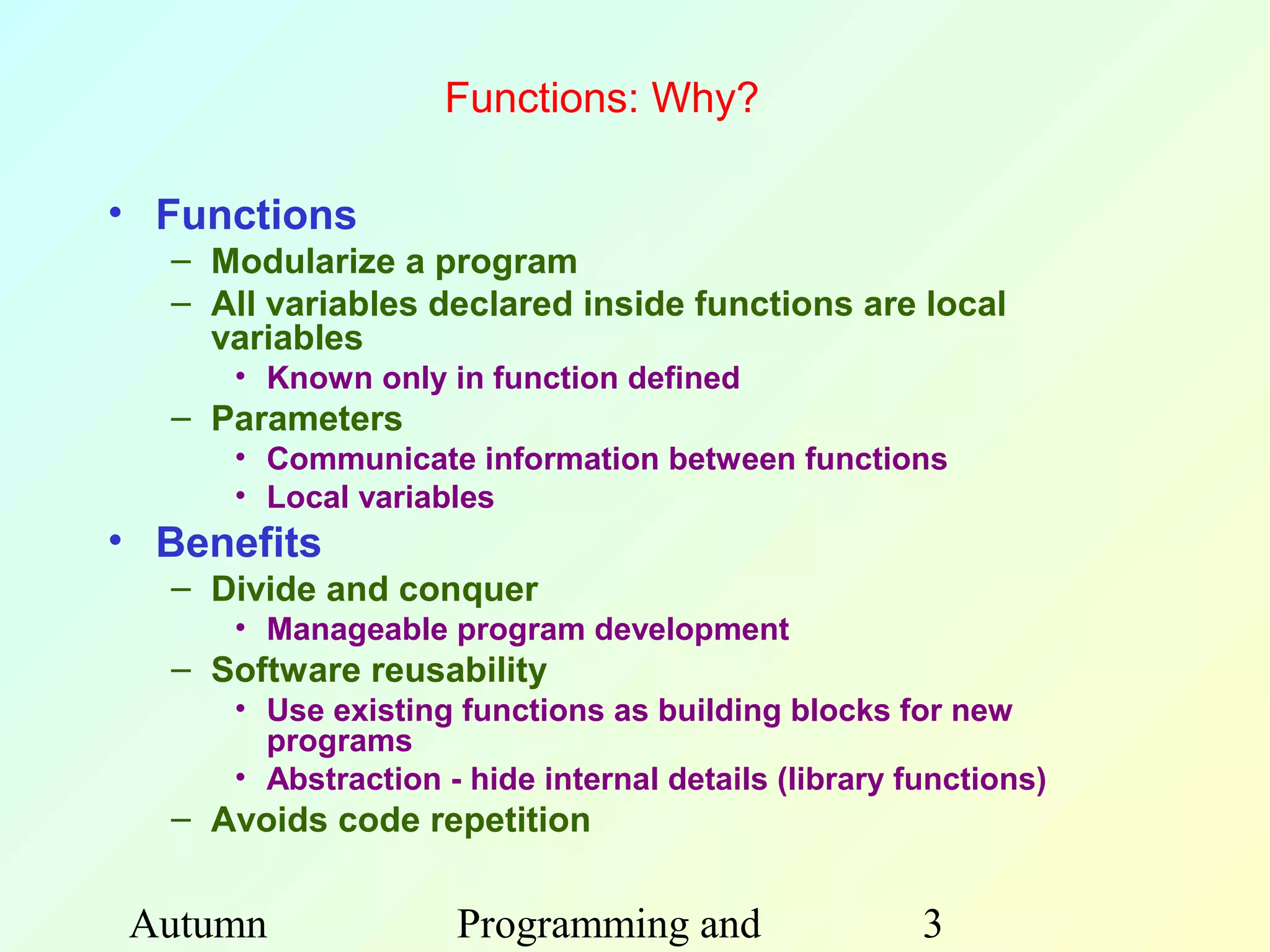
Functions: Why?

• Functions
  – Modularize a program
  – All variables declared inside functions are local
    variables
     • Known only in function defined
  – Parameters
     • Communicate information between functions
     • Local variables
• Benefits
  – Divide and conquer
     • Manageable program development
  – Software reusability
     • Use existing functions as building blocks for new
       programs
     • Abstraction - hide internal details (library functions)
  – Avoids code repetition


Autumn              Programming and                  3
Functions: Why?


• Divide and conquer
  – Construct a program from smaller
    pieces or components
  – Each piece more manageable than the
    original program


Autumn       Programming and    4
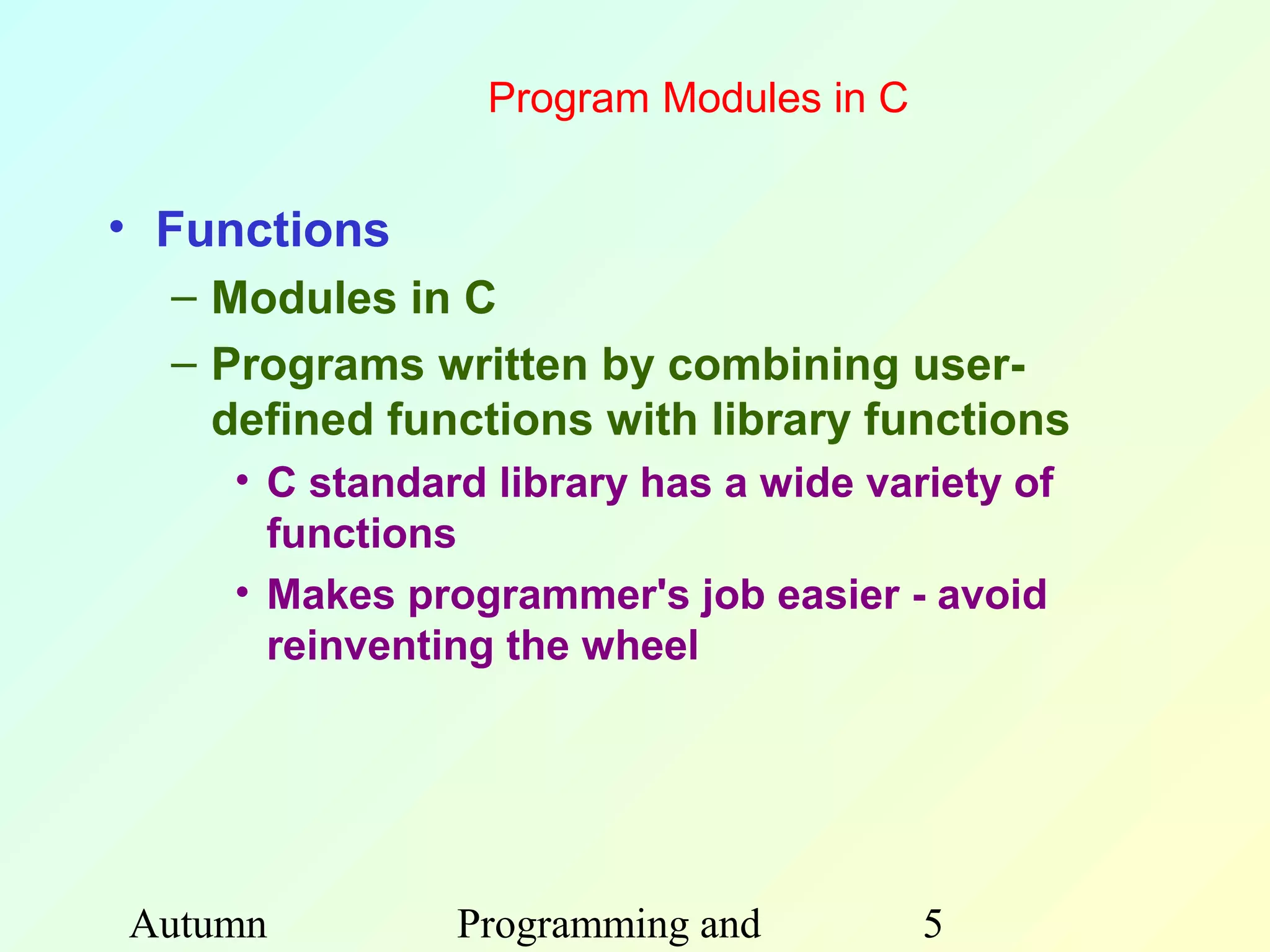
Program Modules in C


• Functions
  – Modules in C
  – Programs written by combining user-
    defined functions with library functions
    • C standard library has a wide variety of
      functions
    • Makes programmer's job easier - avoid
      reinventing the wheel


Autumn         Programming and         5
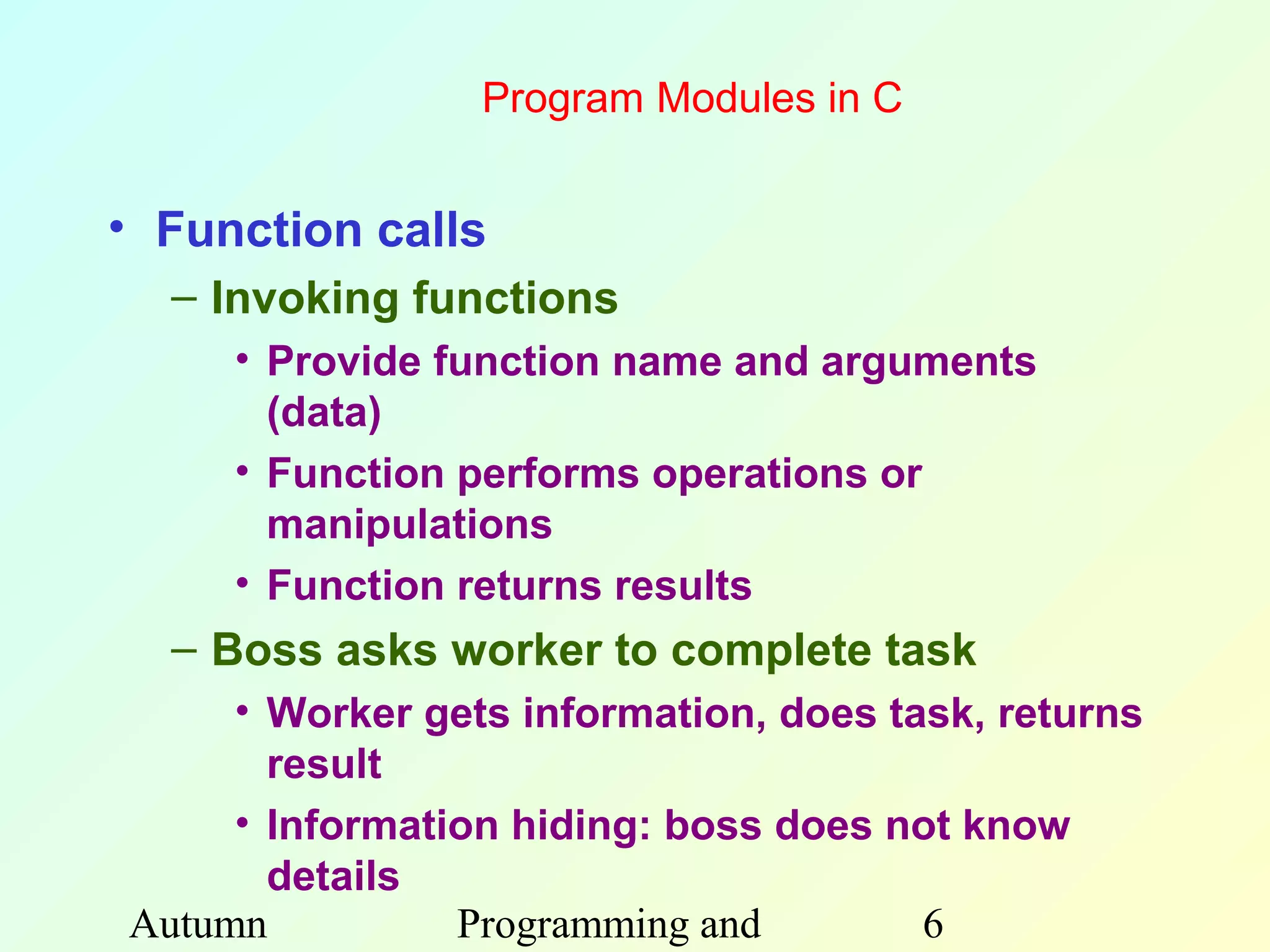
Program Modules in C


• Function calls
  – Invoking functions
     • Provide function name and arguments
       (data)
     • Function performs operations or
       manipulations
     • Function returns results
  – Boss asks worker to complete task
     • Worker gets information, does task, returns
       result
     • Information hiding: boss does not know
       details
Autumn          Programming and        6
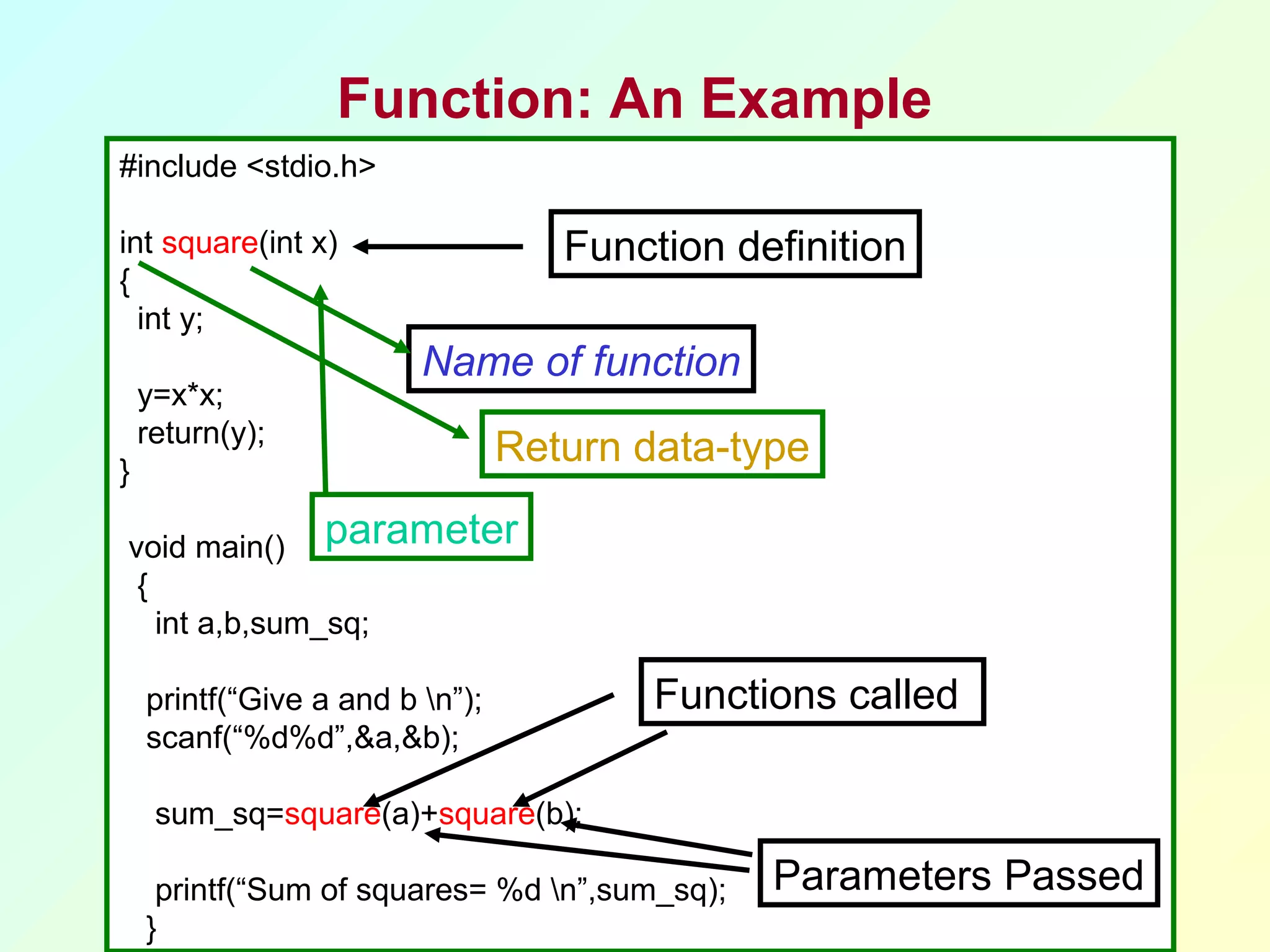
Function: An Example
#include <stdio.h>

int square(int x)                   Function definition
{
  int y;
                         Name of function
    y=x*x;
    return(y);
}
                                 Return data-type

void main() parameter
 {
   int a,b,sum_sq;

    printf(“Give a and b n”);           Functions called
    scanf(“%d%d”,&a,&b);

     sum_sq=square(a)+square(b);

  printf(“Sum of squares= %d n”,sum_sq);      Parameters Passed
Autumn
 }                     Programming and               7
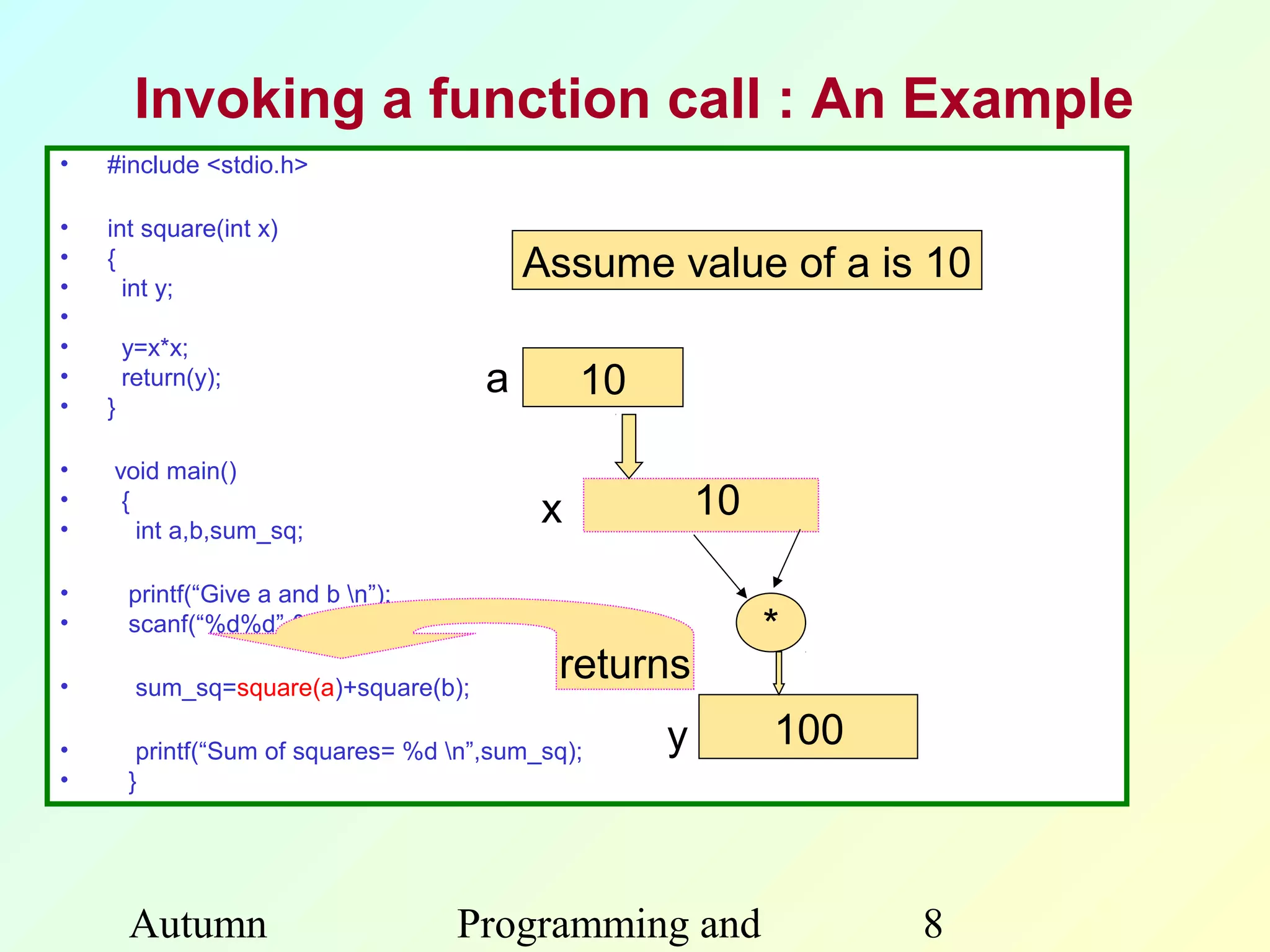
Invoking a function call : An Example
•   #include <stdio.h>

•   int square(int x)
•
•
    {
      int y;
                                           Assume value of a is 10
•
•       y=x*x;
•       return(y);                     a        10
•   }

•   void main()
•    {
                                            x            10
•      int a,b,sum_sq;

•       printf(“Give a and b n”);
•       scanf(“%d%d”,&a,&b);                                  *
•        sum_sq=square(a)+square(b);
                                             returns
•        printf(“Sum of squares= %d n”,sum_sq);     y        100
•       }


        Autumn                       Programming and                8
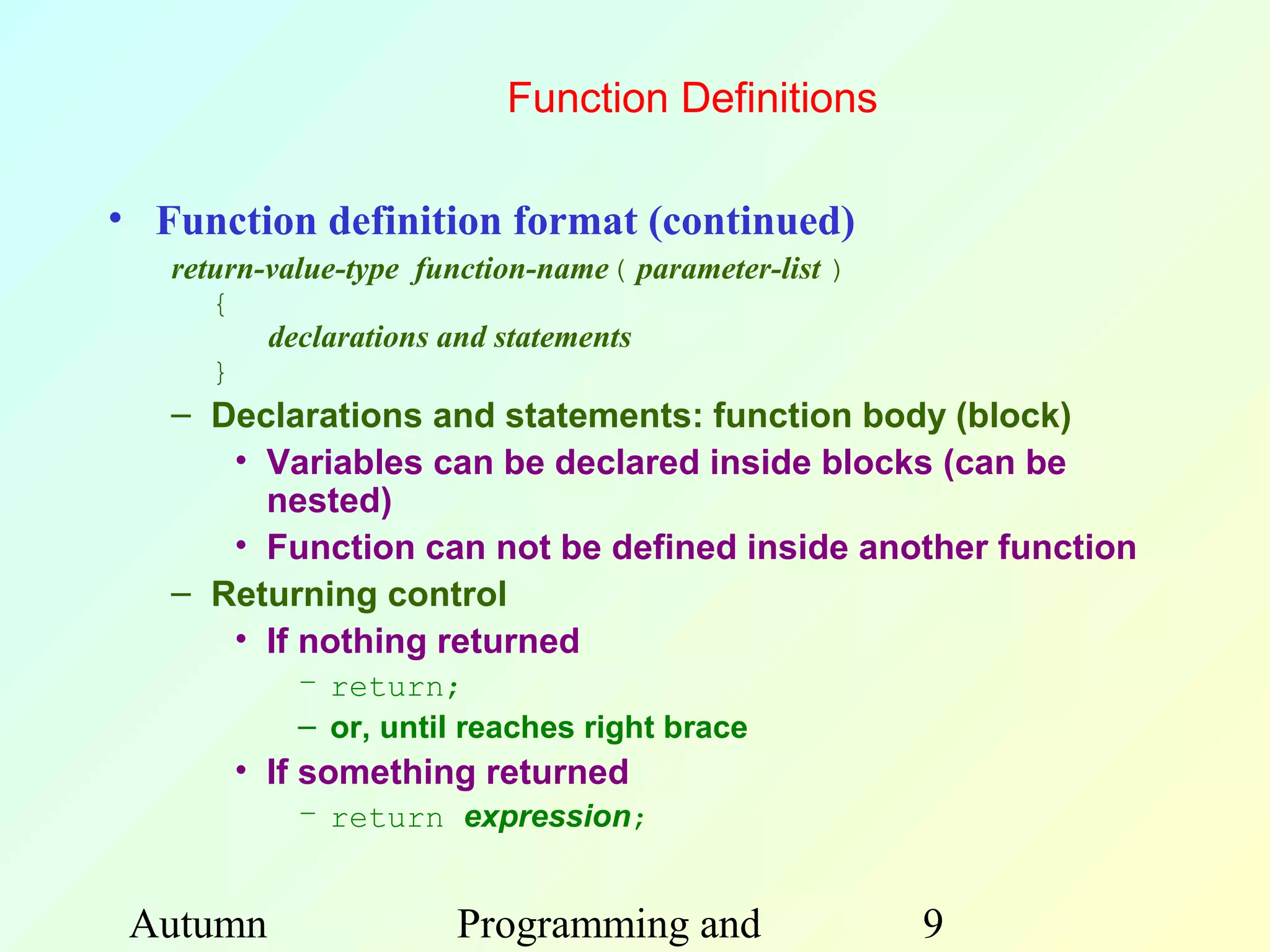
Function Definitions

• Function definition format (continued)
   return-value-type function-name( parameter-list )
      {
          declarations and statements
      }
   – Declarations and statements: function body (block)
      • Variables can be declared inside blocks (can be
        nested)
      • Function can not be defined inside another function
   – Returning control
      • If nothing returned
            – return;
            – or, until reaches right brace
       • If something returned
            – return expression;


 Autumn                Programming and                 9
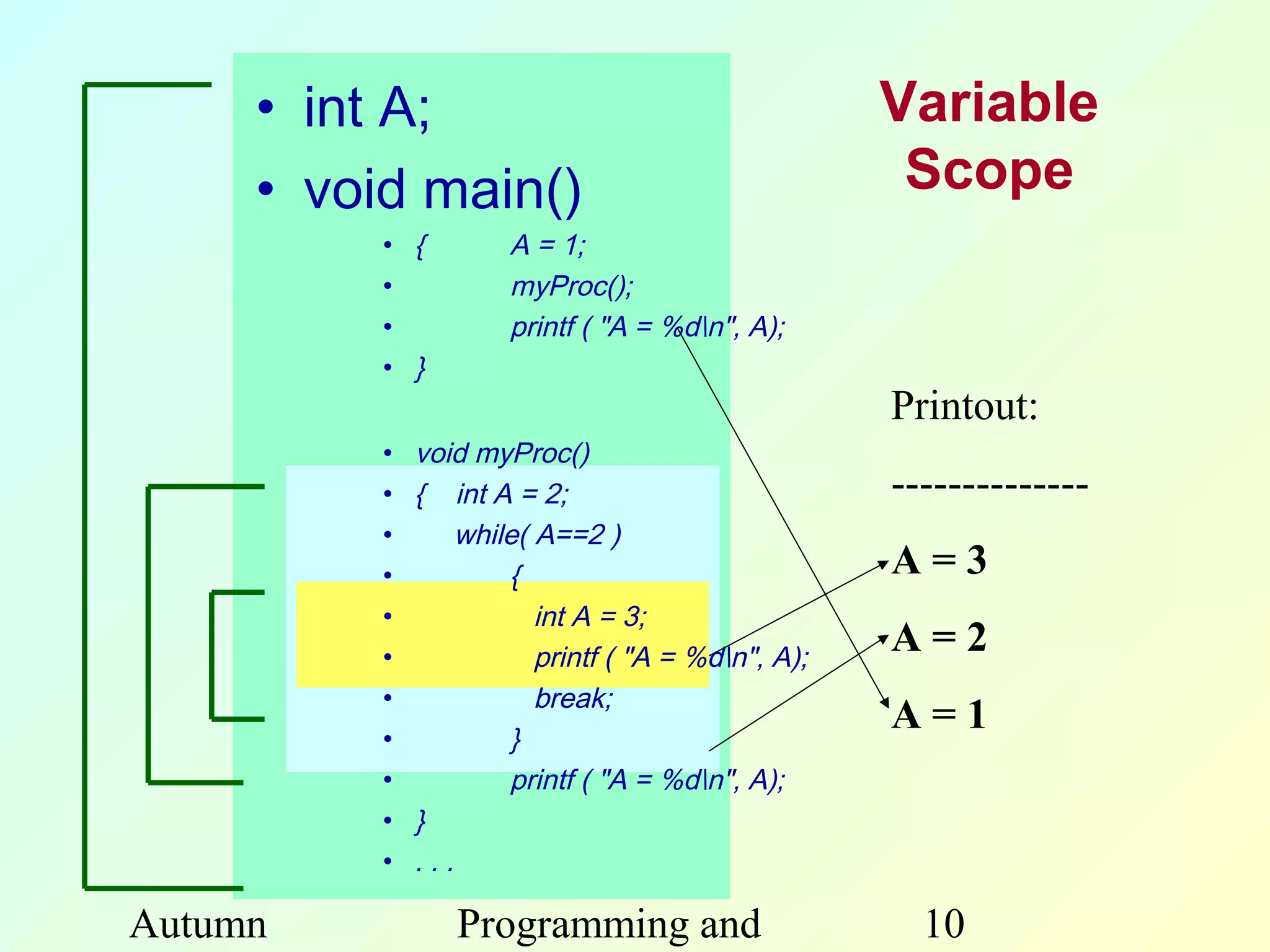
• int A;                                       Variable
     • void main()                                   Scope
          • {         A = 1;
          •           myProc();
          •           printf ( "A = %dn", A);
          • }
                                                    Printout:
          •   void myProc()
          •   { int A = 2;                          --------------
          •       while( A==2 )
          •           {                             A=3
          •              int A = 3;
          •              printf ( "A = %dn", A);
                                                    A=2
          •              break;
          •           }
                                                    A=1
          •           printf ( "A = %dn", A);
          •   }
          •   ...

Autumn           Programming and                      10
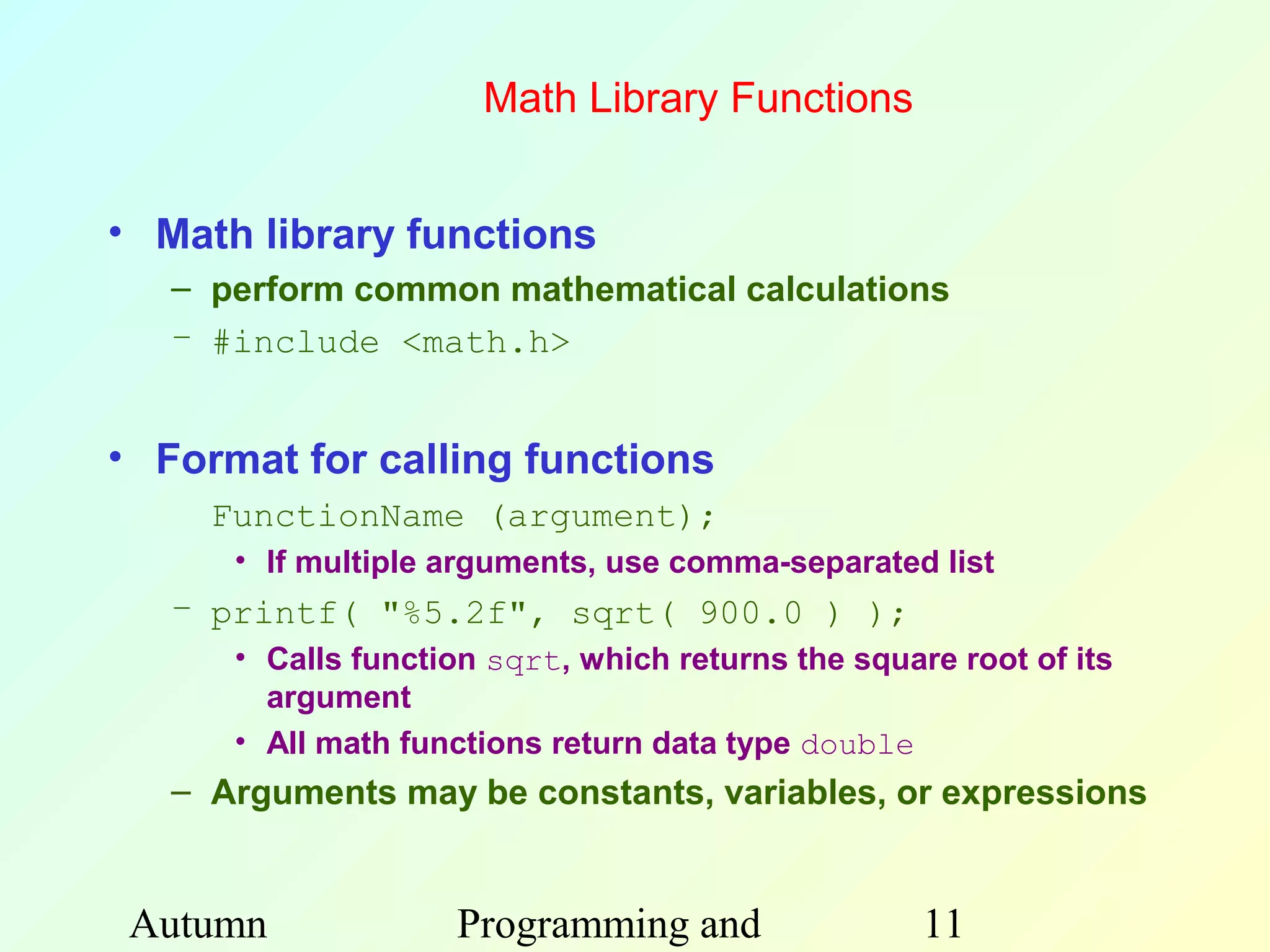
Math Library Functions


• Math library functions
   – perform common mathematical calculations
   – #include <math.h>


• Format for calling functions
     FunctionName (argument);
      • If multiple arguments, use comma-separated list
   – printf( "%5.2f", sqrt( 900.0 ) );
      • Calls function sqrt, which returns the square root of its
        argument
      • All math functions return data type double
   – Arguments may be constants, variables, or expressions


 Autumn             Programming and                 11
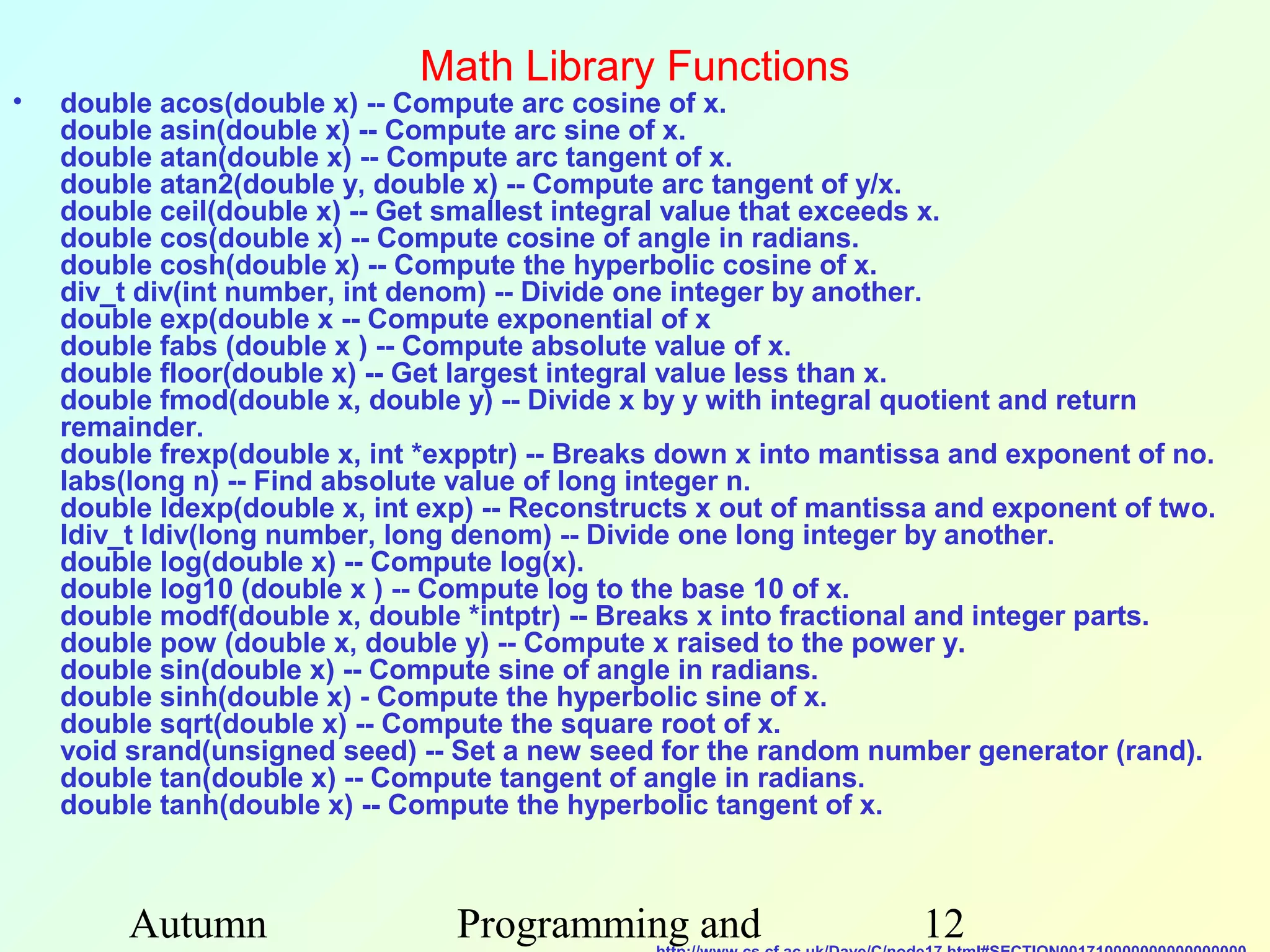
Math Library Functions
•   double acos(double x) -- Compute arc cosine of x.
    double asin(double x) -- Compute arc sine of x.
    double atan(double x) -- Compute arc tangent of x.
    double atan2(double y, double x) -- Compute arc tangent of y/x.
    double ceil(double x) -- Get smallest integral value that exceeds x.
    double cos(double x) -- Compute cosine of angle in radians.
    double cosh(double x) -- Compute the hyperbolic cosine of x.
    div_t div(int number, int denom) -- Divide one integer by another.
    double exp(double x -- Compute exponential of x
    double fabs (double x ) -- Compute absolute value of x.
    double floor(double x) -- Get largest integral value less than x.
    double fmod(double x, double y) -- Divide x by y with integral quotient and return
    remainder.
    double frexp(double x, int *expptr) -- Breaks down x into mantissa and exponent of no.
    labs(long n) -- Find absolute value of long integer n.
    double ldexp(double x, int exp) -- Reconstructs x out of mantissa and exponent of two.
    ldiv_t ldiv(long number, long denom) -- Divide one long integer by another.
    double log(double x) -- Compute log(x).
    double log10 (double x ) -- Compute log to the base 10 of x.
    double modf(double x, double *intptr) -- Breaks x into fractional and integer parts.
    double pow (double x, double y) -- Compute x raised to the power y.
    double sin(double x) -- Compute sine of angle in radians.
    double sinh(double x) - Compute the hyperbolic sine of x.
    double sqrt(double x) -- Compute the square root of x.
    void srand(unsigned seed) -- Set a new seed for the random number generator (rand).
    double tan(double x) -- Compute tangent of angle in radians.
    double tanh(double x) -- Compute the hyperbolic tangent of x.


         Autumn                  Programming and                    12
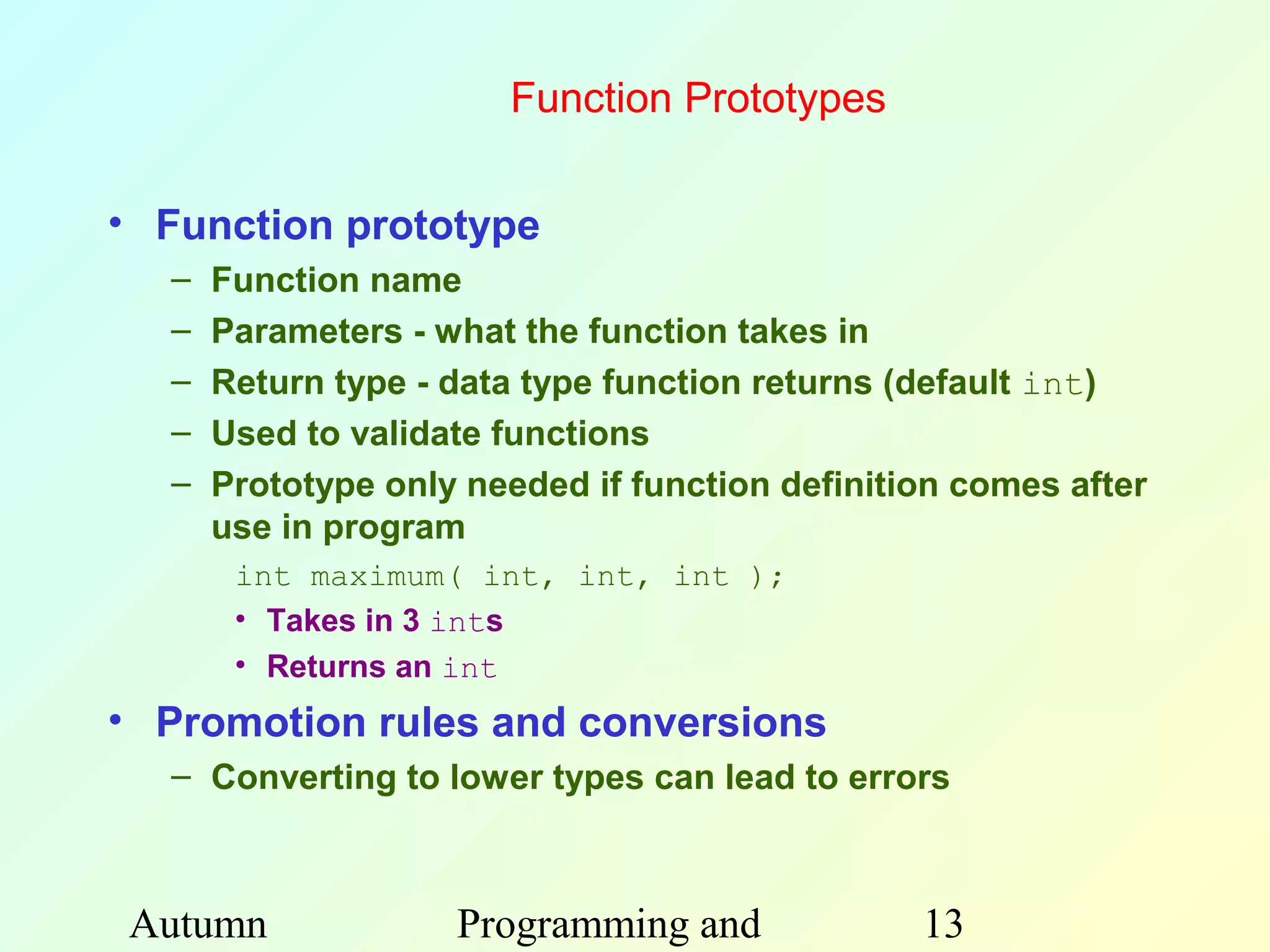
Function Prototypes

• Function prototype
  –   Function name
  –   Parameters - what the function takes in
  –   Return type - data type function returns (default int)
  –   Used to validate functions
  –   Prototype only needed if function definition comes after
      use in program
       int maximum( int, int, int );
       • Takes in 3 ints
       • Returns an int
• Promotion rules and conversions
  – Converting to lower types can lead to errors


Autumn              Programming and             13
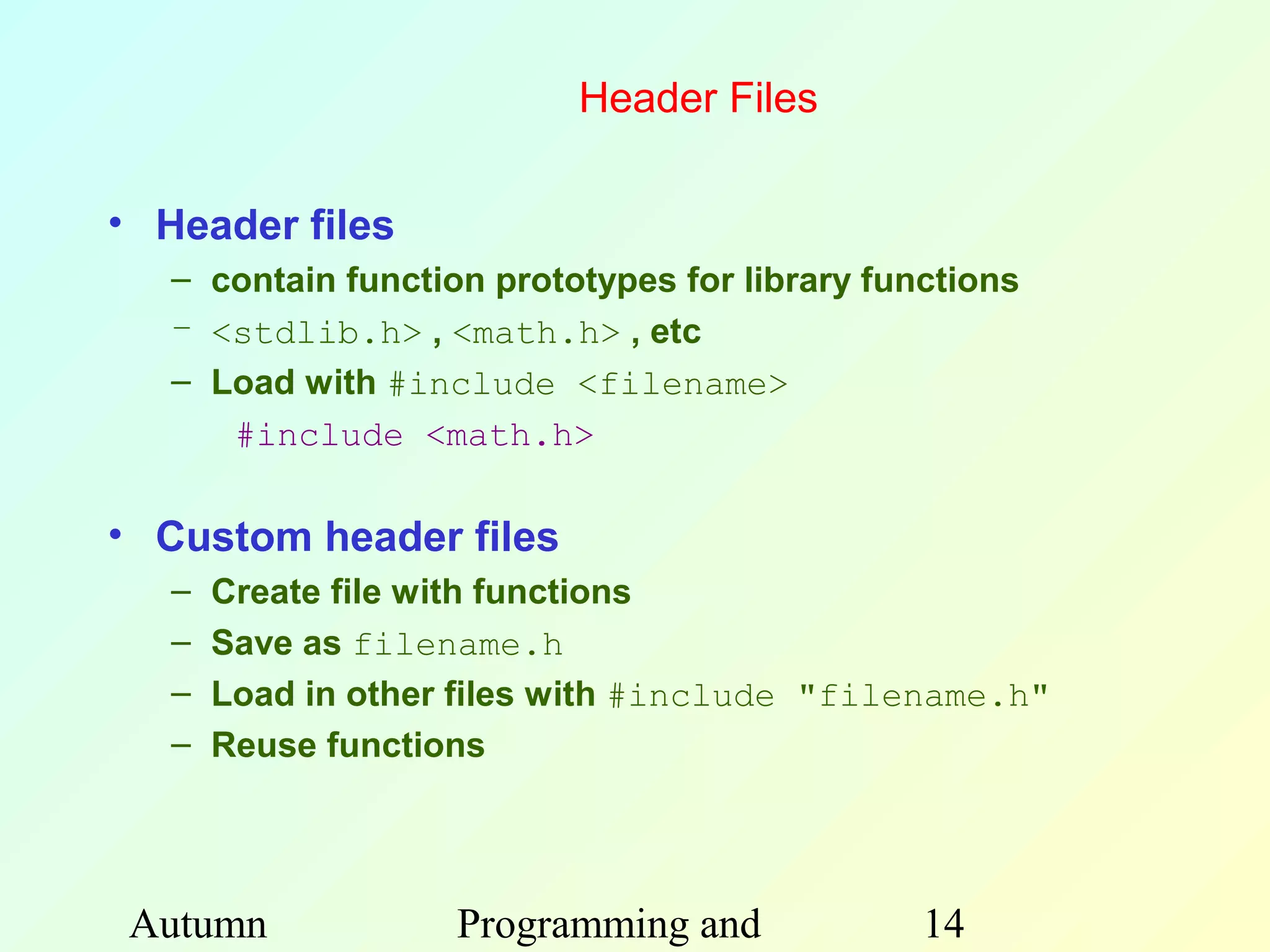
Header Files

• Header files
   – contain function prototypes for library functions
   – <stdlib.h> , <math.h> , etc
   – Load with #include <filename>
      #include <math.h>

• Custom header files
   –   Create file with functions
   –   Save as filename.h
   –   Load in other files with #include "filename.h"
   –   Reuse functions


 Autumn             Programming and             14
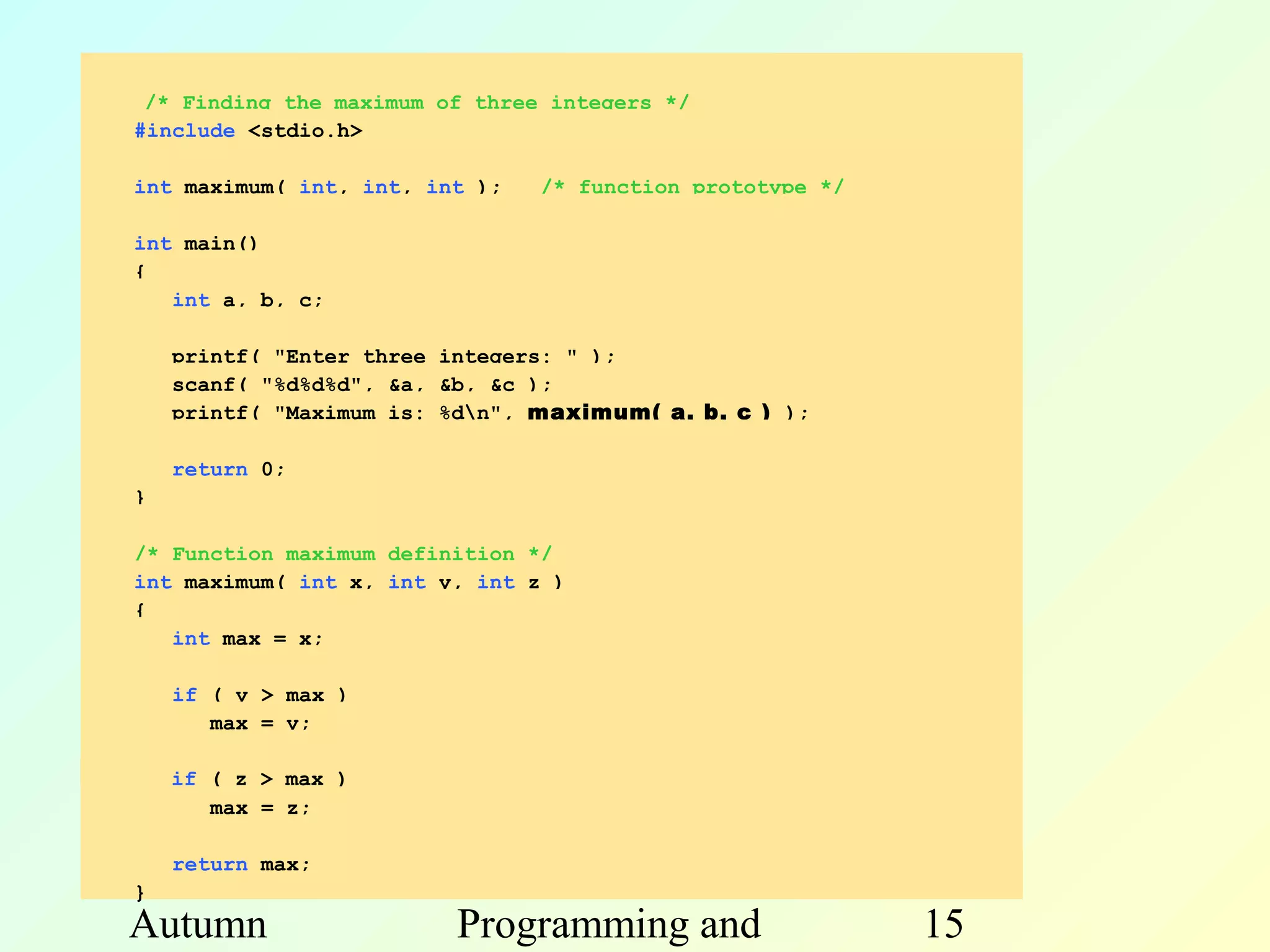
/* Finding the maximum of three integers */
#include <stdio.h>

int maximum( int, int, int );   /* function prototype */

int main()
{
   int a, b, c;

    printf( "Enter three integers: " );
    scanf( "%d%d%d", &a, &b, &c );
    printf( "Maximum is: %dn", maximum( a, b, c ) );

    return 0;
}

/* Function maximum definition */
int maximum( int x, int y, int z )
{
   int max = x;

    if ( y > max )
       max = y;

    if ( z > max )
       max = z;

    return max;
}
Autumn                   Programming and                   15
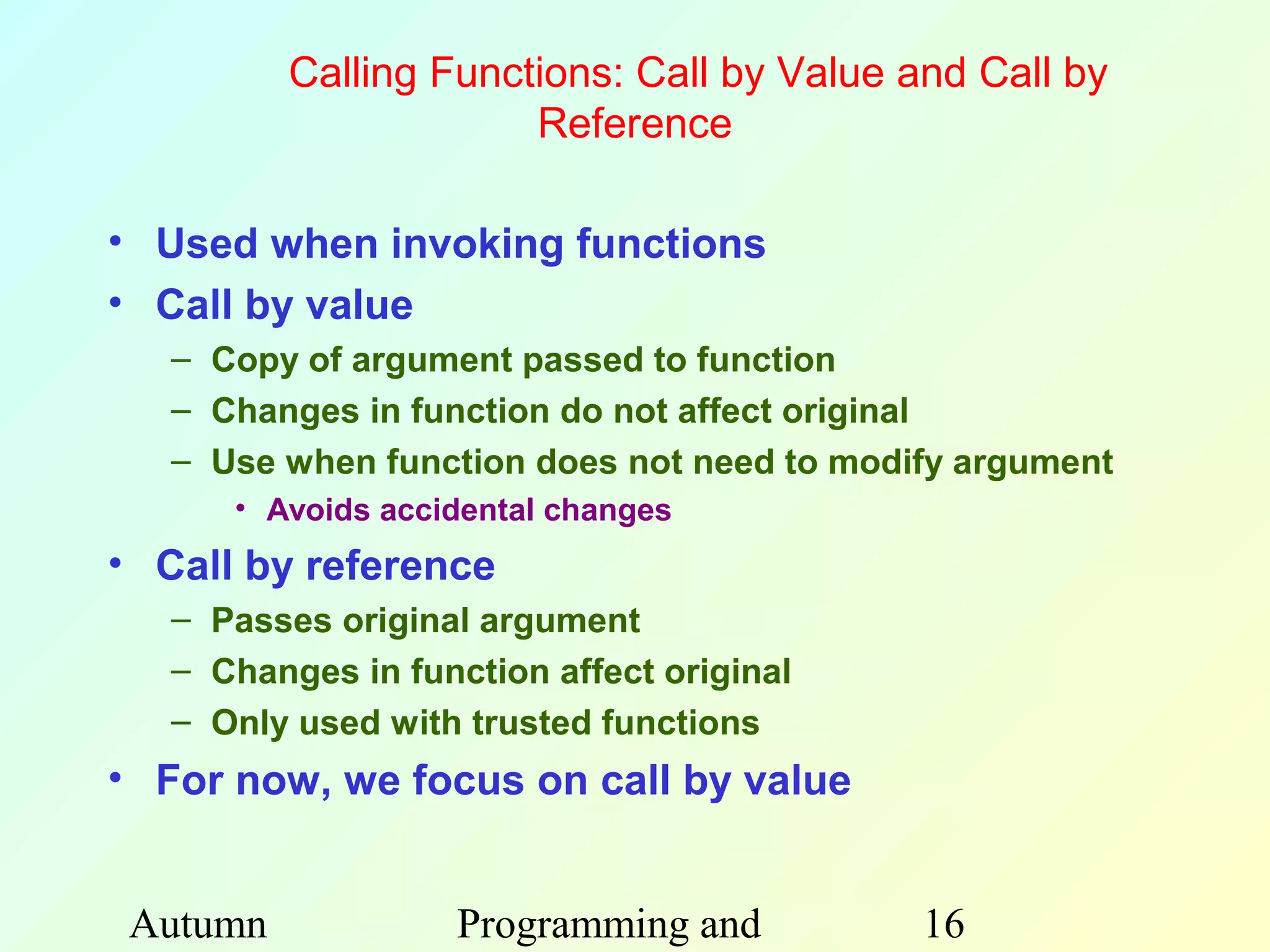
Calling Functions: Call by Value and Call by
                       Reference

• Used when invoking functions
• Call by value
   – Copy of argument passed to function
   – Changes in function do not affect original
   – Use when function does not need to modify argument
      • Avoids accidental changes
• Call by reference
   – Passes original argument
   – Changes in function affect original
   – Only used with trusted functions
• For now, we focus on call by value


 Autumn             Programming and         16
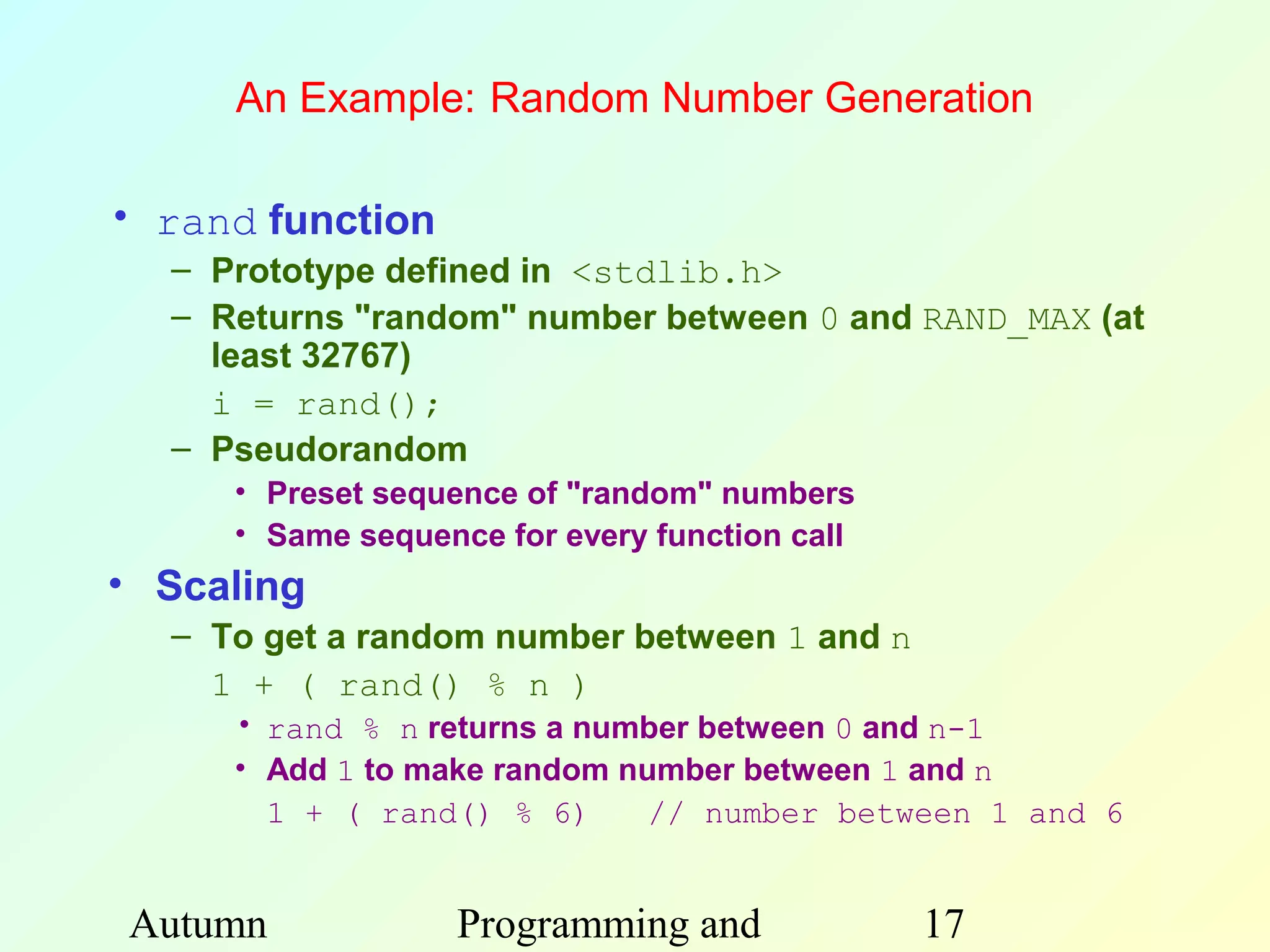
An Example: Random Number Generation

• rand function
  – Prototype defined in <stdlib.h>
  – Returns "random" number between 0 and RAND_MAX (at
    least 32767)
    i = rand();
  – Pseudorandom
     • Preset sequence of "random" numbers
     • Same sequence for every function call
• Scaling
  – To get a random number between 1 and n
    1 + ( rand() % n )
     • rand % n returns a number between 0 and n-1
     • Add 1 to make random number between 1 and n
       1 + ( rand() % 6)      // number between 1 and 6


Autumn            Programming and              17
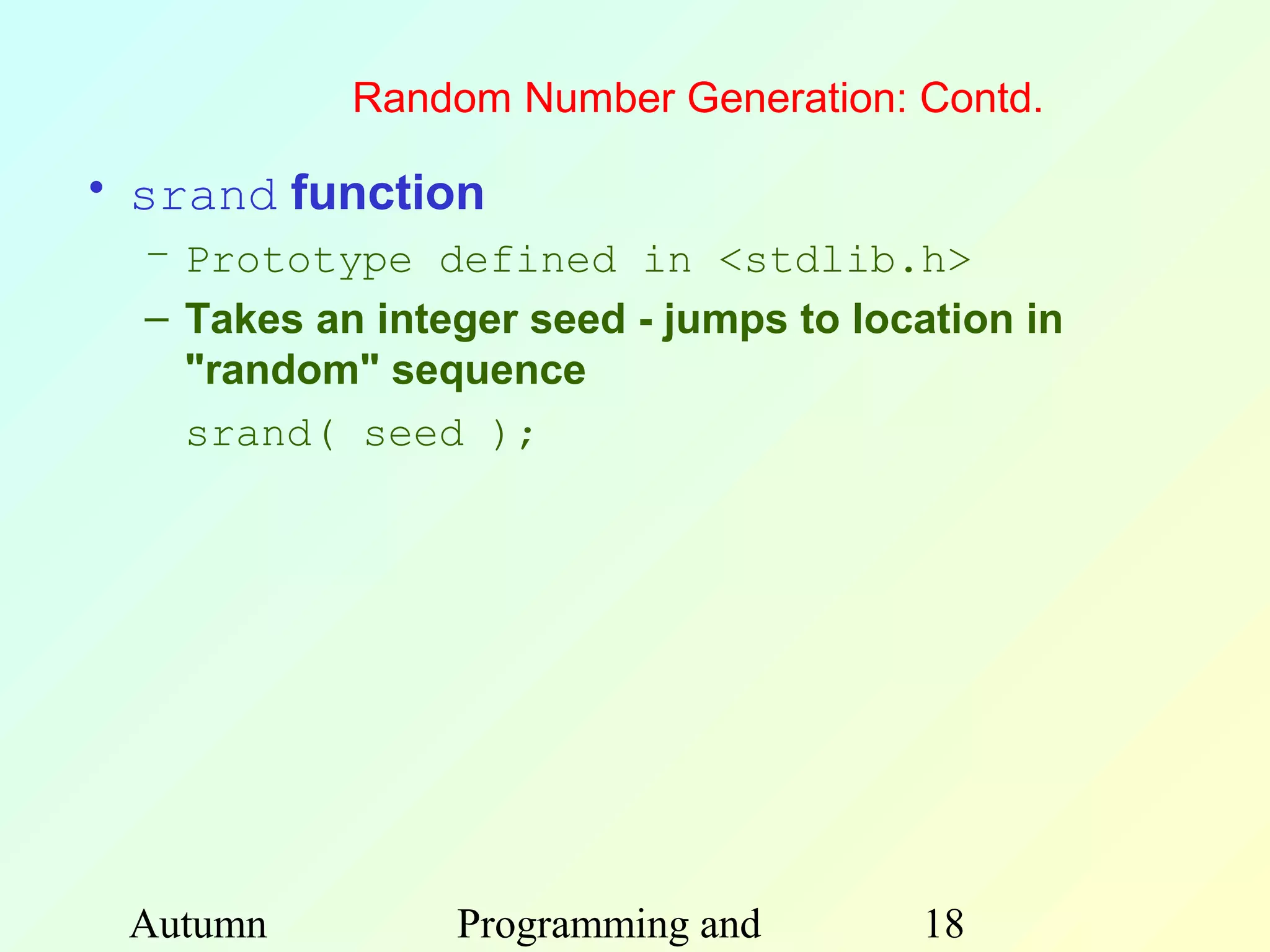
Random Number Generation: Contd.

• srand function
  – Prototype defined in <stdlib.h>
  – Takes an integer seed - jumps to location in
    "random" sequence
    srand( seed );


 Autumn          Programming and        18
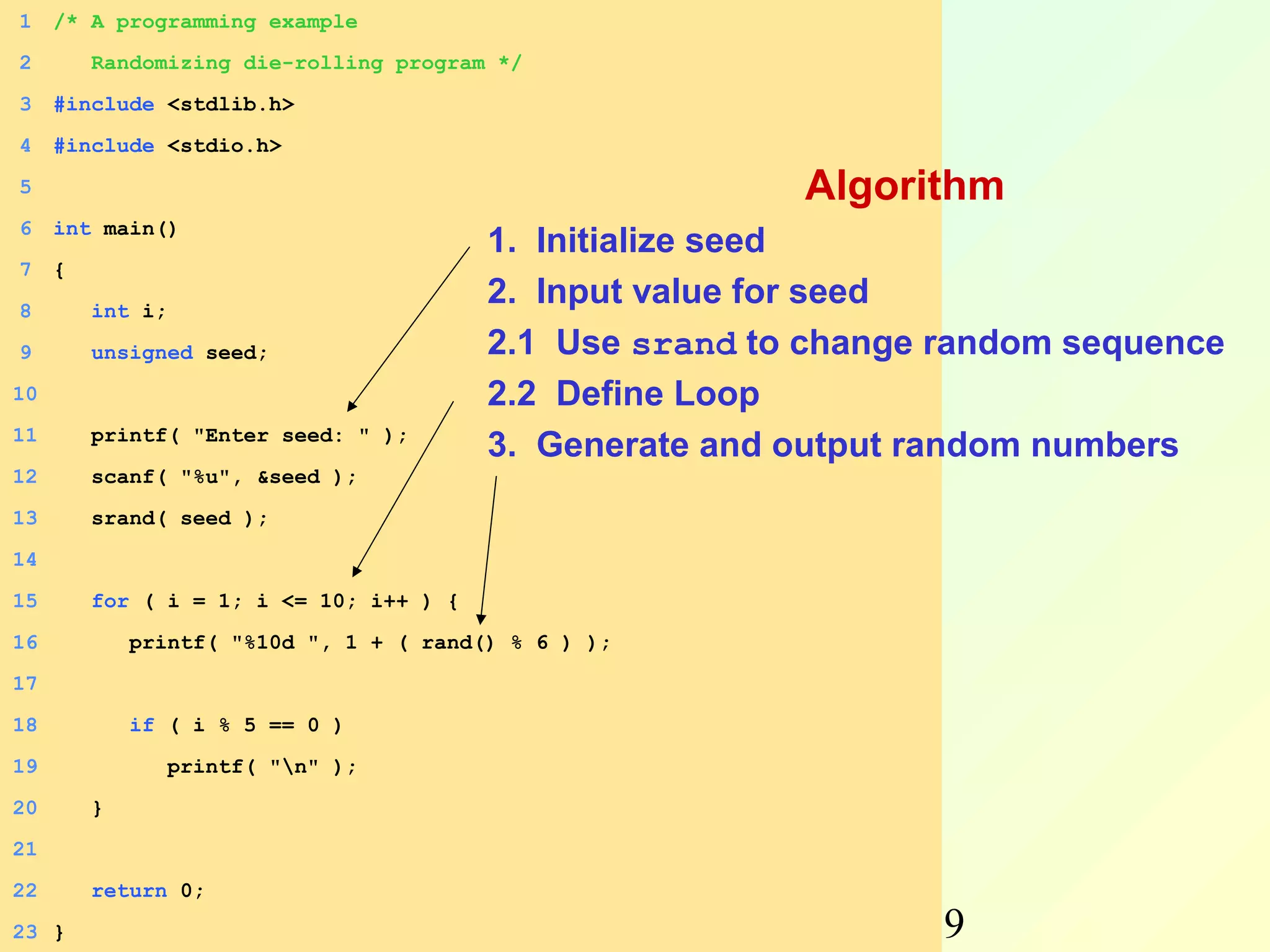
1    /* A programming example
2        Randomizing die-rolling program */
3    #include <stdlib.h>
4    #include <stdio.h>
5                                                        Algorithm
6    int main()
                                         1. Initialize seed
7    {
8        int i;
                                         2. Input value for seed
9        unsigned seed;                  2.1 Use srand to change random sequence
10                                       2.2 Define Loop
11       printf( "Enter seed: " );
                                         3. Generate and output random numbers
12       scanf( "%u", &seed );
13       srand( seed );
14
15       for ( i = 1; i <= 10; i++ ) {
16           printf( "%10d ", 1 + ( rand() % 6 ) );
17
18           if ( i % 5 == 0 )
19                printf( "n" );
20       }
21
22       return 0;
23 }         Autumn                   Programming and           19
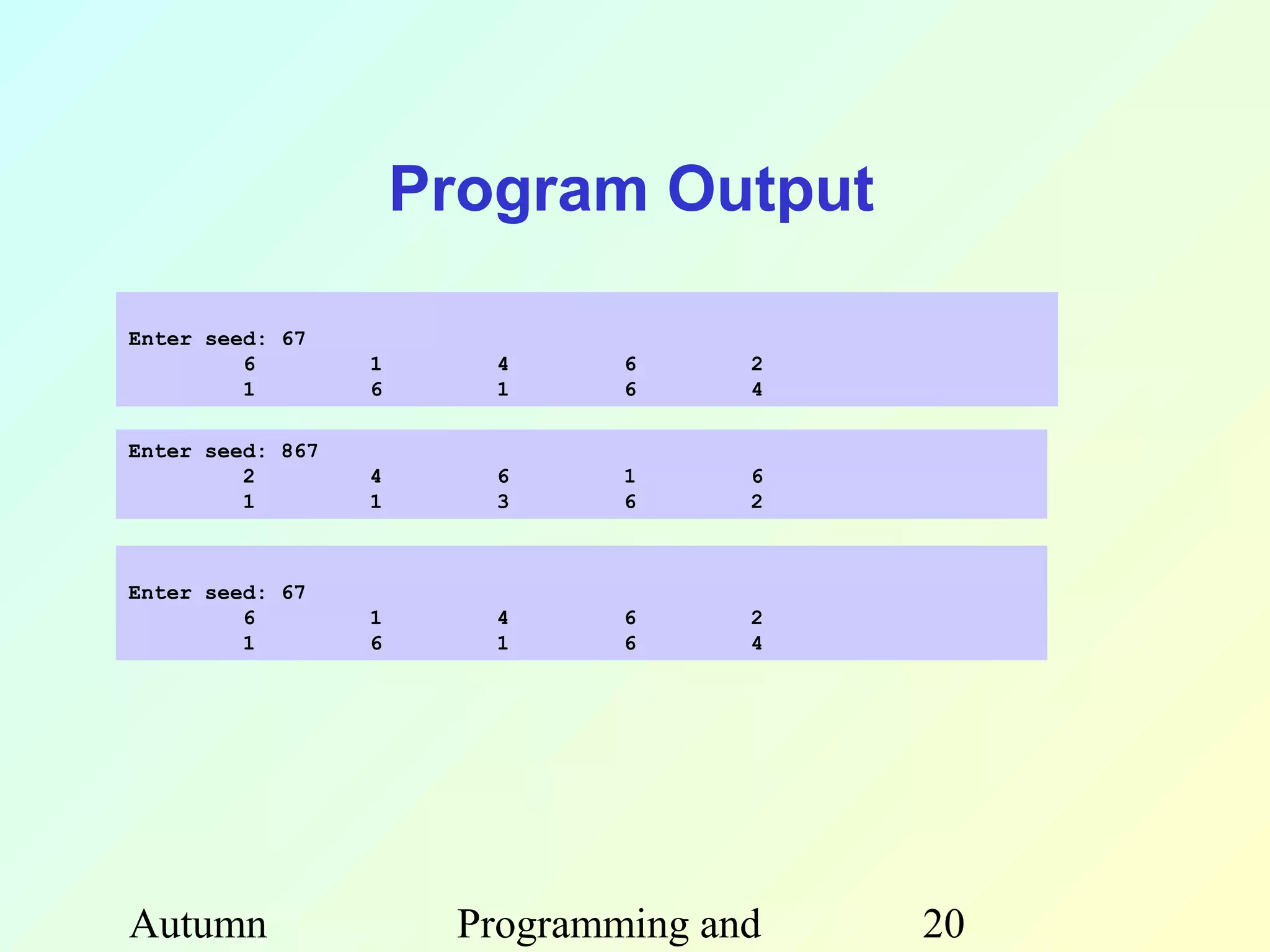
Program Output

Enter seed: 67
         6        1      4     6     2
         1        6      1     6     4

Enter seed: 867
         2        4      6     1     6
         1        1      3     6     2


Enter seed: 67
         6        1      4     6     2
         1        6      1     6     4


Autumn                 Programming and   20
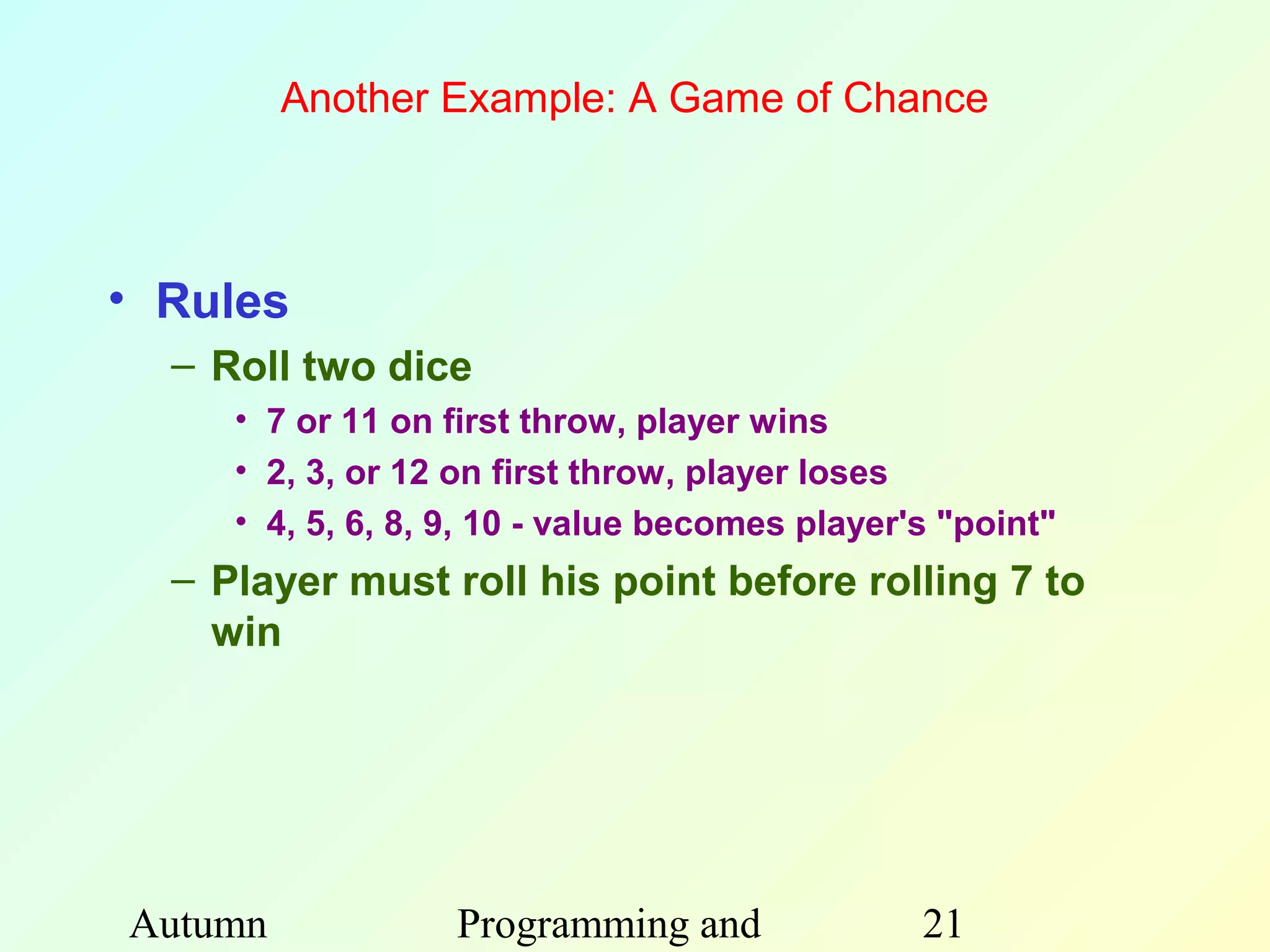
Another Example: A Game of Chance


• Rules
  – Roll two dice
     • 7 or 11 on first throw, player wins
     • 2, 3, or 12 on first throw, player loses
     • 4, 5, 6, 8, 9, 10 - value becomes player's "point"
  – Player must roll his point before rolling 7 to
    win


Autumn             Programming and              21
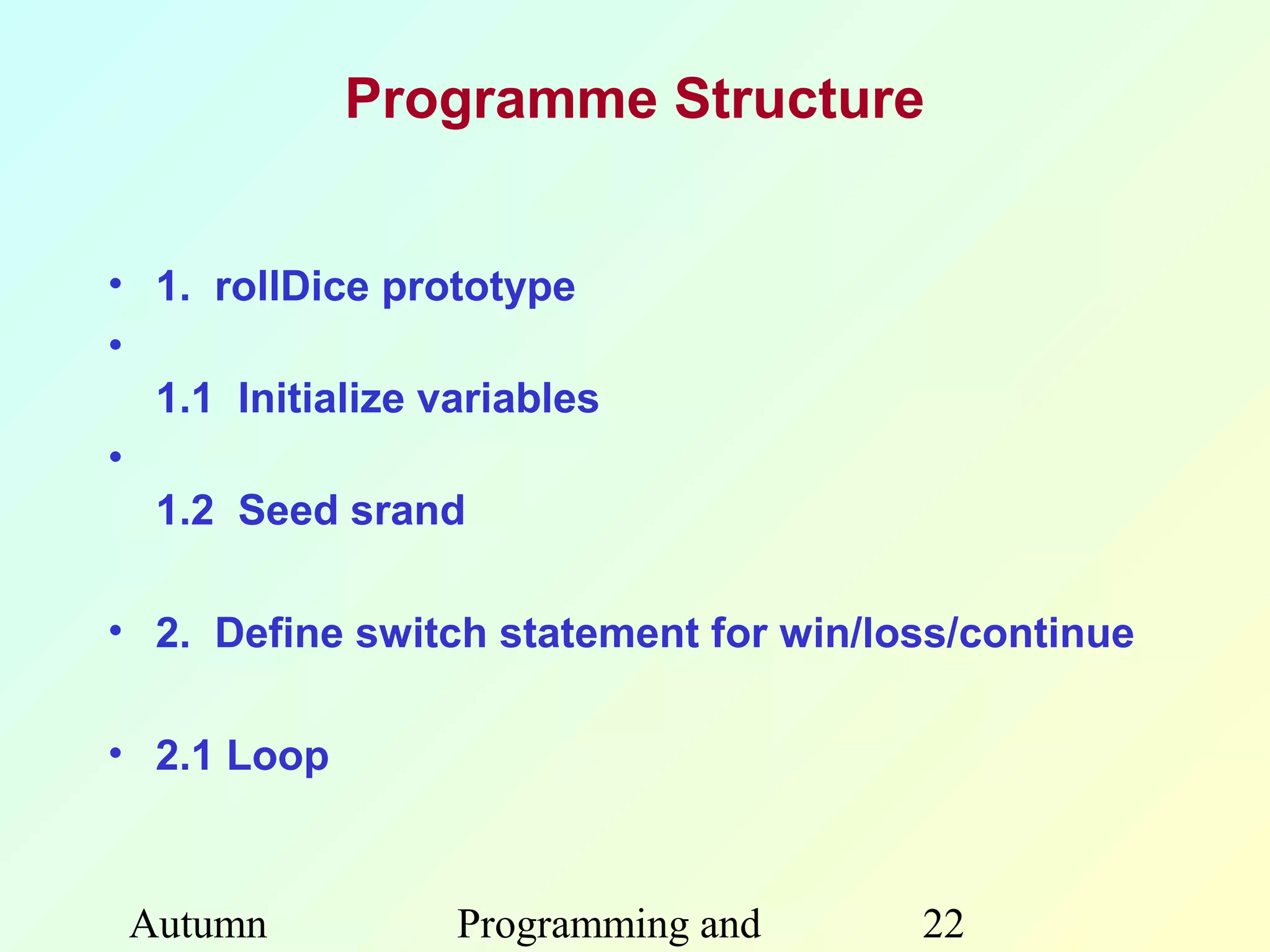
Programme Structure


• 1. rollDice prototype
•
  1.1 Initialize variables
•
  1.2 Seed srand

• 2. Define switch statement for win/loss/continue

• 2.1 Loop


 Autumn           Programming and      22
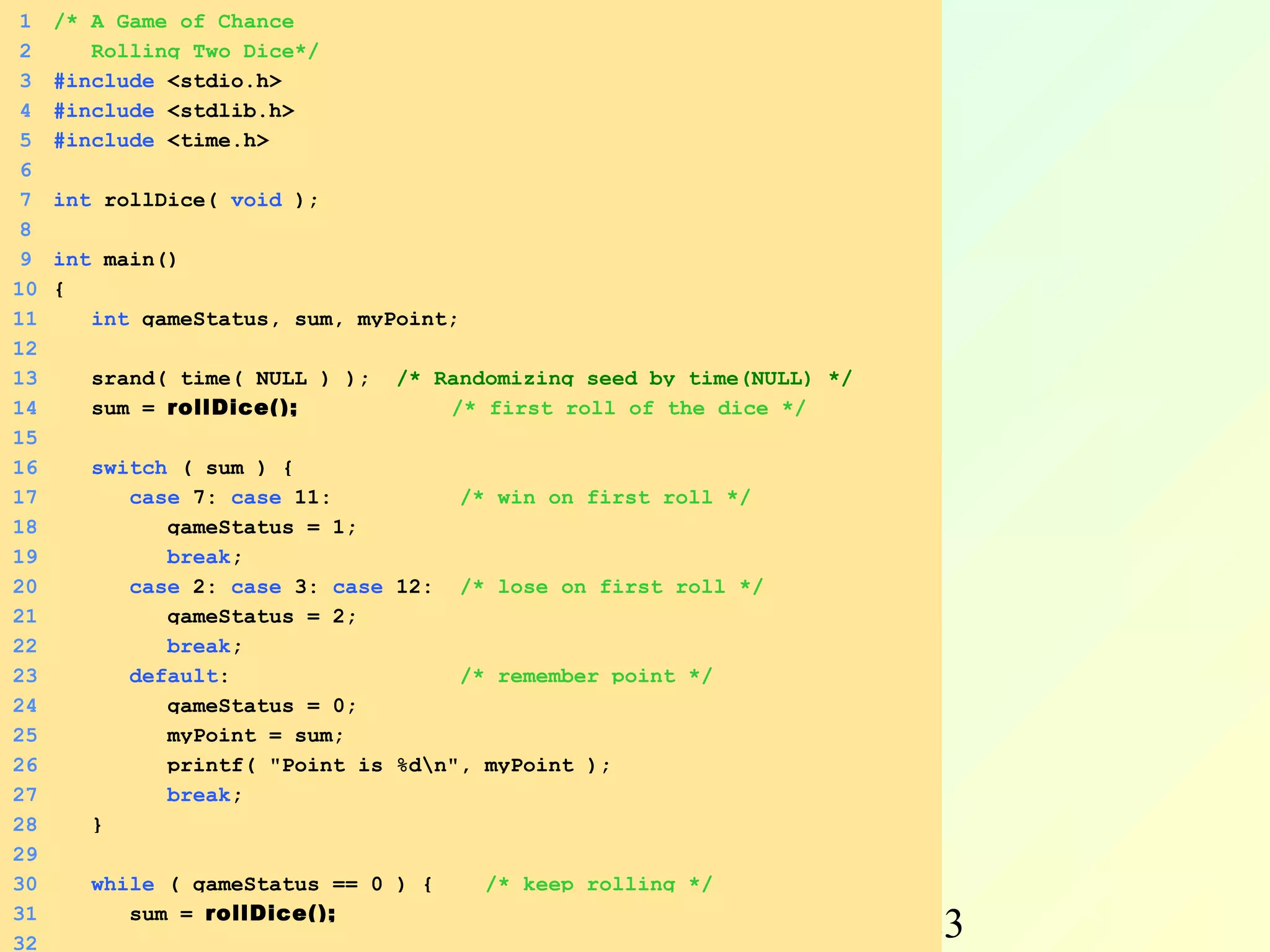
1   /* A Game of Chance
 2      Rolling Two Dice*/
 3   #include <stdio.h>
 4   #include <stdlib.h>
 5   #include <time.h>
 6
 7   int rollDice( void );
 8
 9   int main()
10   {
11      int gameStatus, sum, myPoint;
12
13      srand( time( NULL ) );   /* Randomizing seed by time(NULL) */
14      sum = rollDice();            /* first roll of the dice */
15
16      switch ( sum ) {
17         case 7: case 11:          /* win on first roll */
18            gameStatus = 1;
19            break;
20         case 2: case 3: case 12: /* lose on first roll */
21            gameStatus = 2;
22            break;
23         default:                  /* remember point */
24            gameStatus = 0;
25            myPoint = sum;
26            printf( "Point is %dn", myPoint );
27            break;
28      }
29
30      while ( gameStatus == 0 ) {     /* keep rolling */
           sum = rollDice();
31
32
          Autumn                      Programming and                   23
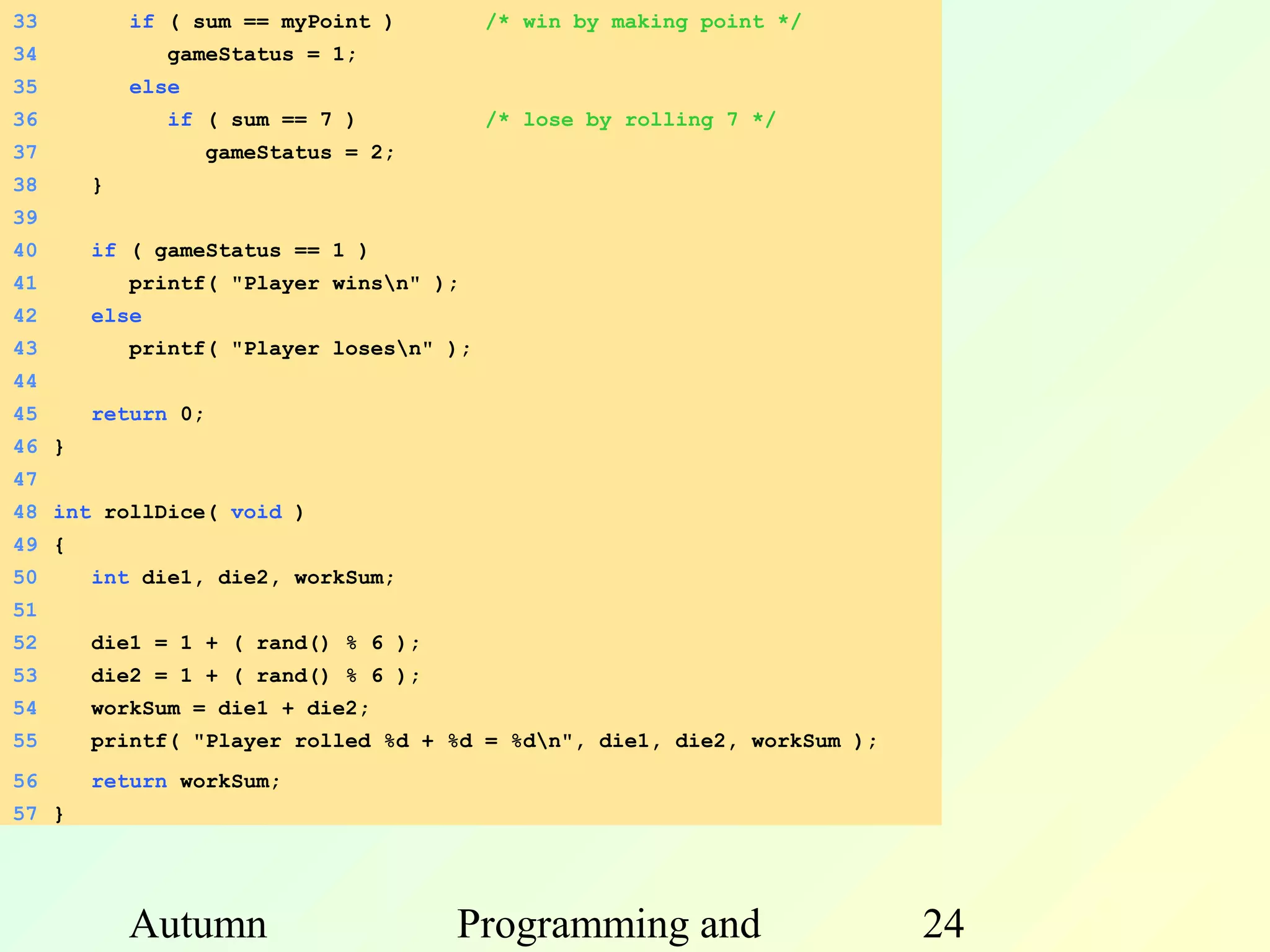
33         if ( sum == myPoint )         /* win by making point */
34            gameStatus = 1;
35         else
36            if ( sum == 7 )            /* lose by rolling 7 */
37                 gameStatus = 2;
38     }
39
40     if ( gameStatus == 1 )
41         printf( "Player winsn" );
42     else
43         printf( "Player losesn" );
44
45     return 0;
46 }
47
48 int rollDice( void )
49 {
50     int die1, die2, workSum;
51
52     die1 = 1 + ( rand() % 6 );
53     die2 = 1 + ( rand() % 6 );
54     workSum = die1 + die2;
55
56
                                2.2 Print win/loss
       printf( "Player rolled %d + %d = %dn", die1, die2, workSum );
       return workSum;
57 }


           Autumn                    Programming and                    24
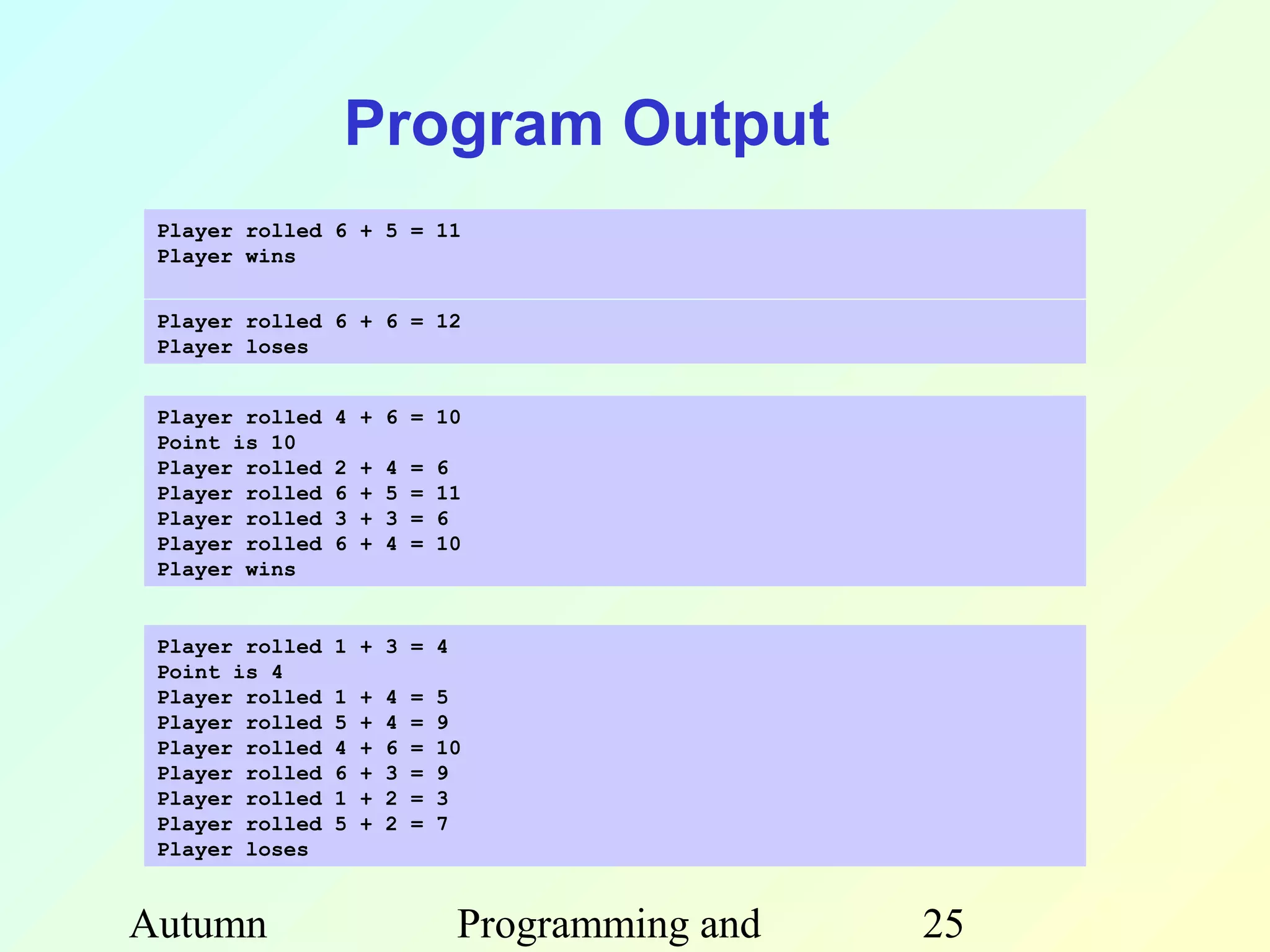
Program Output
 Player rolled 6 + 5 = 11
 Player wins


 Player rolled 6 + 6 = 12
 Player loses


 Player rolled   4 + 6 = 10
 Point is 10
 Player rolled   2   +   4   =   6
 Player rolled   6   +   5   =   11
 Player rolled   3   +   3   =   6
 Player rolled   6   +   4   =   10
 Player wins


 Player rolled   1 + 3 = 4
 Point is 4
 Player rolled   1   +   4   =   5
 Player rolled   5   +   4   =   9
 Player rolled   4   +   6   =   10
 Player rolled   6   +   3   =   9
 Player rolled   1   +   2   =   3
 Player rolled   5   +   2   =   7
 Player loses


Autumn                            Programming and   25
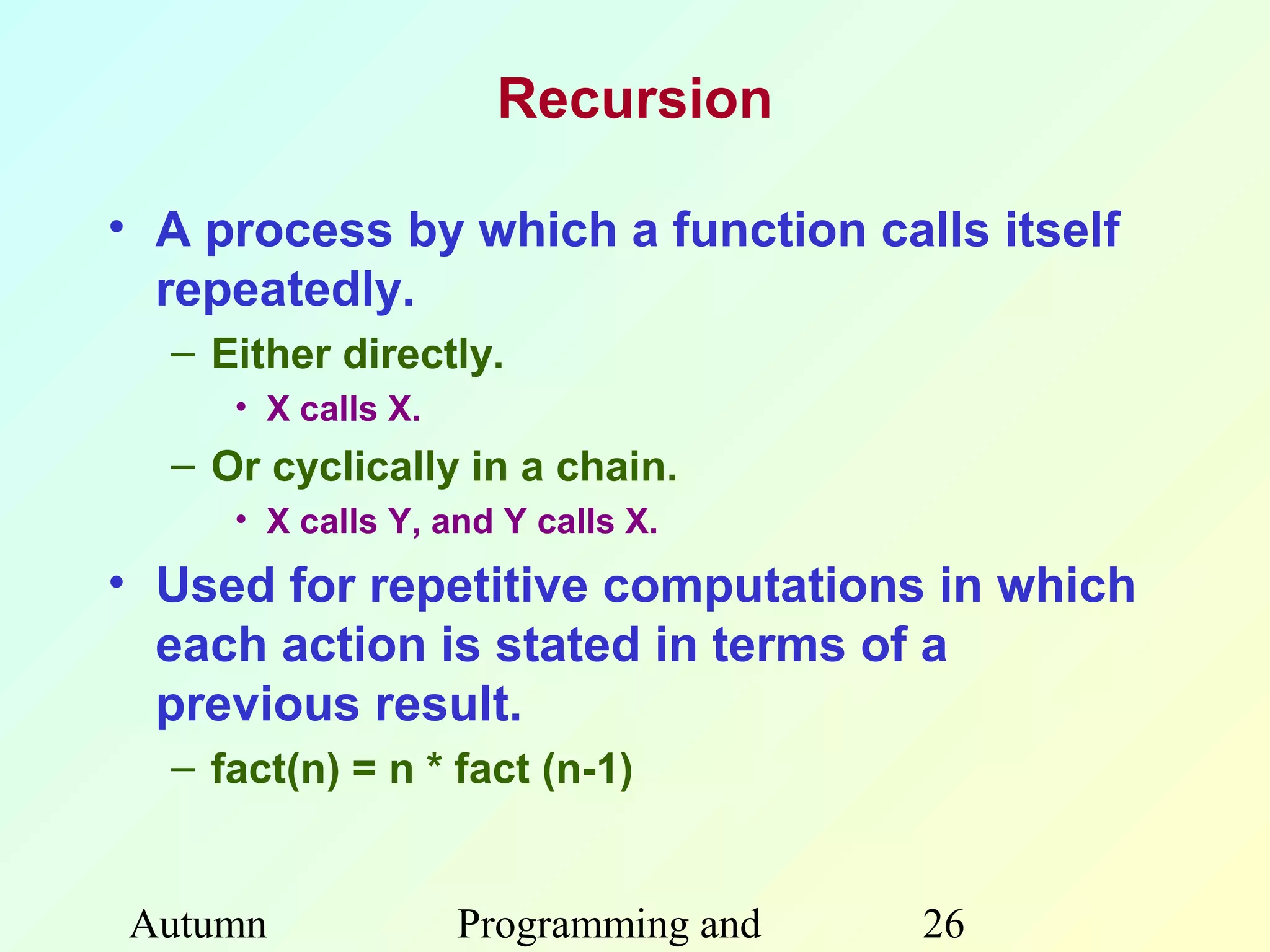
Recursion

• A process by which a function calls itself
  repeatedly.
  – Either directly.
     • X calls X.
  – Or cyclically in a chain.
     • X calls Y, and Y calls X.
• Used for repetitive computations in which
  each action is stated in terms of a
  previous result.
  – fact(n) = n * fact (n-1)


Autumn              Programming and   26
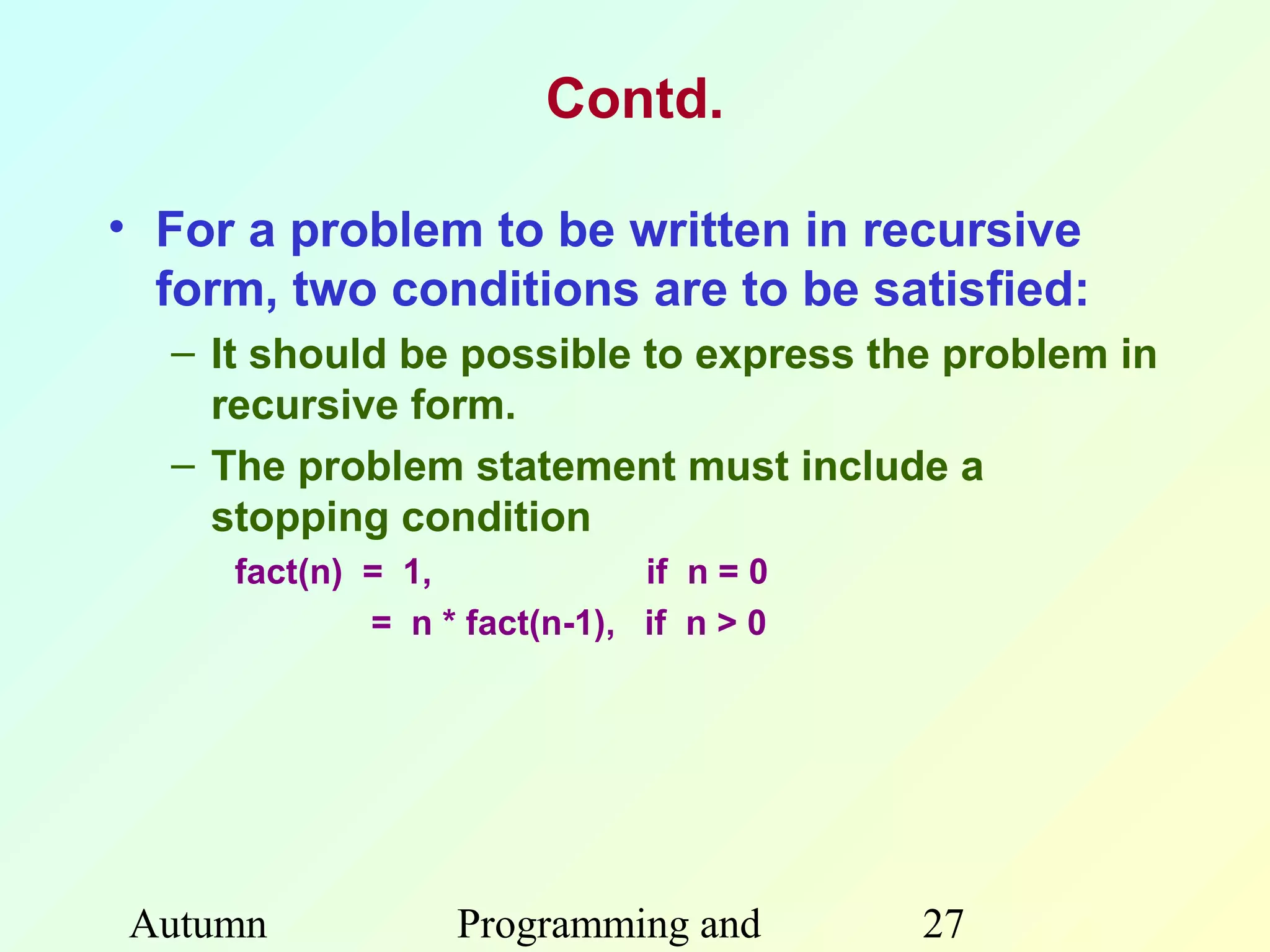
Contd.

• For a problem to be written in recursive
  form, two conditions are to be satisfied:
  – It should be possible to express the problem in
    recursive form.
  – The problem statement must include a
    stopping condition
     fact(n) = 1,             if n = 0
             = n * fact(n-1), if n > 0


Autumn            Programming and        27
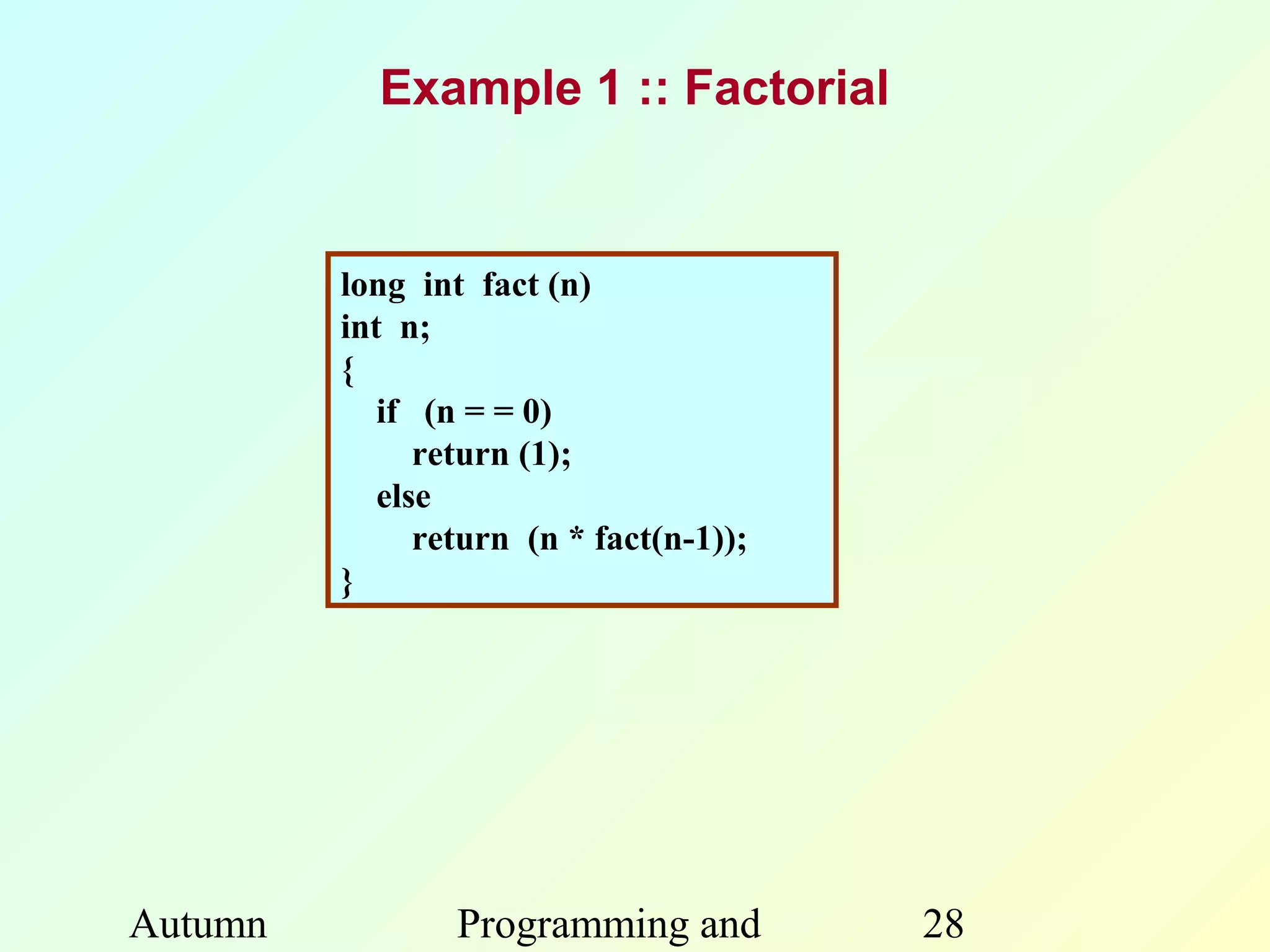
Example 1 :: Factorial


         long int fact (n)
         int n;
         {
            if (n = = 0)
               return (1);
            else
               return (n * fact(n-1));
         }


Autumn           Programming and         28
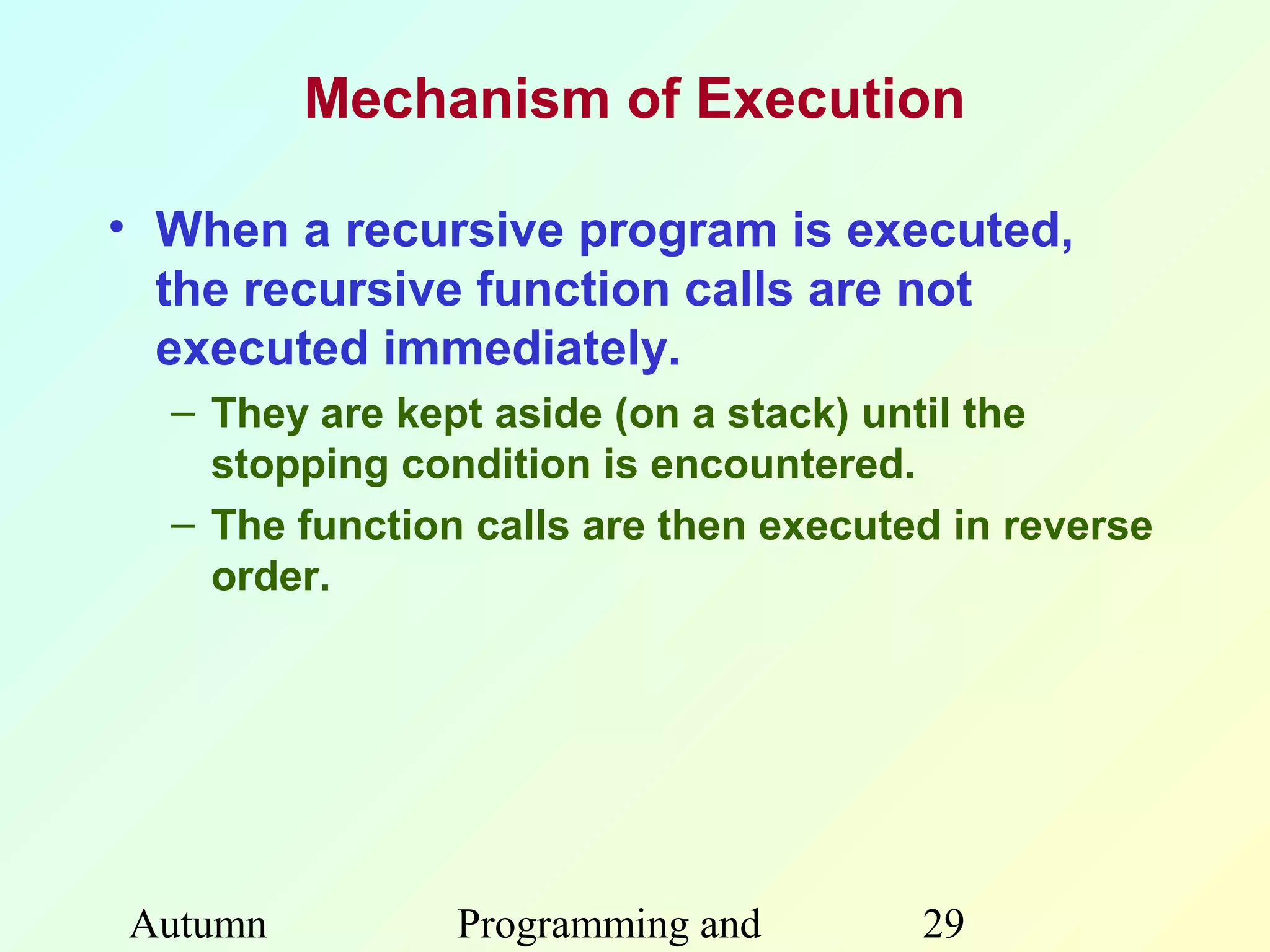
Mechanism of Execution

• When a recursive program is executed,
  the recursive function calls are not
  executed immediately.
  – They are kept aside (on a stack) until the
    stopping condition is encountered.
  – The function calls are then executed in reverse
    order.


Autumn          Programming and        29
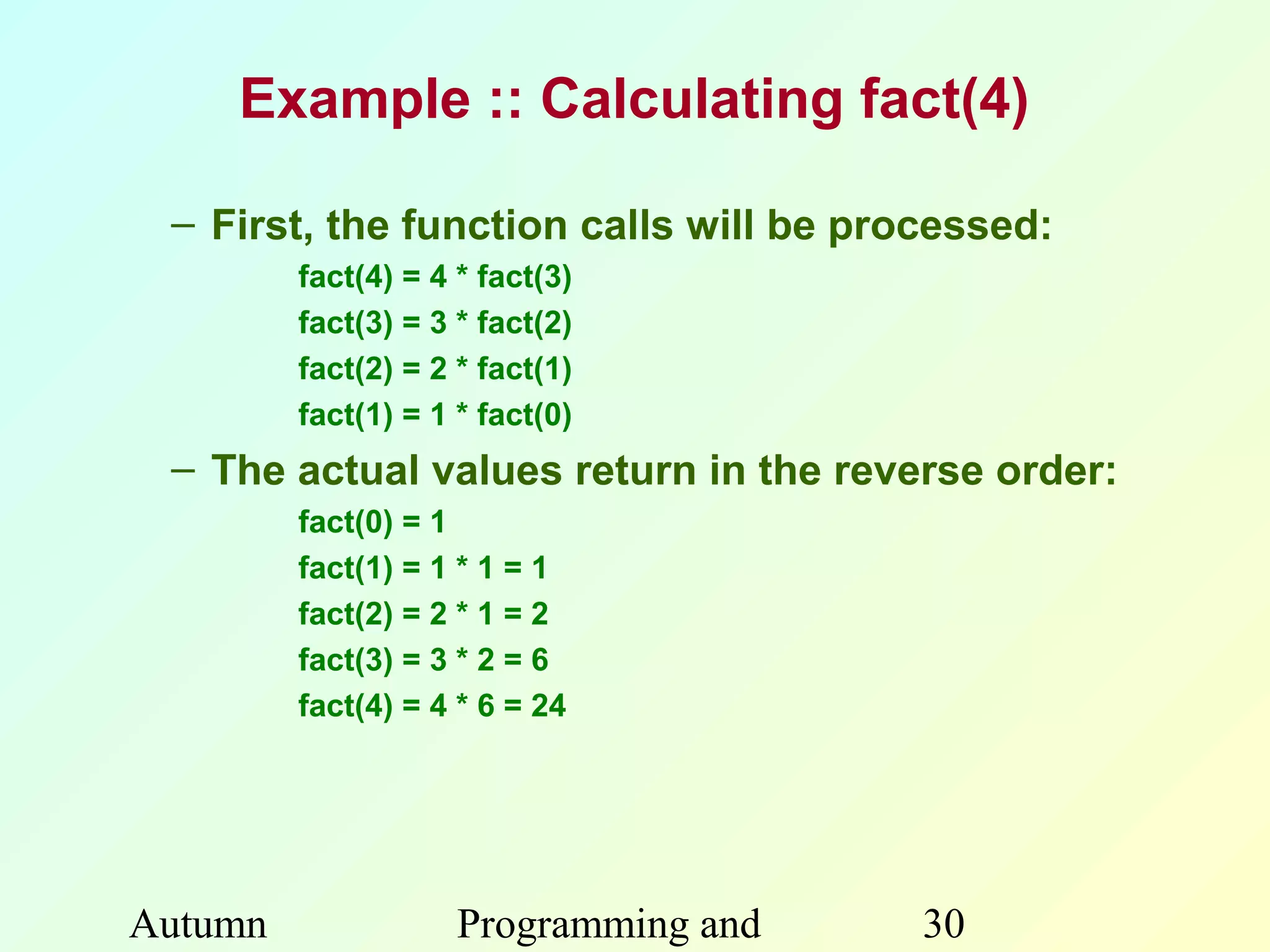
Example :: Calculating fact(4)

 – First, the function calls will be processed:
         fact(4) = 4 * fact(3)
         fact(3) = 3 * fact(2)
         fact(2) = 2 * fact(1)
         fact(1) = 1 * fact(0)
 – The actual values return in the reverse order:
         fact(0) = 1
         fact(1) = 1 * 1 = 1
         fact(2) = 2 * 1 = 2
         fact(3) = 3 * 2 = 6
         fact(4) = 4 * 6 = 24


Autumn               Programming and    30
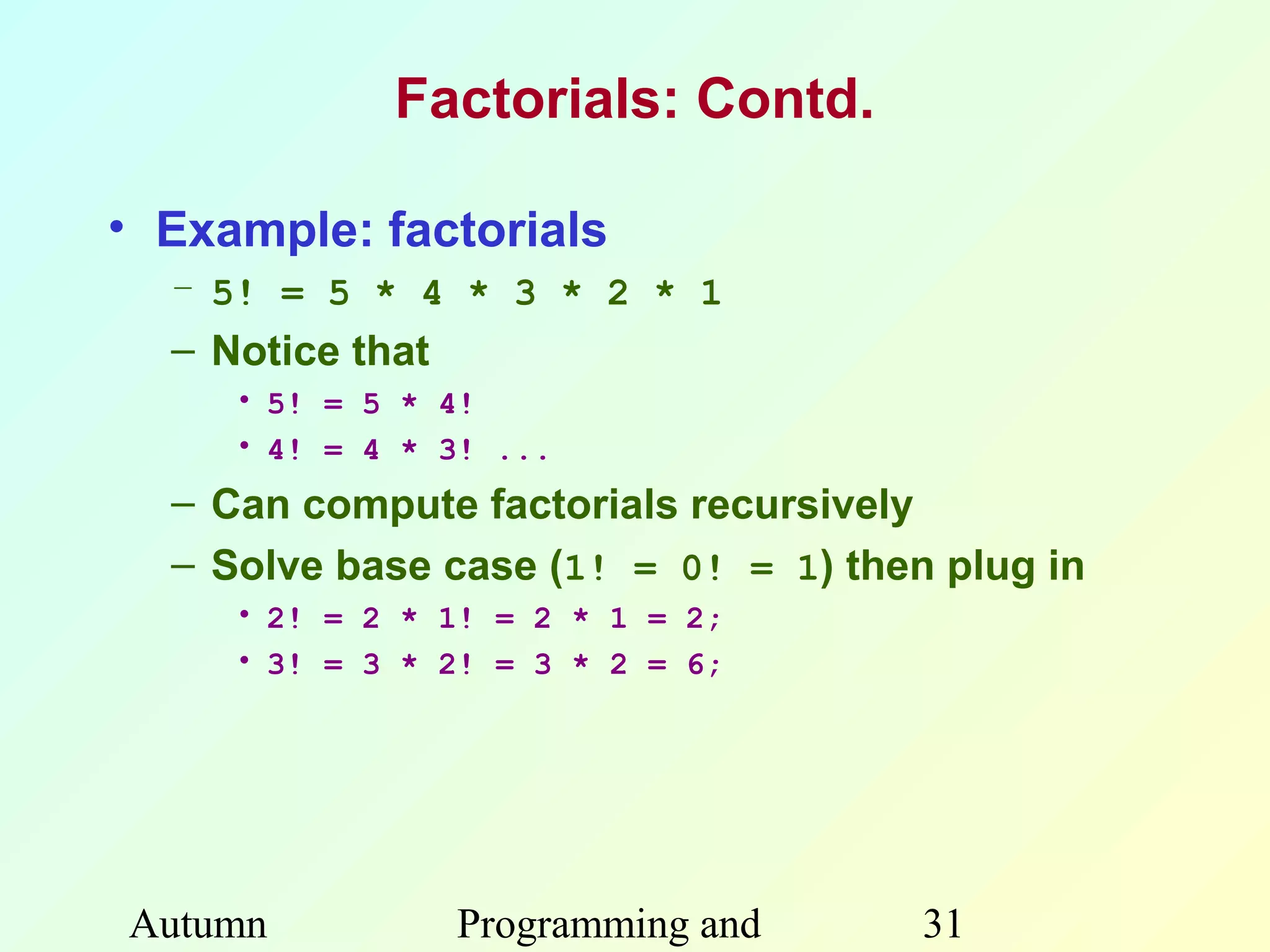
Factorials: Contd.

• Example: factorials
  – 5! = 5 * 4 * 3 * 2 * 1
  – Notice that
     • 5! = 5 * 4!
     • 4! = 4 * 3! ...
  – Can compute factorials recursively
  – Solve base case (1! = 0! = 1) then plug in
     • 2! = 2 * 1! = 2 * 1 = 2;
     • 3! = 3 * 2! = 3 * 2 = 6;


Autumn            Programming and     31
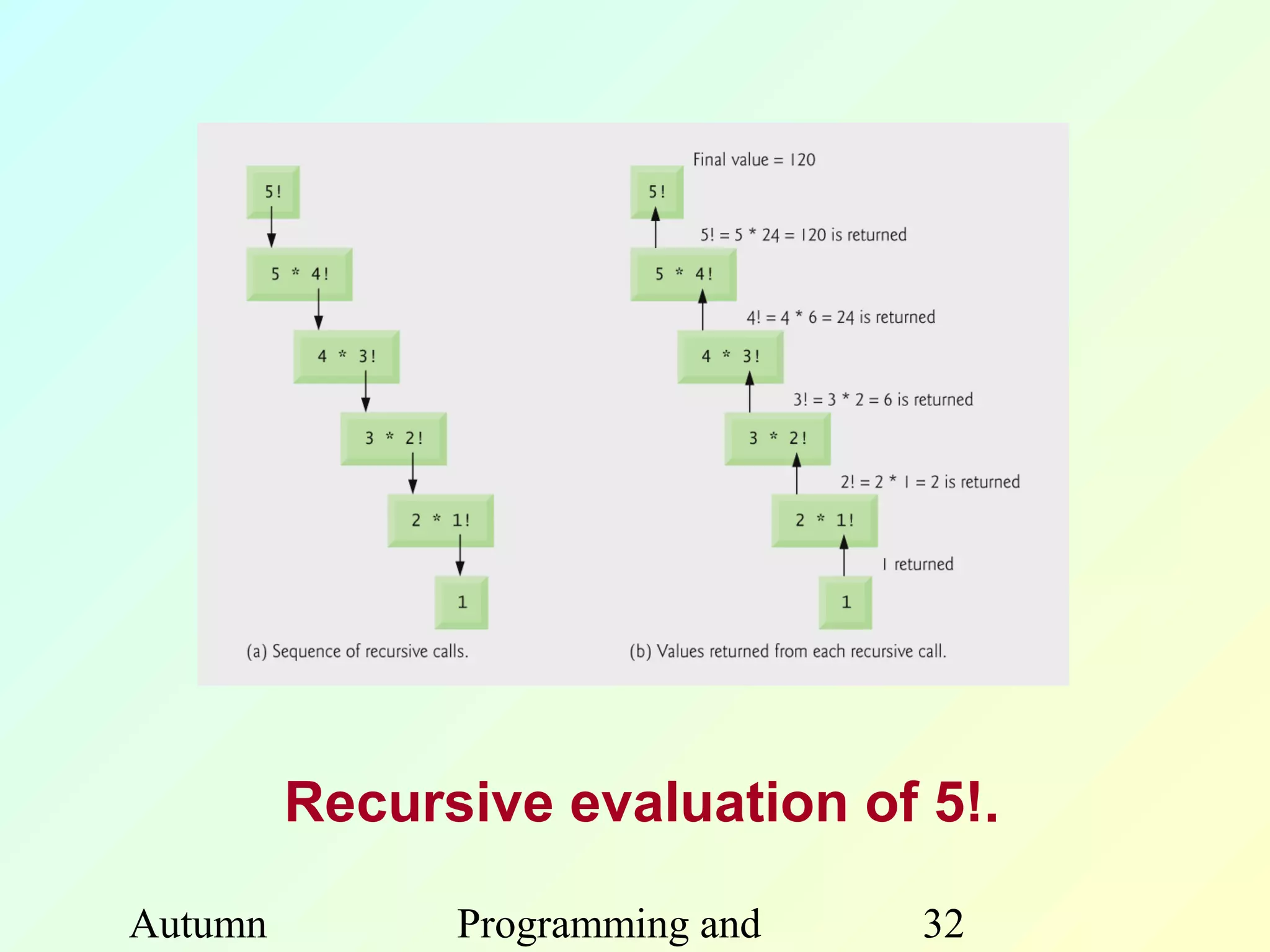
Recursive evaluation of 5!.

Autumn         Programming and   32
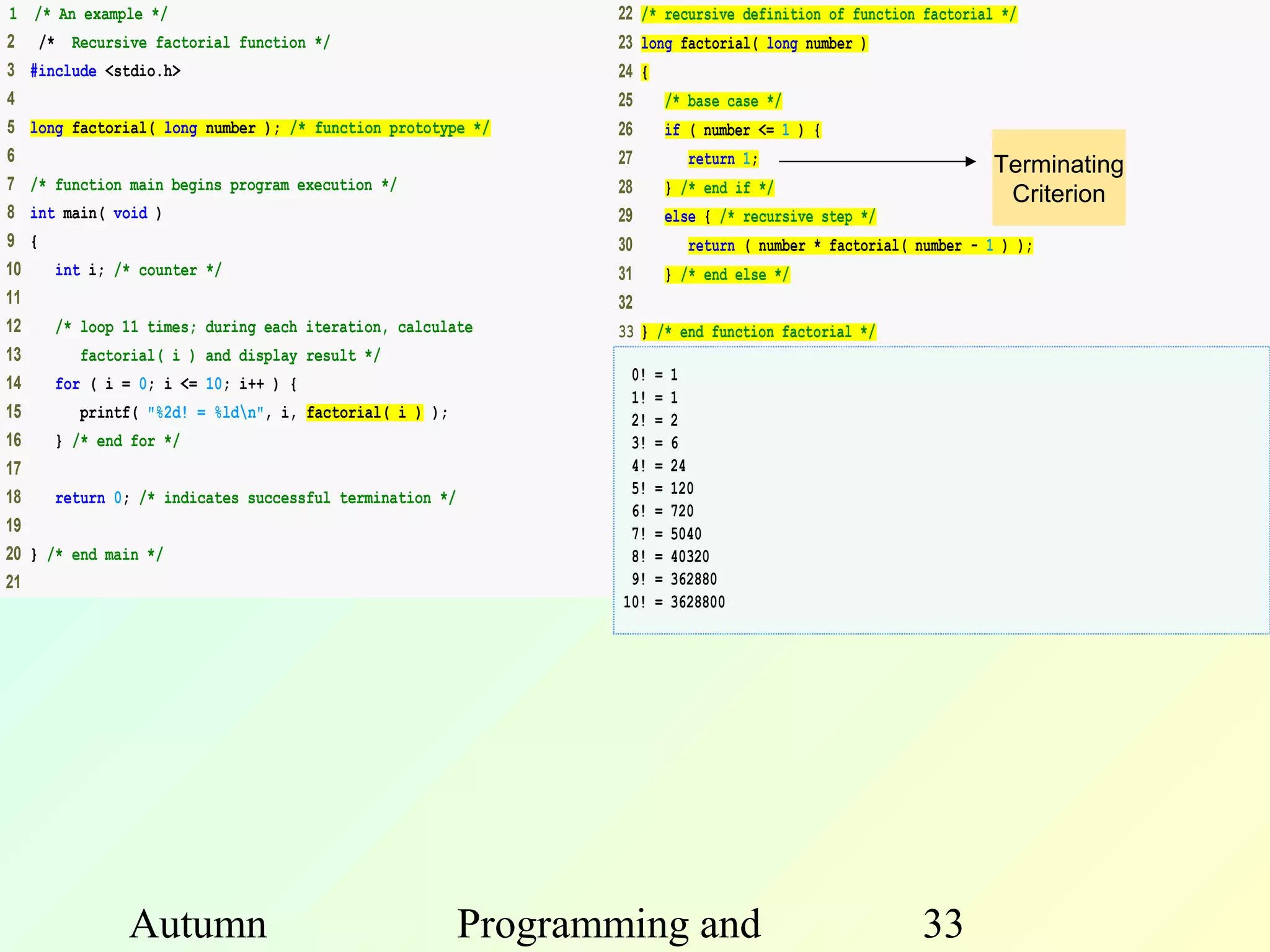
1     /* An example */                                          22 /* recursive definition of function factorial */
2     /* Recursive factorial function */                        23 long factorial( long number )
3    #include <stdio.h>                                         24 {
4                                                               25         /* base case */
5    long factorial( long number ); /* function prototype */    26         if ( number <= 1 ) {
6                                                               27           return 1;                             Terminating
7    /* function main begins program execution */               28         } /* end if */                           Criterion
8    int main( void )                                           29         else { /* recursive step */
9    {                                                          30           return ( number * factorial( number - 1 ) );
10      int i; /* counter */                                    31         } /* end else */
11                                                              32
12     /* loop 11 times; during each iteration, calculate       33 } /* end function factorial */
13        factorial( i ) and display result */
14     for ( i = 0; i <= 10; i++ ) {                              0!   =   1
                                                                  1!   =   1
15        printf( "%2d! = %ldn", i, factorial( i ) );            2!   =   2
16    } /* end for */                                             3!   =   6
17                                                                4!   =   24
18    return 0; /* indicates successful termination */            5!   =   120
                                                                  6!   =   720
19                                                                7!   =   5040
20 } /* end main */                                               8!   =   40320
21                                                                9!   =   362880
                                                                 10!   =   3628800


                Autumn                                   Programming and                                  33
Another Example :: Fibonacci number

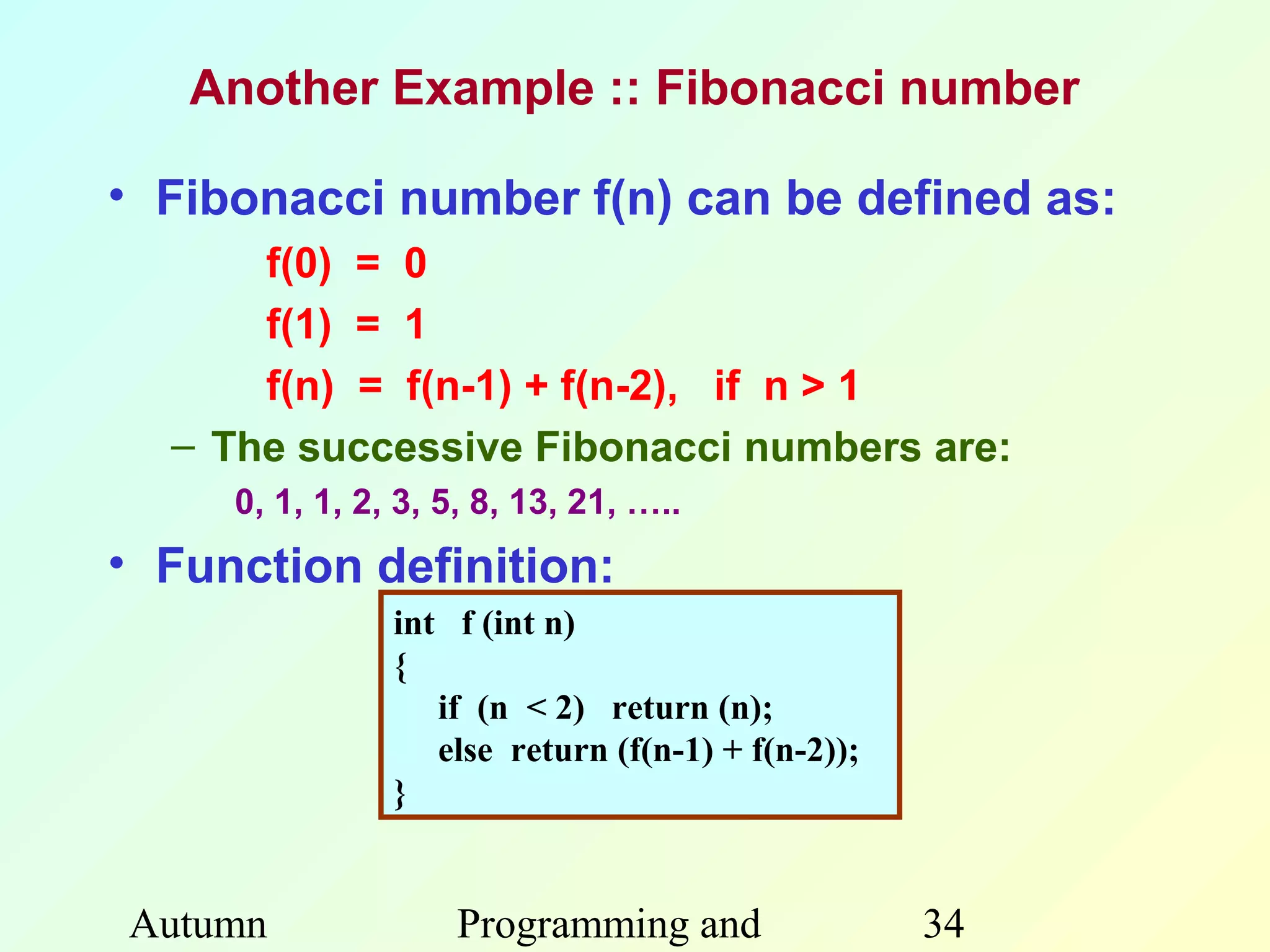
• Fibonacci number f(n) can be defined as:
      f(0) = 0
      f(1) = 1
      f(n) = f(n-1) + f(n-2), if n > 1
  – The successive Fibonacci numbers are:
     0, 1, 1, 2, 3, 5, 8, 13, 21, …..
• Function definition:
                int f (int n)
                {
                   if (n < 2) return (n);
                   else return (f(n-1) + f(n-2));
                }


Autumn              Programming and                 34
Tracing Execution

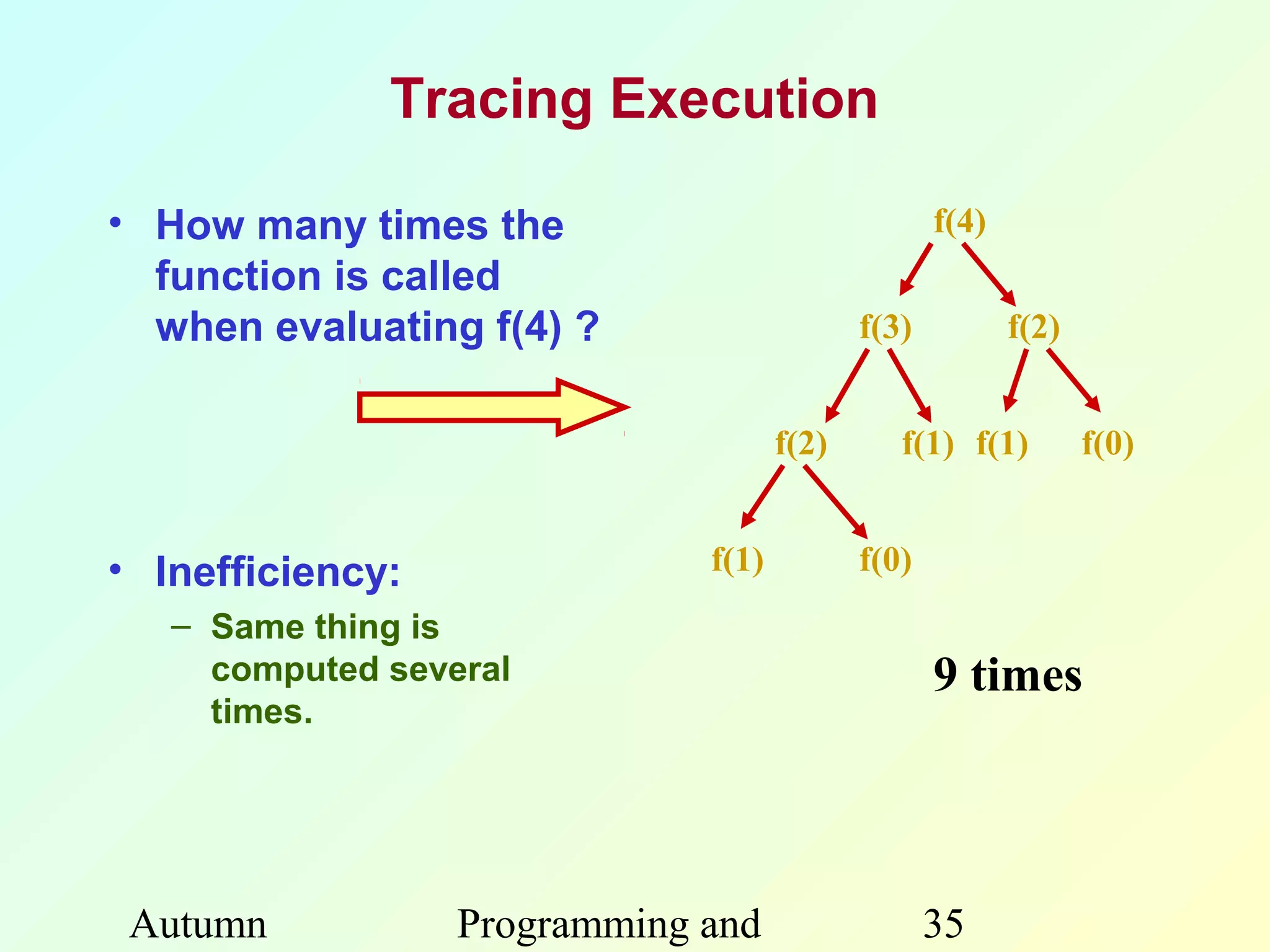
• How many times the                               f(4)
  function is called
  when evaluating f(4) ?                    f(3)          f(2)


                                     f(2)      f(1) f(1)         f(0)


• Inefficiency:               f(1)          f(0)
   – Same thing is
     computed several                              9 times
     times.


 Autumn           Programming and                  35
Example Codes: fibonacci()

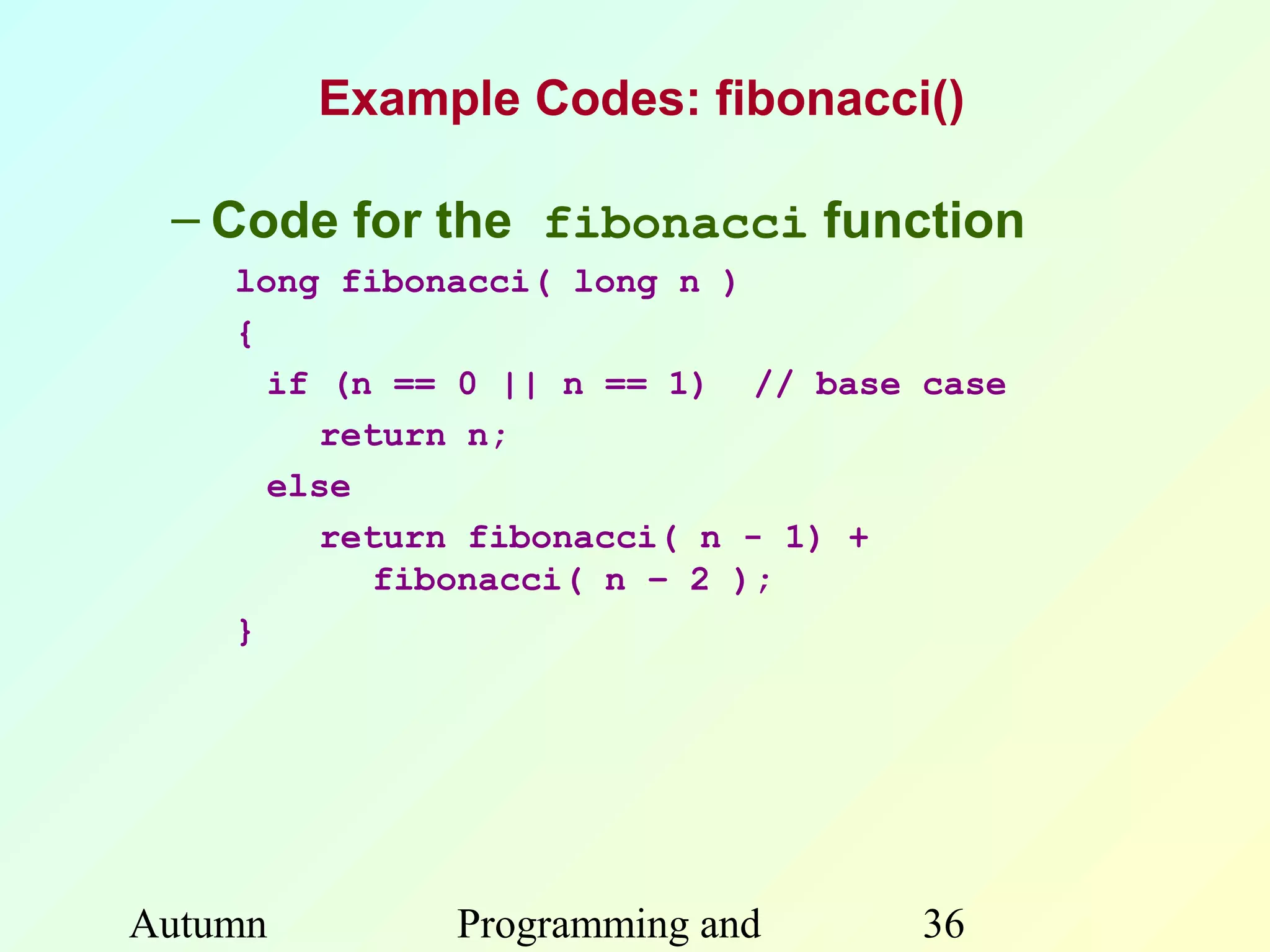
 – Code for the fibonacci function
    long fibonacci( long n )
    {
      if (n == 0 || n == 1) // base case
        return n;
      else
        return fibonacci( n - 1) +
           fibonacci( n – 2 );
    }


Autumn        Programming and       36
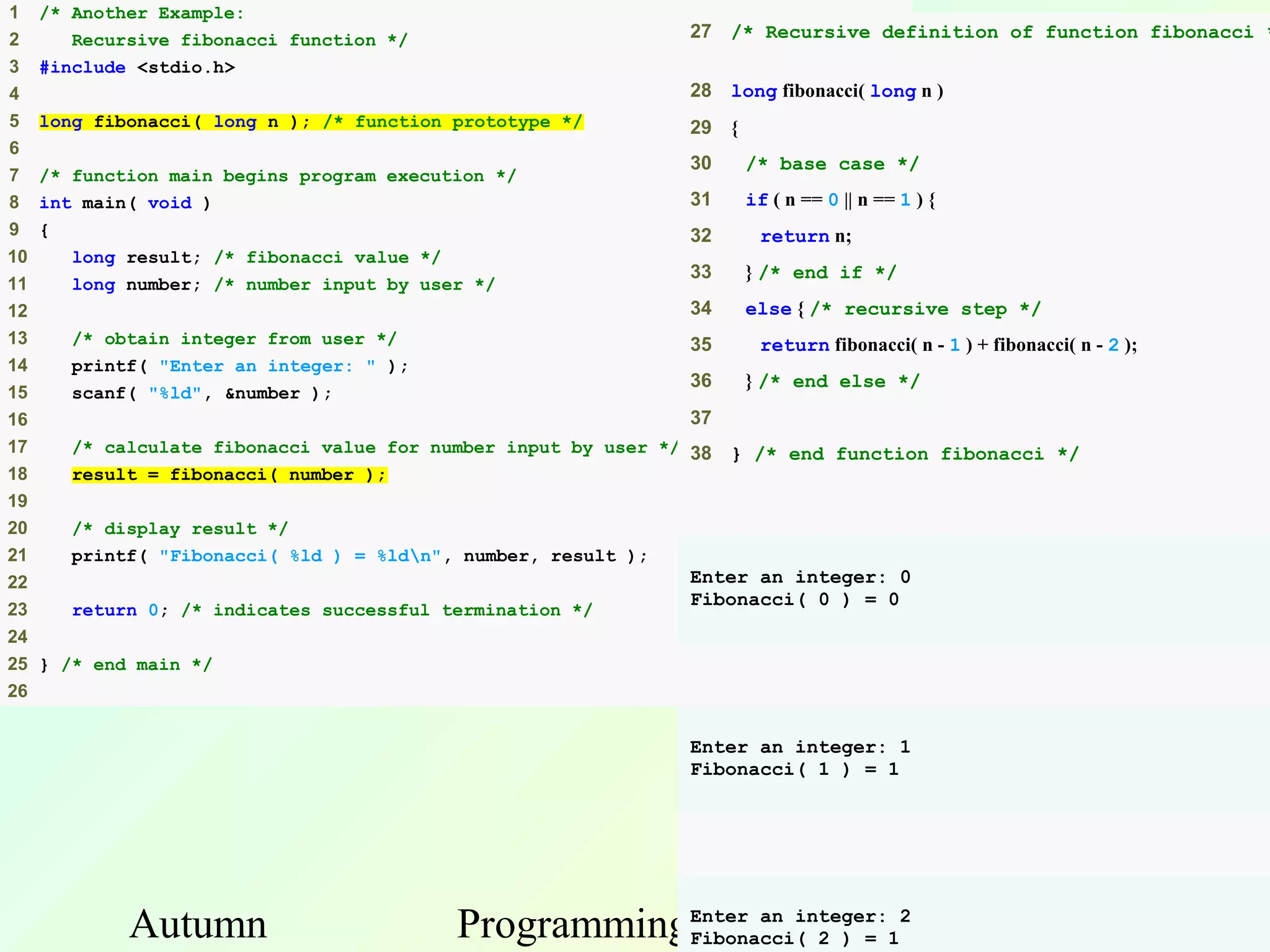
1    /* Another Example:
2       Recursive fibonacci function */                          27 /* Recursive definition of function fibonacci *
3    #include <stdio.h>
4                                                                28 long fibonacci( long n )
5    long fibonacci( long n ); /* function prototype */          29 {
6
                                                                 30     /* base case */
7    /* function main begins program execution */
8    int main( void )                                            31     if ( n == 0 || n == 1 ) {
9    {                                                           32      return n;
10      long result; /* fibonacci value */
                                                                 33     } /* end if */
11      long number; /* number input by user */
12                                                               34     else { /* recursive step */
13      /* obtain integer from user */                           35      return fibonacci( n - 1 ) + fibonacci( n - 2 );
14      printf( "Enter an integer: " );
                                                                 36     } /* end else */
15      scanf( "%ld", &number );
16                                                               37
17      /* calculate fibonacci value for number input by user */ 38   } /* end function fibonacci */
18      result = fibonacci( number );
19
20      /* display result */
21      printf( "Fibonacci( %ld ) = %ldn", number, result );
22                                                               Enter an integer: 0
                                                                 Fibonacci( 0 ) = 0
23      return 0; /* indicates successful termination */
24
25 } /* end main */
26


                                                                 Enter an integer: 1
                                                                 Fibonacci( 1 ) = 1


             Autumn                        ProgrammingEnter an integer:12 37
                                                       and
                                                      Fibonacci( 2 ) =
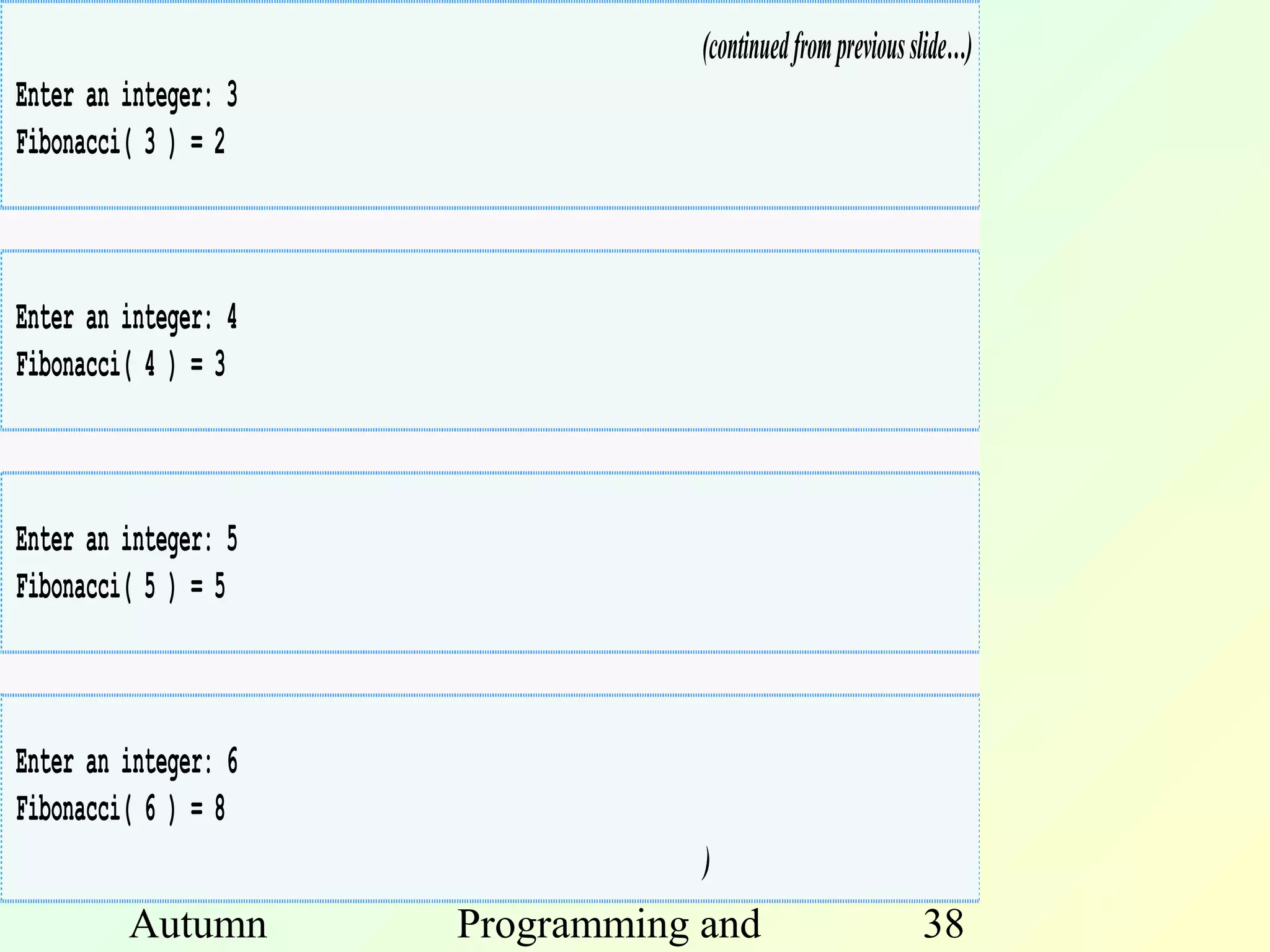
(continued from previous slide…)
Enter an integer: 3
Fibonacci( 3 ) = 2


Enter an integer: 4
Fibonacci( 4 ) = 3


Enter an integer: 5
Fibonacci( 5 ) = 5


Enter an integer: 6
Fibonacci( 6 ) = 8
                                  )
         Autumn       Programming and                       38
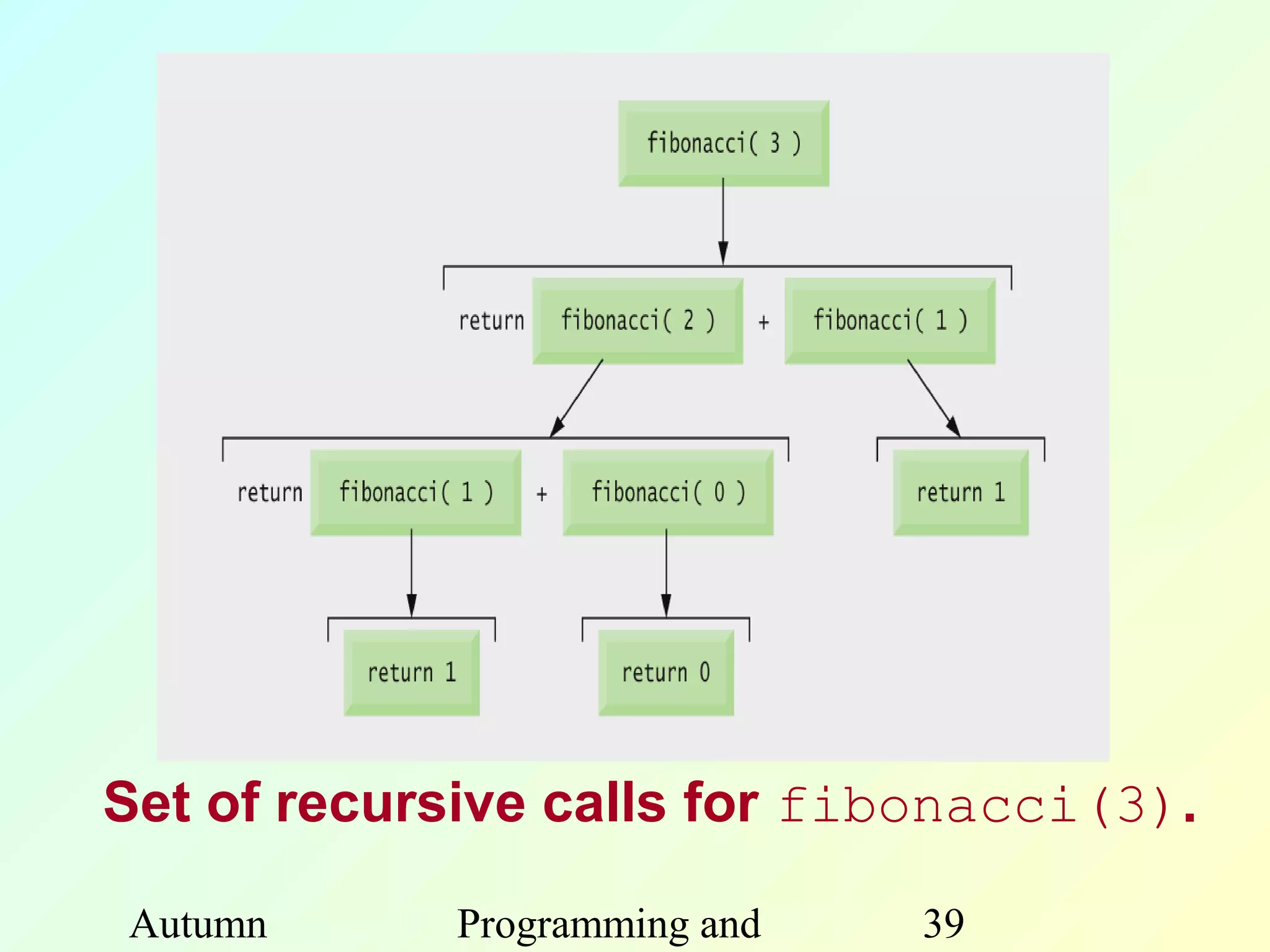
Set of recursive calls for fibonacci(3).

Autumn      Programming and   39
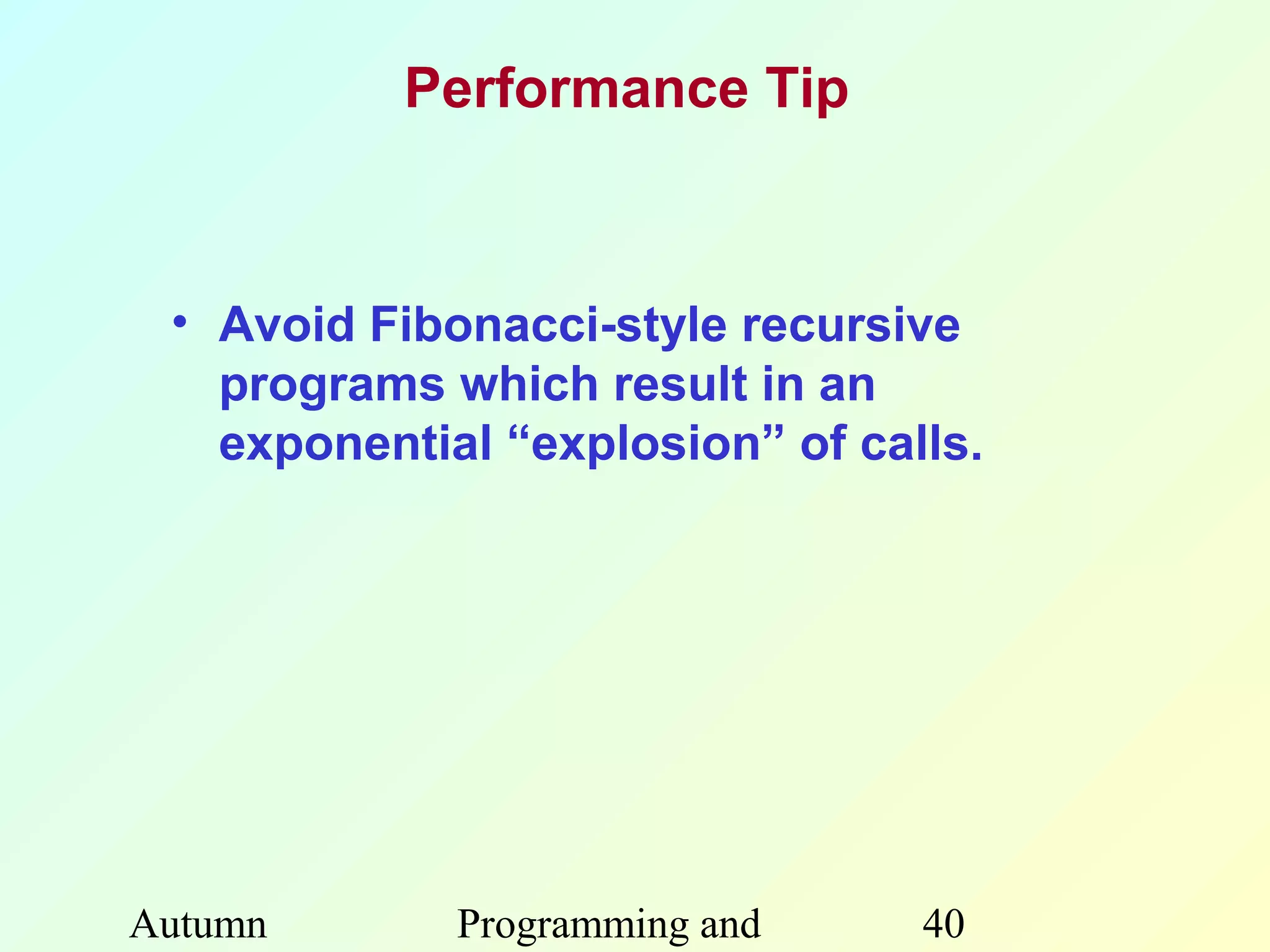
Performance Tip


 • Avoid Fibonacci-style recursive
   programs which result in an
   exponential “explosion” of calls.


Autumn       Programming and     40
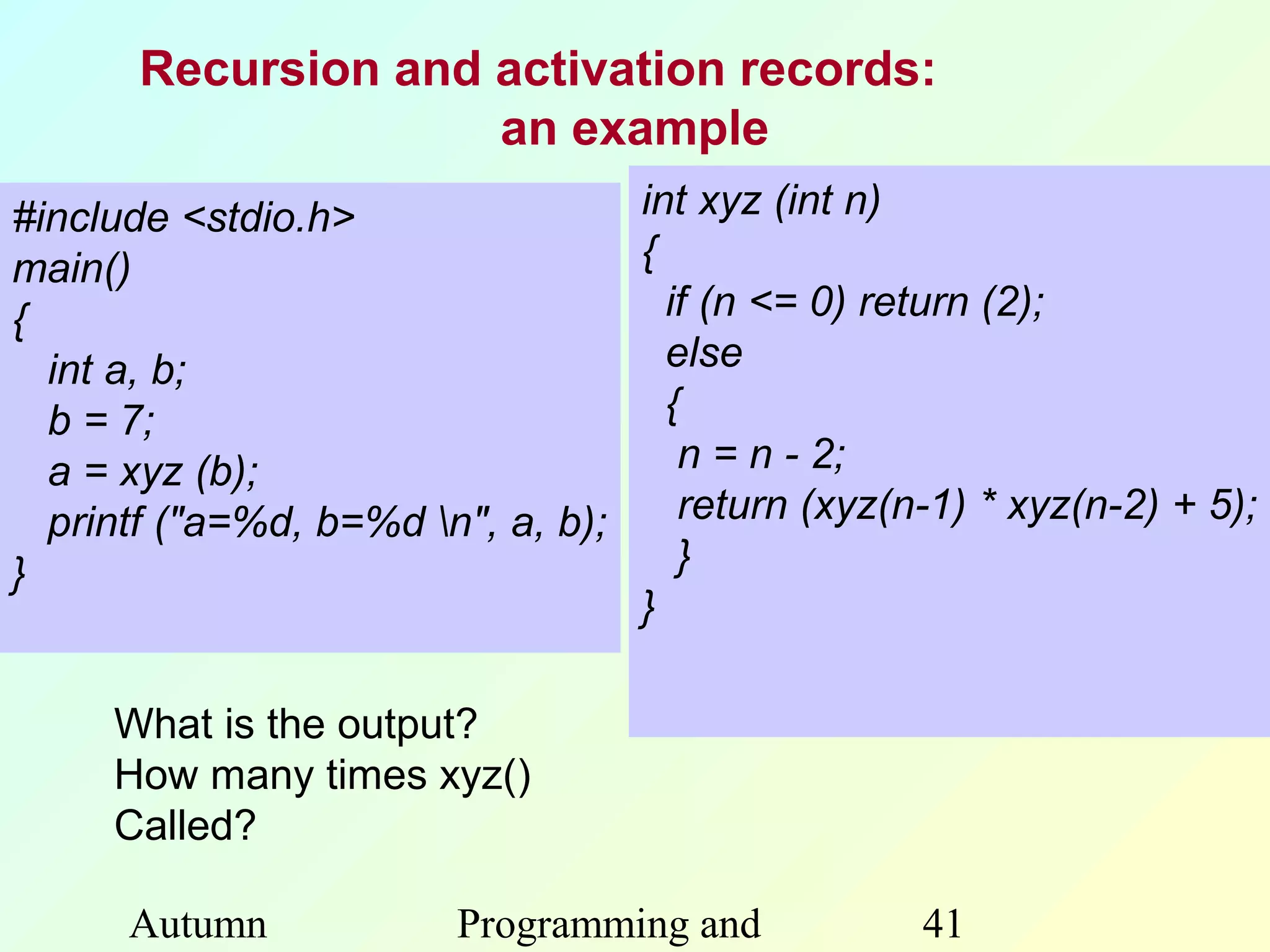
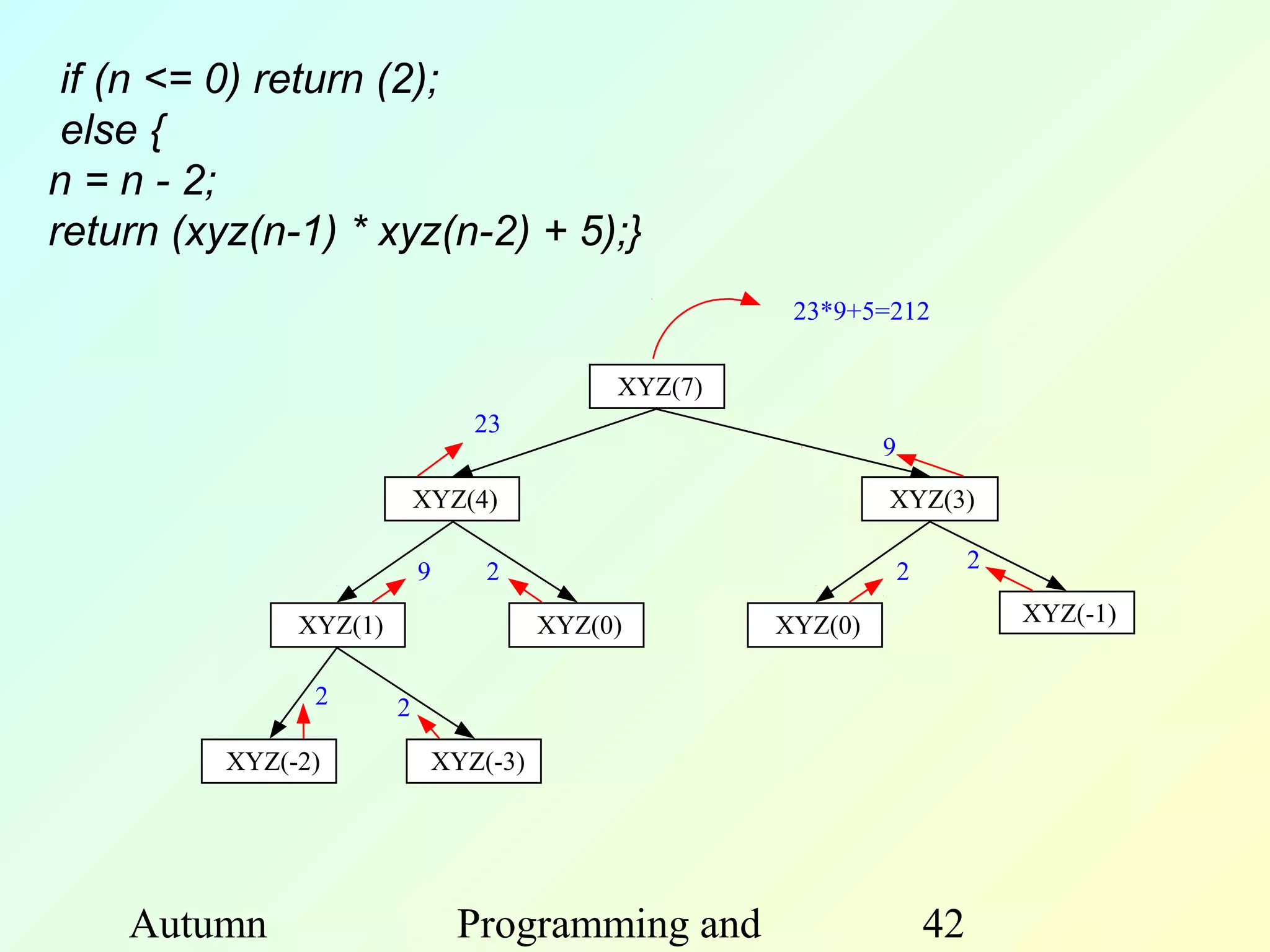
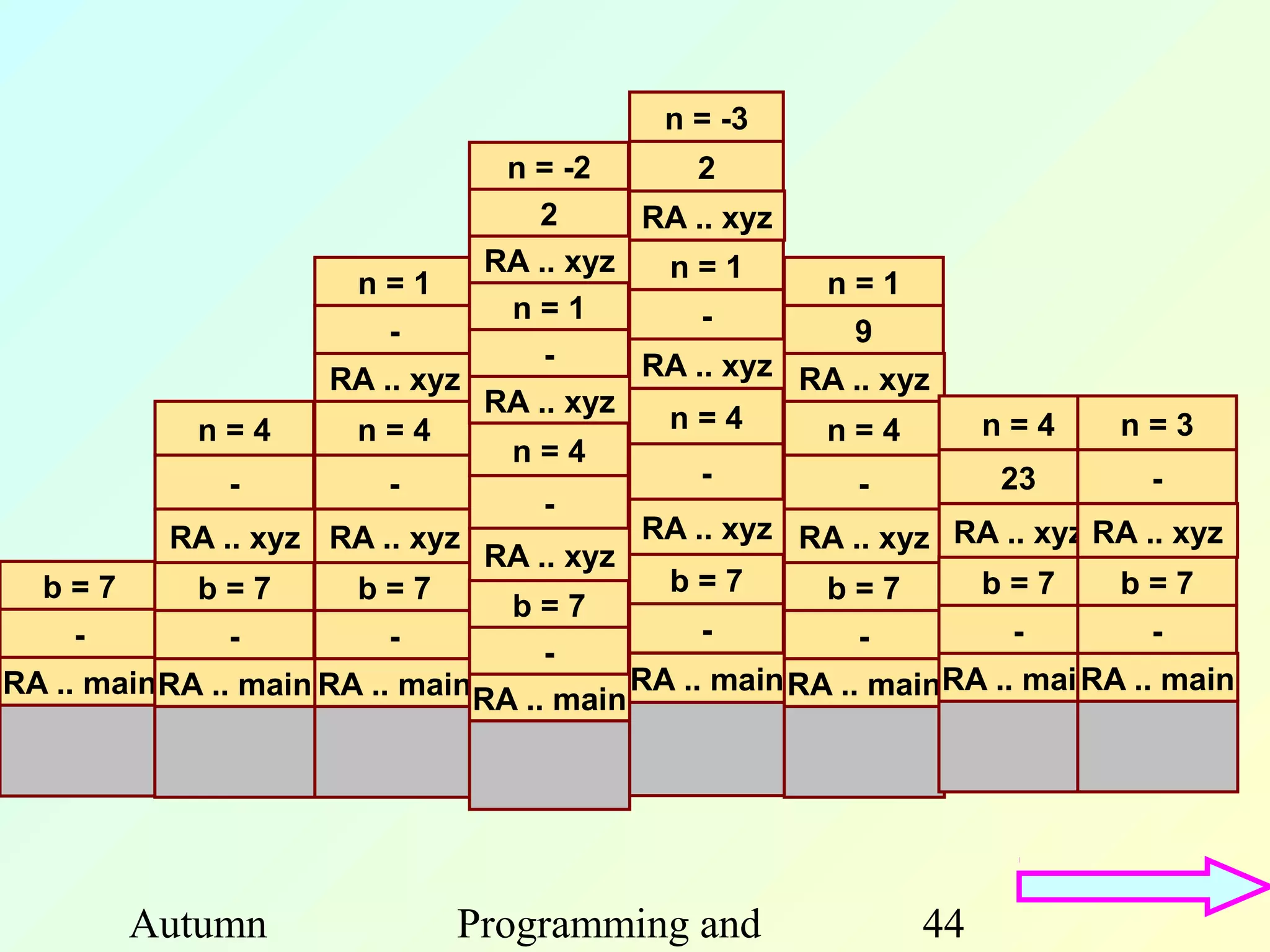
Recursion and activation records:
                     an example
#include <stdio.h>                int xyz (int n)
main()                            {
{                                   if (n <= 0) return (2);
  int a, b;                         else
  b = 7;                            {
  a = xyz (b);                       n = n - 2;
  printf ("a=%d, b=%d n", a, b);    return (xyz(n-1) * xyz(n-2) + 5);
}                                    }
                                  }

     What is the output?
     How many times xyz()
     Called?

      Autumn             Programming and           41
if (n <= 0) return (2);
 else {
n = n - 2;
return (xyz(n-1) * xyz(n-2) + 5);}
                                                         23*9+5=212

                                               XYZ(7)
                                   23
                                                                 9
                            XYZ(4)                               XYZ(3)

                            9       2                                2        2

               XYZ(1)                     XYZ(0)        XYZ(0)                    XYZ(-1)


                2       2

          XYZ(-2)               XYZ(-3)


    Autumn                       Programming and                         42
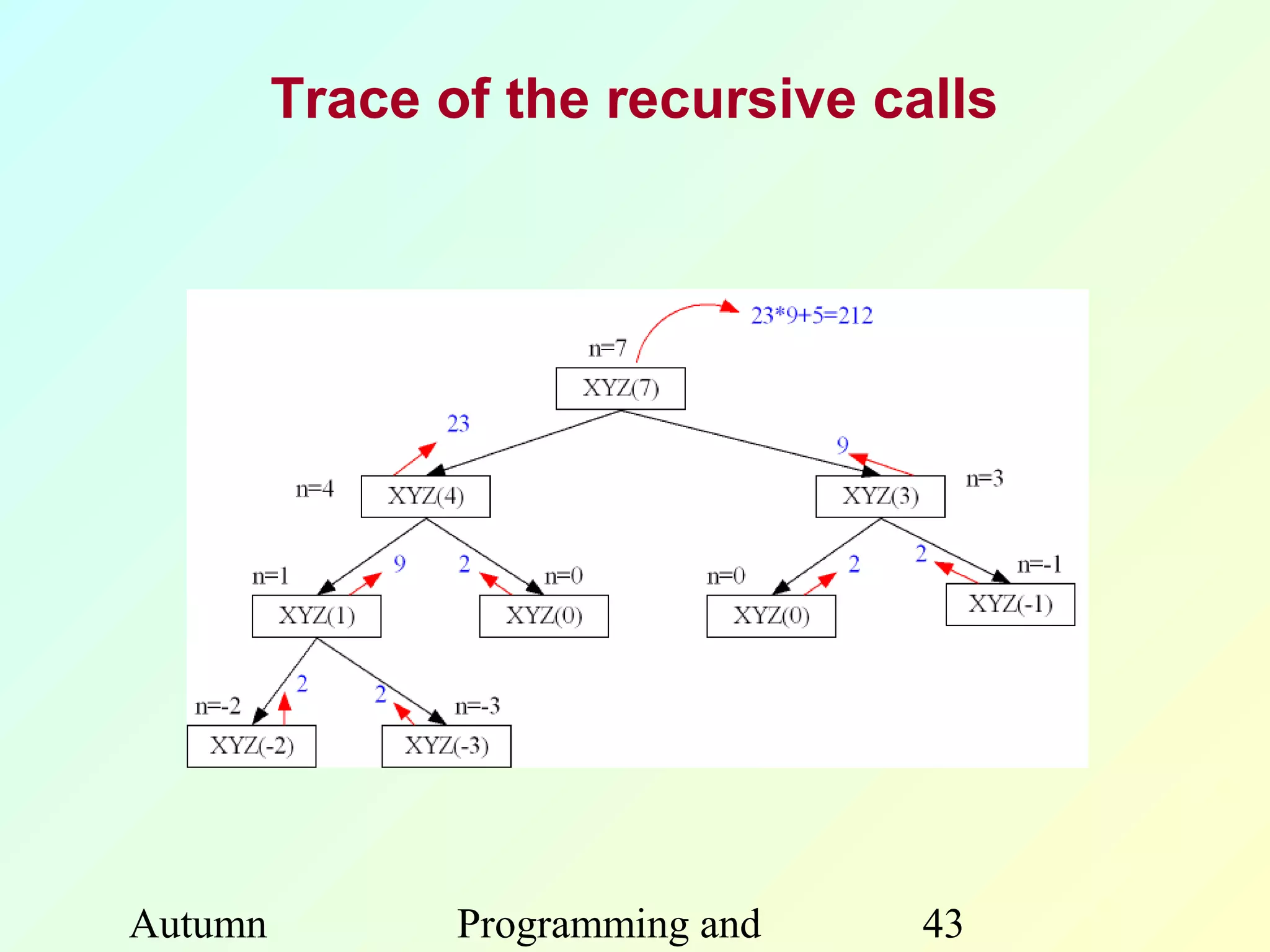
Trace of the recursive calls


Autumn          Programming and   43
n = -3
                                  n = -2        2
                                     2      RA .. xyz
                                 RA .. xyz   n=1
                       n=1                              n=1
                                  n=1           -
                          -                                9
                                     -      RA .. xyz RA .. xyz
                      RA .. xyz
                                 RA .. xyz
            n=4        n=4                   n=4        n=4       n=4      n=3
                                  n=4
               -          -                     -          -        23        -
                                     -
           RA .. xyz RA .. xyz              RA .. xyz RA .. xyz RA .. xyz RA .. xyz
                                 RA .. xyz
  b=7       b=7        b=7                   b=7        b=7       b=7      b=7
                                  b=7
     -         -          -                     -          -         -        -
                                     -
RA .. mainRA .. main RA .. main            RA .. main RA .. mainRA .. main .. main
                                                                         RA
                                RA .. main


        Autumn                Programming and                44
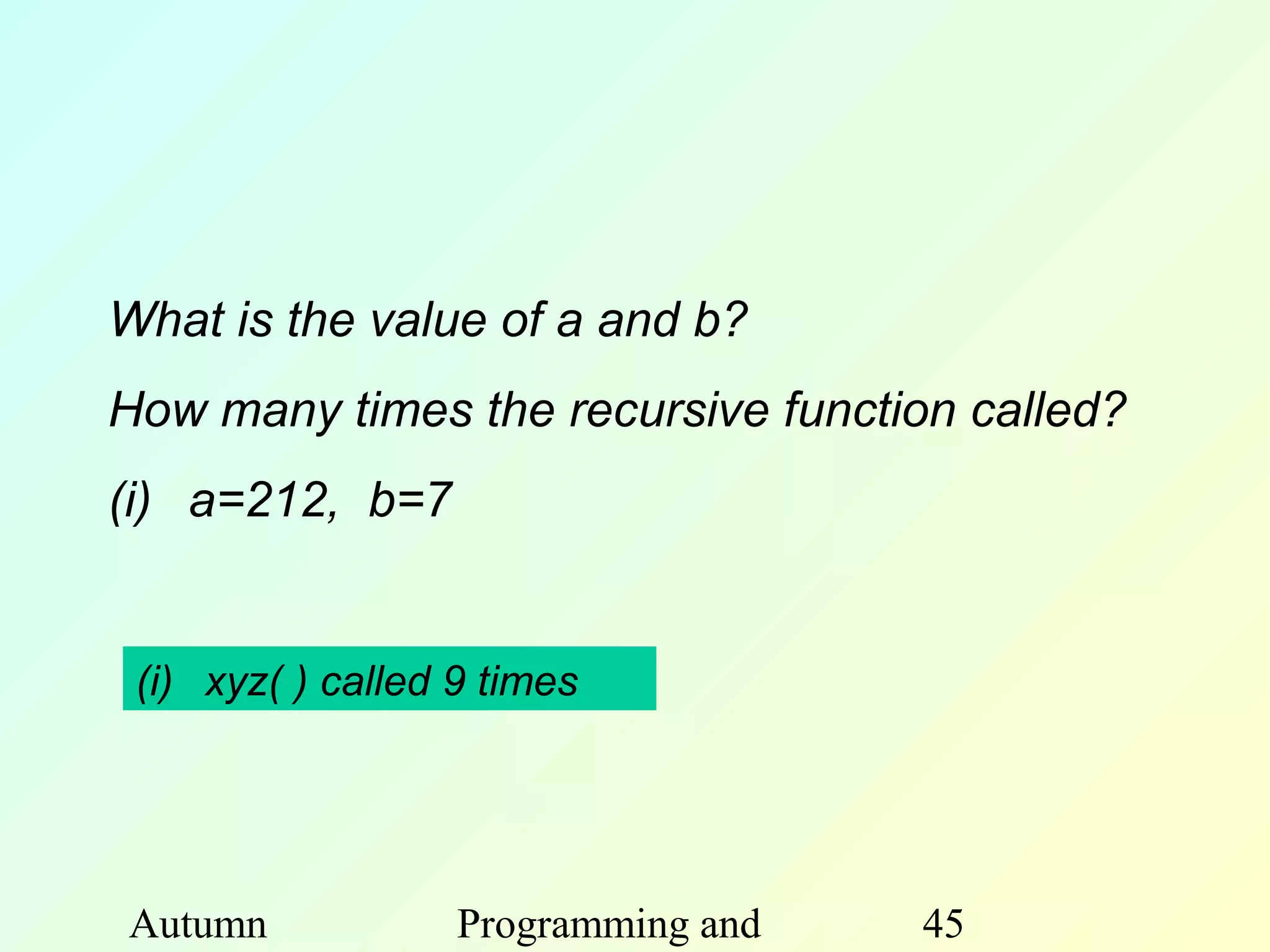
What is the value of a and b?
How many times the recursive function called?
(i) a=212, b=7


 (i) xyz( ) called 9 times


Autumn             Programming and   45
Recursion vs. Iteration

• Repetition
  – Iteration: explicit loop
  – Recursion: repeated function calls
• Termination
  – Iteration: loop condition fails
  – Recursion: base case recognized
• Both can have infinite loops
• Balance
  – Choice between performance (iteration) and
    good software engineering (recursion)


Autumn          Programming and          46
Performance Tip


 • Avoid using recursion in
   performance situations. Recursive
   calls take time and consume
   additional memory.


Autumn      Programming and    48

L4 functions

  • 1.
    Functions Courtsey: University ofPittsburgh-CSD-Khalifa Autumn Programming and 1
  • 2.
    Class Test I:Time and Venue • Date: August 20, 2009 • Time: 6:00 PM to 7:00 PM – Students must occupy seat within 5:45 PM, and carry library card with them. • Venue: VIKRAMSHILA COMPLEX / MAIN BUILDING - Section 7 & 10 (AE-EC) :: AE, AG, AR, BT, CE, CH, CS , CY, EC Room V1 – Section 8 & 10 (Rest) :: Room V2 – Section 9 (AE-CS):: AE, AG, AR, BT, CE, CH, CS Room V3 – Section 9 (Rest):: Room V4 – Section 11:: F 116 – Section 12:: F 142 Autumn Programming and 2
  • 3.
    Functions: Why? • Functions – Modularize a program – All variables declared inside functions are local variables • Known only in function defined – Parameters • Communicate information between functions • Local variables • Benefits – Divide and conquer • Manageable program development – Software reusability • Use existing functions as building blocks for new programs • Abstraction - hide internal details (library functions) – Avoids code repetition Autumn Programming and 3
  • 4.
    Functions: Why? • Divideand conquer – Construct a program from smaller pieces or components – Each piece more manageable than the original program Autumn Programming and 4
  • 5.
    Program Modules inC • Functions – Modules in C – Programs written by combining user- defined functions with library functions • C standard library has a wide variety of functions • Makes programmer's job easier - avoid reinventing the wheel Autumn Programming and 5
  • 6.
    Program Modules inC • Function calls – Invoking functions • Provide function name and arguments (data) • Function performs operations or manipulations • Function returns results – Boss asks worker to complete task • Worker gets information, does task, returns result • Information hiding: boss does not know details Autumn Programming and 6
  • 7.
    Function: An Example #include<stdio.h> int square(int x) Function definition { int y; Name of function y=x*x; return(y); } Return data-type void main() parameter { int a,b,sum_sq; printf(“Give a and b n”); Functions called scanf(“%d%d”,&a,&b); sum_sq=square(a)+square(b); printf(“Sum of squares= %d n”,sum_sq); Parameters Passed Autumn } Programming and 7
  • 8.
    Invoking a functioncall : An Example • #include <stdio.h> • int square(int x) • • { int y; Assume value of a is 10 • • y=x*x; • return(y); a 10 • } • void main() • { x 10 • int a,b,sum_sq; • printf(“Give a and b n”); • scanf(“%d%d”,&a,&b); * • sum_sq=square(a)+square(b); returns • printf(“Sum of squares= %d n”,sum_sq); y 100 • } Autumn Programming and 8
  • 9.
    Function Definitions • Functiondefinition format (continued) return-value-type function-name( parameter-list ) { declarations and statements } – Declarations and statements: function body (block) • Variables can be declared inside blocks (can be nested) • Function can not be defined inside another function – Returning control • If nothing returned – return; – or, until reaches right brace • If something returned – return expression; Autumn Programming and 9
  • 10.
    • int A; Variable • void main() Scope • { A = 1; • myProc(); • printf ( "A = %dn", A); • } Printout: • void myProc() • { int A = 2; -------------- • while( A==2 ) • { A=3 • int A = 3; • printf ( "A = %dn", A); A=2 • break; • } A=1 • printf ( "A = %dn", A); • } • ... Autumn Programming and 10
  • 11.
    Math Library Functions •Math library functions – perform common mathematical calculations – #include <math.h> • Format for calling functions FunctionName (argument); • If multiple arguments, use comma-separated list – printf( "%5.2f", sqrt( 900.0 ) ); • Calls function sqrt, which returns the square root of its argument • All math functions return data type double – Arguments may be constants, variables, or expressions Autumn Programming and 11
  • 12.
    Math Library Functions • double acos(double x) -- Compute arc cosine of x. double asin(double x) -- Compute arc sine of x. double atan(double x) -- Compute arc tangent of x. double atan2(double y, double x) -- Compute arc tangent of y/x. double ceil(double x) -- Get smallest integral value that exceeds x. double cos(double x) -- Compute cosine of angle in radians. double cosh(double x) -- Compute the hyperbolic cosine of x. div_t div(int number, int denom) -- Divide one integer by another. double exp(double x -- Compute exponential of x double fabs (double x ) -- Compute absolute value of x. double floor(double x) -- Get largest integral value less than x. double fmod(double x, double y) -- Divide x by y with integral quotient and return remainder. double frexp(double x, int *expptr) -- Breaks down x into mantissa and exponent of no. labs(long n) -- Find absolute value of long integer n. double ldexp(double x, int exp) -- Reconstructs x out of mantissa and exponent of two. ldiv_t ldiv(long number, long denom) -- Divide one long integer by another. double log(double x) -- Compute log(x). double log10 (double x ) -- Compute log to the base 10 of x. double modf(double x, double *intptr) -- Breaks x into fractional and integer parts. double pow (double x, double y) -- Compute x raised to the power y. double sin(double x) -- Compute sine of angle in radians. double sinh(double x) - Compute the hyperbolic sine of x. double sqrt(double x) -- Compute the square root of x. void srand(unsigned seed) -- Set a new seed for the random number generator (rand). double tan(double x) -- Compute tangent of angle in radians. double tanh(double x) -- Compute the hyperbolic tangent of x. Autumn Programming and 12
  • 13.
    Function Prototypes • Functionprototype – Function name – Parameters - what the function takes in – Return type - data type function returns (default int) – Used to validate functions – Prototype only needed if function definition comes after use in program int maximum( int, int, int ); • Takes in 3 ints • Returns an int • Promotion rules and conversions – Converting to lower types can lead to errors Autumn Programming and 13
  • 14.
    Header Files • Headerfiles – contain function prototypes for library functions – <stdlib.h> , <math.h> , etc – Load with #include <filename> #include <math.h> • Custom header files – Create file with functions – Save as filename.h – Load in other files with #include "filename.h" – Reuse functions Autumn Programming and 14
  • 15.
    /* Finding themaximum of three integers */ #include <stdio.h> int maximum( int, int, int ); /* function prototype */ int main() { int a, b, c; printf( "Enter three integers: " ); scanf( "%d%d%d", &a, &b, &c ); printf( "Maximum is: %dn", maximum( a, b, c ) ); return 0; } /* Function maximum definition */ int maximum( int x, int y, int z ) { int max = x; if ( y > max ) max = y; if ( z > max ) max = z; return max; } Autumn Programming and 15
  • 16.
    Calling Functions: Callby Value and Call by Reference • Used when invoking functions • Call by value – Copy of argument passed to function – Changes in function do not affect original – Use when function does not need to modify argument • Avoids accidental changes • Call by reference – Passes original argument – Changes in function affect original – Only used with trusted functions • For now, we focus on call by value Autumn Programming and 16
  • 17.
    An Example: RandomNumber Generation • rand function – Prototype defined in <stdlib.h> – Returns "random" number between 0 and RAND_MAX (at least 32767) i = rand(); – Pseudorandom • Preset sequence of "random" numbers • Same sequence for every function call • Scaling – To get a random number between 1 and n 1 + ( rand() % n ) • rand % n returns a number between 0 and n-1 • Add 1 to make random number between 1 and n 1 + ( rand() % 6) // number between 1 and 6 Autumn Programming and 17
  • 18.
    Random Number Generation:Contd. • srand function – Prototype defined in <stdlib.h> – Takes an integer seed - jumps to location in "random" sequence srand( seed ); Autumn Programming and 18
  • 19.
    1 /* A programming example 2 Randomizing die-rolling program */ 3 #include <stdlib.h> 4 #include <stdio.h> 5 Algorithm 6 int main() 1. Initialize seed 7 { 8 int i; 2. Input value for seed 9 unsigned seed; 2.1 Use srand to change random sequence 10 2.2 Define Loop 11 printf( "Enter seed: " ); 3. Generate and output random numbers 12 scanf( "%u", &seed ); 13 srand( seed ); 14 15 for ( i = 1; i <= 10; i++ ) { 16 printf( "%10d ", 1 + ( rand() % 6 ) ); 17 18 if ( i % 5 == 0 ) 19 printf( "n" ); 20 } 21 22 return 0; 23 } Autumn Programming and 19
  • 20.
    Program Output Enter seed:67 6 1 4 6 2 1 6 1 6 4 Enter seed: 867 2 4 6 1 6 1 1 3 6 2 Enter seed: 67 6 1 4 6 2 1 6 1 6 4 Autumn Programming and 20
  • 21.
    Another Example: AGame of Chance • Rules – Roll two dice • 7 or 11 on first throw, player wins • 2, 3, or 12 on first throw, player loses • 4, 5, 6, 8, 9, 10 - value becomes player's "point" – Player must roll his point before rolling 7 to win Autumn Programming and 21
  • 22.
    Programme Structure • 1.rollDice prototype • 1.1 Initialize variables • 1.2 Seed srand • 2. Define switch statement for win/loss/continue • 2.1 Loop Autumn Programming and 22
  • 23.
    1 /* A Game of Chance 2 Rolling Two Dice*/ 3 #include <stdio.h> 4 #include <stdlib.h> 5 #include <time.h> 6 7 int rollDice( void ); 8 9 int main() 10 { 11 int gameStatus, sum, myPoint; 12 13 srand( time( NULL ) ); /* Randomizing seed by time(NULL) */ 14 sum = rollDice(); /* first roll of the dice */ 15 16 switch ( sum ) { 17 case 7: case 11: /* win on first roll */ 18 gameStatus = 1; 19 break; 20 case 2: case 3: case 12: /* lose on first roll */ 21 gameStatus = 2; 22 break; 23 default: /* remember point */ 24 gameStatus = 0; 25 myPoint = sum; 26 printf( "Point is %dn", myPoint ); 27 break; 28 } 29 30 while ( gameStatus == 0 ) { /* keep rolling */ sum = rollDice(); 31 32 Autumn Programming and 23
  • 24.
    33 if ( sum == myPoint ) /* win by making point */ 34 gameStatus = 1; 35 else 36 if ( sum == 7 ) /* lose by rolling 7 */ 37 gameStatus = 2; 38 } 39 40 if ( gameStatus == 1 ) 41 printf( "Player winsn" ); 42 else 43 printf( "Player losesn" ); 44 45 return 0; 46 } 47 48 int rollDice( void ) 49 { 50 int die1, die2, workSum; 51 52 die1 = 1 + ( rand() % 6 ); 53 die2 = 1 + ( rand() % 6 ); 54 workSum = die1 + die2; 55 56 2.2 Print win/loss printf( "Player rolled %d + %d = %dn", die1, die2, workSum ); return workSum; 57 } Autumn Programming and 24
  • 25.
    Program Output Playerrolled 6 + 5 = 11 Player wins Player rolled 6 + 6 = 12 Player loses Player rolled 4 + 6 = 10 Point is 10 Player rolled 2 + 4 = 6 Player rolled 6 + 5 = 11 Player rolled 3 + 3 = 6 Player rolled 6 + 4 = 10 Player wins Player rolled 1 + 3 = 4 Point is 4 Player rolled 1 + 4 = 5 Player rolled 5 + 4 = 9 Player rolled 4 + 6 = 10 Player rolled 6 + 3 = 9 Player rolled 1 + 2 = 3 Player rolled 5 + 2 = 7 Player loses Autumn Programming and 25
  • 26.
    Recursion • A processby which a function calls itself repeatedly. – Either directly. • X calls X. – Or cyclically in a chain. • X calls Y, and Y calls X. • Used for repetitive computations in which each action is stated in terms of a previous result. – fact(n) = n * fact (n-1) Autumn Programming and 26
  • 27.
    Contd. • For aproblem to be written in recursive form, two conditions are to be satisfied: – It should be possible to express the problem in recursive form. – The problem statement must include a stopping condition fact(n) = 1, if n = 0 = n * fact(n-1), if n > 0 Autumn Programming and 27
  • 28.
    Example 1 ::Factorial long int fact (n) int n; { if (n = = 0) return (1); else return (n * fact(n-1)); } Autumn Programming and 28
  • 29.
    Mechanism of Execution •When a recursive program is executed, the recursive function calls are not executed immediately. – They are kept aside (on a stack) until the stopping condition is encountered. – The function calls are then executed in reverse order. Autumn Programming and 29
  • 30.
    Example :: Calculatingfact(4) – First, the function calls will be processed: fact(4) = 4 * fact(3) fact(3) = 3 * fact(2) fact(2) = 2 * fact(1) fact(1) = 1 * fact(0) – The actual values return in the reverse order: fact(0) = 1 fact(1) = 1 * 1 = 1 fact(2) = 2 * 1 = 2 fact(3) = 3 * 2 = 6 fact(4) = 4 * 6 = 24 Autumn Programming and 30
  • 31.
    Factorials: Contd. • Example:factorials – 5! = 5 * 4 * 3 * 2 * 1 – Notice that • 5! = 5 * 4! • 4! = 4 * 3! ... – Can compute factorials recursively – Solve base case (1! = 0! = 1) then plug in • 2! = 2 * 1! = 2 * 1 = 2; • 3! = 3 * 2! = 3 * 2 = 6; Autumn Programming and 31
  • 32.
    Recursive evaluation of5!. Autumn Programming and 32
  • 33.
    1 /* An example */ 22 /* recursive definition of function factorial */ 2 /* Recursive factorial function */ 23 long factorial( long number ) 3 #include <stdio.h> 24 { 4 25 /* base case */ 5 long factorial( long number ); /* function prototype */ 26 if ( number <= 1 ) { 6 27 return 1; Terminating 7 /* function main begins program execution */ 28 } /* end if */ Criterion 8 int main( void ) 29 else { /* recursive step */ 9 { 30 return ( number * factorial( number - 1 ) ); 10 int i; /* counter */ 31 } /* end else */ 11 32 12 /* loop 11 times; during each iteration, calculate 33 } /* end function factorial */ 13 factorial( i ) and display result */ 14 for ( i = 0; i <= 10; i++ ) { 0! = 1 1! = 1 15 printf( "%2d! = %ldn", i, factorial( i ) ); 2! = 2 16 } /* end for */ 3! = 6 17 4! = 24 18 return 0; /* indicates successful termination */ 5! = 120 6! = 720 19 7! = 5040 20 } /* end main */ 8! = 40320 21 9! = 362880 10! = 3628800 Autumn Programming and 33
  • 34.
    Another Example ::Fibonacci number • Fibonacci number f(n) can be defined as: f(0) = 0 f(1) = 1 f(n) = f(n-1) + f(n-2), if n > 1 – The successive Fibonacci numbers are: 0, 1, 1, 2, 3, 5, 8, 13, 21, ….. • Function definition: int f (int n) { if (n < 2) return (n); else return (f(n-1) + f(n-2)); } Autumn Programming and 34
  • 35.
    Tracing Execution • Howmany times the f(4) function is called when evaluating f(4) ? f(3) f(2) f(2) f(1) f(1) f(0) • Inefficiency: f(1) f(0) – Same thing is computed several 9 times times. Autumn Programming and 35
  • 36.
    Example Codes: fibonacci() – Code for the fibonacci function long fibonacci( long n ) { if (n == 0 || n == 1) // base case return n; else return fibonacci( n - 1) + fibonacci( n – 2 ); } Autumn Programming and 36
  • 37.
    1 /* Another Example: 2 Recursive fibonacci function */ 27 /* Recursive definition of function fibonacci * 3 #include <stdio.h> 4 28 long fibonacci( long n ) 5 long fibonacci( long n ); /* function prototype */ 29 { 6 30 /* base case */ 7 /* function main begins program execution */ 8 int main( void ) 31 if ( n == 0 || n == 1 ) { 9 { 32 return n; 10 long result; /* fibonacci value */ 33 } /* end if */ 11 long number; /* number input by user */ 12 34 else { /* recursive step */ 13 /* obtain integer from user */ 35 return fibonacci( n - 1 ) + fibonacci( n - 2 ); 14 printf( "Enter an integer: " ); 36 } /* end else */ 15 scanf( "%ld", &number ); 16 37 17 /* calculate fibonacci value for number input by user */ 38 } /* end function fibonacci */ 18 result = fibonacci( number ); 19 20 /* display result */ 21 printf( "Fibonacci( %ld ) = %ldn", number, result ); 22 Enter an integer: 0 Fibonacci( 0 ) = 0 23 return 0; /* indicates successful termination */ 24 25 } /* end main */ 26 Enter an integer: 1 Fibonacci( 1 ) = 1 Autumn ProgrammingEnter an integer:12 37 and Fibonacci( 2 ) =
  • 38.
    (continued from previousslide…) Enter an integer: 3 Fibonacci( 3 ) = 2 Enter an integer: 4 Fibonacci( 4 ) = 3 Enter an integer: 5 Fibonacci( 5 ) = 5 Enter an integer: 6 Fibonacci( 6 ) = 8 ) Autumn Programming and 38
  • 39.
    Set of recursivecalls for fibonacci(3). Autumn Programming and 39
  • 40.
    Performance Tip •Avoid Fibonacci-style recursive programs which result in an exponential “explosion” of calls. Autumn Programming and 40
  • 41.
    Recursion and activationrecords: an example #include <stdio.h> int xyz (int n) main() { { if (n <= 0) return (2); int a, b; else b = 7; { a = xyz (b); n = n - 2; printf ("a=%d, b=%d n", a, b); return (xyz(n-1) * xyz(n-2) + 5); } } } What is the output? How many times xyz() Called? Autumn Programming and 41
  • 42.
    if (n <=0) return (2); else { n = n - 2; return (xyz(n-1) * xyz(n-2) + 5);} 23*9+5=212 XYZ(7) 23 9 XYZ(4) XYZ(3) 9 2 2 2 XYZ(1) XYZ(0) XYZ(0) XYZ(-1) 2 2 XYZ(-2) XYZ(-3) Autumn Programming and 42
  • 43.
    Trace of therecursive calls Autumn Programming and 43
  • 44.
    n = -3 n = -2 2 2 RA .. xyz RA .. xyz n=1 n=1 n=1 n=1 - - 9 - RA .. xyz RA .. xyz RA .. xyz RA .. xyz n=4 n=4 n=4 n=4 n=4 n=3 n=4 - - - - 23 - - RA .. xyz RA .. xyz RA .. xyz RA .. xyz RA .. xyz RA .. xyz RA .. xyz b=7 b=7 b=7 b=7 b=7 b=7 b=7 b=7 - - - - - - - - RA .. mainRA .. main RA .. main RA .. main RA .. mainRA .. main .. main RA RA .. main Autumn Programming and 44
  • 45.
    What is thevalue of a and b? How many times the recursive function called? (i) a=212, b=7 (i) xyz( ) called 9 times Autumn Programming and 45
  • 46.
    Recursion vs. Iteration •Repetition – Iteration: explicit loop – Recursion: repeated function calls • Termination – Iteration: loop condition fails – Recursion: base case recognized • Both can have infinite loops • Balance – Choice between performance (iteration) and good software engineering (recursion) Autumn Programming and 46
  • 47.
    Performance Tip •Avoid using recursion in performance situations. Recursive calls take time and consume additional memory. Autumn Programming and 48