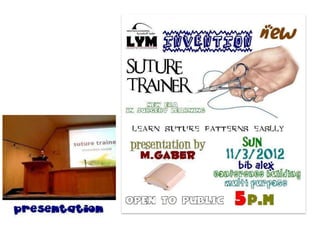
suture training
Dr.
MOHAMED GABER
Vetbook organization
Vet. Syndicate
13-2-2014
www.vetbook.net
SESSION PARTS
INTRODUCTION
Surgical suture: is a medical device used
to hold body tissues together after an
injury or surgery. Application generally
involves using a needle with an attached
length of thread. A number of different
shapes, sizes, and thread materials have
been developed over its millennia of
history.
SUTURE MATERIALS
1-Needles
2-absourable suture material
3-non-absourable suture material
4-needle holder
5-clamps,forceps
1-Needles
A-Classification according to the eye: -
1-Closed eye needle
2-Swaged-on needle (Eyeless or A traumatic
needle)
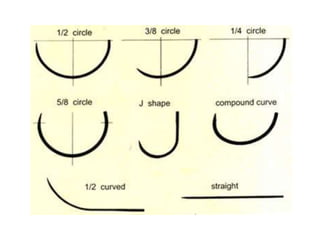
B-Classification according to the body or
the shaft
1-Straight needle or Long stemmed needle
2-Half curved needle
3-Curved needle
4-Hock needle (Heavy bound bodied)
C-Classification according to the point :-
1- cut needle
2- round needle
2-Absorbable suture materials: -
1-Surgical catgut
2-Collagen
3-Polyglycolic acid (Dexon®) and Polygalactin
910 (Vicryl®)
4-Polylactic acid
3-Non-absorbable suture materials: -
1-Silk
2-Cotton
3-Nylon (Dermalon®, Ethilon®& Nurolon®)
4-Polypropylene (Prolene®) and Polyethylene
5-Polymerized caprolactam (Supramid ®&
Vetafil®)
6-Polyesters
7-Stainless steel
4-5- needle holder, clamps
Considerations in choosing
suture materials: -
1-Physical properties: -
• a-Durability: -
Durability of the suture in the wound is affected by many factors
like blood supply of the wound and infection. Tissues that
have great blood supply or infection will get rid of the suture
materials rapidly, so one should choose suture materials of
low absorption rate.
Rate of healing and tension of the suture line affect the choice of
suture material too, so the wounds with high healing rate and
low suture line tension need less durable suture materials,
while those with slow healing rate and high suture line
tension, need more durable suture materials.
• b-Handling ability and knot security: -
Good suture material should has good handling ability, minimal
capillarity, and good knot security, unfortunately, there is no
suture material yet has all phenomena.
• c-Steralization: -
Most of suture materials are represented already sterile.
However, autoclaving is a suitable method of sterilization of
most suture materials (except for catgut), but multiple
autoclaving for more than three times reduces the strength of
the suture material. Gamma irradiation adversely affects
polyglycolic acid and polypropylene. Ethylene oxide gas is a
suitable method of sterilization of all suture materials.
2-Biological properties: -
Tissue reaction ensures as a result of traumatization of the tissue
by the needle and dragging of the suture material, and by the
chemical structure of the suture material. Thus, a traumatic
needle with synthetic monofilament suture materials are
preferred.
Monofilament suture materials are preferred than multifilament
materials as the former has lower chance of keeping
microorganism inside it than the later.
SUTURE PATTERNS
Classification of suture patterns
Interrupted/Continuous
Appositional/Inverting/Everting
Simple/Tension
Appositional sutures
Simple interrupted
Simple continuous
Ford interlocking
Interrupted cruciate
Subcuticular
Tension sutures
horizontal mattress
vertical mattress
Quelled
Far-far-near-near
Far-near-near-far
hallow organ sutures
Lambert
Halsted
Cushing
Connell
Purse string
Appositional sutures
Simple interrupted
Advantages
Advantages of this technique
include its simplicity,
opposition of the skin, and
when a knot is untied, the
other sutures maintain the
strength of the suture line.
Disadvantages
Disadvantages of this
technique include time
consuming because of the
high number of knots and
consuming of large amount of
silk material.
Simple continuous
Advantages
Advantages of this pattern
include its simplicity,
opposition of the skin, can be
performed rapidly, and
consumption of lesser amount
of silk.
Disadvantages
Disadvantages of this pattern
is that when one stitch is
untied, the strength of the
suture line can’t be
maintained.
Ford interlocking
Advantages
Advantages include simplicity
and opposition of the skin
with relative maintenance of
the strength of the suture line
when one stitch is untied.
Disadvantages
Disadvantages includes that it
is not as simple as the
previously mentioned
patterns.
Interrupted cruciate
subcuticular
Tension sutures
horizontal mattress
With stents Without stents
Advantages: -
It can be used in areas
where much tension is
placed on the skin.
Disadvantages: -
It interferes with blood
supply to the skin and
interferes with healing.
vertical mattress
Advantages: -
It doesn’t interfere
with blood supply
of the skin like
horizontal type.
Disadvantages: -
It consumes much
suture material and
more time.
Quilled
Far-far-near-near
Far-near-near-far
Advantages: -
It is a good tension
suture.
Disadvantages: -
It is a time
consuming suture
hallow organ sutures
Lambert
Advantages: -
It is the simplest pattern for
the internal organs, relatively
rapidly performed, inverts
lips of the wound, and never
involves the mucosa so the
possibility of contamination
is low.
Disadvantages: -
It produces slight stenosis of
the bowel.
Halsted
Cushing and Connel
Cushing
Connel
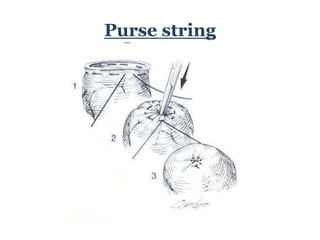
Purse string
suture trainer
it is a suture pad used for learning suture
patterns ,this device simulate body skin
which help medical students for learning
all types of surgical suture easily.
Use
Advantage
1-learning value
2-more qualified
3-easy to be used
4-availability of used material
5-more reality
6-simple structure
7-easily manufacture
8-low cost
Surgical suture workshops
References
RADASCH R. M., MERKLEY, D. F., WILSON J. W., BARSTAD R. D.
(1990) Cystotomy closure: a comparison of the strength of appositional
and inverting suture patterns. Veterinary Surgery; 19(4):283-288.
ROSIN E., ROBINSON G. M. (1989) Knot security of suture materials.
Veterinary Surgery; 18(4):269-273.
TOOMBS J. P., CLARKE K. M. (2003) Basic operative techniques.
In:Textbook of Small Animal Surgery,. D Slatter Ed. WB Saunders,
Philadelphia, PA. Pp 199-221.
Thank you

Suture training course

  • 1.
    suture training Dr. MOHAMED GABER Vetbookorganization Vet. Syndicate 13-2-2014 www.vetbook.net
  • 2.
  • 4.
    INTRODUCTION Surgical suture: isa medical device used to hold body tissues together after an injury or surgery. Application generally involves using a needle with an attached length of thread. A number of different shapes, sizes, and thread materials have been developed over its millennia of history.
  • 5.
    SUTURE MATERIALS 1-Needles 2-absourable suturematerial 3-non-absourable suture material 4-needle holder 5-clamps,forceps
  • 6.
    1-Needles A-Classification according tothe eye: - 1-Closed eye needle 2-Swaged-on needle (Eyeless or A traumatic needle)
  • 7.
    B-Classification according tothe body or the shaft 1-Straight needle or Long stemmed needle 2-Half curved needle 3-Curved needle 4-Hock needle (Heavy bound bodied)
  • 9.
    C-Classification according tothe point :- 1- cut needle 2- round needle
  • 10.
    2-Absorbable suture materials:- 1-Surgical catgut 2-Collagen 3-Polyglycolic acid (Dexon®) and Polygalactin 910 (Vicryl®) 4-Polylactic acid
  • 11.
    3-Non-absorbable suture materials:- 1-Silk 2-Cotton 3-Nylon (Dermalon®, Ethilon®& Nurolon®) 4-Polypropylene (Prolene®) and Polyethylene 5-Polymerized caprolactam (Supramid ®& Vetafil®) 6-Polyesters 7-Stainless steel
  • 13.
  • 14.
    Considerations in choosing suturematerials: - 1-Physical properties: - • a-Durability: - Durability of the suture in the wound is affected by many factors like blood supply of the wound and infection. Tissues that have great blood supply or infection will get rid of the suture materials rapidly, so one should choose suture materials of low absorption rate. Rate of healing and tension of the suture line affect the choice of suture material too, so the wounds with high healing rate and low suture line tension need less durable suture materials, while those with slow healing rate and high suture line tension, need more durable suture materials.
  • 15.
    • b-Handling abilityand knot security: - Good suture material should has good handling ability, minimal capillarity, and good knot security, unfortunately, there is no suture material yet has all phenomena. • c-Steralization: - Most of suture materials are represented already sterile. However, autoclaving is a suitable method of sterilization of most suture materials (except for catgut), but multiple autoclaving for more than three times reduces the strength of the suture material. Gamma irradiation adversely affects polyglycolic acid and polypropylene. Ethylene oxide gas is a suitable method of sterilization of all suture materials.
  • 16.
    2-Biological properties: - Tissuereaction ensures as a result of traumatization of the tissue by the needle and dragging of the suture material, and by the chemical structure of the suture material. Thus, a traumatic needle with synthetic monofilament suture materials are preferred. Monofilament suture materials are preferred than multifilament materials as the former has lower chance of keeping microorganism inside it than the later.
  • 17.
    SUTURE PATTERNS Classification ofsuture patterns Interrupted/Continuous Appositional/Inverting/Everting Simple/Tension
  • 18.
    Appositional sutures Simple interrupted Simplecontinuous Ford interlocking Interrupted cruciate Subcuticular
  • 19.
    Tension sutures horizontal mattress verticalmattress Quelled Far-far-near-near Far-near-near-far
  • 20.
  • 22.
  • 23.
    Simple interrupted Advantages Advantages ofthis technique include its simplicity, opposition of the skin, and when a knot is untied, the other sutures maintain the strength of the suture line. Disadvantages Disadvantages of this technique include time consuming because of the high number of knots and consuming of large amount of silk material.
  • 24.
    Simple continuous Advantages Advantages ofthis pattern include its simplicity, opposition of the skin, can be performed rapidly, and consumption of lesser amount of silk. Disadvantages Disadvantages of this pattern is that when one stitch is untied, the strength of the suture line can’t be maintained.
  • 25.
    Ford interlocking Advantages Advantages includesimplicity and opposition of the skin with relative maintenance of the strength of the suture line when one stitch is untied. Disadvantages Disadvantages includes that it is not as simple as the previously mentioned patterns.
  • 26.
  • 27.
  • 28.
  • 29.
    horizontal mattress With stentsWithout stents Advantages: - It can be used in areas where much tension is placed on the skin. Disadvantages: - It interferes with blood supply to the skin and interferes with healing.
  • 30.
    vertical mattress Advantages: - Itdoesn’t interfere with blood supply of the skin like horizontal type. Disadvantages: - It consumes much suture material and more time.
  • 31.
  • 32.
    Far-far-near-near Far-near-near-far Advantages: - It isa good tension suture. Disadvantages: - It is a time consuming suture
  • 33.
  • 34.
    Lambert Advantages: - It isthe simplest pattern for the internal organs, relatively rapidly performed, inverts lips of the wound, and never involves the mucosa so the possibility of contamination is low. Disadvantages: - It produces slight stenosis of the bowel.
  • 35.
  • 36.
  • 37.
  • 39.
    suture trainer it isa suture pad used for learning suture patterns ,this device simulate body skin which help medical students for learning all types of surgical suture easily.
  • 41.
  • 42.
    Advantage 1-learning value 2-more qualified 3-easyto be used 4-availability of used material 5-more reality 6-simple structure 7-easily manufacture 8-low cost
  • 45.
  • 49.
    References RADASCH R. M.,MERKLEY, D. F., WILSON J. W., BARSTAD R. D. (1990) Cystotomy closure: a comparison of the strength of appositional and inverting suture patterns. Veterinary Surgery; 19(4):283-288. ROSIN E., ROBINSON G. M. (1989) Knot security of suture materials. Veterinary Surgery; 18(4):269-273. TOOMBS J. P., CLARKE K. M. (2003) Basic operative techniques. In:Textbook of Small Animal Surgery,. D Slatter Ed. WB Saunders, Philadelphia, PA. Pp 199-221.
  • 50.