CRICOS No. 00213J
a university for the worldreal
R 1
A/Prof. Marcello La Rosa
BPM Discipline
Queensland University ofTechnology
IAB203 – Business Process Modelling
Week 9, 28 Apr 2015
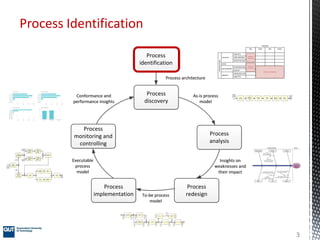
Process Identification
Process
identification
Conformance and
performance insights
Conformance and
performance insights
Process
monitoring and
controlling
Executable
process
model
Executable
process
model
Process
implementation To-be process
model
To-be process
model
Process
analysis
As-is process
model
As-is process
model
Process
discovery
Process architectureProcess architecture
Process
redesign
Insights on
weaknesses and
their impact
Insights on
weaknesses and
their impact
3
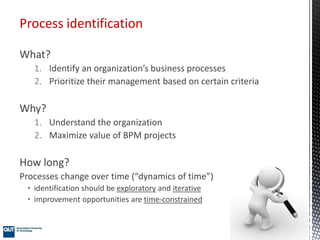
What?
1. Identify an organization’s business processes
2. Prioritize their management based on certain criteria
Why?
1. Understand the organization
2. Maximize value of BPM projects
How long?
Processes change over time (“dynamics of time”)
• identification should be exploratory and iterative
• improvement opportunities are time-constrained
Process identification
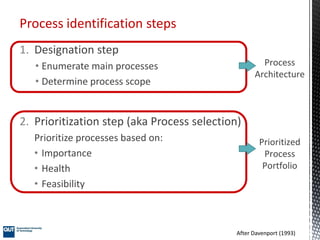
1. Designation step
• Enumerate main processes
• Determine process scope
2. Prioritization step (aka Process selection)
Prioritize processes based on:
• Importance
• Health
• Feasibility
Process identification steps
After Davenport (1993)
Process
Architecture
Prioritized
Process
Portfolio
Process enumeration
There is no “number fits all” - it really depends on
organization’s domain and size
Rule of thumb: 10-20 processes
Trade-off:
• ensuring process scope is manageable, since…
• process scope determines potential impact
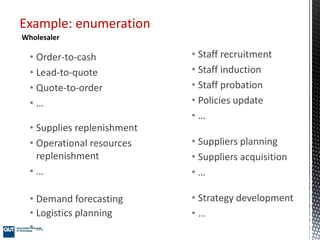
• Order-to-cash
• Lead-to-quote
• Quote-to-order
• …
Example: enumeration
Wholesaler
• Staff recruitment
• Staff induction
• Staff probation
• Policies update
• …
• Supplies replenishment
• Operational resources
replenishment
• …
• Demand forecasting
• Logistics planning
• …
• Strategy development
• …
• Suppliers planning
• Suppliers acquisition
• …
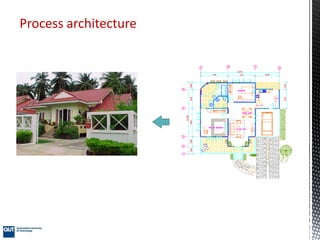
Process architecture
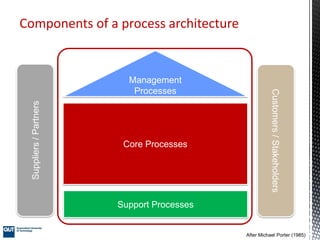
Components of a process architecture
Core Processes
Management
Processes
Suppliers/Partners
Customers/Stakeholders
Support Processes
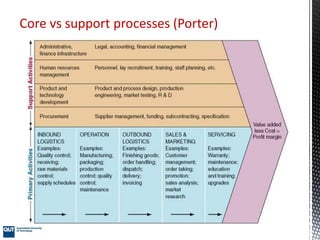
After Michael Porter (1985)
Core vs support processes (Porter)
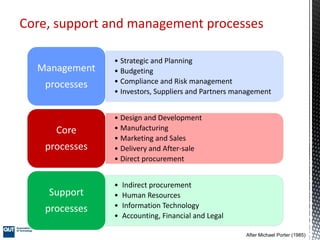
Core, support and management processes
After Michael Porter (1985)
• Strategic and Planning
• Budgeting
• Compliance and Risk management
• Investors, Suppliers and Partners management
Management
processes
• Design and Development
• Manufacturing
• Marketing and Sales
• Delivery and After-sale
• Direct procurement
Core
processes
• Indirect procurement
• Human Resources
• Information Technology
• Accounting, Financial and Legal
Support
processes
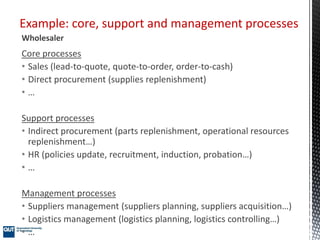
Core processes
• Sales (lead-to-quote, quote-to-order, order-to-cash)
• Direct procurement (supplies replenishment)
• …
Support processes
• Indirect procurement (parts replenishment, operational resources
replenishment…)
• HR (policies update, recruitment, induction, probation…)
• …
Management processes
• Suppliers management (suppliers planning, suppliers acquisition…)
• Logistics management (logistics planning, logistics controlling…)
• …
Example: core, support and management processes
Wholesaler
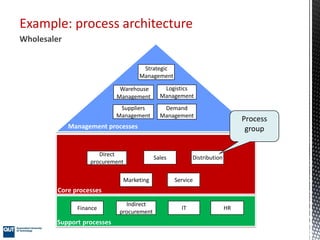
Strategic
Management
Warehouse
Management
Suppliers
Management
Logistics
Management
Management processes
Finance
Indirect
procurement
IT HR
Core processes
Support processes
Wholesaler
Example: process architecture
Demand
Management
Sales
Direct
procurement
Distribution
ServiceMarketing
Process
group
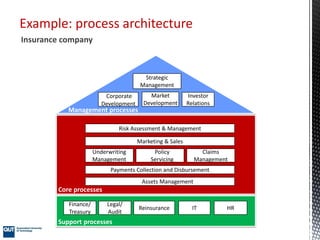
Strategic
Management
Corporate
Development
Investor
Relations
Risk Assessment & Management
Market
Development
Management processes
Marketing & Sales
Underwriting
Management
Policy
Servicing
Claims
Management
Payments Collection and Disbursement
Assets Management
Finance/
Treasury
Legal/
Audit
Reinsurance IT HR
Core processes
Support processes
Insurance company
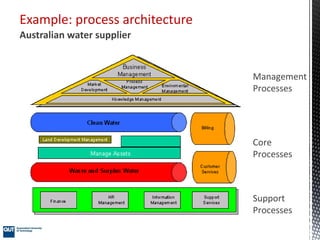
Example: process architecture
Core
Processes
Support
Processes
Management
Processes
Australian water supplier
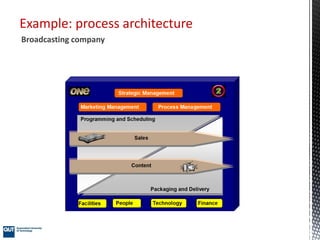
Example: process architecture
Broadcasting company
Process scoping
Processes are interdependent  insights into interrelations
required
• Specialization: general – special product/service
• Horizontal: upstream – downstream processes and their value chains
• Vertical: main processes – sub-processes
Process architecture
Scoping a process
Key scoping questions:
1. When does a given process instance start?
2. When do we consider a process completed?
3. What key objects does the process manipulates?
4. Who participates in the process?
5. Who owns the process?
A well-scoped process:
• Has a clear start, clear end (input, output)
• Has a clear, coherent set of “main objects” and “participants”
• Has a clear owner
Guidelines to identify horizontal boundaries
1. Change of key business object in the process
2. Change of multiplicity of main business object
3. Change in frequency/time
4. Change in intermediate outcome/resolution/objective
Guidelines to identify horizontal boundaries (cont’ed)
1. Core processes
• From an input to an outcome that generates value
• Decompose by identifying intermediate outcomes
2. Support processes
• From a need to a resolution
• Decompose by identifying intermediate resolutions
3. Management processes
• To control other processes
• Decompose by identifying intermediate objectives
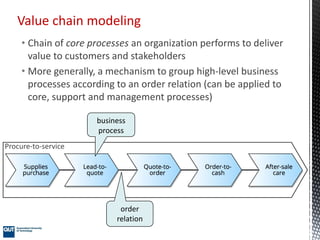
• Chain of core processes an organization performs to deliver
value to customers and stakeholders
• More generally, a mechanism to group high-level business
processes according to an order relation (can be applied to
core, support and management processes)
Value chain modeling
Procure-to-service
business
process
order
relation
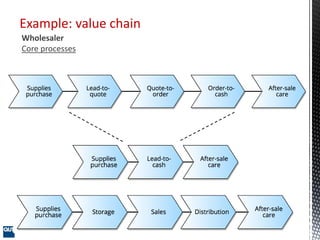
Example: value chain
Wholesaler
Core processes
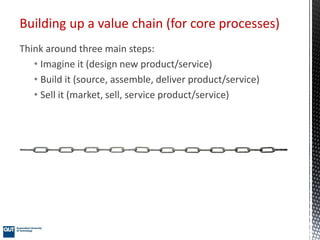
Building up a value chain (for core processes)
Think around three main steps:
• Imagine it (design new product/service)
• Build it (source, assemble, deliver product/service)
• Sell it (market, sell, service product/service)
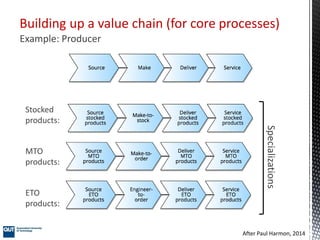
Building up a value chain (for core processes)
Example: Producer
Stocked
products:
MTO
products:
ETO
products:
Specializations
After Paul Harmon, 2014
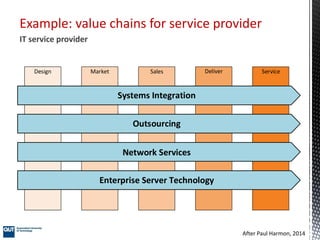
Example: value chains for service provider
ServiceDeliverSalesMarketDesign
Systems Integration
Outsourcing
Network Services
Enterprise Server Technology
IT service provider
After Paul Harmon, 2014
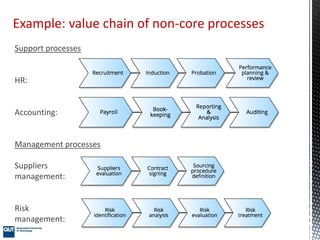
Support processes
HR:
Accounting:
Management processes
Suppliers
management:
Risk
management:
Example: value chain of non-core processes
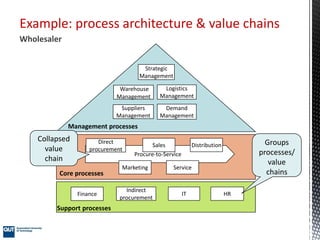
Strategic
Management
Warehouse
Management
Suppliers
Management
Logistics
Management
Management processes
Procure-to-Service
Finance
Indirect
procurement
IT HR
Core processes
Support processes
Wholesaler
Example: process architecture & value chains
Demand
Management
Groups
processes/
value
chains
Collapsed
value
chain
Sales
Direct
procurement
Distribution
ServiceMarketing
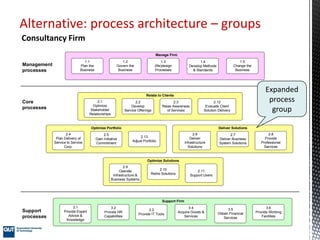
Alternative: process architecture – groups
Management
processes
1.1
Plan the
Business
1.2
Govern the
Business
1.3
(Re)design
Processes
1.5
Change the
Business
1.4
Develop Methods
& Standards
Manage Firm
2.1
Optimize
Stakeholder
Relationships
2.2
Develop
Service Offerings
2.3
Raise Awareness
of Services
2.12
Evaluate Client
Solution Delivery
Relate to Clients
2.4
Plan Delivery of
Service to Service
Corp.
2.5
Gain Initiative
Commitment
2.13
Adjust Portfolio
Optimize Portfolio
2.6
Deliver
Infrastructure
Solutions
2.7
Deliver Business
System Solutions
2.8
Provide
Professional
Services
Deliver Solutions
2.9
Operate
Infrastructure &
Business Systems
2.10
Retire Solutions
2.11
Support Users
Optimize Solutions
Core
processes
3.1
Provide Expert
Advice &
Knowledge
3.2
Provide HR
Capabilities
3.3
Provide IT Tools
3.5
Obtain Financial
Services
3.4
Acquire Goods &
Services
Support Firm
3.6
Provide Working
Facilities
Support
processes
Consultancy Firm
Expanded
process
group
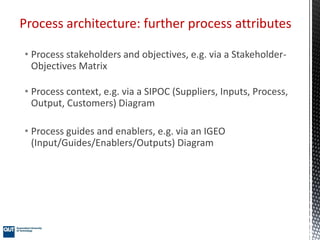
• Process stakeholders and objectives, e.g. via a Stakeholder-
Objectives Matrix
• Process context, e.g. via a SIPOC (Suppliers, Inputs, Process,
Output, Customers) Diagram
• Process guides and enablers, e.g. via an IGEO
(Input/Guides/Enablers/Outputs) Diagram
Process architecture: further process attributes
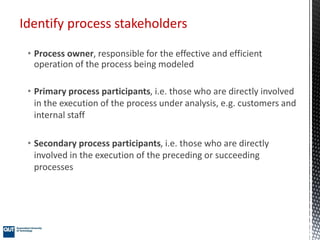
• Process owner, responsible for the effective and efficient
operation of the process being modeled
• Primary process participants, i.e. those who are directly involved
in the execution of the process under analysis, e.g. customers and
internal staff
• Secondary process participants, i.e. those who are directly
involved in the execution of the preceding or succeeding
processes
Identify process stakeholders
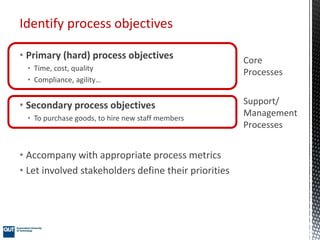
• Primary (hard) process objectives
• Time, cost, quality
• Compliance, agility…
• Secondary process objectives
• To purchase goods, to hire new staff members
• Accompany with appropriate process metrics
• Let involved stakeholders define their priorities
Identify process objectives
Core
Processes
Support/
Management
Processes
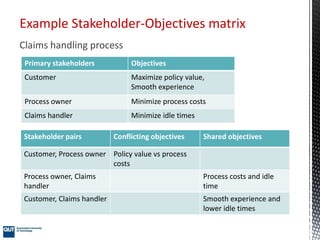
Claims handling process
Example Stakeholder-Objectives matrix
Primary stakeholders Objectives
Customer Maximize policy value,
Smooth experience
Process owner Minimize process costs
Claims handler Minimize idle times
Stakeholder pairs Conflicting objectives Shared objectives
Customer, Process owner Policy value vs process
costs
Process owner, Claims
handler
Process costs and idle
time
Customer, Claims handler Smooth experience and
lower idle times
References
Required
• M. Dumas, M. La Rosa, J. Mendling, H.A. Reijers, “Fundamentals of Business Process
Management”, Springer, 2013, Chapter 2
Recommended
• T.H. Davenport, “Process Innovation: Reengineering Work Through Information Technology”,
Harvard Business School Press, 1993
• M. Hammer, J. Champy, “Reengineering the Corporation: A Manifesto for Business
Revolution”, HarperCollins, 1993
• M.E. Porter, “Competitive Advantage: Creating and Sustaining Superior Performance”, Free
Press, 1985
• P. Harmon, Business Process Change, Morgan Kaufmann, 2014 (3rd edition)
• M. Rosemann, “Process Portfolio Management”, BPTrends, April 2006
• R. Dijkman, I. Vanderfeesten, H.A. Reijers, “The road to a business process architecture: an
overview of approaches and their use”. BETA Working Paper Series, WP 350. Eindhoven
University of Technology, Eindhoven (2011)
Web-sites
• http://www.value-chain.org (Value Reference Model)
• http://www.mindtools.com/pages/article/newSTR_66.htm (more on value chains)
• http://www.apqc.org/process-classification-framework (APQC PCF website)

Process architecture - Part I

  • 1.
    CRICOS No. 00213J auniversity for the worldreal R 1 A/Prof. Marcello La Rosa BPM Discipline Queensland University ofTechnology IAB203 – Business Process Modelling Week 9, 28 Apr 2015
  • 2.
    Process Identification Process identification Conformance and performanceinsights Conformance and performance insights Process monitoring and controlling Executable process model Executable process model Process implementation To-be process model To-be process model Process analysis As-is process model As-is process model Process discovery Process architectureProcess architecture Process redesign Insights on weaknesses and their impact Insights on weaknesses and their impact 3
  • 3.
    What? 1. Identify anorganization’s business processes 2. Prioritize their management based on certain criteria Why? 1. Understand the organization 2. Maximize value of BPM projects How long? Processes change over time (“dynamics of time”) • identification should be exploratory and iterative • improvement opportunities are time-constrained Process identification
  • 4.
    1. Designation step •Enumerate main processes • Determine process scope 2. Prioritization step (aka Process selection) Prioritize processes based on: • Importance • Health • Feasibility Process identification steps After Davenport (1993) Process Architecture Prioritized Process Portfolio
  • 5.
    Process enumeration There isno “number fits all” - it really depends on organization’s domain and size Rule of thumb: 10-20 processes Trade-off: • ensuring process scope is manageable, since… • process scope determines potential impact
  • 6.
    • Order-to-cash • Lead-to-quote •Quote-to-order • … Example: enumeration Wholesaler • Staff recruitment • Staff induction • Staff probation • Policies update • … • Supplies replenishment • Operational resources replenishment • … • Demand forecasting • Logistics planning • … • Strategy development • … • Suppliers planning • Suppliers acquisition • …
  • 7.
  • 8.
    Components of aprocess architecture Core Processes Management Processes Suppliers/Partners Customers/Stakeholders Support Processes After Michael Porter (1985)
  • 9.
    Core vs supportprocesses (Porter)
  • 10.
    Core, support andmanagement processes After Michael Porter (1985) • Strategic and Planning • Budgeting • Compliance and Risk management • Investors, Suppliers and Partners management Management processes • Design and Development • Manufacturing • Marketing and Sales • Delivery and After-sale • Direct procurement Core processes • Indirect procurement • Human Resources • Information Technology • Accounting, Financial and Legal Support processes
  • 11.
    Core processes • Sales(lead-to-quote, quote-to-order, order-to-cash) • Direct procurement (supplies replenishment) • … Support processes • Indirect procurement (parts replenishment, operational resources replenishment…) • HR (policies update, recruitment, induction, probation…) • … Management processes • Suppliers management (suppliers planning, suppliers acquisition…) • Logistics management (logistics planning, logistics controlling…) • … Example: core, support and management processes Wholesaler
  • 12.
    Strategic Management Warehouse Management Suppliers Management Logistics Management Management processes Finance Indirect procurement IT HR Coreprocesses Support processes Wholesaler Example: process architecture Demand Management Sales Direct procurement Distribution ServiceMarketing Process group
  • 13.
    Strategic Management Corporate Development Investor Relations Risk Assessment &Management Market Development Management processes Marketing & Sales Underwriting Management Policy Servicing Claims Management Payments Collection and Disbursement Assets Management Finance/ Treasury Legal/ Audit Reinsurance IT HR Core processes Support processes Insurance company Example: process architecture
  • 14.
  • 15.
  • 16.
    Process scoping Processes areinterdependent  insights into interrelations required • Specialization: general – special product/service • Horizontal: upstream – downstream processes and their value chains • Vertical: main processes – sub-processes Process architecture
  • 17.
    Scoping a process Keyscoping questions: 1. When does a given process instance start? 2. When do we consider a process completed? 3. What key objects does the process manipulates? 4. Who participates in the process? 5. Who owns the process? A well-scoped process: • Has a clear start, clear end (input, output) • Has a clear, coherent set of “main objects” and “participants” • Has a clear owner
  • 18.
    Guidelines to identifyhorizontal boundaries 1. Change of key business object in the process 2. Change of multiplicity of main business object 3. Change in frequency/time 4. Change in intermediate outcome/resolution/objective
  • 19.
    Guidelines to identifyhorizontal boundaries (cont’ed) 1. Core processes • From an input to an outcome that generates value • Decompose by identifying intermediate outcomes 2. Support processes • From a need to a resolution • Decompose by identifying intermediate resolutions 3. Management processes • To control other processes • Decompose by identifying intermediate objectives
  • 20.
    • Chain ofcore processes an organization performs to deliver value to customers and stakeholders • More generally, a mechanism to group high-level business processes according to an order relation (can be applied to core, support and management processes) Value chain modeling Procure-to-service business process order relation
  • 21.
  • 22.
    Building up avalue chain (for core processes) Think around three main steps: • Imagine it (design new product/service) • Build it (source, assemble, deliver product/service) • Sell it (market, sell, service product/service)
  • 23.
    Building up avalue chain (for core processes) Example: Producer Stocked products: MTO products: ETO products: Specializations After Paul Harmon, 2014
  • 24.
    Example: value chainsfor service provider ServiceDeliverSalesMarketDesign Systems Integration Outsourcing Network Services Enterprise Server Technology IT service provider After Paul Harmon, 2014
  • 25.
  • 26.
    Strategic Management Warehouse Management Suppliers Management Logistics Management Management processes Procure-to-Service Finance Indirect procurement IT HR Coreprocesses Support processes Wholesaler Example: process architecture & value chains Demand Management Groups processes/ value chains Collapsed value chain Sales Direct procurement Distribution ServiceMarketing
  • 27.
    Alternative: process architecture– groups Management processes 1.1 Plan the Business 1.2 Govern the Business 1.3 (Re)design Processes 1.5 Change the Business 1.4 Develop Methods & Standards Manage Firm 2.1 Optimize Stakeholder Relationships 2.2 Develop Service Offerings 2.3 Raise Awareness of Services 2.12 Evaluate Client Solution Delivery Relate to Clients 2.4 Plan Delivery of Service to Service Corp. 2.5 Gain Initiative Commitment 2.13 Adjust Portfolio Optimize Portfolio 2.6 Deliver Infrastructure Solutions 2.7 Deliver Business System Solutions 2.8 Provide Professional Services Deliver Solutions 2.9 Operate Infrastructure & Business Systems 2.10 Retire Solutions 2.11 Support Users Optimize Solutions Core processes 3.1 Provide Expert Advice & Knowledge 3.2 Provide HR Capabilities 3.3 Provide IT Tools 3.5 Obtain Financial Services 3.4 Acquire Goods & Services Support Firm 3.6 Provide Working Facilities Support processes Consultancy Firm Expanded process group
  • 28.
    • Process stakeholdersand objectives, e.g. via a Stakeholder- Objectives Matrix • Process context, e.g. via a SIPOC (Suppliers, Inputs, Process, Output, Customers) Diagram • Process guides and enablers, e.g. via an IGEO (Input/Guides/Enablers/Outputs) Diagram Process architecture: further process attributes
  • 29.
    • Process owner,responsible for the effective and efficient operation of the process being modeled • Primary process participants, i.e. those who are directly involved in the execution of the process under analysis, e.g. customers and internal staff • Secondary process participants, i.e. those who are directly involved in the execution of the preceding or succeeding processes Identify process stakeholders
  • 30.
    • Primary (hard)process objectives • Time, cost, quality • Compliance, agility… • Secondary process objectives • To purchase goods, to hire new staff members • Accompany with appropriate process metrics • Let involved stakeholders define their priorities Identify process objectives Core Processes Support/ Management Processes
  • 31.
    Claims handling process ExampleStakeholder-Objectives matrix Primary stakeholders Objectives Customer Maximize policy value, Smooth experience Process owner Minimize process costs Claims handler Minimize idle times Stakeholder pairs Conflicting objectives Shared objectives Customer, Process owner Policy value vs process costs Process owner, Claims handler Process costs and idle time Customer, Claims handler Smooth experience and lower idle times
  • 32.
    References Required • M. Dumas,M. La Rosa, J. Mendling, H.A. Reijers, “Fundamentals of Business Process Management”, Springer, 2013, Chapter 2 Recommended • T.H. Davenport, “Process Innovation: Reengineering Work Through Information Technology”, Harvard Business School Press, 1993 • M. Hammer, J. Champy, “Reengineering the Corporation: A Manifesto for Business Revolution”, HarperCollins, 1993 • M.E. Porter, “Competitive Advantage: Creating and Sustaining Superior Performance”, Free Press, 1985 • P. Harmon, Business Process Change, Morgan Kaufmann, 2014 (3rd edition) • M. Rosemann, “Process Portfolio Management”, BPTrends, April 2006 • R. Dijkman, I. Vanderfeesten, H.A. Reijers, “The road to a business process architecture: an overview of approaches and their use”. BETA Working Paper Series, WP 350. Eindhoven University of Technology, Eindhoven (2011) Web-sites • http://www.value-chain.org (Value Reference Model) • http://www.mindtools.com/pages/article/newSTR_66.htm (more on value chains) • http://www.apqc.org/process-classification-framework (APQC PCF website)