Contents
1. The Context of Process Identification
2. Definition of the Process Architecture
1. Process Categories
2. Relationships Between Processes
3. Reuse of Reference Models
4. Process Landscape Model
5. The Example of SAP’s Process Architecture
3. Process Selection
1. Selection Criteria
2. Process Performance Measures
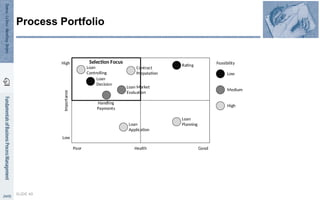
3. Process Portfolio
4. Recap
SEITE 1
Chapter 2: Process Identification
Process
discovery
Process
identification
Process
analysis
Process
implementation
Process
monitoring
Process
redesign
Process architecture
As-is process
model
Insights on
weaknesses and
their impact
To-be process
model
Executable
process
model
Conformance and
performance
insights
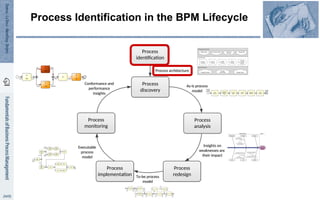
Process Identification in the BPM Lifecycle
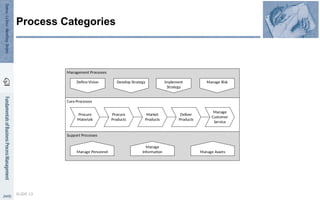
Define Vision Develop Strategy Implement
Strategy
Manage Personnel Manage Assets
Management Processes
Core Processes
Support Processes
Manage Risk
Manage
Information
Procure
Materials
Procure
Products
Market
Products
Deliver
Products
Manage
Customer
Service
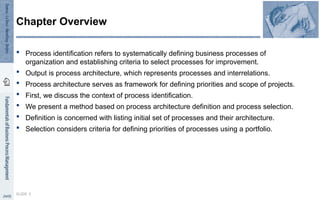
 Process identification refers to systematically defining business processes of
organization and establishing criteria to select processes for improvement.
 Output is process architecture, which represents processes and interrelations.
 Process architecture serves as framework for defining priorities and scope of projects.
 First, we discuss the context of process identification.
 We present a method based on process architecture definition and process selection.
 Definition is concerned with listing initial set of processes and their architecture.
 Selection considers criteria for defining priorities of processes using a portfolio.
SLIDE 3
Chapter Overview
Contents
1. The Context of Process Identification
2. Definition of the Process Architecture
1. Process Categories
2. Relationships Between Processes
3. Reuse of Reference Models
4. Process Landscape Model
5. The Example of SAP’s Process Architecture
3. Process Selection
1. Selection Criteria
2. Process Performance Measures
3. Process Portfolio
4. Recap
SEITE 4
Chapter 2: Process Identification
Business strategy is an organizational perspective on
setting and meeting business goals. (Mintzberg)
SLIDE 5
Definition of Business Strategy
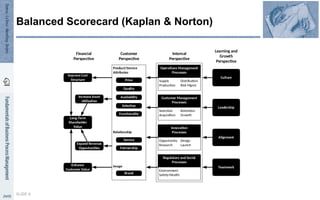
Innovation
Processes
Opportunity
Research
Design
Launch
Operations Management
Processes
Supply
Production
Distribution
Risk Mgmt.
Internal
Perspective
Customer
Perspective
Product/Service
Attributes
Relationship
Image
Price
Quality
Availability
Selection
Functionality
Service
Partnership
Brand
Improve Cost
Structure
Increase Asset
Utilization
Expand Revenue
Opportunities
Enhance
Customer Value
Financial
Perspective
Long-Term
Shareholder
Value
Learning and
Growth
Perspective
Culture
Leadership
Alignment
Teamwork
Regulatory and Social
Processes
Employment
Community
Environment
Safety/Health
Customer Management
Processes
Selection
Acquisition
Retention
Growth
SLIDE 6
Balanced Scorecard (Kaplan & Norton)
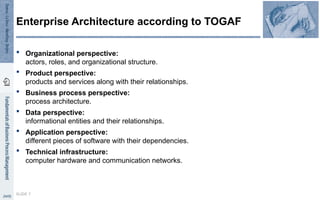
 Organizational perspective:
actors, roles, and organizational structure.
 Product perspective:
products and services along with their relationships.
 Business process perspective:
process architecture.
 Data perspective:
informational entities and their relationships.
 Application perspective:
different pieces of software with their dependencies.
 Technical infrastructure:
computer hardware and communication networks.
SLIDE 7
Enterprise Architecture according to TOGAF
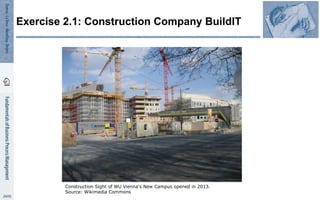
Exercise 2.1: Construction Company BuildIT
Construction Sight of WU Vienna‘s New Campus opened in 2013.
Source: Wikimedia Commons
Exercise 2.1-2: Construction Company BuildIT
Consider the construction company BuildIT and its procure-to-pay process that is
described on page 2.
 To which category in the internal perspective of Figure 2.1 does this process belong?
 How does it influence different aspects of the customer perspective?
 How is it shaped by aspects of the learning and growth perspective?
 Which aspects in the organizational, product, data, application, and technical
infrastructure perspectives have to be described to understand this process?
SLIDE 10
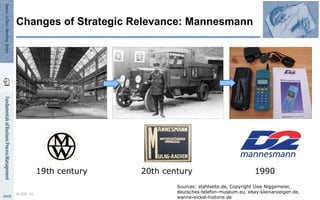
Changes of Strategic Relevance: Mannesmann
Sources: stahlseite.de, Copyright Uwe Niggemeier,
deutsches-telefon-museum.eu, ebay-kleinanzeigen.de,
wanne-eickel-historie.de
19th century 20th century 1990
 Is it a process at all?
 It must be possible to identify main action, which
is applied to a category of cases.
 Name is of form verb + noun.
 Can the process be controlled?
 Repetitive series of events and activities to
execute individually observable cases.
 Without a clear case notion, process management
is not feasible.
 Also, without any sense of repetition, a group of
business activities may better qualify as a project
than as a business process.
 Is the process important enough to manage?
 There is customer who is willing to pay for
outcomes,
 Organization that carries out the process would be
willing to pay another party for taking over, or
 Legal, mandatory framework compels an
organization to execute it.
 Is the scope of the process not too big?
 1:1 relation between initial event and activities.
 Is the scope of the process not too small?
 Rule of thumb: there should be at least three
different actors – excluding the customer – involved.
 If there are no handoffs between multiple actors or
systems, there is little that can be improved using
BPM methods.
SLIDE 11
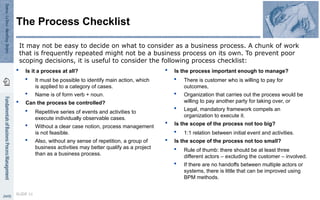
The Process Checklist
It may not be easy to decide on what to consider as a business process. A chunk of work
that is frequently repeated might not be a business process on its own. To prevent poor
scoping decisions, it is useful to consider the following process checklist:
Contents
1. The Context of Process Identification
2. Definition of the Process Architecture
1. Process Categories
2. Relationships Between Processes
3. Reuse of Reference Models
4. Process Landscape Model
5. The Example of SAP’s Process Architecture
3. Process Selection
1. Selection Criteria
2. Process Performance Measures
3. Process Portfolio
4. Recap
SEITE 12
Chapter 2: Process Identification
Define Vision Develop Strategy Implement
Strategy
Manage Personnel Manage Assets
Management Processes
Core Processes
Support Processes
Manage Risk
Manage
Information
Procure
Materials
Procure
Products
Market
Products
Deliver
Products
Manage
Customer
Service
SLIDE 13
Process Categories
Exercise 2.3: University
WU Vienna‘s New Campus opened in 2013. Source: Wikimedia Commons
 What are core, support, and management processes of a university?
Exercise 2.3: University
Procure
Materials
Procure
Products
Market
Products
Deliver
Products
Manage
Customer
Service
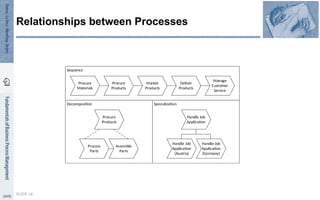
Sequence
Decomposition Specialization
Procure
Products
Handle Job
Application
Process
Parts
Assemble
Parts
Handle Job
Application
(Austria)
Handle Job
Application
(Germany)
SLIDE 16
Relationships between Processes
 Can you think of other types of relations that are useful to distinguish between
processes?
 Hint. Think about the purpose of identifying the relations between business
processes
Exercise 2.4: Relationships
Logical
Levels
Physical
Levels
Business
Levels
Operations
Levels
Process
Levels
Model structure, methodology and
modelling standards
Shows groups of related business
functions and standard end-to-end
processes (e.g. Service Streams)
Decomposition of core processes into
detailed ‘success model’ business
process flows
Detailed operational process flows
with error conditions and product and
geographical variants (where
required).
Further decomposition of detailed
operational where required
Process Groupings
Business Activities
Core Processes
Business Process Flows
Detailed Process Flows
Level A
Level B
Level C
Level D
Level E
Level F
Operational Process Flows
Defines business activities
Distinguishes operational customer
oriented processes from management
and strategic process
Core processes that combine together to
deliver Service Streams and other end-
to-end processes
Meta
Level
©BritishTelecommunications (2005)
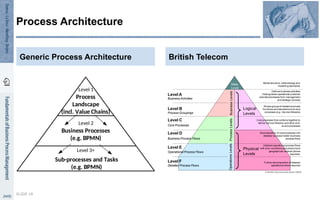
Generic Process Architecture
SLIDE 18
Process Architecture
British Telecom
Level 1
Level 2
Level 3+
Process
Landscape
(incl. Value Chains)
Business Processes
(e.g. BPMN)
Sub-processes and Tasks
(e.g. BPMN)
SLIDE 19
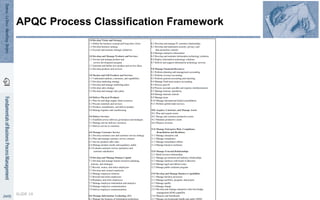
APQC Process Classification Framework
SLIDE 20
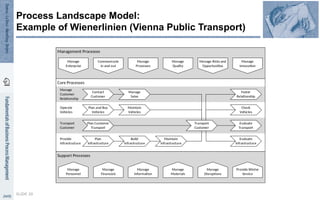
Process Landscape Model:
Example of Wienerlinien (Vienna Public Transport)
Manage
Enterprise
Manage
Personnel
Management Processes
Core Processes
Support Processes
Communicate
in and out
Manage
Processes
Manage
Quality
Manage Risks and
Opportunities
Manage
Innovation
Contact
Customer
Manage
Sales
Manage
Customer
Relationship
Operate
Vehicles
Plan and Buy
Vehicles
Maintain
Vehicles
Transport
Customer
Transport
Customer
Evaluate
Transport
Provide
Infrastructure
Plan
Infrastructure
Build
Infrastructure
Maintain
Infrastructure
Evaluate
Infrastructure
Check
Vehicles
Foster
Relationship
Manage
Financials
Manage
Information
Manage
Materials
Manage
Disruptions
Provide Winter
Service
Plan Customer
Transport
1. Clarify terminology:
 Define key terms.
 Use organizational glossary.
 Use reference models.
 Ensure that stakeholders have a consistent understanding of process landscape model.
2. Identify end-to-end processes:
 Those processes interface with customers and suppliers.
 Goods and services that organization provides are good starting point.
 Properties help to distinguish processes, including: Product type, Service type, Channel, Customer type.
3. For each end-to-end process, identify its sequential processes:
 Identify the internal, intermediate outcomes of end-to-end process.
 Perspectives help set boundaries: Product lifecycle, Customer relationship, Supply chain, Transaction
stages, Change of business objects, Separation.
4. For each business process, identify its major management and support processes:
 What is required to execute the previously identified processes.
 Typical support processes are management of personnel, financials, information, and materials.
 However, these can be core processes if they are integral part of business model.
 Management processes are usually generic.
SLIDE 21
How to define Process Landscape Model
5. Decompose and specialize business processes:
 Processes of process landscape should be further subdivided into abstract process on Level 2.
 Further subdivision until processes can be managed autonomously by single process owner.
 Considerations when this subdivision should stop: Manageability and Impact.
6. Compile process profile:
 Each of the identified processes should be described using process profile.
 Process profile supports definition of boundaries, vision performance indicators, resources, etc.
7. Check completeness and consistency:
 Reference models can be used to check whether all major processes are included.
 Reference models can help to check consistency of terminology.
 Check whether all processes can be associated with functional units of organization chart and vice versa.
SLIDE 22
How to define Process Landscape Model
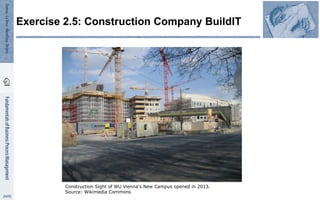
Exercise 2.5: Construction Company BuildIT
Construction Sight of WU Vienna‘s New Campus opened in 2013.
Source: Wikimedia Commons
 Which APQC categories on Level 1 are relevant for a construction company like
BuildIT?
SLIDE 24
Exercise 2.5: Construction Company BuildIT
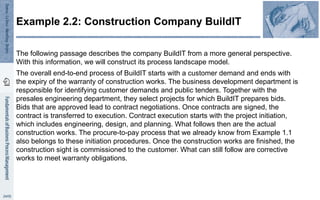
Example 2.2: Construction Company BuildIT
The following passage describes the company BuildIT from a more general perspective.
With this information, we will construct its process landscape model.
The overall end-to-end process of BuildIT starts with a customer demand and ends with
the expiry of the warranty of construction works. The business development department is
responsible for identifying customer demands and public tenders. Together with the
presales engineering department, they select projects for which BuildIT prepares bids.
Bids that are approved lead to contract negotiations. Once contracts are signed, the
contract is transferred to execution. Contract execution starts with the project initiation,
which includes engineering, design, and planning. What follows then are the actual
construction works. The procure-to-pay process that we already know from Example 1.1
also belongs to these initiation procedures. Once the construction works are finished, the
construction sight is commissioned to the customer. What can still follow are corrective
works to meet warranty obligations.
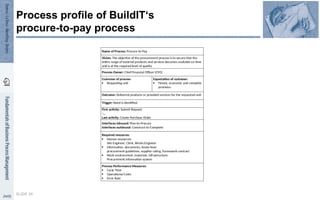
Name of Process: Procure-to-Pay
Vision: The objective of the procurement process is to secure that the
entire range of external products and services becomes available on time
and is at the required level of quality.
Customer of process:
 Requesting unit
Expectation of customer:
 Timely, economic and complete
provision
Outcome: Delivered products or provided services for the requested unit
Trigger: Need is identified
First activity: Submit Request
͙..
Last activity: Create Purchase Order
Interfaces inbound: Plan-to-Procure
Interfaces outbound: Construct-to-Complete
Required resources:
 Human resources:
Site Engineer, Clerk, Works Engineer
 Information, documents, know-how:
procurement guidelines, supplier rating, framework contract
 Work environment, materials, infrastructure:
Procurement information system
Process Performance Measures:
 Cycle Time
 Operational Costs
 Error Rate
Process Owner: Chief Financial Officer (CFO)
SLIDE 26
Process profile of BuildIT‘s
procure-to-pay process
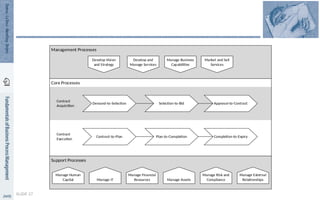
Manage Human
Capital
Management Processes
Core Processes
Support Processes
Develop Vision
and Strategy
Develop and
Manage Services
Market and Sell
Services
Demand-to-Selection Selection-to-Bid
Contract
Acquisition
Contract
Execution
Approval-to-Contract
Manage IT
Manage Financial
Resources Manage Assets
Manage Risk and
Compliance
Manage External
Relationships
Manage Business
Capabilities
Contract-to-Plan Plan-to-Completion Completion-to-Expiry
SLIDE 27
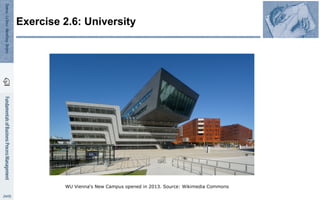
Exercise 2.6: University
WU Vienna‘s New Campus opened in 2013. Source: Wikimedia Commons
 Create a process landscape model for a university by applying the seven steps
described in this section. Use the APQC Process Classification Framework as an
aid.
Exercise 2.6: University
 Explain how the trade-off between impact and manageability works out for broad
and narrow processes, respectively.
Exercise 2.7: Manageabilty and Impact
SLIDE 31
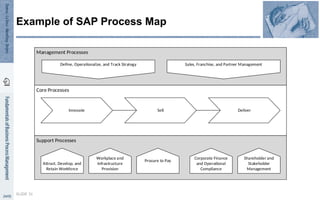
Example of SAP Process Map
Manage
Enterprise
Management Processes
Manage
Innovation
Define, Operationalize, and Track Strategy
Attract, Develop, and
Retain Workforce
Management Processes
Core Processes
Support Processes
Workplace and
Infrastructure
Provision
Procure to Pay
Corporate Finance
and Operational
Compliance
Shareholder and
Stakeholder
Management
Sales, Franchise, and Partner Management
Innovate Sell Deliver
Contents
1. The Context of Process Identification
2. Definition of the Process Architecture
1. Process Categories
2. Relationships Between Processes
3. Reuse of Reference Models
4. Process Landscape Model
5. The Example of SAP’s Process Architecture
3. Process Selection
1. Selection Criteria
2. Process Performance Measures
3. Process Portfolio
4. Recap
SEITE 32
Chapter 2: Process Identification
 Strategic Importance:
 Find out which processes have the greatest impact on the strategic goals.
 Consider profitability, uniqueness, or contribution to competitive advantages.
 Select those processes for process management that relate to strategy.
 Health:
 Determine which processes are in deepest trouble.
 These processes may profit the most from BPM initiatives.
 Feasibility:
 Determine how susceptible process is to BPM initiatives, incidentally or continuously.
 Culture and politics may be obstacles.
 BPM should focus on those processes where it is reasonable to achieve benefits.
SLIDE 33
Selection Criteria
 Exercise 2.8. Consider again the procure-to-pay process of BuildIT (page 2) and
the admission process of a university (page 5) as described in Chapter 1.
 Discuss their strategic importance, their health, and the feasibility of a potential
improvement to these processes.
Further Questions:
 Given all the discussed criteria, does an assessment of the importance, health, and
feasibility always point us to the same processes to actively manage?
 Should all processes that are unhealthy, of strategic importance, and feasible to
manage be subjected to BPM?
SLIDE 34
Exercise 2.8: Selection Criteria
Performance Measures
 Time
 Cost
 Quality
 Flexibility
Performance Objectives
 Formulate performance objectives of the
process at a high level, in the form of a
desirable state that the process should
ideally reach, e.g., customers should be
served in less than 30 minutes.
 For each performance objective, identify the
relevant performance dimension(s) and
aggregation function(s), and from there,
define one or more performance measures
for the objective in question, e.g., the
percentage of customers served in less than
30 minutes. Let us call this measure ST(30).
 Define a more refined objective based on
this performance measure, such as
ST(30) >99%.
SLIDE 35
Process Performance Measures
 A restaurant has recently lost many customers
due to poor customer service. The
management team has decided to address
this issue first of all by focusing on the delivery
of meals.
 The team gathered data by asking customers
about how quickly they liked to receive their
meals and what they considered as an
acceptable wait.
 The data suggested that half of the customers
would prefer their meals to be served in 15
min or less. All customers agreed that a
waiting time of 30 min or more is unacceptable
 In this scenario, most relevant performance
dimension is serving time.
 One objective is to completely avoid waiting
times above 30 min.
 Percentage of customers served in less than
30 min should be close to 100%.
 Thus, the percentage of customers served in
less than 30 minutes is relevant performance
measure.
 Threshold mentioned in scenario is 15 min.
 Choice between two performance measures:
average meal delivery time or percentage of
customers served in 15 min.
SLIDE 36
Example 2.3: Restaurant
 Consider the following summary of issues reported in a travel agency.
 A travel agency has recently lost several medium-sized and large corporate
customers due to complaints about poor customer service. The management team
of the travel agency decided to appoint a team of analysts to address this problem.
The team gathered data by conducting interviews and surveys with current and
past corporate customers and also by gathering customer feedback data that the
travel agency has recorded over time.
 About 2% of customers complained about errors that had been made in their
bookings. In one occasion, a customer had requested a change to a flight booking.
The travel agent wrote an email to the customer suggesting that the change had
been made and attached a modified travel itinerary. However, it later turned out that
the modified booking had not been confirmed in the flight reservation system. As a
result, the customer was not allowed to board the flight and this led to a series of
severe inconveniences for the customer.
SLIDE 37
Exercise 2.9: Travel Agency
 Similar problems had occurred when booking a flight initially: the customer had
asked for certain dates, but the flight tickets had been issued for different dates.
Additionally, customers complained of the long times it took to get responses to
their requests for quotes and itineraries. In most cases, employees of the travel
agency replied to requests for quotes within 2-4 working hours, but in the case of
some complicated itinerary requests (about 10% of the requests), it took them up to
2 days.
 Finally, about 5% of customers also complained that the travel agents did not find
the best flight connections and prices for them. These customers essentially stated
that they had found better itineraries and prices on the Web by searching by
themselves.
1. Which business processes should the travel agency select for improvement?
2. For each of the business processes you identified above, indicate which
performance measure the travel agency should improve.
SLIDE 38
Exercise 2.9: Travel Agency
SLIDE 39
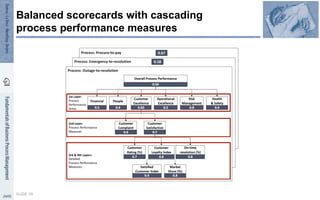
Balanced scorecards with cascading
process performance measures
Importance
Health
Poor Good
Low
High Feasibility
Low
Medium
High
Loan
Controlling
Loan
Decision
Loan Market
Evaluation
Contract
Prepatation
Rating
Handling
Payments
Loan
Application
Loan
Planning
Selection Focus
SLIDE 40
Process Portfolio
Exercise 2.10: University
WU Vienna‘s New Campus opened in 2013. Source: Wikimedia Commons
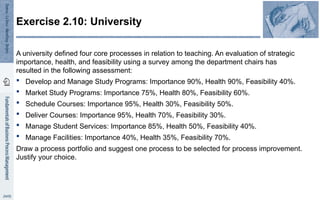
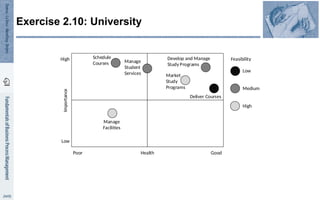
A university defined four core processes in relation to teaching. An evaluation of strategic
importance, health, and feasibility using a survey among the department chairs has
resulted in the following assessment:
 Develop and Manage Study Programs: Importance 90%, Health 90%, Feasibility 40%.
 Market Study Programs: Importance 75%, Health 80%, Feasibility 60%.
 Schedule Courses: Importance 95%, Health 30%, Feasibility 50%.
 Deliver Courses: Importance 95%, Health 70%, Feasibility 30%.
 Manage Student Services: Importance 85%, Health 50%, Feasibility 40%.
 Manage Facilities: Importance 40%, Health 35%, Feasibility 70%.
Draw a process portfolio and suggest one process to be selected for process improvement.
Justify your choice.
Exercise 2.10: University
Importance
Health
Poor Good
Low
High Feasibility
Low
Medium
High
Develop and Manage
Study Programs
Market
Study
Programs
Deliver Courses
Manage
Student
Services
Schedule
Courses
Manage
Facilities
Exercise 2.10: University
Contents
1. The Context of Process Identification
2. Definition of the Process Architecture
1. Process Categories
2. Relationships Between Processes
3. Reuse of Reference Models
4. Process Landscape Model
5. The Example of SAP’s Process Architecture
3. Process Selection
1. Selection Criteria
2. Process Performance Measures
3. Process Portfolio
4. Recap
SEITE 44
Chapter 2: Process Identification
 In this chapter, we discussed process identification.
 Process architecture definition aims at enumerating major processes of organization.
 Process architecture defines relationship between processes.
 Seven-step method for definition of process architecture including process landscape model.
 Process selection is concerned with prioritizing processes.
 Priorities upon importance of processes, health, and feasibility of improvements.
 Assessed by process owners or grounded on process performance measures and objectives.
 Most common performance dimensions are time, cost, quality, and flexibility.
 Process portfolios help in selection of processes for improvement.
 Selected processes become subject of remaining phases of BPM lifecycle.
SLIDE 45
Recap

FBPM2-Chapter-02-ProcessIdentification.pptx

  • 1.
    Contents 1. The Contextof Process Identification 2. Definition of the Process Architecture 1. Process Categories 2. Relationships Between Processes 3. Reuse of Reference Models 4. Process Landscape Model 5. The Example of SAP’s Process Architecture 3. Process Selection 1. Selection Criteria 2. Process Performance Measures 3. Process Portfolio 4. Recap SEITE 1 Chapter 2: Process Identification
  • 2.
    Process discovery Process identification Process analysis Process implementation Process monitoring Process redesign Process architecture As-is process model Insightson weaknesses and their impact To-be process model Executable process model Conformance and performance insights Process Identification in the BPM Lifecycle Define Vision Develop Strategy Implement Strategy Manage Personnel Manage Assets Management Processes Core Processes Support Processes Manage Risk Manage Information Procure Materials Procure Products Market Products Deliver Products Manage Customer Service
  • 3.
     Process identificationrefers to systematically defining business processes of organization and establishing criteria to select processes for improvement.  Output is process architecture, which represents processes and interrelations.  Process architecture serves as framework for defining priorities and scope of projects.  First, we discuss the context of process identification.  We present a method based on process architecture definition and process selection.  Definition is concerned with listing initial set of processes and their architecture.  Selection considers criteria for defining priorities of processes using a portfolio. SLIDE 3 Chapter Overview
  • 4.
    Contents 1. The Contextof Process Identification 2. Definition of the Process Architecture 1. Process Categories 2. Relationships Between Processes 3. Reuse of Reference Models 4. Process Landscape Model 5. The Example of SAP’s Process Architecture 3. Process Selection 1. Selection Criteria 2. Process Performance Measures 3. Process Portfolio 4. Recap SEITE 4 Chapter 2: Process Identification
  • 5.
    Business strategy isan organizational perspective on setting and meeting business goals. (Mintzberg) SLIDE 5 Definition of Business Strategy
  • 6.
    Innovation Processes Opportunity Research Design Launch Operations Management Processes Supply Production Distribution Risk Mgmt. Internal Perspective Customer Perspective Product/Service Attributes Relationship Image Price Quality Availability Selection Functionality Service Partnership Brand ImproveCost Structure Increase Asset Utilization Expand Revenue Opportunities Enhance Customer Value Financial Perspective Long-Term Shareholder Value Learning and Growth Perspective Culture Leadership Alignment Teamwork Regulatory and Social Processes Employment Community Environment Safety/Health Customer Management Processes Selection Acquisition Retention Growth SLIDE 6 Balanced Scorecard (Kaplan & Norton)
  • 7.
     Organizational perspective: actors,roles, and organizational structure.  Product perspective: products and services along with their relationships.  Business process perspective: process architecture.  Data perspective: informational entities and their relationships.  Application perspective: different pieces of software with their dependencies.  Technical infrastructure: computer hardware and communication networks. SLIDE 7 Enterprise Architecture according to TOGAF
  • 8.
    Exercise 2.1: ConstructionCompany BuildIT Construction Sight of WU Vienna‘s New Campus opened in 2013. Source: Wikimedia Commons
  • 9.
    Exercise 2.1-2: ConstructionCompany BuildIT Consider the construction company BuildIT and its procure-to-pay process that is described on page 2.  To which category in the internal perspective of Figure 2.1 does this process belong?  How does it influence different aspects of the customer perspective?  How is it shaped by aspects of the learning and growth perspective?  Which aspects in the organizational, product, data, application, and technical infrastructure perspectives have to be described to understand this process?
  • 10.
    SLIDE 10 Changes ofStrategic Relevance: Mannesmann Sources: stahlseite.de, Copyright Uwe Niggemeier, deutsches-telefon-museum.eu, ebay-kleinanzeigen.de, wanne-eickel-historie.de 19th century 20th century 1990
  • 11.
     Is ita process at all?  It must be possible to identify main action, which is applied to a category of cases.  Name is of form verb + noun.  Can the process be controlled?  Repetitive series of events and activities to execute individually observable cases.  Without a clear case notion, process management is not feasible.  Also, without any sense of repetition, a group of business activities may better qualify as a project than as a business process.  Is the process important enough to manage?  There is customer who is willing to pay for outcomes,  Organization that carries out the process would be willing to pay another party for taking over, or  Legal, mandatory framework compels an organization to execute it.  Is the scope of the process not too big?  1:1 relation between initial event and activities.  Is the scope of the process not too small?  Rule of thumb: there should be at least three different actors – excluding the customer – involved.  If there are no handoffs between multiple actors or systems, there is little that can be improved using BPM methods. SLIDE 11 The Process Checklist It may not be easy to decide on what to consider as a business process. A chunk of work that is frequently repeated might not be a business process on its own. To prevent poor scoping decisions, it is useful to consider the following process checklist:
  • 12.
    Contents 1. The Contextof Process Identification 2. Definition of the Process Architecture 1. Process Categories 2. Relationships Between Processes 3. Reuse of Reference Models 4. Process Landscape Model 5. The Example of SAP’s Process Architecture 3. Process Selection 1. Selection Criteria 2. Process Performance Measures 3. Process Portfolio 4. Recap SEITE 12 Chapter 2: Process Identification
  • 13.
    Define Vision DevelopStrategy Implement Strategy Manage Personnel Manage Assets Management Processes Core Processes Support Processes Manage Risk Manage Information Procure Materials Procure Products Market Products Deliver Products Manage Customer Service SLIDE 13 Process Categories
  • 14.
    Exercise 2.3: University WUVienna‘s New Campus opened in 2013. Source: Wikimedia Commons
  • 15.
     What arecore, support, and management processes of a university? Exercise 2.3: University
  • 16.
  • 17.
     Can youthink of other types of relations that are useful to distinguish between processes?  Hint. Think about the purpose of identifying the relations between business processes Exercise 2.4: Relationships
  • 18.
    Logical Levels Physical Levels Business Levels Operations Levels Process Levels Model structure, methodologyand modelling standards Shows groups of related business functions and standard end-to-end processes (e.g. Service Streams) Decomposition of core processes into detailed ‘success model’ business process flows Detailed operational process flows with error conditions and product and geographical variants (where required). Further decomposition of detailed operational where required Process Groupings Business Activities Core Processes Business Process Flows Detailed Process Flows Level A Level B Level C Level D Level E Level F Operational Process Flows Defines business activities Distinguishes operational customer oriented processes from management and strategic process Core processes that combine together to deliver Service Streams and other end- to-end processes Meta Level ©BritishTelecommunications (2005) Generic Process Architecture SLIDE 18 Process Architecture British Telecom Level 1 Level 2 Level 3+ Process Landscape (incl. Value Chains) Business Processes (e.g. BPMN) Sub-processes and Tasks (e.g. BPMN)
  • 19.
    SLIDE 19 APQC ProcessClassification Framework
  • 20.
    SLIDE 20 Process LandscapeModel: Example of Wienerlinien (Vienna Public Transport) Manage Enterprise Manage Personnel Management Processes Core Processes Support Processes Communicate in and out Manage Processes Manage Quality Manage Risks and Opportunities Manage Innovation Contact Customer Manage Sales Manage Customer Relationship Operate Vehicles Plan and Buy Vehicles Maintain Vehicles Transport Customer Transport Customer Evaluate Transport Provide Infrastructure Plan Infrastructure Build Infrastructure Maintain Infrastructure Evaluate Infrastructure Check Vehicles Foster Relationship Manage Financials Manage Information Manage Materials Manage Disruptions Provide Winter Service Plan Customer Transport
  • 21.
    1. Clarify terminology: Define key terms.  Use organizational glossary.  Use reference models.  Ensure that stakeholders have a consistent understanding of process landscape model. 2. Identify end-to-end processes:  Those processes interface with customers and suppliers.  Goods and services that organization provides are good starting point.  Properties help to distinguish processes, including: Product type, Service type, Channel, Customer type. 3. For each end-to-end process, identify its sequential processes:  Identify the internal, intermediate outcomes of end-to-end process.  Perspectives help set boundaries: Product lifecycle, Customer relationship, Supply chain, Transaction stages, Change of business objects, Separation. 4. For each business process, identify its major management and support processes:  What is required to execute the previously identified processes.  Typical support processes are management of personnel, financials, information, and materials.  However, these can be core processes if they are integral part of business model.  Management processes are usually generic. SLIDE 21 How to define Process Landscape Model
  • 22.
    5. Decompose andspecialize business processes:  Processes of process landscape should be further subdivided into abstract process on Level 2.  Further subdivision until processes can be managed autonomously by single process owner.  Considerations when this subdivision should stop: Manageability and Impact. 6. Compile process profile:  Each of the identified processes should be described using process profile.  Process profile supports definition of boundaries, vision performance indicators, resources, etc. 7. Check completeness and consistency:  Reference models can be used to check whether all major processes are included.  Reference models can help to check consistency of terminology.  Check whether all processes can be associated with functional units of organization chart and vice versa. SLIDE 22 How to define Process Landscape Model
  • 23.
    Exercise 2.5: ConstructionCompany BuildIT Construction Sight of WU Vienna‘s New Campus opened in 2013. Source: Wikimedia Commons
  • 24.
     Which APQCcategories on Level 1 are relevant for a construction company like BuildIT? SLIDE 24 Exercise 2.5: Construction Company BuildIT
  • 25.
    Example 2.2: ConstructionCompany BuildIT The following passage describes the company BuildIT from a more general perspective. With this information, we will construct its process landscape model. The overall end-to-end process of BuildIT starts with a customer demand and ends with the expiry of the warranty of construction works. The business development department is responsible for identifying customer demands and public tenders. Together with the presales engineering department, they select projects for which BuildIT prepares bids. Bids that are approved lead to contract negotiations. Once contracts are signed, the contract is transferred to execution. Contract execution starts with the project initiation, which includes engineering, design, and planning. What follows then are the actual construction works. The procure-to-pay process that we already know from Example 1.1 also belongs to these initiation procedures. Once the construction works are finished, the construction sight is commissioned to the customer. What can still follow are corrective works to meet warranty obligations.
  • 26.
    Name of Process:Procure-to-Pay Vision: The objective of the procurement process is to secure that the entire range of external products and services becomes available on time and is at the required level of quality. Customer of process:  Requesting unit Expectation of customer:  Timely, economic and complete provision Outcome: Delivered products or provided services for the requested unit Trigger: Need is identified First activity: Submit Request ͙.. Last activity: Create Purchase Order Interfaces inbound: Plan-to-Procure Interfaces outbound: Construct-to-Complete Required resources:  Human resources: Site Engineer, Clerk, Works Engineer  Information, documents, know-how: procurement guidelines, supplier rating, framework contract  Work environment, materials, infrastructure: Procurement information system Process Performance Measures:  Cycle Time  Operational Costs  Error Rate Process Owner: Chief Financial Officer (CFO) SLIDE 26 Process profile of BuildIT‘s procure-to-pay process
  • 27.
    Manage Human Capital Management Processes CoreProcesses Support Processes Develop Vision and Strategy Develop and Manage Services Market and Sell Services Demand-to-Selection Selection-to-Bid Contract Acquisition Contract Execution Approval-to-Contract Manage IT Manage Financial Resources Manage Assets Manage Risk and Compliance Manage External Relationships Manage Business Capabilities Contract-to-Plan Plan-to-Completion Completion-to-Expiry SLIDE 27
  • 28.
    Exercise 2.6: University WUVienna‘s New Campus opened in 2013. Source: Wikimedia Commons
  • 29.
     Create aprocess landscape model for a university by applying the seven steps described in this section. Use the APQC Process Classification Framework as an aid. Exercise 2.6: University
  • 30.
     Explain howthe trade-off between impact and manageability works out for broad and narrow processes, respectively. Exercise 2.7: Manageabilty and Impact
  • 31.
    SLIDE 31 Example ofSAP Process Map Manage Enterprise Management Processes Manage Innovation Define, Operationalize, and Track Strategy Attract, Develop, and Retain Workforce Management Processes Core Processes Support Processes Workplace and Infrastructure Provision Procure to Pay Corporate Finance and Operational Compliance Shareholder and Stakeholder Management Sales, Franchise, and Partner Management Innovate Sell Deliver
  • 32.
    Contents 1. The Contextof Process Identification 2. Definition of the Process Architecture 1. Process Categories 2. Relationships Between Processes 3. Reuse of Reference Models 4. Process Landscape Model 5. The Example of SAP’s Process Architecture 3. Process Selection 1. Selection Criteria 2. Process Performance Measures 3. Process Portfolio 4. Recap SEITE 32 Chapter 2: Process Identification
  • 33.
     Strategic Importance: Find out which processes have the greatest impact on the strategic goals.  Consider profitability, uniqueness, or contribution to competitive advantages.  Select those processes for process management that relate to strategy.  Health:  Determine which processes are in deepest trouble.  These processes may profit the most from BPM initiatives.  Feasibility:  Determine how susceptible process is to BPM initiatives, incidentally or continuously.  Culture and politics may be obstacles.  BPM should focus on those processes where it is reasonable to achieve benefits. SLIDE 33 Selection Criteria
  • 34.
     Exercise 2.8.Consider again the procure-to-pay process of BuildIT (page 2) and the admission process of a university (page 5) as described in Chapter 1.  Discuss their strategic importance, their health, and the feasibility of a potential improvement to these processes. Further Questions:  Given all the discussed criteria, does an assessment of the importance, health, and feasibility always point us to the same processes to actively manage?  Should all processes that are unhealthy, of strategic importance, and feasible to manage be subjected to BPM? SLIDE 34 Exercise 2.8: Selection Criteria
  • 35.
    Performance Measures  Time Cost  Quality  Flexibility Performance Objectives  Formulate performance objectives of the process at a high level, in the form of a desirable state that the process should ideally reach, e.g., customers should be served in less than 30 minutes.  For each performance objective, identify the relevant performance dimension(s) and aggregation function(s), and from there, define one or more performance measures for the objective in question, e.g., the percentage of customers served in less than 30 minutes. Let us call this measure ST(30).  Define a more refined objective based on this performance measure, such as ST(30) >99%. SLIDE 35 Process Performance Measures
  • 36.
     A restauranthas recently lost many customers due to poor customer service. The management team has decided to address this issue first of all by focusing on the delivery of meals.  The team gathered data by asking customers about how quickly they liked to receive their meals and what they considered as an acceptable wait.  The data suggested that half of the customers would prefer their meals to be served in 15 min or less. All customers agreed that a waiting time of 30 min or more is unacceptable  In this scenario, most relevant performance dimension is serving time.  One objective is to completely avoid waiting times above 30 min.  Percentage of customers served in less than 30 min should be close to 100%.  Thus, the percentage of customers served in less than 30 minutes is relevant performance measure.  Threshold mentioned in scenario is 15 min.  Choice between two performance measures: average meal delivery time or percentage of customers served in 15 min. SLIDE 36 Example 2.3: Restaurant
  • 37.
     Consider thefollowing summary of issues reported in a travel agency.  A travel agency has recently lost several medium-sized and large corporate customers due to complaints about poor customer service. The management team of the travel agency decided to appoint a team of analysts to address this problem. The team gathered data by conducting interviews and surveys with current and past corporate customers and also by gathering customer feedback data that the travel agency has recorded over time.  About 2% of customers complained about errors that had been made in their bookings. In one occasion, a customer had requested a change to a flight booking. The travel agent wrote an email to the customer suggesting that the change had been made and attached a modified travel itinerary. However, it later turned out that the modified booking had not been confirmed in the flight reservation system. As a result, the customer was not allowed to board the flight and this led to a series of severe inconveniences for the customer. SLIDE 37 Exercise 2.9: Travel Agency
  • 38.
     Similar problemshad occurred when booking a flight initially: the customer had asked for certain dates, but the flight tickets had been issued for different dates. Additionally, customers complained of the long times it took to get responses to their requests for quotes and itineraries. In most cases, employees of the travel agency replied to requests for quotes within 2-4 working hours, but in the case of some complicated itinerary requests (about 10% of the requests), it took them up to 2 days.  Finally, about 5% of customers also complained that the travel agents did not find the best flight connections and prices for them. These customers essentially stated that they had found better itineraries and prices on the Web by searching by themselves. 1. Which business processes should the travel agency select for improvement? 2. For each of the business processes you identified above, indicate which performance measure the travel agency should improve. SLIDE 38 Exercise 2.9: Travel Agency
  • 39.
    SLIDE 39 Balanced scorecardswith cascading process performance measures
  • 40.
    Importance Health Poor Good Low High Feasibility Low Medium High Loan Controlling Loan Decision LoanMarket Evaluation Contract Prepatation Rating Handling Payments Loan Application Loan Planning Selection Focus SLIDE 40 Process Portfolio
  • 41.
    Exercise 2.10: University WUVienna‘s New Campus opened in 2013. Source: Wikimedia Commons
  • 42.
    A university definedfour core processes in relation to teaching. An evaluation of strategic importance, health, and feasibility using a survey among the department chairs has resulted in the following assessment:  Develop and Manage Study Programs: Importance 90%, Health 90%, Feasibility 40%.  Market Study Programs: Importance 75%, Health 80%, Feasibility 60%.  Schedule Courses: Importance 95%, Health 30%, Feasibility 50%.  Deliver Courses: Importance 95%, Health 70%, Feasibility 30%.  Manage Student Services: Importance 85%, Health 50%, Feasibility 40%.  Manage Facilities: Importance 40%, Health 35%, Feasibility 70%. Draw a process portfolio and suggest one process to be selected for process improvement. Justify your choice. Exercise 2.10: University
  • 43.
    Importance Health Poor Good Low High Feasibility Low Medium High Developand Manage Study Programs Market Study Programs Deliver Courses Manage Student Services Schedule Courses Manage Facilities Exercise 2.10: University
  • 44.
    Contents 1. The Contextof Process Identification 2. Definition of the Process Architecture 1. Process Categories 2. Relationships Between Processes 3. Reuse of Reference Models 4. Process Landscape Model 5. The Example of SAP’s Process Architecture 3. Process Selection 1. Selection Criteria 2. Process Performance Measures 3. Process Portfolio 4. Recap SEITE 44 Chapter 2: Process Identification
  • 45.
     In thischapter, we discussed process identification.  Process architecture definition aims at enumerating major processes of organization.  Process architecture defines relationship between processes.  Seven-step method for definition of process architecture including process landscape model.  Process selection is concerned with prioritizing processes.  Priorities upon importance of processes, health, and feasibility of improvements.  Assessed by process owners or grounded on process performance measures and objectives.  Most common performance dimensions are time, cost, quality, and flexibility.  Process portfolios help in selection of processes for improvement.  Selected processes become subject of remaining phases of BPM lifecycle. SLIDE 45 Recap