Being an Effective
Student Series
Marcus Simmons
Supportive Services Coordinator/Advisor –
Itawamba Community College
Being an Effective
Student Series
Note taking
Time Management &
Organizational Skills
Effective Study Skills
Taking Exams or Tests

Marcus Simmons
Supportive Services Coordinator/Advisor –
Itawamba Community College
Being an Effective
Student Series
This CD:

Note taking

Marcus Simmons
Tech Prep Coordinator –
Itawamba Community College
Note Taking
•
•
•
•
•

The Cornell Method
The Outline Method
The Mapping Method
The Charting Method
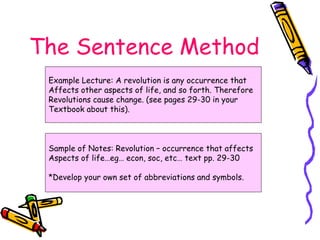
The Sentence Method
The Cornell Method
Jackson Mississippi

The capital of Mississippi.

The US Senate

Serves for 6 years before
having to run again.
Each state has 2
senators
The Cornell Method
• Advantages
–
–
–
–

Organized and easy to review
Good format for major concepts and ideas
Simples and efficient
Saves time

• Disadvantages
– None

• When to Use

– In any lecture type situation
The Outline Method
• Extrasensory Perception

– Definition: means of perceiving without use of
organs
• Three kinds

– Telepathy: sending messages
– Clairvoyance: forecasting
– Psychokinesis: perceiving events external to a situation

• Current Status

– No current research to support or refute
– Few psychologists say impossible
The Outline Method
•

Advantages

•

Disadvantages

•

When to Use

– Well organized if done correctly
– Reduces editing
– Easy to review
– Requires more in class thought
– May not show good sequence relationships
– Cannot use if the lecture is too fast
– Great to use when the lecture is presented in outline format
– Best when there is enough time during the lecture to really organize
your thoughts well
– Best when you have mastered the note taking skills and are a better
note taker than most people
The Mapping Method
Extrasensory Perception

3 types
Telepathy –
Sending messages

Psychokinesis –
Perceiving events
Clairvoyance –
Forecasting
The Mapping Method
• Advantages
–
–
–
–
–

Can visually track lectures easily
Little thinking required and relationship can be tracked easily
Easy to edit later
Reviewing easy conducted
Easy to transfer to other means of studying like flashcards

• Disadvantages

– Hard to hear changes in content from major points to facts

• When to Use

– When the lecture is well organized
– Can be useful with guest lecturers when you are not familiar
with what the lecture will be about
The Charting Method

Period

Important People

Events

1941-1945

FDR

WW II
The Charting Method
• Advantages

– Helps to track conversational style lectures better
– Reduces the amount of writing
– Easy to review facts and relationships

• Disadvantages

– Learning the system and being able to distinguish good
categories or headings
– Must be able to understand the lecture well

• When to Use
–
–
–
–

When tests focus on facts and relationships
Content is heavy and presented very fast
When you need to reduce editing time
When you want to get a large overview of all of the material
The Sentence Method
Example Lecture: A revolution is any occurrence that
Affects other aspects of life, and so forth. Therefore
Revolutions cause change. (see pages 29-30 in your
Textbook about this).

Sample of Notes: Revolution – occurrence that affects
Aspects of life…eg… econ, soc, etc… text pp. 29-30
*Develop your own set of abbreviations and symbols.
The Sentence Method
• Advantages

– Slightly more organized than paragraphs
– Gets most all of the information

• Disadvantages

– Hard to determine the major and minor points
– Difficult to edit without re-writing
– Difficult to review unless edited or re-written

• When to Use

– Lecture has to be organized well
– When you can hear the points but are unsure of their
relationship during the lecture
– The instructor present points, but points are not grouped
together well
Conclusion
Try the other of this series:
• Time Management &
Organizational Skills
• Effective Study Skills
• Taking Exams or Tests
Marcus Simmons
Supportive Services Coordinator/Advisor
Student Support Center – Room 123 E
mgsimmons@iccms.edu
References
Developing your studying method. (n.d.) Certification Crazy. Retrieved January
6, 2006 from, http://www.certification-crazy.net/studyadvice%20method.htm
Doyle, B. (2004). Effective study techniques.
Retrieved January 6, 2006 from Arkansas State University web site:
http://www.clt.astate.edu/bdoyle/effective_studytechniques.htm

Ellis, D. (2006). Becoming a master student. (11th ed.). New York: Houghton
Mifflin Company.
Landsberger, J. (2005). The SQ3R reading method. Study Guides and Strategies.
Retrieved February 10, 2006 from, http://www.studygs.net/texred2/htm
Lorphevre, T. (2005). Core Skills Survival Guide. Retrieved February 10, 2006
from London South Bank University Core Skills Survival Guide web site:
www.lsbu.ac.uk/caxton
Note taking system. (n.d). Retrieved February 10, 2006 from California
Polytechnic State University web site:
http://www.sas.calpoly.edu/asc/ssl/html
Richards, R. (2002). Memory strategies for students. LDOnLine. Retrieved
October 4, 2005 from,
www.ldonline.org/ld_indepth/teaching_techniques/memory_strategies.htm
Seidman, A. (2005). Program justification. Learning Support Centers in Higher
Education. Retrieved February 2, 2006 from,
http://www.pvc.maricopa.edu/~lsche/resources/program_just.htm
Test taking and anxiety. (2001). Retrieved January 6, 2006 from Pennsylvania
State University Learning Center web site:
http://www.ulrc.psu.edu/studyskills/test_taking.html

Being an Effective Student: Taking Notes

  • 1.
    Being an Effective StudentSeries Marcus Simmons Supportive Services Coordinator/Advisor – Itawamba Community College
  • 2.
    Being an Effective StudentSeries Note taking Time Management & Organizational Skills Effective Study Skills Taking Exams or Tests Marcus Simmons Supportive Services Coordinator/Advisor – Itawamba Community College
  • 3.
    Being an Effective StudentSeries This CD: Note taking Marcus Simmons Tech Prep Coordinator – Itawamba Community College
  • 4.
    Note Taking • • • • • The CornellMethod The Outline Method The Mapping Method The Charting Method The Sentence Method
  • 5.
    The Cornell Method JacksonMississippi The capital of Mississippi. The US Senate Serves for 6 years before having to run again. Each state has 2 senators
  • 6.
    The Cornell Method •Advantages – – – – Organized and easy to review Good format for major concepts and ideas Simples and efficient Saves time • Disadvantages – None • When to Use – In any lecture type situation
  • 7.
    The Outline Method •Extrasensory Perception – Definition: means of perceiving without use of organs • Three kinds – Telepathy: sending messages – Clairvoyance: forecasting – Psychokinesis: perceiving events external to a situation • Current Status – No current research to support or refute – Few psychologists say impossible
  • 8.
    The Outline Method • Advantages • Disadvantages • Whento Use – Well organized if done correctly – Reduces editing – Easy to review – Requires more in class thought – May not show good sequence relationships – Cannot use if the lecture is too fast – Great to use when the lecture is presented in outline format – Best when there is enough time during the lecture to really organize your thoughts well – Best when you have mastered the note taking skills and are a better note taker than most people
  • 9.
    The Mapping Method ExtrasensoryPerception 3 types Telepathy – Sending messages Psychokinesis – Perceiving events Clairvoyance – Forecasting
  • 10.
    The Mapping Method •Advantages – – – – – Can visually track lectures easily Little thinking required and relationship can be tracked easily Easy to edit later Reviewing easy conducted Easy to transfer to other means of studying like flashcards • Disadvantages – Hard to hear changes in content from major points to facts • When to Use – When the lecture is well organized – Can be useful with guest lecturers when you are not familiar with what the lecture will be about
  • 11.
    The Charting Method Period ImportantPeople Events 1941-1945 FDR WW II
  • 12.
    The Charting Method •Advantages – Helps to track conversational style lectures better – Reduces the amount of writing – Easy to review facts and relationships • Disadvantages – Learning the system and being able to distinguish good categories or headings – Must be able to understand the lecture well • When to Use – – – – When tests focus on facts and relationships Content is heavy and presented very fast When you need to reduce editing time When you want to get a large overview of all of the material
  • 13.
    The Sentence Method ExampleLecture: A revolution is any occurrence that Affects other aspects of life, and so forth. Therefore Revolutions cause change. (see pages 29-30 in your Textbook about this). Sample of Notes: Revolution – occurrence that affects Aspects of life…eg… econ, soc, etc… text pp. 29-30 *Develop your own set of abbreviations and symbols.
  • 14.
    The Sentence Method •Advantages – Slightly more organized than paragraphs – Gets most all of the information • Disadvantages – Hard to determine the major and minor points – Difficult to edit without re-writing – Difficult to review unless edited or re-written • When to Use – Lecture has to be organized well – When you can hear the points but are unsure of their relationship during the lecture – The instructor present points, but points are not grouped together well
  • 15.
    Conclusion Try the otherof this series: • Time Management & Organizational Skills • Effective Study Skills • Taking Exams or Tests Marcus Simmons Supportive Services Coordinator/Advisor Student Support Center – Room 123 E mgsimmons@iccms.edu
  • 16.
    References Developing your studyingmethod. (n.d.) Certification Crazy. Retrieved January 6, 2006 from, http://www.certification-crazy.net/studyadvice%20method.htm Doyle, B. (2004). Effective study techniques. Retrieved January 6, 2006 from Arkansas State University web site: http://www.clt.astate.edu/bdoyle/effective_studytechniques.htm Ellis, D. (2006). Becoming a master student. (11th ed.). New York: Houghton Mifflin Company. Landsberger, J. (2005). The SQ3R reading method. Study Guides and Strategies. Retrieved February 10, 2006 from, http://www.studygs.net/texred2/htm Lorphevre, T. (2005). Core Skills Survival Guide. Retrieved February 10, 2006 from London South Bank University Core Skills Survival Guide web site: www.lsbu.ac.uk/caxton Note taking system. (n.d). Retrieved February 10, 2006 from California Polytechnic State University web site: http://www.sas.calpoly.edu/asc/ssl/html Richards, R. (2002). Memory strategies for students. LDOnLine. Retrieved October 4, 2005 from, www.ldonline.org/ld_indepth/teaching_techniques/memory_strategies.htm Seidman, A. (2005). Program justification. Learning Support Centers in Higher Education. Retrieved February 2, 2006 from, http://www.pvc.maricopa.edu/~lsche/resources/program_just.htm Test taking and anxiety. (2001). Retrieved January 6, 2006 from Pennsylvania State University Learning Center web site: http://www.ulrc.psu.edu/studyskills/test_taking.html