Table 1
Research Table of Literature
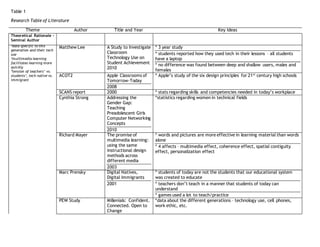
Theme Author Title and Year Key Ideas
Theoretical Rationale –
Seminal Author
*data specific to this
generation and their tech
use
*multimedia learning
facilitates learning more
quickly
*tension of teachers’ vs.
students’, tech native vs.
immigrant
Matthew Lee A Study to Investigate
Classroom
Technology Use on
Student Achievement
2010
* 3 year study
* students reported how they used tech in their lessons – all students
have a laptop
* no difference was found between deep and shallow users, males and
females
ACOT2 Apple Classrooms of
Tomorrow-Today
2008
* Apple’s study of the six design principles for 21st
century high schools
SCANS report 2000 * stats regarding skills and competencies needed in today’s workplace
Cynthia Strong Addressing the
Gender Gap:
Teaching
Preadolescent Girls
Computer Networking
Concepts
2010
*statistics regarding women in technical fields
Richard Mayer The promise of
multimedia learning:
using the same
instructional design
methods across
different media
2003
* words and pictures are more effective in learning material than words
alone
* 4 affects – multimedia effect, coherence effect, spatial contiguity
effect, personalization effect
Marc Prensky Digital Natives,
Digital Immigrants
2001
* students of today are not the students that our educational system
was created to educate
* teachers don’t teach in a manner that students of today can
understand
* games used a lot to teach/practice
PEW Study Millenials: Confident.
Connected. Open to
Change
*data about the different generations – technology use, cell phones,
work ethic, etc.
2010
Joyce Pittman The need for training
standards in new
technologies for
inservice teachers
1999
*conference proceedings demonstrating the need for tech teaching
standards for people who are already teaching
PEW Study Growing Old:
Expectations vs.
Reality
2009
* generational perceptions of getting old
* technology statistics – a few of them
Theme 1
*technology gap between
students and teachers
*need for teachers to get
up to speed/grow in their
tech abilities
The Digital Divide –
Bridging the Gap
PEW Study Forty Years After
Woodstock, A Gentler
Generation Gap
* looks at generational perceptions of different topics, including
technology
Julie Mueller Computer Integration
in Elementary and
Secondary Schools:
Variables Influencing
Educators
2009
* looks at teacher perceptions about computer integration
* researched the characteristics and variables that tell who will be a
high or low integrator
* built a model that includes content, pedagogical and technological
knowledge, personal characteristics of teachers, and support from
other resources
Punya Mishra and
Matthew Koehler
Technological
Pedagogical Content
Knowlegdge: A
Framework for
Teacher Knowledge
* TPACK – content pedagogy and technology
* how to teach based on this framework and methods that have resulted
from this
Lawrence Baines Rage Towards the
Machine: Technology
and Standards in
2001
* history of tech standards and their need/creation
Watson, D. Understanding the
relationship between
ICT and education
means exploring
innovation and
change.
2006
Taylor et al Learning with versus
without technology in
elementary and
secondary school
*stats on integration and non-integration – shows integration helps
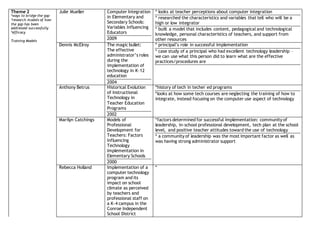
Theme 2
*ways to bridge the gap
*research models of how
the gap has been
addressed successfully
*efficacy
Training Models
Julie Mueller Computer Integration
in Elementary and
Secondary Schools:
Variables Influencing
Educators
2009
* looks at teacher perceptions about computer integration
* researched the characteristics and variables that tell who will be a
high or low integrator
* built a model that includes content, pedagogical and technological
knowledge, personal characteristics of teachers, and support from
other resources
Dennis McElroy The magic bullet:
The effective
administrator’s roles
during the
implementation of
technology in K-12
education
2004
* principal’s role in successful implementation
* case study of a principal who had excellent technology leadership –
we can use what this person did to learn what are the effective
practices/procedures are
Anthony Betrus Historical Evolution
of Instructional
Technology in
Teacher Education
Programs
2002
*history of tech in techer ed programs
*looks at how some tech courses are neglecting the training of how to
integrate, instead focusing on the computer use aspect of technology
Marilyn Catchings Models of
Professional
Development for
Teachers: Factors
Influencing
Technology
Implementation in
Elementary Schools
2000
*factors determined for successful implementation: community of
leadership, in-school professional development, tech plan at the school
level, and positive teacher attitudes toward the use of technology
* a community of leadership was the most important factor as well as
was having strong administrator support
Rebecca Holland Implementation of a
computer technology
program and its
impact on school
climate as perceived
by teachers and
professional staff on
a K-4 campus in the
Conroe Independent
School District
*
1998
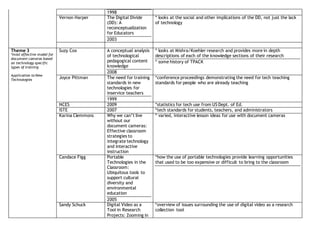
Vernon Harper The Digital Divide
(DD): A
reconceptualization
for Educators
2003
* looks at the social and other implications of the DD, not just the lack
of technology
Theme 3
*most effective model for
document cameras based
on technology specific
types of training
Application to New
Technologies
Suzy Cox A conceptual analysis
of technological
pedagogical content
knowledge
2008
* looks at Mishra/Koehler research and provides more in depth
descriptions of each of the knowledge sections of their research
* some history of TPACK
Joyce Pittman The need for training
standards in new
technologies for
inservice teachers
1999
*conference proceedings demonstrating the need for tech teaching
standards for people who are already teaching
NCES 2009 *statistics for tech use from US Dept. of Ed.
ISTE 2007 *tech standards for students, teachers, and administrators
Karina Clemmons Why we can’t live
without our
document cameras:
Effective classroom
strategies to
integrate technology
and interactive
instruction
* varied, interactive lesson ideas for use with document cameras
Candace Figg Portable
Technologies in the
Classroom:
Ubiquitous tools to
support cultural
diversity and
environmental
education
2005
*how the use of portable technologies provide learning opportunities
that used to be too expensive or difficult to bring to the classroom
Sandy Schuck Digital Video as a
Tool in Research
Projects: Zooming in
*overview of issues surrounding the use of digital video as a research
collection tool
on current issues
2004
Summary
*multimedia learning is
good, but there is a gap
between students’ and
teachers’ use/ability, so
it is good to train
teachers to be effective
users of technology

Thesis Research Table

  • 1.
    Table 1 Research Tableof Literature Theme Author Title and Year Key Ideas Theoretical Rationale – Seminal Author *data specific to this generation and their tech use *multimedia learning facilitates learning more quickly *tension of teachers’ vs. students’, tech native vs. immigrant Matthew Lee A Study to Investigate Classroom Technology Use on Student Achievement 2010 * 3 year study * students reported how they used tech in their lessons – all students have a laptop * no difference was found between deep and shallow users, males and females ACOT2 Apple Classrooms of Tomorrow-Today 2008 * Apple’s study of the six design principles for 21st century high schools SCANS report 2000 * stats regarding skills and competencies needed in today’s workplace Cynthia Strong Addressing the Gender Gap: Teaching Preadolescent Girls Computer Networking Concepts 2010 *statistics regarding women in technical fields Richard Mayer The promise of multimedia learning: using the same instructional design methods across different media 2003 * words and pictures are more effective in learning material than words alone * 4 affects – multimedia effect, coherence effect, spatial contiguity effect, personalization effect Marc Prensky Digital Natives, Digital Immigrants 2001 * students of today are not the students that our educational system was created to educate * teachers don’t teach in a manner that students of today can understand * games used a lot to teach/practice PEW Study Millenials: Confident. Connected. Open to Change *data about the different generations – technology use, cell phones, work ethic, etc.
  • 2.
    2010 Joyce Pittman Theneed for training standards in new technologies for inservice teachers 1999 *conference proceedings demonstrating the need for tech teaching standards for people who are already teaching PEW Study Growing Old: Expectations vs. Reality 2009 * generational perceptions of getting old * technology statistics – a few of them Theme 1 *technology gap between students and teachers *need for teachers to get up to speed/grow in their tech abilities The Digital Divide – Bridging the Gap PEW Study Forty Years After Woodstock, A Gentler Generation Gap * looks at generational perceptions of different topics, including technology Julie Mueller Computer Integration in Elementary and Secondary Schools: Variables Influencing Educators 2009 * looks at teacher perceptions about computer integration * researched the characteristics and variables that tell who will be a high or low integrator * built a model that includes content, pedagogical and technological knowledge, personal characteristics of teachers, and support from other resources Punya Mishra and Matthew Koehler Technological Pedagogical Content Knowlegdge: A Framework for Teacher Knowledge * TPACK – content pedagogy and technology * how to teach based on this framework and methods that have resulted from this Lawrence Baines Rage Towards the Machine: Technology and Standards in 2001 * history of tech standards and their need/creation Watson, D. Understanding the relationship between ICT and education means exploring innovation and change. 2006 Taylor et al Learning with versus without technology in elementary and secondary school *stats on integration and non-integration – shows integration helps
  • 3.
    Theme 2 *ways tobridge the gap *research models of how the gap has been addressed successfully *efficacy Training Models Julie Mueller Computer Integration in Elementary and Secondary Schools: Variables Influencing Educators 2009 * looks at teacher perceptions about computer integration * researched the characteristics and variables that tell who will be a high or low integrator * built a model that includes content, pedagogical and technological knowledge, personal characteristics of teachers, and support from other resources Dennis McElroy The magic bullet: The effective administrator’s roles during the implementation of technology in K-12 education 2004 * principal’s role in successful implementation * case study of a principal who had excellent technology leadership – we can use what this person did to learn what are the effective practices/procedures are Anthony Betrus Historical Evolution of Instructional Technology in Teacher Education Programs 2002 *history of tech in techer ed programs *looks at how some tech courses are neglecting the training of how to integrate, instead focusing on the computer use aspect of technology Marilyn Catchings Models of Professional Development for Teachers: Factors Influencing Technology Implementation in Elementary Schools 2000 *factors determined for successful implementation: community of leadership, in-school professional development, tech plan at the school level, and positive teacher attitudes toward the use of technology * a community of leadership was the most important factor as well as was having strong administrator support Rebecca Holland Implementation of a computer technology program and its impact on school climate as perceived by teachers and professional staff on a K-4 campus in the Conroe Independent School District *
  • 4.
    1998 Vernon Harper TheDigital Divide (DD): A reconceptualization for Educators 2003 * looks at the social and other implications of the DD, not just the lack of technology Theme 3 *most effective model for document cameras based on technology specific types of training Application to New Technologies Suzy Cox A conceptual analysis of technological pedagogical content knowledge 2008 * looks at Mishra/Koehler research and provides more in depth descriptions of each of the knowledge sections of their research * some history of TPACK Joyce Pittman The need for training standards in new technologies for inservice teachers 1999 *conference proceedings demonstrating the need for tech teaching standards for people who are already teaching NCES 2009 *statistics for tech use from US Dept. of Ed. ISTE 2007 *tech standards for students, teachers, and administrators Karina Clemmons Why we can’t live without our document cameras: Effective classroom strategies to integrate technology and interactive instruction * varied, interactive lesson ideas for use with document cameras Candace Figg Portable Technologies in the Classroom: Ubiquitous tools to support cultural diversity and environmental education 2005 *how the use of portable technologies provide learning opportunities that used to be too expensive or difficult to bring to the classroom Sandy Schuck Digital Video as a Tool in Research Projects: Zooming in *overview of issues surrounding the use of digital video as a research collection tool
  • 5.
    on current issues 2004 Summary *multimedialearning is good, but there is a gap between students’ and teachers’ use/ability, so it is good to train teachers to be effective users of technology