
What is OKR?
www.leanperformance.com
How Silicon Valley
sets goals?
OKR:
Objectives and Key Results
@meetfelipe
OKR is a goal setting framework
used in Silicon Valley.
It is a simple system to create
alignment and engagement around
measurable and dynamic goals,
usually reset every quarter.
Created by Intel
@meetfelipe
Agile Goals
1Instead of annual static goals, OKR uses
shorter planning cycles, usually quarterly.
@meetfelipe
Simplicity
2
To enable frequent goal setting, OKR is
simple and lightweight. Set goals in
days instead of months.
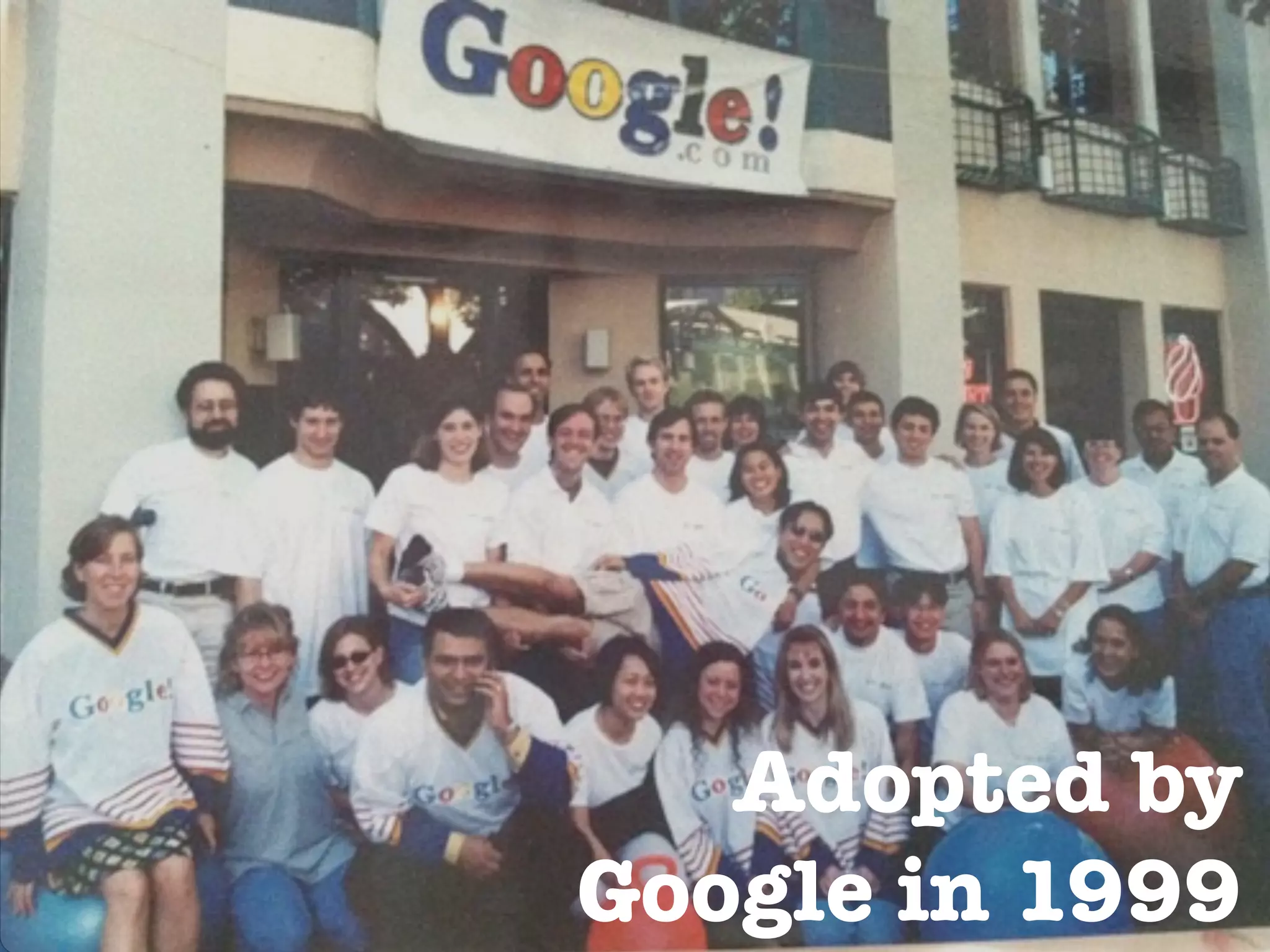
Adopted by
Google in 1999
@meetfelipe
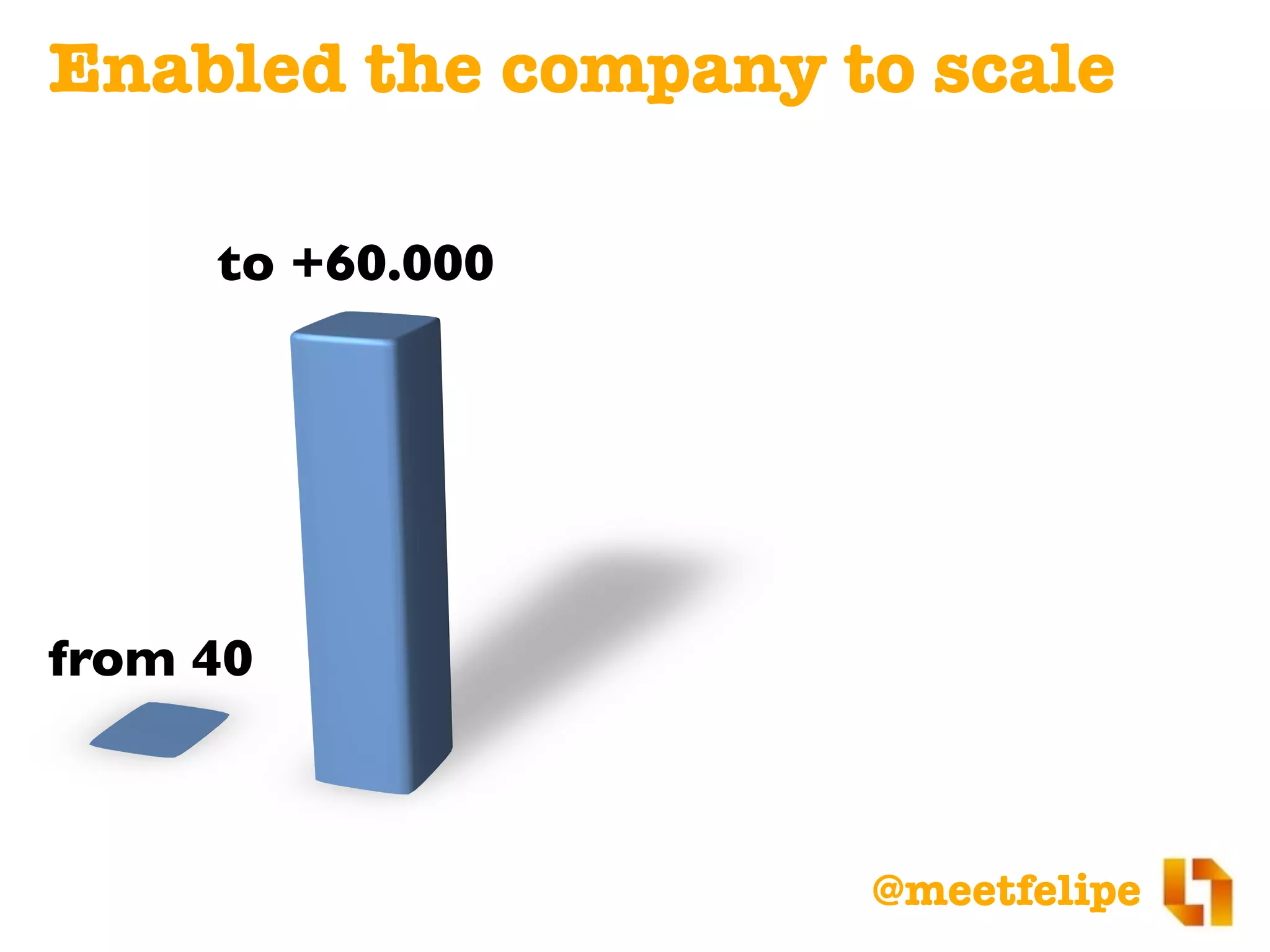
from 40
to +60.000
Enabled the company to scale
@meetfelipe
from 40
to +60.000
Enabled the company to scale
OKR is used both by
small teams and large
enterprises.
Who is using OKR?
@meetfelipe
John Doerr
•John Doerr is one of the most successful
venture capitalists of all time, having
invested in Amazon and Google.
•Doerr, who worked at Intel and introduced
Google to OKR, has a simple formula for
setting goals:
John Doerr
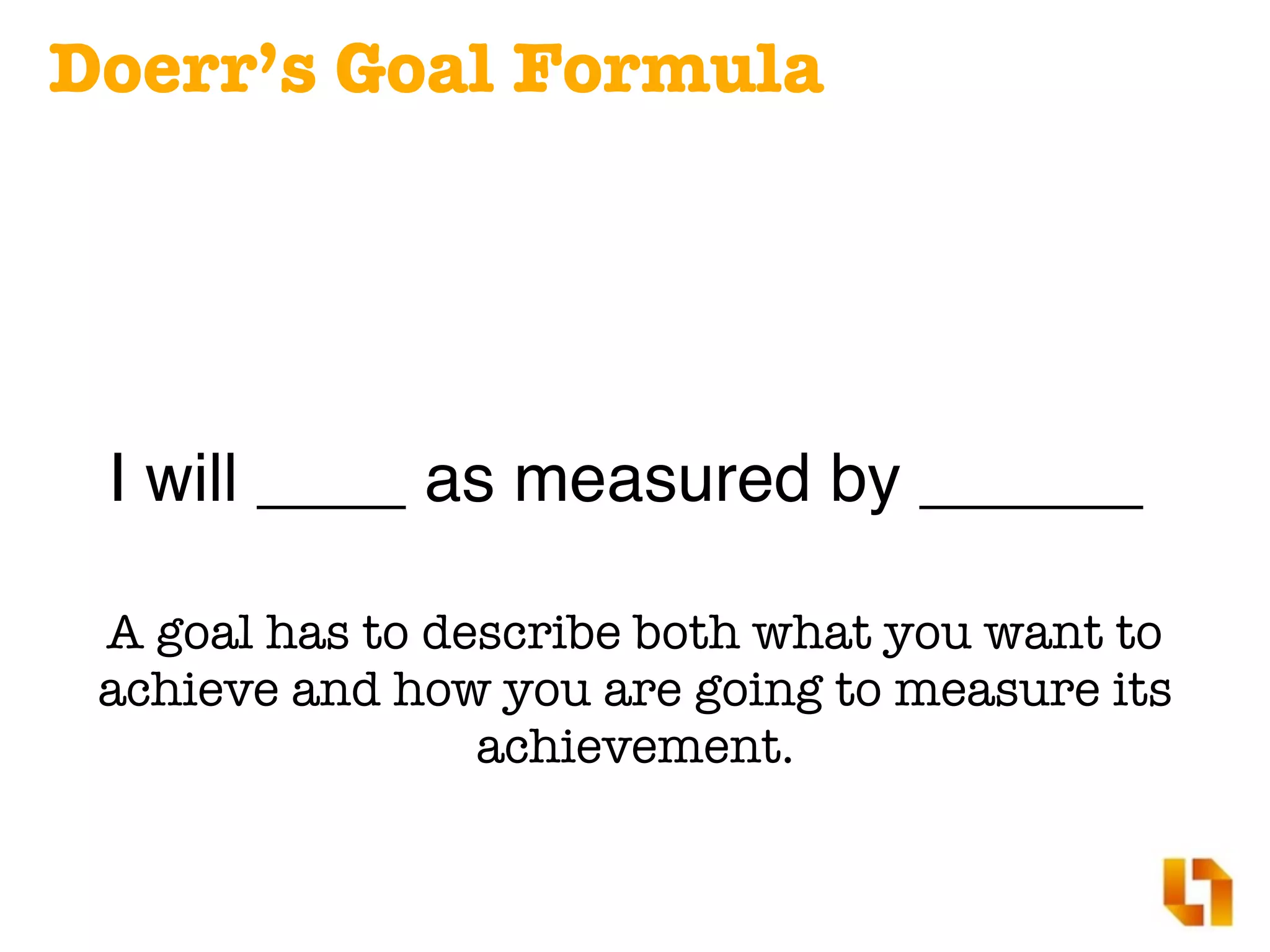
Doerr’s Goal Formula
I will ____ as measured by ______
Doerr’s Goal Formula
I will ____ as measured by ______
A goal has to describe both what you want to
achieve and how you are going to measure its
achievement.
@meetfelipe
Measurement
A measurement culture is an
integral part of OKR
Doerr’s Goal Formula
I will (Objective) as measured by (this
set of Key Results)
Doerr’s Goal Formula
I will (Objective) as measured by (this
set of Key Results)
OKR has two components, the Objective (What we
want to achieve) e a set of Key Results (How will
we know if we are getting there).
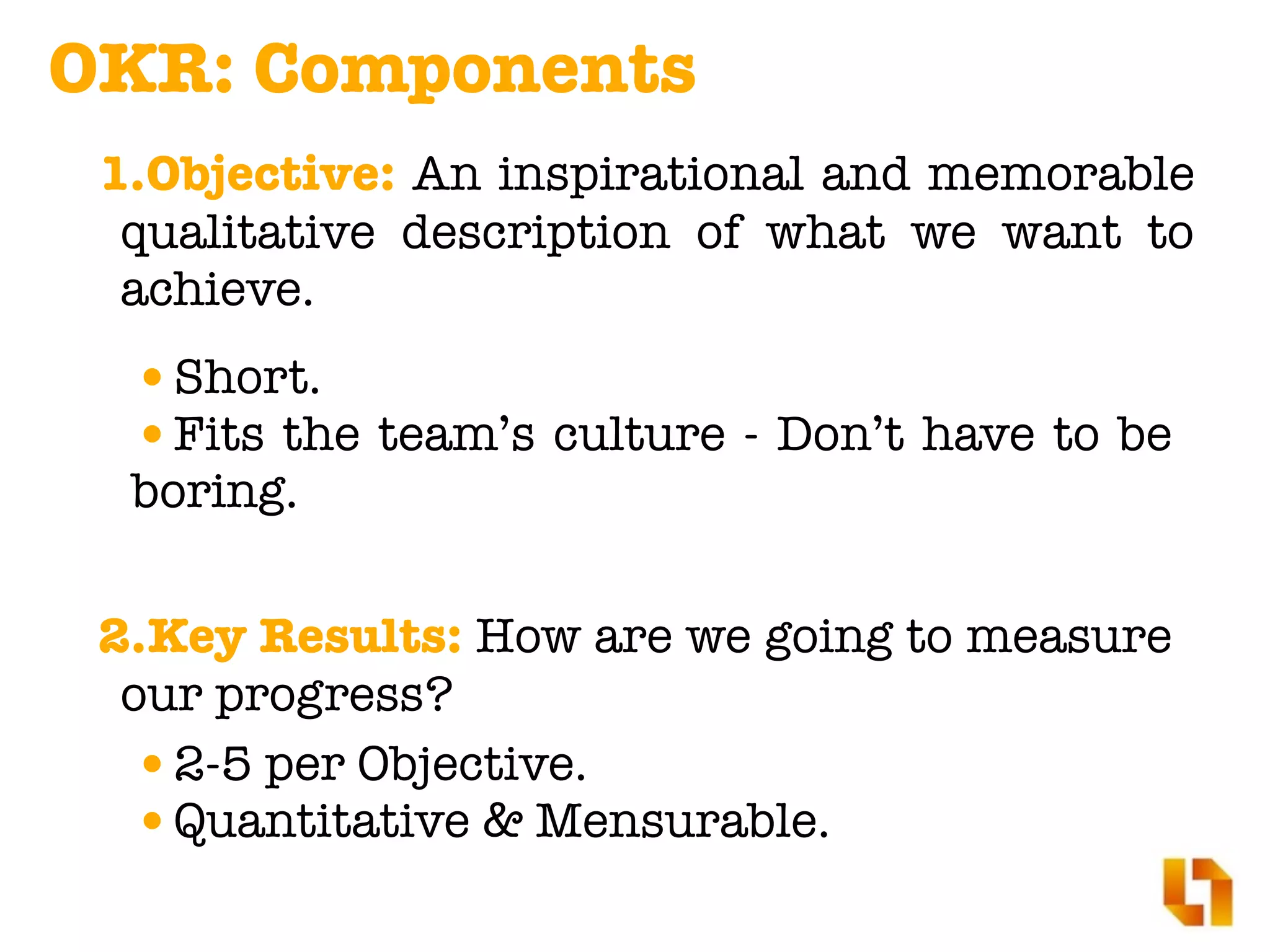
OKR: Components
2.Key Results: How are we going to measure
our progress?
•2-5 per Objective.
•Quantitative & Mensurable.
1.Objective: An inspirational and memorable
qualitative description of what we want to
achieve.
•Short.
•Fits the team’s culture - Don’t have to be
boring.
•Increase Net Promoter Score to 52%.
•Reduce revenue churn to 1%.
•Increase average weekly visits to 3.3 per
active user.
•Increase non paid (organic) traffic to 80%.
•Increase engagement (users that complete a
full profile) to 75%.
Objective: Delight our customers
OKR: Example
Key Results:
@meetfelipe
Engaging Objectives
Goals don’t have to be boring. 3
@meetfelipe
Objectives should be engaging
and fun. They can be
informal, using slangs, jokes,
and even profanity –
whatever fits the company
culture.
@meetfelipeAchieve Rocket Growth
@meetfelipe
Give sleepy users
a shot of Red Bull
@meetfelipe
Provide Kick-Ass
Service
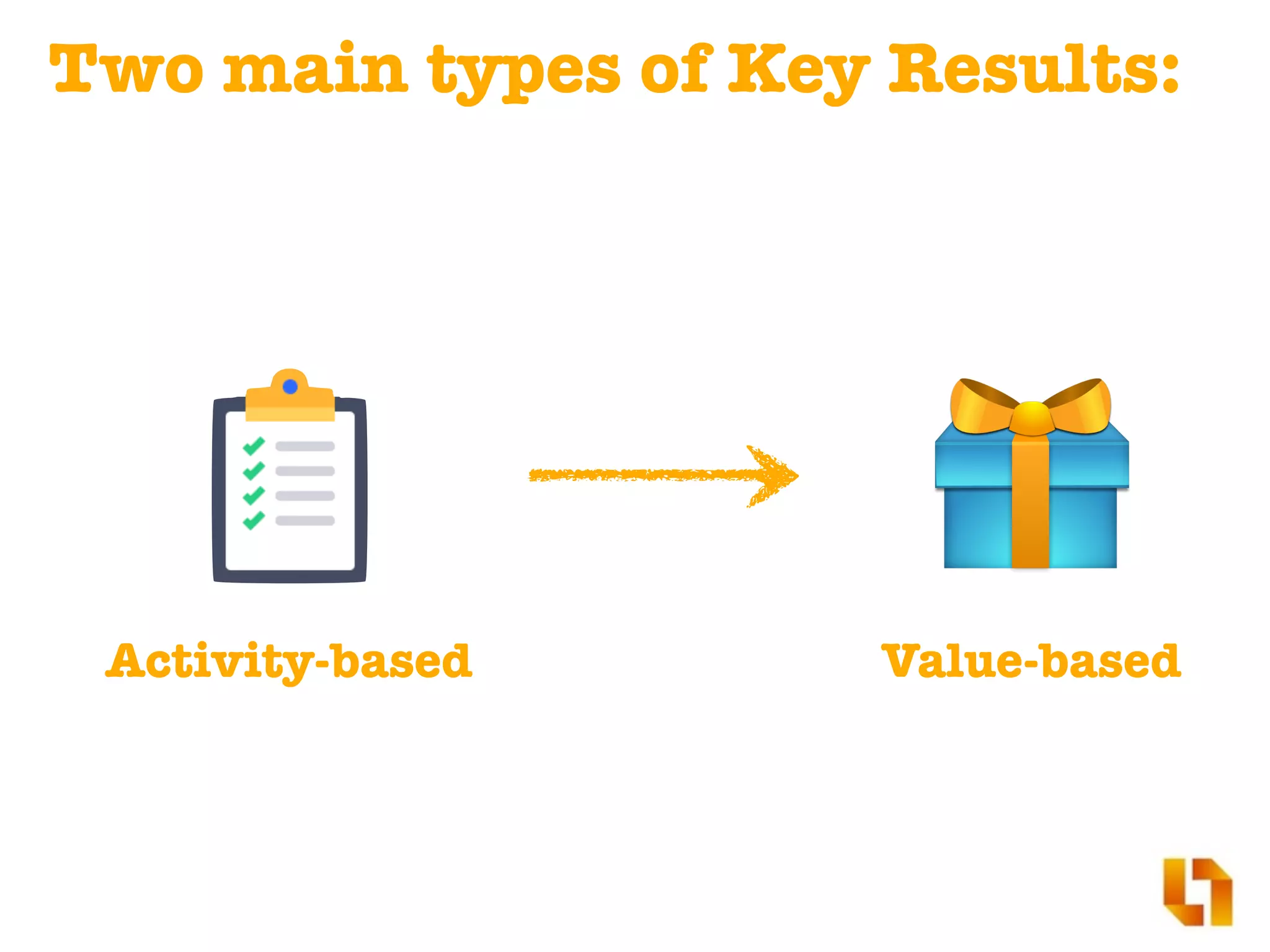
Two main types of Key Results:
Value-basedActivity-based
Value-based Key Results
Measure the delivery of
value to the organization or
the customer.
Focus on the destination,
not on the means to get there.
Separate OKRs from activities
•Objective: What we want to achieve.
•Key Results: How are we going to measure
our progress?
•Initiatives: What we are going to do to reach
our objective: projects, tasks, activities…
Transparency
OKRs should be public. Everyone has
access to everyone else’s OKRs and
current results. 4
5Regular ceremonies for tracking results.
Check-ins
Check-ins
•Regular ceremonies
for tracking results.
•OKRs vs putting out
fires.
•Focused on improving
results and not on
giving excuses.
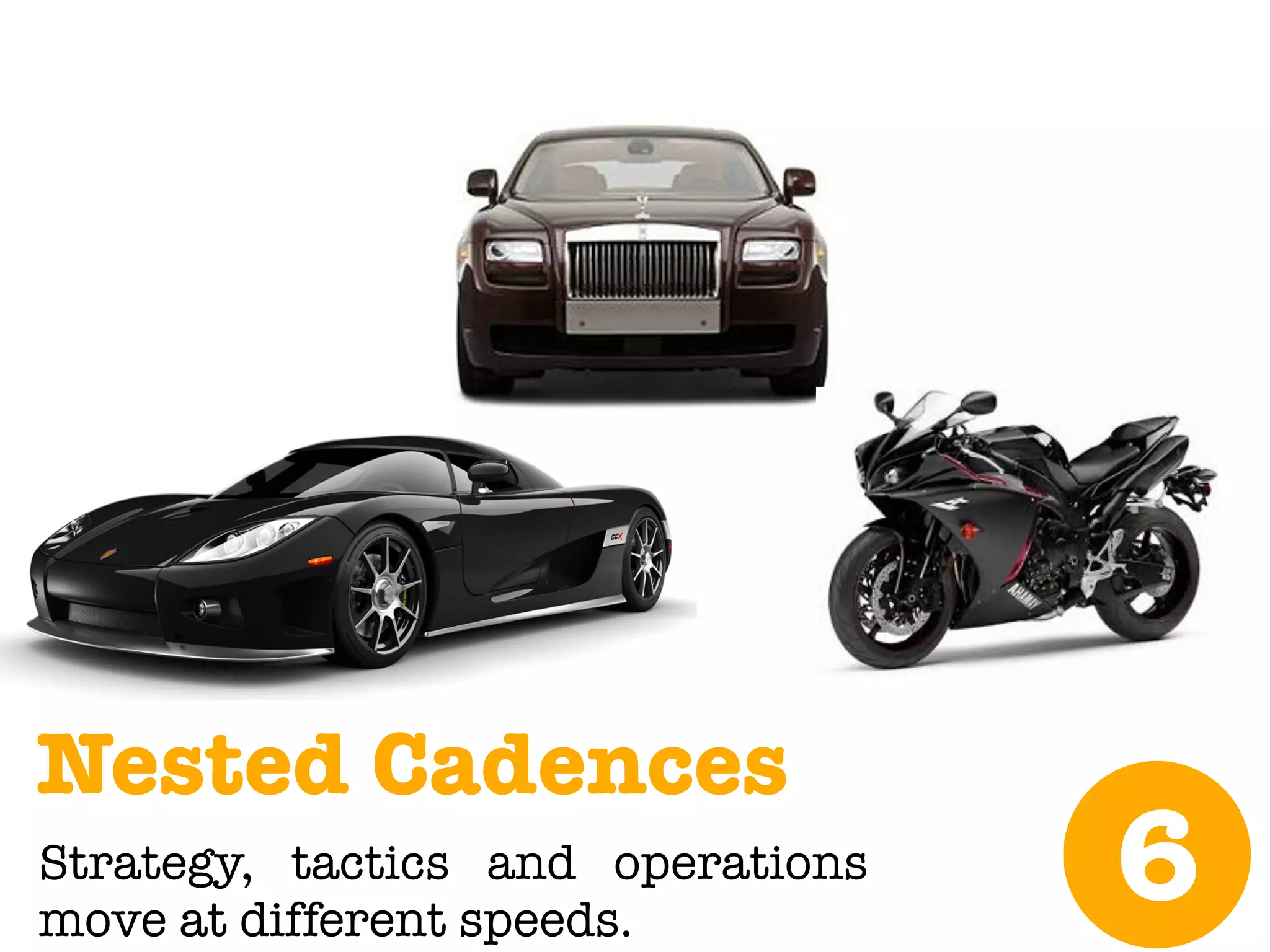
Nested Cadences
Strategy, tactics and operations
move at different speeds.
6
@meetfelipe
Strategy and tactics have
different natural tempos, as
the latter tends to change
much faster. To solve this, OKR
adopts different cadences:
Tactical shorter-term OKRs for the teams
High level strategic OKRs for the company
Regular check-ins for follow-through
@meetfelipe
Bidirectional Goal Setting
60% of the OKRs are created bottom-up.
7
@meetfelipe
Instead of using the traditional
top-down cascading, OKR uses
a market-based approach that
is simultaneously bottom-up
and top-down.
Advanced Topics
Moonshots
8 Bold, ambitious goals that make
the team rethink the way they work
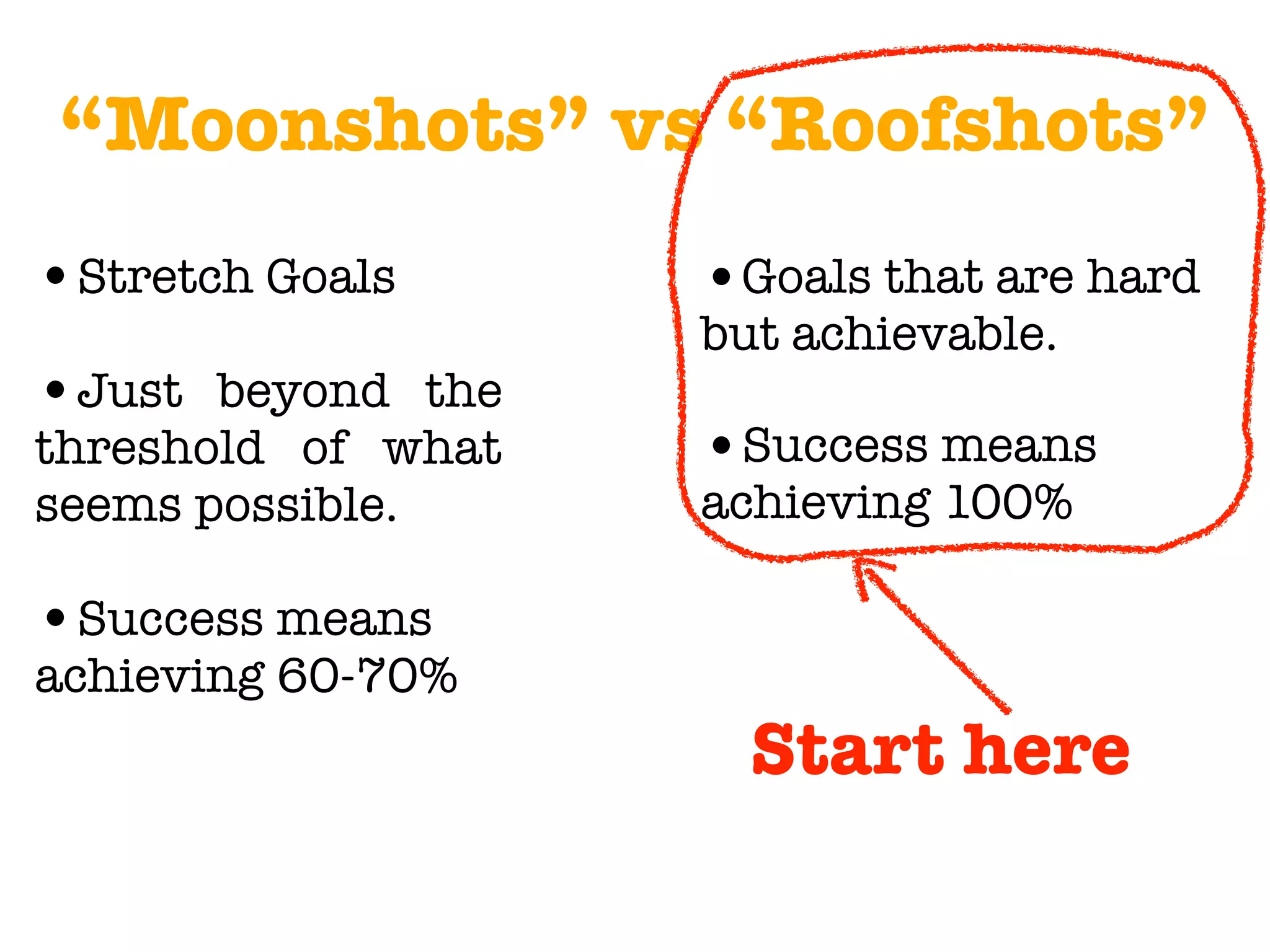
“Moonshots” vs “Roofshots”
•Stretch Goals
•Just beyond the
threshold of what
seems possible.
•Success means
achieving 60-70%
•Goals that are hard
but achievable.
•Success means
achieving 100%
“Moonshots” vs “Roofshots”
•Stretch Goals
•Just beyond the
threshold of what
seems possible.
•Success means
achieving 60-70%
•Goals that are hard
but achievable.
•Success means
achieving 100%
Start here
Leave the Moonshots for
later
Decoupling
Rewards
9
Separating goals from salary
and promotions to incentivize
challenging goals.
“[OKR] should be just one
input used to determine how
well an individual is doing.”
High Output Management, Andy
Grove
Learn more about OKR
OKR Guide
leanperformance.com/en/okr

What is OKR?