Mable_Maria 1
2Mable_Maria
3Mable_Maria
DEFINITION
When children cannot adjust to a complex
environment around them, they become unable
to behave in the socially acceptable way
resulting in exhibition of peculiar behaviours
and this is called as behavioural problems.
4Mable_Maria
CAUSES
• Faulty Parental Attitude
• Inadequate Family Environment
• Mentally And Physically Sick or Handicapped
Conditions
• Influence of Social Relationships
• Influence of Mass Media
5Mable_Maria
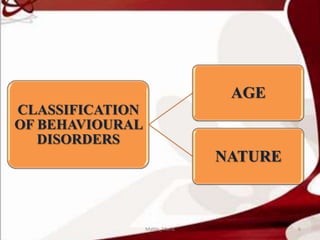
CLASSIFICATION
OF BEHAVIOURAL
DISORDERS
AGE
NATURE
6Mable_Maria
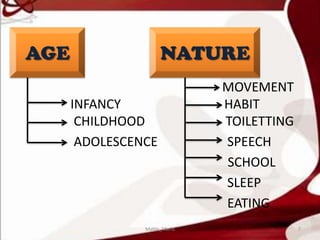
•
MOVEMENT
INFANCY HABIT
CHILDHOOD TOILETTING
ADOLESCENCE SPEECH
SCHOOL
SLEEP
EATING
AGE NATURE
7Mable_Maria
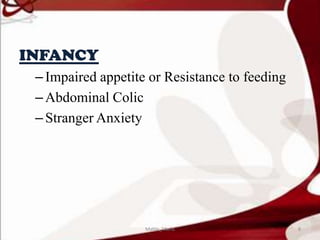
INFANCY
–Impaired appetite or Resistance to feeding
–Abdominal Colic
–Stranger Anxiety
8Mable_Maria
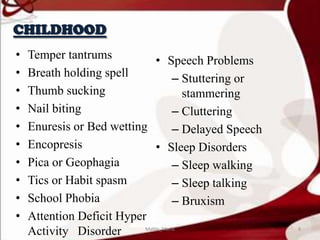
CHILDHOOD
• Temper tantrums
• Breath holding spell
• Thumb sucking
• Nail biting
• Enuresis or Bed wetting
• Encopresis
• Pica or Geophagia
• Tics or Habit spasm
• School Phobia
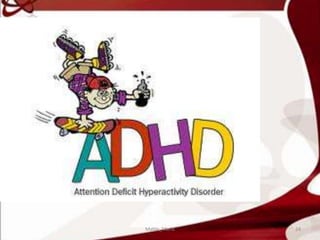
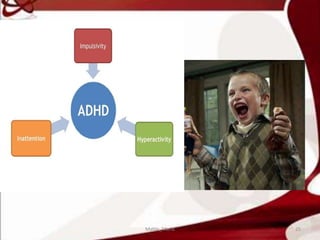
• Attention Deficit Hyper
Activity Disorder
• Speech Problems
– Stuttering or
stammering
– Cluttering
– Delayed Speech
• Sleep Disorders
– Sleep walking
– Sleep talking
– Bruxism
9Mable_Maria
ADOLESCENCE
• Masturbation
• Juvenile Delinquency
• Substance Abuse
• Anorexia Nervosa
10Mable_Maria
11Mable_Maria
Problems of Movements
• Head Banging
• Breath holding Spells
• Temper tantrums
• Tics
Problems of habit
• Thumb sucking
• Nail biting
• Pica
• Trichotillomania
12Mable_Maria
Problems of Toilet Training
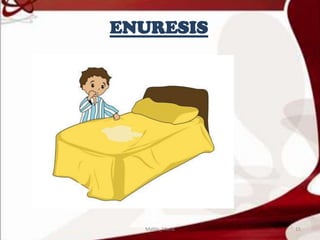
• Enuresis
• Encopresis
Problems of Speech
• Stuttering
• Elective mutism
Problems at School
• School Phobia
13Mable_Maria
Sleep Disorders
• Somnambulism
• Nightmares
Eating Disorders
• Anorexia Nervosa
• Bulimia Nervosa
• Pica
14Mable_Maria
ENURESIS
15Mable_Maria
DEFINITION
• Enuresis is a disorder of involuntary
micturition in children who are beyond the age
when normal bladder control should have been
acquired.
• Enuresis refers to the wetting of one’s clothes
or one’s bed past the age of 3 years.
16Mable_Maria
INCIDENCE
• It is common during 4 years to 12 years age
group.
• Studies suggest that 2.5 % in the age group of
0-10 years have enuresis and at age 5, it is 7 %
for males and 3 % for females.
17Mable_Maria
Types
Enuresis has been classified into :
• Persistent(primary)
• Regressive (secondary)
18Mable_Maria
ETIOLOGY
• Genetic
• Psychological
• Physiological
• Organic
19Mable_Maria
CLINICAL FEATURES
• Incontinence
• Dysuria
• Hematuria
• Straining on urination
• Dribbling
• Stress incontinence( with coughing, lifting or
running)
• Poor bowel control
• Continuous dampness
20Mable_Maria
INVESTIGATIONS
• Full medical history
• Genital and neurological examination
• Urinalysis for albumin, sugar, microscopy, and
culture
• if the child has UTI, he should be further
evaluated by USG, cysto urethrogram and uro
dynamic studies.
21Mable_Maria
TREATMENT
• Pharmacologic
• Non-Pharmacologic
–Behaviour Modification
–Parental Counselling
–Bladder Exercises
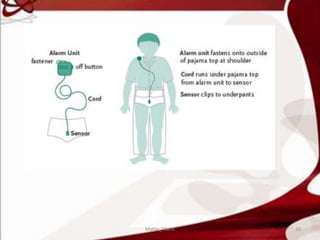
–Alarm Device
22Mable_Maria
23Mable_Maria
24Mable_Maria
25Mable_Maria
INCIDENCE
26Mable_Maria
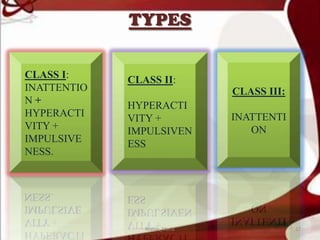
TYPES
CLASS I:
INATTENTIO
N +
HYPERACTI
VITY +
IMPULSIVE
NESS.
CLASS II:
HYPERACTI
VITY +
IMPULSIVEN
ESS
CLASS III:
INATTENTI
ON
27Mable_Maria
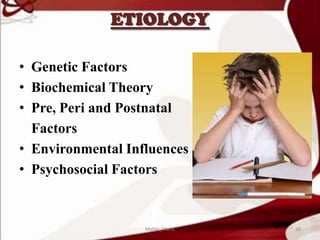
ETIOLOGY
• Genetic Factors
• Biochemical Theory
• Pre, Peri and Postnatal
Factors
• Environmental Influences
• Psychosocial Factors
28Mable_Maria
RISK FACTORS
• Drug exposure in utero.
• Birth complications.
• Low birth weight.
• lead poisoning.
29Mable_Maria
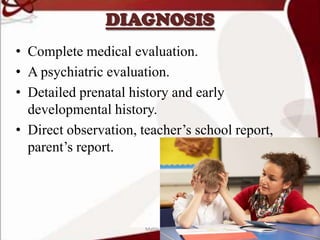
DIAGNOSIS
• Complete medical evaluation.
• A psychiatric evaluation.
• Detailed prenatal history and early
developmental history.
• Direct observation, teacher’s school report,
parent’s report.
30Mable_Maria
CLINICAL FEATURES
• Sensitive to stimuli, easily upset by noise, light,
temperature and other environmental changes.
• At times the reverse occurs and the children are
flaccid and limp, sleep more and the growth and
development is slow in the first month of life.
• General coordination deficit.
• Short attention span, easily distractable.
• Failure to finish tasks
• Impulsivity.
• Memory and thinking deficits.
• Specific learning disabilities.
31Mable_Maria
TREATMENT
Pharmacologic
Non Pharmacologic
- Psychologic Therapies
• Behaviour therapy
• Cognitive Behaviour Therapy
• Biofeedback
32Mable_Maria
NURSING INTERVENTION
• Develop a trusting relationship with the child.
• Ensure safe environment.
• Offer recognition for successful attempts and
positive reinforcement.
• Provide information and materials related to the
child’s disorder and effective parenting
techniques.
• Explain and demonstrate positive parenting
techniques
• Coordinate overall treatment plan with schools,
collateral personnel and the family.
33Mable_Maria
PROGNOSIS
34Mable_Maria
35Mable_Maria
36Mable_Maria
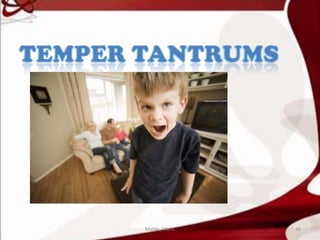
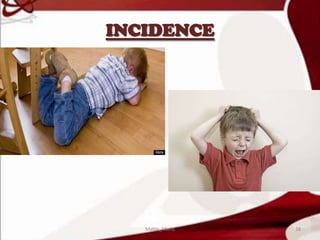
DEFINITION
From the age of 18 months to 3 years, the child
begins to develop autonomy and starts separating
from primary caregivers. When they can’t express
their autonomy they become frustrated and angry.
Some of them show their frustration and defiance
with physical aggression or resistance such as
biting , crying, kicking, throwing objects, hitting
and head banging. This kind of physical
aggressive behaviour is known as Temper
tantrum.
37Mable_Maria
INCIDENCE
38Mable_Maria
ETIOLOGY
• Parental Factors
• Child personality
• Other Factors
Precipitants
• Not meeting demands
• Interruption of play
• Threat of abandonment
• Stranger anxiety, criticism
• Imitation
39Mable_Maria
CLINICAL FEATURES
• Screaming,
• biting,
• hammering,
• stamping feet, thrashing arms,
• kicking, throwing objects,
• rolling on the floor
40Mable_Maria
MANAGEMENT
• Temper tantrums often cease with age.
Remove underlying insecurity, over protection
and faulty parental attitude.
• During an attack, the child should be protected
from injuring himself and the others.
• Deviating his attention from the immediate
cause and changing the environment can
reduce the tantrum.
41Mable_Maria
• Parents should be calm, loving, firm and
consistent and such behaviour should not allow
the child to take advantage of gaining things.
• Some temper tantrums result from the child’s
frustration at failing to master a task. These
can be managed by distracting the child and
permitting success in more manageable
activity.
42Mable_Maria
• Ignoring is an effective way to avoid
reinforcing tantrums although young children
should be held till they regain control.
• “Time out procedure”- In using time out
procedure, parents should not attempt to inflict
a fixed number of minutes of isolation. The
goal should be to help the child develop self
regulation.
43Mable_Maria
44Mable_Maria
Definition
Breath holding spells are reflexive events in
which typically there is a provoking event that
causes anger, frustration and child starts to cry.
The crying stops at full expiration when the
child becomes apnoeic and cyanotic or pale.
45Mable_Maria
Incidence
• Seen in 4-5 % of paediatric population.
• Common in the children of age group 1-5
years of age.
• Begins before 18 months of age;
• Common in girls and those from lower social
class and nuclear families.
46Mable_Maria
Types
• Cyanotic
• Pallid
47Mable_Maria
Etiology
• Parental Factors
• Other factors
• Precipitants
48Mable_Maria
Clinical Features
49Mable_Maria
Management
• Pharmacologic management
• Non Pharmacologic management
– Immediate measures
– Long term measures
– Parental education
50Mable_Maria
51Mable_Maria
Definition
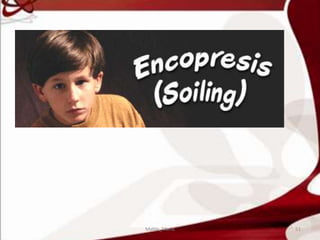
• Encopresis refers to passage of faeces into
inappropriate places at age when bowel control
should have been established.
52Mable_Maria
Etiology
• Inefficient intestinal motility
• Aggressive and prolonged medical
management (laxatives, enemas, suppositories)
• Dietary manipulation for perceived
constipation
• Anal fissures and rashes
• Surgical procedures for imperforate anus
• Psychosocial stresses or illness
53Mable_Maria
Management
• Initial Counseling
• Initial catharsis
• Maintenance regimen
• At home
• Dietary management
54Mable_Maria
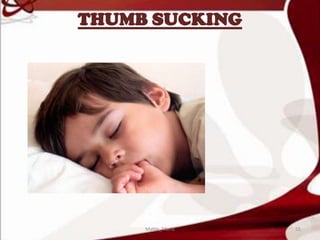
THUMB SUCKING
55Mable_Maria
Definition
• Thumb sucking is defined as the habit of
putting thumb into the mouth most of the time.
• It usually involves placing the thumb into the
mouth and rhythmically repeating sucking
contact for a prolonged duration.
56Mable_Maria
Etiology
• A gratifying action especially under unpleasant
and unsatisfying feeding situation.
• Psychological
• Precipitants
57Mable_Maria
Management
• Parental counselling
• Behaviour Therapy
• Use of T-guards
58Mable_Maria
PICA (GEOPHAGIA)
Pica is a habit disorder of eating non edible
substances such as clay, paint, chalks, pencil,
plaster from wall etc.
59Mable_Maria
Causes
• Parental neglect, poor attention of the
caregiver, inadequate love and affection,
mental health conditions like mental
retardation and OCD etc.
• Nutritional deficiencies.
• Children of poor socio economic status family,
malnourished and mentally subnormal
children.
60Mable_Maria
Clinical Features
• Anaemia
• Perverted appetite
• Intestinal parasitosis
• lead poisoning
• Vitamins and mineral deficiency,
• Trichotillomania, trichobezoar etc.
61Mable_Maria
Diagnosis
• Blood investigations
• According to the DSM classification, a person is
said to have pica, only if:
• Persistent eating of non nutritive substances for a
period of at least one month
• Does not meet the criteria for either having
autism, schizophrenia, or Kleine-Levin syndrome.
• The eating behavior is not culturally sanctioned.
• If the eating behavior occurs exclusively during
the course of another mental disorder
62Mable_Maria
Treatment
• Treatment of the deficiencies.
• Parental counselling
• Education and guidance
• Behaviour modification
• Psychotherapy
63Mable_Maria
TICS
Tic is an abnormal involuntary movement
which occurs suddenly, repetitively, rapidly
and is purposeless in nature.
64Mable_Maria
Types
Motor Tics- characterized by repetitive motor
movements.
- Simple motor tics
- Complex motor tics
Vocal Tics- characterized by repetitive
vocalisations.
- Simple vocal tics
- Complex vocal tics
65Mable_Maria
Treatment
• Pharmacotherapy
• Haloperidol is the drug of choice. In severe
cases, pimozide or clonidine can be used.
• Antipsychotics (blocks dopamine receptors)
• Benzodiazepines to reduce anxiety.
• Serotonin reuptake inhibitors.
• Behaviour therapy may be used.
• Parents and the family should be educated and
counselled about course of disorder and
spontaneous resolvement of disorder
• Relaxation exercises have proven efficacy.
• Awareness training.
66Mable_Maria
67Mable_Maria
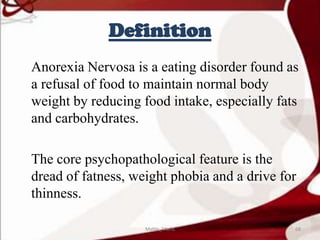
Definition
Anorexia Nervosa is a eating disorder found as
a refusal of food to maintain normal body
weight by reducing food intake, especially fats
and carbohydrates.
The core psychopathological feature is the
dread of fatness, weight phobia and a drive for
thinness.
68Mable_Maria
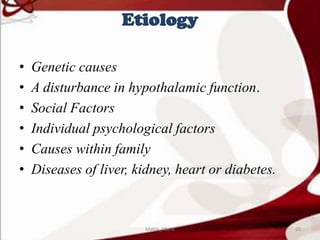
Etiology
• Genetic causes
• A disturbance in hypothalamic function.
• Social Factors
• Individual psychological factors
• Causes within family
• Diseases of liver, kidney, heart or diabetes.
69Mable_Maria
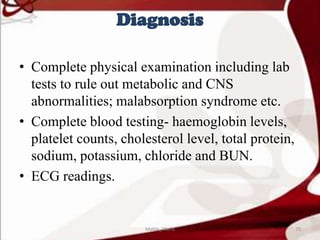
Diagnosis
• Complete physical examination including lab
tests to rule out metabolic and CNS
abnormalities; malabsorption syndrome etc.
• Complete blood testing- haemoglobin levels,
platelet counts, cholesterol level, total protein,
sodium, potassium, chloride and BUN.
• ECG readings.
70Mable_Maria
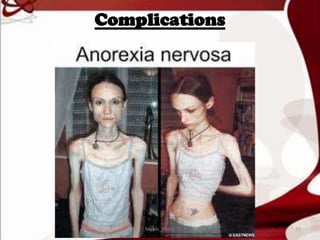
Complications
71Mable_Maria
Management
• Pharmacotherapy
Neuroleptics
Appetite stimulants
Antidepressants
• Psychological Therapies
Individual psychotherapy
Behavioural therapy
Cognitive behaviour therapy
Family therapy
72Mable_Maria
BULIMIA NERVOSA
73Mable_Maria
Definition
Bulimia nervosa is characterised by episodes
of binge eating followed by feelings of guilt,
humiliation, depression and self condemnation.
74Mable_Maria
Etiology
• More common in first degree, biological relatives
of people with bulimia.
• Specific areas of chromosome 10p linked to
families with a history of bulimia
• Possible role of serotonin levels in brain.
• Society’s emphasis on appearance and thinness.
• Family disturbances or conflict.
• Sexual abuse.
• Learned maladaptive behaviour.
• Struggle for control or self identity.
75Mable_Maria
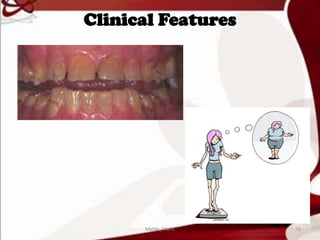
Clinical Features
76Mable_Maria
Diagnosis
History Collection and physical examination.
Laboratory tests – blood glucose, serum
electrolytes etc.
77Mable_Maria
Management
• Psychotherapy
• TCAs or Selective serotonin reuptake
inhibitors.
• Hospitalization in complicated cases.
78Mable_Maria
79Mable_Maria
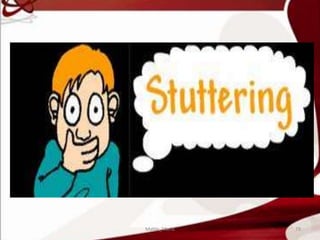
Definition
Stuttering or stammering is a defect in speech
characterized by interruptions in the flow of
speech, hesitations, spasmodic repetitions and
prolongation of sounds specially of initial
consonants.
80Mable_Maria
Types
• Developmental
• Acquired
• Psychogenic
81Mable_Maria
Causes
• It is evident in children who cannot cope with
the environmental and emotional stresses.
• It is commonly found in boys with fear,
anxiety and timid personality.
• Family history.
82Mable_Maria
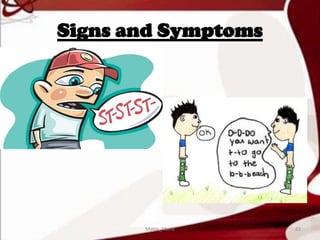
Signs and Symptoms
83Mable_Maria
Management
• Behaviour modification
• Relaxation therapy
• Parents need counselling
• Breath control exercises and speech therapy.
• Fluency Shaping Therapy
• Stuttering Modification Therapy
• Electronic Fluency Device
• Anti stuttering medications.
84Mable_Maria
CLUTTERING
• Cluttering is a speech and communication
disorder characterised by unclear and hurried
speech in which words tumble over each other.
There are awkward movements of hands, feet,
and body. These children have erratic and
poorly organized personality and behaviour
pattern
• Management includes behaviour modification
and psychotherapy.
85Mable_Maria
86Mable_Maria
Definition
School phobia is persistent and abnormal fear
of going to school.
It is emotional disorder of the children who are
afraid to leave the parents, especially mother
and prefer to remain at home and refuse to go
to school profusely.
87Mable_Maria
Signs and Symptoms
Recurrent physical complaints like abdominal
pain, headaches which subside if allowed to
remain at home.
88Mable_Maria
Management
• Habit formation
• Improvement of school environment
• assessment of health status of the child to
detect any health problems for necessary
interventions.
• Family counselling
• Behaviour techniques
• Drugs
89Mable_Maria
90Mable_Maria
By about 6-7 months, the infant can
differentiate between the primary caregivers
and others. Thus at this age, they develop fear
of unfamiliar people or strangers. The infant ,
when approached by unfamiliar person, turns
away, even cry or runs towards the primary
caregiver. This is known as stranger reaction.
91Mable_Maria
Management
• Nurses should advise the parents to be calm.
• Infant is managed with relaxation techniques.
• Reassurance of parents.
• child should be referred to psychiatrist to
evaluate for associated anxiety disorders.
• Cognitive behavioural therapy and family
therapy are being tried.
92Mable_Maria
93Mable_Maria
DEFINITION
Colic is characterized by intermittent episodes
of abdominal pain and severe crying in infants
younger than 3 months of age.
94Mable_Maria
• According to Dr. Sethna, Juvenile delinquency
involves wrong doing by a child or a young
person who is under an age specified by the
law of the place concerned.
• A juvenile delinquent is a person who is
below 16 years of age (18 years in case of a
girl) who indulges in antisocial activity.
95Mable_Maria
Causes
• Social Causes
• Psychological causes
• Economic Causes
• Physical
96Mable_Maria
Management
• Reform of Juvenile Delinquents
• Probation
• Reformatory Institutions
• Psychological Techniques
– Play Therapy
– Finger Painting
– Psychodrama
97Mable_Maria
SOMNAMBULISM
• Walking and carrying out complex activities during the state of sleep
is termed as somnambulism.
• Child moves aimlessly during the sleep.
• It is more common in boys. It is seen in 5-8 % of children in the age
of 5-12 years.
• Often sleep walking is related to stress.
• Management: Plan for scheduled awakenings. Room should be free
from dangerous articles. Provide comfortable happy environment.
Parents need to be educated and counselled regarding the disease.
98Mable_Maria
99Mable_Maria
MATERNAL DEPRIVATION
Causes:
• Young age of the parent (teenage parent)
• Unwanted pregnancy.
• lower level of education
• Lower socio economic status
• Absence of father
• Mental Illness, including post partum
depression.
100Mable_Maria
Symptoms
• Decreased or absent linear growth.
• Lack of appropriate hygiene
• Lack of interaction between mother and child
• Weight less than 5th percentile or an inadequate
rate of weight gain.
101Mable_Maria
Treatment
• Multidisciplinary approach including
physicians, nutritionist, social workers and
visiting nurse.
• In severe cases hospitalization is required.
• Child’s intake is increased to 150 cal per
kg/day.
• Advise the parents to seek help from
programmes available for young parents,
single parent etc.
102Mable_Maria
103Mable_Maria
Definition
• The term failure to thrive is applied to infants
and young children (usually up to the age of 2-
3 years) who show failure of expected weight
gain and striking lack of well being.
• The essential component in failure to thrive is
sluggish weight gain.
104Mable_Maria
Etiology
• Extrinsic Causes
– Poor dietary intake
– Social and emotional deprivation
• Intrinsic Causes
– Malabsorption
– Intestinal parasitosis
– Persistent vomiting
– Metabolic
– Chronic Illnesses
105Mable_Maria
Clinical Manifestations
• Infant is underweight for age (usually 3rd
percentile)
• Child appears small in size with expressionless
faces
• Poor gross motor activity
• Delayed vocalization
• Poor response.
• Child tends to remain absorbed in thumb sucking.
• Beyond infancy the child is underweight, thin and
inactive.
106Mable_Maria
Mable_Maria 107

Behavioural paediatrics ppt

  • 1.
  • 2.
  • 3.
  • 4.
    DEFINITION When children cannotadjust to a complex environment around them, they become unable to behave in the socially acceptable way resulting in exhibition of peculiar behaviours and this is called as behavioural problems. 4Mable_Maria
  • 5.
    CAUSES • Faulty ParentalAttitude • Inadequate Family Environment • Mentally And Physically Sick or Handicapped Conditions • Influence of Social Relationships • Influence of Mass Media 5Mable_Maria
  • 6.
  • 7.
    • MOVEMENT INFANCY HABIT CHILDHOOD TOILETTING ADOLESCENCESPEECH SCHOOL SLEEP EATING AGE NATURE 7Mable_Maria
  • 8.
    INFANCY –Impaired appetite orResistance to feeding –Abdominal Colic –Stranger Anxiety 8Mable_Maria
  • 9.
    CHILDHOOD • Temper tantrums •Breath holding spell • Thumb sucking • Nail biting • Enuresis or Bed wetting • Encopresis • Pica or Geophagia • Tics or Habit spasm • School Phobia • Attention Deficit Hyper Activity Disorder • Speech Problems – Stuttering or stammering – Cluttering – Delayed Speech • Sleep Disorders – Sleep walking – Sleep talking – Bruxism 9Mable_Maria
  • 10.
    ADOLESCENCE • Masturbation • JuvenileDelinquency • Substance Abuse • Anorexia Nervosa 10Mable_Maria
  • 11.
  • 12.
    Problems of Movements •Head Banging • Breath holding Spells • Temper tantrums • Tics Problems of habit • Thumb sucking • Nail biting • Pica • Trichotillomania 12Mable_Maria
  • 13.
    Problems of ToiletTraining • Enuresis • Encopresis Problems of Speech • Stuttering • Elective mutism Problems at School • School Phobia 13Mable_Maria
  • 14.
    Sleep Disorders • Somnambulism •Nightmares Eating Disorders • Anorexia Nervosa • Bulimia Nervosa • Pica 14Mable_Maria
  • 15.
  • 16.
    DEFINITION • Enuresis isa disorder of involuntary micturition in children who are beyond the age when normal bladder control should have been acquired. • Enuresis refers to the wetting of one’s clothes or one’s bed past the age of 3 years. 16Mable_Maria
  • 17.
    INCIDENCE • It iscommon during 4 years to 12 years age group. • Studies suggest that 2.5 % in the age group of 0-10 years have enuresis and at age 5, it is 7 % for males and 3 % for females. 17Mable_Maria
  • 18.
    Types Enuresis has beenclassified into : • Persistent(primary) • Regressive (secondary) 18Mable_Maria
  • 19.
    ETIOLOGY • Genetic • Psychological •Physiological • Organic 19Mable_Maria
  • 20.
    CLINICAL FEATURES • Incontinence •Dysuria • Hematuria • Straining on urination • Dribbling • Stress incontinence( with coughing, lifting or running) • Poor bowel control • Continuous dampness 20Mable_Maria
  • 21.
    INVESTIGATIONS • Full medicalhistory • Genital and neurological examination • Urinalysis for albumin, sugar, microscopy, and culture • if the child has UTI, he should be further evaluated by USG, cysto urethrogram and uro dynamic studies. 21Mable_Maria
  • 22.
    TREATMENT • Pharmacologic • Non-Pharmacologic –BehaviourModification –Parental Counselling –Bladder Exercises –Alarm Device 22Mable_Maria
  • 23.
  • 24.
  • 25.
  • 26.
  • 27.
    TYPES CLASS I: INATTENTIO N + HYPERACTI VITY+ IMPULSIVE NESS. CLASS II: HYPERACTI VITY + IMPULSIVEN ESS CLASS III: INATTENTI ON 27Mable_Maria
  • 28.
    ETIOLOGY • Genetic Factors •Biochemical Theory • Pre, Peri and Postnatal Factors • Environmental Influences • Psychosocial Factors 28Mable_Maria
  • 29.
    RISK FACTORS • Drugexposure in utero. • Birth complications. • Low birth weight. • lead poisoning. 29Mable_Maria
  • 30.
    DIAGNOSIS • Complete medicalevaluation. • A psychiatric evaluation. • Detailed prenatal history and early developmental history. • Direct observation, teacher’s school report, parent’s report. 30Mable_Maria
  • 31.
    CLINICAL FEATURES • Sensitiveto stimuli, easily upset by noise, light, temperature and other environmental changes. • At times the reverse occurs and the children are flaccid and limp, sleep more and the growth and development is slow in the first month of life. • General coordination deficit. • Short attention span, easily distractable. • Failure to finish tasks • Impulsivity. • Memory and thinking deficits. • Specific learning disabilities. 31Mable_Maria

  • 32.
    TREATMENT Pharmacologic Non Pharmacologic - PsychologicTherapies • Behaviour therapy • Cognitive Behaviour Therapy • Biofeedback 32Mable_Maria
  • 33.
    NURSING INTERVENTION • Developa trusting relationship with the child. • Ensure safe environment. • Offer recognition for successful attempts and positive reinforcement. • Provide information and materials related to the child’s disorder and effective parenting techniques. • Explain and demonstrate positive parenting techniques • Coordinate overall treatment plan with schools, collateral personnel and the family. 33Mable_Maria
  • 34.
  • 35.
  • 36.
  • 37.
    DEFINITION From the ageof 18 months to 3 years, the child begins to develop autonomy and starts separating from primary caregivers. When they can’t express their autonomy they become frustrated and angry. Some of them show their frustration and defiance with physical aggression or resistance such as biting , crying, kicking, throwing objects, hitting and head banging. This kind of physical aggressive behaviour is known as Temper tantrum. 37Mable_Maria
  • 38.
  • 39.
    ETIOLOGY • Parental Factors •Child personality • Other Factors Precipitants • Not meeting demands • Interruption of play • Threat of abandonment • Stranger anxiety, criticism • Imitation 39Mable_Maria
  • 40.
    CLINICAL FEATURES • Screaming, •biting, • hammering, • stamping feet, thrashing arms, • kicking, throwing objects, • rolling on the floor 40Mable_Maria
  • 41.
    MANAGEMENT • Temper tantrumsoften cease with age. Remove underlying insecurity, over protection and faulty parental attitude. • During an attack, the child should be protected from injuring himself and the others. • Deviating his attention from the immediate cause and changing the environment can reduce the tantrum. 41Mable_Maria
  • 42.
    • Parents shouldbe calm, loving, firm and consistent and such behaviour should not allow the child to take advantage of gaining things. • Some temper tantrums result from the child’s frustration at failing to master a task. These can be managed by distracting the child and permitting success in more manageable activity. 42Mable_Maria
  • 43.
    • Ignoring isan effective way to avoid reinforcing tantrums although young children should be held till they regain control. • “Time out procedure”- In using time out procedure, parents should not attempt to inflict a fixed number of minutes of isolation. The goal should be to help the child develop self regulation. 43Mable_Maria
  • 44.
  • 45.
    Definition Breath holding spellsare reflexive events in which typically there is a provoking event that causes anger, frustration and child starts to cry. The crying stops at full expiration when the child becomes apnoeic and cyanotic or pale. 45Mable_Maria
  • 46.
    Incidence • Seen in4-5 % of paediatric population. • Common in the children of age group 1-5 years of age. • Begins before 18 months of age; • Common in girls and those from lower social class and nuclear families. 46Mable_Maria
  • 47.
  • 48.
    Etiology • Parental Factors •Other factors • Precipitants 48Mable_Maria
  • 49.
  • 50.
    Management • Pharmacologic management •Non Pharmacologic management – Immediate measures – Long term measures – Parental education 50Mable_Maria
  • 51.
  • 52.
    Definition • Encopresis refersto passage of faeces into inappropriate places at age when bowel control should have been established. 52Mable_Maria
  • 53.
    Etiology • Inefficient intestinalmotility • Aggressive and prolonged medical management (laxatives, enemas, suppositories) • Dietary manipulation for perceived constipation • Anal fissures and rashes • Surgical procedures for imperforate anus • Psychosocial stresses or illness 53Mable_Maria
  • 54.
    Management • Initial Counseling •Initial catharsis • Maintenance regimen • At home • Dietary management 54Mable_Maria
  • 55.
  • 56.
    Definition • Thumb suckingis defined as the habit of putting thumb into the mouth most of the time. • It usually involves placing the thumb into the mouth and rhythmically repeating sucking contact for a prolonged duration. 56Mable_Maria
  • 57.
    Etiology • A gratifyingaction especially under unpleasant and unsatisfying feeding situation. • Psychological • Precipitants 57Mable_Maria
  • 58.
    Management • Parental counselling •Behaviour Therapy • Use of T-guards 58Mable_Maria
  • 59.
    PICA (GEOPHAGIA) Pica isa habit disorder of eating non edible substances such as clay, paint, chalks, pencil, plaster from wall etc. 59Mable_Maria
  • 60.
    Causes • Parental neglect,poor attention of the caregiver, inadequate love and affection, mental health conditions like mental retardation and OCD etc. • Nutritional deficiencies. • Children of poor socio economic status family, malnourished and mentally subnormal children. 60Mable_Maria
  • 61.
    Clinical Features • Anaemia •Perverted appetite • Intestinal parasitosis • lead poisoning • Vitamins and mineral deficiency, • Trichotillomania, trichobezoar etc. 61Mable_Maria
  • 62.
    Diagnosis • Blood investigations •According to the DSM classification, a person is said to have pica, only if: • Persistent eating of non nutritive substances for a period of at least one month • Does not meet the criteria for either having autism, schizophrenia, or Kleine-Levin syndrome. • The eating behavior is not culturally sanctioned. • If the eating behavior occurs exclusively during the course of another mental disorder 62Mable_Maria
  • 63.
    Treatment • Treatment ofthe deficiencies. • Parental counselling • Education and guidance • Behaviour modification • Psychotherapy 63Mable_Maria
  • 64.
    TICS Tic is anabnormal involuntary movement which occurs suddenly, repetitively, rapidly and is purposeless in nature. 64Mable_Maria
  • 65.
    Types Motor Tics- characterizedby repetitive motor movements. - Simple motor tics - Complex motor tics Vocal Tics- characterized by repetitive vocalisations. - Simple vocal tics - Complex vocal tics 65Mable_Maria
  • 66.
    Treatment • Pharmacotherapy • Haloperidolis the drug of choice. In severe cases, pimozide or clonidine can be used. • Antipsychotics (blocks dopamine receptors) • Benzodiazepines to reduce anxiety. • Serotonin reuptake inhibitors. • Behaviour therapy may be used. • Parents and the family should be educated and counselled about course of disorder and spontaneous resolvement of disorder • Relaxation exercises have proven efficacy. • Awareness training. 66Mable_Maria
  • 67.
  • 68.
    Definition Anorexia Nervosa isa eating disorder found as a refusal of food to maintain normal body weight by reducing food intake, especially fats and carbohydrates. The core psychopathological feature is the dread of fatness, weight phobia and a drive for thinness. 68Mable_Maria
  • 69.
    Etiology • Genetic causes •A disturbance in hypothalamic function. • Social Factors • Individual psychological factors • Causes within family • Diseases of liver, kidney, heart or diabetes. 69Mable_Maria
  • 70.
    Diagnosis • Complete physicalexamination including lab tests to rule out metabolic and CNS abnormalities; malabsorption syndrome etc. • Complete blood testing- haemoglobin levels, platelet counts, cholesterol level, total protein, sodium, potassium, chloride and BUN. • ECG readings. 70Mable_Maria
  • 71.
  • 72.
    Management • Pharmacotherapy Neuroleptics Appetite stimulants Antidepressants •Psychological Therapies Individual psychotherapy Behavioural therapy Cognitive behaviour therapy Family therapy 72Mable_Maria
  • 73.
  • 74.
    Definition Bulimia nervosa ischaracterised by episodes of binge eating followed by feelings of guilt, humiliation, depression and self condemnation. 74Mable_Maria
  • 75.
    Etiology • More commonin first degree, biological relatives of people with bulimia. • Specific areas of chromosome 10p linked to families with a history of bulimia • Possible role of serotonin levels in brain. • Society’s emphasis on appearance and thinness. • Family disturbances or conflict. • Sexual abuse. • Learned maladaptive behaviour. • Struggle for control or self identity. 75Mable_Maria
  • 76.
  • 77.
    Diagnosis History Collection andphysical examination. Laboratory tests – blood glucose, serum electrolytes etc. 77Mable_Maria
  • 78.
    Management • Psychotherapy • TCAsor Selective serotonin reuptake inhibitors. • Hospitalization in complicated cases. 78Mable_Maria
  • 79.
  • 80.
    Definition Stuttering or stammeringis a defect in speech characterized by interruptions in the flow of speech, hesitations, spasmodic repetitions and prolongation of sounds specially of initial consonants. 80Mable_Maria
  • 81.
  • 82.
    Causes • It isevident in children who cannot cope with the environmental and emotional stresses. • It is commonly found in boys with fear, anxiety and timid personality. • Family history. 82Mable_Maria
  • 83.
  • 84.
    Management • Behaviour modification •Relaxation therapy • Parents need counselling • Breath control exercises and speech therapy. • Fluency Shaping Therapy • Stuttering Modification Therapy • Electronic Fluency Device • Anti stuttering medications. 84Mable_Maria
  • 85.
    CLUTTERING • Cluttering isa speech and communication disorder characterised by unclear and hurried speech in which words tumble over each other. There are awkward movements of hands, feet, and body. These children have erratic and poorly organized personality and behaviour pattern • Management includes behaviour modification and psychotherapy. 85Mable_Maria
  • 86.
  • 87.
    Definition School phobia ispersistent and abnormal fear of going to school. It is emotional disorder of the children who are afraid to leave the parents, especially mother and prefer to remain at home and refuse to go to school profusely. 87Mable_Maria
  • 88.
    Signs and Symptoms Recurrentphysical complaints like abdominal pain, headaches which subside if allowed to remain at home. 88Mable_Maria
  • 89.
    Management • Habit formation •Improvement of school environment • assessment of health status of the child to detect any health problems for necessary interventions. • Family counselling • Behaviour techniques • Drugs 89Mable_Maria
  • 90.
  • 91.
    By about 6-7months, the infant can differentiate between the primary caregivers and others. Thus at this age, they develop fear of unfamiliar people or strangers. The infant , when approached by unfamiliar person, turns away, even cry or runs towards the primary caregiver. This is known as stranger reaction. 91Mable_Maria
  • 92.
    Management • Nurses shouldadvise the parents to be calm. • Infant is managed with relaxation techniques. • Reassurance of parents. • child should be referred to psychiatrist to evaluate for associated anxiety disorders. • Cognitive behavioural therapy and family therapy are being tried. 92Mable_Maria
  • 93.
  • 94.
    DEFINITION Colic is characterizedby intermittent episodes of abdominal pain and severe crying in infants younger than 3 months of age. 94Mable_Maria
  • 95.
    • According toDr. Sethna, Juvenile delinquency involves wrong doing by a child or a young person who is under an age specified by the law of the place concerned. • A juvenile delinquent is a person who is below 16 years of age (18 years in case of a girl) who indulges in antisocial activity. 95Mable_Maria
  • 96.
    Causes • Social Causes •Psychological causes • Economic Causes • Physical 96Mable_Maria
  • 97.
    Management • Reform ofJuvenile Delinquents • Probation • Reformatory Institutions • Psychological Techniques – Play Therapy – Finger Painting – Psychodrama 97Mable_Maria
  • 98.
    SOMNAMBULISM • Walking andcarrying out complex activities during the state of sleep is termed as somnambulism. • Child moves aimlessly during the sleep. • It is more common in boys. It is seen in 5-8 % of children in the age of 5-12 years. • Often sleep walking is related to stress. • Management: Plan for scheduled awakenings. Room should be free from dangerous articles. Provide comfortable happy environment. Parents need to be educated and counselled regarding the disease. 98Mable_Maria
  • 99.
  • 100.
    MATERNAL DEPRIVATION Causes: • Youngage of the parent (teenage parent) • Unwanted pregnancy. • lower level of education • Lower socio economic status • Absence of father • Mental Illness, including post partum depression. 100Mable_Maria
  • 101.
    Symptoms • Decreased orabsent linear growth. • Lack of appropriate hygiene • Lack of interaction between mother and child • Weight less than 5th percentile or an inadequate rate of weight gain. 101Mable_Maria
  • 102.
    Treatment • Multidisciplinary approachincluding physicians, nutritionist, social workers and visiting nurse. • In severe cases hospitalization is required. • Child’s intake is increased to 150 cal per kg/day. • Advise the parents to seek help from programmes available for young parents, single parent etc. 102Mable_Maria
  • 103.
  • 104.
    Definition • The termfailure to thrive is applied to infants and young children (usually up to the age of 2- 3 years) who show failure of expected weight gain and striking lack of well being. • The essential component in failure to thrive is sluggish weight gain. 104Mable_Maria
  • 105.
    Etiology • Extrinsic Causes –Poor dietary intake – Social and emotional deprivation • Intrinsic Causes – Malabsorption – Intestinal parasitosis – Persistent vomiting – Metabolic – Chronic Illnesses 105Mable_Maria
  • 106.
    Clinical Manifestations • Infantis underweight for age (usually 3rd percentile) • Child appears small in size with expressionless faces • Poor gross motor activity • Delayed vocalization • Poor response. • Child tends to remain absorbed in thumb sucking. • Beyond infancy the child is underweight, thin and inactive. 106Mable_Maria
  • 107.