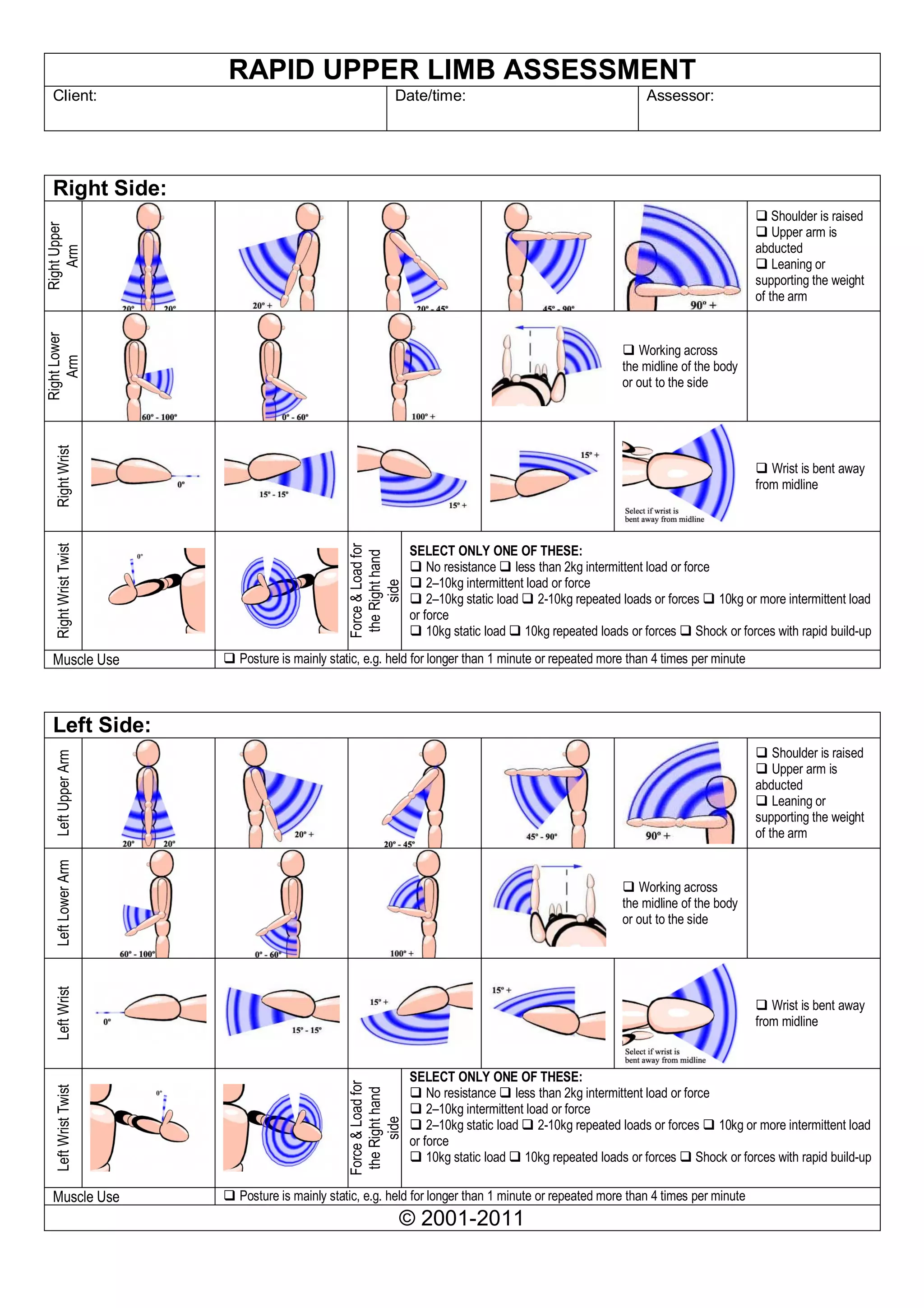
RAPID UPPER LIMB ASSESSMENT
Client: Date/time: Assessor:
Right Side:
RightUpper
Arm
 Shoulder is raised
 Upper arm is
abducted
 Leaning or
supporting the weight
of the arm
RightLower
Arm
 Working across
the midline of the body
or out to the side
RightWrist
 Wrist is bent away
from midline
RightWristTwist
Force&Loadfor
theRighthand
side
SELECT ONLY ONE OF THESE:
 No resistance  less than 2kg intermittent load or force
 2–10kg intermittent load or force
 2–10kg static load  2-10kg repeated loads or forces  10kg or more intermittent load
or force
 10kg static load  10kg repeated loads or forces  Shock or forces with rapid build-up
Muscle Use  Posture is mainly static, e.g. held for longer than 1 minute or repeated more than 4 times per minute
Left Side:
LeftUpperArm
 Shoulder is raised
 Upper arm is
abducted
 Leaning or
supporting the weight
of the arm
LeftLowerArm
 Working across
the midline of the body
or out to the side
LeftWrist
 Wrist is bent away
from midline
LeftWristTwist
Force&Loadfor
theRighthand
side
SELECT ONLY ONE OF THESE:
 No resistance  less than 2kg intermittent load or force
 2–10kg intermittent load or force
 2–10kg static load  2-10kg repeated loads or forces  10kg or more intermittent load
or force
 10kg static load  10kg repeated loads or forces  Shock or forces with rapid build-up
Muscle Use  Posture is mainly static, e.g. held for longer than 1 minute or repeated more than 4 times per minute
© 2001-2011
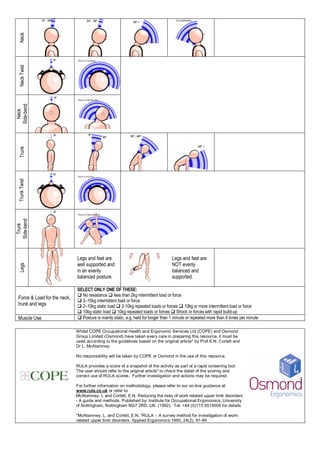
NeckNeckTwist
Neck
Side-bend
TrunkTrunkTwist
Trunk
Side-bend
Legs
Legs and feet are
well supported and
in an evenly
balanced posture.
Legs and feet are
NOT evenly
balanced and
supported.
Force & Load for the neck,
trunk and legs
SELECT ONLY ONE OF THESE:
 No resistance  less than 2kg intermittent load or force
 2–10kg intermittent load or force
 2–10kg static load  2-10kg repeated loads or forces  10kg or more intermittent load or force
 10kg static load  10kg repeated loads or forces  Shock or forces with rapid build-up
Muscle Use  Posture is mainly static, e.g. held for longer than 1 minute or repeated more than 4 times per minute
Whilst COPE Occupational Health and Ergonomic Services Ltd (COPE) and Osmond
Group Limited (Osmond) have taken every care in preparing this resource, it must be
used according to the guidelines based on the original article* by Prof E.N. Corlett and
Dr L. McAtamney.
No responsibility will be taken by COPE or Osmond in the use of this resource.
RULA provides a score of a snapshot of the activity as part of a rapid screening tool.
The user should refer to the original article* to check the detail of the scoring and
correct use of RULA scores. Further investigation and actions may be required.
For further information on methodology, please refer to our on-line guidance at
www.rula.co.uk or refer to:
McAtamney, L and Corlett, E.N. Reducing the risks of work related upper limb disorders
- A guide and methods. Published by: Institute for Occupational Ergonomics, University
of Nottingham, Nottingham NG7 2RD, UK. (1992). Tel: +44 (0)115 9514005 for details.
*McAtamney, L. and Corlett, E.N. "RULA -: A survey method for investigation of work-
related upper limb disorders. Applied Ergonomics 1993, 24(2), 91-99

Rula sheet

  • 1.
    RAPID UPPER LIMBASSESSMENT Client: Date/time: Assessor: Right Side: RightUpper Arm  Shoulder is raised  Upper arm is abducted  Leaning or supporting the weight of the arm RightLower Arm  Working across the midline of the body or out to the side RightWrist  Wrist is bent away from midline RightWristTwist Force&Loadfor theRighthand side SELECT ONLY ONE OF THESE:  No resistance  less than 2kg intermittent load or force  2–10kg intermittent load or force  2–10kg static load  2-10kg repeated loads or forces  10kg or more intermittent load or force  10kg static load  10kg repeated loads or forces  Shock or forces with rapid build-up Muscle Use  Posture is mainly static, e.g. held for longer than 1 minute or repeated more than 4 times per minute Left Side: LeftUpperArm  Shoulder is raised  Upper arm is abducted  Leaning or supporting the weight of the arm LeftLowerArm  Working across the midline of the body or out to the side LeftWrist  Wrist is bent away from midline LeftWristTwist Force&Loadfor theRighthand side SELECT ONLY ONE OF THESE:  No resistance  less than 2kg intermittent load or force  2–10kg intermittent load or force  2–10kg static load  2-10kg repeated loads or forces  10kg or more intermittent load or force  10kg static load  10kg repeated loads or forces  Shock or forces with rapid build-up Muscle Use  Posture is mainly static, e.g. held for longer than 1 minute or repeated more than 4 times per minute © 2001-2011
  • 2.
    NeckNeckTwist Neck Side-bend TrunkTrunkTwist Trunk Side-bend Legs Legs and feetare well supported and in an evenly balanced posture. Legs and feet are NOT evenly balanced and supported. Force & Load for the neck, trunk and legs SELECT ONLY ONE OF THESE:  No resistance  less than 2kg intermittent load or force  2–10kg intermittent load or force  2–10kg static load  2-10kg repeated loads or forces  10kg or more intermittent load or force  10kg static load  10kg repeated loads or forces  Shock or forces with rapid build-up Muscle Use  Posture is mainly static, e.g. held for longer than 1 minute or repeated more than 4 times per minute Whilst COPE Occupational Health and Ergonomic Services Ltd (COPE) and Osmond Group Limited (Osmond) have taken every care in preparing this resource, it must be used according to the guidelines based on the original article* by Prof E.N. Corlett and Dr L. McAtamney. No responsibility will be taken by COPE or Osmond in the use of this resource. RULA provides a score of a snapshot of the activity as part of a rapid screening tool. The user should refer to the original article* to check the detail of the scoring and correct use of RULA scores. Further investigation and actions may be required. For further information on methodology, please refer to our on-line guidance at www.rula.co.uk or refer to: McAtamney, L and Corlett, E.N. Reducing the risks of work related upper limb disorders - A guide and methods. Published by: Institute for Occupational Ergonomics, University of Nottingham, Nottingham NG7 2RD, UK. (1992). Tel: +44 (0)115 9514005 for details. *McAtamney, L. and Corlett, E.N. "RULA -: A survey method for investigation of work- related upper limb disorders. Applied Ergonomics 1993, 24(2), 91-99