Oral Contraceptives
Up to date Overview
Dr. Mamdouh Sabry
MD. Ain Shams Uni. Cairo, Ph.D. Paris V Uni.
Mataria Teaching Hosp. & Nasser Institute
Cairo, Egypt
History
• Fertility control is as old as humankind.
• Embryocide and abortion were the methods
of choice among primitive societies.
• Condom appeared during the 16th
century to
protect first from STD ( S ) which was
epidemic at that time.
• Spermicides and occlusive pessaries
introduced for commercial use in the 19th
century.
• Richter introduced thread pessary and
Grafenberg used copper made intrauterine
ring, few years later, at the end of the 19th
century.
The Pill
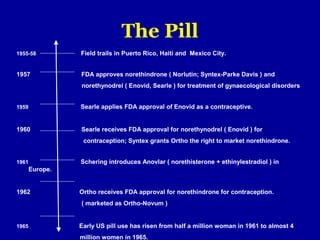
1955-58 Field trails in Puerto Rico, Haiti and Mexico City.
1957 FDA approves norethindrone ( Norlutin; Syntex-Parke Davis ) and
norethynodrel ( Enovid, Searle ) for treatment of gynaecological disorders
1959 Searle applies FDA approval of Enovid as a contraceptive.
1960 Searle receives FDA approval for norethynodrel ( Enovid ) for
contraception; Syntex grants Ortho the right to market norethindrone.
1961 Schering introduces Anovlar ( norethisterone + ethinylestradiol ) in
Europe.
1962 Ortho receives FDA approval for norethindrone for contraception.
( marketed as Ortho-Novum )
1965 Early US pill use has risen from half a million woman in 1961 to almost 4
million women in 1965.
Pharmacology
Estrogen Component
 Ethinyl estradiol ( EE ) developed by adding ethinyl group
at 17th
position of estradiol ( inactive orally ) orally
active potent estrogen.
 Mestranol ( 3-methyl ether of EE ) converted into EE in the
body.
 All low dose pills contain EE.
 Metabolism of EE varies from female to female and variable
in the same female at different times. This explains
difference in side effects from case to case.
 Thrombosis as a side effect is dose related.
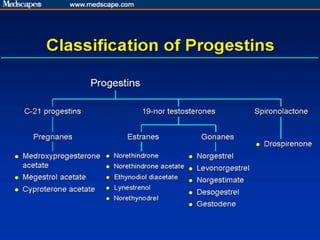
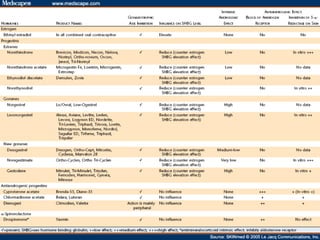
II. Progestin Content
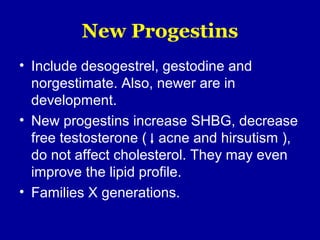
New Progestins
• Include desogestrel, gestodine and
norgestimate. Also, newer are in
development.
• New progestins increase SHBG, decrease
free testosterone ( acne and hirsutism ),
do not affect cholesterol. They may even
improve the lipid profile.
• Families X generations.
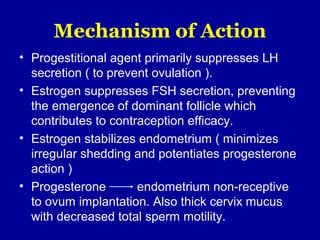
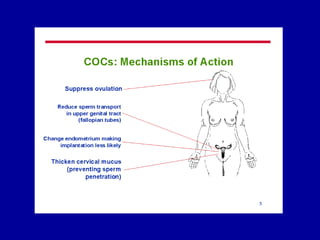
Mechanism of Action
• Progestitional agent primarily suppresses LH
secretion ( to prevent ovulation ).
• Estrogen suppresses FSH secretion, preventing
the emergence of dominant follicle which
contributes to contraception efficacy.
• Estrogen stabilizes endometrium ( minimizes
irregular shedding and potentiates progesterone
action )
• Progesterone endometrium non-receptive
to ovum implantation. Also thick cervix mucus
with decreased total sperm motility.
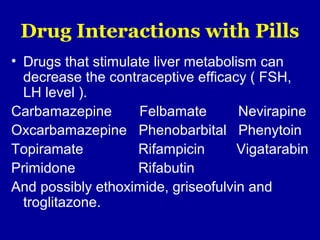
Drug Interactions with Pills
• Drugs that stimulate liver metabolism can
decrease the contraceptive efficacy ( FSH,
LH level ).
Carbamazepine Felbamate Nevirapine
Oxcarbamazepine Phenobarbital Phenytoin
Topiramate Rifampicin Vigatarabin
Primidone Rifabutin
And possibly ethoximide, griseofulvin and
troglitazone.
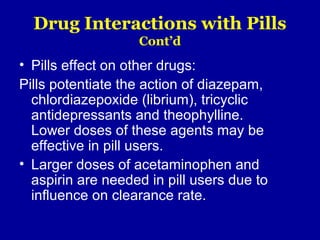
Drug Interactions with Pills
Cont’d
• Pills effect on other drugs:
Pills potentiate the action of diazepam,
chlordiazepoxide (librium), tricyclic
antidepressants and theophylline.
Lower doses of these agents may be
effective in pill users.
• Larger doses of acetaminophen and
aspirin are needed in pill users due to
influence on clearance rate.
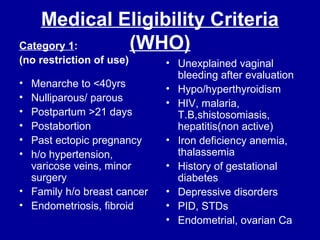
Medical Eligibility Criteria
(WHO)Category 1:
(no restriction of use)
• Menarche to <40yrs
• Nulliparous/ parous
• Postpartum >21 days
• Postabortion
• Past ectopic pregnancy
• h/o hypertension,
varicose veins, minor
surgery
• Family h/o breast cancer
• Endometriosis, fibroid
• Unexplained vaginal
bleeding after evaluation
• Hypo/hyperthyroidism
• HIV, malaria,
T.B,shistosomiasis,
hepatitis(non active)
• Iron deficiency anemia,
thalassemia
• History of gestational
diabetes
• Depressive disorders
• PID, STDs
• Endometrial, ovarian Ca
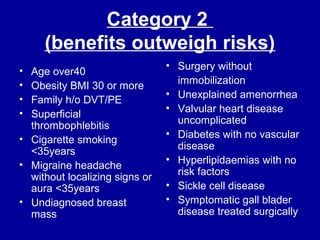
Category 2
(benefits outweigh risks)
• Age over40
• Obesity BMI 30 or more
• Family h/o DVT/PE
• Superficial
thrombophlebitis
• Cigarette smoking
<35years
• Migraine headache
without localizing signs or
aura <35years
• Undiagnosed breast
mass
• Surgery without
immobilization
• Unexplained amenorrhea
• Valvular heart disease
uncomplicated
• Diabetes with no vascular
disease
• Hyperlipidaemias with no
risk factors
• Sickle cell disease
• Symptomatic gall blader
disease treated surgically
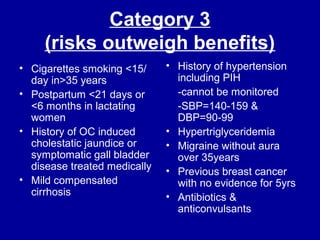
Category 3
(risks outweigh benefits)
• Cigarettes smoking <15/
day in>35 years
• Postpartum <21 days or
<6 months in lactating
women
• History of OC induced
cholestatic jaundice or
symptomatic gall bladder
disease treated medically
• Mild compensated
cirrhosis
• History of hypertension
including PIH
-cannot be monitored
-SBP=140-159 &
DBP=90-99
• Hypertriglyceridemia
• Migraine without aura
over 35years
• Previous breast cancer
with no evidence for 5yrs
• Antibiotics &
anticonvulsants
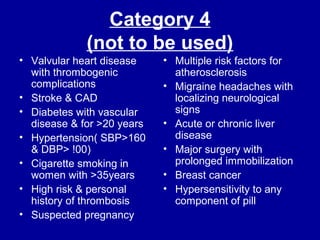
Category 4
(not to be used)
• Valvular heart disease
with thrombogenic
complications
• Stroke & CAD
• Diabetes with vascular
disease & for >20 years
• Hypertension( SBP>160
& DBP> !00)
• Cigarette smoking in
women with >35years
• High risk & personal
history of thrombosis
• Suspected pregnancy
• Multiple risk factors for
atherosclerosis
• Migraine headaches with
localizing neurological
signs
• Acute or chronic liver
disease
• Major surgery with
prolonged immobilization
• Breast cancer
• Hypersensitivity to any
component of pill
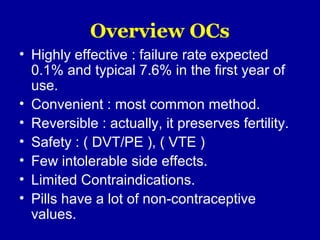
Overview OCs
• Highly effective : failure rate expected
0.1% and typical 7.6% in the first year of
use.
• Convenient : most common method.
• Reversible : actually, it preserves fertility.
• Safety : ( DVT/PE ), ( VTE )
• Few intolerable side effects.
• Limited Contraindications.
• Pills have a lot of non-contraceptive
values.
Cycle Related Benefits
• Decreased blood loss.
• Scheduled bleeding episodes.
• Minimize or eliminate menstrual period.
Possible Health Benefits
• Less salpingitis ( PID ).
• Less anaemia
• Less symptoms of PCO.
• Less benign breast distension.
• Decreased functioning ovarian cysts.
• Less benign ovarian neoplasia.
• Possible fewer myomas.
• Less Rheumatoid arthritis.
Possible Health Benefits
Cont’d
• Stop ovulation in patients with bleeding
tendency to prevent intra-peritoneal
bleeding at ovulation.
• Most of this evidence is based on studies
using higher amounts of estrogen ( 30-35
mcg. )
Cancer
• Pills protect against:
Endometrial Cancer ( 50-60% risk )
Ovarian Cancer ( 40-80% risk )
Cervical ( with long term use only in
women infected with HPV ).
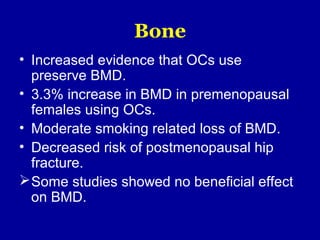
Bone
• Increased evidence that OCs use
preserve BMD.
• 3.3% increase in BMD in premenopausal
females using OCs.
• Moderate smoking related loss of BMD.
• Decreased risk of postmenopausal hip
fracture.
Some studies showed no beneficial effect
on BMD.
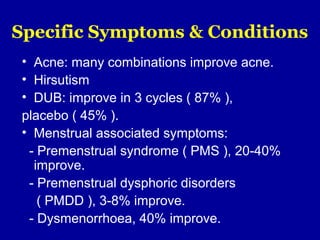
Specific Symptoms & Conditions
• Acne: many combinations improve acne.
• Hirsutism
• DUB: improve in 3 cycles ( 87% ),
placebo ( 45% ).
• Menstrual associated symptoms:
- Premenstrual syndrome ( PMS ), 20-40%
improve.
- Premenstrual dysphoric disorders
( PMDD ), 3-8% improve.
- Dysmenorrhoea, 40% improve.
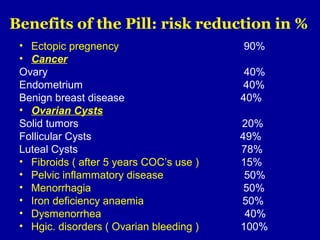
Benefits of the Pill: risk reduction in %
• Ectopic pregnency 90%
• Cancer
Ovary 40%
Endometrium 40%
Benign breast disease 40%
• Ovarian Cysts
Solid tumors 20%
Follicular Cysts 49%
Luteal Cysts 78%
• Fibroids ( after 5 years COC’s use ) 15%
• Pelvic inflammatory disease 50%
• Menorrhagia 50%
• Iron deficiency anaemia 50%
• Dysmenorrhea 40%
• Hgic. disorders ( Ovarian bleeding ) 100%
“ It is safer for a young woman to be on
the Pill than to become pregnant “
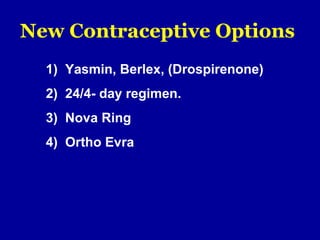
New Contraceptive Options
1) Yasmin, Berlex, (Drospirenone)
2) 24/4- day regimen.
3) Nova Ring
4) Ortho Evra
New Contraceptive Options
Cont’d
Yasmin, Berlex:
Contains 30 mcg of EE and 3 mg of a novel
progestin – Drospirenone.
Similar effectiveness to low dose OCs with
mild mineralocorticoid and diuretic effect.
It can be used in patients with chronic NSAID
users, and in renal disease.
New Contraceptive Options
Cont’d
24/4 day Regimen:
Two recent pills with 24/4 day regimen that
differs from 21/7 regimen, both deliver 20
mcg EE ( Luestrin 24 Fe …… 1 mg
norethindrone acetate ) and ( YAZ,
Scherring……. 3 mg drospirenone ).
They decrease the amount and duration of
bleeding and inhibit folliculogenesis better.
New Contraceptive Options
Cont’d
Vaginal Ring ( Nuva Ring, Organon ):
The flexible ring polymer……( 5mcg of EE/day
+ 120 mcg etonogestrel, active metabolite of
desogestrel ).
3 weeks use and one week free.
New Contraceptive Options
Cont’d
Contraceptive Weekly Patch ( Ortho
Evra, Janssen-Cilag ):
Delivers 20 mcg EE and 150 mcg
norelgestromin ( active metabolite of
norgestimate ) each day ( steady state level ).
One patch every week for 3 weeks and one
patch free week.
Future Prospects
• Decrease Estrogen
• Anti androgens
• Patching
• Nasal
• Post-coital ( local or patching )
• Libido
Thank you

Oral Contraceptives, Up to date Overview

  • 1.
    Oral Contraceptives Up todate Overview Dr. Mamdouh Sabry MD. Ain Shams Uni. Cairo, Ph.D. Paris V Uni. Mataria Teaching Hosp. & Nasser Institute Cairo, Egypt
  • 2.
    History • Fertility controlis as old as humankind. • Embryocide and abortion were the methods of choice among primitive societies. • Condom appeared during the 16th century to protect first from STD ( S ) which was epidemic at that time. • Spermicides and occlusive pessaries introduced for commercial use in the 19th century. • Richter introduced thread pessary and Grafenberg used copper made intrauterine ring, few years later, at the end of the 19th century.
  • 3.
    The Pill 1955-58 Fieldtrails in Puerto Rico, Haiti and Mexico City. 1957 FDA approves norethindrone ( Norlutin; Syntex-Parke Davis ) and norethynodrel ( Enovid, Searle ) for treatment of gynaecological disorders 1959 Searle applies FDA approval of Enovid as a contraceptive. 1960 Searle receives FDA approval for norethynodrel ( Enovid ) for contraception; Syntex grants Ortho the right to market norethindrone. 1961 Schering introduces Anovlar ( norethisterone + ethinylestradiol ) in Europe. 1962 Ortho receives FDA approval for norethindrone for contraception. ( marketed as Ortho-Novum ) 1965 Early US pill use has risen from half a million woman in 1961 to almost 4 million women in 1965.
  • 4.
    Pharmacology Estrogen Component  Ethinylestradiol ( EE ) developed by adding ethinyl group at 17th position of estradiol ( inactive orally ) orally active potent estrogen.  Mestranol ( 3-methyl ether of EE ) converted into EE in the body.  All low dose pills contain EE.  Metabolism of EE varies from female to female and variable in the same female at different times. This explains difference in side effects from case to case.  Thrombosis as a side effect is dose related.
  • 5.
  • 6.
    New Progestins • Includedesogestrel, gestodine and norgestimate. Also, newer are in development. • New progestins increase SHBG, decrease free testosterone ( acne and hirsutism ), do not affect cholesterol. They may even improve the lipid profile. • Families X generations.
  • 8.
    Mechanism of Action •Progestitional agent primarily suppresses LH secretion ( to prevent ovulation ). • Estrogen suppresses FSH secretion, preventing the emergence of dominant follicle which contributes to contraception efficacy. • Estrogen stabilizes endometrium ( minimizes irregular shedding and potentiates progesterone action ) • Progesterone endometrium non-receptive to ovum implantation. Also thick cervix mucus with decreased total sperm motility.
  • 10.
    Drug Interactions withPills • Drugs that stimulate liver metabolism can decrease the contraceptive efficacy ( FSH, LH level ). Carbamazepine Felbamate Nevirapine Oxcarbamazepine Phenobarbital Phenytoin Topiramate Rifampicin Vigatarabin Primidone Rifabutin And possibly ethoximide, griseofulvin and troglitazone.
  • 11.
    Drug Interactions withPills Cont’d • Pills effect on other drugs: Pills potentiate the action of diazepam, chlordiazepoxide (librium), tricyclic antidepressants and theophylline. Lower doses of these agents may be effective in pill users. • Larger doses of acetaminophen and aspirin are needed in pill users due to influence on clearance rate.
  • 12.
    Medical Eligibility Criteria (WHO)Category1: (no restriction of use) • Menarche to <40yrs • Nulliparous/ parous • Postpartum >21 days • Postabortion • Past ectopic pregnancy • h/o hypertension, varicose veins, minor surgery • Family h/o breast cancer • Endometriosis, fibroid • Unexplained vaginal bleeding after evaluation • Hypo/hyperthyroidism • HIV, malaria, T.B,shistosomiasis, hepatitis(non active) • Iron deficiency anemia, thalassemia • History of gestational diabetes • Depressive disorders • PID, STDs • Endometrial, ovarian Ca
  • 13.
    Category 2 (benefits outweighrisks) • Age over40 • Obesity BMI 30 or more • Family h/o DVT/PE • Superficial thrombophlebitis • Cigarette smoking <35years • Migraine headache without localizing signs or aura <35years • Undiagnosed breast mass • Surgery without immobilization • Unexplained amenorrhea • Valvular heart disease uncomplicated • Diabetes with no vascular disease • Hyperlipidaemias with no risk factors • Sickle cell disease • Symptomatic gall blader disease treated surgically
  • 14.
    Category 3 (risks outweighbenefits) • Cigarettes smoking <15/ day in>35 years • Postpartum <21 days or <6 months in lactating women • History of OC induced cholestatic jaundice or symptomatic gall bladder disease treated medically • Mild compensated cirrhosis • History of hypertension including PIH -cannot be monitored -SBP=140-159 & DBP=90-99 • Hypertriglyceridemia • Migraine without aura over 35years • Previous breast cancer with no evidence for 5yrs • Antibiotics & anticonvulsants
  • 15.
    Category 4 (not tobe used) • Valvular heart disease with thrombogenic complications • Stroke & CAD • Diabetes with vascular disease & for >20 years • Hypertension( SBP>160 & DBP> !00) • Cigarette smoking in women with >35years • High risk & personal history of thrombosis • Suspected pregnancy • Multiple risk factors for atherosclerosis • Migraine headaches with localizing neurological signs • Acute or chronic liver disease • Major surgery with prolonged immobilization • Breast cancer • Hypersensitivity to any component of pill
  • 16.
    Overview OCs • Highlyeffective : failure rate expected 0.1% and typical 7.6% in the first year of use. • Convenient : most common method. • Reversible : actually, it preserves fertility. • Safety : ( DVT/PE ), ( VTE ) • Few intolerable side effects. • Limited Contraindications. • Pills have a lot of non-contraceptive values.
  • 17.
    Cycle Related Benefits •Decreased blood loss. • Scheduled bleeding episodes. • Minimize or eliminate menstrual period.
  • 18.
    Possible Health Benefits •Less salpingitis ( PID ). • Less anaemia • Less symptoms of PCO. • Less benign breast distension. • Decreased functioning ovarian cysts. • Less benign ovarian neoplasia. • Possible fewer myomas. • Less Rheumatoid arthritis.
  • 19.
    Possible Health Benefits Cont’d •Stop ovulation in patients with bleeding tendency to prevent intra-peritoneal bleeding at ovulation. • Most of this evidence is based on studies using higher amounts of estrogen ( 30-35 mcg. )
  • 20.
    Cancer • Pills protectagainst: Endometrial Cancer ( 50-60% risk ) Ovarian Cancer ( 40-80% risk ) Cervical ( with long term use only in women infected with HPV ).
  • 21.
    Bone • Increased evidencethat OCs use preserve BMD. • 3.3% increase in BMD in premenopausal females using OCs. • Moderate smoking related loss of BMD. • Decreased risk of postmenopausal hip fracture. Some studies showed no beneficial effect on BMD.
  • 22.
    Specific Symptoms &Conditions • Acne: many combinations improve acne. • Hirsutism • DUB: improve in 3 cycles ( 87% ), placebo ( 45% ). • Menstrual associated symptoms: - Premenstrual syndrome ( PMS ), 20-40% improve. - Premenstrual dysphoric disorders ( PMDD ), 3-8% improve. - Dysmenorrhoea, 40% improve.
  • 23.
    Benefits of thePill: risk reduction in % • Ectopic pregnency 90% • Cancer Ovary 40% Endometrium 40% Benign breast disease 40% • Ovarian Cysts Solid tumors 20% Follicular Cysts 49% Luteal Cysts 78% • Fibroids ( after 5 years COC’s use ) 15% • Pelvic inflammatory disease 50% • Menorrhagia 50% • Iron deficiency anaemia 50% • Dysmenorrhea 40% • Hgic. disorders ( Ovarian bleeding ) 100%
  • 24.
    “ It issafer for a young woman to be on the Pill than to become pregnant “
  • 25.
    New Contraceptive Options 1)Yasmin, Berlex, (Drospirenone) 2) 24/4- day regimen. 3) Nova Ring 4) Ortho Evra
  • 26.
    New Contraceptive Options Cont’d Yasmin,Berlex: Contains 30 mcg of EE and 3 mg of a novel progestin – Drospirenone. Similar effectiveness to low dose OCs with mild mineralocorticoid and diuretic effect. It can be used in patients with chronic NSAID users, and in renal disease.
  • 27.
    New Contraceptive Options Cont’d 24/4day Regimen: Two recent pills with 24/4 day regimen that differs from 21/7 regimen, both deliver 20 mcg EE ( Luestrin 24 Fe …… 1 mg norethindrone acetate ) and ( YAZ, Scherring……. 3 mg drospirenone ). They decrease the amount and duration of bleeding and inhibit folliculogenesis better.
  • 28.
    New Contraceptive Options Cont’d VaginalRing ( Nuva Ring, Organon ): The flexible ring polymer……( 5mcg of EE/day + 120 mcg etonogestrel, active metabolite of desogestrel ). 3 weeks use and one week free.
  • 29.
    New Contraceptive Options Cont’d ContraceptiveWeekly Patch ( Ortho Evra, Janssen-Cilag ): Delivers 20 mcg EE and 150 mcg norelgestromin ( active metabolite of norgestimate ) each day ( steady state level ). One patch every week for 3 weeks and one patch free week.
  • 30.
    Future Prospects • DecreaseEstrogen • Anti androgens • Patching • Nasal • Post-coital ( local or patching ) • Libido
  • 31.