By Maddy Fox
Major labels 1988–1999 (Big Six)
 Warner Music Group
 EMI
 Sony (known as CBS Records until January 1991 then known as Sony Music thereafter)
 BMG
 Universal Music Group
 PolyGram
Major labels 1999–2004 (Big Five)
 Warner Music Group
 EMI
 Sony
 BMG
 Universal Music Group (PolyGram absorbed into UMG)
Major labels 2004–2008 (Big Four)
 Universal Music Group
 Sony BMG (Sony and BMG joint-venture)
 Warner Music Group
 EMI
Major labels 2008–2012 (Big Four)
 Universal Music Group
 Sony Music Entertainment (BMG absorbed into Sony)
 Warner Music Group
 EMI
Major labels since 2012 (Big Three)
 Universal Music Group (part of EMI's recorded music division absorbed into UMG)
 Sony Music Entertainment (EMI Music Publishing absorbed into Sony/ATV Music Publishing)
 Warner Music Group (EMI's Parlophone and EMI/Virgin Classics labels absorbed into WMG on 1 July 2013)
Record labels are often under the control of a corporate
umbrella organization called a "music group". A music group
is typically owned by an international conglomerate "holding
company", which often has non-music divisions as well. A
music group controls and consists of music publishing
companies, record (sound recording) manufacturers, record
distributors, and record labels. As of 2007, the "big four"
music groups control about 70% of the world music market,
and about 80% of the United States music market. Record
companies (manufacturers, distributors, and labels) may
also comprise a "record group" which is, in turn, controlled
by a music group. The constituent companies in a music
group or record group are sometimes marketed as being
"divisions" of the group.
 The Ruff Ryders featured hardcore rap acts to help bring the attention
back to New York hip-hop during the late ’90s. Founded by brothers,
Darrin ‘Dee’ Dean and Joaquin “Waah” Dean, the Ruff Ryder’s started by
managing DMX and The L.O.X. The Deans, uncles of Swizz
Beatz, eventually signed a distribution deal with Interscope Records. With
Swizz on production, the label released successful projects by Eve,
Jadakiss and The L.O.X. However, the label hasn’t released a hit in years
and most of the top artists have moved on to other labels.
 In the early ’90s, most Southern rap artists were shut out of major label
deals. As a result, many independent labels were formed to distribute
southern hip-hop. In 1990, Tony Draper created Suave House Records
and signed Memphis duo, 8 Ball & MJG. The duo released the classic
album Coming Out Hard in 1993 and followed with four other solid
albums. With the help of producers, T-Mixx and 8 Ball & MJG, the Suave
House sound of using soul samples pre-dated Kanye West’s production
style by 10 years. Other artists on Suave House who gained prominence
in the South include Tela, South Circle and Crime Boss. But in the early
‘2000s, 8 Ball & MJG left the label due to mis-management of funds by
Draper. The label has never regained the status it enjoyed during the ’90s.
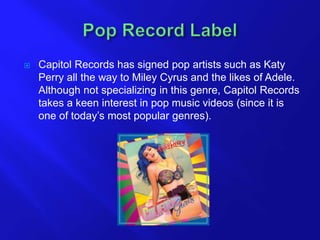
 Capitol Records has signed pop artists such as Katy
Perry all the way to Miley Cyrus and the likes of Adele.
Although not specializing in this genre, Capitol Records
takes a keen interest in pop music videos (since it is
one of today’s most popular genres).
 Our song What Do You Want by Area 52 is an upbeat song with a
rock aspect. Therefore we want a record label that deals with fast/
loud songs by similar artists. However to ensure our music video is
recorded by people with explicit ideas that’ll suit our song choice, I
feel it is perhaps best to start our own record company.
 Using a mixture or our initial we have come up with the label –
RAM Productions! This choice is very simple and does not refer to
the genre in the title but does however have its best interest’s at
heart.

Music record labels

  • 1.
  • 2.
    Major labels 1988–1999(Big Six)  Warner Music Group  EMI  Sony (known as CBS Records until January 1991 then known as Sony Music thereafter)  BMG  Universal Music Group  PolyGram Major labels 1999–2004 (Big Five)  Warner Music Group  EMI  Sony  BMG  Universal Music Group (PolyGram absorbed into UMG) Major labels 2004–2008 (Big Four)  Universal Music Group  Sony BMG (Sony and BMG joint-venture)  Warner Music Group  EMI Major labels 2008–2012 (Big Four)  Universal Music Group  Sony Music Entertainment (BMG absorbed into Sony)  Warner Music Group  EMI Major labels since 2012 (Big Three)  Universal Music Group (part of EMI's recorded music division absorbed into UMG)  Sony Music Entertainment (EMI Music Publishing absorbed into Sony/ATV Music Publishing)  Warner Music Group (EMI's Parlophone and EMI/Virgin Classics labels absorbed into WMG on 1 July 2013)
  • 3.
    Record labels areoften under the control of a corporate umbrella organization called a "music group". A music group is typically owned by an international conglomerate "holding company", which often has non-music divisions as well. A music group controls and consists of music publishing companies, record (sound recording) manufacturers, record distributors, and record labels. As of 2007, the "big four" music groups control about 70% of the world music market, and about 80% of the United States music market. Record companies (manufacturers, distributors, and labels) may also comprise a "record group" which is, in turn, controlled by a music group. The constituent companies in a music group or record group are sometimes marketed as being "divisions" of the group.
  • 5.
     The RuffRyders featured hardcore rap acts to help bring the attention back to New York hip-hop during the late ’90s. Founded by brothers, Darrin ‘Dee’ Dean and Joaquin “Waah” Dean, the Ruff Ryder’s started by managing DMX and The L.O.X. The Deans, uncles of Swizz Beatz, eventually signed a distribution deal with Interscope Records. With Swizz on production, the label released successful projects by Eve, Jadakiss and The L.O.X. However, the label hasn’t released a hit in years and most of the top artists have moved on to other labels.
  • 6.
     In theearly ’90s, most Southern rap artists were shut out of major label deals. As a result, many independent labels were formed to distribute southern hip-hop. In 1990, Tony Draper created Suave House Records and signed Memphis duo, 8 Ball & MJG. The duo released the classic album Coming Out Hard in 1993 and followed with four other solid albums. With the help of producers, T-Mixx and 8 Ball & MJG, the Suave House sound of using soul samples pre-dated Kanye West’s production style by 10 years. Other artists on Suave House who gained prominence in the South include Tela, South Circle and Crime Boss. But in the early ‘2000s, 8 Ball & MJG left the label due to mis-management of funds by Draper. The label has never regained the status it enjoyed during the ’90s.
  • 7.
     Capitol Recordshas signed pop artists such as Katy Perry all the way to Miley Cyrus and the likes of Adele. Although not specializing in this genre, Capitol Records takes a keen interest in pop music videos (since it is one of today’s most popular genres).
  • 8.
     Our songWhat Do You Want by Area 52 is an upbeat song with a rock aspect. Therefore we want a record label that deals with fast/ loud songs by similar artists. However to ensure our music video is recorded by people with explicit ideas that’ll suit our song choice, I feel it is perhaps best to start our own record company.  Using a mixture or our initial we have come up with the label – RAM Productions! This choice is very simple and does not refer to the genre in the title but does however have its best interest’s at heart.