Tangible 3D printouts from GIS-Data:
      A work in progress report

             November 14 2012


             Peter Löwe, CeGIT
          Marcel Ludwig, Section 1.1
Introduction

• We use GIS to
   – process environmental data to trigger decisions –by decision makers.
   – to derive 2D maps from our data for the web or print to communicate.
   – to derive volatile 3D visualisations using GIS or other tools – to
     communicate.
• Things get tricky
   – When the decision makers have to interact with the data.
   – Decision makers aren‘t GIS ninjas – and don‘t carebother to read the
     manual.
   – Volatile 3D images on 3D Screens like Geo Walls, Visio Labs etc. don‘t last
     for later reference.
• Duh.
Skills + Tools + Standards:
       The whole is larger than its parts
• GFZ Section 1.1 is successfully operating a 3D printer -
  mostly for rapid prototyping

• The Centre for GeoInformation Technology (CeGIT) is involved
  in R&D projects involving GIS and complex data:
   – TRIDEC-Project: Quality checking for „2D+Time“ data stacks.
   – Upcoming projects: Visualizion of geological bodies in 3D.

• Common technological standards allow Section 1.1 and CeGIT to
  share their ressources.
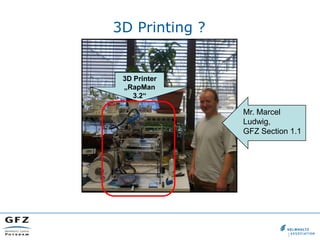
3D Printing ?


 3D Printer
 „RapMan
    3.2“

                Mr. Marcel
                Ludwig,
                GFZ Section 1.1
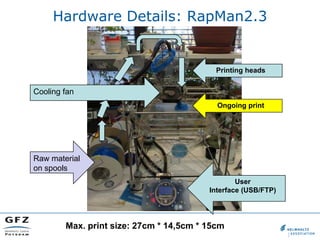
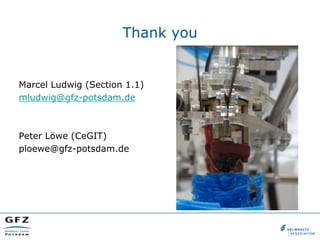
Hardware Details: RapMan2.3


                                           Printing heads


Cooling fan
                                           Ongoing print


Raw material
on spools
                                                 User
                                         Interface (USB/FTP)


        Max. print size: 27cm * 14,5cm * 15cm
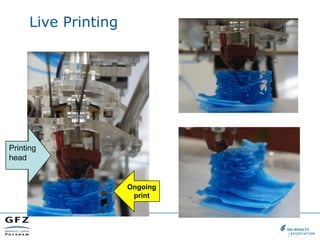
Live Printing


Printing
head


                      Ongoing
                       print
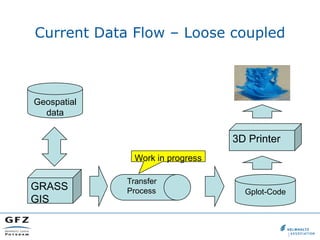
Current Data Flow – Loose coupled


Geospatial
  data


                                  3D Printer
               Work in progress

             Transfer
GRASS        Process                Gplot-Code
GIS
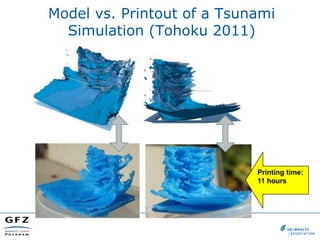
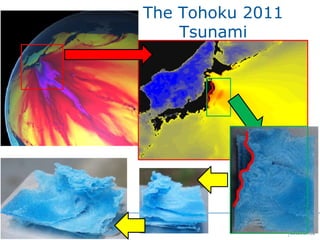
Model vs. Printout of a Tsunami
  Simulation (Tohoku 2011)


                            Printing time:
                            11 hours
THAT is a Tsunami ?


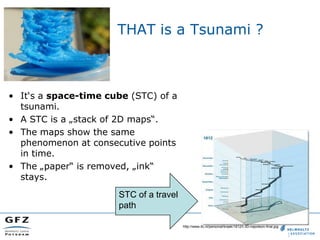
• It‘s a space-time cube (STC) of a
  tsunami.
• A STC is a „stack of 2D maps“.
• The maps show the same
  phenomenon at consecutive points
  in time.
• The „paper“ is removed, „ink“
  stays.
                      STC of a travel
                      path

                                        http://www.itc.nl/personal/kraak/1812/t-3D-napoleon-final.jpg
The Tohoku 2011
    Tsunami
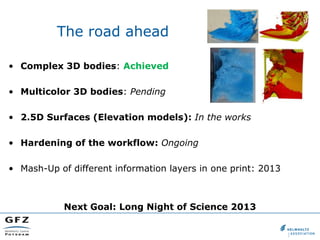
The road ahead

• Complex 3D bodies: Achieved

• Multicolor 3D bodies: Pending

• 2.5D Surfaces (Elevation models): In the works

• Hardening of the workflow: Ongoing

• Mash-Up of different information layers in one print: 2013


            Next Goal: Long Night of Science 2013
Thank you


Marcel Ludwig (Section 1.1)
mludwig@gfz-potsdam.de


Peter Löwe (CeGIT)
ploewe@gfz-potsdam.de

GFZ GIS DAY 2012: Tangible printouts from GIS-data

  • 1.
    Tangible 3D printoutsfrom GIS-Data: A work in progress report November 14 2012 Peter Löwe, CeGIT Marcel Ludwig, Section 1.1
  • 2.
    Introduction • We useGIS to – process environmental data to trigger decisions –by decision makers. – to derive 2D maps from our data for the web or print to communicate. – to derive volatile 3D visualisations using GIS or other tools – to communicate. • Things get tricky – When the decision makers have to interact with the data. – Decision makers aren‘t GIS ninjas – and don‘t carebother to read the manual. – Volatile 3D images on 3D Screens like Geo Walls, Visio Labs etc. don‘t last for later reference. • Duh.
  • 3.
    Skills + Tools+ Standards: The whole is larger than its parts • GFZ Section 1.1 is successfully operating a 3D printer - mostly for rapid prototyping • The Centre for GeoInformation Technology (CeGIT) is involved in R&D projects involving GIS and complex data: – TRIDEC-Project: Quality checking for „2D+Time“ data stacks. – Upcoming projects: Visualizion of geological bodies in 3D. • Common technological standards allow Section 1.1 and CeGIT to share their ressources.
  • 4.
    3D Printing ? 3D Printer „RapMan 3.2“ Mr. Marcel Ludwig, GFZ Section 1.1
  • 5.
    Hardware Details: RapMan2.3 Printing heads Cooling fan Ongoing print Raw material on spools User Interface (USB/FTP) Max. print size: 27cm * 14,5cm * 15cm
  • 6.
  • 7.
    Current Data Flow– Loose coupled Geospatial data 3D Printer Work in progress Transfer GRASS Process Gplot-Code GIS
  • 8.
    Model vs. Printoutof a Tsunami Simulation (Tohoku 2011) Printing time: 11 hours
  • 9.
    THAT is aTsunami ? • It‘s a space-time cube (STC) of a tsunami. • A STC is a „stack of 2D maps“. • The maps show the same phenomenon at consecutive points in time. • The „paper“ is removed, „ink“ stays. STC of a travel path http://www.itc.nl/personal/kraak/1812/t-3D-napoleon-final.jpg
  • 10.
  • 11.
    The road ahead •Complex 3D bodies: Achieved • Multicolor 3D bodies: Pending • 2.5D Surfaces (Elevation models): In the works • Hardening of the workflow: Ongoing • Mash-Up of different information layers in one print: 2013 Next Goal: Long Night of Science 2013
  • 12.
    Thank you Marcel Ludwig(Section 1.1) mludwig@gfz-potsdam.de Peter Löwe (CeGIT) ploewe@gfz-potsdam.de