Task-Based Language Teaching: Sorting Out the Misunderstandings Rod Ellis Department of Applied language Studies and Linguistics University of Auckland
Scoping my talk Defining and classifying ‘tasks’ Defining ‘task-based language teaching’ Identifying and addressing misunderstandings Some genuine problems with TBLT Some conclusions about TBLT
PART ONE Defining and classifying ‘tasks’.
What is a task? A task is goal directed. A task involves a primary focus on meaning. The participants choose the linguistic resources needed to complete the task. A task has a clearly defined outcome.
Types of Tasks Unfocused tasks a.  Pedagogic b.  Real world Focused tasks
An example of a pedagogic unfocused task Four students – each has one picture and describes it to the rest of the class. Students from the rest of the class ask the four students questions about their pictures. One student from the class tries to tell the story. If necessary Steps 2 and 3 are repeated
Example of a real-world unfocused task Look at the e-mail message below. Listen to Mr.  Pointer’s instructions on the tape. Make notes if you want to. Then write a suitable reply to Lesieur. Dear Mr. Pointer Please send flight number, date and time of arrival and I will arrange for someone to meet you at the airport. Lesieur.
An example of a focused task You are the owner of a private language school and have advertised for a new English teacher. Below  are summaries of   the CVs of four applicants. Discuss each applicant and then decide which one to offer the job to.   JOCK, aged 30  B.A. in social studies.  Has spent a year working his way round the world.  Has spent six years teaching economics in state school.  Has written a highly successful novel about teachers.  Has lived in a back-to-nature commune for two years.  Has been married twice - now divorced. Two children.  Has been running local youth group for three years.    BETTY, aged 45  Has been married for 24 years, three children.  Has not worked most of that time.  Has done evening courses in youth guidance.  Has spent the last year teaching pupils privately for state  –  with   good result s. Has been constantly active in local government - has been elected to   local council   twice.
Types of focused tasks Structure-based production tasks Structure-based comprehension tasks Consciousness-raising tasks
Tasks and the four language skills A common misunderstanding of task-based instruction is that it necessarily involves oral interaction. But tasks can be designed to develop any of the four language skills (listening, speaking, reading and writing). Many tasks are ‘integrative’ (i.e. involve more than one skill).
PART TWO Defining ‘task-based language teaching’  (TBLT)
What is ‘task-based language teaching’? TBLT is an approach to teaching a second/foreign language that seeks to engage learners in interactionally authentic language use by having them perform a series of tasks. It aims to both enable learners (1) to acquire new linguistic knowledge and (2) to proceduralize their existing knowledge.
Focus on forms vs. focus on form 1.  Focus on forms Focus on forms entails the prior selection of a linguistic element which is presented and practised (e.g. PPP). 2.  Focus on form ‘ Focus on form … overtly draws students’ attention to linguistic elements as they arise incidentally in lessons whose overrriding focus is on meaning or communication’. Long (1991; 45-6):
Three ways of focusing on form Reactive focus on form (error correction) Teacher-initiated focus on form Student-initiated focus on form
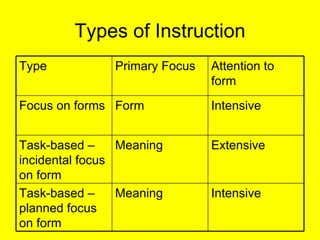
Types of Instruction Type Primary Focus Attention to form Focus on forms Form Intensive Task-based – incidental focus on form Meaning Extensive Task-based – planned focus on form Meaning Intensive
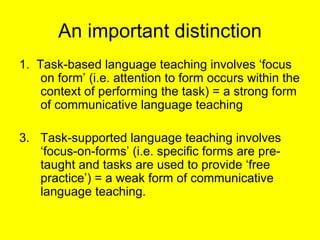
An important distinction 1.  Task-based language teaching involves ‘focus on form’ (i.e. attention to form occurs within the context of performing the task) = a strong form of communicative language teaching Task-supported language teaching involves ‘focus-on-forms’ (i.e. specific forms are pre-taught and tasks are used to provide ‘free practice’) = a weak form of communicative language teaching.
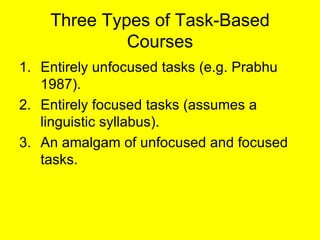
Three Types of Task-Based Courses Entirely unfocused tasks (e.g. Prabhu 1987). Entirely focused tasks (assumes a linguistic syllabus). An amalgam of unfocused and focused tasks.
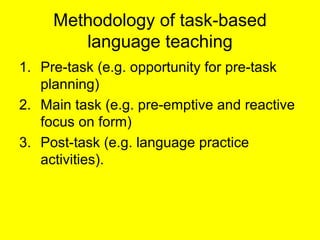
Methodology of task-based language teaching Pre-task (e.g. opportunity for pre-task planning) Main task (e.g. pre-emptive and reactive focus on form) Post-task (e.g. language practice activities).
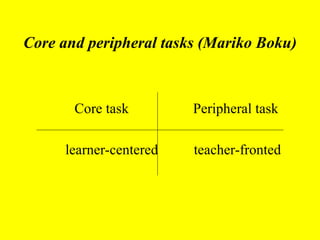
  Core and peripheral tasks (Mariko Boku)       Core task  Peripheral task     learner-centered  teacher-fronted           
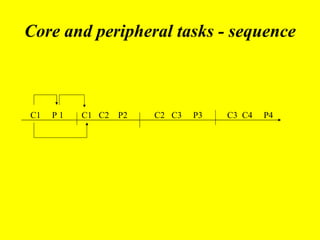
Core and peripheral tasks - sequence C1  P 1  C1  C2  P2  C2  C3  P3  C3  C4  P4
The TBLT Cavaliers Long (1996) Willis (1996) Skehan (1998) Ellis (2003)
Key Characteristics of TBLT (Swan 2005) ‘ Natural’ or ‘naturalistic’ language use Learner-centred rather than teacher controlled Focus on form (intervention while retaining ‘naturalness’). Tasks serve as the means for achieving natural language use. Traditional approaches are ineffective.
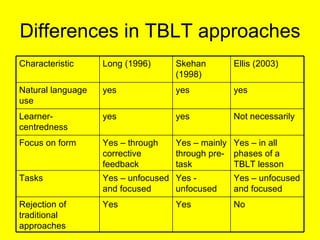
Differences in TBLT approaches Characteristic Long (1996) Skehan (1998) Ellis (2003) Natural language use yes yes yes Learner-centredness yes yes Not necessarily Focus on form Yes – through corrective feedback Yes – mainly through pre-task Yes – in all phases of a TBLT lesson Tasks Yes – unfocused and focused Yes - unfocused Yes – unfocused and focused Rejection of traditional approaches Yes Yes No
PART THREE Addressing the misunderstandings
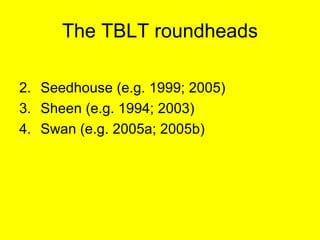
The TBLT roundheads Seedhouse (e.g. 1999; 2005) Sheen (e.g. 1994; 2003) Swan (e.g. 2005a; 2005b)
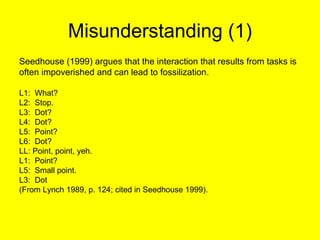
Misunderstanding (1) Seedhouse (1999) argues that the interaction that results from tasks is often impoverished and can lead to fossilization. L1:  What? L2:  Stop. L3:  Dot? L4:  Dot? L5:  Point? L6:  Dot? LL: Point, point, yeh. L1:  Point? L5:  Small point. L3:  Dot (From Lynch 1989, p. 124; cited in Seedhouse 1999).
Response It all depends on the choice of task in relation to the developmental level of the  learner: *  for beginners the extract Seedhouse cites as evidence of impoverished interaction may not be impoverished at all; *  more complex tasks will result in more complex  language .
Misunderstanding (2) Seedhouse (2005) argues that ‘task-as-workplan’ has weak construct validity because the interaction that transpires when learners perform a task (i.e. the ‘task-as-process’) frequently does not match that intended by designers of the task.
Response This is a serious criticism because, if correct, it means that it will be impossible to design a task-based course to ensure  adequate coverage of the target language. But, in fact, there is substantial evidence to  suggest that it is possible to design tasks  that are predictive of language use.
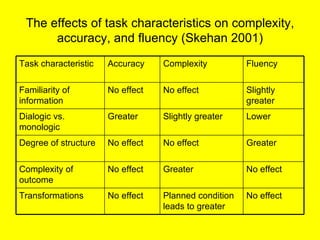
The effects of task characteristics on complexity, accuracy, and fluency (Skehan 2001) Task characteristic Accuracy Complexity Fluency Familiarity of information No effect No effect Slightly greater Dialogic vs. monologic Greater Slightly greater Lower Degree of structure No effect No effect Greater Complexity of outcome No effect Greater No effect Transformations No effect Planned condition leads to greater No effect
Misunderstanding (3) Sheen (2003) claims that in TBLT there is ‘ no grammar syllabus’. TBLT writers ‘generally offer little more than a brief list of suggestions regarding the selection and presentation of new language’.  TBLT ‘outlaws’ the grammar syllabus (Swan 2005).
Response It is true that in some versions of TBLT (e.g. Long’s or Skehan’s) there is no grammar syllabus. But this is seen as advantageous in that teaching discrete points of  grammar is problematic as learners’ interlanguage does not develop incrementally. Ellis’ version of TBLT does allow for a grammar syllabus which can be used alongside a task-based syllabus either as a separate module in the whole course or as a checklist to guide the selection of grammatical features for focused tasks. All versions of TBLT allow for attention to grammar through focus on form at some stage in a task-based lesson.  In TBLT the focus is on ‘remedial’ grammar.
Misunderstanding (4) Sheen(2003) also characterizes TBLT as requiring that any treatment of grammar  take the form of quick corrective feedback  allowing for minimal interruption of the task  activity.
Response Only Long characterizes focus-on-form as involving brief corrective feedback (recasts). Skehan sees attention to form originating from design and implementational options (e.g. pre-task planning). Ellis emphasizes that focus-on-form can involve pre-emptive work as well as corrective feedback and can be quite explicit.
Misunderstanding (5) Sheen (2003) also claims and that in TBLT  any post-task grammar work is supposed to  take the form of grammar-problem solving tasks  (i.e. CR tasks).
Response In Willis (1996) and Ellis (2003) post-task work on grammar can take a variety of forms, including explicit instruction, problem-solving tasks and practice activities.
Misunderstanding (6) Sheen (2003) claims that ‘the only grammar to be dealt with (in TBLT) is that which causes a problem in communication’.
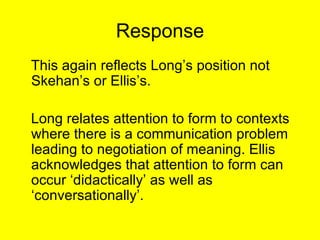
Response This again reflects Long’s position not Skehan’s or Ellis’s. Long relates attention to form to contexts where there is a communication problem leading to negotiation of meaning. Ellis acknowledges that attention to form can occur ‘didactically’ as well as ‘conversationally’.
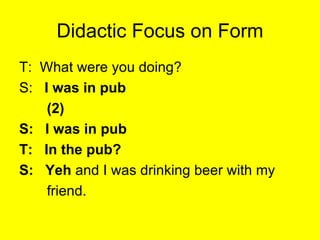
Didactic Focus on Form T:  What were you doing? S:  I was in pub (2) S:  I was in pub T:  In the pub? S:  Yeh  and I was drinking beer with my friend.
Misunderstanding (6) The theoretical rationale for TBLT is typically limited to the acquisition of grammar; vocabulary and phonology are ignored (Swan 2005)
Response This is false. There have been a number of studies that have focused on the acquisition of grammar through TBLT (e.g. Mackey 1999) but several other studies have examined the acquisition of vocabulary (e.g. Ellis et al 1994). There have been few studies that have examined phonology (but see Loewen 2005).
Misunderstanding (7) TBLT puts the emphasis on output. ‘ It remains true that TBLT provides learners with substantially less new language than “traditional” approaches.’ ‘ In the tiny corpus of a year’s task-based input, even some basic structures may not occur often, much core vocabulary is likely to be absent, and many other lexical items will appear only once or twice’. (Swan 2005)
Response This is the most fundamental misunderstanding of TBLT because it assumes that tasks must inevitably involve interaction and production. But, in fact, tasks can also be ‘input-based’ (i.e. involve listening or reading).  Indeed, extensive reading activities can be viewed as tasks. Arguably, a task-based course is capable of providing much greater exposure to the target language than a traditional course.
Misunderstanding (8) ‘ The thrust of TBLT is to cast the teacher in the role of manager and facilitator of communicative activity rather than an important source of new language’. That is, TBLT promotes learner-centredness at the expense of teacher-directed instruction. (Swan 2005)
Response Again, this depends on the version of TBLT one is considering.  Swan’s comment is largely true of Long’s version of TBLT but not of others. Ellis has consistently argued that tasks can be usefully performed in teacher-class interaction (i.e. need not involve group or pair work) and points to the advantages this have for ensuring a teacher-led focus on form. Prabhu (1987) insists that tasks are better performed in lock-step teaching. In fact, all stages of a task-based lesson can be performed in either a ‘learner-centred’ or ‘teacher-led’ way (e.g. pre-task planning). Thus TBLT is largely neutral as to whether it is learner- or teacher-centred way.
Misunderstanding (9) Beginner learners need to be taught grammar because they will not be able to shift attention to code features in interaction if in fact they know so little basic grammar that they cannot produce discourse to shift from. TBLT is only suitable for ‘acquisition-rich contexts’. Swan (2005)
Response Of course beginner learners will not be able to engage productively in discourse. But this is only a problem for TBLT if it is assumed (as Swan wrongly does) that TBLT necessarily involves production. In fact, a TBLT course for beginners would necessarily have to focus on input-based tasks to develop initial proficiency (see Prabhu 1987). The early stages of L2 acquisition are agrammatical; one does not need grammar to start communicating. In fact, TBLT may be better suited to acquisition-poor contexts (e.g. EFL in Japan) in that it is more likely to develop communicative confidence and fluency.  The argument comes down to whether it is better to adopt a ‘fluency first’ or ‘accuracy first’ approach.
Misunderstanding (10) Both Sheen and Swan argue that there is no empirical evidence to support either the hypotheses that construct the theoretical rationale for TBLT or to demonstrate that TBLT is superior to traditional focus-on-forms’ appraoches. ‘ Legislation by hypothesis’.
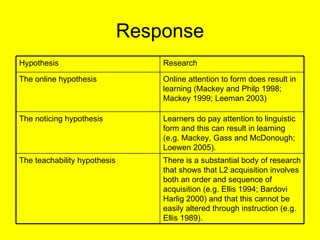
Response Hypothesis Research The online hypothesis Online attention to form does result in learning (Mackey and Philp 1998; Mackey 1999; Leeman 2003) The noticing hypothesis Learners do pay attention to linguistic form and this can result in learning (e.g. Mackey, Gass and McDonough; Loewen 2005). The teachability hypothesis There is a substantial body of research that shows that L2 acquisition involves both an order and sequence of acquisition (e.g. Ellis 1994; Bardovi Harlig 2000) and that this cannot be easily altered through instruction (e.g. Ellis 1989).
Response (cont.) Neither Sheen nor Swan make any reference to Prabhu (1987) and Beretta and Davies’ (1985) evaluation of this TBLT project in India. The conclusions of this evaluation were: In the tests favouring the ‘traditional group, this group did best In the tests favouring the TBLT group, this group did best In the neutral tests (e.g. a contextualized grammar test; dictation; listening/reading comprehension), the TBLT group did best. But there are problems with conducting such evaluations and also with the kind of comparative method studies that Sheen constantly asks for.
Part Four Some real problems and their solutions.
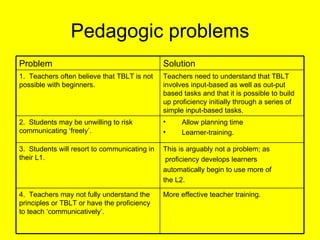
Pedagogic problems Problem Solution 1.  Teachers often believe that TBLT is not possible with beginners. Teachers need to understand that TBLT involves input-based as well as out-put based tasks and that it is possible to build up proficiency initially through a series of simple input-based tasks. 2.  Students may be unwilling to risk communicating ‘freely’. Allow planning time Learner-training. 3.  Students will resort to communicating in their L1. This is arguably not a problem; as proficiency develops learners  automatically begin to use more of  the L2. 4.  Teachers may not fully understand the principles or TBLT or have the proficiency to teach ‘communicatively’.  More effective teacher training.
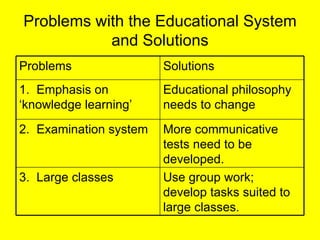
Problems with the Educational System and Solutions Problems Solutions 1.  Emphasis on ‘knowledge learning’ Educational philosophy needs to change 2.  Examination system More communicative tests need to be developed. 3.  Large classes Use group work; develop tasks suited to large classes.
Conclusions Task-based teaching offers the opportunity for ‘natural’ learning inside the classroom. It emphasizes meaning over form but can also cater for learning form. It is intrinsically motivating. It is compatible with a learner-centred educational philosophy but also allows for teacher input and direction. It caters to the development of communicative fluency while not neglecting accuracy. It can be used alongside a more traditional approach.

Task based language teaching

  • 1.
    Task-Based Language Teaching:Sorting Out the Misunderstandings Rod Ellis Department of Applied language Studies and Linguistics University of Auckland
  • 2.
    Scoping my talkDefining and classifying ‘tasks’ Defining ‘task-based language teaching’ Identifying and addressing misunderstandings Some genuine problems with TBLT Some conclusions about TBLT
  • 3.
    PART ONE Definingand classifying ‘tasks’.
  • 4.
    What is atask? A task is goal directed. A task involves a primary focus on meaning. The participants choose the linguistic resources needed to complete the task. A task has a clearly defined outcome.
  • 5.
    Types of TasksUnfocused tasks a. Pedagogic b. Real world Focused tasks
  • 6.
    An example ofa pedagogic unfocused task Four students – each has one picture and describes it to the rest of the class. Students from the rest of the class ask the four students questions about their pictures. One student from the class tries to tell the story. If necessary Steps 2 and 3 are repeated
  • 7.
    Example of areal-world unfocused task Look at the e-mail message below. Listen to Mr. Pointer’s instructions on the tape. Make notes if you want to. Then write a suitable reply to Lesieur. Dear Mr. Pointer Please send flight number, date and time of arrival and I will arrange for someone to meet you at the airport. Lesieur.
  • 8.
    An example ofa focused task You are the owner of a private language school and have advertised for a new English teacher. Below are summaries of the CVs of four applicants. Discuss each applicant and then decide which one to offer the job to.   JOCK, aged 30 B.A. in social studies. Has spent a year working his way round the world. Has spent six years teaching economics in state school. Has written a highly successful novel about teachers. Has lived in a back-to-nature commune for two years. Has been married twice - now divorced. Two children. Has been running local youth group for three years.   BETTY, aged 45 Has been married for 24 years, three children. Has not worked most of that time. Has done evening courses in youth guidance. Has spent the last year teaching pupils privately for state – with good result s. Has been constantly active in local government - has been elected to local council twice.
  • 9.
    Types of focusedtasks Structure-based production tasks Structure-based comprehension tasks Consciousness-raising tasks
  • 10.
    Tasks and thefour language skills A common misunderstanding of task-based instruction is that it necessarily involves oral interaction. But tasks can be designed to develop any of the four language skills (listening, speaking, reading and writing). Many tasks are ‘integrative’ (i.e. involve more than one skill).
  • 11.
    PART TWO Defining‘task-based language teaching’ (TBLT)
  • 12.
    What is ‘task-basedlanguage teaching’? TBLT is an approach to teaching a second/foreign language that seeks to engage learners in interactionally authentic language use by having them perform a series of tasks. It aims to both enable learners (1) to acquire new linguistic knowledge and (2) to proceduralize their existing knowledge.
  • 13.
    Focus on formsvs. focus on form 1. Focus on forms Focus on forms entails the prior selection of a linguistic element which is presented and practised (e.g. PPP). 2. Focus on form ‘ Focus on form … overtly draws students’ attention to linguistic elements as they arise incidentally in lessons whose overrriding focus is on meaning or communication’. Long (1991; 45-6):
  • 14.
    Three ways offocusing on form Reactive focus on form (error correction) Teacher-initiated focus on form Student-initiated focus on form
  • 15.
    Types of InstructionType Primary Focus Attention to form Focus on forms Form Intensive Task-based – incidental focus on form Meaning Extensive Task-based – planned focus on form Meaning Intensive
  • 16.
    An important distinction1. Task-based language teaching involves ‘focus on form’ (i.e. attention to form occurs within the context of performing the task) = a strong form of communicative language teaching Task-supported language teaching involves ‘focus-on-forms’ (i.e. specific forms are pre-taught and tasks are used to provide ‘free practice’) = a weak form of communicative language teaching.
  • 17.
    Three Types ofTask-Based Courses Entirely unfocused tasks (e.g. Prabhu 1987). Entirely focused tasks (assumes a linguistic syllabus). An amalgam of unfocused and focused tasks.
  • 18.
    Methodology of task-basedlanguage teaching Pre-task (e.g. opportunity for pre-task planning) Main task (e.g. pre-emptive and reactive focus on form) Post-task (e.g. language practice activities).
  • 19.
      Core andperipheral tasks (Mariko Boku)      Core task Peripheral task     learner-centered teacher-fronted          
  • 20.
    Core and peripheraltasks - sequence C1 P 1 C1 C2 P2 C2 C3 P3 C3 C4 P4
  • 21.
    The TBLT CavaliersLong (1996) Willis (1996) Skehan (1998) Ellis (2003)
  • 22.
    Key Characteristics ofTBLT (Swan 2005) ‘ Natural’ or ‘naturalistic’ language use Learner-centred rather than teacher controlled Focus on form (intervention while retaining ‘naturalness’). Tasks serve as the means for achieving natural language use. Traditional approaches are ineffective.
  • 23.
    Differences in TBLTapproaches Characteristic Long (1996) Skehan (1998) Ellis (2003) Natural language use yes yes yes Learner-centredness yes yes Not necessarily Focus on form Yes – through corrective feedback Yes – mainly through pre-task Yes – in all phases of a TBLT lesson Tasks Yes – unfocused and focused Yes - unfocused Yes – unfocused and focused Rejection of traditional approaches Yes Yes No
  • 24.
    PART THREE Addressingthe misunderstandings
  • 25.
    The TBLT roundheadsSeedhouse (e.g. 1999; 2005) Sheen (e.g. 1994; 2003) Swan (e.g. 2005a; 2005b)
  • 26.
    Misunderstanding (1) Seedhouse(1999) argues that the interaction that results from tasks is often impoverished and can lead to fossilization. L1: What? L2: Stop. L3: Dot? L4: Dot? L5: Point? L6: Dot? LL: Point, point, yeh. L1: Point? L5: Small point. L3: Dot (From Lynch 1989, p. 124; cited in Seedhouse 1999).
  • 27.
    Response It alldepends on the choice of task in relation to the developmental level of the learner: * for beginners the extract Seedhouse cites as evidence of impoverished interaction may not be impoverished at all; * more complex tasks will result in more complex language .
  • 28.
    Misunderstanding (2) Seedhouse(2005) argues that ‘task-as-workplan’ has weak construct validity because the interaction that transpires when learners perform a task (i.e. the ‘task-as-process’) frequently does not match that intended by designers of the task.
  • 29.
    Response This isa serious criticism because, if correct, it means that it will be impossible to design a task-based course to ensure adequate coverage of the target language. But, in fact, there is substantial evidence to suggest that it is possible to design tasks that are predictive of language use.
  • 30.
    The effects oftask characteristics on complexity, accuracy, and fluency (Skehan 2001) Task characteristic Accuracy Complexity Fluency Familiarity of information No effect No effect Slightly greater Dialogic vs. monologic Greater Slightly greater Lower Degree of structure No effect No effect Greater Complexity of outcome No effect Greater No effect Transformations No effect Planned condition leads to greater No effect
  • 31.
    Misunderstanding (3) Sheen(2003) claims that in TBLT there is ‘ no grammar syllabus’. TBLT writers ‘generally offer little more than a brief list of suggestions regarding the selection and presentation of new language’. TBLT ‘outlaws’ the grammar syllabus (Swan 2005).
  • 32.
    Response It istrue that in some versions of TBLT (e.g. Long’s or Skehan’s) there is no grammar syllabus. But this is seen as advantageous in that teaching discrete points of grammar is problematic as learners’ interlanguage does not develop incrementally. Ellis’ version of TBLT does allow for a grammar syllabus which can be used alongside a task-based syllabus either as a separate module in the whole course or as a checklist to guide the selection of grammatical features for focused tasks. All versions of TBLT allow for attention to grammar through focus on form at some stage in a task-based lesson. In TBLT the focus is on ‘remedial’ grammar.
  • 33.
    Misunderstanding (4) Sheen(2003)also characterizes TBLT as requiring that any treatment of grammar take the form of quick corrective feedback allowing for minimal interruption of the task activity.
  • 34.
    Response Only Longcharacterizes focus-on-form as involving brief corrective feedback (recasts). Skehan sees attention to form originating from design and implementational options (e.g. pre-task planning). Ellis emphasizes that focus-on-form can involve pre-emptive work as well as corrective feedback and can be quite explicit.
  • 35.
    Misunderstanding (5) Sheen(2003) also claims and that in TBLT any post-task grammar work is supposed to take the form of grammar-problem solving tasks (i.e. CR tasks).
  • 36.
    Response In Willis(1996) and Ellis (2003) post-task work on grammar can take a variety of forms, including explicit instruction, problem-solving tasks and practice activities.
  • 37.
    Misunderstanding (6) Sheen(2003) claims that ‘the only grammar to be dealt with (in TBLT) is that which causes a problem in communication’.
  • 38.
    Response This againreflects Long’s position not Skehan’s or Ellis’s. Long relates attention to form to contexts where there is a communication problem leading to negotiation of meaning. Ellis acknowledges that attention to form can occur ‘didactically’ as well as ‘conversationally’.
  • 39.
    Didactic Focus onForm T: What were you doing? S: I was in pub (2) S: I was in pub T: In the pub? S: Yeh and I was drinking beer with my friend.
  • 40.
    Misunderstanding (6) Thetheoretical rationale for TBLT is typically limited to the acquisition of grammar; vocabulary and phonology are ignored (Swan 2005)
  • 41.
    Response This isfalse. There have been a number of studies that have focused on the acquisition of grammar through TBLT (e.g. Mackey 1999) but several other studies have examined the acquisition of vocabulary (e.g. Ellis et al 1994). There have been few studies that have examined phonology (but see Loewen 2005).
  • 42.
    Misunderstanding (7) TBLTputs the emphasis on output. ‘ It remains true that TBLT provides learners with substantially less new language than “traditional” approaches.’ ‘ In the tiny corpus of a year’s task-based input, even some basic structures may not occur often, much core vocabulary is likely to be absent, and many other lexical items will appear only once or twice’. (Swan 2005)
  • 43.
    Response This isthe most fundamental misunderstanding of TBLT because it assumes that tasks must inevitably involve interaction and production. But, in fact, tasks can also be ‘input-based’ (i.e. involve listening or reading). Indeed, extensive reading activities can be viewed as tasks. Arguably, a task-based course is capable of providing much greater exposure to the target language than a traditional course.
  • 44.
    Misunderstanding (8) ‘The thrust of TBLT is to cast the teacher in the role of manager and facilitator of communicative activity rather than an important source of new language’. That is, TBLT promotes learner-centredness at the expense of teacher-directed instruction. (Swan 2005)
  • 45.
    Response Again, thisdepends on the version of TBLT one is considering. Swan’s comment is largely true of Long’s version of TBLT but not of others. Ellis has consistently argued that tasks can be usefully performed in teacher-class interaction (i.e. need not involve group or pair work) and points to the advantages this have for ensuring a teacher-led focus on form. Prabhu (1987) insists that tasks are better performed in lock-step teaching. In fact, all stages of a task-based lesson can be performed in either a ‘learner-centred’ or ‘teacher-led’ way (e.g. pre-task planning). Thus TBLT is largely neutral as to whether it is learner- or teacher-centred way.
  • 46.
    Misunderstanding (9) Beginnerlearners need to be taught grammar because they will not be able to shift attention to code features in interaction if in fact they know so little basic grammar that they cannot produce discourse to shift from. TBLT is only suitable for ‘acquisition-rich contexts’. Swan (2005)
  • 47.
    Response Of coursebeginner learners will not be able to engage productively in discourse. But this is only a problem for TBLT if it is assumed (as Swan wrongly does) that TBLT necessarily involves production. In fact, a TBLT course for beginners would necessarily have to focus on input-based tasks to develop initial proficiency (see Prabhu 1987). The early stages of L2 acquisition are agrammatical; one does not need grammar to start communicating. In fact, TBLT may be better suited to acquisition-poor contexts (e.g. EFL in Japan) in that it is more likely to develop communicative confidence and fluency. The argument comes down to whether it is better to adopt a ‘fluency first’ or ‘accuracy first’ approach.
  • 48.
    Misunderstanding (10) BothSheen and Swan argue that there is no empirical evidence to support either the hypotheses that construct the theoretical rationale for TBLT or to demonstrate that TBLT is superior to traditional focus-on-forms’ appraoches. ‘ Legislation by hypothesis’.
  • 49.
    Response Hypothesis ResearchThe online hypothesis Online attention to form does result in learning (Mackey and Philp 1998; Mackey 1999; Leeman 2003) The noticing hypothesis Learners do pay attention to linguistic form and this can result in learning (e.g. Mackey, Gass and McDonough; Loewen 2005). The teachability hypothesis There is a substantial body of research that shows that L2 acquisition involves both an order and sequence of acquisition (e.g. Ellis 1994; Bardovi Harlig 2000) and that this cannot be easily altered through instruction (e.g. Ellis 1989).
  • 50.
    Response (cont.) NeitherSheen nor Swan make any reference to Prabhu (1987) and Beretta and Davies’ (1985) evaluation of this TBLT project in India. The conclusions of this evaluation were: In the tests favouring the ‘traditional group, this group did best In the tests favouring the TBLT group, this group did best In the neutral tests (e.g. a contextualized grammar test; dictation; listening/reading comprehension), the TBLT group did best. But there are problems with conducting such evaluations and also with the kind of comparative method studies that Sheen constantly asks for.
  • 51.
    Part Four Somereal problems and their solutions.
  • 52.
    Pedagogic problems ProblemSolution 1. Teachers often believe that TBLT is not possible with beginners. Teachers need to understand that TBLT involves input-based as well as out-put based tasks and that it is possible to build up proficiency initially through a series of simple input-based tasks. 2. Students may be unwilling to risk communicating ‘freely’. Allow planning time Learner-training. 3. Students will resort to communicating in their L1. This is arguably not a problem; as proficiency develops learners automatically begin to use more of the L2. 4. Teachers may not fully understand the principles or TBLT or have the proficiency to teach ‘communicatively’. More effective teacher training.
  • 53.
    Problems with theEducational System and Solutions Problems Solutions 1. Emphasis on ‘knowledge learning’ Educational philosophy needs to change 2. Examination system More communicative tests need to be developed. 3. Large classes Use group work; develop tasks suited to large classes.
  • 54.
    Conclusions Task-based teachingoffers the opportunity for ‘natural’ learning inside the classroom. It emphasizes meaning over form but can also cater for learning form. It is intrinsically motivating. It is compatible with a learner-centred educational philosophy but also allows for teacher input and direction. It caters to the development of communicative fluency while not neglecting accuracy. It can be used alongside a more traditional approach.