Communication Overload  6/9/11 PMI-SVC Mtg Carter Engelhart, PMP
Communication Overload
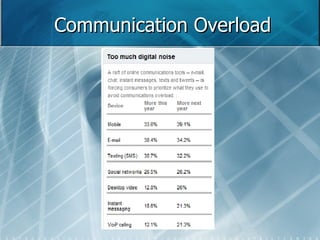
USA Today Article According of Jon Swartz of USA Today in his article  Social media users grapple with information overload: ”  Corporate users received about 110 messages a day in 2010, says market researcher Radicati Group. There are 110 million tweets a day, Twitter says. Researcher Basex has pegged business productivity losses due to the "cost of unnecessary interruptions" at $650 billion in 2007.”
Information Overload Syndrome - IOS  Could you be suffering from IOS ?
According to Newsweek article  I Can’t Think  by Sharon Begley Feb 27,2011 “ The Twitterization of our culture has revolutionized our lives, but with an unintended consequence—our overloaded brains freeze when we have to make decisions.”
According to Newsweek article  I Can’t Think  by Sharon Begley Feb 27,2011 “ A key reason for information’s diminishing or even negative returns is the  limited capacity of the brain’s working memory.   It can hold roughly seven items  (which is why seven-digit phone numbers were a great idea).  Anything more must be processed into long-term memory. That takes conscious effort, as when you study for an exam.  When more than seven units of information land in our brain’s inbox, argues psychologist Joanne Cantor, author of the 2009 book Conquer Cyber Overload and an emerita professor at the University of Wisconsin,  the brain struggles to figure out what to keep and what to disregard.  Ignoring the repetitious and the useless requires cognitive resources and vigilance, a harder task when there is so much information.”
According to Newsweek article  I Can’t Think  by Sharon Begley Feb 27,2011 “ ‘ Recency’ Trumps Quality   The brain is wired to notice change over stasis.  An arriving email that pops to the top of your BlackBerry qualifies as a change; so does a new Facebook post.  We are conditioned to give greater weight in our decision-making machinery to what is latest, not what is more important or more interesting.  “There is a powerful ‘recency’ effect in decision making,” says behavioral economist George Loewenstein of Carnegie Mellon University. “We pay a lot of attention to the most recent information, discounting what came earlier.”
According to Newsweek article  I Can’t Think  by Sharon Begley Feb 27,2011 “ ‘ The Neglected Unconscious   Creative decisions are more likely to bubble up from a brain that applies unconscious thought to a problem, rather than going at it in a full-frontal, analytical assault. So while we’re likely to think creative thoughts in the shower, it’s much harder if we’re under a virtual deluge of data.”
Is Less Really MORE! Researchers have noted that the more people blasted by a barrage of information the more errors and misunderstanding occur. Project Quality can plummet
The golden needle in the hay stack Twitter, Facebook, email (cc), texting, RSS feeds, Cell Phones, arrays of document storage locations (aka snipe hunt), Instant  Messaging… are heading towards our brains like a force 5 tornado. That golden nugget is being camouflaged by zillions of competing communication channels.
How to Stop the Madness Don’t schedule a meeting, WebEX or conference call without having both a clearly stated objective and a written agenda ( ahead of time ). Identify the stakeholders of what you are communicating (aka the people who care   ) and include them but not the rest of the world. Avoid CC’ing and/or replying to everyone on your email   system
How to Stop the Madness Consider including each persons preferred primary and secondary method of communication within your communication plan contact list and try to honor that whenever possible. Consider adding a note to each communication inviting people to effectively unsubcribe to future related communication when appropriate (people who are included in meetings, emails, etc. who were incorrectly identified as stakeholders)
Meeting Attendees Ideas? Avoid repeating presentation information by rewarding people who show up on time.  Try to limit email sent to colocated staff Speak up – Let the message sender know when you wish to be removed from the communication channel. Stakeholder analysis – revisit your stakeholder analysis documents over time to ensure that only the appropriate people receive your communication. Explain to the recipient(s) why you are sending communication to them. Recognize when you should turn off your incoming communication channels in order to ensure quality deliverables.
Ideas? Credits USA Today Newsweek PMI-SVC [I-80] Roundtable Attendees Images – Microsoft Office Gallery (office.microsoft.com)

Communication Overload

  • 1.
    Communication Overload 6/9/11 PMI-SVC Mtg Carter Engelhart, PMP
  • 2.
  • 3.
    USA Today ArticleAccording of Jon Swartz of USA Today in his article Social media users grapple with information overload: ” Corporate users received about 110 messages a day in 2010, says market researcher Radicati Group. There are 110 million tweets a day, Twitter says. Researcher Basex has pegged business productivity losses due to the "cost of unnecessary interruptions" at $650 billion in 2007.”
  • 4.
    Information Overload Syndrome- IOS Could you be suffering from IOS ?
  • 5.
    According to Newsweekarticle I Can’t Think by Sharon Begley Feb 27,2011 “ The Twitterization of our culture has revolutionized our lives, but with an unintended consequence—our overloaded brains freeze when we have to make decisions.”
  • 6.
    According to Newsweekarticle I Can’t Think by Sharon Begley Feb 27,2011 “ A key reason for information’s diminishing or even negative returns is the limited capacity of the brain’s working memory. It can hold roughly seven items (which is why seven-digit phone numbers were a great idea). Anything more must be processed into long-term memory. That takes conscious effort, as when you study for an exam. When more than seven units of information land in our brain’s inbox, argues psychologist Joanne Cantor, author of the 2009 book Conquer Cyber Overload and an emerita professor at the University of Wisconsin, the brain struggles to figure out what to keep and what to disregard. Ignoring the repetitious and the useless requires cognitive resources and vigilance, a harder task when there is so much information.”
  • 7.
    According to Newsweekarticle I Can’t Think by Sharon Begley Feb 27,2011 “ ‘ Recency’ Trumps Quality The brain is wired to notice change over stasis. An arriving email that pops to the top of your BlackBerry qualifies as a change; so does a new Facebook post. We are conditioned to give greater weight in our decision-making machinery to what is latest, not what is more important or more interesting. “There is a powerful ‘recency’ effect in decision making,” says behavioral economist George Loewenstein of Carnegie Mellon University. “We pay a lot of attention to the most recent information, discounting what came earlier.”
  • 8.
    According to Newsweekarticle I Can’t Think by Sharon Begley Feb 27,2011 “ ‘ The Neglected Unconscious Creative decisions are more likely to bubble up from a brain that applies unconscious thought to a problem, rather than going at it in a full-frontal, analytical assault. So while we’re likely to think creative thoughts in the shower, it’s much harder if we’re under a virtual deluge of data.”
  • 9.
    Is Less ReallyMORE! Researchers have noted that the more people blasted by a barrage of information the more errors and misunderstanding occur. Project Quality can plummet
  • 10.
    The golden needlein the hay stack Twitter, Facebook, email (cc), texting, RSS feeds, Cell Phones, arrays of document storage locations (aka snipe hunt), Instant Messaging… are heading towards our brains like a force 5 tornado. That golden nugget is being camouflaged by zillions of competing communication channels.
  • 11.
    How to Stopthe Madness Don’t schedule a meeting, WebEX or conference call without having both a clearly stated objective and a written agenda ( ahead of time ). Identify the stakeholders of what you are communicating (aka the people who care  ) and include them but not the rest of the world. Avoid CC’ing and/or replying to everyone on your email system
  • 12.
    How to Stopthe Madness Consider including each persons preferred primary and secondary method of communication within your communication plan contact list and try to honor that whenever possible. Consider adding a note to each communication inviting people to effectively unsubcribe to future related communication when appropriate (people who are included in meetings, emails, etc. who were incorrectly identified as stakeholders)
  • 13.
    Meeting Attendees Ideas?Avoid repeating presentation information by rewarding people who show up on time. Try to limit email sent to colocated staff Speak up – Let the message sender know when you wish to be removed from the communication channel. Stakeholder analysis – revisit your stakeholder analysis documents over time to ensure that only the appropriate people receive your communication. Explain to the recipient(s) why you are sending communication to them. Recognize when you should turn off your incoming communication channels in order to ensure quality deliverables.
  • 14.
    Ideas? Credits USAToday Newsweek PMI-SVC [I-80] Roundtable Attendees Images – Microsoft Office Gallery (office.microsoft.com)