Chapter 15
Section 1
 What is the structure and purpose of the federal
bureaucracy?
 Bureaucracies exist to coordinate the work of people in
large organizations.
 The goal of a bureaucracy is to allow people to perform
large-scale and/or complex work as efficiently as possible.
 For example, the federal bureaucracy employs millions of
people to do work as varied as defending the
nation, delivering mail, and regulating business.
 A bureaucracy has three key features:
 Hierarchical authority:There is a chain of command
that runs from a few people at the top down to many
workers at the bottom.
 Job specialization: Each worker in the organization
has specific duties and responsibilities.
 Formalized rules:Work is guided by a large number
of written rules and regulations available to all
employees.
 Having a hierarchy means that major decisions require
the approval of high-ranking organization members,
which helps keep them aware of what is going on.
 Job specialization allows each employee to become
skilled at a certain task and perform it with greater
efficiency.
 Formalized rules help bureaucrats deal with issues
in an objective manner and create a set of reliable
standards for the organization that all employees
can learn and follow.
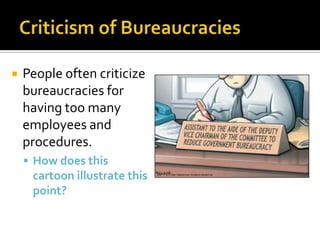
 People often criticize
bureaucracies for
having too many
employees and
procedures.
 How does this
cartoon illustrate this
point?
 The federal bureaucracy consists of all the
agencies, people, and procedures through which
the federal government makes and carries out
public policy.
 Most of the federal bureaucracy is part of the
executive branch, but the judicial and legislative
branches have bureaucracies as well.
 Bureaucrats are appointed, not elected, officers
of the federal government.
 The Constitution refers to the presence of
executive departments within the executive
branch.
 The Constitution does not specify the
number, powers, or organization of these
executive departments.
 The structure of the federal bureaucracy has
developed over time, to meet the needs of
policy makers for an administration that can
carry out their decisions.
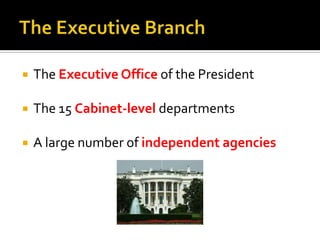
 The Executive Office of the President
 The 15 Cabinet-level departments
 A large number of independent agencies
 The executive branch of the Federal
Government is composed of a large number
of agencies, all of them created by acts of
Congress to execute the laws of the United
States.
 Nearly 80 percent of all of the men and
women who work for these agencies in fact
work some place other than
Washington, D.C.
 The Executive Office of the President is an umbrella
agency composed of several sub-agencies staffed by
the President’s closest advisors and assistants.
 Often called the Cabinet departments, the executive
departments and their subunits carry out much of the
work of the Federal Government.
 The independent agencies are not attached to any of
the Cabinet departments and exercise a wide range of
responsibilities in the carrying out of government
business as well as serving the public.
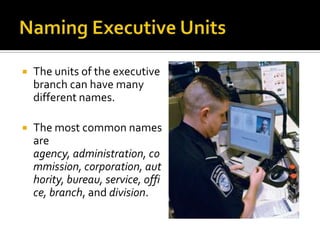
 The units of the executive
branch can have many
different names.
 The most common names
are
agency, administration, co
mmission, corporation, aut
hority, bureau, service, offi
ce, branch, and division.
 There are few clear guidelines on how to assign
these names.
 The titles agency or administration often refer to major
units.
 Commission refers to units that regulate business.
 Corporation or authority refer to units that have business
functions.
 Many federal agencies are referred to by their initials, such
as the EPA, FBI, or NASA
 Congress and the President give the various
line agencies goals to meet.
 The staff agencies then help the line agencies
meet these goals.
 Staff agencies also assist the President.
 For example, the Executive Office of the
President includes several staff agencies that
advise the president but do not administer
public programs or directly enforce policy.
 The Environmental Protection Agency is a
line agency responsible for enforcing the
nation’s environmental and pollution laws on
a daily basis.
Section 2
 What agencies and advisors are part of the
Executive Office of the President and what are their
functions?
 The Executive Office of the President (EOP) includes:
▪ The White House
▪ The National Security Council
▪ The Office of Management and Budget
▪ Many other executive units
 The EOP advises and informs the President on issues such
as foreign policy, national security, and the economy.
 All of the agencies and employees in the
executive branch are legally subordinate to the
President and exist to help the President wield
executive power.
 The EOP works closely with the President.
 The EOP was formed in 1939.Today it has some
900 advisors and assistants.
 The EOP is one example of how much the
modern executive branch has grown since the
founding of our nation.
 The EOP is centered onTheWhite House, home
to much of the President’s key personal and
political staff.
 This staff includes individuals such as the chief of
staff, the counselor to the President, and the
press secretary.
 A large number of advisors and assistants inThe
White House provide the President with
information on a range of topics, including the
economy, congressional relations, political
affairs, national defense, and public relations.
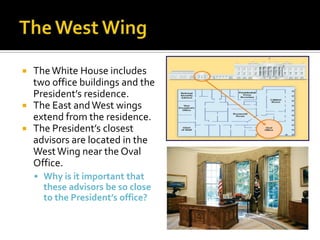
 TheWhite House includes
two office buildings and the
President’s residence.
 The East andWest wings
extend from the residence.
 The President’s closest
advisors are located in the
WestWing near the Oval
Office.
 Why is it important that
these advisors be so close
to the President’s office?
 The NSC is a staff agency that advises the
President on all domestic, foreign, and
military matters that relate to national
security.
 It also gives direction to U.S. intelligence
agencies.
 The President chairs the NSC, whose
members also include theVice President and
the secretaries of state, treasury, and
defense.
 The Director of National Intelligence and the
chairman of the Joint Chiefs of Staff also
attend NSC meetings.
 The small staff of experts in foreign and
military policy employed by the NSC work
under the President’s assistant for national
security affairs, who is often called the
national security advisor.
 During the 1980s, the NSC went beyond its
staff agency role to carry out covert
operations, which led to the Iran-Contra
scandal.
 The Office of Management and Budget (OMB) is the
largest unit in the Executive Office of the President.
It prepares the federal budget submitted by the
President to Congress each year.
 The federal government’s fiscal year runs from October 1
to September 30.
 Each federal agency provides the OMB with
estimates of its spending needs, which the OMB
reviews and adjusts to fit the President’s overall
policy and budget plans.
 Preparing an official budget can take more than a
year.The result is a carefully crafted plan for how
the federal government should operate.
 The OMB must consider a variety of factors before it
creates the President’s final budget proposal.These
factors include:
 What the government can spend
 What Americans want
 What the President wants
 The OMB also monitors the work of all
agencies in the executive branch and works
to ensure that their policies agree with those
of the President.
 In addition, the OMB helps the President
prepare executive orders and veto messages.
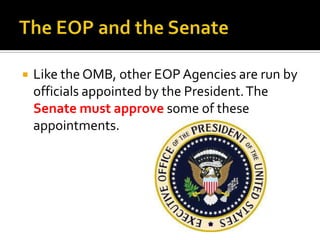
 Like the OMB, other EOPAgencies are run by
officials appointed by the President.The
Senate must approve some of these
appointments.
 The Office of National Drug Control Policy was
established in 1988 to prepare the nation’s drug
control strategy and coordinate the federal
agencies that take part in the war on drugs.
 The three-member Council of Economic
Advisers advises and informs the President on
economic policy and helps prepare the annual
Economic Report to Congress, submitted in
January or February each year.
 Other agencies in the EOP advise the President on
topics such as science and technology, the
environment, foreign trade, and public policy.They
include:
 The Office of Science andTechnology Policy
 The Council on Environmental Quality
 The Office of United StatesTrade Representatives
 The Office of Policy Development
 The Office of theVice President, which has grown in
recent years, houses theVice President’s advisors
and staff.
Section 3
 What is the Cabinet and what does it do?
 The Cabinet is an informal advisory body made up
of the heads of the 15 executive departments.
 It also includes other key advisors to the
President.
 Individually, Cabinet members run their
departments and carry out presidential policies.
 As a group, they advise the President.
 The 15 executive departments are also called
the Cabinet departments.
 The First Congress created the Departments of
State,Treasury, andWar in 1789.
 Over time, departments have been
added, abolished, divided and combined to meet
the changing needs of the country.
 Each department is headed by a secretary appointed by the
President.
 The Department of Justice (DoJ) is headed by the attorney
general.
 The department heads ensure that their departments carry out
presidential policy.
 They also represent the interests of their departments when
dealing with theWhite House, Congress, other departments,
and the public.
 Each department head has many assistants and aides to help
with issues such as public relations, planning, and budgeting.
 The executive departments employ nearly two-
thirds of the civilian federal workforce.
 Roughly 80 percent of these employees are career civil
servants, not appointees.
 Nearly 90 percent of federal civilian employees work
outsideWashington, D.C.
 Each department is divided into smaller subunits
with specific line or staff duties.
 For example, the Criminal Division of the DoJ is further
divided into sections dealing with counterterrorism and
narcotics.
 The executive departments vary widely in visibility,
size, and importance.
 The Department of State is the oldest and most
prestigious, but among the smallest.
 The Department of Defense is the largest, with more
than 2 million civilian and military employees.
 The Department of Health and Human Services has the
largest budget, accounting for about a fourth of all federal
spending.
 Each of the now 15 executive departments was
created by Congress.
 Their respective areas of responsibility generally
reflect the conditions of the period and the major
issues facing the nation when each of them was
established.
 What new department(s) do you think might be created
in the 21st century?
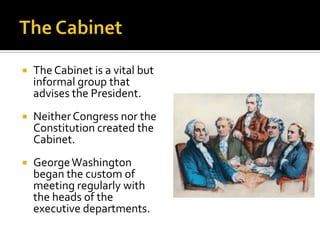
 The Cabinet is a vital but
informal group that
advises the President.
 NeitherCongress nor the
Constitution created the
Cabinet.
 GeorgeWashington
began the custom of
meeting regularly with
the heads of the
executive departments.
 The Cabinet includes the heads of the 15
executive departments.
 Today, it also includes:
 The Vice President
 The President’s chief domestic policy adviser
 TheWhite House Chief of Staff
 The director of the OMB
 Other officials as chosen by the President, often from
within the ranks of the Executive Office of the
President
 The President appoints the head of each
of the 15 executive departments.
 Each appointee must be confirmed by the
Senate. The Senate rarely rejects an
appointee.
 What factors are considered when
appointing executive department heads?
 Party affiliation and influence
 Professional qualifications and experience
 Regional background and ties to key issues
handled by a given department
 A desire for gender, racial, and ethnic balance
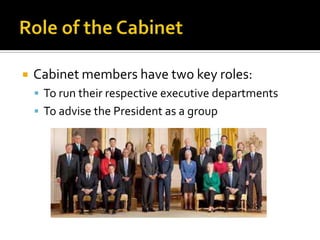
 Cabinet members have two key roles:
 To run their respective executive departments
 To advise the President as a group
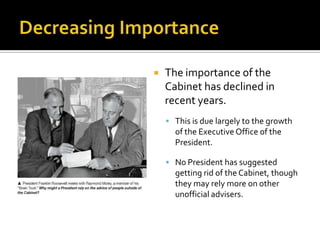
 The importance of the
Cabinet has declined in
recent years.
 This is due largely to the growth
of the Executive Office of the
President.
 No President has suggested
getting rid of the Cabinet, though
they may rely more on other
unofficial advisers.
Section 4
 What are the roles and structures of the
independent agencies?
 Independent agencies are units created by Congress that
operate outside of the executive departments.
 There are more than 100 such agencies, carrying out many
different tasks.
 Independent agencies can be divided into three broad
categories:
▪ Independent executive agencies
▪ Independent regulatory commissions
▪ Government corporations
 Some perform work that does not fit easily into any existing
executive department.
 Some are independent to protect them from partisan politics or to
satisfy the desires of various interest groups.
 Some are independent because they perform sensitive work, like
financial regulation.
 Several agencies perform tasks similar to those of executive
departments.
 A few, like the Social Security Agency, are larger than several
executive departments.
 Most independent agencies remain under the authority of the
President.
 Most independent agencies are executive
agencies.
 The largest of these agencies are organized like
executive departments
 The majority have small staffs and budgets and
receive little public attention.
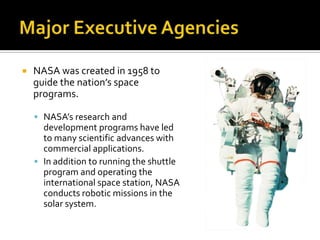
 NASA was created in 1958 to
guide the nation’s space
programs.
 NASA’s research and
development programs have led
to many scientific advances with
commercial applications.
 In addition to running the shuttle
program and operating the
international space station, NASA
conducts robotic missions in the
solar system.
 The civil service system replaced the
patronage system in the late 1800s.
 The patronage system rewarded political
supporters with public offices.
 Officeholders changed with each new
administration and the system suffered from
widespread corruption and inefficiency.
 The Pendleton Civil Service Act of 1883 set
up the foundation for the modern merit-
based system of hiring and promotion.
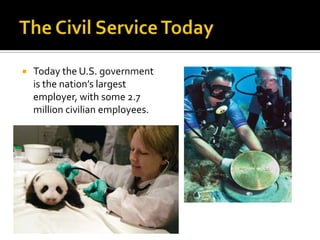
 Today the U.S. government
is the nation’s largest
employer, with some 2.7
million civilian employees.
 Nearly 90 percent of executive branch employees are
now covered by the merit system.
 Under this system, hiring and promotion are based on merit and
scores on examinations.
 The Merit Systems Protection Board ensures that the system is
not abused, handling all complaints.
 The Office of Personnel Management hires, pays, and promotes
career civilian employees of the government who make up the
civil service.
 Nearly 90 percent of executive branch employees are
now covered by the merit system.
 Under this system, hiring and promotion are based on merit and
scores on examinations.
 The Merit Systems Protection Board ensures that the system is
not abused, handling all complaints.
 The Office of Personnel Management hires, pays, and promotes
career civilian employees of the government who make up the
civil service.
 The draft law remains on the books.
 All males between the ages of 18 and 26 must
serve in the military if called.They must register
with the Selective Service at age 18.
 Congress must authorize a reactivation of the
draft before troops can be conscripted.
 These agencies are largely independent of the executive
branch.
 Each is headed by a board or commission whose members
are appointed by the President and approved by the Senate.
 These members serve long, staggered terms so that only one
term per board expires each year.
 Members can only be removed for causes specified by
Congress.
 Only a bare majority of members can belong to the same
political party.
 These conditions help keep the independent regulatory
agencies truly independent.
 Independent regulatory agencies have quasi-
legislative and judicial powers.
 They can make rules and regulations with the force of
law.
 They can decide disputes in certain fields.
 These agencies are an exception to the idea
of separation of powers.
 Some critics are concerned that these
agencies have too much power or use it
unfairly.
 The focus of the independent regulatory
commissions is to ensure the stability of the nation’s
economy.
 Eleven federal agencies have been established to
set and enforce standards on financial markets,
employment, business practices, and public safety.
 Should the government regulate these industries?
 These agencies were set up by Congress to perform
businesslike activities.
 They were rarely used until WorldWar I and the Great
Depression.
 There are now more than 50 government corporations,
including:
▪ The U.S. Postal Service
▪ The Federal Deposit Insurance Corporation
▪ The National Railroad Passenger Corporation
▪ The TennesseeValley Authority
 Government corporations are similar to
private corporations, except that:
 Congress decides their purpose and functions.
 Their officers are public employees, typically chosen
by the President and then approved by the Senate.
 They are financed by public funds.
 Government corporations are supposed to
have more independence and flexibility than
other executive agencies.

Chapter 15 presentation

  • 1.
  • 2.
  • 3.
     What isthe structure and purpose of the federal bureaucracy?  Bureaucracies exist to coordinate the work of people in large organizations.  The goal of a bureaucracy is to allow people to perform large-scale and/or complex work as efficiently as possible.  For example, the federal bureaucracy employs millions of people to do work as varied as defending the nation, delivering mail, and regulating business.
  • 4.
     A bureaucracyhas three key features:  Hierarchical authority:There is a chain of command that runs from a few people at the top down to many workers at the bottom.  Job specialization: Each worker in the organization has specific duties and responsibilities.  Formalized rules:Work is guided by a large number of written rules and regulations available to all employees.
  • 5.
     Having ahierarchy means that major decisions require the approval of high-ranking organization members, which helps keep them aware of what is going on.  Job specialization allows each employee to become skilled at a certain task and perform it with greater efficiency.  Formalized rules help bureaucrats deal with issues in an objective manner and create a set of reliable standards for the organization that all employees can learn and follow.
  • 6.
     People oftencriticize bureaucracies for having too many employees and procedures.  How does this cartoon illustrate this point?
  • 7.
     The federalbureaucracy consists of all the agencies, people, and procedures through which the federal government makes and carries out public policy.  Most of the federal bureaucracy is part of the executive branch, but the judicial and legislative branches have bureaucracies as well.  Bureaucrats are appointed, not elected, officers of the federal government.
  • 8.
     The Constitutionrefers to the presence of executive departments within the executive branch.  The Constitution does not specify the number, powers, or organization of these executive departments.  The structure of the federal bureaucracy has developed over time, to meet the needs of policy makers for an administration that can carry out their decisions.
  • 9.
     The ExecutiveOffice of the President  The 15 Cabinet-level departments  A large number of independent agencies
  • 10.
     The executivebranch of the Federal Government is composed of a large number of agencies, all of them created by acts of Congress to execute the laws of the United States.  Nearly 80 percent of all of the men and women who work for these agencies in fact work some place other than Washington, D.C.
  • 11.
     The ExecutiveOffice of the President is an umbrella agency composed of several sub-agencies staffed by the President’s closest advisors and assistants.  Often called the Cabinet departments, the executive departments and their subunits carry out much of the work of the Federal Government.  The independent agencies are not attached to any of the Cabinet departments and exercise a wide range of responsibilities in the carrying out of government business as well as serving the public.
  • 12.
     The unitsof the executive branch can have many different names.  The most common names are agency, administration, co mmission, corporation, aut hority, bureau, service, offi ce, branch, and division.
  • 13.
     There arefew clear guidelines on how to assign these names.  The titles agency or administration often refer to major units.  Commission refers to units that regulate business.  Corporation or authority refer to units that have business functions.  Many federal agencies are referred to by their initials, such as the EPA, FBI, or NASA
  • 14.
     Congress andthe President give the various line agencies goals to meet.  The staff agencies then help the line agencies meet these goals.  Staff agencies also assist the President.
  • 15.
     For example,the Executive Office of the President includes several staff agencies that advise the president but do not administer public programs or directly enforce policy.  The Environmental Protection Agency is a line agency responsible for enforcing the nation’s environmental and pollution laws on a daily basis.
  • 16.
  • 17.
     What agenciesand advisors are part of the Executive Office of the President and what are their functions?  The Executive Office of the President (EOP) includes: ▪ The White House ▪ The National Security Council ▪ The Office of Management and Budget ▪ Many other executive units  The EOP advises and informs the President on issues such as foreign policy, national security, and the economy.
  • 18.
     All ofthe agencies and employees in the executive branch are legally subordinate to the President and exist to help the President wield executive power.  The EOP works closely with the President.  The EOP was formed in 1939.Today it has some 900 advisors and assistants.  The EOP is one example of how much the modern executive branch has grown since the founding of our nation.
  • 19.
     The EOPis centered onTheWhite House, home to much of the President’s key personal and political staff.  This staff includes individuals such as the chief of staff, the counselor to the President, and the press secretary.  A large number of advisors and assistants inThe White House provide the President with information on a range of topics, including the economy, congressional relations, political affairs, national defense, and public relations.
  • 20.
     TheWhite Houseincludes two office buildings and the President’s residence.  The East andWest wings extend from the residence.  The President’s closest advisors are located in the WestWing near the Oval Office.  Why is it important that these advisors be so close to the President’s office?
  • 21.
     The NSCis a staff agency that advises the President on all domestic, foreign, and military matters that relate to national security.  It also gives direction to U.S. intelligence agencies.
  • 22.
     The Presidentchairs the NSC, whose members also include theVice President and the secretaries of state, treasury, and defense.  The Director of National Intelligence and the chairman of the Joint Chiefs of Staff also attend NSC meetings.
  • 23.
     The smallstaff of experts in foreign and military policy employed by the NSC work under the President’s assistant for national security affairs, who is often called the national security advisor.  During the 1980s, the NSC went beyond its staff agency role to carry out covert operations, which led to the Iran-Contra scandal.
  • 24.
     The Officeof Management and Budget (OMB) is the largest unit in the Executive Office of the President. It prepares the federal budget submitted by the President to Congress each year.  The federal government’s fiscal year runs from October 1 to September 30.  Each federal agency provides the OMB with estimates of its spending needs, which the OMB reviews and adjusts to fit the President’s overall policy and budget plans.
  • 25.
     Preparing anofficial budget can take more than a year.The result is a carefully crafted plan for how the federal government should operate.  The OMB must consider a variety of factors before it creates the President’s final budget proposal.These factors include:  What the government can spend  What Americans want  What the President wants
  • 26.
     The OMBalso monitors the work of all agencies in the executive branch and works to ensure that their policies agree with those of the President.  In addition, the OMB helps the President prepare executive orders and veto messages.
  • 27.
     Like theOMB, other EOPAgencies are run by officials appointed by the President.The Senate must approve some of these appointments.
  • 28.
     The Officeof National Drug Control Policy was established in 1988 to prepare the nation’s drug control strategy and coordinate the federal agencies that take part in the war on drugs.  The three-member Council of Economic Advisers advises and informs the President on economic policy and helps prepare the annual Economic Report to Congress, submitted in January or February each year.
  • 29.
     Other agenciesin the EOP advise the President on topics such as science and technology, the environment, foreign trade, and public policy.They include:  The Office of Science andTechnology Policy  The Council on Environmental Quality  The Office of United StatesTrade Representatives  The Office of Policy Development  The Office of theVice President, which has grown in recent years, houses theVice President’s advisors and staff.
  • 30.
  • 31.
     What isthe Cabinet and what does it do?  The Cabinet is an informal advisory body made up of the heads of the 15 executive departments.  It also includes other key advisors to the President.  Individually, Cabinet members run their departments and carry out presidential policies.  As a group, they advise the President.
  • 32.
     The 15executive departments are also called the Cabinet departments.  The First Congress created the Departments of State,Treasury, andWar in 1789.  Over time, departments have been added, abolished, divided and combined to meet the changing needs of the country.
  • 33.
     Each departmentis headed by a secretary appointed by the President.  The Department of Justice (DoJ) is headed by the attorney general.  The department heads ensure that their departments carry out presidential policy.  They also represent the interests of their departments when dealing with theWhite House, Congress, other departments, and the public.  Each department head has many assistants and aides to help with issues such as public relations, planning, and budgeting.
  • 34.
     The executivedepartments employ nearly two- thirds of the civilian federal workforce.  Roughly 80 percent of these employees are career civil servants, not appointees.  Nearly 90 percent of federal civilian employees work outsideWashington, D.C.  Each department is divided into smaller subunits with specific line or staff duties.  For example, the Criminal Division of the DoJ is further divided into sections dealing with counterterrorism and narcotics.
  • 35.
     The executivedepartments vary widely in visibility, size, and importance.  The Department of State is the oldest and most prestigious, but among the smallest.  The Department of Defense is the largest, with more than 2 million civilian and military employees.  The Department of Health and Human Services has the largest budget, accounting for about a fourth of all federal spending.
  • 36.
     Each ofthe now 15 executive departments was created by Congress.  Their respective areas of responsibility generally reflect the conditions of the period and the major issues facing the nation when each of them was established.  What new department(s) do you think might be created in the 21st century?
  • 37.
     The Cabinetis a vital but informal group that advises the President.  NeitherCongress nor the Constitution created the Cabinet.  GeorgeWashington began the custom of meeting regularly with the heads of the executive departments.
  • 38.
     The Cabinetincludes the heads of the 15 executive departments.  Today, it also includes:  The Vice President  The President’s chief domestic policy adviser  TheWhite House Chief of Staff  The director of the OMB  Other officials as chosen by the President, often from within the ranks of the Executive Office of the President
  • 39.
     The Presidentappoints the head of each of the 15 executive departments.  Each appointee must be confirmed by the Senate. The Senate rarely rejects an appointee.
  • 40.
     What factorsare considered when appointing executive department heads?  Party affiliation and influence  Professional qualifications and experience  Regional background and ties to key issues handled by a given department  A desire for gender, racial, and ethnic balance
  • 41.
     Cabinet membershave two key roles:  To run their respective executive departments  To advise the President as a group
  • 42.
     The importanceof the Cabinet has declined in recent years.  This is due largely to the growth of the Executive Office of the President.  No President has suggested getting rid of the Cabinet, though they may rely more on other unofficial advisers.
  • 43.
  • 44.
     What arethe roles and structures of the independent agencies?  Independent agencies are units created by Congress that operate outside of the executive departments.  There are more than 100 such agencies, carrying out many different tasks.  Independent agencies can be divided into three broad categories: ▪ Independent executive agencies ▪ Independent regulatory commissions ▪ Government corporations
  • 45.
     Some performwork that does not fit easily into any existing executive department.  Some are independent to protect them from partisan politics or to satisfy the desires of various interest groups.  Some are independent because they perform sensitive work, like financial regulation.  Several agencies perform tasks similar to those of executive departments.  A few, like the Social Security Agency, are larger than several executive departments.  Most independent agencies remain under the authority of the President.
  • 46.
     Most independentagencies are executive agencies.  The largest of these agencies are organized like executive departments  The majority have small staffs and budgets and receive little public attention.
  • 47.
     NASA wascreated in 1958 to guide the nation’s space programs.  NASA’s research and development programs have led to many scientific advances with commercial applications.  In addition to running the shuttle program and operating the international space station, NASA conducts robotic missions in the solar system.
  • 48.
     The civilservice system replaced the patronage system in the late 1800s.  The patronage system rewarded political supporters with public offices.  Officeholders changed with each new administration and the system suffered from widespread corruption and inefficiency.  The Pendleton Civil Service Act of 1883 set up the foundation for the modern merit- based system of hiring and promotion.
  • 49.
     Today theU.S. government is the nation’s largest employer, with some 2.7 million civilian employees.
  • 50.
     Nearly 90percent of executive branch employees are now covered by the merit system.  Under this system, hiring and promotion are based on merit and scores on examinations.  The Merit Systems Protection Board ensures that the system is not abused, handling all complaints.  The Office of Personnel Management hires, pays, and promotes career civilian employees of the government who make up the civil service.
  • 51.
     Nearly 90percent of executive branch employees are now covered by the merit system.  Under this system, hiring and promotion are based on merit and scores on examinations.  The Merit Systems Protection Board ensures that the system is not abused, handling all complaints.  The Office of Personnel Management hires, pays, and promotes career civilian employees of the government who make up the civil service.
  • 52.
     The draftlaw remains on the books.  All males between the ages of 18 and 26 must serve in the military if called.They must register with the Selective Service at age 18.  Congress must authorize a reactivation of the draft before troops can be conscripted.
  • 53.
     These agenciesare largely independent of the executive branch.  Each is headed by a board or commission whose members are appointed by the President and approved by the Senate.  These members serve long, staggered terms so that only one term per board expires each year.  Members can only be removed for causes specified by Congress.  Only a bare majority of members can belong to the same political party.  These conditions help keep the independent regulatory agencies truly independent.
  • 54.
     Independent regulatoryagencies have quasi- legislative and judicial powers.  They can make rules and regulations with the force of law.  They can decide disputes in certain fields.  These agencies are an exception to the idea of separation of powers.  Some critics are concerned that these agencies have too much power or use it unfairly.
  • 55.
     The focusof the independent regulatory commissions is to ensure the stability of the nation’s economy.  Eleven federal agencies have been established to set and enforce standards on financial markets, employment, business practices, and public safety.  Should the government regulate these industries?
  • 56.
     These agencieswere set up by Congress to perform businesslike activities.  They were rarely used until WorldWar I and the Great Depression.  There are now more than 50 government corporations, including: ▪ The U.S. Postal Service ▪ The Federal Deposit Insurance Corporation ▪ The National Railroad Passenger Corporation ▪ The TennesseeValley Authority
  • 57.
     Government corporationsare similar to private corporations, except that:  Congress decides their purpose and functions.  Their officers are public employees, typically chosen by the President and then approved by the Senate.  They are financed by public funds.  Government corporations are supposed to have more independence and flexibility than other executive agencies.